×
Request Free Sample ×

Kindly complete the form below to receive a free sample of this Report

* Please use a valid business email

Leading companies partner with us for data-driven Insights

clients tt-cursor
Hero Background
English
Chinese
French
Japanese
Korean
German
Spanish

Bamboos Market Trends

ID: MRFR/Agri/17693-HCR
111 Pages
Anshula Mandaokar
February 2026

Bamboos Market Size, Share, Industry Trend & Analysis Research Report Information By End Use Industry (Wood and Furniture (Timber Substitute, Plywood, Mat Boards, Flooring, Furniture, and Outdoor Decking), Construction (Scaffolding, Housing, and Roads), Food (bamboo shoots), Pulp & Paper, Textile, Agriculture, and Others (Charcoal & Handicrafts)) And By Region (North America, Europe, Asia-Pacific, And Rest Of The World) – Forecast Till 2035.

Share:
Download PDF ×

We do not share your information with anyone. However, we may send you emails based on your report interest from time to time. You may contact us at any time to opt-out.

Bamboos Market Infographic
Purchase Options

Market Trends

Key Emerging Trends in the Bamboos Market

The bamboo market has been experiencing notable trends in recent years, driven by various factors such as sustainability, eco-friendly alternatives, and increasing demand for renewable resources. One significant trend in the market is the growing popularity of bamboo products across various industries, including construction, furniture, textiles, and consumer goods. Bamboo, known for its fast growth rate and sustainability, is increasingly being used as a substitute for traditional materials such as wood, plastic, and metal. With consumers becoming more environmentally conscious and seeking sustainable alternatives, the demand for bamboo products is expected to continue rising, driving market expansion in diverse sectors.

Moreover, technological advancements and innovations in bamboo processing and manufacturing have further fueled market growth and diversification. Advanced manufacturing techniques such as bamboo composite technology and engineered bamboo products have enabled manufacturers to produce high-quality and versatile bamboo materials for various applications. Additionally, advancements in bamboo preservation methods and treatment processes have enhanced the durability, strength, and resistance of bamboo products to environmental factors such as moisture, insects, and decay. These technological advancements are driving innovation and differentiation in the bamboo market, catering to the evolving needs of industries and consumers alike.

Furthermore, sustainability has emerged as a key driver shaping the bamboo market, as businesses and consumers seek environmentally friendly alternatives to conventional materials. Bamboo, a renewable and biodegradable resource, offers several environmental benefits, including carbon sequestration, soil conservation, and biodiversity preservation. Additionally, bamboo cultivation requires minimal water, pesticides, and fertilizers compared to other crops, making it a sustainable choice for agricultural practices. As concerns about deforestation, climate change, and plastic pollution continue to grow, the demand for bamboo products is expected to increase, driving market growth and fostering a shift towards sustainable consumption and production patterns.

Additionally, the COVID-19 pandemic has had a significant impact on the bamboo market, influencing consumer behavior, supply chain dynamics, and market trends. With lockdowns and restrictions disrupting global trade and economic activities, the demand for bamboo products faced challenges such as supply chain disruptions, labor shortages, and shifting consumption patterns. However, as economies gradually reopen and recovery efforts accelerate, the demand for bamboo products is expected to rebound, driven by factors such as increased emphasis on sustainability, home renovation projects, and growth in e-commerce sales. Moreover, the pandemic has highlighted the importance of resilient and sustainable supply chains, driving interest in locally sourced and eco-friendly materials such as bamboo.

On the other hand, the bamboo market is facing challenges such as limited infrastructure, regulatory constraints, and competition from alternative materials. Despite its rapid growth rate and sustainability, bamboo cultivation and processing require adequate infrastructure and investment in harvesting, transportation, and processing facilities. Moreover, regulatory constraints related to land use, environmental protection, and certification standards can pose challenges for bamboo growers and manufacturers, particularly in regions with limited governance and enforcement mechanisms. Additionally, competition from alternative materials such as timber, plastics, and metals may limit the growth potential of the bamboo market, particularly in applications requiring specific performance characteristics or certifications.

Author
Anshula Mandaokar
Team Lead - Research

Anshula Mandaokar holds an academic degree in Chemical Engineering and has been contributing to the field for more than 5 years. She has expertise in Market Research and Business Consulting and serves as a Team Lead for a reputed Market Research firm under the Chemicals and Materials domain spectrum. She has worked on multiple projects, generating explicit results in a quick turnaround time. Her understanding of data interpretation justifies her role as a leader.

Leave a Comment

FAQs

What is the current valuation of the Bamboos Market as of 2024?

<p>The Bamboos Market was valued at 69.64 USD Billion in 2024.</p>

What is the projected market valuation for the Bamboos Market in 2035?

<p>The projected valuation for the Bamboos Market in 2035 is 116.66 USD Billion.</p>

What is the expected CAGR for the Bamboos Market during the forecast period 2025 - 2035?

<p>The expected CAGR for the Bamboos Market during the forecast period 2025 - 2035 is 4.8%.</p>

Which segments are included in the Bamboos Market, and what are their valuations?

<p>Key segments include Wood and Furniture (20.0 USD Billion), Construction (25.0 USD Billion), and Food (12.0 USD Billion) among others.</p>

Who are the key players in the Bamboos Market?

<p>Key players in the Bamboos Market include Bamboo Technologies, Bamboo Living, and Bamboo Supply Co, among others.</p>

How does the Construction segment perform in the Bamboos Market?

The Construction segment was valued at 15.0 USD Billion in 2024 and is projected to reach 25.0 USD Billion.

What is the valuation of the Textile segment in the Bamboos Market?

The Textile segment was valued at 7.0 USD Billion in 2024 and is expected to grow to 10.0 USD Billion.

What is the valuation trend for the Agriculture segment in the Bamboos Market?

The Agriculture segment was valued at 5.0 USD Billion in 2024 and is projected to increase to 8.0 USD Billion.

What is the expected growth for the Others segment in the Bamboos Market?

The Others segment was valued at 12.64 USD Billion in 2024 and is anticipated to grow to 26.66 USD Billion.

How does the Bamboos Market compare to other materials in terms of growth potential?

The Bamboos Market, with a projected CAGR of 4.8%, indicates a robust growth potential compared to traditional materials.

Market Summary

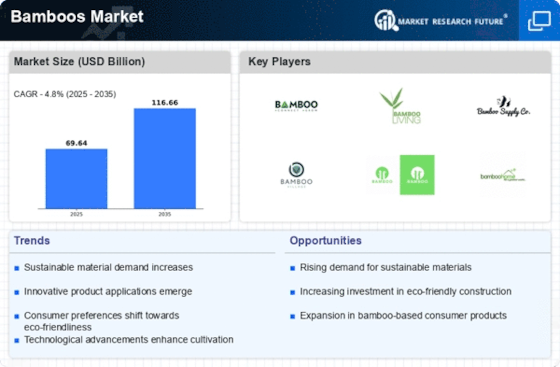
As per Market Research Future analysis, the Bamboos Market Size was estimated at 69.64 USD Billion in 2024. The Bamboos industry is projected to grow from 72.99 USD Billion in 2025 to 116.66 USD Billion by 2035, exhibiting a compound annual growth rate (CAGR) of 4.8% during the forecast period 2025 - 2035

Key Market Trends & Highlights

The Bamboos Market is experiencing a robust growth trajectory driven by sustainability and innovation.

  • The North American market remains the largest, driven by increasing consumer awareness and preferences for sustainable materials. In the Asia-Pacific region, the bamboos market is the fastest-growing, fueled by rapid urbanization and construction activities. The wood and furniture segment continues to dominate the market, while the construction segment is emerging as the fastest-growing area. Sustainability initiatives and technological advancements are key drivers propelling the market forward.

Market Size & Forecast

2024 Market Size 69.64 (USD Billion)
2035 Market Size 116.66 (USD Billion)
CAGR (2025 - 2035) 4.8%
Largest Regional Market Share in 2024 North America

Major Players

<a href="https://getbambootech.com/">Bamboo Technologies (US)</a>, Bamboo Living (US), <a href="https://bamboosupply.net/">Bamboo Supply Co (US)</a>, Bamboo Village (VN), Bamboo Products (IN), Bamboo Home (CN), Bamboo Import (CA), Bamboo World (AU)

Market Trends

The Bamboos Market is currently experiencing a notable transformation, driven by increasing awareness of sustainable materials and eco-friendly practices. As consumers and industries alike seek alternatives to traditional wood and plastic, bamboo emerges as a viable option due to its rapid growth and renewability. This shift is not merely a trend but appears to be a fundamental change in how materials are sourced and utilized across various sectors, including construction, textiles, and packaging. Furthermore, the versatility of bamboo allows it to be processed into a wide array of products, enhancing its appeal in diverse applications. In addition to sustainability, the Bamboos Market is influenced by technological advancements that facilitate the processing and manufacturing of bamboo products. Innovations in treatment and preservation techniques are likely to enhance the durability and aesthetic qualities of bamboo, making it more attractive to consumers. As the market evolves, it seems poised to capture a larger share of The Bamboos Market, potentially reshaping consumer preferences and industry standards. The ongoing exploration of bamboo's capabilities suggests a promising future for this remarkable plant, as it continues to gain traction in various bamboos market trends worldwide.

Sustainability Focus

The emphasis on sustainable materials is reshaping the Bamboos Market. As environmental concerns rise, bamboo is increasingly recognized for its eco-friendly properties, leading to greater adoption across industries.

Technological Innovations

Advancements in processing technologies are enhancing the appeal of bamboo products. Improved treatment methods are likely to increase durability and expand the range of applications, attracting more consumers.

Diverse Applications

The versatility of bamboo is driving its use in various sectors, from construction to textiles. This broad applicability suggests that the Bamboos Market may continue to grow as new uses are discovered.

Bamboos Market Market Drivers

Diverse Applications

The versatility of bamboo is emerging as a significant driver for the Bamboos Market. Bamboo is utilized in a myriad of applications, including construction, furniture, textiles, and paper products. This diversity not only caters to various consumer needs but also enhances market resilience against economic fluctuations. In 2025, the construction sector is anticipated to account for a substantial share of the bamboo market, driven by the material's strength and sustainability. Additionally, the growing trend of eco-friendly products in the textile industry is likely to further propel demand. As industries increasingly recognize the benefits of bamboo, the Bamboos Market is expected to expand, reflecting the material's adaptability and broad appeal.

Sustainability Initiatives

The increasing emphasis on sustainability appears to be a pivotal driver for the Bamboos Market. As consumers and businesses alike become more environmentally conscious, the demand for sustainable materials has surged. Bamboo, known for its rapid growth and minimal resource requirements, presents an attractive alternative to traditional timber and plastic products. In 2025, the market for bamboo products is projected to reach approximately USD 98 billion, reflecting a growing preference for eco-friendly materials. This trend is likely to be bolstered by government policies promoting sustainable practices, which may further enhance the market's growth trajectory. The Bamboos Market is thus positioned to benefit from this shift towards sustainability, as it aligns with broader environmental goals.

Technological Advancements

Technological innovations are playing a crucial role in shaping the Bamboos Market. Advances in processing techniques and product development have enabled manufacturers to create a wider array of bamboo-based products, from construction materials to textiles. For instance, the introduction of engineered bamboo products has enhanced the material's strength and durability, making it suitable for various applications. The market is expected to witness a compound annual growth rate of around 5.5% through 2025, driven by these technological advancements. Furthermore, the integration of digital technologies in supply chain management is likely to improve efficiency and reduce costs, thereby fostering growth within the Bamboos Market. As these technologies continue to evolve, they may unlock new opportunities for innovation and expansion.

Government Policies and Support

Government initiatives aimed at promoting sustainable practices are likely to serve as a catalyst for the Bamboos Market. Various countries are implementing policies that encourage the use of renewable resources, including bamboo, in construction and manufacturing. These policies may include subsidies, tax incentives, and research funding, which could enhance the competitiveness of bamboo products in the market. As governments increasingly recognize the economic and environmental benefits of bamboo cultivation, the Bamboos Market is expected to experience accelerated growth. The alignment of government objectives with market trends may create a favorable environment for investment and innovation, further solidifying bamboo's position as a key player in sustainable materials.

Consumer Awareness and Preferences

Rising consumer awareness regarding environmental issues is significantly influencing the Bamboos Market. As individuals become more informed about the ecological impact of their choices, there is a noticeable shift towards products that are perceived as sustainable and eco-friendly. This trend is particularly evident among younger demographics, who are more likely to prioritize sustainability in their purchasing decisions. Market Research Future indicates that approximately 70% of consumers are willing to pay a premium for sustainable products, which bodes well for the Bamboos Market. This heightened awareness is likely to drive demand for bamboo products, as consumers seek alternatives to conventional materials that contribute to environmental degradation.

Market Segment Insights

By End Use Industry: Wood and Furniture (Largest) vs. Construction (Fastest-Growing)

In the Bamboos Market Analysis, the 'End Use Industry' segment reveals a diverse distribution among its key players. The Wood and Furniture segment holds significant market share, largely attributed to the sustainable appeal and durability of bamboo as a material. Meanwhile, Construction is emerging as a critical player, driven by the demand for eco-friendly building materials that can contribute to sustainable construction practices.

Wood and Furniture (Dominant) vs. Construction (Emerging)

The Wood and Furniture segment is distinguished by its strong demand for bamboo, recognized for its aesthetics, strength, and versatility. It caters to furniture manufacturers, interior designers, and builders seeking sustainable alternatives to traditional materials. Conversely, the Construction segment is poised for rapid expansion due to a rising trend in green building practices and the need for sustainable infrastructure. This booming market is characterized by increasing investments in eco-friendly construction projects, fostering a growing interest in bamboo's application for structural elements, panels, and flooring.

Get more detailed insights about Bamboos Market Research Report - Global Forecast by 2035

Regional Insights

North America : Sustainable Growth Leader

The North American bamboo market is experiencing significant growth, driven by increasing consumer awareness of sustainable materials and eco-friendly construction practices. The U.S. holds the largest market share at approximately 60%, followed by Canada at around 25%. Regulatory support for sustainable building materials is further catalyzing this growth, with various states implementing green building codes that favor bamboo products. Key players in this region include Bamboo Technologies, Bamboo Living, and Bamboo Supply Co, which are leading the charge in innovation and product development. The competitive landscape is characterized by a mix of established companies and emerging startups, all vying for market share. The focus on sustainability and the growing demand for bamboo in construction and home goods are expected to drive further expansion in this sector.

Europe : Emerging Eco-Friendly Market

The European bamboo market share is rapidly evolving, with a growing emphasis on sustainability and eco-friendly products. Germany and the UK are the largest markets, collectively holding about 50% of the market share. Regulatory frameworks, such as the EU's Green Deal, are promoting the use of renewable materials, including bamboo, in construction and manufacturing, thus driving demand. Leading countries in this region are Germany, the UK, and France, with a competitive landscape featuring both local and international players. Companies like Bamboo Village and Bamboo Products are making significant strides in product innovation and market penetration. The increasing consumer preference for sustainable alternatives is expected to further boost the bamboo market in Europe.

Asia-Pacific : Global Bamboo Hub

The Asia-Pacific region is the largest market for bamboo, driven by high demand in construction, furniture, and textiles. China and India are the leading countries, accounting for approximately 70% of the market share. The region benefits from favorable climatic conditions for bamboo cultivation and strong government support for sustainable forestry practices, which are key growth drivers in this sector. The competitive landscape is robust, with numerous local players such as Bamboo Home and Bamboo Products leading the market. The presence of established supply chains and a growing export market further enhance the region's dominance. As global demand for bamboo products rises, Asia-Pacific is poised for continued growth, leveraging its natural resources and manufacturing capabilities.

Key Players and Competitive Insights

Leading market players are putting a lot of money on R&D to expand their product lines, which will help the market for weight reduction products grow. Additionally, market players are engaging in a range of calculated initiatives to increase their worldwide presence, with important market developments involving the introduction of new products, contracts, M&A transactions, increased investment, and cooperation with other enterprises. to grow and endure in an increasingly cutthroat and dynamic market, Bamboos industry must provide reasonably priced goods.
Manufacturing locally is one of the primary business techniques used by manufacturers to cut operational costs in the Bamboos industry to help customers and expand the market segment. In recent years, the Bamboos industry has provided some of the biggest benefits to medicine. Major players in the Bamboos Market, including Moso International BV, Shanghai Tenbro Bamboo Textile Co. Ltd, Tengda Bamboo-Wood Co. Ltd., Higuera Hardwoods LLC, Dasso Industrial Group Co. Ltd., and others, are attempting to increase market demand by investing in research and development operations.
Moso International BV has made a name for itself as a world authority in the bamboo sector. The business is well-known for encouraging and offering environmentally friendly bamboo solutions for a range of uses, such as building, outdoor projects, and interior design. The company sells a wide variety of bamboo goods, such as decking, panels, flooring, veneers, and outdoor solutions. Both home and commercial building projects are served by these goods.
In March The German bamboo manufacturer Bambeau Becker has been acquired by MOSO International B.V. During the projected timeframe, these purchases will contribute to the market's expansion.
Bamboo Bio Composites Sdn Bhd is a business that specializes in the creation and manufacturing of bio-composite materials made of bamboo. In order to produce composite materials that are both environmentally benign and sustainable, bio-composites usually require blending natural fibers, like bamboo, with polymers or other materials. In 2021, Bambusa Bamboo Powder was introduced by Bambusa, a company that specializes in bamboo-based products. This high-quality, sustainably sourced bamboo powder can be used in a variety of goods, such as food and drink, cosmetics, and personal hygiene items. It provides a healthy, natural substitute for artificial substances.

Key Companies in the Bamboos Market include

Industry Developments

September 2022: Libas Consumer Products Ltd. introduced the bamboo-based "Organic Innerwear" brand "KNG" and declared a rights issue. Because of its ecological and non-allergic features, this launch replaces traditional undergarments.

October 2021: Nestlé SA declared that 3.5 million bamboo plants and clumps would be planted in the Philippines. The goal of planting 200 million trees by 2030 was bolstered by this reforestation effort by Nestlé SA.

June 2021: Cali Bamboo Holdings, Inc. was acquired by UK-based Victoria Pic for $76.1 million, signaling the company's intention to expand its current North American distribution business.

Future Outlook

Bamboos Market Future Outlook

The future outlook for the Bamboos Market is exceptionally positive, driven by the global transition toward decarbonization and circular economies. Growth is fueled by the rapid adoption of engineered bamboo in construction, the rise of biodegradable packaging to replace single-use plastics, and the expanding use of high-performance bamboo fibers in the sustainable textile industry.

New opportunities lie in:

  • <p>Expansion into biodegradable packaging solutions Development of bamboo-based textiles for fashion industry Investment in bamboo cultivation for carbon credits</p>

By 2035, the Bamboos Market is expected to achieve substantial growth and diversification.

Market Segmentation

Bamboos Market End Use Industry Outlook

  • Wood and Furniture
  • Construction
  • Food
  • Pulp & Paper
  • Textile
  • Agriculture
  • Others

Report Scope

MARKET SIZE 2024 69.64(USD Billion)
MARKET SIZE 2025 72.99(USD Billion)
MARKET SIZE 2035 116.66(USD Billion)
COMPOUND ANNUAL GROWTH RATE (CAGR) 4.8% (2025 - 2035)
REPORT COVERAGE Revenue Forecast, Competitive Landscape, Growth Factors, and Trends
BASE YEAR 2024
Market Forecast Period 2025 - 2035
Historical Data 2019 - 2024
Market Forecast Units USD Billion
Key Companies Profiled Bamboo Technologies (US), Bamboo Living (US), Bamboo Supply Co (US), Bamboo Village (VN), Bamboo Products (IN), Bamboo Home (CN), Bamboo Import (CA), Bamboo World (AU)
Segments Covered End Use Industry, Region
Key Market Opportunities Growing demand for sustainable materials drives innovation in the Bamboos Market.
Key Market Dynamics Rising consumer preference for sustainable materials drives innovation and competition in the bamboos market.
Countries Covered North America, Europe, APAC, South America, MEA

FAQs

What is the current valuation of the Bamboos Market as of 2024?

<p>The Bamboos Market was valued at 69.64 USD Billion in 2024.</p>

What is the projected market valuation for the Bamboos Market in 2035?

<p>The projected valuation for the Bamboos Market in 2035 is 116.66 USD Billion.</p>

What is the expected CAGR for the Bamboos Market during the forecast period 2025 - 2035?

<p>The expected CAGR for the Bamboos Market during the forecast period 2025 - 2035 is 4.8%.</p>

Which segments are included in the Bamboos Market, and what are their valuations?

<p>Key segments include Wood and Furniture (20.0 USD Billion), Construction (25.0 USD Billion), and Food (12.0 USD Billion) among others.</p>

Who are the key players in the Bamboos Market?

<p>Key players in the Bamboos Market include Bamboo Technologies, Bamboo Living, and Bamboo Supply Co, among others.</p>

How does the Construction segment perform in the Bamboos Market?

The Construction segment was valued at 15.0 USD Billion in 2024 and is projected to reach 25.0 USD Billion.

What is the valuation of the Textile segment in the Bamboos Market?

The Textile segment was valued at 7.0 USD Billion in 2024 and is expected to grow to 10.0 USD Billion.

What is the valuation trend for the Agriculture segment in the Bamboos Market?

The Agriculture segment was valued at 5.0 USD Billion in 2024 and is projected to increase to 8.0 USD Billion.

What is the expected growth for the Others segment in the Bamboos Market?

The Others segment was valued at 12.64 USD Billion in 2024 and is anticipated to grow to 26.66 USD Billion.

How does the Bamboos Market compare to other materials in terms of growth potential?

The Bamboos Market, with a projected CAGR of 4.8%, indicates a robust growth potential compared to traditional materials.

  1. SECTION I: EXECUTIVE SUMMARY AND KEY HIGHLIGHTS
    1. | 1.1 EXECUTIVE SUMMARY
    2. | | 1.1.1 Market Overview
    3. | | 1.1.2 Key Findings
    4. | | 1.1.3 Market Segmentation
    5. | | 1.1.4 Competitive Landscape
    6. | | 1.1.5 Challenges and Opportunities
    7. | | 1.1.6 Future Outlook
  2. SECTION II: SCOPING, METHODOLOGY AND MARKET STRUCTURE
    1. | 2.1 MARKET INTRODUCTION
    2. | | 2.1.1 Definition
    3. | | 2.1.2 Scope of the study
    4. | | | 2.1.2.1 Research Objective
    5. | | | 2.1.2.2 Assumption
    6. | | | 2.1.2.3 Limitations
    7. | 2.2 RESEARCH METHODOLOGY
    8. | | 2.2.1 Overview
    9. | | 2.2.2 Data Mining
    10. | | 2.2.3 Secondary Research
    11. | | 2.2.4 Primary Research
    12. | | | 2.2.4.1 Primary Interviews and Information Gathering Process
    13. | | | 2.2.4.2 Breakdown of Primary Respondents
    14. | | 2.2.5 Forecasting Model
    15. | | 2.2.6 Market Size Estimation
    16. | | | 2.2.6.1 Bottom-Up Approach
    17. | | | 2.2.6.2 Top-Down Approach
    18. | | 2.2.7 Data Triangulation
    19. | | 2.2.8 Validation
  3. SECTION III: QUALITATIVE ANALYSIS
    1. | 3.1 MARKET DYNAMICS
    2. | | 3.1.1 Overview
    3. | | 3.1.2 Drivers
    4. | | 3.1.3 Restraints
    5. | | 3.1.4 Opportunities
    6. | 3.2 MARKET FACTOR ANALYSIS
    7. | | 3.2.1 Value chain Analysis
    8. | | 3.2.2 Porter's Five Forces Analysis
    9. | | | 3.2.2.1 Bargaining Power of Suppliers
    10. | | | 3.2.2.2 Bargaining Power of Buyers
    11. | | | 3.2.2.3 Threat of New Entrants
    12. | | | 3.2.2.4 Threat of Substitutes
    13. | | | 3.2.2.5 Intensity of Rivalry
    14. | | 3.2.3 COVID-19 Impact Analysis
    15. | | | 3.2.3.1 Market Impact Analysis
    16. | | | 3.2.3.2 Regional Impact
    17. | | | 3.2.3.3 Opportunity and Threat Analysis
  4. SECTION IV: QUANTITATIVE ANALYSIS
    1. | 4.1 Chemicals and Materials, BY End Use Industry (USD Billion)
    2. | | 4.1.1 Wood and Furniture
    3. | | 4.1.2 Construction
    4. | | 4.1.3 Food
    5. | | 4.1.4 Pulp & Paper
    6. | | 4.1.5 Textile
    7. | | 4.1.6 Agriculture
    8. | | 4.1.7 Others
    9. | 4.2 Chemicals and Materials, BY Region (USD Billion)
    10. | | 4.2.1 North America
    11. | | | 4.2.1.1 US
    12. | | | 4.2.1.2 Canada
    13. | | 4.2.2 Europe
    14. | | | 4.2.2.1 Germany
    15. | | | 4.2.2.2 UK
    16. | | | 4.2.2.3 France
    17. | | | 4.2.2.4 Russia
    18. | | | 4.2.2.5 Italy
    19. | | | 4.2.2.6 Spain
    20. | | | 4.2.2.7 Rest of Europe
    21. | | 4.2.3 APAC
    22. | | | 4.2.3.1 China
    23. | | | 4.2.3.2 India
    24. | | | 4.2.3.3 Japan
    25. | | | 4.2.3.4 South Korea
    26. | | | 4.2.3.5 Malaysia
    27. | | | 4.2.3.6 Thailand
    28. | | | 4.2.3.7 Indonesia
    29. | | | 4.2.3.8 Rest of APAC
    30. | | 4.2.4 South America
    31. | | | 4.2.4.1 Brazil
    32. | | | 4.2.4.2 Mexico
    33. | | | 4.2.4.3 Argentina
    34. | | | 4.2.4.4 Rest of South America
    35. | | 4.2.5 MEA
    36. | | | 4.2.5.1 GCC Countries
    37. | | | 4.2.5.2 South Africa
    38. | | | 4.2.5.3 Rest of MEA
  5. SECTION V: COMPETITIVE ANALYSIS
    1. | 5.1 Competitive Landscape
    2. | | 5.1.1 Overview
    3. | | 5.1.2 Competitive Analysis
    4. | | 5.1.3 Market share Analysis
    5. | | 5.1.4 Major Growth Strategy in the Chemicals and Materials
    6. | | 5.1.5 Competitive Benchmarking
    7. | | 5.1.6 Leading Players in Terms of Number of Developments in the Chemicals and Materials
    8. | | 5.1.7 Key developments and growth strategies
    9. | | | 5.1.7.1 New Product Launch/Service Deployment
    10. | | | 5.1.7.2 Merger & Acquisitions
    11. | | | 5.1.7.3 Joint Ventures
    12. | | 5.1.8 Major Players Financial Matrix
    13. | | | 5.1.8.1 Sales and Operating Income
    14. | | | 5.1.8.2 Major Players R&D Expenditure. 2023
    15. | 5.2 Company Profiles
    16. | | 5.2.1 Bamboo Technologies (US)
    17. | | | 5.2.1.1 Financial Overview
    18. | | | 5.2.1.2 Products Offered
    19. | | | 5.2.1.3 Key Developments
    20. | | | 5.2.1.4 SWOT Analysis
    21. | | | 5.2.1.5 Key Strategies
    22. | | 5.2.2 Bamboo Living (US)
    23. | | | 5.2.2.1 Financial Overview
    24. | | | 5.2.2.2 Products Offered
    25. | | | 5.2.2.3 Key Developments
    26. | | | 5.2.2.4 SWOT Analysis
    27. | | | 5.2.2.5 Key Strategies
    28. | | 5.2.3 Bamboo Supply Co (US)
    29. | | | 5.2.3.1 Financial Overview
    30. | | | 5.2.3.2 Products Offered
    31. | | | 5.2.3.3 Key Developments
    32. | | | 5.2.3.4 SWOT Analysis
    33. | | | 5.2.3.5 Key Strategies
    34. | | 5.2.4 Bamboo Village (VN)
    35. | | | 5.2.4.1 Financial Overview
    36. | | | 5.2.4.2 Products Offered
    37. | | | 5.2.4.3 Key Developments
    38. | | | 5.2.4.4 SWOT Analysis
    39. | | | 5.2.4.5 Key Strategies
    40. | | 5.2.5 Bamboo Products (IN)
    41. | | | 5.2.5.1 Financial Overview
    42. | | | 5.2.5.2 Products Offered
    43. | | | 5.2.5.3 Key Developments
    44. | | | 5.2.5.4 SWOT Analysis
    45. | | | 5.2.5.5 Key Strategies
    46. | | 5.2.6 Bamboo Home (CN)
    47. | | | 5.2.6.1 Financial Overview
    48. | | | 5.2.6.2 Products Offered
    49. | | | 5.2.6.3 Key Developments
    50. | | | 5.2.6.4 SWOT Analysis
    51. | | | 5.2.6.5 Key Strategies
    52. | | 5.2.7 Bamboo Import (CA)
    53. | | | 5.2.7.1 Financial Overview
    54. | | | 5.2.7.2 Products Offered
    55. | | | 5.2.7.3 Key Developments
    56. | | | 5.2.7.4 SWOT Analysis
    57. | | | 5.2.7.5 Key Strategies
    58. | | 5.2.8 Bamboo World (AU)
    59. | | | 5.2.8.1 Financial Overview
    60. | | | 5.2.8.2 Products Offered
    61. | | | 5.2.8.3 Key Developments
    62. | | | 5.2.8.4 SWOT Analysis
    63. | | | 5.2.8.5 Key Strategies
    64. | 5.3 Appendix
    65. | | 5.3.1 References
    66. | | 5.3.2 Related Reports
  6. LIST OF FIGURES
    1. | 6.1 MARKET SYNOPSIS
    2. | 6.2 NORTH AMERICA MARKET ANALYSIS
    3. | 6.3 US MARKET ANALYSIS BY END USE INDUSTRY
    4. | 6.4 CANADA MARKET ANALYSIS BY END USE INDUSTRY
    5. | 6.5 EUROPE MARKET ANALYSIS
    6. | 6.6 GERMANY MARKET ANALYSIS BY END USE INDUSTRY
    7. | 6.7 UK MARKET ANALYSIS BY END USE INDUSTRY
    8. | 6.8 FRANCE MARKET ANALYSIS BY END USE INDUSTRY
    9. | 6.9 RUSSIA MARKET ANALYSIS BY END USE INDUSTRY
    10. | 6.10 ITALY MARKET ANALYSIS BY END USE INDUSTRY
    11. | 6.11 SPAIN MARKET ANALYSIS BY END USE INDUSTRY
    12. | 6.12 REST OF EUROPE MARKET ANALYSIS BY END USE INDUSTRY
    13. | 6.13 APAC MARKET ANALYSIS
    14. | 6.14 CHINA MARKET ANALYSIS BY END USE INDUSTRY
    15. | 6.15 INDIA MARKET ANALYSIS BY END USE INDUSTRY
    16. | 6.16 JAPAN MARKET ANALYSIS BY END USE INDUSTRY
    17. | 6.17 SOUTH KOREA MARKET ANALYSIS BY END USE INDUSTRY
    18. | 6.18 MALAYSIA MARKET ANALYSIS BY END USE INDUSTRY
    19. | 6.19 THAILAND MARKET ANALYSIS BY END USE INDUSTRY
    20. | 6.20 INDONESIA MARKET ANALYSIS BY END USE INDUSTRY
    21. | 6.21 REST OF APAC MARKET ANALYSIS BY END USE INDUSTRY
    22. | 6.22 SOUTH AMERICA MARKET ANALYSIS
    23. | 6.23 BRAZIL MARKET ANALYSIS BY END USE INDUSTRY
    24. | 6.24 MEXICO MARKET ANALYSIS BY END USE INDUSTRY
    25. | 6.25 ARGENTINA MARKET ANALYSIS BY END USE INDUSTRY
    26. | 6.26 REST OF SOUTH AMERICA MARKET ANALYSIS BY END USE INDUSTRY
    27. | 6.27 MEA MARKET ANALYSIS
    28. | 6.28 GCC COUNTRIES MARKET ANALYSIS BY END USE INDUSTRY
    29. | 6.29 SOUTH AFRICA MARKET ANALYSIS BY END USE INDUSTRY
    30. | 6.30 REST OF MEA MARKET ANALYSIS BY END USE INDUSTRY
    31. | 6.31 KEY BUYING CRITERIA OF CHEMICALS AND MATERIALS
    32. | 6.32 RESEARCH PROCESS OF MRFR
    33. | 6.33 DRO ANALYSIS OF CHEMICALS AND MATERIALS
    34. | 6.34 DRIVERS IMPACT ANALYSIS: CHEMICALS AND MATERIALS
    35. | 6.35 RESTRAINTS IMPACT ANALYSIS: CHEMICALS AND MATERIALS
    36. | 6.36 SUPPLY / VALUE CHAIN: CHEMICALS AND MATERIALS
    37. | 6.37 CHEMICALS AND MATERIALS, BY END USE INDUSTRY, 2024 (% SHARE)
    38. | 6.38 CHEMICALS AND MATERIALS, BY END USE INDUSTRY, 2024 TO 2035 (USD Billion)
    39. | 6.39 BENCHMARKING OF MAJOR COMPETITORS
  7. LIST OF TABLES
    1. | 7.1 LIST OF ASSUMPTIONS
    2. | | 7.1.1
    3. | 7.2 North America MARKET SIZE ESTIMATES; FORECAST
    4. | | 7.2.1 BY END USE INDUSTRY, 2025-2035 (USD Billion)
    5. | 7.3 US MARKET SIZE ESTIMATES; FORECAST
    6. | | 7.3.1 BY END USE INDUSTRY, 2025-2035 (USD Billion)
    7. | 7.4 Canada MARKET SIZE ESTIMATES; FORECAST
    8. | | 7.4.1 BY END USE INDUSTRY, 2025-2035 (USD Billion)
    9. | 7.5 Europe MARKET SIZE ESTIMATES; FORECAST
    10. | | 7.5.1 BY END USE INDUSTRY, 2025-2035 (USD Billion)
    11. | 7.6 Germany MARKET SIZE ESTIMATES; FORECAST
    12. | | 7.6.1 BY END USE INDUSTRY, 2025-2035 (USD Billion)
    13. | 7.7 UK MARKET SIZE ESTIMATES; FORECAST
    14. | | 7.7.1 BY END USE INDUSTRY, 2025-2035 (USD Billion)
    15. | 7.8 France MARKET SIZE ESTIMATES; FORECAST
    16. | | 7.8.1 BY END USE INDUSTRY, 2025-2035 (USD Billion)
    17. | 7.9 Russia MARKET SIZE ESTIMATES; FORECAST
    18. | | 7.9.1 BY END USE INDUSTRY, 2025-2035 (USD Billion)
    19. | 7.10 Italy MARKET SIZE ESTIMATES; FORECAST
    20. | | 7.10.1 BY END USE INDUSTRY, 2025-2035 (USD Billion)
    21. | 7.11 Spain MARKET SIZE ESTIMATES; FORECAST
    22. | | 7.11.1 BY END USE INDUSTRY, 2025-2035 (USD Billion)
    23. | 7.12 Rest of Europe MARKET SIZE ESTIMATES; FORECAST
    24. | | 7.12.1 BY END USE INDUSTRY, 2025-2035 (USD Billion)
    25. | 7.13 APAC MARKET SIZE ESTIMATES; FORECAST
    26. | | 7.13.1 BY END USE INDUSTRY, 2025-2035 (USD Billion)
    27. | 7.14 China MARKET SIZE ESTIMATES; FORECAST
    28. | | 7.14.1 BY END USE INDUSTRY, 2025-2035 (USD Billion)
    29. | 7.15 India MARKET SIZE ESTIMATES; FORECAST
    30. | | 7.15.1 BY END USE INDUSTRY, 2025-2035 (USD Billion)
    31. | 7.16 Japan MARKET SIZE ESTIMATES; FORECAST
    32. | | 7.16.1 BY END USE INDUSTRY, 2025-2035 (USD Billion)
    33. | 7.17 South Korea MARKET SIZE ESTIMATES; FORECAST
    34. | | 7.17.1 BY END USE INDUSTRY, 2025-2035 (USD Billion)
    35. | 7.18 Malaysia MARKET SIZE ESTIMATES; FORECAST
    36. | | 7.18.1 BY END USE INDUSTRY, 2025-2035 (USD Billion)
    37. | 7.19 Thailand MARKET SIZE ESTIMATES; FORECAST
    38. | | 7.19.1 BY END USE INDUSTRY, 2025-2035 (USD Billion)
    39. | 7.20 Indonesia MARKET SIZE ESTIMATES; FORECAST
    40. | | 7.20.1 BY END USE INDUSTRY, 2025-2035 (USD Billion)
    41. | 7.21 Rest of APAC MARKET SIZE ESTIMATES; FORECAST
    42. | | 7.21.1 BY END USE INDUSTRY, 2025-2035 (USD Billion)
    43. | 7.22 South America MARKET SIZE ESTIMATES; FORECAST
    44. | | 7.22.1 BY END USE INDUSTRY, 2025-2035 (USD Billion)
    45. | 7.23 Brazil MARKET SIZE ESTIMATES; FORECAST
    46. | | 7.23.1 BY END USE INDUSTRY, 2025-2035 (USD Billion)
    47. | 7.24 Mexico MARKET SIZE ESTIMATES; FORECAST
    48. | | 7.24.1 BY END USE INDUSTRY, 2025-2035 (USD Billion)
    49. | 7.25 Argentina MARKET SIZE ESTIMATES; FORECAST
    50. | | 7.25.1 BY END USE INDUSTRY, 2025-2035 (USD Billion)
    51. | 7.26 Rest of South America MARKET SIZE ESTIMATES; FORECAST
    52. | | 7.26.1 BY END USE INDUSTRY, 2025-2035 (USD Billion)
    53. | 7.27 MEA MARKET SIZE ESTIMATES; FORECAST
    54. | | 7.27.1 BY END USE INDUSTRY, 2025-2035 (USD Billion)
    55. | 7.28 GCC Countries MARKET SIZE ESTIMATES; FORECAST
    56. | | 7.28.1 BY END USE INDUSTRY, 2025-2035 (USD Billion)
    57. | 7.29 South Africa MARKET SIZE ESTIMATES; FORECAST
    58. | | 7.29.1 BY END USE INDUSTRY, 2025-2035 (USD Billion)
    59. | 7.30 Rest of MEA MARKET SIZE ESTIMATES; FORECAST
    60. | | 7.30.1 BY END USE INDUSTRY, 2025-2035 (USD Billion)
    61. | 7.31 PRODUCT LAUNCH/PRODUCT DEVELOPMENT/APPROVAL
    62. | | 7.31.1
    63. | 7.32 ACQUISITION/PARTNERSHIP
    64. | | 7.32.1

Chemicals and Materials Market Segmentation

Chemicals and Materials By End Use Industry (USD Billion, 2025-2035)

  • Wood and Furniture
  • Construction
  • Food
  • Pulp & Paper
  • Textile
  • Agriculture
  • Others
Infographic

Free Sample Request

Kindly complete the form below to receive a free sample of this Report

Get Free Sample

Customer Strories

Compare Licence

×
Features License Type
Single User Multiuser License Enterprise User
Price $4,950 $5,950 $7,250
Maximum User Access Limit 1 User Upto 10 Users Unrestricted Access Throughout the Organization
Free Customization
Direct Access to Analyst
Deliverable Format
Platform Access
Discount on Next Purchase 10% 15% 15%
Printable Versions