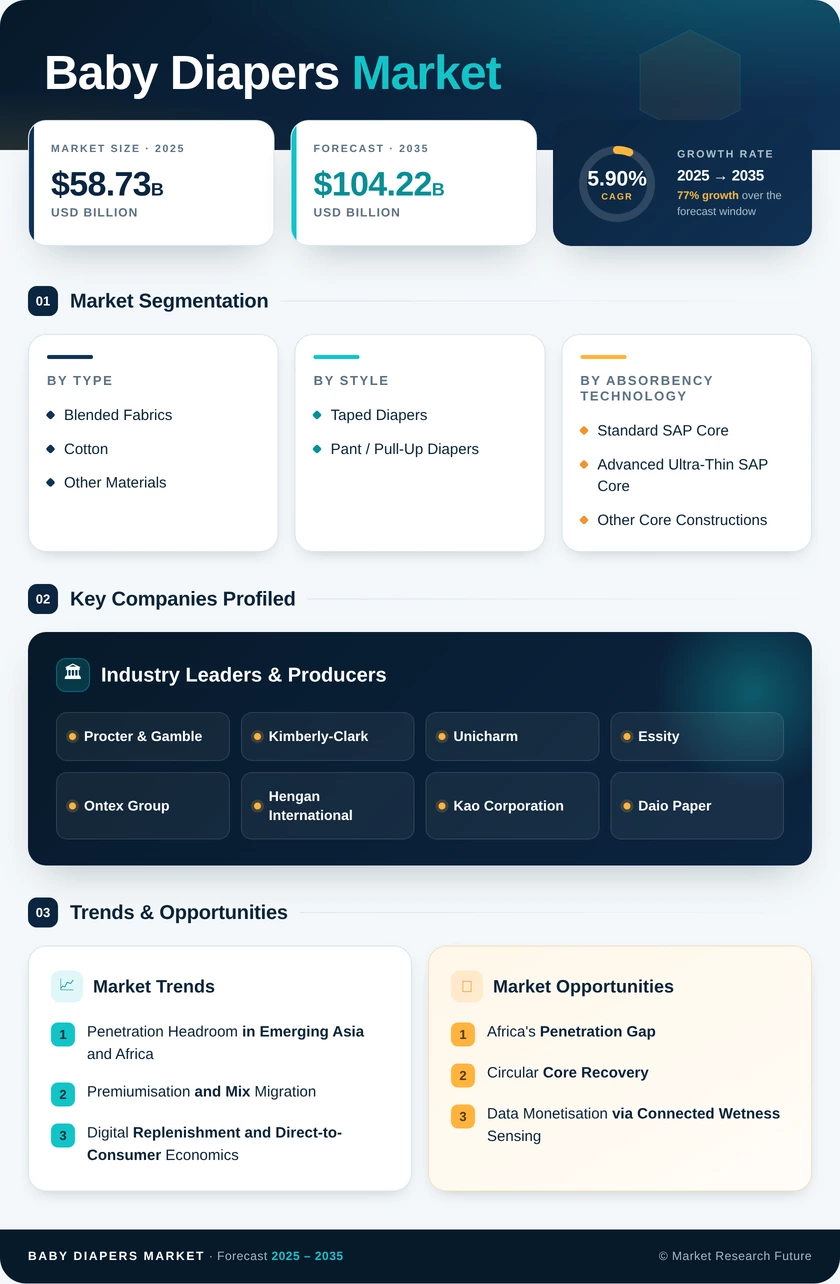
Baby Diapers Market (2026 - 2035)

ID: MRFR/CG/5204-HCR 128 Pages Snehal Singh Last Updated: October 27, 2026
Baby Diapers Market Size, Share, Industry Trend & Analysis Research Report By Product Type (Cloth Diapers, Disposable Diapers, Biodegradable & Others), By Style (Taped Diapers, Pant / Pull-Up Diapers), By Absorbency Technology (Standard SAP Core, Advanced Ultra-Thin SAP Core, Other Core Constructions), By Material Type (Cotton, Blended Fabrics, Other Materials), By Distribution Channel (Supermarkets/Hypermarkets, Convenience Stores, Pharmacies/Drug Stores, Online Retail, Others), By Geography (North America, Europe, Asia-Pacific, South America, Middle East & Africa) - Forecast to 2035
Baby Diapers Market
Market Size
Forecast Period2026-2035
CAGR (2026-2035)5.90%
2025 Market SizeUSD 58.73 Billion
2035 Market SizeUSD 104.22 Billion
Key Players
Procter & Gamble
Kimberly-Clark
Unicharm
Essity
Ontex Group
Hengan International
Opportunities
  • Africa's Penetration Gap
  • Circular Core Recovery
  • Data Monetisation via Connected Wetness Sensing
  1. 1 Market Overview |
    1. 1.1 Study Assumptions & Market Definition |
    2. 1.2 Scope of the Study |
    3. 1.3 Research Methodology
  2. 2 Market Summary & Key Takeaways
  3. 3 Global Market Size & Forecast (2021–2035) |
    1. 3.1 Historical Market Size (2021–2025) |
    2. 3.2 Current & Forecast Market Size (2026–2035) |
    3. 3.3 Market Size by Revenue (USD Billion) |
    4. 3.4 Year-over-Year Growth Analysis
  4. 4 Market Drivers Analysis |
    1. 4.1 Penetration Headroom in Emerging Asia and Africa |
    2. 4.2 Premiumisation and Mix Migration |
    3. 4.3 Digital Replenishment and Direct-to-Consumer Economics |
    4. 4.4 Core Engineering and Material Efficiency
  5. 5 Market Restraints Analysis |
    1. 5.1 The Demographic Ceiling |
    2. 5.2 Raw Material and Compliance Cost Pressure |
    3. 5.3 Private Label and Substitution Pressure
  6. 6 Market Opportunity Analysis |
    1. 6.1 Africa's Penetration Gap |
    2. 6.2 Circular Core Recovery |
    3. 6.3 Data Monetisation via Connected Wetness Sensing |
    4. 6.4 Pant Format Conversion in South Asia |
    5. 6.5 Private-Label Manufacturing for Grocery Chains |
    6. 6.6 Industry Value Chain Analysis |
    7. 6.7 Porter's Five Forces Analysis
  7. 7 Regional Analysis |
    1. 7.1 North America | |
      1. 7.1.1 United States | |
      2. 7.1.2 Canada | |
      3. 7.1.3 Mexico |
    2. 7.2 Europe | |
      1. 7.2.1 Germany | |
      2. 7.2.2 United Kingdom | |
      3. 7.2.3 France | |
      4. 7.2.4 Italy | |
      5. 7.2.5 Spain | |
      6. 7.2.6 Nordic Countries | |
      7. 7.2.7 Russia | |
      8. 7.2.8 Rest of Europe |
    3. 7.3 Asia-Pacific | |
      1. 7.3.1 China | |
      2. 7.3.2 India | |
      3. 7.3.3 Japan | |
      4. 7.3.4 South Korea | |
      5. 7.3.5 ASEAN | |
      6. 7.3.6 Rest of Asia-Pacific |
    4. 7.4 South America | |
      1. 7.4.1 Brazil | |
      2. 7.4.2 Argentina | |
      3. 7.4.3 Rest of South America |
    5. 7.5 Middle East & Africa | |
      1. 7.5.1 Saudi Arabia | |
      2. 7.5.2 UAE | |
      3. 7.5.3 South Africa | |
      4. 7.5.4 Egypt | |
      5. 7.5.5 Rest of Middle East & Africa
  8. 8 Future Outlook (2026–2035) |
    1. 8.1 Sensing and Connected Care |
    2. 8.2 Circularity and Extended Producer Responsibility |
    3. 8.3 Material Substitution at Scale |
    4. 8.4 Consolidation and Regional Specialisation
  9. 9 Segmentation Analysis |
    1. 9.1 By Product Type | |
      1. 9.1.1 Cloth Diapers | |
      2. 9.1.2 Disposable Diapers | |
      3. 9.1.3 Biodegradable & Others |
    2. 9.2 By Style | |
      1. 9.2.1 Taped Diapers | |
      2. 9.2.2 Pant / Pull-Up Diapers |
    3. 9.3 By Absorbency Technology | |
      1. 9.3.1 Standard SAP Core | |
      2. 9.3.2 Advanced Ultra-Thin SAP Core | |
      3. 9.3.3 Other Core Constructions |
    4. 9.4 By Material Type | |
      1. 9.4.1 Cotton | |
      2. 9.4.2 Blended Fabrics | |
      3. 9.4.3 Other Materials |
    5. 9.5 By Distribution Channel | |
      1. 9.5.1 Supermarkets / Hypermarkets | |
      2. 9.5.2 Convenience Stores | |
      3. 9.5.3 Pharmacies / Drug Stores | |
      4. 9.5.4 Online Retail | |
      5. 9.5.5 Others
  10. 10 Competitive Landscape |
    1. 10.1 Market Share Analysis (2026) |
    2. 10.2 Competitive Benchmarking Matrix |
    3. 10.3 Company Profiles | |
      1. 10.3.1 Procter & Gamble | |
      2. 10.3.2 Kimberly-Clark | |
      3. 10.3.3 Unicharm | |
      4. 10.3.4 Essity | |
      5. 10.3.5 Ontex Group | |
      6. 10.3.6 Hengan International | |
      7. 10.3.7 Kao Corporation | |
      8. 10.3.8 Daio Paper | |
      9. 10.3.9 First Quality Enterprises | |
      10. 10.3.10 Hayat Kimya | |
      11. 10.3.11 Nobel Hygiene | |
      12. 10.3.12 TZMO Group
  11. 11 Recent Developments & News
  12. 12 Report Scope & Methodology |
    1. 12.1 Study Period & Base Year |
    2. 12.2 Valuation Currency & Conventions
  13. 13 Detailed Sources & Citations |
    1. 13.1 Data Sources |
    2. 13.2 Abbreviations
  14. 14 Frequently Asked Questions (FAQs)
  15. 15 LIST OF TABLES
  16. 16 LIST OF FIGURES

Segmentation Quick Reference

DimensionSub-SegmentsDominant SegmentFastest Growing Segment
By Product TypeCloth Diapers, Disposable Diapers, Biodegradable & OthersDisposable DiapersBiodegradable & Others
By StyleTaped Diapers, Pant / Pull-Up DiapersTaped DiapersPant / Pull-Up Diapers
By Absorbency TechnologyStandard SAP Core, Advanced Ultra-Thin SAP Core, Other Core ConstructionsStandard SAP CoreAdvanced Ultra-Thin SAP Core
By Material TypeCotton, Blended Fabrics, Other MaterialsBlended FabricsCotton
By Distribution ChannelSupermarkets/Hypermarkets, Convenience Stores, Pharmacies/Drug Stores, Online Retail, OthersSupermarkets / HypermarketsOnline Retail
By GeographyNorth America, Europe, Asia-Pacific, South America, Middle East & AfricaAsia-PacificNorth America


Market Segmentation Overview

By Product Type

Sub-SegmentKey Trend
Cloth DiapersStabilised as a committed sustainability niche rather than a mass-market alternative
Disposable DiapersVolume base of the category; growth increasingly driven by price and tier mix rather than units
Biodegradable & OthersFastest-scaling sub-category as retailers allocate dedicated eco shelf space


Product type remains the primary commercial split. Disposables anchor the category on convenience economics, while biodegradable constructions are moving from experiment to permanent assortment line under regulatory and retailer pressure.

By Style

Sub-SegmentKey Trend
Taped DiapersUniversal entry format; retains majority share on newborn fit requirements
Pant / Pull-Up DiapersRapid conversion at the 9-month-plus stage; carries a durable price premium


Style migration is one of the cleanest value levers available to manufacturers. Every market follows the same curve — taped-dominant, then pant-majority — with Japan already past the crossover and South Asia roughly a decade behind.

By Absorbency Technology

Sub-SegmentKey Trend
Standard SAP CoreCost-led default across Africa and much of South Asia
Advanced Ultra-Thin SAP CoreConverting-line retrofits deliver material and freight cost savings simultaneously
Other Core ConstructionsHybrid and specialty absorbent systems serving niche claims


Core technology decides the category's margin structure. Ultra-thin cores reduce input weight and pallet cube together, which is why converters prioritise line conversion capital over brand spend.

By Material Type

Sub-SegmentKey Trend
CottonSensitive-skin and natural-claim positioning commands a premium
Blended FabricsOptimal balance of softness, tensile strength and cost
Other MaterialsBamboo, bagasse and bio-based substitutions gaining Asian production share


Material selection increasingly answers to regulation as much as performance. Ingredient-transparency rules in Europe have pushed formulation disclosure into a competitive dimension rather than a compliance afterthought.

By Distribution Channel

Sub-SegmentKey Trend
Supermarkets / HypermarketsBasket consolidation and promotional depth sustain leading share
Convenience StoresEmergency and top-up purchase occasions; small-count packs
Pharmacies / Drug StoresHighest-trust channel for newborn and first-purchase decisions
Online RetailSubscription replenishment creates the strongest customer lock-in
OthersSpecialty baby retail and direct institutional supply


Channel strategy now determines competitive outcomes as much as product quality. Online subscription models capture retail margin and lifetime value that traditional grocery relationships cannot replicate, which is why every major manufacturer has built a direct platform since 2023.




Download PDF ×

We do not share your information with anyone. However, we may send you emails based on your report interest from time to time. You may contact us at any time to opt-out.