×
Hero Background
English
Chinese
French
Japanese
Korean
German
Spanish

Azelaic Acid Market Share

ID: MRFR/CnM/17713-HCR
111 Pages
Anshula Mandaokar
October 2025

Azelaic Acid Market Research Report Information By Product Type (Polymer Grade, Technical Grade, and Pharmaceutical Grade), By Application (Plastics, Lubricants, Electronics, Pharmaceuticals and Cosmetics, Personal Care, and Other Applications), By Region (North America, Europe, Asia-Pacific, And Rest Of The World) –Market Forecast Till 2035.

Share:
Download PDF ×

We do not share your information with anyone. However, we may send you emails based on your report interest from time to time. You may contact us at any time to opt-out.

Azelaic Acid Market Infographic
Purchase Options

Market Share

Azelaic Acid Market Share Analysis

In the Azelaic Acid market, various positioning strategies are employed by companies to gain a competitive edge and increase their market share. One of the primary strategies is differentiation, where companies focus on highlighting unique features or benefits of their azelaic acid products compared to competitors. This could include aspects such as purity, formulation, or effectiveness in treating specific skin conditions like acne or rosacea. By emphasizing these distinct qualities, companies aim to attract customers who value these attributes and are willing to choose their products over others in the market.

Cost leadership is another common positioning strategy in the Azelaic Acid market. Companies may strive to offer their products at a lower price point compared to competitors while maintaining acceptable quality standards. This approach appeals to price-sensitive customers and can help companies capture market share by undercutting competitors' prices. Additionally, companies may invest in economies of scale or efficient production processes to further reduce costs and enhance their competitive advantage in terms of pricing.

Niche targeting is also prevalent in the Azelaic Acid market. Instead of catering to the broader market, companies may focus on specific segments or applications where their products can excel. For example, a company might target dermatologists or skincare professionals with specialized formulations of azelaic acid for medical or aesthetic treatments. By catering to niche markets, companies can often command higher prices and build strong brand loyalty among customers with unique needs or preferences.

Market segmentation plays a crucial role in positioning strategies for the Azelaic Acid market. Companies may segment the market based on factors such as demographics, skin types, or geographical regions to better understand and target their customer base. By tailoring marketing efforts and product offerings to specific segments, companies can more effectively meet the diverse needs and preferences of their target audience, thereby increasing their market share within those segments.

Branding and marketing are essential components of market share positioning strategies in the Azelaic Acid market. Strong branding helps companies differentiate their products from competitors and build trust and recognition among customers. Effective marketing campaigns, both online and offline, can further reinforce this positioning by highlighting the unique benefits and value propositions of the company's azelaic acid products. By investing in branding and marketing efforts, companies can increase awareness, drive demand, and ultimately capture a larger share of the market.

Partnerships and collaborations are another avenue for market share positioning in the Azelaic Acid market. By forming strategic alliances with skincare professionals, dermatologists, or other industry players, companies can expand their reach and access new markets or customer segments. Collaborations can also provide opportunities for knowledge sharing, research, and product development, allowing companies to innovate and differentiate their offerings in the market.

Innovation is a critical driver of market share positioning strategies in the Azelaic Acid market. Companies that invest in research and development to develop new formulations, delivery methods, or applications of azelaic acid can gain a competitive advantage by offering innovative solutions that meet evolving customer needs. Whether it's developing products with enhanced efficacy, safety, or convenience, innovation enables companies to stay ahead of the competition and capture market share in this dynamic industry.

Author
Anshula Mandaokar
Team Lead - Research

Anshula Mandaokar holds an academic degree in Chemical Engineering and has been contributing to the field for more than 5 years. She has expertise in Market Research and Business Consulting and serves as a Team Lead for a reputed Market Research firm under the Chemicals and Materials domain spectrum. She has worked on multiple projects, generating explicit results in a quick turnaround time. Her understanding of data interpretation justifies her role as a leader.

Leave a Comment

FAQs

What is the current valuation of the Azelaic Acid Market as of 2024?

The Azelaic Acid Market was valued at 0.2787 USD Billion in 2024.

What is the projected market valuation for the Azelaic Acid Market in 2035?

The market is projected to reach a valuation of 0.599 USD Billion by 2035.

What is the expected CAGR for the Azelaic Acid Market during the forecast period 2025 - 2035?

The expected CAGR for the Azelaic Acid Market during the forecast period 2025 - 2035 is 7.2%.

Which companies are considered key players in the Azelaic Acid Market?

Key players in the market include BASF SE, Galderma S.A., Almirall S.A., Mylan N.V., Fujifilm Diosynth Biotechnologies, Sientra, Inc., Hugel, Inc., and Athenex, Inc.

What are the main product types in the Azelaic Acid Market and their valuations?

The main product types include Polymer Grade, Technical Grade, and Pharmaceutical Grade, with valuations ranging from 0.0835 to 0.214 USD Billion.

How do the application segments of the Azelaic Acid Market perform?

Application segments such as Pharmaceuticals and Cosmetics are valued between 0.1 and 0.25 USD Billion, indicating strong demand.

Market Summary

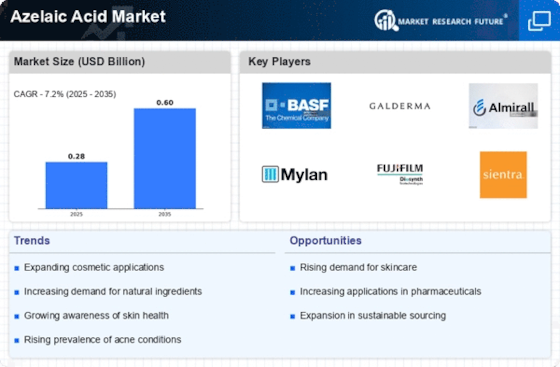
As per MRFR analysis, the Azelaic Acid Market Size was estimated at 0.2787 USD Billion in 2024. The Azelaic Acid industry is projected to grow from 0.2988 in 2025 to 0.599 by 2035, exhibiting a compound annual growth rate (CAGR) of 7.2 during the forecast period 2025 - 2035.

Key Market Trends & Highlights

The Azelaic Acid Market is experiencing robust growth driven by evolving consumer preferences and innovative product formulations.

  • The demand for natural ingredients in skincare is rising, particularly in North America, which remains the largest market for azelaic acid.
  • Asia-Pacific is emerging as the fastest-growing region, reflecting a shift towards advanced skincare solutions.
  • Pharmaceutical grade azelaic acid continues to dominate the market, while technical grade is witnessing rapid growth due to increasing applications.
  • Key market drivers include growing awareness of skin conditions and the rise in e-commerce, which facilitate access to innovative skincare products.

Market Size & Forecast

2024 Market Size 0.2787 (USD Billion)
2035 Market Size 0.599 (USD Billion)
CAGR (2025 - 2035) 7.2%
Largest Regional Market Share in 2024 North America

Major Players

<p>BASF SE (DE), Galderma S.A. (CH), Almirall S.A. (ES), Mylan N.V. (NL), Fujifilm Diosynth Biotechnologies (JP), Sientra, Inc. (US), Hugel, Inc. (KR), Athenex, Inc. (US)</p>

Market Trends

The Azelaic Acid Market is currently experiencing a notable transformation, driven by increasing consumer awareness regarding skin health and the rising prevalence of skin conditions such as acne and rosacea. This organic compound, derived from grains, is gaining traction due to its multifaceted benefits, including anti-inflammatory and antibacterial properties. As a result, the demand for azelaic acid in both cosmetic and pharmaceutical applications appears to be on the rise. Furthermore, the growing trend towards natural and clean beauty products is likely to bolster the market, as consumers increasingly seek effective yet gentle ingredients for their skincare routines. In addition, the Azelaic Acid Market is witnessing a surge in research and development activities aimed at exploring new formulations and delivery methods. This innovation could enhance the efficacy of azelaic acid, making it a more appealing option for consumers. Moreover, the expansion of e-commerce platforms is facilitating greater accessibility to azelaic acid products, allowing consumers to easily obtain these items from the comfort of their homes. Overall, the Azelaic Acid Market seems poised for growth, driven by evolving consumer preferences and advancements in product development.

Rising Demand for Natural Ingredients

There is a growing inclination among consumers towards products that feature natural and organic components. This trend is influencing the Azelaic Acid Market, as azelaic acid is perceived as a safer alternative to synthetic ingredients. The shift towards clean beauty is prompting manufacturers to incorporate azelaic acid into their formulations, appealing to health-conscious consumers.

Increased Focus on Skin Health

The heightened awareness surrounding skin health is propelling the Azelaic Acid Market forward. Consumers are increasingly seeking solutions for various skin issues, including acne and hyperpigmentation. Azelaic acid's proven effectiveness in addressing these concerns is likely to enhance its popularity among skincare enthusiasts.

Advancements in Product Formulation

Ongoing research and development efforts are leading to innovative formulations that enhance the delivery and effectiveness of azelaic acid. These advancements may result in new product offerings that cater to diverse consumer needs, thereby expanding the market's reach and appeal.

Azelaic Acid Market Market Drivers

Innovation in Skincare Products

Innovation within the skincare sector is a pivotal driver for the Azelaic Acid Market. Manufacturers are increasingly focusing on developing advanced formulations that enhance the efficacy of azelaic acid. This includes combining azelaic acid with other active ingredients to create synergistic effects, thereby improving product performance. The introduction of new delivery systems, such as microencapsulation, is also gaining traction, allowing for better absorption and longer-lasting effects. Market data indicates that the demand for innovative skincare solutions is on the rise, with consumers seeking products that offer visible results. As a result, the Azelaic Acid Market is likely to benefit from these advancements, as brands strive to meet the evolving preferences of consumers.

Growing Awareness of Skin Conditions

The increasing awareness of various skin conditions, such as acne and rosacea, is driving the Azelaic Acid Market. Consumers are becoming more informed about the benefits of azelaic acid, which is known for its anti-inflammatory and antibacterial properties. This awareness is leading to a rise in demand for skincare products containing azelaic acid, as individuals seek effective solutions for their skin issues. According to recent data, the market for acne treatment products is projected to reach substantial figures, indicating a robust growth trajectory. As consumers prioritize skin health, the Azelaic Acid Market is likely to experience significant expansion, with manufacturers responding by developing innovative formulations that cater to this growing demand.

Rise in E-commerce and Online Retail

The surge in e-commerce and online retail platforms is transforming the way consumers access skincare products, including those in the Azelaic Acid Market. With the convenience of online shopping, consumers can easily compare products, read reviews, and make informed purchasing decisions. This trend is particularly beneficial for niche products like azelaic acid, which may not be widely available in physical stores. Data suggests that online sales of skincare products have seen a remarkable increase, contributing to the overall growth of the Azelaic Acid Market. As more consumers turn to online platforms for their skincare needs, the market is expected to expand further, providing opportunities for brands to reach a broader audience.

Regulatory Support for Safe Ingredients

Regulatory bodies are increasingly emphasizing the importance of safe and effective ingredients in skincare formulations, which positively impacts the Azelaic Acid Market. Azelaic acid is recognized for its safety profile and efficacy, making it a preferred choice among formulators. Regulatory support for the use of azelaic acid in over-the-counter products is likely to encourage manufacturers to incorporate it into their offerings. This trend aligns with the growing consumer demand for transparency and safety in skincare products. As regulations evolve to support the use of beneficial ingredients, the Azelaic Acid Market is expected to thrive, with more products entering the market that highlight azelaic acid as a key ingredient.

Increasing Popularity of Clean Beauty Trends

The clean beauty movement is gaining momentum, influencing consumer preferences and purchasing behaviors in the Azelaic Acid Market. Consumers are increasingly seeking products that are free from harmful chemicals and are made with natural ingredients. Azelaic acid, being a naturally derived compound, aligns well with this trend, appealing to health-conscious consumers. Market Research Future indicates that the clean beauty segment is experiencing rapid growth, with consumers willing to pay a premium for products that meet their clean beauty standards. This shift in consumer behavior is likely to propel the Azelaic Acid Market forward, as brands adapt their offerings to cater to the clean beauty ethos, thereby enhancing their market presence.

Market Segment Insights

By Product Type: Pharmaceutical Grade (Largest) vs. Technical Grade (Fastest-Growing)

<p>In the Azelaic Acid Market, the distribution of market share among product types reveals that Pharmaceutical Grade stands as the largest contributor, characterized by its extensive use in cosmetic and dermatological applications. It is primarily favored for its efficacy in treating skin conditions like acne and rosacea, ensuring its dominance in the market. On the other hand, Technical Grade, while smaller in share, is gaining traction as it finds application in various industrial processes, particularly in agriculture and coatings, indicating a dynamic shift in sector preferences.</p>

<p>Pharmaceutical Grade (Dominant) vs. Technical Grade (Emerging)</p>

<p>Pharmaceutical Grade Azelaic Acid Market is renowned for its purity and compliance with health regulations, making it the preferred choice in medical applications. Its ability to effectively address skin issues and its integration in skincare formulations uphold its dominant market position. In contrast, Technical Grade Azelaic Acid Market is emerging quickly in different sectors due to its cost-effectiveness and versatility. It serves as a functional ingredient in formulations for agricultural products and coatings. This emerging position reflects a broader trend where industrial applications are increasingly recognizing the benefits of Azelaic Acid Market, suggesting a potential shift in focus that could reshape market dynamics.</p>

By Application: Pharmaceuticals and Cosmetics (Largest) vs. Personal Care (Fastest-Growing)

<p>The application segment of the Azelaic Acid Market displays a diverse distribution of uses, with Pharmaceuticals and Cosmetics holding the largest market share. This segment benefits from the compound's anti-inflammatory and antibacterial properties, making it a preferred choice in skincare formulations and treatments for conditions such as acne and rosacea. Meanwhile, Personal Care is rapidly gaining traction as consumers increasingly prioritize natural and effective ingredients, driving demand for clean label products enriched with azelaic acid. Growth trends in the Azelaic Acid Market are significantly influenced by the increasing focus on personal health and skin wellness. The Pharmaceuticals and Cosmetics sectors leverage clinical studies that support the efficacy of azelaic acid in treating various skin ailments, thus sustaining its status as a leading ingredient. In contrast, the Personal Care segment sees emerging opportunities, driven by the rising consumer preference for multifunctional personal care products that blend skincare and cosmetic benefits, positioning azelaic acid as a key ingredient in innovative formulations.</p>

<p>Pharmaceuticals and Cosmetics (Dominant) vs. Personal Care (Emerging)</p>

<p>Pharmaceuticals and Cosmetics dominate the Azelaic Acid Market due to their extensive application of azelaic acid as a therapeutic agent in dermatological products. This segment is characterized by strong regulatory backing, with numerous products undergoing clinical trials to demonstrate their benefits. Azelaic acid’s ability to reduce inflammation and promote cell turnover supports its high demand in this area. On the other hand, the Personal Care segment represents a burgeoning market, appealing to consumers seeking natural ingredients with proven efficacy. As the beauty industry shifts toward clean beauty trends, products incorporating azelaic acid are increasingly marketed for their ability to enhance skin health without harsh chemicals, establishing a competitive edge in the emerging market.</p>

Get more detailed insights about Azelaic Acid Market Research Report - Global Forecast by 2035

Regional Insights

North America : Market Leader in Innovation

The North American azelaic acid market is driven by increasing demand for skincare products and rising awareness of acne treatment options. The region holds the largest market share at approximately 40%, supported by favorable regulatory frameworks and a growing trend towards natural ingredients in cosmetics. The FDA's approval of azelaic acid formulations has further catalyzed market growth, making it a preferred choice among consumers seeking effective treatments. The United States is the leading country in this market, with significant contributions from Canada. Key players such as Sientra, Inc. and Almirall S.A. are actively involved in product development and marketing strategies. The competitive landscape is characterized by innovation and strategic partnerships, ensuring a steady supply of high-quality azelaic acid products to meet consumer demands.

Europe : Regulatory Support and Growth

Europe is witnessing a robust growth trajectory in the azelaic acid market, driven by increasing consumer awareness and regulatory support for dermatological products. The region holds the second-largest market share at around 30%. The European Medicines Agency (EMA) has recognized azelaic acid's efficacy, which has encouraged manufacturers to invest in research and development, leading to innovative product offerings. Leading countries in this market include Germany, France, and the UK, where demand for azelaic acid is surging due to its effectiveness in treating skin conditions. Major players like Galderma S.A. and BASF SE are expanding their product lines to cater to this growing demand. The competitive landscape is marked by collaborations and strategic alliances, enhancing the availability of azelaic acid in various formulations.

Asia-Pacific : Emerging Market Potential

The Asia-Pacific region is emerging as a significant player in the azelaic acid market, driven by increasing disposable incomes and a growing focus on skincare. The market share in this region is approximately 20%, with countries like Japan and South Korea leading the demand due to their advanced skincare culture. Regulatory bodies are beginning to recognize the benefits of azelaic acid, which is expected to further boost market growth in the coming years. Japan and South Korea are at the forefront, with a strong presence of local and international players such as Fujifilm Diosynth Biotechnologies and Hugel, Inc. The competitive landscape is evolving, with companies focusing on product innovation and marketing strategies tailored to local preferences. This dynamic environment is fostering a surge in azelaic acid product offerings, catering to the diverse needs of consumers in the region.

Middle East and Africa : Untapped Market Potential

The Middle East and Africa (MEA) region presents untapped potential for the azelaic acid market, driven by increasing awareness of skincare and rising disposable incomes. The market share is currently around 10%, with growth expected as more consumers seek effective solutions for skin conditions. Regulatory frameworks are gradually evolving, which is likely to facilitate market entry for new products and brands in the region. Countries like South Africa and the UAE are leading the way in adopting azelaic acid products, with a growing number of local and international players entering the market. The competitive landscape is characterized by a mix of established brands and emerging companies, all vying for market share. Key players are focusing on education and awareness campaigns to promote the benefits of azelaic acid, which is crucial for driving consumer adoption in this developing market.

Key Players and Competitive Insights

The Azelaic Acid Market is currently characterized by a dynamic competitive landscape, driven by increasing demand for effective dermatological treatments and the growing awareness of skin health. Key players such as BASF SE (Germany), Galderma S.A. (Switzerland), and Almirall S.A. (Spain) are strategically positioned to leverage their extensive research and development capabilities. These companies focus on innovation and product differentiation, which are critical in a market that is becoming increasingly competitive. Their operational strategies, including regional expansion and partnerships, are shaping the market's competitive environment, fostering a climate where collaboration and technological advancement are paramount.

In terms of business tactics, companies are increasingly localizing manufacturing to enhance supply chain efficiency and reduce costs. The Azelaic Acid Market appears moderately fragmented, with several players vying for market share. The collective influence of these key players is significant, as they not only drive innovation but also set industry standards that smaller companies often follow. This competitive structure suggests that while there is room for new entrants, established companies maintain a stronghold through their established reputations and resources.

In August 2025, Galderma S.A. (Switzerland) announced the launch of a new formulation of azelaic acid, specifically targeting acne and rosacea. This strategic move is indicative of Galderma's commitment to addressing unmet medical needs in dermatology. By enhancing their product line, Galderma not only strengthens its market position but also demonstrates an understanding of evolving consumer preferences towards effective and safe skin treatments. This launch is likely to bolster their competitive edge in a market that is increasingly focused on specialized solutions.

In September 2025, BASF SE (Germany) revealed a partnership with a leading biotechnology firm to develop a novel delivery system for azelaic acid. This collaboration underscores BASF's focus on innovation and its intent to enhance the efficacy of its products. By investing in advanced delivery technologies, BASF aims to improve patient outcomes and differentiate its offerings in a crowded marketplace. Such strategic alliances are crucial as they enable companies to pool resources and expertise, thereby accelerating product development cycles.

In October 2025, Almirall S.A. (Spain) expanded its distribution network in Asia, aiming to tap into the growing demand for dermatological products in the region. This strategic expansion reflects Almirall's proactive approach to capturing emerging market opportunities. By enhancing its presence in Asia, Almirall positions itself to benefit from the increasing consumer awareness regarding skin health and the rising prevalence of skin conditions, which could lead to substantial revenue growth in the coming years.

As of October 2025, the Azelaic Acid Market is witnessing trends that emphasize digitalization, sustainability, and the integration of artificial intelligence in product development. These trends are reshaping the competitive landscape, as companies increasingly seek to leverage technology for operational efficiency and enhanced customer engagement. Strategic alliances are becoming more prevalent, allowing companies to innovate collaboratively and respond swiftly to market demands. Looking ahead, competitive differentiation is likely to evolve from traditional price-based competition to a focus on innovation, technological advancements, and supply chain reliability, which will be essential for sustaining market leadership.

Key Companies in the Azelaic Acid Market market include

Industry Developments

Kangyuan Pharmaceutical in Hubei TuoChu announced a patent granted to it for a novel method of producing azelaic acid from renewable sources in June 2023. The company is confident that through this process, it will be able to undercut the cost of conventional production of azelaic acid. Conversely, Emery Oleochemicals announced its intention to increase the production capacity of azelaic at its Ohio plant located in Cincinnati. This project, which is set for completion in 2024, seeks to expand the current output volume of azalea acid by twofold.

Hubei TuoChu Kangyuan Pharmaceutical Co., Ltd. has patented a new way of synthesizing azelaic acid using green feedstocks. Compared with traditional methods, this newly designed approach would promise not only more environmentally friendly but less costly approaches towards its manufacture. Collistar was founded in Milan (Italy) back in 1983, and being one company owned by Bolton Group, it has become well-known all over the world for beauty products entirely made within Italy.

Apart from leading positions in the Italian cosmetic segment for 19 years, out of total presence in Italy and over another about forty-five countries worldwide, Aromatherapy, Body Care, Face Care, Hair Care, MakeUp, Solar Care, etc.Collistar sources simple and natural cosmetics aimed at maximum efficiency and tolerability. Collistar is also involved in sustainable living. Consequently, the phrases “organic” and “natural” have become buzzwords in most beauty parlors around the world today. They tend to evoke some feeling of purity that appeals to those customers who still adhere to conventional ways of treatment for their skin problems.

However, this binary is misleadingly simple; it does not account for the confusing landscape of natural labeling or how difficult it is to understand the ingredients list.

Future Outlook

Azelaic Acid Market Future Outlook

<p>The Azelaic Acid Market is projected to grow at a 7.2% CAGR from 2024 to 2035, driven by increasing demand in skincare and pharmaceutical applications.</p>

New opportunities lie in:

  • <p>Expansion into emerging markets with tailored formulations.</p>
  • <p>Development of innovative delivery systems for enhanced efficacy.</p>
  • <p>Strategic partnerships with cosmetic brands for co-branded products.</p>

<p>By 2035, the Azelaic Acid Market is expected to solidify its position as a key player in the global skincare industry.</p>

Market Segmentation

Azelaic Acid Market Application Outlook

  • Plastics
  • Lubricants
  • Electronics
  • Pharmaceuticals and Cosmetics
  • Personal Care
  • Other Applications

Azelaic Acid Market Product Type Outlook

  • Polymer Grade
  • Technical Grade
  • Pharmaceutical Grade

Report Scope

MARKET SIZE 20240.2787(USD Billion)
MARKET SIZE 20250.2988(USD Billion)
MARKET SIZE 20350.599(USD Billion)
COMPOUND ANNUAL GROWTH RATE (CAGR)7.2% (2024 - 2035)
REPORT COVERAGERevenue Forecast, Competitive Landscape, Growth Factors, and Trends
BASE YEAR2024
Market Forecast Period2025 - 2035
Historical Data2019 - 2024
Market Forecast UnitsUSD Billion
Key Companies ProfiledMarket analysis in progress
Segments CoveredMarket segmentation analysis in progress
Key Market OpportunitiesGrowing demand for natural skincare products enhances opportunities in the Azelaic Acid Market.
Key Market DynamicsRising demand for azelaic acid in skincare products drives innovation and competition among manufacturers.
Countries CoveredNorth America, Europe, APAC, South America, MEA

FAQs

What is the current valuation of the Azelaic Acid Market as of 2024?

The Azelaic Acid Market was valued at 0.2787 USD Billion in 2024.

What is the projected market valuation for the Azelaic Acid Market in 2035?

The market is projected to reach a valuation of 0.599 USD Billion by 2035.

What is the expected CAGR for the Azelaic Acid Market during the forecast period 2025 - 2035?

The expected CAGR for the Azelaic Acid Market during the forecast period 2025 - 2035 is 7.2%.

Which companies are considered key players in the Azelaic Acid Market?

Key players in the market include BASF SE, Galderma S.A., Almirall S.A., Mylan N.V., Fujifilm Diosynth Biotechnologies, Sientra, Inc., Hugel, Inc., and Athenex, Inc.

What are the main product types in the Azelaic Acid Market and their valuations?

The main product types include Polymer Grade, Technical Grade, and Pharmaceutical Grade, with valuations ranging from 0.0835 to 0.214 USD Billion.

How do the application segments of the Azelaic Acid Market perform?

Application segments such as Pharmaceuticals and Cosmetics are valued between 0.1 and 0.25 USD Billion, indicating strong demand.

  1. SECTION I: EXECUTIVE SUMMARY AND KEY HIGHLIGHTS
    1. EXECUTIVE SUMMARY
      1. Market Overview
      2. Key Findings
      3. Market Segmentation
      4. Competitive Landscape
      5. Challenges and Opportunities
      6. Future Outlook
  2. SECTION II: SCOPING, METHODOLOGY AND MARKET STRUCTURE
    1. MARKET INTRODUCTION
      1. Definition
      2. Scope of the study
    2. RESEARCH METHODOLOGY
      1. Overview
      2. Data Mining
      3. Secondary Research
      4. Primary Research
      5. Forecasting Model
      6. Market Size Estimation
      7. Data Triangulation
      8. Validation
  3. SECTION III: QUALITATIVE ANALYSIS
    1. MARKET DYNAMICS
      1. Overview
      2. Drivers
      3. Restraints
      4. Opportunities
    2. MARKET FACTOR ANALYSIS
      1. Value chain Analysis
      2. Porter's Five Forces Analysis
      3. COVID-19 Impact Analysis
  4. SECTION IV: QUANTITATIVE ANALYSIS
    1. Chemicals and Materials, BY Product Type (USD Billion)
      1. Polymer Grade
      2. Technical Grade
      3. Pharmaceutical Grade
    2. Chemicals and Materials, BY Application (USD Billion)
      1. Plastics
      2. Lubricants
      3. Electronics
      4. Pharmaceuticals and Cosmetics
      5. Personal Care
      6. Other Applications
    3. Chemicals and Materials, BY Region (USD Billion)
      1. North America
      2. Europe
      3. APAC
      4. South America
      5. MEA
  5. SECTION V: COMPETITIVE ANALYSIS
    1. Competitive Landscape
      1. Overview
      2. Competitive Analysis
      3. Market share Analysis
      4. Major Growth Strategy in the Chemicals and Materials
      5. Competitive Benchmarking
      6. Leading Players in Terms of Number of Developments in the Chemicals and Materials
      7. Key developments and growth strategies
      8. Major Players Financial Matrix
    2. Company Profiles
      1. BASF SE (DE)
      2. Galderma S.A. (CH)
      3. Almirall S.A. (ES)
      4. Mylan N.V. (NL)
      5. Fujifilm Diosynth Biotechnologies (JP)
      6. Sientra, Inc. (US)
      7. Hugel, Inc. (KR)
      8. Athenex, Inc. (US)
    3. Appendix
      1. References
      2. Related Reports
  6. LIST OF FIGURES
    1. MARKET SYNOPSIS
    2. NORTH AMERICA MARKET ANALYSIS
    3. US MARKET ANALYSIS BY PRODUCT TYPE
    4. US MARKET ANALYSIS BY APPLICATION
    5. CANADA MARKET ANALYSIS BY PRODUCT TYPE
    6. CANADA MARKET ANALYSIS BY APPLICATION
    7. EUROPE MARKET ANALYSIS
    8. GERMANY MARKET ANALYSIS BY PRODUCT TYPE
    9. GERMANY MARKET ANALYSIS BY APPLICATION
    10. UK MARKET ANALYSIS BY PRODUCT TYPE
    11. UK MARKET ANALYSIS BY APPLICATION
    12. FRANCE MARKET ANALYSIS BY PRODUCT TYPE
    13. FRANCE MARKET ANALYSIS BY APPLICATION
    14. RUSSIA MARKET ANALYSIS BY PRODUCT TYPE
    15. RUSSIA MARKET ANALYSIS BY APPLICATION
    16. ITALY MARKET ANALYSIS BY PRODUCT TYPE
    17. ITALY MARKET ANALYSIS BY APPLICATION
    18. SPAIN MARKET ANALYSIS BY PRODUCT TYPE
    19. SPAIN MARKET ANALYSIS BY APPLICATION
    20. REST OF EUROPE MARKET ANALYSIS BY PRODUCT TYPE
    21. REST OF EUROPE MARKET ANALYSIS BY APPLICATION
    22. APAC MARKET ANALYSIS
    23. CHINA MARKET ANALYSIS BY PRODUCT TYPE
    24. CHINA MARKET ANALYSIS BY APPLICATION
    25. INDIA MARKET ANALYSIS BY PRODUCT TYPE
    26. INDIA MARKET ANALYSIS BY APPLICATION
    27. JAPAN MARKET ANALYSIS BY PRODUCT TYPE
    28. JAPAN MARKET ANALYSIS BY APPLICATION
    29. SOUTH KOREA MARKET ANALYSIS BY PRODUCT TYPE
    30. SOUTH KOREA MARKET ANALYSIS BY APPLICATION
    31. MALAYSIA MARKET ANALYSIS BY PRODUCT TYPE
    32. MALAYSIA MARKET ANALYSIS BY APPLICATION
    33. THAILAND MARKET ANALYSIS BY PRODUCT TYPE
    34. THAILAND MARKET ANALYSIS BY APPLICATION
    35. INDONESIA MARKET ANALYSIS BY PRODUCT TYPE
    36. INDONESIA MARKET ANALYSIS BY APPLICATION
    37. REST OF APAC MARKET ANALYSIS BY PRODUCT TYPE
    38. REST OF APAC MARKET ANALYSIS BY APPLICATION
    39. SOUTH AMERICA MARKET ANALYSIS
    40. BRAZIL MARKET ANALYSIS BY PRODUCT TYPE
    41. BRAZIL MARKET ANALYSIS BY APPLICATION
    42. MEXICO MARKET ANALYSIS BY PRODUCT TYPE
    43. MEXICO MARKET ANALYSIS BY APPLICATION
    44. ARGENTINA MARKET ANALYSIS BY PRODUCT TYPE
    45. ARGENTINA MARKET ANALYSIS BY APPLICATION
    46. REST OF SOUTH AMERICA MARKET ANALYSIS BY PRODUCT TYPE
    47. REST OF SOUTH AMERICA MARKET ANALYSIS BY APPLICATION
    48. MEA MARKET ANALYSIS
    49. GCC COUNTRIES MARKET ANALYSIS BY PRODUCT TYPE
    50. GCC COUNTRIES MARKET ANALYSIS BY APPLICATION
    51. SOUTH AFRICA MARKET ANALYSIS BY PRODUCT TYPE
    52. SOUTH AFRICA MARKET ANALYSIS BY APPLICATION
    53. REST OF MEA MARKET ANALYSIS BY PRODUCT TYPE
    54. REST OF MEA MARKET ANALYSIS BY APPLICATION
    55. KEY BUYING CRITERIA OF CHEMICALS AND MATERIALS
    56. RESEARCH PROCESS OF MRFR
    57. DRO ANALYSIS OF CHEMICALS AND MATERIALS
    58. DRIVERS IMPACT ANALYSIS: CHEMICALS AND MATERIALS
    59. RESTRAINTS IMPACT ANALYSIS: CHEMICALS AND MATERIALS
    60. SUPPLY / VALUE CHAIN: CHEMICALS AND MATERIALS
    61. CHEMICALS AND MATERIALS, BY PRODUCT TYPE, 2024 (% SHARE)
    62. CHEMICALS AND MATERIALS, BY PRODUCT TYPE, 2024 TO 2035 (USD Billion)
    63. CHEMICALS AND MATERIALS, BY APPLICATION, 2024 (% SHARE)
    64. CHEMICALS AND MATERIALS, BY APPLICATION, 2024 TO 2035 (USD Billion)
    65. BENCHMARKING OF MAJOR COMPETITORS
  7. LIST OF TABLES
    1. LIST OF ASSUMPTIONS
    2. North America MARKET SIZE ESTIMATES; FORECAST
      1. BY PRODUCT TYPE, 2025-2035 (USD Billion)
      2. BY APPLICATION, 2025-2035 (USD Billion)
    3. US MARKET SIZE ESTIMATES; FORECAST
      1. BY PRODUCT TYPE, 2025-2035 (USD Billion)
      2. BY APPLICATION, 2025-2035 (USD Billion)
    4. Canada MARKET SIZE ESTIMATES; FORECAST
      1. BY PRODUCT TYPE, 2025-2035 (USD Billion)
      2. BY APPLICATION, 2025-2035 (USD Billion)
    5. Europe MARKET SIZE ESTIMATES; FORECAST
      1. BY PRODUCT TYPE, 2025-2035 (USD Billion)
      2. BY APPLICATION, 2025-2035 (USD Billion)
    6. Germany MARKET SIZE ESTIMATES; FORECAST
      1. BY PRODUCT TYPE, 2025-2035 (USD Billion)
      2. BY APPLICATION, 2025-2035 (USD Billion)
    7. UK MARKET SIZE ESTIMATES; FORECAST
      1. BY PRODUCT TYPE, 2025-2035 (USD Billion)
      2. BY APPLICATION, 2025-2035 (USD Billion)
    8. France MARKET SIZE ESTIMATES; FORECAST
      1. BY PRODUCT TYPE, 2025-2035 (USD Billion)
      2. BY APPLICATION, 2025-2035 (USD Billion)
    9. Russia MARKET SIZE ESTIMATES; FORECAST
      1. BY PRODUCT TYPE, 2025-2035 (USD Billion)
      2. BY APPLICATION, 2025-2035 (USD Billion)
    10. Italy MARKET SIZE ESTIMATES; FORECAST
      1. BY PRODUCT TYPE, 2025-2035 (USD Billion)
      2. BY APPLICATION, 2025-2035 (USD Billion)
    11. Spain MARKET SIZE ESTIMATES; FORECAST
      1. BY PRODUCT TYPE, 2025-2035 (USD Billion)
      2. BY APPLICATION, 2025-2035 (USD Billion)
    12. Rest of Europe MARKET SIZE ESTIMATES; FORECAST
      1. BY PRODUCT TYPE, 2025-2035 (USD Billion)
      2. BY APPLICATION, 2025-2035 (USD Billion)
    13. APAC MARKET SIZE ESTIMATES; FORECAST
      1. BY PRODUCT TYPE, 2025-2035 (USD Billion)
      2. BY APPLICATION, 2025-2035 (USD Billion)
    14. China MARKET SIZE ESTIMATES; FORECAST
      1. BY PRODUCT TYPE, 2025-2035 (USD Billion)
      2. BY APPLICATION, 2025-2035 (USD Billion)
    15. India MARKET SIZE ESTIMATES; FORECAST
      1. BY PRODUCT TYPE, 2025-2035 (USD Billion)
      2. BY APPLICATION, 2025-2035 (USD Billion)
    16. Japan MARKET SIZE ESTIMATES; FORECAST
      1. BY PRODUCT TYPE, 2025-2035 (USD Billion)
      2. BY APPLICATION, 2025-2035 (USD Billion)
    17. South Korea MARKET SIZE ESTIMATES; FORECAST
      1. BY PRODUCT TYPE, 2025-2035 (USD Billion)
      2. BY APPLICATION, 2025-2035 (USD Billion)
    18. Malaysia MARKET SIZE ESTIMATES; FORECAST
      1. BY PRODUCT TYPE, 2025-2035 (USD Billion)
      2. BY APPLICATION, 2025-2035 (USD Billion)
    19. Thailand MARKET SIZE ESTIMATES; FORECAST
      1. BY PRODUCT TYPE, 2025-2035 (USD Billion)
      2. BY APPLICATION, 2025-2035 (USD Billion)
    20. Indonesia MARKET SIZE ESTIMATES; FORECAST
      1. BY PRODUCT TYPE, 2025-2035 (USD Billion)
      2. BY APPLICATION, 2025-2035 (USD Billion)
    21. Rest of APAC MARKET SIZE ESTIMATES; FORECAST
      1. BY PRODUCT TYPE, 2025-2035 (USD Billion)
      2. BY APPLICATION, 2025-2035 (USD Billion)
    22. South America MARKET SIZE ESTIMATES; FORECAST
      1. BY PRODUCT TYPE, 2025-2035 (USD Billion)
      2. BY APPLICATION, 2025-2035 (USD Billion)
    23. Brazil MARKET SIZE ESTIMATES; FORECAST
      1. BY PRODUCT TYPE, 2025-2035 (USD Billion)
      2. BY APPLICATION, 2025-2035 (USD Billion)
    24. Mexico MARKET SIZE ESTIMATES; FORECAST
      1. BY PRODUCT TYPE, 2025-2035 (USD Billion)
      2. BY APPLICATION, 2025-2035 (USD Billion)
    25. Argentina MARKET SIZE ESTIMATES; FORECAST
      1. BY PRODUCT TYPE, 2025-2035 (USD Billion)
      2. BY APPLICATION, 2025-2035 (USD Billion)
    26. Rest of South America MARKET SIZE ESTIMATES; FORECAST
      1. BY PRODUCT TYPE, 2025-2035 (USD Billion)
      2. BY APPLICATION, 2025-2035 (USD Billion)
    27. MEA MARKET SIZE ESTIMATES; FORECAST
      1. BY PRODUCT TYPE, 2025-2035 (USD Billion)
      2. BY APPLICATION, 2025-2035 (USD Billion)
    28. GCC Countries MARKET SIZE ESTIMATES; FORECAST
      1. BY PRODUCT TYPE, 2025-2035 (USD Billion)
      2. BY APPLICATION, 2025-2035 (USD Billion)
    29. South Africa MARKET SIZE ESTIMATES; FORECAST
      1. BY PRODUCT TYPE, 2025-2035 (USD Billion)
      2. BY APPLICATION, 2025-2035 (USD Billion)
    30. Rest of MEA MARKET SIZE ESTIMATES; FORECAST
      1. BY PRODUCT TYPE, 2025-2035 (USD Billion)
      2. BY APPLICATION, 2025-2035 (USD Billion)
    31. PRODUCT LAUNCH/PRODUCT DEVELOPMENT/APPROVAL
    32. ACQUISITION/PARTNERSHIP

Azelaic Acid Market Segmentation

Azelaic Acid Product Type Outlook (USD Billion, 2018-2032)

  • Polymer Grade
  • Technical Grade
  • Pharmaceutical Grade

Azelaic Acid Application Outlook (USD Billion, 2018-2032)

  • Plastics
  • Lubricants
  • Electronics
  • Pharmaceuticals and Cosmetics
  • Personal Care
  • Other Applications

Azelaic Acid Regional Outlook (USD Billion, 2018-2032)

  • North America Outlook (USD Billion, 2018-2032)

    • North America Azelaic Acid by Product Type
      • Polymer Grade
      • Technical Grade
      • Pharmaceutical Grade
    • North America Azelaic Acid by Application
      • Plastics
      • Lubricants
      • Electronics
      • Pharmaceuticals and Cosmetics
      • Personal Care
      • Other Applications
    • US Outlook (USD Billion, 2018-2032)

    • US Azelaic Acid by Product Type
      • Polymer Grade
      • Technical Grade
      • Pharmaceutical Grade
    • US Azelaic Acid by Application
      • Plastics
      • Lubricants
      • Electronics
      • Pharmaceuticals and Cosmetics
      • Personal Care
      • Other Applications
    • CANADA Outlook (USD Billion, 2018-2032)

    • CANADA Azelaic Acid by Product Type
      • Polymer Grade
      • Technical Grade
      • Pharmaceutical Grade
    • CANADA Azelaic Acid by Application
      • Plastics
      • Lubricants
      • Electronics
      • Pharmaceuticals and Cosmetics
      • Personal Care
      • Other Applications
  • Europe Outlook (USD Billion, 2018-2032)

    • Europe Azelaic Acid by Product Type
      • Polymer Grade
      • Technical Grade
      • Pharmaceutical Grade
    • Europe Azelaic Acid by Application
      • Plastics
      • Lubricants
      • Electronics
      • Pharmaceuticals and Cosmetics
      • Personal Care
      • Other Applications
    • Germany Outlook (USD Billion, 2018-2032)

    • Germany Azelaic Acid by Product Type
      • Polymer Grade
      • Technical Grade
      • Pharmaceutical Grade
    • Germany Azelaic Acid by Application
      • Plastics
      • Lubricants
      • Electronics
      • Pharmaceuticals and Cosmetics
      • Personal Care
      • Other Applications
    • France Outlook (USD Billion, 2018-2032)

    • France Azelaic Acid by Product Type
      • Polymer Grade
      • Technical Grade
      • Pharmaceutical Grade
    • France Azelaic Acid by Application
      • Plastics
      • Lubricants
      • Electronics
      • Pharmaceuticals and Cosmetics
      • Personal Care
      • Other Applications
    • UK Outlook (USD Billion, 2018-2032)

    • UK Azelaic Acid by Product Type
      • Polymer Grade
      • Technical Grade
      • Pharmaceutical Grade
    • UK Azelaic Acid by Application
      • Plastics
      • Lubricants
      • Electronics
      • Pharmaceuticals and Cosmetics
      • Personal Care
      • Other Applications
    • ITALY Outlook (USD Billion, 2018-2032)

    • ITALY Azelaic Acid by Product Type
      • Polymer Grade
      • Technical Grade
      • Pharmaceutical Grade
    • ITALY Azelaic Acid by Application
      • Plastics
      • Lubricants
      • Electronics
      • Pharmaceuticals and Cosmetics
      • Personal Care
      • Other Applications
    • SPAIN Outlook (USD Billion, 2018-2032)

    • Spain Azelaic Acid by Product Type
      • Polymer Grade
      • Technical Grade
      • Pharmaceutical Grade
    • Spain Azelaic Acid by Application
      • Plastics
      • Lubricants
      • Electronics
      • Pharmaceuticals and Cosmetics
      • Personal Care
      • Other Applications
    • Rest Of Europe Outlook (USD Billion, 2018-2032)

    • Rest Of Europe Azelaic Acid by Product Type
      • Polymer Grade
      • Technical Grade
      • Pharmaceutical Grade
    • REST OF EUROPE Azelaic Acid by Application
      • Plastics
      • Lubricants
      • Electronics
      • Pharmaceuticals and Cosmetics
      • Personal Care
      • Other Applications
  • Asia-Pacific Outlook (USD Billion, 2018-2032)

    • Asia-Pacific Azelaic Acid by Product Type
      • Polymer Grade
      • Technical Grade
      • Pharmaceutical Grade
    • Asia-Pacific Azelaic Acid by Application
      • Plastics
      • Lubricants
      • Electronics
      • Pharmaceuticals and Cosmetics
      • Personal Care
      • Other Applications
    • China Outlook (USD Billion, 2018-2032)

    • China Azelaic Acid by Product Type
      • Polymer Grade
      • Technical Grade
      • Pharmaceutical Grade
    • China Azelaic Acid by Application
      • Plastics
      • Lubricants
      • Electronics
      • Pharmaceuticals and Cosmetics
      • Personal Care
      • Other Applications
    • Japan Outlook (USD Billion, 2018-2032)

    • Japan Azelaic Acid by Product Type
      • Polymer Grade
      • Technical Grade
      • Pharmaceutical Grade
    • Japan Azelaic Acid by Application
      • Plastics
      • Lubricants
      • Electronics
      • Pharmaceuticals and Cosmetics
      • Personal Care
      • Other Applications
    • India Outlook (USD Billion, 2018-2032)

    • India Azelaic Acid by Product Type
      • Polymer Grade
      • Technical Grade
      • Pharmaceutical Grade
    • India Azelaic Acid by Application
      • Plastics
      • Lubricants
      • Electronics
      • Pharmaceuticals and Cosmetics
      • Personal Care
      • Other Applications
    • Australia Outlook (USD Billion, 2018-2032)

    • Australia Azelaic Acid by Product Type
      • Polymer Grade
      • Technical Grade
      • Pharmaceutical Grade
    • Australia Azelaic Acid by Application
      • Plastics
      • Lubricants
      • Electronics
      • Pharmaceuticals and Cosmetics
      • Personal Care
      • Other Applications
    • Rest of Asia-Pacific Outlook (USD Billion, 2018-2032)

    • Rest of Asia-Pacific Azelaic Acid by Product Type
      • Polymer Grade
      • Technical Grade
      • Pharmaceutical Grade
    • Rest of Asia-Pacific Azelaic Acid by Application
      • Plastics
      • Lubricants
      • Electronics
      • Pharmaceuticals and Cosmetics
      • Personal Care
      • Other Applications
  • Rest of the World Outlook (USD Billion, 2018-2032)

    • Rest of the World Azelaic Acid by Product Type
      • Polymer Grade
      • Technical Grade
      • Pharmaceutical Grade
    • Rest of the World Azelaic Acid by Application
      • Plastics
      • Lubricants
      • Electronics
      • Pharmaceuticals and Cosmetics
      • Personal Care
      • Other Applications
    • Middle East Outlook (USD Billion, 2018-2032)

    • Middle East Azelaic Acid by Product Type
      • Polymer Grade
      • Technical Grade
      • Pharmaceutical Grade
    • Middle East Azelaic Acid by Application
      • Plastics
      • Lubricants
      • Electronics
      • Pharmaceuticals and Cosmetics
      • Personal Care
      • Other Applications
    • Africa Outlook (USD Billion, 2018-2032)

    • Africa Azelaic Acid by Product Type
      • Polymer Grade
      • Technical Grade
      • Pharmaceutical Grade
    • Africa Azelaic Acid by Application
      • Plastics
      • Lubricants
      • Electronics
      • Pharmaceuticals and Cosmetics
      • Personal Care
      • Other Applications
    • Latin America Outlook (USD Billion, 2018-2032)

    • Latin America Azelaic Acid by Product Type
      • Polymer Grade
      • Technical Grade
      • Pharmaceutical Grade
    • Latin America Azelaic Acid by Application
      • Plastics
      • Lubricants
      • Electronics
      • Pharmaceuticals and Cosmetics
      • Personal Care
      • Other Applications
Infographic

Free Sample Request

Kindly complete the form below to receive a free sample of this Report

Get Free Sample

Customer Strories

Compare Licence

×
Features License Type
Single User Multiuser License Enterprise User
Price $4,950 $5,950 $7,250
Maximum User Access Limit 1 User Upto 10 Users Unrestricted Access Throughout the Organization
Free Customization
Direct Access to Analyst
Deliverable Format
Platform Access
Discount on Next Purchase 10% 15% 15%
Printable Versions