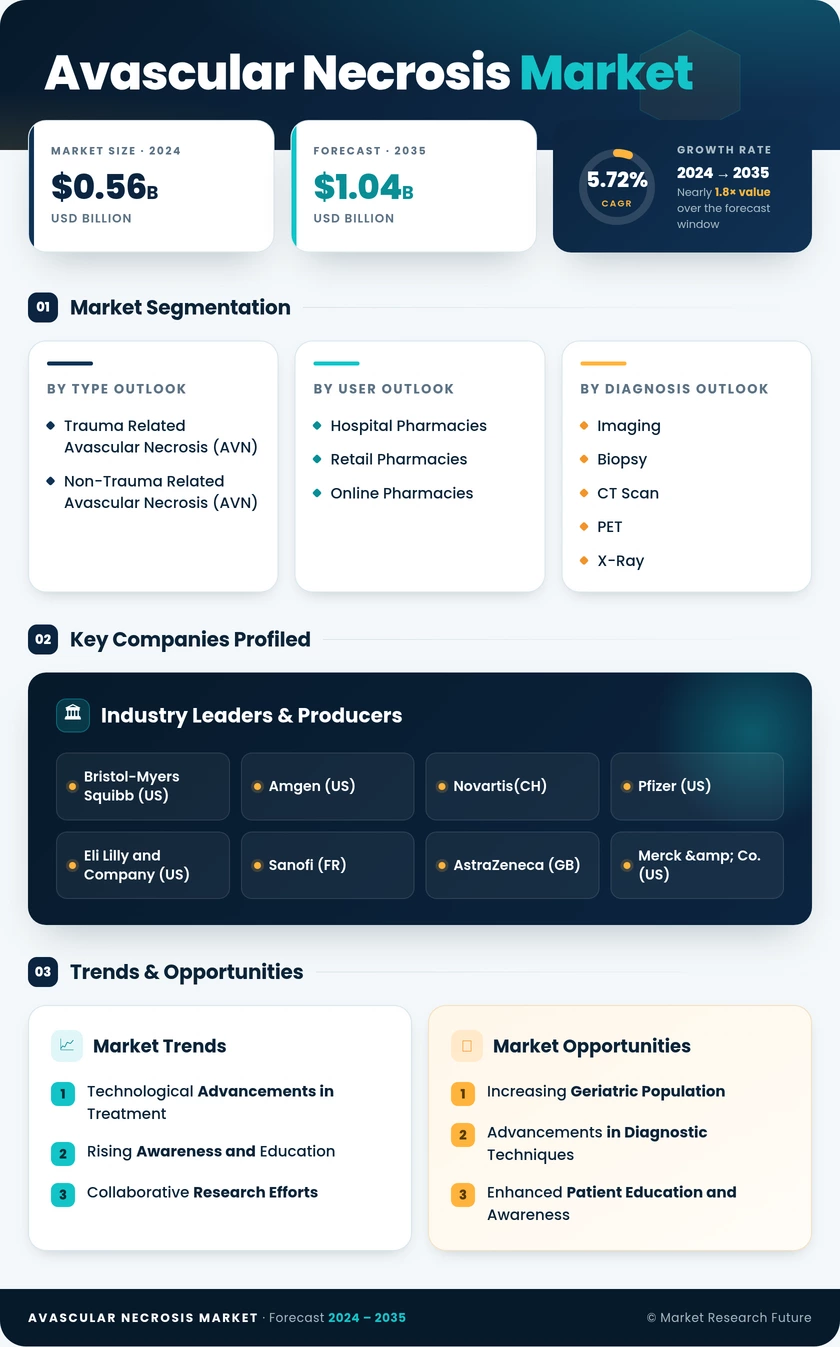
Avascular Necrosis Market (2026 - 2035)

ID: MRFR/MED/4673-CR 539 Pages Rahul Gotadki Last Updated: November 03, 2026
Avascular Necrosis Market Research Report Information By Type (Trauma Related Avascular Necrosis (AVN) and Non-Trauma Related Avascular Necrosis (AVN)0, By Treatment (Nonsteroidal Anti-Inflammatory Drugs (NSAIDS), Cholesterol Lowing Drugs, Osteoporosis Drugs, Blood Thinners, and Others), By Diagnosis (Imaging, Biopsy, CT Scan, PET and X- Ray), By End User (Hospital Pharmacies, Retail Pharmacies, and Online Pharmacies) And By Region (North America, Europe, Asia-Pacific, And Rest Of The World) –Market Forecast Till 2035
Avascular Necrosis Market
Market Size
Forecast Period2026-2035
CAGR (2026-2035)6.6%
2025 Market SizeUSD 689.3 Million
2035 Market SizeUSD 1,334.4 Million
Key Players
Stryker
Zimmer Biomet
Johnson & Johnson MedTech
Smith+Nephew
Enovis
Medtronic
Opportunities
  • Public Insurance Expansion in India and Southeast Asia
  • Imaging Data Platforms and Subscription Analytics
  • Outpatient Hip Reconstruction Pathways
  1. 1 Market Summary | |
  2. 2 Key Report Takeaways | |
    1. 2.1 By Treatment Type | |
    2. 2.2 By Disease Type | |
    3. 2.3 By Diagnosis | |
    4. 2.4 By End User | |
    5. 2.5 By Region | |
  3. 3 Market Size and Forecast (2021–2035) | |
  4. 4 Driver Impact Analysis | |
    1. 4.1 Rising Corticosteroid and Alcohol Exposure | |
    2. 4.2 Ageing Populations and Growing THA Volumes | |
    3. 4.3 MRI and AI-Assisted Early Detection | |
    4. 4.4 Robotic and Cementless Implant Innovation | |
    5. 4.5 Cell-Augmented Joint-Preserving Procedures | |
    6. 4.6 Sickle Cell Disease Burden and Screening Programs | |
  5. 5 Restraints Impact Analysis | |
    1. 5.1 Volume-Based Procurement Price Cuts | |
    2. 5.2 Late Diagnosis and Limited MRI Access | |
    3. 5.3 Weak Evidence for Pharmacologic Therapy | |
    4. 5.4 EU MDR Compliance Costs | |
    5. 5.5 Implant Recalls and Product Liability | |
  6. 6 Opportunities | |
    1. 6.1 Public Insurance Expansion in India and Southeast Asia | |
    2. 6.2 Imaging Data Platforms and Subscription Analytics | |
    3. 6.3 Outpatient Hip Reconstruction Pathways | |
    4. 6.4 Orthobiologics for Pre-Collapse Disease | |
    5. 6.5 Sickle Cell Care Networks in Africa and the Middle East | |
  7. 7 Regional Market Share and Country-Level Analysis | |
    1. 7.1 North America | | |
      1. 7.1.1 United States | | |
      2. 7.1.2 Canada | | |
      3. 7.1.3 Mexico | |
    2. 7.2 Europe | | |
      1. 7.2.1 Germany | | |
      2. 7.2.2 United Kingdom | | |
      3. 7.2.3 France | | |
      4. 7.2.4 Italy | | |
      5. 7.2.5 Spain | | |
      6. 7.2.6 Nordic Countries | | |
      7. 7.2.7 Russia | | |
      8. 7.2.8 Rest of Europe | |
    3. 7.3 Asia-Pacific | | |
      1. 7.3.1 China | | |
      2. 7.3.2 India | | |
      3. 7.3.3 Japan | | |
      4. 7.3.4 South Korea | | |
      5. 7.3.5 ASEAN | | |
      6. 7.3.6 Rest of Asia-Pacific | |
    4. 7.4 South America | | |
      1. 7.4.1 Brazil | | |
      2. 7.4.2 Argentina | | |
      3. 7.4.3 Rest of South America | |
    5. 7.5 Middle East & Africa | | |
      1. 7.5.1 Saudi Arabia | | |
      2. 7.5.2 UAE | | |
      3. 7.5.3 South Africa | | |
      4. 7.5.4 Egypt | | |
      5. 7.5.5 Rest of Middle East & Africa | |
  8. 8 Future Outlook (2026–2035) | |
    1. 8.1 AI-Guided Staging and Triage | |
    2. 8.2 Robotic Surgery and the Outpatient Shift | |
    3. 8.3 Regenerative Therapy Pipeline | |
    4. 8.4 Value-Based Payment and Registry Accountability | |
  9. 9 Segmentation Analysis | |
    1. 9.1 By Treatment Type | | |
      1. 9.1.1 Drugs | | | |
        1. 9.1.1.1 Nonsteroidal Anti-Inflammatory Drugs | | | |
        2. 9.1.1.2 Cholesterol-Lowering Drugs | | | |
        3. 9.1.1.3 Blood Thinners | | | |
        4. 9.1.1.4 Other Drugs | | |
      2. 9.1.2 Bone Replacement Devices & Implants | | | |
        1. 9.1.2.1 Bone Grafts | | | |
        2. 9.1.2.2 Joint Replacement Surgery | | | |
        3. 9.1.2.3 Cementless Prosthesis | |
    2. 9.2 By Disease Type | | |
      1. 9.2.1 Traumatic Avascular Necrosis | | |
      2. 9.2.2 Non-Traumatic Avascular Necrosis | | |
      3. 9.2.3 Fracture-Induced | | |
      4. 9.2.4 Dislocation-Induced | | |
      5. 9.2.5 Post-Surgical | | |
      6. 9.2.6 Crush Injury-Related | | |
      7. 9.2.7 Sports Injury-Associated | | |
      8. 9.2.8 Steroid-Induced | | |
      9. 9.2.9 Alcohol-Induced | | |
      10. 9.2.10 Sickle Cell Disease-Associated | | |
      11. 9.2.11 Lupus-Related | | |
      12. 9.2.12 Radiation Therapy-Induced | | |
      13. 9.2.13 Idiopathic | |
    3. 9.3 By Diagnosis | | |
      1. 9.3.1 Imaging | | |
      2. 9.3.2 Biopsy | | |
      3. 9.3.3 Computed Tomography Scan | | |
      4. 9.3.4 Positron Emission Tomography | | |
      5. 9.3.5 X-Ray | | |
      6. 9.3.6 Others | |
    4. 9.4 By End User | | |
      1. 9.4.1 Hospitals | | |
      2. 9.4.2 Specialty Clinics | | |
      3. 9.4.3 Ambulatory Surgical Centers | | |
      4. 9.4.4 Rehabilitation Centers | | |
      5. 9.4.5 Home Care Settings | | |
      6. 9.4.4 Others | |
  10. 10 Competitive Landscape | |
    1. 10.1 Market Concentration Analysis | |
    2. 10.2 Competitive Benchmarking Matrix | |
  11. 11 Recent News & Developments | |
  12. 12 Report Scope and Methodology | |
  13. 13 Detailed Sources and Citations | |
  14. 14 Frequently Asked Questions (FAQs) | | LIST OF TABLES | |
  15. TABLE 1 Global Avascular Necrosis Market Summary, 2025–2035 | |
  16. TABLE 2 Global Avascular Necrosis Market Size & Forecast, by Revenue (USD Million), 2021–2035 | |
  17. TABLE 3 Driver Impact Analysis | |
  18. TABLE 4 Restraints Impact Analysis | |
  19. TABLE 5 Global Avascular Necrosis Market, by Region, 2025 | |
  20. TABLE 6 North America Avascular Necrosis Market, by Country, 2025 | |
  21. TABLE 7 Europe Avascular Necrosis Market, by Country, 2025 | |
  22. TABLE 8 Asia-Pacific Avascular Necrosis Market, by Country, 2025 | |
  23. TABLE 9 South America Avascular Necrosis Market, by Country, 2025 | |
  24. TABLE 10 Middle East & Africa Avascular Necrosis Market, by Country, 2025 | |
  25. TABLE 11 Global Avascular Necrosis Market, by Treatment Type, 2025 | |
  26. TABLE 12 Global Avascular Necrosis Market, by Disease Type, 2025 | |
  27. TABLE 13 Global Avascular Necrosis Market, by Diagnosis, 2025 | |
  28. TABLE 14 Global Avascular Necrosis Market, by End User, 2025 | |
  29. TABLE 15 Competitive Benchmarking Matrix – Global Avascular Necrosis Market | |
  30. TABLE 16 Report Scope and Methodology | |
  31. TABLE 17 Detailed Sources and Citations | | LIST OF FIGURES | |
  32. FIGURE 1 Market Dynamics Overview – Drivers, Restraints and Opportunities | |
  33. FIGURE 2 Avascular Necrosis Value Chain Analysis | |
  34. FIGURE 3 Porter's Five Forces Analysis | |
  35. FIGURE 4 Global Avascular Necrosis Market Size Trend, 2021–2035 (USD Million) | |
  36. FIGURE 5 Market Share by Treatment Type, 2025 | |
  37. FIGURE 6 Market Share by Disease Type, 2025 | |
  38. FIGURE 7 Market Share by Diagnosis, 2025 | |
  39. FIGURE 8 Market Share by End User, 2025 | |
  40. FIGURE 9 Regional Market Share, 2025 | |
  41. FIGURE 10 Competitive Landscape – Estimated Revenue Share Ranges of Key Players

Segmentation Quick Reference

DimensionSub-SegmentsDominant SegmentFastest Growing Segment
By Treatment TypeDrugs; Bone Replacement Devices & ImplantsBone Replacement Devices & Implants (57.6% share)Total Hip Implants (7.8% CAGR)
By Disease TypeTraumatic Avascular Necrosis; Non-Traumatic Avascular NecrosisNon-Traumatic Avascular Necrosis (64.0% share)Steroid-Induced (7.3% CAGR)
By DiagnosisImaging; Biopsy; OthersImaging (50.4% share)MRI (8.2% CAGR)
By End UserHospitals; Specialty Clinics; Ambulatory Surgical Centers; OthersHospitals (58.3% share)Ambulatory Surgical Centers (7.9% CAGR (2026–2035))
By RegionNorth America; Europe; Asia-Pacific; South America; Middle East & AfricaNorth America (39.6% share)Asia-Pacific (8.3% CAGR (2026–2035))

Market Segmentation Overview

By Treatment Type

Sub-SegmentKey Trend
DrugsStatins, anticoagulants and bisphosphonates used in pre-collapse care; biologic combinations under study
Bone Replacement Devices & ImplantsCementless total hip implants and robotic placement gaining share

Bone Replacement Devices & Implants lead treatment revenue because most patients reach surgeons after collapse, leaving total hip arthroplasty as the definitive option. Within the segment, total hip implants grow fastest as cementless fixation and robotic placement suit younger patients. Drugs hold a steady supporting role in early disease, but weak trial evidence keeps their growth below that of implants.

By Disease Type

Sub-SegmentKey Trend
Traumatic Avascular NecrosisEarly fracture fixation and hip-preserving surgery
Non-Traumatic Avascular NecrosisRising steroid-induced and multifocal presentations

Non-Traumatic Avascular Necrosis leads because corticosteroid and alcohol exposure produce bilateral, multifocal disease that multiplies imaging and surgery per patient. Its steroid-induced sub-segment grows fastest, reinforced by the post-COVID-19 cohort. Traumatic Avascular Necrosis remains a large secondary pool where early detection after fracture favors preservation procedures.

By Diagnosis

Sub-SegmentKey Trend
ImagingMRI-led staging with AI-assisted interpretation
BiopsyDeclining use as image resolution improves
OthersBone scintigraphy retained for multifocal workups

Imaging leads diagnosis and MRI is its fastest-growing modality, because marrow edema is visible on MRI well before radiographic change and AI tools now support non-specialist readers. Biopsy is shrinking toward a confirmatory role for indeterminate lesions, while other methods such as bone scintigraphy persist mainly in multifocal disease.

By End User

Sub-SegmentKey Trend
HospitalsIntegrated imaging, surgery and multidisciplinary care
Specialty ClinicsLong-term monitoring and drug management
Ambulatory Surgical CentersOutpatient total hip arthroplasty growth
OthersResearch-led regenerative therapy trials

Hospitals lead because complex bilateral cases need MRI, operating capacity and multidisciplinary teams under one roof. Ambulatory Surgical Centers grow fastest as payers shift healthy THA patients to outpatient settings. Specialty Clinics retain a monitoring role for pre-collapse patients on drug therapy.


Download PDF ×

We do not share your information with anyone. However, we may send you emails based on your report interest from time to time. You may contact us at any time to opt-out.