×
Request Free Sample ×

Kindly complete the form below to receive a free sample of this Report

* Please use a valid business email

Leading companies partner with us for data-driven Insights

clients tt-cursor
Hero Background
English
Chinese
French
Japanese
Korean
German
Spanish

Autonomous Navigation Market Trends

ID: MRFR/AD/6181-HCR
133 Pages
Swapnil Palwe
October 2025

Autonomous Navigation Market Size, Share, Industry Trend & Analysis Research Report Information by Solution (Processing Unit, Sensing System, and Software), Platform (Airborne, Land, Marine, and Space), Application (Military & Government and Commercial) and Region - Forecast till 2035

Share:
Download PDF ×

We do not share your information with anyone. However, we may send you emails based on your report interest from time to time. You may contact us at any time to opt-out.

Autonomous Navigation Market Infographic
×
Autonomous Navigation Market Infographic Full View
Purchase Options

Market Trends

Autonomous Navigation Market Trends

The Autonomous Navigation Market is witnessing significant trends reflecting advancements in technology, industry adoption, regulatory developments, and market dynamics. Autonomous navigation systems, leveraging technologies such as artificial intelligence (AI), machine learning, sensors, and computer vision, enable vehicles and robots to navigate and operate autonomously without human intervention, marking a transformative shift in various industries. One prominent trend in the Autonomous Navigation Market is the rapid development and deployment of autonomous vehicles across different sectors, including automotive, maritime, aerospace, and agriculture. In the automotive industry, autonomous navigation systems are revolutionizing the way vehicles are driven, with autonomous cars, trucks, and drones offering safer, more efficient, and convenient transportation solutions. Companies like Tesla, Waymo, and Uber are investing heavily in autonomous vehicle technology, with a focus on achieving higher levels of autonomy and scalability in real-world environments. Furthermore, the adoption of autonomous navigation systems in the maritime sector is gaining momentum, driven by the need for safer, more efficient, and environmentally friendly maritime transportation solutions. Autonomous ships and unmanned surface vessels (USVs) equipped with advanced navigation and collision avoidance systems promise to reduce human error, improve fuel efficiency, and enhance maritime safety and security. Companies such as Rolls-Royce, Kongsberg, and Wärtsilä are leading the development of autonomous shipping technologies, aiming to transform the maritime industry's operations and logistics. In the aerospace sector, the adoption of autonomous navigation systems is revolutionizing unmanned aerial vehicles (UAVs) and drones, enabling new applications such as aerial mapping, surveillance, delivery, and inspection. Autonomous drones equipped with AI-powered navigation, obstacle detection, and sense-and-avoid capabilities offer cost-effective and scalable solutions for various industries, including agriculture, construction, infrastructure inspection, and disaster response. Companies like DJI, Parrot, and Lockheed Martin are driving innovation in autonomous drone technology, unlocking new opportunities for commercial and military applications. Moreover, the agricultural industry is embracing autonomous navigation systems to revolutionize farming operations and increase productivity, efficiency, and sustainability. Autonomous tractors, drones, and robotic harvesters equipped with GPS, sensors, and AI algorithms enable precision agriculture techniques such as automated planting, crop monitoring, and yield optimization. Companies like John Deere, CNH Industrial, and Trimble are developing autonomous farming solutions to address labor shortages, reduce input costs, and optimize crop yields in an increasingly digitized and data-driven agricultural landscape. Additionally, regulatory developments and standards play a crucial role in shaping the adoption and deployment of autonomous navigation systems across industries. Regulatory bodies such as the Federal Aviation Administration (FAA), European Aviation Safety Agency (EASA), and International Maritime Organization (IMO) are working to establish guidelines, certification requirements, and safety standards for autonomous vehicles and systems to ensure compliance with regulatory frameworks and ensure safe and responsible deployment. Furthermore, market dynamics such as investment trends, partnerships, and mergers and acquisitions (M&A) activity are driving innovation and consolidation in the Autonomous Navigation Market. Venture capital firms, technology companies, and automotive manufacturers are investing billions of dollars in autonomous navigation startups and research initiatives to accelerate the development and commercialization of autonomous vehicles and systems. Strategic partnerships and collaborations between industry players, academic institutions, and government agencies are fostering innovation, knowledge sharing, and ecosystem development in the autonomous navigation space.

Author
Swapnil Palwe
Team Lead - Research

With a technical background as Bachelor's in Mechanical Engineering, with MBA in Operations Management , Swapnil has 6+ years of experience in market research, consulting and analytics with the tasks of data mining, analysis, and project execution. He is the POC for our clients, for their consulting projects running under the Automotive/A&D domain. Swapnil has worked on major projects in verticals such as Aerospace & Defense, Automotive and many other domain projects. He has worked on projects for fortune 500 companies' syndicate and consulting projects along with several government projects.

Leave a Comment

FAQs

What is the size of autonomous navigation market?

Autonomous navigation market Grow at a CAGR Of 16.59% by 2020-2030 read more

Who Are Global Top Key Drivers in Autonomous navigation Industry

Collins Aerospace (US),Thales Group (France),Rolls-Royce (UK),Honeywell International Inc. (US),ABB (US),Kongsberg Group (Norway),Trimble Inc. (US),Northrop Grumman Corporation (US),L3 Technologies, Inc. (US),General Dynamics Corporation (US),Raytheon Company (US),Moog Inc. (US),Furuno Electric Co., Ltd (Japan),Safran (France),RH Marine (Netherlands)

In Which Region Autonomous navigation Business Growing Rapidly ?

North American region was projected to dominate the global Autonomous Navigation Market

What is the autonomous navigation market driver?

The availability of numerous solutions can support the promotion of the autonomous navigation market.

What is the autonomous navigation market restrain?

Growing cases of cyber threats to restrain the autonomous navigation market.

Market Summary

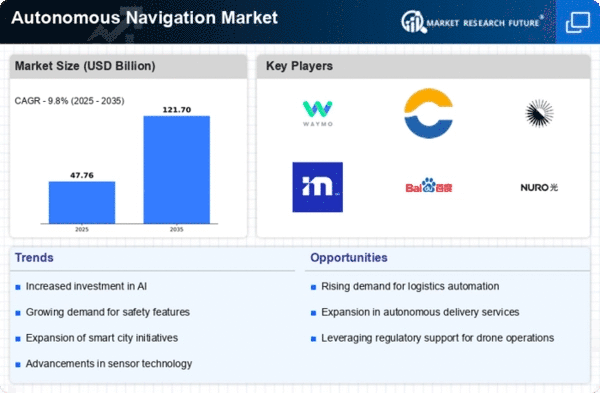
As per MRFR analysis, the Autonomous Navigation Market Size was estimated at 43.5 USD Billion in 2024. The Autonomous Navigation industry is projected to grow from 47.8 USD Billion in 2025 to 121.7 USD Billion by 2035, exhibiting a compound annual growth rate (CAGR) of 9.8 during the forecast period 2025 - 2035.

Key Market Trends & Highlights

The Autonomous Navigation Market is poised for substantial growth driven by technological advancements and increasing demand across various sectors.

  • The integration of AI and machine learning is transforming the capabilities of autonomous navigation systems.
  • North America remains the largest market, while the Asia-Pacific region is experiencing the fastest growth in adoption.
  • Automated Guided Vehicles dominate the market, whereas drones are emerging as the fastest-growing segment.
  • Rising demand for autonomous vehicles and increased investment in research and development are key drivers propelling market expansion.

Market Size & Forecast

2024 Market Size 43.5 (USD Billion)
2035 Market Size 121.7 (USD Billion)
CAGR (2025 - 2035) 9.8%
Largest Regional Market Share in 2024 North America

Major Players

<p>Waymo (US), Cruise (US), Aurora (US), Mobileye (IL), Baidu (CN), Nuro (US), Zoox (US), Pony.ai (CN), Aptiv (IE)</p>

Market Trends

The Autonomous Navigation Market is currently experiencing a transformative phase, driven by advancements in artificial intelligence, sensor technology, and machine learning. These innovations are enabling vehicles and drones to navigate complex environments with increased precision and safety. As industries such as logistics, agriculture, and transportation adopt autonomous systems, the demand for reliable navigation solutions continues to grow. Furthermore, regulatory frameworks are evolving to accommodate these technologies, fostering an environment conducive to innovation and investment. This shift not only enhances operational efficiency but also opens new avenues for economic growth and job creation. In addition to technological advancements, consumer acceptance plays a crucial role in shaping the Autonomous Navigation Market. As public awareness of autonomous systems increases, so does the willingness to embrace these innovations. Companies are focusing on developing user-friendly interfaces and ensuring robust safety measures to build trust among users. The integration of autonomous navigation into everyday applications, such as personal vehicles and delivery services, is likely to redefine mobility and logistics in the near future. Overall, the Autonomous Navigation Market appears poised for substantial growth, driven by a combination of technological progress and changing consumer attitudes.

Integration of AI and Machine Learning

The incorporation of artificial intelligence and machine learning algorithms is revolutionizing the Autonomous Navigation Market. These technologies enhance the ability of systems to learn from their environments, improving decision-making processes and operational efficiency. As AI continues to evolve, it is expected to enable more sophisticated navigation capabilities, allowing for real-time adjustments and increased adaptability in dynamic settings.

Expansion in Diverse Industries

Various sectors, including agriculture, logistics, and public transportation, are increasingly adopting autonomous navigation solutions. This trend indicates a broader acceptance of these technologies beyond traditional applications. As industries recognize the potential for cost savings and improved productivity, the demand for tailored navigation systems is likely to rise, fostering innovation and competition.

Regulatory Developments and Safety Standards

The establishment of regulatory frameworks and safety standards is crucial for the growth of the Autonomous Navigation Market. Governments are actively working to create guidelines that ensure the safe deployment of autonomous systems. These regulations not only address safety concerns but also promote public confidence in the technology, paving the way for wider adoption and integration into everyday life.

Autonomous Navigation Market Market Drivers

Technological Advancements

The Global Autonomous Navigation Market Industry is propelled by rapid technological advancements in artificial intelligence and machine learning. These innovations enhance the capabilities of autonomous systems, enabling them to process vast amounts of data in real-time. For instance, the integration of advanced sensors and computer vision technologies allows for improved navigation accuracy. As of 2024, the market is valued at 16.2 USD Billion, reflecting the increasing adoption of autonomous navigation solutions across various sectors, including automotive and Aerospace. This trend is expected to continue, with the market projected to reach 87.5 USD Billion by 2035, indicating a robust growth trajectory.

Market Segment Insights

By Application: Automated Guided Vehicle (Largest) vs. Drones (Fastest-Growing)

<p>In the Autonomous Navigation Market, the application segment showcases a diverse range of technologies with distinct market shares. The Automated Guided Vehicle (AGV) segment holds a significant position, being widely adopted in various industrial settings for efficiency in material handling. On the other hand, Drones are rapidly gaining traction, especially in sectors like logistics, agriculture, and surveillance, capturing a notable portion of the market with their versatility and innovative applications.</p>

<p>Drones (Emerging) vs. Robotic Process Automation (Dominant)</p>

<p>Drones have emerged as a transformative application within the Autonomous Navigation Market, with capabilities extending beyond traditional uses into areas such as aerial delivery, mapping, and inspection. Their rapid technological advancements and decreasing costs have fueled market growth, attracting investment and interest from diverse industries. Conversely, Robotic Process Automation (RPA) is currently a dominant player, offering enhanced operational efficiency through automating repetitive tasks across various sectors. RPA's integration into workflows showcases its significant role in streamlining operations and enhancing productivity.</p>

By End Use: Transportation (Largest) vs. Logistics (Fastest-Growing)

<p>In the Autonomous Navigation Market, the end use segment is predominantly driven by Transportation, which holds the largest share. This segment encompasses personal vehicles, public transport, and freight solutions employing autonomous technologies, showcasing a robust demand for safer and more efficient transportation options. Logistics follows closely, experiencing rapid adoption due to increased automation in supply chain processes, optimizing operations and reducing costs significantly across various industries.</p>

<p>Logistics: Automated Delivery (Dominant) vs. Agriculture (Emerging)</p>

<p>Within the logistics domain, Automated Delivery stands out as the dominant force, integrating autonomous navigation to enhance delivery efficiency and speed. This segment is characterized by technologies that streamline last-mile delivery, attracting both established companies and new entrants. In contrast, Agriculture is emerging with significant potential for growth. Autonomous navigation is revolutionizing traditional farming practices through precision agriculture, enabling farmers to optimize resources and maximize yields. As these applications expand, the agricultural segment is becoming increasingly integral to the overall autonomous navigation landscape.</p>

By Technology: Lidar (Largest) vs. Artificial Intelligence (Fastest-Growing)

<p>In the Autonomous Navigation Market, Lidar technology leads in market share, primarily due to its precision in environment detection and mapping. It outpaces other technologies, ensuring vehicles perceive their surroundings with high accuracy. Following Lidar, Computer Vision and GPS hold substantial shares, each contributing distinct benefits to autonomous navigation systems although not at the same level of dominance as Lidar. Artificial Intelligence, while currently smaller in market share, exhibits significant potential due to its ability to enhance decision-making processes in navigation systems.</p>

<p>Technology: Lidar (Dominant) vs. Artificial Intelligence (Emerging)</p>

<p>Lidar, as a dominant technology in autonomous navigation, offers superior accuracy in spatial awareness and obstacle detection, making it essential for safe navigation in complex environments. Its capacity to create detailed 3D maps is unparalleled, allowing for real-time data processing essential for autonomous vehicles. On the other hand, Artificial Intelligence (AI) is an emerging force within this sector, driving advancements in navigation logic, perception, and real-time decision-making. The synergy between AI and sensor technologies like Lidar is fostering rapid innovations that enhance vehicle autonomy. As AI continues to evolve, its integration into existing systems is predicted to revolutionize how autonomous vehicles interpret and respond to their environment.</p>

By Component: Sensors (Largest) vs. Software (Fastest-Growing)

<p>In the Autonomous Navigation Market, the component segment is primarily distributed among sensors, actuators, control systems, and software. Among these, sensors hold the largest market share due to their critical role in enabling navigation systems to perceive and interpret their environment. Following sensors, software has shown impressive growth rates due to advancements in artificial intelligence and machine learning, making them essential for autonomous decision-making. Actuators and control systems, while vital for movement and operation, have a smaller share compared to these two components.</p>

<p>Sensors (Dominant) vs. Software (Emerging)</p>

<p>Sensors are the dominant component in the Autonomous Navigation Market, responsible for gathering data about the surroundings, including distance, speed, and obstacles, which are crucial for navigation accuracy. Technologies like LIDAR, radar, and cameras comprise this segment, offering reliability and performance. In contrast, software is the emerging force, providing the algorithms and frameworks necessary for interpreting sensor data and executing navigation tasks. This segment's rapid growth is attributable to rising public interest in autonomous vehicles and smart systems, utilizing machine learning and AI to enhance efficiency and safety in navigation.</p>

Get more detailed insights about Global Autonomous Navigation Market Research Report—Forecast till 2035

Regional Insights

North America : Innovation and Leadership Hub

North America continues to lead the Autonomous Navigation Market, holding a significant market share of 20.0 in 2024. The region's growth is driven by rapid technological advancements, substantial investments in R&D, and supportive regulatory frameworks. The increasing demand for autonomous vehicles, coupled with a strong focus on safety and efficiency, propels market expansion. Government initiatives aimed at fostering innovation further enhance the region's competitive edge. The competitive landscape in North America is characterized by the presence of key players such as Waymo, Cruise, and Aurora, which are at the forefront of autonomous technology. The U.S. remains a leader in this sector, with states like California and Arizona serving as testing grounds for autonomous vehicles. The collaboration between tech companies and automotive manufacturers is also pivotal, ensuring a robust ecosystem for growth and innovation.

Europe : Regulatory Framework and Innovation

Europe's Autonomous Navigation Market is projected to reach a size of 10.5 by 2025, driven by stringent regulations and a commitment to sustainability. The European Union's focus on reducing carbon emissions and enhancing road safety has catalyzed the adoption of autonomous technologies. Countries like Germany and France are leading the charge, implementing policies that support the development and deployment of autonomous vehicles, thus creating a favorable environment for market growth. The competitive landscape in Europe features key players such as Mobileye and Aptiv, alongside numerous startups innovating in the space. The region's emphasis on collaboration between public and private sectors fosters a dynamic ecosystem. With a strong regulatory framework in place, Europe is well-positioned to advance its autonomous navigation capabilities, ensuring safety and efficiency in transportation.

Asia-Pacific : Emerging Market with High Potential

The Asia-Pacific region is witnessing significant growth in the Autonomous Navigation Market, with a projected size of 10.0 by 2025. This growth is fueled by increasing urbanization, rising disposable incomes, and a growing demand for smart transportation solutions. Countries like China and Japan are at the forefront, investing heavily in autonomous vehicle technology and infrastructure, supported by favorable government policies aimed at enhancing mobility and reducing traffic congestion. China, in particular, is a key player in the autonomous navigation landscape, with companies like Baidu and Pony.ai leading the charge. The competitive environment is characterized by rapid technological advancements and a surge in partnerships between tech firms and automotive manufacturers. As the region continues to innovate, it is poised to become a major hub for autonomous navigation solutions, catering to both domestic and international markets.

Middle East and Africa : Emerging Opportunities and Challenges

The Middle East and Africa region is gradually emerging in the Autonomous Navigation Market, with a market size of 3.0 projected for 2025. The growth is driven by increasing investments in smart city initiatives and infrastructure development. Countries like the UAE are leading the way, implementing policies that encourage the adoption of autonomous technologies. The region's unique challenges, such as varying regulatory environments and infrastructure readiness, present both opportunities and hurdles for market players. The competitive landscape is still developing, with a mix of local and international players exploring opportunities in the autonomous navigation space. The presence of key players is limited, but initiatives to foster innovation and collaboration are on the rise. As the region continues to invest in technology and infrastructure, it is expected to see a gradual increase in the adoption of autonomous navigation solutions, paving the way for future growth.
Key Players and Competitive Insights

The Autonomous Navigation Market is currently characterized by intense competition and rapid technological advancements, driven by the increasing demand for efficient transportation solutions and the integration of artificial intelligence (AI) in navigation systems. Key players such as Waymo (US), Cruise (US), and Mobileye (IL) are at the forefront, each adopting distinct strategies to enhance their market positioning. Waymo (US) focuses on innovation through extensive testing and development of its self-driving technology, while Cruise (US) emphasizes partnerships with automotive manufacturers to expand its fleet capabilities. Mobileye (IL), on the other hand, leverages its expertise in computer vision to provide advanced driver-assistance systems, thereby enhancing safety and reliability in autonomous navigation.

The business tactics employed by these companies include localizing manufacturing and optimizing supply chains to reduce costs and improve efficiency. The market structure appears moderately fragmented, with several players vying for dominance. However, the collective influence of major companies like Waymo (US) and Cruise (US) suggests a trend towards consolidation, as these firms seek to establish themselves as leaders in the evolving landscape of autonomous navigation.

In November 2025, Waymo (US) announced a strategic partnership with a leading automotive manufacturer to co-develop next-generation autonomous vehicles. This collaboration is expected to enhance Waymo's technological capabilities and accelerate the deployment of its self-driving fleet, positioning the company to capture a larger share of the market. The significance of this partnership lies in its potential to streamline production processes and integrate advanced AI features into vehicles, thereby improving overall performance and safety.

In October 2025, Cruise (US) expanded its operations into several new urban markets, launching its autonomous ride-hailing service in key metropolitan areas. This expansion is indicative of Cruise's aggressive growth strategy, aiming to increase its market presence and capitalize on the rising demand for autonomous transportation solutions. The strategic importance of this move is underscored by the potential to gather valuable data from diverse driving environments, which can be utilized to refine its algorithms and enhance service reliability.

In September 2025, Mobileye (IL) unveiled a new suite of AI-driven navigation tools designed to improve the efficiency of autonomous vehicles in complex urban settings. This development highlights Mobileye's commitment to innovation and its focus on addressing the unique challenges posed by urban navigation. The introduction of these tools is likely to strengthen Mobileye's competitive edge, as they offer enhanced capabilities that can be integrated into various vehicle platforms.

As of December 2025, the competitive trends in the Autonomous Navigation Market are increasingly defined by digitalization, sustainability, and the integration of AI technologies. Strategic alliances among key players are shaping the landscape, fostering collaboration that enhances technological advancements and market reach. Looking ahead, competitive differentiation is expected to evolve, with a shift from price-based competition to a focus on innovation, technology, and supply chain reliability. Companies that can effectively leverage these trends will likely emerge as leaders in the market.

Key Companies in the Autonomous Navigation Market include

Industry Developments

In May 2024, the US Navy signed a contract worth USD 28.0 million with the prominent market player Raytheon with an aim to supply variable depth sonars. It is especially proposed for its littoral combat ship class.

  • Autonomous Shipping:
    • The Nippon Foundation MEGURI2040 Fully Autonomous Ship Program is actively working towards practical implementation of fully autonomous navigation for coastal shipping by 2025. Stage 2 of the project (2023-2026) aims to improve collision-avoidance and auto berthing/un-berthing technology, with demonstration tests for several vessels planned for July-November 2025.
    • Companies like Furuno are developing new technological innovations for safer and more efficient autonomous ship operations, including "Recognition Support," "Decision Support," and "Operation Support" systems.
    • Autonomous Ship Expo and Conference (next edition June 2026) continues to be a key event showcasing advancements in autonomous navigation technologies for the maritime industry.


Future Outlook

Autonomous Navigation Market Future Outlook

<p>The Autonomous Navigation Market is projected to grow at a 9.8% CAGR from 2024 to 2035, driven by advancements in AI, sensor technology, and increasing demand for automation.</p>

New opportunities lie in:

  • <p>Development of AI-driven navigation software for logistics optimization.</p>
  • <p>Integration of autonomous navigation in urban air mobility solutions.</p>
  • <p>Partnerships with automotive manufacturers for autonomous vehicle systems.</p>

<p>By 2035, the Autonomous Navigation Market is expected to be a pivotal sector, reflecting robust growth and innovation.</p>

Market Segmentation

Autonomous Navigation Market End Use Outlook

  • Transportation
  • Logistics
  • Agriculture
  • Military

Autonomous Navigation Market Component Outlook

  • Sensors
  • Actuators
  • Control Systems
  • Software

Autonomous Navigation Market Technology Outlook

  • Lidar
  • Computer Vision
  • GPS
  • Artificial Intelligence

Autonomous Navigation Market Application Outlook

  • Automated Guided Vehicle
  • Drones
  • Robotic Process Automation
  • Self-Driving Cars

Report Scope

MARKET SIZE 202443.5(USD Billion)
MARKET SIZE 202547.8(USD Billion)
MARKET SIZE 2035121.7(USD Billion)
COMPOUND ANNUAL GROWTH RATE (CAGR)9.8% (2024 - 2035)
REPORT COVERAGERevenue Forecast, Competitive Landscape, Growth Factors, and Trends
BASE YEAR2024
Market Forecast Period2025 - 2035
Historical Data2019 - 2024
Market Forecast UnitsUSD Billion
Key Companies ProfiledWaymo (US), Cruise (US), Aurora (US), Mobileye (IL), Baidu (CN), Nuro (US), Zoox (US), Pony.ai (CN), Aptiv (IE)
Segments CoveredApplication, End Use, Technology, Component
Key Market OpportunitiesIntegration of artificial intelligence in Autonomous Navigation Market enhances safety and efficiency in transportation systems.
Key Market DynamicsTechnological advancements and regulatory changes drive competitive dynamics in the Autonomous Navigation Market.
Countries CoveredNorth America, Europe, APAC, South America, MEA

FAQs

What is the size of autonomous navigation market?

Autonomous navigation market Grow at a CAGR Of 16.59% by 2020-2030 read more

Who Are Global Top Key Drivers in Autonomous navigation Industry

Collins Aerospace (US),Thales Group (France),Rolls-Royce (UK),Honeywell International Inc. (US),ABB (US),Kongsberg Group (Norway),Trimble Inc. (US),Northrop Grumman Corporation (US),L3 Technologies, Inc. (US),General Dynamics Corporation (US),Raytheon Company (US),Moog Inc. (US),Furuno Electric Co., Ltd (Japan),Safran (France),RH Marine (Netherlands)

In Which Region Autonomous navigation Business Growing Rapidly ?

North American region was projected to dominate the global Autonomous Navigation Market

What is the autonomous navigation market driver?

The availability of numerous solutions can support the promotion of the autonomous navigation market.

What is the autonomous navigation market restrain?

Growing cases of cyber threats to restrain the autonomous navigation market.

  1. SECTION I: EXECUTIVE SUMMARY AND KEY HIGHLIGHTS
    1. | 1.1 EXECUTIVE SUMMARY
  2. SECTION II: SCOPING, METHODOLOGY AND MARKET STRUCTURE
    1. | 2.1 MARKET INTRODUCTION
    2. | 2.2 RESEARCH METHODOLOGY
  3. SECTION III: QUALITATIVE ANALYSIS
    1. | 3.1 MARKET DYNAMICS
    2. | 3.2 MARKET FACTOR ANALYSIS
  4. SECTION IV: QUANTITATIVE ANALYSIS
    1. | 4.1 Aerospace & Defense, BY Application (USD Billion)
    2. | 4.2 Aerospace & Defense, BY End Use (USD Billion)
    3. | 4.3 Aerospace & Defense, BY Technology (USD Billion)
    4. | 4.4 Aerospace & Defense, BY Component (USD Billion)
    5. | 4.5 Aerospace & Defense, BY Region (USD Billion)
  5. SECTION V: COMPETITIVE ANALYSIS
    1. | 5.1 Competitive Landscape
    2. | 5.2 Company Profiles
    3. | 5.3 Appendix

Global Autonomous Navigation Market Segmentation

Market Segmentation Overview

  • Detailed segmentation data will be available in the full report
  • Comprehensive analysis by multiple parameters
  • Regional and country-level breakdowns
  • Market size forecasts by segment
Infographic

Free Sample Request

Kindly complete the form below to receive a free sample of this Report

Get Free Sample

Customer Strories

Compare Licence

×
Features License Type
Single User Multiuser License Enterprise User
Price $4,950 $5,950 $7,250
Maximum User Access Limit 1 User Upto 10 Users Unrestricted Access Throughout the Organization
Free Customization
Direct Access to Analyst
Deliverable Format
Platform Access
Discount on Next Purchase 10% 15% 15%
Printable Versions