
Request Free Sample ×

Kindly complete the form below to receive a free sample of this Report

* Please use a valid business email

Leading companies partner with us for data-driven Insights

clients tt-cursor
Hero Background
English
Chinese
French
Japanese
Korean
German
Spanish

Automotive Semiconductor Market Share

ID: MRFR/AT/8964-CR
200 Pages
Triveni Bhoyar
June 2025

Automotive Semiconductor Market Size, Share & Growth Analysis Report By Application (Powertrain, Infotainment, ADAS, Body Control, Chassis), By Vehicle Type (Passenger Vehicles, Commercial Vehicles, Electric Vehicles), By Technology (Microcontrollers, Power Devices, Sensors, Analog ICs), By Functionality (Connectivity, Safety, Efficiency, Autonomy) and By Regional (North America, Europe, South America, Asia Pacific, Middle East and Africa) - Industry Trends & Forecast to 2035

Share:
Download PDF ×

We do not share your information with anyone. However, we may send you emails based on your report interest from time to time. You may contact us at any time to opt-out.

Automotive Semiconductor Market Infographic
Purchase Options

Market Share

Automotive Semiconductor Market Share Analysis

There are numerous strategies for market share positioning developed by automotive semiconductor companies in the constantly changing environment of this industry. A popular strategy is to differentiate by providing customized and innovative semiconductors for automotive applications. This may involve creating sophisticated sensors, processors or connectivity technologies that make them superior to their rivals. With differentiation, businesses create a place for themselves and thus get customers looking to use advanced technologies in their vehicles. Cost leadership is another important strategy, which requires the company to become a low-cost provider of automotive semiconductors. Scalability, streamlining production processes and efficient supply chain management are key pillars of this approach. A cost leadership strategy enables companies to deliver low-price products and attract price sensitive customers, increasing their market share. But it is necessary to maintain a balance in cost-cutting measures without sacrificing semiconductor product quality and performance. Market segmentation is also one of the most popular strategies in automotive semiconductor industry. Companies specify market segments or target customer groups and adjust their semiconductor solutions to these needs. This can include the creation of electric vehicle-targeted products, driverless automobiles technologies and in car entertainment. However, knowing the needs of various groups enables companies to address diverse customers’ demands and corporate niche market shares. The collaboration and strategic partnerships are an important aspect of the market share positioning in auto semiconductors. A good way for companies to extend their product lines or enter new markets is by joining some form of alliance with automakers, Tier 1 suppliers, or even other semiconductor manufacturers. Such partnerships provide shared resources, know-how and help companies manage the challenges of a dynamic automotive industry. These alliances also enable the creation of holistic offerings that address the interdependent nature of current vehicles. Geographical spread is one of the major strategies for market share positioning. Companies can enter emerging markets with increasing automotive sectors establishing grounds in areas where semiconductor solutions demand is growing. Companies can penetrate and capture market share in diverse global markets by gaining understanding of regional preferences, regulatory landscapes, and customers’ needs.


Author
Author Profile
Triveni Bhoyar
Senior Research Analyst

Triveni Bhoyar has over 5 years of experience in the market research industry, specializing in the Automotive and Aerospace & Defense sectors. She has contributed to 200+ reports, including numerous custom projects for leading global companies, delivering solutions to complex business challenges. Renowned for her ability to generate valuable insights, Triveni excels in addressing unique market dynamics with precision and depth. Her expertise spans market sizing, competitive intelligence, and trend analysis, enabling clients to craft data-driven growth strategies. With strong analytical rigor and a client-centric approach, she plays a pivotal role in driving impactful, strategic decision-making.

Leave a Comment

FAQs

What is the projected market valuation of the Automotive Semiconductor Market in 2035?

<p>The projected market valuation for the Automotive Semiconductor Market in 2035 is 89.24 USD Billion.</p>

What was the market valuation of the Automotive Semiconductor Market in 2024?

<p>The overall market valuation of the Automotive Semiconductor Market was 52.23 USD Billion in 2024.</p>

What is the expected CAGR for the Automotive Semiconductor Market from 2025 to 2035?

<p>The expected CAGR for the Automotive Semiconductor Market during the forecast period 2025 - 2035 is 4.99%.</p>

Which segments are expected to show significant growth in the Automotive Semiconductor Market?

<p>Segments such as Powertrain, ADAS, and Infotainment are expected to show significant growth, with valuations projected to reach 25.0, 20.0, and 18.0 USD Billion respectively.</p>

Who are the key players in the Automotive Semiconductor Market?

<p>Key players in the Automotive Semiconductor Market include NXP Semiconductors, Infineon Technologies, Texas Instruments, and STMicroelectronics.</p>

What is the projected valuation for the Powertrain segment by 2035?

<p>The Powertrain segment is projected to reach a valuation of 25.0 USD Billion by 2035.</p>

How does the valuation of Electric Vehicles compare to that of Commercial Vehicles in 2035?

<p>By 2035, the valuation of Electric Vehicles is projected to be 19.24 USD Billion, compared to 20.0 USD Billion for Commercial Vehicles.</p>

What is the expected valuation for the Safety functionality segment in 2035?

<p>The Safety functionality segment is expected to reach a valuation of 20.0 USD Billion by 2035.</p>

Which technology segment is projected to have the highest valuation in 2035?

<p>The Microcontrollers technology segment is projected to have the highest valuation, reaching 25.0 USD Billion by 2035.</p>

What is the anticipated growth for the Chassis segment in the Automotive Semiconductor Market?

<p>The Chassis segment is anticipated to grow, with a projected valuation of 14.24 USD Billion by 2035.</p>

Market Summary

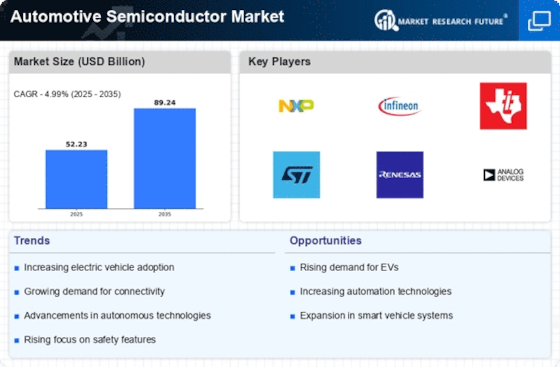
As per Market Research Future analysis, the Automotive Semiconductor Market Size was estimated at 52.23 USD Billion in 2024. The Automotive Semiconductor industry is projected to grow from 54.84 USD Billion in 2025 to 89.24 USD Billion by 2035, exhibiting a compound annual growth rate (CAGR) of 4.9% during the forecast period 2025 - 2035

Key Market Trends & Highlights

The Automotive Semiconductor Market is poised for substantial growth driven by technological advancements and evolving consumer preferences.

  • The rise of electric vehicles is reshaping the semiconductor landscape, particularly in North America. Advancements in autonomous driving technologies are propelling demand for sophisticated semiconductor solutions in the Asia-Pacific region. Enhanced connectivity solutions are becoming increasingly vital in both passenger vehicles and electric vehicles, reflecting changing consumer expectations. The increasing demand for advanced driver assistance systems and the growth of electric vehicle infrastructure are key drivers of market expansion.

Market Size & Forecast

2024 Market Size 52.23 (USD Billion)
2035 Market Size 89.24 (USD Billion)
CAGR (2025 - 2035) 4.99%
Largest Regional Market Share in 2024 North America

Major Players

NXP Semiconductors (NL), Infineon Technologies (DE), Texas Instruments (US), STMicroelectronics (FR), Renesas Electronics (JP), Analog Devices (US), Microchip Technology (US), ON Semiconductor (US)

Market Trends

The Automotive Semiconductor Market is currently experiencing a transformative phase, driven by the increasing integration of advanced technologies in vehicles. This sector is witnessing a surge in demand for semiconductors that support functionalities such as electric powertrains, autonomous driving systems, and enhanced connectivity features. As automotive manufacturers strive to meet consumer expectations for smarter and more efficient vehicles, the reliance on sophisticated semiconductor solutions becomes more pronounced.

The ongoing evolution of vehicle design and functionality necessitates a robust supply chain capable of delivering high-performance components that can withstand the rigors of automotive applications. Moreover, the Auto Semiconductor Market is likely to be influenced by regulatory changes aimed at promoting sustainability and safety. Governments around the world are implementing stricter emissions standards and encouraging the adoption of electric vehicles, which in turn drives the need for specialized semiconductor technologies.

This shift not only enhances vehicle performance but also aligns with global efforts to reduce carbon footprints. As the Automotive Semiconductor Market continues to evolve, collaboration between semiconductor manufacturers and automotive companies appears essential to foster innovation and address emerging challenges in this dynamic landscape.

Rise of Electric Vehicles

The Automotive Semiconductors Market is witnessing a notable shift towards electric vehicles, which require specialized semiconductor components for efficient power management and battery control. This trend indicates a growing emphasis on sustainability and energy efficiency within the automotive sector.

Advancements in Autonomous Driving

The development of autonomous driving technologies is significantly impacting the Auto Semiconductor Market. Advanced sensors and processing units are essential for enabling features such as lane-keeping assistance and adaptive cruise control, suggesting a robust demand for high-performance semiconductors.

Enhanced Connectivity Solutions

The increasing demand for connected vehicles is shaping the Vehicle Semiconductor Industry. Technologies that facilitate vehicle-to-everything (V2X) communication are becoming crucial, indicating a trend towards integrating more sophisticated semiconductor solutions to enhance user experience and safety.

Automotive Semiconductor Market Market Drivers

Rising Focus on Vehicle Electrification

The Automotive Semiconductor Market is significantly impacted by the rising focus on vehicle electrification. As manufacturers transition from internal combustion engines to electric and hybrid vehicles, the demand for specialized semiconductors is expected to escalate. By 2025, the market for power semiconductors in automotive applications is projected to grow by over 15%, driven by the need for efficient energy conversion and management. This shift towards electrification not only enhances vehicle performance but also aligns with global sustainability goals. Consequently, the Auto Semiconductor Market is poised for substantial growth as it adapts to the evolving landscape of vehicle electrification and the associated semiconductor requirements.

Growth of Electric Vehicle Infrastructure

The Automotive Semiconductor Industry is significantly influenced by the expansion of electric vehicle (EV) infrastructure. As governments and private entities invest in charging stations and battery technology, the demand for semiconductors in EVs is expected to rise. By 2025, the EV market is anticipated to account for over 20% of total vehicle sales, necessitating advanced semiconductor solutions for battery management systems, power electronics, and electric drivetrains. This growth not only reflects a shift towards sustainable transportation but also underscores the critical role of semiconductors in enabling efficient energy management and performance optimization in electric vehicles, thereby propelling the Auto Semiconductor Market forward.

Advancements in Automotive Safety Regulations

The Automotive Semiconductor Sector is being shaped by advancements in automotive safety regulations. Governments worldwide are increasingly implementing stringent safety standards, compelling manufacturers to integrate advanced safety technologies into their vehicles. As of 2025, the market for safety-related semiconductors is expected to grow significantly, driven by the need for compliance with these regulations. Technologies such as collision avoidance systems, electronic stability control, and tire pressure monitoring systems rely heavily on semiconductor components. This regulatory landscape not only enhances consumer safety but also presents a substantial opportunity for the Vehicle Semiconductor Industry, as manufacturers invest in innovative semiconductor solutions to meet evolving safety requirements.

Integration of Internet of Things in Vehicles

The Automotive Semiconductor Landscape is witnessing a transformative shift with the integration of Internet of Things (IoT) technologies in vehicles. This integration facilitates enhanced connectivity, allowing vehicles to communicate with each other and with infrastructure. As of 2025, the market for connected vehicles is projected to exceed 50 billion USD, driven by consumer demand for smart features and real-time data analytics. Semiconductors play a pivotal role in enabling these IoT functionalities, including vehicle-to-everything (V2X) communication, remote diagnostics, and over-the-air updates. This trend suggests a burgeoning opportunity for the Vehicle Semiconductor Industry, as automakers increasingly adopt IoT solutions to improve user experience and operational efficiency.

Increasing Demand for Advanced Driver Assistance Systems

The Global Automotive Semiconductor Market is experiencing a notable surge in demand for Advanced Driver Assistance Systems (ADAS). These systems, which enhance vehicle safety and driving convenience, rely heavily on semiconductor technology. As of 2025, the market for ADAS is projected to reach approximately 30 billion USD, driven by consumer preferences for safety features and regulatory mandates. The integration of semiconductors in ADAS enables functionalities such as adaptive cruise control, lane-keeping assistance, and automatic emergency braking. This trend indicates a robust growth trajectory for the Auto Electronics Semiconductor Market, as manufacturers increasingly prioritize the incorporation of these technologies into new vehicle models.

Market Segment Insights

By Application: Powertrain (Largest) vs. ADAS (Fastest-Growing)

The automotive semiconductor market showcases a diverse distribution of segment values, where the Powertrain segment dominates with the largest share owing to its critical role in vehicle performance and efficiency. Following behind, the Infotainment and Body Control segments play vital roles in providing connectivity and comfort features. Meanwhile, the Chassis segment also holds a significant position as it contributes to safety and stability, while ADAS emerges as a notable contender with rapid growth due to increasing regulatory measures and consumer demand for autonomous driving features.

Powertrain (Dominant) vs. ADAS (Emerging)

The Powertrain segment is pivotal in the automotive semiconductor landscape, focusing on engine control units and electrical systems that enhance vehicle performance and fuel efficiency. This segment has well-established technology with strong support from OEMs for innovations like hybrid and electric vehicles.<br> <br>Conversely, the ADAS segment has gained momentum swiftly, fueled by the global push for safer and smarter automotive solutions. <a href="https://www.marketresearchfuture.com/reports/advanced-driver-assistance-systems-market-4434">Advanced driver-assistance system</a>, including adaptive cruise control and automated parking, are leading the charge in semiconductor demand, driven by evolving consumer expectations and stringent safety regulations. This segment is on the precipice of becoming a powerhouse as automotive manufacturers prioritize integrating cutting-edge technologies into their vehicle architectures.

By Vehicle Type: Passenger Vehicles (Largest) vs. Electric Vehicles (Fastest-Growing)

The Automotive Semiconductor Market is significantly influenced by the vehicle type segment, where passenger vehicles hold the largest Automotive Semiconductor Market share due to their widespread adoption and integration of advanced semiconductor technologies. This segment is characterized by an increase in demand for infotainment systems, advanced driver-assistance systems (ADAS), and connectivity features that enhance the driving experience. Electric vehicles, on the other hand, are rapidly capturing Automotive Semiconductor Market attention, fueled by the global shift towards sustainability and electric mobility initiatives. This growing focus is a major driving force behind the continuous innovation of semiconductor applications, enabling features like <a href="https://www.marketresearchfuture.com/reports/battery-management-market-25645">battery management</a> and electric powertrains.

Passenger Vehicles (Dominant) vs. Electric Vehicles (Emerging)

In the Automotive Semiconductor Market, passenger vehicles stand out as the dominant category, comprising a significant portion of the overall demand due to their integration of various electronic systems aimed at improving safety, comfort, and convenience. Features such as lane-keeping assistance, adaptive cruise control, and advanced infotainment systems leverage sophisticated semiconductor technologies. Meanwhile, electric vehicles are emerging as a key growth area, attributed to changing consumer preferences and government incentives promoting electric mobility. Electric vehicles require specialized semiconductor components for electric motors, <a title="battery" href="https://www.marketresearchfuture.com/reports/battery-market-2930" target="_blank" rel="noopener">battery</a> management systems, and thermal management, positioning them as an essential and rapidly evolving segment in this Automotive Semiconductor Market landscape.

By Technology: Microcontrollers (Largest) vs. Power Devices (Fastest-Growing)

In the Automotive Semiconductor Market, microcontrollers represent the largest share among various technology segments, serving as the backbone for numerous vehicle electronic systems. They are vital for applications such as engine management, transmission control, and advanced driver-assistance systems (ADAS). Power devices, while smaller in overall share, are rapidly gaining traction due to the increasing demand for electric vehicles and sophisticated power management systems, reflecting a dynamic shift in the Automotive Semiconductor Market landscape.

Microcontrollers (Dominant) vs. Power Devices (Emerging)

Microcontrollers have established themselves as a dominant force in the automotive sector, enabling the development of advanced automotive electronics and autonomous systems due to their versatility and processing power. They are integral to the functioning of various automotive applications ranging from safety systems to entertainment and connectivity features. On the other hand, power devices, categorized as an emerging segment, are driven by the electrification trend in the automotive industry. The rise of electric vehicles necessitates efficient power conversion and management solutions, making power devices increasingly critical for automotive applications. This evolution indicates a growing investment in R&amp;D to enhance the efficiency and performance of power devices.

By Functionality: Safety (Largest) vs. Connectivity (Fastest-Growing)

In the Automotive Semiconductor Market, the functionality segment is characterized by diverse values such as Connectivity, Safety, Efficiency, and Autonomy. Among these, Safety stands out as the largest contributor, driven by stringent regulatory requirements and ongoing advancements in safety technology. Connectivity, on the other hand, is gaining traction rapidly, owing to the increasing demand for connected vehicles and IoT applications, which has been catalyzed by consumer preferences for enhanced in-car experiences and the rise of smart transportation solutions.

Connectivity: Emerging vs. Safety: Dominant

Safety remains the dominant value in the Automotive Semiconductor Market as it is central to compliance and consumer safety preferences. It encompasses critical features such as ADAS (Advanced Driver-Assistance Systems) and automated emergency braking, reflecting significant investment from automakers in this area. Conversely, Connectivity is emerging as a key player, spurred by trends towards <a href="https://www.marketresearchfuture.com/reports/vehicle-to-everything-communication-system-market-23084">vehicle-to-everything (V2X) communication</a> and in-car infotainment systems. This segment is experiencing rapid growth as automakers prioritize connected services, enhancing user experience and driving future innovations in vehicle functionality.

Get more detailed insights about Automotive Semiconductor Market Research Report—Global Forecast till 2035

Regional Insights

North America : Innovation and Leadership Hub

North America is the largest market for automotive semiconductors, holding approximately 40% of the global share. The region's growth is driven by increasing demand for electric vehicles (EVs) and advanced driver-assistance systems (ADAS). Regulatory support for EV adoption and stringent safety standards further catalyze Automotive Semiconductor Market expansion. The U.S. and Canada are the primary contributors, with significant investments in semiconductor manufacturing and R&D. The competitive landscape is robust, featuring key players like Texas Instruments, ON Semiconductor, and NXP Semiconductors. These companies are at the forefront of innovation, focusing on developing high-performance chips tailored for automotive applications. The presence of major automotive manufacturers in the region also fuels demand, as they seek to integrate advanced technologies into their vehicles, ensuring North America's continued leadership in the automotive semiconductor sector.

Europe : Regulatory-Driven Market Growth

Europe is the second-largest market for automotive semiconductors, accounting for around 30% of the global Automotive Semiconductor Market share. The region's growth is significantly influenced by stringent environmental regulations and a strong push towards electrification. The European Union's Green Deal and various national initiatives aim to reduce carbon emissions, driving demand for semiconductors in electric and hybrid vehicles. Countries like Germany and France lead in Automotive Semiconductor Market share, supported by their automotive manufacturing prowess. The competitive landscape in Europe is characterized by key players such as Infineon Technologies and STMicroelectronics, which are heavily investing in R&D to develop innovative semiconductor solutions. The presence of established automotive manufacturers, including Volkswagen and Renault, further enhances the Automotive Semiconductor Market's dynamics. Collaboration between semiconductor firms and automotive companies is also on the rise, fostering advancements in technology and sustainability.

Asia-Pacific : Emerging Powerhouse in Technology

Asia-Pacific is witnessing rapid growth in the automotive semiconductor industry, holding approximately 25% of the global share. The region's expansion is driven by increasing vehicle production, rising disposable incomes, and a growing focus on smart automotive technologies. Countries like China and Japan are at the forefront, with China being the largest automotive Automotive Semiconductor Market globally, significantly influencing semiconductor demand. Government initiatives to promote electric vehicles and smart transportation systems further bolster Automotive Semiconductor Market growth. The competitive landscape is vibrant, with key players such as Renesas Electronics and Analog Devices leading the charge. The presence of numerous automotive manufacturers in the region, including Toyota and Honda, creates a robust demand for advanced semiconductor solutions. Additionally, the region is becoming a hub for innovation, with many companies investing in research and development to enhance their product offerings and meet the evolving needs of the automotive sector.

Middle East and Africa : Resource-Rich Frontier for Growth

The Middle East and Africa (MEA) region is gradually emerging in the automotive semiconductor market, holding about 5% of the global share. The growth is primarily driven by increasing vehicle ownership and government initiatives aimed at enhancing automotive infrastructure. Countries like South Africa and the UAE are leading the way, with investments in smart city projects and electric vehicle adoption, which are expected to drive semiconductor demand in the coming years. The competitive landscape is still developing, with a few key players beginning to establish a foothold in the market. Local manufacturers are increasingly collaborating with global semiconductor firms to enhance their capabilities. The region's unique challenges, such as varying regulatory environments and economic disparities, present both opportunities and hurdles for market players looking to expand their presence in the automotive semiconductor sector.

Key Players and Competitive Insights

The Automotive Semiconductor Market has gained significant momentum in recent years due to the increasing demand for advanced automotive technologies. As vehicles become more sophisticated with the integration of electronics for enhanced safety, performance, and connectivity, the competition within this sector has intensified. Key players are striving to innovate and adapt to changing consumer preferences while facing challenges such as supply chain disruptions and varying regulatory standards across different regions. The adoption of electric vehicles (EVs), autonomous driving technologies, and connected car systems continues to drive market expansion, making it essential for companies to not only provide reliable semiconductor solutions but also to position themselves strategically within this competitive landscape. Broadcom has established a strong presence in the Automobile Semiconductor Market by leveraging its extensive portfolio of semiconductor solutions tailored specifically for automotive applications. The company's strengths lie in its innovative technology and the ability to provide high-performance semiconductors that enhance vehicle connectivity and safety features. Broadcom's products include a wide range of components used in automotive systems, such as advanced driver-assistance systems (ADAS), infotainment platforms, and vehicle networking solutions. The company's commitment to research and development, along with strategic partnerships, has solidified its position in the market, enabling it to respond proactively to emerging trends and customer needs in the automotive sector. Rohm Semiconductor plays a pivotal role in the Automobile Semiconductor Market with a diverse product lineup focused on power management, sensors, and connectivity solutions. The company is recognized for its advanced semiconductor technologies that cater to the growing demand for fuel-efficient and electric vehicles. Rohm's strengths are highlighted by its capacity for innovation, particularly in the development of energy-efficient power devices and integrated circuits for various automotive applications. The firm's strategic mergers and acquisitions have further bolstered its market presence, allowing it to expand its technological capabilities and strengthen its supply chain. Rohm's proactive approach in enhancing its product offerings, alongside its focus on customer collaboration and responsiveness to market dynamics, positions it strongly for continued growth and competitiveness in the global automotive semiconductor arena. In May 2025, China launched a state-level automotive chip testing platform, focusing on quality, safety, and performance verification. The facility supports domestic semiconductor advancement for EVs and intelligent vehicles. It strengthens China’s push for self-reliance in critical automotive technologies. In October 2025, Hyundai Mobis partnered with 23 companies to develop a Korean automotive-chip ecosystem, aiming to strengthen semiconductor self-reliance for future vehicles. The consortium plans to advance design, manufacturing, and localization of automotive chips. This move is crucial amid global chip shortages and increasing demand for intelligent vehicle electronics.

Key Companies in the Automotive Semiconductor Market include

Industry Developments

  • Q2 2024: NXP Semiconductors to build new $2.6 billion chip plant in the Netherlands NXP Semiconductors announced plans to invest $2.6 billion in a new automotive chip manufacturing facility in the Netherlands, aiming to boost production capacity for advanced automotive semiconductors.
  • Q2 2024: Infineon opens new €1.6 billion power semiconductor plant in Dresden Infineon Technologies inaugurated its new power semiconductor plant in Dresden, Germany, focused on producing chips for electric vehicles and energy-efficient automotive applications.
  • Q2 2024: Renesas Electronics acquires Altium for $5.9 billion to expand automotive software portfolio Renesas Electronics completed the acquisition of Altium, an Australian software company, to strengthen its automotive semiconductor and software integration capabilities.
  • Q3 2024: ON Semiconductor signs multi-year supply agreement with Tesla for silicon carbide chips ON Semiconductor entered a multi-year contract to supply Tesla with silicon carbide power semiconductors for use in electric vehicle powertrains.
  • Q3 2024: Bosch opens new semiconductor test center in Malaysia Bosch officially opened a new semiconductor testing facility in Penang, Malaysia, to support growing demand for automotive chips in Asia.
  • Q3 2024: STMicroelectronics and GlobalFoundries open $5.7 billion chip plant in France STMicroelectronics and GlobalFoundries jointly launched a new semiconductor manufacturing facility in Crolles, France, dedicated to automotive and industrial chips.
  • Q4 2024: Texas Instruments appoints new head of automotive semiconductor division Texas Instruments named Lisa Su as the new head of its automotive semiconductor business, signaling a strategic focus on automotive growth.
  • Q4 2024: Qualcomm launches new Snapdragon Ride Flex SoC for autonomous vehicles Qualcomm introduced the Snapdragon Ride Flex system-on-chip, designed to power next-generation autonomous driving and advanced driver-assistance systems.
  • Q1 2025: Samsung Electronics wins major contract to supply automotive chips to Hyundai Samsung Electronics secured a significant contract to provide advanced automotive semiconductors for Hyundai's upcoming electric vehicle models.
  • Q1 2025: Intel announces $3 billion expansion of automotive chip production in Arizona Intel revealed a $3 billion investment to expand its automotive semiconductor manufacturing capacity at its Arizona facility, targeting increased demand from EV makers.
  • Q2 2025: Rohm Semiconductor opens new SiC power device plant in Japan Rohm Semiconductor inaugurated a new silicon carbide (SiC) power device manufacturing plant in Japan to meet rising demand from the automotive sector.
  • Q2 2025: NXP and Foxconn announce partnership to develop next-gen automotive platforms NXP Semiconductors and Foxconn entered a strategic partnership to co-develop advanced automotive platforms, focusing on connectivity and electrification.

Future Outlook

Automotive Semiconductor Market Future Outlook

The global automotive semiconductor market is projected to grow at a 4.99% CAGR from 2025 to 2035, driven by advancements in electric vehicles, autonomous driving technologies, and increased connectivity.

New opportunities lie in:

  • <p>Development of advanced driver-assistance systems (ADAS) chips Expansion of semiconductor manufacturing facilities in emerging markets Integration of AI-driven analytics in automotive semiconductor design</p>

By 2035, the Automotive Semiconductor Market is expected to be robust, driven by innovation and increased demand.

Market Segmentation

Automotive Semiconductor Market Technology Outlook

  • Microcontrollers
  • Power Devices
  • Sensors
  • Analog ICs

Automotive Semiconductor Market Application Outlook

  • Powertrain
  • Infotainment
  • ADAS
  • Body Control
  • Chassis

Automotive Semiconductor Market Vehicle Type Outlook

  • Passenger Vehicles
  • Commercial Vehicles
  • Electric Vehicles

Automotive Semiconductor Market Functionality Outlook

  • Connectivity
  • Safety
  • Efficiency
  • Autonomy

Report Scope

MARKET SIZE 2024 52.23(USD Billion)
MARKET SIZE 2025 54.84(USD Billion)
MARKET SIZE 2035 89.24(USD Billion)
COMPOUND ANNUAL GROWTH RATE (CAGR) 4.99% (2025 - 2035)
REPORT COVERAGE Revenue Forecast, Competitive Landscape, Growth Factors, and Trends
BASE YEAR 2024
Market Forecast Period 2025 - 2035
Historical Data 2019 - 2024
Market Forecast Units USD Billion
Key Companies Profiled NXP Semiconductors (NL), Infineon Technologies (DE), Texas Instruments (US), STMicroelectronics (FR), Renesas Electronics (JP), Analog Devices (US), Microchip Technology (US), ON Semiconductor (US)
Segments Covered Application, Vehicle Type, Technology, Functionality, Regional
Key Market Opportunities Integration of advanced driver assistance systems (ADAS) drives demand in the Automotive Semiconductor Market.
Key Market Dynamics Rising demand for electric vehicles drives innovation and competition in the automotive semiconductor sector.
Countries Covered North America, Europe, APAC, South America, MEA

FAQs

What is the projected market valuation of the Automotive Semiconductor Market in 2035?

<p>The projected market valuation for the Automotive Semiconductor Market in 2035 is 89.24 USD Billion.</p>

What was the market valuation of the Automotive Semiconductor Market in 2024?

<p>The overall market valuation of the Automotive Semiconductor Market was 52.23 USD Billion in 2024.</p>

What is the expected CAGR for the Automotive Semiconductor Market from 2025 to 2035?

<p>The expected CAGR for the Automotive Semiconductor Market during the forecast period 2025 - 2035 is 4.99%.</p>

Which segments are expected to show significant growth in the Automotive Semiconductor Market?

<p>Segments such as Powertrain, ADAS, and Infotainment are expected to show significant growth, with valuations projected to reach 25.0, 20.0, and 18.0 USD Billion respectively.</p>

Who are the key players in the Automotive Semiconductor Market?

<p>Key players in the Automotive Semiconductor Market include NXP Semiconductors, Infineon Technologies, Texas Instruments, and STMicroelectronics.</p>

What is the projected valuation for the Powertrain segment by 2035?

<p>The Powertrain segment is projected to reach a valuation of 25.0 USD Billion by 2035.</p>

How does the valuation of Electric Vehicles compare to that of Commercial Vehicles in 2035?

<p>By 2035, the valuation of Electric Vehicles is projected to be 19.24 USD Billion, compared to 20.0 USD Billion for Commercial Vehicles.</p>

What is the expected valuation for the Safety functionality segment in 2035?

<p>The Safety functionality segment is expected to reach a valuation of 20.0 USD Billion by 2035.</p>

Which technology segment is projected to have the highest valuation in 2035?

<p>The Microcontrollers technology segment is projected to have the highest valuation, reaching 25.0 USD Billion by 2035.</p>

What is the anticipated growth for the Chassis segment in the Automotive Semiconductor Market?

<p>The Chassis segment is anticipated to grow, with a projected valuation of 14.24 USD Billion by 2035.</p>

  1. SECTION I: EXECUTIVE SUMMARY AND KEY HIGHLIGHTS
    1. | 1.1 EXECUTIVE SUMMARY
    2. | | 1.1.1 Market Overview
    3. | | 1.1.2 Key Findings
    4. | | 1.1.3 Market Segmentation
    5. | | 1.1.4 Competitive Landscape
    6. | | 1.1.5 Challenges and Opportunities
    7. | | 1.1.6 Future Outlook
  2. SECTION II: SCOPING, METHODOLOGY AND MARKET STRUCTURE
    1. | 2.1 MARKET INTRODUCTION
    2. | | 2.1.1 Definition
    3. | | 2.1.2 Scope of the study
    4. | | | 2.1.2.1 Research Objective
    5. | | | 2.1.2.2 Assumption
    6. | | | 2.1.2.3 Limitations
    7. | 2.2 RESEARCH METHODOLOGY
    8. | | 2.2.1 Overview
    9. | | 2.2.2 Data Mining
    10. | | 2.2.3 Secondary Research
    11. | | 2.2.4 Primary Research
    12. | | | 2.2.4.1 Primary Interviews and Information Gathering Process
    13. | | | 2.2.4.2 Breakdown of Primary Respondents
    14. | | 2.2.5 Forecasting Model
    15. | | 2.2.6 Market Size Estimation
    16. | | | 2.2.6.1 Bottom-Up Approach
    17. | | | 2.2.6.2 Top-Down Approach
    18. | | 2.2.7 Data Triangulation
    19. | | 2.2.8 Validation
  3. SECTION III: QUALITATIVE ANALYSIS
    1. | 3.1 MARKET DYNAMICS
    2. | | 3.1.1 Overview
    3. | | 3.1.2 Drivers
    4. | | 3.1.3 Restraints
    5. | | 3.1.4 Opportunities
    6. | 3.2 MARKET FACTOR ANALYSIS
    7. | | 3.2.1 Value chain Analysis
    8. | | 3.2.2 Porter's Five Forces Analysis
    9. | | | 3.2.2.1 Bargaining Power of Suppliers
    10. | | | 3.2.2.2 Bargaining Power of Buyers
    11. | | | 3.2.2.3 Threat of New Entrants
    12. | | | 3.2.2.4 Threat of Substitutes
    13. | | | 3.2.2.5 Intensity of Rivalry
    14. | | 3.2.3 COVID-19 Impact Analysis
    15. | | | 3.2.3.1 Market Impact Analysis
    16. | | | 3.2.3.2 Regional Impact
    17. | | | 3.2.3.3 Opportunity and Threat Analysis
  4. SECTION IV: QUANTITATIVE ANALYSIS
    1. | 4.1 Automobile, BY Application (USD Billion)
    2. | | 4.1.1 Powertrain
    3. | | 4.1.2 Infotainment
    4. | | 4.1.3 ADAS
    5. | | 4.1.4 Body Control
    6. | | 4.1.5 Chassis
    7. | 4.2 Automobile, BY Vehicle Type (USD Billion)
    8. | | 4.2.1 Passenger Vehicles
    9. | | 4.2.2 Commercial Vehicles
    10. | | 4.2.3 Electric Vehicles
    11. | 4.3 Automobile, BY Technology (USD Billion)
    12. | | 4.3.1 Microcontrollers
    13. | | 4.3.2 Power Devices
    14. | | 4.3.3 Sensors
    15. | | 4.3.4 Analog ICs
    16. | 4.4 Automobile, BY Functionality (USD Billion)
    17. | | 4.4.1 Connectivity
    18. | | 4.4.2 Safety
    19. | | 4.4.3 Efficiency
    20. | | 4.4.4 Autonomy
    21. | 4.5 Automobile, BY Region (USD Billion)
    22. | | 4.5.1 North America
    23. | | | 4.5.1.1 US
    24. | | | 4.5.1.2 Canada
    25. | | 4.5.2 Europe
    26. | | | 4.5.2.1 Germany
    27. | | | 4.5.2.2 UK
    28. | | | 4.5.2.3 France
    29. | | | 4.5.2.4 Russia
    30. | | | 4.5.2.5 Italy
    31. | | | 4.5.2.6 Spain
    32. | | | 4.5.2.7 Rest of Europe
    33. | | 4.5.3 APAC
    34. | | | 4.5.3.1 China
    35. | | | 4.5.3.2 India
    36. | | | 4.5.3.3 Japan
    37. | | | 4.5.3.4 South Korea
    38. | | | 4.5.3.5 Malaysia
    39. | | | 4.5.3.6 Thailand
    40. | | | 4.5.3.7 Indonesia
    41. | | | 4.5.3.8 Rest of APAC
    42. | | 4.5.4 South America
    43. | | | 4.5.4.1 Brazil
    44. | | | 4.5.4.2 Mexico
    45. | | | 4.5.4.3 Argentina
    46. | | | 4.5.4.4 Rest of South America
    47. | | 4.5.5 MEA
    48. | | | 4.5.5.1 GCC Countries
    49. | | | 4.5.5.2 South Africa
    50. | | | 4.5.5.3 Rest of MEA
  5. SECTION V: COMPETITIVE ANALYSIS
    1. | 5.1 Competitive Landscape
    2. | | 5.1.1 Overview
    3. | | 5.1.2 Competitive Analysis
    4. | | 5.1.3 Market share Analysis
    5. | | 5.1.4 Major Growth Strategy in the Automobile
    6. | | 5.1.5 Competitive Benchmarking
    7. | | 5.1.6 Leading Players in Terms of Number of Developments in the Automobile
    8. | | 5.1.7 Key developments and growth strategies
    9. | | | 5.1.7.1 New Product Launch/Service Deployment
    10. | | | 5.1.7.2 Merger & Acquisitions
    11. | | | 5.1.7.3 Joint Ventures
    12. | | 5.1.8 Major Players Financial Matrix
    13. | | | 5.1.8.1 Sales and Operating Income
    14. | | | 5.1.8.2 Major Players R&D Expenditure. 2023
    15. | 5.2 Company Profiles
    16. | | 5.2.1 NXP Semiconductors (NL)
    17. | | | 5.2.1.1 Financial Overview
    18. | | | 5.2.1.2 Products Offered
    19. | | | 5.2.1.3 Key Developments
    20. | | | 5.2.1.4 SWOT Analysis
    21. | | | 5.2.1.5 Key Strategies
    22. | | 5.2.2 Infineon Technologies (DE)
    23. | | | 5.2.2.1 Financial Overview
    24. | | | 5.2.2.2 Products Offered
    25. | | | 5.2.2.3 Key Developments
    26. | | | 5.2.2.4 SWOT Analysis
    27. | | | 5.2.2.5 Key Strategies
    28. | | 5.2.3 Texas Instruments (US)
    29. | | | 5.2.3.1 Financial Overview
    30. | | | 5.2.3.2 Products Offered
    31. | | | 5.2.3.3 Key Developments
    32. | | | 5.2.3.4 SWOT Analysis
    33. | | | 5.2.3.5 Key Strategies
    34. | | 5.2.4 STMicroelectronics (FR)
    35. | | | 5.2.4.1 Financial Overview
    36. | | | 5.2.4.2 Products Offered
    37. | | | 5.2.4.3 Key Developments
    38. | | | 5.2.4.4 SWOT Analysis
    39. | | | 5.2.4.5 Key Strategies
    40. | | 5.2.5 Renesas Electronics (JP)
    41. | | | 5.2.5.1 Financial Overview
    42. | | | 5.2.5.2 Products Offered
    43. | | | 5.2.5.3 Key Developments
    44. | | | 5.2.5.4 SWOT Analysis
    45. | | | 5.2.5.5 Key Strategies
    46. | | 5.2.6 Analog Devices (US)
    47. | | | 5.2.6.1 Financial Overview
    48. | | | 5.2.6.2 Products Offered
    49. | | | 5.2.6.3 Key Developments
    50. | | | 5.2.6.4 SWOT Analysis
    51. | | | 5.2.6.5 Key Strategies
    52. | | 5.2.7 Microchip Technology (US)
    53. | | | 5.2.7.1 Financial Overview
    54. | | | 5.2.7.2 Products Offered
    55. | | | 5.2.7.3 Key Developments
    56. | | | 5.2.7.4 SWOT Analysis
    57. | | | 5.2.7.5 Key Strategies
    58. | | 5.2.8 ON Semiconductor (US)
    59. | | | 5.2.8.1 Financial Overview
    60. | | | 5.2.8.2 Products Offered
    61. | | | 5.2.8.3 Key Developments
    62. | | | 5.2.8.4 SWOT Analysis
    63. | | | 5.2.8.5 Key Strategies
    64. | 5.3 Appendix
    65. | | 5.3.1 References
    66. | | 5.3.2 Related Reports
  6. LIST OF FIGURES
    1. | 6.1 MARKET SYNOPSIS
    2. | 6.2 NORTH AMERICA MARKET ANALYSIS
    3. | 6.3 US MARKET ANALYSIS BY APPLICATION
    4. | 6.4 US MARKET ANALYSIS BY VEHICLE TYPE
    5. | 6.5 US MARKET ANALYSIS BY TECHNOLOGY
    6. | 6.6 US MARKET ANALYSIS BY FUNCTIONALITY
    7. | 6.7 CANADA MARKET ANALYSIS BY APPLICATION
    8. | 6.8 CANADA MARKET ANALYSIS BY VEHICLE TYPE
    9. | 6.9 CANADA MARKET ANALYSIS BY TECHNOLOGY
    10. | 6.10 CANADA MARKET ANALYSIS BY FUNCTIONALITY
    11. | 6.11 EUROPE MARKET ANALYSIS
    12. | 6.12 GERMANY MARKET ANALYSIS BY APPLICATION
    13. | 6.13 GERMANY MARKET ANALYSIS BY VEHICLE TYPE
    14. | 6.14 GERMANY MARKET ANALYSIS BY TECHNOLOGY
    15. | 6.15 GERMANY MARKET ANALYSIS BY FUNCTIONALITY
    16. | 6.16 UK MARKET ANALYSIS BY APPLICATION
    17. | 6.17 UK MARKET ANALYSIS BY VEHICLE TYPE
    18. | 6.18 UK MARKET ANALYSIS BY TECHNOLOGY
    19. | 6.19 UK MARKET ANALYSIS BY FUNCTIONALITY
    20. | 6.20 FRANCE MARKET ANALYSIS BY APPLICATION
    21. | 6.21 FRANCE MARKET ANALYSIS BY VEHICLE TYPE
    22. | 6.22 FRANCE MARKET ANALYSIS BY TECHNOLOGY
    23. | 6.23 FRANCE MARKET ANALYSIS BY FUNCTIONALITY
    24. | 6.24 RUSSIA MARKET ANALYSIS BY APPLICATION
    25. | 6.25 RUSSIA MARKET ANALYSIS BY VEHICLE TYPE
    26. | 6.26 RUSSIA MARKET ANALYSIS BY TECHNOLOGY
    27. | 6.27 RUSSIA MARKET ANALYSIS BY FUNCTIONALITY
    28. | 6.28 ITALY MARKET ANALYSIS BY APPLICATION
    29. | 6.29 ITALY MARKET ANALYSIS BY VEHICLE TYPE
    30. | 6.30 ITALY MARKET ANALYSIS BY TECHNOLOGY
    31. | 6.31 ITALY MARKET ANALYSIS BY FUNCTIONALITY
    32. | 6.32 SPAIN MARKET ANALYSIS BY APPLICATION
    33. | 6.33 SPAIN MARKET ANALYSIS BY VEHICLE TYPE
    34. | 6.34 SPAIN MARKET ANALYSIS BY TECHNOLOGY
    35. | 6.35 SPAIN MARKET ANALYSIS BY FUNCTIONALITY
    36. | 6.36 REST OF EUROPE MARKET ANALYSIS BY APPLICATION
    37. | 6.37 REST OF EUROPE MARKET ANALYSIS BY VEHICLE TYPE
    38. | 6.38 REST OF EUROPE MARKET ANALYSIS BY TECHNOLOGY
    39. | 6.39 REST OF EUROPE MARKET ANALYSIS BY FUNCTIONALITY
    40. | 6.40 APAC MARKET ANALYSIS
    41. | 6.41 CHINA MARKET ANALYSIS BY APPLICATION
    42. | 6.42 CHINA MARKET ANALYSIS BY VEHICLE TYPE
    43. | 6.43 CHINA MARKET ANALYSIS BY TECHNOLOGY
    44. | 6.44 CHINA MARKET ANALYSIS BY FUNCTIONALITY
    45. | 6.45 INDIA MARKET ANALYSIS BY APPLICATION
    46. | 6.46 INDIA MARKET ANALYSIS BY VEHICLE TYPE
    47. | 6.47 INDIA MARKET ANALYSIS BY TECHNOLOGY
    48. | 6.48 INDIA MARKET ANALYSIS BY FUNCTIONALITY
    49. | 6.49 JAPAN MARKET ANALYSIS BY APPLICATION
    50. | 6.50 JAPAN MARKET ANALYSIS BY VEHICLE TYPE
    51. | 6.51 JAPAN MARKET ANALYSIS BY TECHNOLOGY
    52. | 6.52 JAPAN MARKET ANALYSIS BY FUNCTIONALITY
    53. | 6.53 SOUTH KOREA MARKET ANALYSIS BY APPLICATION
    54. | 6.54 SOUTH KOREA MARKET ANALYSIS BY VEHICLE TYPE
    55. | 6.55 SOUTH KOREA MARKET ANALYSIS BY TECHNOLOGY
    56. | 6.56 SOUTH KOREA MARKET ANALYSIS BY FUNCTIONALITY
    57. | 6.57 MALAYSIA MARKET ANALYSIS BY APPLICATION
    58. | 6.58 MALAYSIA MARKET ANALYSIS BY VEHICLE TYPE
    59. | 6.59 MALAYSIA MARKET ANALYSIS BY TECHNOLOGY
    60. | 6.60 MALAYSIA MARKET ANALYSIS BY FUNCTIONALITY
    61. | 6.61 THAILAND MARKET ANALYSIS BY APPLICATION
    62. | 6.62 THAILAND MARKET ANALYSIS BY VEHICLE TYPE
    63. | 6.63 THAILAND MARKET ANALYSIS BY TECHNOLOGY
    64. | 6.64 THAILAND MARKET ANALYSIS BY FUNCTIONALITY
    65. | 6.65 INDONESIA MARKET ANALYSIS BY APPLICATION
    66. | 6.66 INDONESIA MARKET ANALYSIS BY VEHICLE TYPE
    67. | 6.67 INDONESIA MARKET ANALYSIS BY TECHNOLOGY
    68. | 6.68 INDONESIA MARKET ANALYSIS BY FUNCTIONALITY
    69. | 6.69 REST OF APAC MARKET ANALYSIS BY APPLICATION
    70. | 6.70 REST OF APAC MARKET ANALYSIS BY VEHICLE TYPE
    71. | 6.71 REST OF APAC MARKET ANALYSIS BY TECHNOLOGY
    72. | 6.72 REST OF APAC MARKET ANALYSIS BY FUNCTIONALITY
    73. | 6.73 SOUTH AMERICA MARKET ANALYSIS
    74. | 6.74 BRAZIL MARKET ANALYSIS BY APPLICATION
    75. | 6.75 BRAZIL MARKET ANALYSIS BY VEHICLE TYPE
    76. | 6.76 BRAZIL MARKET ANALYSIS BY TECHNOLOGY
    77. | 6.77 BRAZIL MARKET ANALYSIS BY FUNCTIONALITY
    78. | 6.78 MEXICO MARKET ANALYSIS BY APPLICATION
    79. | 6.79 MEXICO MARKET ANALYSIS BY VEHICLE TYPE
    80. | 6.80 MEXICO MARKET ANALYSIS BY TECHNOLOGY
    81. | 6.81 MEXICO MARKET ANALYSIS BY FUNCTIONALITY
    82. | 6.82 ARGENTINA MARKET ANALYSIS BY APPLICATION
    83. | 6.83 ARGENTINA MARKET ANALYSIS BY VEHICLE TYPE
    84. | 6.84 ARGENTINA MARKET ANALYSIS BY TECHNOLOGY
    85. | 6.85 ARGENTINA MARKET ANALYSIS BY FUNCTIONALITY
    86. | 6.86 REST OF SOUTH AMERICA MARKET ANALYSIS BY APPLICATION
    87. | 6.87 REST OF SOUTH AMERICA MARKET ANALYSIS BY VEHICLE TYPE
    88. | 6.88 REST OF SOUTH AMERICA MARKET ANALYSIS BY TECHNOLOGY
    89. | 6.89 REST OF SOUTH AMERICA MARKET ANALYSIS BY FUNCTIONALITY
    90. | 6.90 MEA MARKET ANALYSIS
    91. | 6.91 GCC COUNTRIES MARKET ANALYSIS BY APPLICATION
    92. | 6.92 GCC COUNTRIES MARKET ANALYSIS BY VEHICLE TYPE
    93. | 6.93 GCC COUNTRIES MARKET ANALYSIS BY TECHNOLOGY
    94. | 6.94 GCC COUNTRIES MARKET ANALYSIS BY FUNCTIONALITY
    95. | 6.95 SOUTH AFRICA MARKET ANALYSIS BY APPLICATION
    96. | 6.96 SOUTH AFRICA MARKET ANALYSIS BY VEHICLE TYPE
    97. | 6.97 SOUTH AFRICA MARKET ANALYSIS BY TECHNOLOGY
    98. | 6.98 SOUTH AFRICA MARKET ANALYSIS BY FUNCTIONALITY
    99. | 6.99 REST OF MEA MARKET ANALYSIS BY APPLICATION
    100. | 6.100 REST OF MEA MARKET ANALYSIS BY VEHICLE TYPE
    101. | 6.101 REST OF MEA MARKET ANALYSIS BY TECHNOLOGY
    102. | 6.102 REST OF MEA MARKET ANALYSIS BY FUNCTIONALITY
    103. | 6.103 KEY BUYING CRITERIA OF AUTOMOBILE
    104. | 6.104 RESEARCH PROCESS OF MRFR
    105. | 6.105 DRO ANALYSIS OF AUTOMOBILE
    106. | 6.106 DRIVERS IMPACT ANALYSIS: AUTOMOBILE
    107. | 6.107 RESTRAINTS IMPACT ANALYSIS: AUTOMOBILE
    108. | 6.108 SUPPLY / VALUE CHAIN: AUTOMOBILE
    109. | 6.109 AUTOMOBILE, BY APPLICATION, 2024 (% SHARE)
    110. | 6.110 AUTOMOBILE, BY APPLICATION, 2024 TO 2035 (USD Billion)
    111. | 6.111 AUTOMOBILE, BY VEHICLE TYPE, 2024 (% SHARE)
    112. | 6.112 AUTOMOBILE, BY VEHICLE TYPE, 2024 TO 2035 (USD Billion)
    113. | 6.113 AUTOMOBILE, BY TECHNOLOGY, 2024 (% SHARE)
    114. | 6.114 AUTOMOBILE, BY TECHNOLOGY, 2024 TO 2035 (USD Billion)
    115. | 6.115 AUTOMOBILE, BY FUNCTIONALITY, 2024 (% SHARE)
    116. | 6.116 AUTOMOBILE, BY FUNCTIONALITY, 2024 TO 2035 (USD Billion)
    117. | 6.117 BENCHMARKING OF MAJOR COMPETITORS
  7. LIST OF TABLES
    1. | 7.1 LIST OF ASSUMPTIONS
    2. | | 7.1.1
    3. | 7.2 North America MARKET SIZE ESTIMATES; FORECAST
    4. | | 7.2.1 BY APPLICATION, 2025-2035 (USD Billion)
    5. | | 7.2.2 BY VEHICLE TYPE, 2025-2035 (USD Billion)
    6. | | 7.2.3 BY TECHNOLOGY, 2025-2035 (USD Billion)
    7. | | 7.2.4 BY FUNCTIONALITY, 2025-2035 (USD Billion)
    8. | 7.3 US MARKET SIZE ESTIMATES; FORECAST
    9. | | 7.3.1 BY APPLICATION, 2025-2035 (USD Billion)
    10. | | 7.3.2 BY VEHICLE TYPE, 2025-2035 (USD Billion)
    11. | | 7.3.3 BY TECHNOLOGY, 2025-2035 (USD Billion)
    12. | | 7.3.4 BY FUNCTIONALITY, 2025-2035 (USD Billion)
    13. | 7.4 Canada MARKET SIZE ESTIMATES; FORECAST
    14. | | 7.4.1 BY APPLICATION, 2025-2035 (USD Billion)
    15. | | 7.4.2 BY VEHICLE TYPE, 2025-2035 (USD Billion)
    16. | | 7.4.3 BY TECHNOLOGY, 2025-2035 (USD Billion)
    17. | | 7.4.4 BY FUNCTIONALITY, 2025-2035 (USD Billion)
    18. | 7.5 Europe MARKET SIZE ESTIMATES; FORECAST
    19. | | 7.5.1 BY APPLICATION, 2025-2035 (USD Billion)
    20. | | 7.5.2 BY VEHICLE TYPE, 2025-2035 (USD Billion)
    21. | | 7.5.3 BY TECHNOLOGY, 2025-2035 (USD Billion)
    22. | | 7.5.4 BY FUNCTIONALITY, 2025-2035 (USD Billion)
    23. | 7.6 Germany MARKET SIZE ESTIMATES; FORECAST
    24. | | 7.6.1 BY APPLICATION, 2025-2035 (USD Billion)
    25. | | 7.6.2 BY VEHICLE TYPE, 2025-2035 (USD Billion)
    26. | | 7.6.3 BY TECHNOLOGY, 2025-2035 (USD Billion)
    27. | | 7.6.4 BY FUNCTIONALITY, 2025-2035 (USD Billion)
    28. | 7.7 UK MARKET SIZE ESTIMATES; FORECAST
    29. | | 7.7.1 BY APPLICATION, 2025-2035 (USD Billion)
    30. | | 7.7.2 BY VEHICLE TYPE, 2025-2035 (USD Billion)
    31. | | 7.7.3 BY TECHNOLOGY, 2025-2035 (USD Billion)
    32. | | 7.7.4 BY FUNCTIONALITY, 2025-2035 (USD Billion)
    33. | 7.8 France MARKET SIZE ESTIMATES; FORECAST
    34. | | 7.8.1 BY APPLICATION, 2025-2035 (USD Billion)
    35. | | 7.8.2 BY VEHICLE TYPE, 2025-2035 (USD Billion)
    36. | | 7.8.3 BY TECHNOLOGY, 2025-2035 (USD Billion)
    37. | | 7.8.4 BY FUNCTIONALITY, 2025-2035 (USD Billion)
    38. | 7.9 Russia MARKET SIZE ESTIMATES; FORECAST
    39. | | 7.9.1 BY APPLICATION, 2025-2035 (USD Billion)
    40. | | 7.9.2 BY VEHICLE TYPE, 2025-2035 (USD Billion)
    41. | | 7.9.3 BY TECHNOLOGY, 2025-2035 (USD Billion)
    42. | | 7.9.4 BY FUNCTIONALITY, 2025-2035 (USD Billion)
    43. | 7.10 Italy MARKET SIZE ESTIMATES; FORECAST
    44. | | 7.10.1 BY APPLICATION, 2025-2035 (USD Billion)
    45. | | 7.10.2 BY VEHICLE TYPE, 2025-2035 (USD Billion)
    46. | | 7.10.3 BY TECHNOLOGY, 2025-2035 (USD Billion)
    47. | | 7.10.4 BY FUNCTIONALITY, 2025-2035 (USD Billion)
    48. | 7.11 Spain MARKET SIZE ESTIMATES; FORECAST
    49. | | 7.11.1 BY APPLICATION, 2025-2035 (USD Billion)
    50. | | 7.11.2 BY VEHICLE TYPE, 2025-2035 (USD Billion)
    51. | | 7.11.3 BY TECHNOLOGY, 2025-2035 (USD Billion)
    52. | | 7.11.4 BY FUNCTIONALITY, 2025-2035 (USD Billion)
    53. | 7.12 Rest of Europe MARKET SIZE ESTIMATES; FORECAST
    54. | | 7.12.1 BY APPLICATION, 2025-2035 (USD Billion)
    55. | | 7.12.2 BY VEHICLE TYPE, 2025-2035 (USD Billion)
    56. | | 7.12.3 BY TECHNOLOGY, 2025-2035 (USD Billion)
    57. | | 7.12.4 BY FUNCTIONALITY, 2025-2035 (USD Billion)
    58. | 7.13 APAC MARKET SIZE ESTIMATES; FORECAST
    59. | | 7.13.1 BY APPLICATION, 2025-2035 (USD Billion)
    60. | | 7.13.2 BY VEHICLE TYPE, 2025-2035 (USD Billion)
    61. | | 7.13.3 BY TECHNOLOGY, 2025-2035 (USD Billion)
    62. | | 7.13.4 BY FUNCTIONALITY, 2025-2035 (USD Billion)
    63. | 7.14 China MARKET SIZE ESTIMATES; FORECAST
    64. | | 7.14.1 BY APPLICATION, 2025-2035 (USD Billion)
    65. | | 7.14.2 BY VEHICLE TYPE, 2025-2035 (USD Billion)
    66. | | 7.14.3 BY TECHNOLOGY, 2025-2035 (USD Billion)
    67. | | 7.14.4 BY FUNCTIONALITY, 2025-2035 (USD Billion)
    68. | 7.15 India MARKET SIZE ESTIMATES; FORECAST
    69. | | 7.15.1 BY APPLICATION, 2025-2035 (USD Billion)
    70. | | 7.15.2 BY VEHICLE TYPE, 2025-2035 (USD Billion)
    71. | | 7.15.3 BY TECHNOLOGY, 2025-2035 (USD Billion)
    72. | | 7.15.4 BY FUNCTIONALITY, 2025-2035 (USD Billion)
    73. | 7.16 Japan MARKET SIZE ESTIMATES; FORECAST
    74. | | 7.16.1 BY APPLICATION, 2025-2035 (USD Billion)
    75. | | 7.16.2 BY VEHICLE TYPE, 2025-2035 (USD Billion)
    76. | | 7.16.3 BY TECHNOLOGY, 2025-2035 (USD Billion)
    77. | | 7.16.4 BY FUNCTIONALITY, 2025-2035 (USD Billion)
    78. | 7.17 South Korea MARKET SIZE ESTIMATES; FORECAST
    79. | | 7.17.1 BY APPLICATION, 2025-2035 (USD Billion)
    80. | | 7.17.2 BY VEHICLE TYPE, 2025-2035 (USD Billion)
    81. | | 7.17.3 BY TECHNOLOGY, 2025-2035 (USD Billion)
    82. | | 7.17.4 BY FUNCTIONALITY, 2025-2035 (USD Billion)
    83. | 7.18 Malaysia MARKET SIZE ESTIMATES; FORECAST
    84. | | 7.18.1 BY APPLICATION, 2025-2035 (USD Billion)
    85. | | 7.18.2 BY VEHICLE TYPE, 2025-2035 (USD Billion)
    86. | | 7.18.3 BY TECHNOLOGY, 2025-2035 (USD Billion)
    87. | | 7.18.4 BY FUNCTIONALITY, 2025-2035 (USD Billion)
    88. | 7.19 Thailand MARKET SIZE ESTIMATES; FORECAST
    89. | | 7.19.1 BY APPLICATION, 2025-2035 (USD Billion)
    90. | | 7.19.2 BY VEHICLE TYPE, 2025-2035 (USD Billion)
    91. | | 7.19.3 BY TECHNOLOGY, 2025-2035 (USD Billion)
    92. | | 7.19.4 BY FUNCTIONALITY, 2025-2035 (USD Billion)
    93. | 7.20 Indonesia MARKET SIZE ESTIMATES; FORECAST
    94. | | 7.20.1 BY APPLICATION, 2025-2035 (USD Billion)
    95. | | 7.20.2 BY VEHICLE TYPE, 2025-2035 (USD Billion)
    96. | | 7.20.3 BY TECHNOLOGY, 2025-2035 (USD Billion)
    97. | | 7.20.4 BY FUNCTIONALITY, 2025-2035 (USD Billion)
    98. | 7.21 Rest of APAC MARKET SIZE ESTIMATES; FORECAST
    99. | | 7.21.1 BY APPLICATION, 2025-2035 (USD Billion)
    100. | | 7.21.2 BY VEHICLE TYPE, 2025-2035 (USD Billion)
    101. | | 7.21.3 BY TECHNOLOGY, 2025-2035 (USD Billion)
    102. | | 7.21.4 BY FUNCTIONALITY, 2025-2035 (USD Billion)
    103. | 7.22 South America MARKET SIZE ESTIMATES; FORECAST
    104. | | 7.22.1 BY APPLICATION, 2025-2035 (USD Billion)
    105. | | 7.22.2 BY VEHICLE TYPE, 2025-2035 (USD Billion)
    106. | | 7.22.3 BY TECHNOLOGY, 2025-2035 (USD Billion)
    107. | | 7.22.4 BY FUNCTIONALITY, 2025-2035 (USD Billion)
    108. | 7.23 Brazil MARKET SIZE ESTIMATES; FORECAST
    109. | | 7.23.1 BY APPLICATION, 2025-2035 (USD Billion)
    110. | | 7.23.2 BY VEHICLE TYPE, 2025-2035 (USD Billion)
    111. | | 7.23.3 BY TECHNOLOGY, 2025-2035 (USD Billion)
    112. | | 7.23.4 BY FUNCTIONALITY, 2025-2035 (USD Billion)
    113. | 7.24 Mexico MARKET SIZE ESTIMATES; FORECAST
    114. | | 7.24.1 BY APPLICATION, 2025-2035 (USD Billion)
    115. | | 7.24.2 BY VEHICLE TYPE, 2025-2035 (USD Billion)
    116. | | 7.24.3 BY TECHNOLOGY, 2025-2035 (USD Billion)
    117. | | 7.24.4 BY FUNCTIONALITY, 2025-2035 (USD Billion)
    118. | 7.25 Argentina MARKET SIZE ESTIMATES; FORECAST
    119. | | 7.25.1 BY APPLICATION, 2025-2035 (USD Billion)
    120. | | 7.25.2 BY VEHICLE TYPE, 2025-2035 (USD Billion)
    121. | | 7.25.3 BY TECHNOLOGY, 2025-2035 (USD Billion)
    122. | | 7.25.4 BY FUNCTIONALITY, 2025-2035 (USD Billion)
    123. | 7.26 Rest of South America MARKET SIZE ESTIMATES; FORECAST
    124. | | 7.26.1 BY APPLICATION, 2025-2035 (USD Billion)
    125. | | 7.26.2 BY VEHICLE TYPE, 2025-2035 (USD Billion)
    126. | | 7.26.3 BY TECHNOLOGY, 2025-2035 (USD Billion)
    127. | | 7.26.4 BY FUNCTIONALITY, 2025-2035 (USD Billion)
    128. | 7.27 MEA MARKET SIZE ESTIMATES; FORECAST
    129. | | 7.27.1 BY APPLICATION, 2025-2035 (USD Billion)
    130. | | 7.27.2 BY VEHICLE TYPE, 2025-2035 (USD Billion)
    131. | | 7.27.3 BY TECHNOLOGY, 2025-2035 (USD Billion)
    132. | | 7.27.4 BY FUNCTIONALITY, 2025-2035 (USD Billion)
    133. | 7.28 GCC Countries MARKET SIZE ESTIMATES; FORECAST
    134. | | 7.28.1 BY APPLICATION, 2025-2035 (USD Billion)
    135. | | 7.28.2 BY VEHICLE TYPE, 2025-2035 (USD Billion)
    136. | | 7.28.3 BY TECHNOLOGY, 2025-2035 (USD Billion)
    137. | | 7.28.4 BY FUNCTIONALITY, 2025-2035 (USD Billion)
    138. | 7.29 South Africa MARKET SIZE ESTIMATES; FORECAST
    139. | | 7.29.1 BY APPLICATION, 2025-2035 (USD Billion)
    140. | | 7.29.2 BY VEHICLE TYPE, 2025-2035 (USD Billion)
    141. | | 7.29.3 BY TECHNOLOGY, 2025-2035 (USD Billion)
    142. | | 7.29.4 BY FUNCTIONALITY, 2025-2035 (USD Billion)
    143. | 7.30 Rest of MEA MARKET SIZE ESTIMATES; FORECAST
    144. | | 7.30.1 BY APPLICATION, 2025-2035 (USD Billion)
    145. | | 7.30.2 BY VEHICLE TYPE, 2025-2035 (USD Billion)
    146. | | 7.30.3 BY TECHNOLOGY, 2025-2035 (USD Billion)
    147. | | 7.30.4 BY FUNCTIONALITY, 2025-2035 (USD Billion)
    148. | 7.31 PRODUCT LAUNCH/PRODUCT DEVELOPMENT/APPROVAL
    149. | | 7.31.1
    150. | 7.32 ACQUISITION/PARTNERSHIP
    151. | | 7.32.1

Automobile Market Segmentation

Automobile By Application (USD Billion, 2025-2035)

  • Powertrain
  • Infotainment
  • ADAS
  • Body Control
  • Chassis

Automobile By Vehicle Type (USD Billion, 2025-2035)

  • Passenger Vehicles
  • Commercial Vehicles
  • Electric Vehicles

Automobile By Technology (USD Billion, 2025-2035)

  • Microcontrollers
  • Power Devices
  • Sensors
  • Analog ICs

Automobile By Functionality (USD Billion, 2025-2035)

  • Connectivity
  • Safety
  • Efficiency
  • Autonomy
Infographic

Free Sample Request

Kindly complete the form below to receive a free sample of this Report

Get Free Sample

Customer Strories

Compare Licence

×
Features License Type
Single User Multiuser License Enterprise User
Price $4,950 $5,950 $7,250
Maximum User Access Limit 1 User Upto 10 Users Unrestricted Access Throughout the Organization
Free Customization
Direct Access to Analyst
Deliverable Format
Platform Access
Discount on Next Purchase 10% 15% 15%
Printable Versions
%>