×
Request Free Sample ×

Kindly complete the form below to receive a free sample of this Report

* Please use a valid business email

Leading companies partner with us for data-driven Insights

clients tt-cursor
Hero Background
English
Chinese
French
Japanese
Korean
German
Spanish

Automotive Plain Carbon ERW Tubes Market Trends

ID: MRFR/AT/7204-CR
88 Pages
Sejal Akre
January 2020

Automotive Plain Carbon ERW Tubes Market Research Report Information by Application (Frames, Suspension, Exhaust and others), Vehicle Type (Passenger Car and Commercial Vehicle) and Region - Forecast till 2035

Share:
Download PDF ×

We do not share your information with anyone. However, we may send you emails based on your report interest from time to time. You may contact us at any time to opt-out.

Automotive Plain Carbon ERW Tubes Market Infographic
×
Automotive Plain Carbon ERW Tubes Market Infographic Full View
Purchase Options

Market Trends

Key Emerging Trends in the Automotive Plain Carbon ERW Tubes Market

The utilization of plain carbon electric resistance welding (ERW) tubes remains pivotal in various automotive applications, including steering linkages, steering columns, shock absorbers, propeller shafts, tie rods, body frames, rear body frames, and axle tubes. The growth trajectory of the global automotive plain carbon ERW tubes market is propelled by the rapid expansion of the automotive aftermarket and the burgeoning use of these tubes across diverse automotive components. However, the market's progression might encounter impediments due to escalating raw material costs.

Projections suggest that the global automotive plain carbon ERW tubes market is anticipated to witness a Compound Annual Growth Rate (CAGR) of around 7.36% throughout the forecast period, culminating in a valuation of USD 5,130.9 million by 2025. In the year 2018, Asia-Pacific emerged as the frontrunner in this market, commanding a significant share of 41.34%. It was trailed by Europe and North America, which secured shares of 27.14% and 19.16%, respectively.

The segmentation of the automotive plain carbon ERW tubes market is based on application, vehicle type, and region. Within the application segment, frames exhibited dominance by clinching a substantial share of 42.72% and a valuation of USD 1,343.6 million in 2018. This segment is predicted to sustain its lead, boasting the highest CAGR of 5.77% during the forecast period. Meanwhile, concerning vehicle type, the passenger car segment emerged as the market leader, commanding a share of 66.49% and accumulating a value of USD 2,091.2 million in 2018. This segment is projected to experience a growth rate of 6.69% throughout the forecast period.

Author
Sejal Akre
Senior Research Analyst

She has over 5 years of rich experience, in market research and consulting providing valuable market insights to client. Hands on expertise in management consulting, and extensive knowledge in domain including ICT, Automotive & Transportation and Aerospace & Defense. She is skilled in Go-to market strategy, industry analysis, market sizing, in depth company profiling, competitive intelligence & benchmarking and value chain amongst others.

Leave a Comment

FAQs

What is the expected CAGR for automotive plain carbon RW tubes market?

The automotive plain carbon RW tubes market is projected to mark 4.2% CAGR.

What is the primary driver of the automotive plain carbon RW tubes market?

Increasing expansion of the automotive aftermarket is prognosticated to impact the automotive plain carbon RW tubes market favorably.

What factor can pose a challenge to market players?

Increasing price of raw materials can restrict market growth in the near future.

Which region holds the largest share?

APAC holds the largest share of the automotive plain carbon RW tubes market.

By application, what are the segments of the automotive plain carbon RW tubes market?

The application based segments of the automotive plain carbon RW tubes market are frames, exhaust, suspension, and others.

On the basis of vehicle type, what are the segments of the automotive plain carbon RW tubes market?

The segments of the automotive plain carbon RW tubes market on the basis of vehicle type are passenger car and commercial vehicle.

Who are the key participants of the automotive plain carbon RW tubes market?

JFE Steel Corporation (Japan), Innoventive Industries Limited (India), AK Steel Corporation (US), Hyundai Steel (South Korea), Tata Precision Tubes (India), Nippon Steel Corporation (Japan), Jindal Pipes Ltd (India), Tubular Steel Inc. (US), ArcelorMittal (Luxembourg), and Rexal Tubes (India).

Market Summary

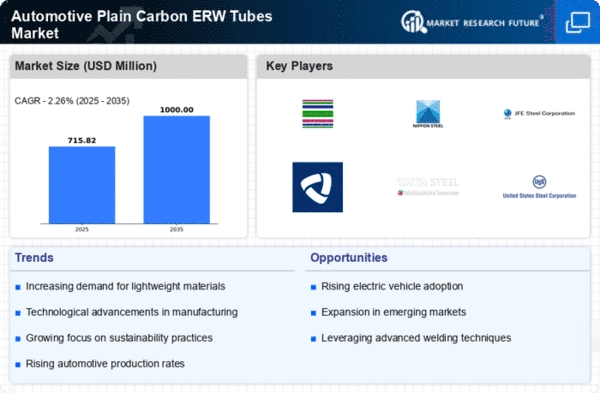
As per MRFR analysis, the Automotive Plain Carbon ERW Tubes Market Size was estimated at 700.0 USD Million in 2024. The Automotive Plain Carbon ERW Tubes industry is projected to grow from 800.0 in 2025 to 1000.0 by 2035, exhibiting a compound annual growth rate (CAGR) of 2.26 during the forecast period 2025 - 2035.

Key Market Trends & Highlights

The Automotive Plain Carbon ERW Tubes Market is poised for growth driven by sustainability and technological advancements.

  • North America remains the largest market for automotive plain carbon ERW tubes, reflecting robust automotive production. Asia-Pacific is identified as the fastest-growing region, driven by increasing vehicle demand and production capabilities. Exhaust systems dominate the market, while suspension systems are emerging as the fastest-growing segment due to evolving vehicle designs. Rising demand for lightweight materials and a focus on vehicle safety are key drivers propelling market expansion.

Market Size & Forecast

2024 Market Size 700.0 (USD Million)
2035 Market Size 1000.0 (USD Million)
CAGR (2025 - 2035) 2.26%
Largest Regional Market Share in 2024 North America

Major Players

Tenaris (AR), Nippon Steel Corporation (JP), JFE Steel Corporation (JP), Severstal (RU), Tata Steel (IN), United States Steel Corporation (US), Steel Authority of India Limited (IN), Thyssenkrupp AG (DE), ArcelorMittal (LU)

Market Trends

The Automotive Plain Carbon ERW Tubes Market is currently experiencing a dynamic phase characterized by evolving consumer preferences and technological advancements. The demand for lightweight and durable materials in automotive applications is driving manufacturers to innovate and enhance their product offerings.

This market segment is witnessing a shift towards higher quality standards, as automotive manufacturers increasingly prioritize safety and performance. Additionally, the growing emphasis on sustainability is prompting companies to adopt eco-friendly practices in their production processes, which may influence the overall market landscape. Furthermore, the competitive environment within the Automotive Plain Carbon ERW Tubes Market is intensifying, as new entrants and established players alike strive to capture market share.

Strategic partnerships and collaborations are becoming more prevalent, as companies seek to leverage each other's strengths and capabilities. The integration of advanced manufacturing technologies, such as automation and digitalization, is likely to enhance operational efficiency and reduce production costs. As the market continues to evolve, stakeholders must remain vigilant and adaptable to emerging trends and consumer demands.

Sustainability Initiatives

The Automotive Plain Carbon ERW Tubes Market is increasingly influenced by sustainability initiatives. Manufacturers are adopting eco-friendly practices, such as utilizing recycled materials and reducing waste during production. This trend reflects a broader commitment to environmental responsibility, which resonates with consumers and regulatory bodies alike.

Technological Advancements

Technological advancements are reshaping the Automotive Plain Carbon ERW Tubes Market. Innovations in manufacturing processes, such as automation and precision engineering, are enhancing product quality and efficiency. These developments enable manufacturers to meet the rising demand for high-performance components in the automotive sector.

Customization and Flexibility

Customization and flexibility are becoming key drivers in the Automotive Plain Carbon ERW Tubes Market. As automotive manufacturers seek to differentiate their products, the demand for tailored solutions is growing. This trend encourages suppliers to offer a wider range of sizes, shapes, and specifications to meet diverse customer needs.

Automotive Plain Carbon ERW Tubes Market Market Drivers

Market Growth Projections

The Global Automotive Plain Carbon ERW Tubes Market Industry is projected to grow from 5.82 USD Billion in 2024 to 9.16 USD Billion by 2035, reflecting a compound annual growth rate of 4.21% from 2025 to 2035. This growth trajectory highlights the increasing demand for automotive components that meet stringent performance and safety standards. The market dynamics are influenced by various factors, including technological advancements, rising automotive production rates, and the expansion of electric vehicles. These elements collectively contribute to a favorable environment for the growth of plain carbon ERW tubes in the automotive sector.

Rising Automotive Production Rates

The Global Automotive Plain Carbon ERW Tubes Market Industry is closely linked to the rising production rates of automobiles worldwide. As emerging economies expand their automotive manufacturing capabilities, the demand for ERW tubes is expected to surge. Countries such as India and China are ramping up production to meet both domestic and international market needs. This increase in automotive production is likely to drive the market value significantly, with projections indicating a compound annual growth rate of 4.21% from 2025 to 2035. Such growth reflects the industry's adaptability to changing consumer preferences and the need for efficient supply chains.

Expansion of Electric Vehicle Market

The expansion of the electric vehicle market is poised to significantly impact the Global Automotive Plain Carbon ERW Tubes Market Industry. As more manufacturers pivot towards electric vehicles, the demand for lightweight and durable materials is increasing. Plain carbon ERW tubes are well-suited for electric vehicle applications due to their structural integrity and weight advantages. This shift towards electrification is likely to create new opportunities for growth in the market, as manufacturers seek to optimize vehicle designs for efficiency. The anticipated growth trajectory suggests that the market will continue to evolve in response to the changing landscape of the automotive industry.

Growing Demand for Lightweight Materials

The Global Automotive Plain Carbon ERW Tubes Market Industry is experiencing an upsurge in demand for lightweight materials, driven by the automotive sector's focus on enhancing fuel efficiency and reducing emissions. Manufacturers are increasingly adopting plain carbon ERW tubes due to their favorable strength-to-weight ratio, which contributes to overall vehicle performance. As regulations tighten globally, the automotive industry is projected to prioritize materials that support sustainability goals. This trend is expected to bolster the market, with a projected value of 5.82 USD Billion in 2024, indicating a robust growth trajectory as manufacturers seek to innovate and comply with environmental standards.

Technological Advancements in Manufacturing

Technological advancements in manufacturing processes are significantly influencing the Global Automotive Plain Carbon ERW Tubes Market Industry. Innovations such as automated welding techniques and precision machining are enhancing the production efficiency and quality of ERW tubes. These advancements not only reduce production costs but also improve the overall performance of automotive components. As manufacturers adopt these technologies, they are likely to see increased competitiveness in the market. The anticipated growth to 9.16 USD Billion by 2035 suggests that these technological improvements will play a crucial role in meeting the rising demand for high-quality automotive components.

Increasing Focus on Vehicle Safety Standards

The Global Automotive Plain Carbon ERW Tubes Market Industry is also benefiting from the increasing focus on vehicle safety standards. Governments worldwide are implementing stricter regulations to enhance vehicle safety, which necessitates the use of high-quality materials in automotive manufacturing. Plain carbon ERW tubes, known for their durability and strength, are becoming essential components in the production of safer vehicles. This trend is likely to drive demand as manufacturers strive to comply with safety regulations, thereby contributing to the market's growth. The emphasis on safety is expected to sustain the industry's expansion in the coming years.


Market Segment Insights

By Application: Exhaust Systems (Largest) vs. Suspension Systems (Fastest-Growing)

The Automotive Plain Carbon ERW Tubes Market exhibits a diverse application landscape, with Exhaust Systems holding a significant market share. This segment plays a crucial role in the overall performance and emission control of vehicles, effectively capturing the largest share among applications. In contrast, Chassis Components and Fuel Lines follow closely, contributing to the steadily expanding role these tubes play across various automotive configurations. The competitive landscape showcases how integral these applications are to maintaining efficiency and safety in modern vehicles. Growth trends indicate that the demand for Suspension Systems is on the rise, driven by advancements in automotive technology and the increasing focus on enhancing vehicle performance and ride comfort. As manufacturers aim to comply with stricter emission regulations, the need for efficient Exhaust Systems solidifies their market presence, while the emerging trend of lightweight materials in Suspension design fuels its swift market growth. This dual influence creates a dynamic environment within the Automotive Plain Carbon ERW Tubes segment.

Exhaust Systems (Dominant) vs. Fuel Lines (Emerging)

In the Automotive Plain Carbon ERW Tubes Market, Exhaust Systems dominate due to their pivotal role in vehicle performance, ensuring optimal exhaust flow and emission reduction. This segment's established presence stems from consistent technological advancements aimed at enhancing fuel efficiency. Conversely, Fuel Lines, while emerging, are rapidly gaining importance driven by the shift towards electric vehicles and innovative fuel systems. These tubes must withstand various pressures, making them a critical component in ensuring safety and efficiency. The differentiating factors include material composition and adaptability to new fuel technologies, signaling a transformative shift in consumer preferences and regulatory requirements influencing both segments.

By End Use: Passenger Vehicles (Largest) vs. Commercial Vehicles (Fastest-Growing)

In the Automotive Plain Carbon ERW Tubes Market, the distribution of market share is heavily tilted towards passenger vehicles, which capture the largest section of the market due to their high demand and usage. This segment is supported by the increasing number of vehicle registrations and a growing consumer preference for personal mobility solutions. Conversely, commercial vehicles have been emerging as a significant contributor, reflecting a competitive market that addresses the rising <a href="https://www.marketresearchfuture.com/reports/fuel-cell-commercial-vehicle-market-32271">commercial transportation</a> needs globally. Growth trends indicate that while passenger vehicles are currently the dominant segment, commercial vehicles are showcasing considerable expansion potential. Factors such as rising logistics and freight transport, along with increasing urbanization, are contributing to the rapid growth of this segment. Additionally, the advancement of technology and investment in infrastructure is driving the demand for commercial vehicles, making it a focal point for manufacturers and investors alike.

Passenger Vehicles (Dominant) vs. Commercial Vehicles (Emerging)

Passenger vehicles are characterized by their substantial market penetration due to consumer preferences for personal and family transportation, thus accounting for a significant share of the Automotive Plain Carbon ERW Tubes Market. These vehicles typically require high-quality and durable materials for safety and performance, which enhances the demand for ERW tubes. On the other hand, commercial vehicles, though currently smaller in market size, exhibit emerging potential driven by growing e-commerce and delivery services. As industries seek to enhance their fleets for logistics operations, the demand for lightweight yet strong automotive components, such as ERW tubes, is expected to rise. This segment's evolution towards efficiency and sustainability will pave the way for innovative solutions in the automotive sector.

By Manufacturing Process: Electric Resistance Welding (Largest) vs. Seamless Tubing (Fastest-Growing)

In the Automotive Plain Carbon ERW Tubes Market, the manufacturing processes are pivotal in determining product quality and market acceptance. Electric Resistance Welding (ERW) leads the market, recognized for its efficiency and cost-effectiveness. Seamless tubing, although smaller in market share, has exhibited remarkable potential for growth, appealing to niche applications where strength and reliability are paramount. Hot rolled tubing, while a traditional choice, is gradually losing ground as newer methods gain traction. Analyzing growth trends, the push for lightweight and durable materials is driving innovation in manufacturing processes. Electric Resistance Welding remains dominant due to its scalability and adaptability to various automotive applications. Seamless tubing is gaining momentum, particularly in high-stress environments, thus positioning it as a key player for future growth in the industry, driven by advancements in technology and increasing demand for higher-quality materials.

Manufacturing Process: Electric Resistance Welding (Dominant) vs. Seamless Tubing (Emerging)

The Electric Resistance Welding (ERW) process exemplifies dominance in the automotive plain carbon ERW tubes market, owing to its robust production capabilities and cost efficiency. This method offers a reliable technique for producing consistent quality tubes, which are vital for automotive structures. Its widespread acceptance stems from its balance of performance and price, making it a staple for various applications. Conversely, Seamless Tubing is emerging as a significant alternative, particularly appreciated for its enhanced strength and reliability in critical applications. Its manufacturing process allows for creating tubes without seams, thus minimizing the risk of failure under pressure. The growing automotive emphasis on safety and performance is propelling seamless tubing into a more prominent market position, fostering ongoing innovation.

By Material Type: Low Carbon Steel (Largest) vs. High Carbon Steel (Fastest-Growing)

In the Automotive Plain Carbon ERW Tubes Market, Low Carbon Steel holds the largest market share due to its favorable properties such as high ductility and weldability, which make it the preferred choice for automotive applications. Medium Carbon Steel also plays a significant role, displaying moderate demand based on its balanced mechanical properties. High Carbon Steel, while a smaller segment, is gaining traction for its superior strength and durability, making it increasingly sought after in performance-oriented automotive applications.

Low Carbon Steel (Dominant) vs. High Carbon Steel (Emerging)

Low Carbon Steel is the dominant segment in the Automotive Plain Carbon ERW Tubes Market, offering excellent formability and cost-effectiveness, which is crucial for mass production in the automotive industry. It is mainly used in applications where flexibility and ease of fabrication are paramount. In contrast, High Carbon Steel is emerging as a critical player in the market due to its enhanced strength and hardness. Producers are investing more in High Carbon Steel ERW tubes to meet the growing demand for lightweight yet high-strength materials in specialized automotive applications, ultimately paving the way for technological advancements in this sector.

By Thickness: Thin Wall (Largest) vs. Medium Wall (Fastest-Growing)

The Automotive Plain Carbon ERW Tubes Market is characterized by a diverse thickness segmentation, with Thin Wall tubes dominating the market share. This segment caters primarily to lightweight automotive applications, giving it a competitive edge due to the increasing demand for fuel-efficient vehicles. Medium Wall tubes are emerging as a vital segment, gaining traction owing to their versatility and balanced performance metrics, which appeal to a broader range of automotive manufacturers. Thick Wall tubes, while crucial for structural integrity, represent a smaller share as the industry shifts towards lighter materials.

Thickness: Thin Wall (Dominant) vs. Medium Wall (Emerging)

Thin Wall automotive tubes are designed to provide maximum strength while minimizing weight, making them essential for modern vehicles aiming for better fuel efficiency and performance. They have become the dominant choice among manufacturers due to their cost-effectiveness and superior mechanical properties. In contrast, Medium Wall tubes are seen as an emerging market segment, offering a compromise between weight and strength, which caters to a variety of automotive applications. These tubes are increasingly favored for their ability to handle medium pressure environments and are being adopted in innovative vehicle designs, thus expanding their market presence.

Get more detailed insights about Automotive Plain Carbon ERW Tubes Market Research Report - Global Forecast till 2035

Regional Insights

North America : Market Leader in ERW Tubes

North America is poised to maintain its leadership in the Automotive Plain Carbon ERW Tubes Market, holding a significant market share of 350.0. The region's growth is driven by robust automotive production, increasing demand for lightweight materials, and stringent regulations promoting fuel efficiency. Additionally, advancements in manufacturing technologies are enhancing production capabilities, further fueling market expansion. The United States stands as the primary contributor, with major players like United States Steel Corporation and Tenaris leading the charge. The competitive landscape is characterized by innovation and strategic partnerships among key manufacturers. The presence of established automotive giants also drives demand for high-quality ERW tubes, ensuring a thriving market environment.

Europe : Emerging Market Dynamics

Europe's Automotive Plain Carbon ERW Tubes Market is projected to grow, with a market size of 200.0. The region benefits from a strong automotive sector, driven by increasing consumer demand for electric vehicles and stringent environmental regulations. The European Union's focus on sustainability and carbon neutrality is catalyzing investments in advanced manufacturing processes, which are expected to enhance market growth. Leading countries such as Germany and France are at the forefront, with key players like Thyssenkrupp AG and ArcelorMittal actively participating in the market. The competitive landscape is marked by innovation and a shift towards sustainable practices, positioning Europe as a dynamic player in The Automotive Plain Carbon ERW Tubes. "The European automotive industry is committed to reducing emissions and enhancing efficiency through innovative materials and technologies."

Asia-Pacific : Rapid Growth and Innovation

The Asia-Pacific region is witnessing rapid growth in the Automotive Plain Carbon ERW Tubes Market, with a market size of 130.0. Key growth drivers include increasing automotive production, rising disposable incomes, and a growing focus on fuel efficiency. Additionally, government initiatives aimed at boosting the manufacturing sector are expected to further stimulate demand for ERW tubes in the automotive industry. Countries like Japan and India are leading the charge, with major players such as Nippon Steel Corporation and Tata Steel making significant contributions. The competitive landscape is characterized by a mix of established manufacturers and emerging players, fostering innovation and enhancing product offerings. The region's focus on technological advancements is set to drive future growth in the market.

Middle East and Africa : Untapped Market Potential

The Middle East and Africa region presents untapped potential in the Automotive Plain Carbon ERW Tubes Market, with a market size of 20.0. The growth is primarily driven by increasing automotive manufacturing and infrastructure development. Additionally, government initiatives aimed at diversifying economies and promoting local manufacturing are expected to enhance market opportunities in the automotive sector. Countries like South Africa and the UAE are emerging as key players in the market, with local manufacturers beginning to establish a foothold. The competitive landscape is evolving, with both local and international players vying for market share. As the region continues to develop its automotive industry, the demand for high-quality ERW tubes is anticipated to rise significantly.

Key Players and Competitive Insights

The Automotive Plain Carbon ERW Tubes Market is currently characterized by a competitive landscape that is both dynamic and multifaceted. Key growth drivers include the increasing demand for lightweight materials in automotive manufacturing, coupled with stringent regulations aimed at reducing emissions. Major players such as Tenaris (Argentina), Nippon Steel Corporation (Japan), and Tata Steel (India) are strategically positioning themselves through innovation and regional expansion. For instance, Tenaris (Argentina) has focused on enhancing its production capabilities to meet the rising demand for high-strength tubes, while Nippon Steel Corporation (Japan) emphasizes technological advancements in manufacturing processes to improve efficiency and reduce costs. These strategies collectively shape a competitive environment that is increasingly focused on sustainability and technological integration.
In terms of business tactics, companies are increasingly localizing manufacturing to reduce lead times and optimize supply chains. The market structure appears moderately fragmented, with several key players exerting influence over specific regions. This fragmentation allows for a diverse range of offerings, yet the collective strength of major companies like JFE Steel Corporation (Japan) and Severstal (Russia) ensures that competition remains robust. The interplay between localized production and The Automotive Plain Carbon ERW Tubes's competitive dynamics moving forward.
In November 2025, Tata Steel (India) announced a strategic partnership with a leading automotive manufacturer to develop advanced lightweight ERW tubes aimed at enhancing vehicle performance. This collaboration is significant as it not only aligns with the growing trend towards lightweight materials but also positions Tata Steel as a frontrunner in innovation within the automotive sector. The partnership is expected to yield products that meet the stringent performance standards required by modern vehicles, thereby enhancing Tata Steel's market share.
In October 2025, Nippon Steel Corporation (Japan) unveiled a new production line dedicated to the manufacturing of high-strength ERW tubes. This investment reflects the company's commitment to meeting the evolving needs of the automotive industry, particularly in terms of safety and efficiency. By enhancing its production capabilities, Nippon Steel is likely to strengthen its competitive position and respond effectively to the increasing demand for advanced materials.
In September 2025, JFE Steel Corporation (Japan) launched a sustainability initiative aimed at reducing carbon emissions in its manufacturing processes. This initiative is particularly relevant in the context of global efforts to combat climate change and aligns with the automotive industry's shift towards more sustainable practices. By prioritizing sustainability, JFE Steel is not only enhancing its corporate responsibility but also appealing to environmentally conscious consumers and manufacturers.
As of December 2025, current competitive trends in the Automotive Plain Carbon ERW Tubes Market are increasingly defined by digitalization, sustainability, and the integration of AI technologies. Strategic alliances are becoming more prevalent, as companies recognize the need to collaborate in order to innovate and meet market demands. The competitive differentiation is likely to evolve from traditional price-based competition to a focus on innovation, technology, and supply chain reliability. This shift suggests that companies that invest in advanced technologies and sustainable practices will be better positioned to thrive in the future.

Key Companies in the Automotive Plain Carbon ERW Tubes Market include

Industry Developments

Future Outlook

Automotive Plain Carbon ERW Tubes Market Future Outlook

The Automotive Plain Carbon ERW Tubes Market is projected to grow at a 2.26% CAGR from 2025 to 2035, driven by increasing automotive production and demand for lightweight materials.

New opportunities lie in:

  • Expansion into electric vehicle (EV) component manufacturing
  • Development of high-strength, lightweight tube variants
  • Strategic partnerships with automotive OEMs for supply chain integration

By 2035, the market is expected to achieve robust growth, reflecting evolving automotive industry demands.

Market Segmentation

Automotive Plain Carbon ERW Tubes Market End Use Outlook

  • Passenger Vehicles
  • Commercial Vehicles
  • Two-Wheelers

Automotive Plain Carbon ERW Tubes Market Thickness Outlook

  • Thin Wall
  • Medium Wall
  • Thick Wall

Automotive Plain Carbon ERW Tubes Market Application Outlook

  • Exhaust Systems
  • Chassis Components
  • Suspension Systems
  • Fuel Lines

Automotive Plain Carbon ERW Tubes Market Material Type Outlook

  • Low Carbon Steel
  • Medium Carbon Steel
  • High Carbon Steel

Automotive Plain Carbon ERW Tubes Market Manufacturing Process Outlook

  • Electric Resistance Welding
  • Seamless Tubing
  • Hot Rolled Tubing

Report Scope

MARKET SIZE 2024 700.0(USD Million)
MARKET SIZE 2025 800.0(USD Million)
MARKET SIZE 2035 1000.0(USD Million)
COMPOUND ANNUAL GROWTH RATE (CAGR) 2.26% (2025 - 2035)
REPORT COVERAGE Revenue Forecast, Competitive Landscape, Growth Factors, and Trends
BASE YEAR 2024
Market Forecast Period 2025 - 2035
Historical Data 2019 - 2024
Market Forecast Units USD Million
Key Companies Profiled Tenaris (AR), Nippon Steel Corporation (JP), JFE Steel Corporation (JP), Severstal (RU), Tata Steel (IN), United States Steel Corporation (US), Steel Authority of India Limited (IN), Thyssenkrupp AG (DE), ArcelorMittal (LU)
Segments Covered Application, End Use, Manufacturing Process, Material Type, Thickness
Key Market Opportunities Growing demand for lightweight materials in automotive manufacturing enhances opportunities in the Automotive Plain Carbon ERW Tubes Market.
Key Market Dynamics Rising demand for lightweight materials drives innovation in Automotive Plain Carbon Electric Resistance Welded Tubes manufacturing.
Countries Covered North America, Europe, APAC, South America, MEA

FAQs

What is the expected CAGR for automotive plain carbon RW tubes market?

The automotive plain carbon RW tubes market is projected to mark 4.2% CAGR.

What is the primary driver of the automotive plain carbon RW tubes market?

Increasing expansion of the automotive aftermarket is prognosticated to impact the automotive plain carbon RW tubes market favorably.

What factor can pose a challenge to market players?

Increasing price of raw materials can restrict market growth in the near future.

Which region holds the largest share?

APAC holds the largest share of the automotive plain carbon RW tubes market.

By application, what are the segments of the automotive plain carbon RW tubes market?

The application based segments of the automotive plain carbon RW tubes market are frames, exhaust, suspension, and others.

On the basis of vehicle type, what are the segments of the automotive plain carbon RW tubes market?

The segments of the automotive plain carbon RW tubes market on the basis of vehicle type are passenger car and commercial vehicle.

Who are the key participants of the automotive plain carbon RW tubes market?

JFE Steel Corporation (Japan), Innoventive Industries Limited (India), AK Steel Corporation (US), Hyundai Steel (South Korea), Tata Precision Tubes (India), Nippon Steel Corporation (Japan), Jindal Pipes Ltd (India), Tubular Steel Inc. (US), ArcelorMittal (Luxembourg), and Rexal Tubes (India).

  1. SECTION I: EXECUTIVE SUMMARY AND KEY HIGHLIGHTS
    1. | 1.1 EXECUTIVE SUMMARY
  2. SECTION II: SCOPING, METHODOLOGY AND MARKET STRUCTURE
    1. | 2.1 MARKET INTRODUCTION
    2. | 2.2 RESEARCH METHODOLOGY
  3. SECTION III: QUALITATIVE ANALYSIS
    1. | 3.1 MARKET DYNAMICS
    2. | 3.2 MARKET FACTOR ANALYSIS
  4. SECTION IV: QUANTITATIVE ANALYSIS
    1. | 4.1 Automobile, BY Application (USD Million)
    2. | 4.2 Automobile, BY End Use (USD Million)
    3. | 4.3 Automobile, BY Manufacturing Process (USD Million)
    4. | 4.4 Automobile, BY Material Type (USD Million)
    5. | 4.5 Automobile, BY Thickness (USD Million)
    6. | 4.6 Automobile, BY Region (USD Million)
  5. SECTION V: COMPETITIVE ANALYSIS
    1. | 5.1 Competitive Landscape
    2. | 5.2 Company Profiles
    3. | 5.3 Appendix

Automotive Plain Carbon ERW Tubes Market Segmentation

Market Segmentation Overview

  • Detailed segmentation data will be available in the full report
  • Comprehensive analysis by multiple parameters
  • Regional and country-level breakdowns
  • Market size forecasts by segment
Infographic

Free Sample Request

Kindly complete the form below to receive a free sample of this Report

Get Free Sample

Customer Strories

Compare Licence

×
Features License Type
Single User Multiuser License Enterprise User
Price $4,950 $5,950 $7,250
Maximum User Access Limit 1 User Upto 10 Users Unrestricted Access Throughout the Organization
Free Customization
Direct Access to Analyst
Deliverable Format
Platform Access
Discount on Next Purchase 10% 15% 15%
Printable Versions