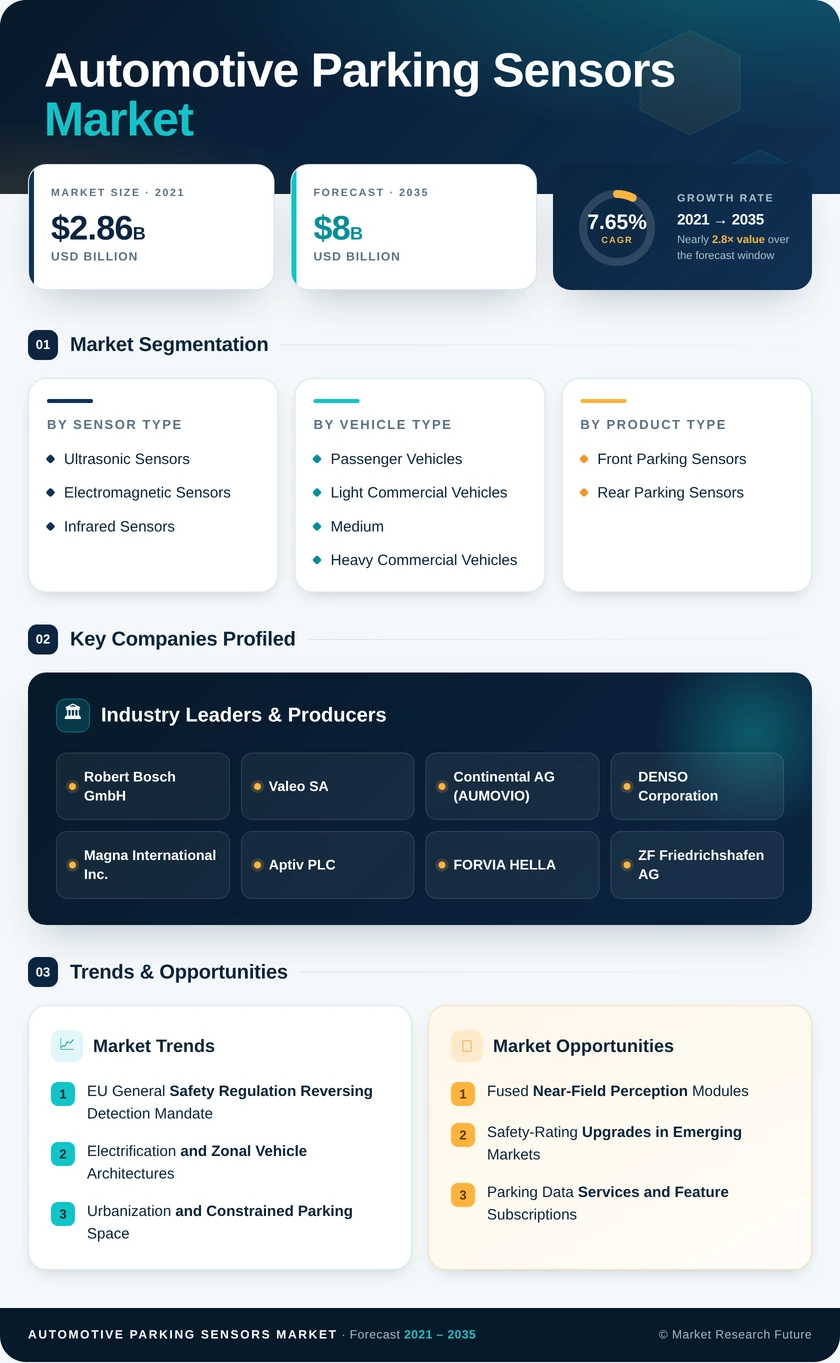
Automotive Parking Sensors Market (2026 - 2035)

ID: MRFR/AT/5985-HCR 100 Pages Shubham Munde Last Updated: October 16, 2026
Automotive Parking Sensors Market Research Report By Sensor Type (Ultrasonic Sensors, Electromagnetic Sensors, Infrared Sensors), By Vehicle Type (Passenger Vehicles, Light Commercial Vehicles, Medium and Heavy Commercial Vehicles), By Product Type (Front Parking Sensors, Rear Parking Sensors), By Distribution Channel (OEM, Aftermarket) - Forecast to 2035
Automotive Parking Sensors Market
Market Size
Forecast Period2026-2035
CAGR (2026-2035)7.65%
2025 Market SizeUSD 3.83 Billion
2035 Market SizeUSD 8.00 billion
Key Players
Robert Bosch GmbH
Valeo SA
Continental AG
DENSO Corporation
Magna International Inc.
Aptiv PLC
Opportunities
  • Fused Near-Field Perception Modules
  • Safety-Rating Upgrades in Emerging Markets
  • Parking Data Services and Feature Subscriptions
  1. 1 Market Summary | |
  2. 2 Key Report Takeaways | |
    1. 2.1 By Sensor Type | |
    2. 2.2 By Vehicle Type | |
    3. 2.3 By Product Type | |
    4. 2.4 By Distribution Channel | |
    5. 2.5 By Region | |
  3. 3 Market Size and Forecast (2021–2035) | |
    1. 3.1 Historical Market Size (2021–2025) | |
    2. 3.2 Forecast Market Size (2026–2035) | |
    3. 3.3 Year-over-Year Growth Analysis | |
  4. 4 Driver Impact Analysis | |
    1. 4.1 EU General Safety Regulation Reversing Detection Mandate | |
    2. 4.2 Electrification and Zonal Vehicle Architectures | |
    3. 4.3 Urbanization and Constrained Parking Space | |
    4. 4.4 NCAP Safety-Assist Scoring in Emerging Markets | |
    5. 4.5 Backover Crash Prevention in North America | |
    6. 4.6 Electrification of Last-Mile Light Commercial Fleets | |
  5. 5 Restraints Impact Analysis | |
    1. 5.1 Camera-Only Perception Strategies | |
    2. 5.2 Technology-Neutral Compliance Rules | |
    3. 5.3 Semiconductor Supply Volatility | |
    4. 5.4 Repair and Recalibration Costs | |
    5. 5.5 Cost Sensitivity in Entry-Level Vehicles | |
  6. 6 Opportunities | |
    1. 6.1 Fused Near-Field Perception Modules | |
    2. 6.2 Safety-Rating Upgrades in Emerging Markets | |
    3. 6.3 Parking Data Services and Feature Subscriptions | |
    4. 6.4 Automated Valet Parking Infrastructure | |
    5. 6.5 Fleet Retrofit Programs for Electric Vans | |
  7. 7 Regional Market Share and Country-Level Analysis | |
    1. 7.1 North America | | |
      1. 7.1.1 US | | |
      2. 7.1.2 Canada | | |
      3. 7.1.3 Mexico | |
    2. 7.2 Europe | | |
      1. 7.2.1 Germany | | |
      2. 7.2.2 UK | | |
      3. 7.2.3 France | | |
      4. 7.2.4 Italy | | |
      5. 7.2.5 Spain | | |
      6. 7.2.6 Nordic Countries | | |
      7. 7.2.7 Russia | | |
      8. 7.2.8 Rest of Europe | |
    3. 7.3 Asia-Pacific | | |
      1. 7.3.1 China | | |
      2. 7.3.2 India | | |
      3. 7.3.3 Japan | | |
      4. 7.3.4 South Korea | | |
      5. 7.3.5 ASEAN | | |
      6. 7.3.6 Rest of Asia-Pacific | |
    4. 7.4 South America | | |
      1. 7.4.1 Brazil | | |
      2. 7.4.2 Argentina | | |
      3. 7.4.3 Rest of South America | |
    5. 7.5 Middle East & Africa | | |
      1. 7.5.1 Saudi Arabia | | |
      2. 7.5.2 UAE | | |
      3. 7.5.3 South Africa | | |
      4. 7.5.4 Egypt | | |
      5. 7.5.5 Rest of Middle East & Africa | |
  8. 8 Future Outlook (2026–2035) | |
    1. 8.1 AI Perception and Automated Parking | |
    2. 8.2 Software-Defined Vehicles and Platform Economics | |
    3. 8.3 Electrification Supercycle | |
    4. 8.4 Sustainability and Materials Compliance | |
  9. 9 Segmentation Analysis | |
    1. 9.1 By Sensor Type | | |
      1. 9.1.1 Ultrasonic Sensors | | |
      2. 9.1.2 Electromagnetic Sensors | | |
      3. 9.1.3 Infrared Sensors | |
    2. 9.2 By Vehicle Type | | |
      1. 9.2.1 Passenger Vehicles | | |
      2. 9.2.2 Light Commercial Vehicles | | |
      3. 9.2.3 Medium and Heavy Commercial Vehicles | |
    3. 9.3 By Product Type | | |
      1. 9.3.1 Front Parking Sensors | | |
      2. 9.3.2 Rear Parking Sensors | |
    4. 9.4 By Distribution Channel | | |
      1. 9.4.1 OEM | | |
      2. 9.4.2 Aftermarket | |
  10. 10 Competitive Landscape | |
    1. 10.1 Market Concentration Analysis | |
    2. 10.2 Competitive Benchmarking Matrix | |
    3. 10.3 Company Profiles | | |
      1. 10.3.1 Robert Bosch GmbH | | |
      2. 10.3.2 Valeo SA | | |
      3. 10.3.3 Continental AG (AUMOVIO) | | |
      4. 10.3.4 DENSO Corporation | | |
      5. 10.3.5 Magna International Inc. | | |
      6. 10.3.6 Aptiv PLC | | |
      7. 10.3.7 FORVIA HELLA | | |
      8. 10.3.8 ZF Friedrichshafen AG | | |
      9. 10.3.9 Murata Manufacturing Co., Ltd. | | |
      10. 10.3.10 Texas Instruments Incorporated | |
  11. 11 Recent News & Developments | |
  12. 12 Report Scope and Methodology | |
  13. 13 Detailed Sources and Citations | |
  14. 14 Frequently Asked Questions (FAQs) | | LIST OF TABLES | |
  15. TABLE 1 Report Summary Parameters, 2025–2035 | |
  16. TABLE 2 Global Market Size & Forecast, by Revenue (USD Billion), 2021–2035 | |
  17. TABLE 3 Driver Impact Analysis, 2026–2035 | |
  18. TABLE 4 Restraints Impact Analysis, 2026–2035 | |
  19. TABLE 5 Regional Summary, by Region, 2025 | |
  20. TABLE 6 North America Country-Level Analysis, 2025–2035 | |
  21. TABLE 7 Europe Country-Level Analysis, 2025–2035 | |
  22. TABLE 8 Asia-Pacific Country-Level Analysis, 2025–2035 | |
  23. TABLE 9 South America Country-Level Analysis, 2025–2035 | |
  24. TABLE 10 Middle East & Africa Country-Level Analysis, 2025–2035 | |
  25. TABLE 11 Market Segmentation, by Sensor Type, 2025–2035 | |
  26. TABLE 12 Market Segmentation, by Vehicle Type, 2025–2035 | |
  27. TABLE 13 Market Segmentation, by Product Type, 2025–2035 | |
  28. TABLE 14 Market Segmentation, by Distribution Channel, 2025–2035 | |
  29. TABLE 15 Competitive Benchmarking Matrix, 2025 | |
  30. TABLE 16 Report Scope and Methodology | |
  31. TABLE 17 Detailed Sources and Citations | |
  32. TABLE 18 Segmentation Quick Reference | |
  33. TABLE 19 Sensor Type Sub-Segment Trends | |
  34. TABLE 20 Vehicle Type Sub-Segment Trends | |
  35. TABLE 21 Product Type Sub-Segment Trends | |
  36. TABLE 22 Distribution Channel Sub-Segment Trends | | LIST OF FIGURES | |
  37. FIGURE 1 Market Dynamics Overview — Drivers, Restraints, and Opportunities | |
  38. FIGURE 2 Industry Value Chain Analysis | |
  39. FIGURE 3 Porter's Five Forces Analysis | |
  40. FIGURE 4 Global Market Size Trend (USD Billion), 2021–2035 | |
  41. FIGURE 5 Year-over-Year Growth Rate, 2021–2035 | |
  42. FIGURE 6 Market Share by Sensor Type, 2025 | |
  43. FIGURE 7 Market Share by Vehicle Type, 2025 | |
  44. FIGURE 8 Market Share by Product Type, 2025 | |
  45. FIGURE 9 Market Share by Distribution Channel, 2025 | |
  46. FIGURE 10 Regional Market Share, 2025 | |
  47. FIGURE 11 Regional CAGR Comparison, 2026–2035 | |
  48. FIGURE 12 Competitive Landscape — Estimated Revenue Share Ranges, 2025 | |
  49. FIGURE 13 Competitive Positioning Matrix

Segmentation Quick Reference

DimensionSub-SegmentsDominant SegmentFastest Growing Segment
By Sensor TypeUltrasonic Sensors, Electromagnetic Sensors, Infrared SensorsUltrasonic Sensors (74.3% share)Infrared Sensors (9.7% CAGR)
By Vehicle TypePassenger Vehicles, Light Commercial Vehicles, Medium and Heavy Commercial VehiclesPassenger Vehicles (77.7% share)Light Commercial Vehicles (8.9% CAGR)
By Product TypeFront Parking Sensors, Rear Parking SensorsRear Parking Sensors (60.1% share)Front Parking Sensors (8.4% CAGR)
By Distribution ChannelOEM, AftermarketOEM (78.5% share)Aftermarket (8.6% CAGR)
By RegionNorth America, Europe, Asia-Pacific, South America, Middle East & AfricaEurope (34.5% share (2025))Asia-Pacific (9.1% CAGR (2026–2035))


Market Segmentation Overview

By Sensor Type

Sub-SegmentKey Trend
Ultrasonic SensorsMEMS designs extend range while shrinking package size
Electromagnetic SensorsNo-drill installation sustains aftermarket demand.
Infrared SensorsFalling imager prices enable dual-mode corner modules.


Ultrasonic Sensors lead with a 74.3% share because standardized digital interfaces and high production volumes keep unit costs low enough for entry-level fitment. Infrared Sensors grow fastest at a 9.7% CAGR, as Tier-1 suppliers pair thermopile arrays with ultrasonic transducers to improve low-light detection. Electromagnetic Sensors hold a niche with retrofit buyers who want to avoid drilling painted bumpers.

By Vehicle Type

Sub-SegmentKey Trend
Passenger VehiclesRear sensors standard on entry models, 360-degree suites on premium trims
Light Commercial VehiclesElectric delivery vans raise sensor count per vehicle.
Medium and Heavy Commercial VehiclesBumper-step pods reduce loading-dock collisions.


Passenger Vehicles dominate with a 77.7% share, reflecting standard rear-sensor fitment across compact and mid-size cars. Light Commercial Vehicles grow fastest at an 8.9% CAGR because electric vans operating under European CO₂ targets need full-perimeter coverage for curbside deliveries. Medium and Heavy Commercial Vehicles adopt more slowly, with purchases driven by fleet downtime costs rather than regulation.

By Product Type

Sub-SegmentKey Trend
Front Parking SensorsCamera fusion enables curb-height estimation
Rear Parking SensorsStandard fitment on A- and B-segment hatchbacks


Rear Parking Sensors hold a 60.1% share because reversing collisions remain the most frequent low-speed insurance claim, and automakers fit them even on base trims. Front Parking Sensors grow faster at an 8.4% CAGR as congested cities demand tighter curb maneuvers. Automated valet features are also moving down into mid-segment models.

By Distribution Channel

Sub-SegmentKey Trend
OEMMulti-year Tier-1 contracts tied to full-vehicle validation
AftermarketPlug-and-play harnesses lower installation barriers.


The OEM channel leads with a 78.5% share because regulatory compliance and full-vehicle validation push automakers toward factory-fit sensor systems from established Tier-1 suppliers. The Aftermarket grows faster at an 8.6% CAGR, driven by collision-damage replacement on an aging fleet and retrofit demand from commercial operators. Professional installers are absorbing the work that growing electronic complexity has taken away from do-it-yourself buyers.




Download PDF ×

We do not share your information with anyone. However, we may send you emails based on your report interest from time to time. You may contact us at any time to opt-out.