Automotive Operating System Market (2026 - 2035)

ID: MRFR/AT/10375-HCR
128 Pages
Shubham Munde
Last Updated: July 23, 2026
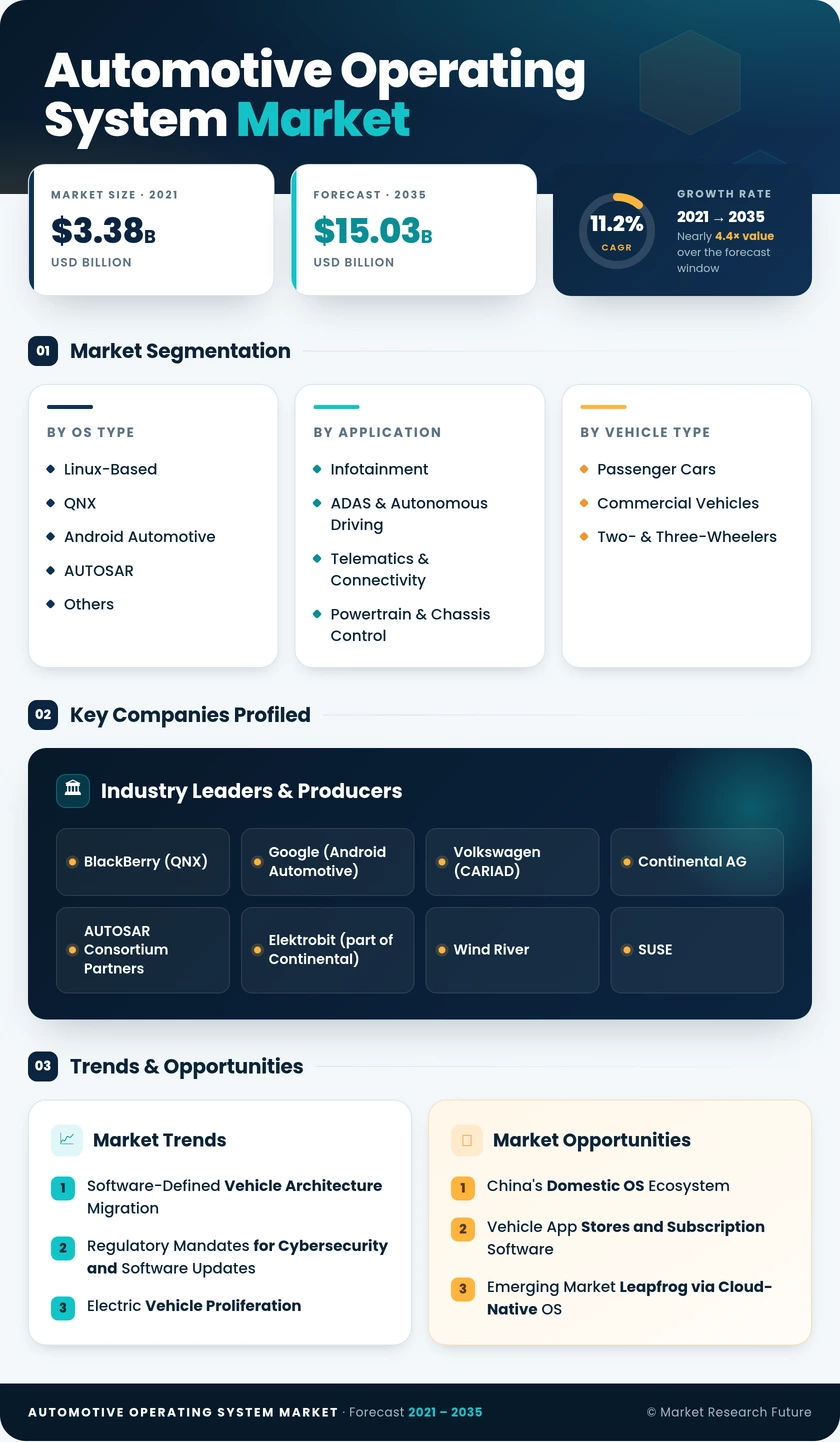
Automotive Operating System Market Research Report By OS Type (Linux-Based, QNX (BlackBerry), Android Automotive, AUTOSAR (Classic & Adaptive), Others (Proprietary/RTOS)), By Application (Infotainment, ADAS & Autonomous Driving, Telematics & Connectivity, Powertrain & Chassis Control), By Vehicle Type (Passenger Cars, Commercial Vehicles, Two- & Three-Wheelers) and By Regional (North America, Europe, South America, Asia Pacific, Middle East and Africa) - Industry Forecast to 2035
Automotive Operating System Market
Market Size
Forecast Period2026-2035
CAGR (2026-2035)11.2%
2025 Market SizeUSD 5.20 Billion
2035 Market SizeUSD 15.03 Billion
Key Players
BlackBerry
Google
Volkswagen
Continental AG
AUTOSAR Consortium Partners
Elektrobit
Opportunities
  • China's Domestic OS Ecosystem
  • Vehicle App Stores and Subscription Software
  • Emerging Market Leapfrog via Cloud-Native OS
  1. 1 Market Overview |
    1. 1.1 Study Assumptions & Market Definition |
    2. 1.2 Scope of the Study |
    3. 1.3 Research Methodology
  2. 2 Market Summary & Key Takeaways
  3. 3 Market Dynamics |
    1. 3.1 Market Drivers Analysis | |
      1. 3.1.1 Software-Defined Vehicle Architecture Migration | |
      2. 3.1.2 UNECE WP.29 Cybersecurity & Software Update Mandates | |
      3. 3.1.3 Electric Vehicle Proliferation Requiring Integrated OS Platforms | |
      4. 3.1.4 L2+/L3 Autonomous Driving Software Requirements | |
      5. 3.1.5 In-Vehicle App Store and Subscription Revenue Models | |
      6. 3.1.6 Cloud-Native Development Toolchains for Automotive | |
      7. 3.1.7 Government-Funded Connected Vehicle Infrastructure |
    2. 3.2 Market Restraints Analysis | |
      1. 3.2.1 Fragmented In-Vehicle Hardware Architectures | |
      2. 3.2.2 High OS Integration and Validation Costs | |
      3. 3.2.3 Semiconductor Supply Constraints for SoCs | |
      4. 3.2.4 Cybersecurity Liability Concerns | |
      5. 3.2.5 Talent Shortage in Embedded Automotive Software |
    3. 3.3 Market Opportunity Analysis | |
      1. 3.3.1 China's Domestic OS Ecosystem | |
      2. 3.3.2 Vehicle App Stores and Subscription Software | |
      3. 3.3.3 Emerging Market Leapfrog via Cloud-Native OS | |
      4. 3.3.4 Functional-Safety OS for Commercial Fleets | |
      5. 3.3.5 Data Monetization through Vehicle OS Telemetry |
    4. 3.4 Industry Value Chain Analysis |
    5. 3.5 Porter's Five Forces Analysis
  4. 4 Global Automotive Operating System Market Size & Forecast (2021–2035) |
    1. 4.1 Historical Market Size (2021–2025) |
    2. 4.2 Current & Forecast Market Size (2026–2035) |
    3. 4.3 Market Size by Revenue (USD Billion) |
    4. 4.4 Year-over-Year Growth Analysis
  5. 5 Segmentation Analysis |
    1. 5.1 By OS Type | |
      1. 5.1.1 Linux-Based | |
      2. 5.1.2 QNX (BlackBerry) | |
      3. 5.1.3 Android Automotive | |
      4. 5.1.4 AUTOSAR (Classic & Adaptive) | |
      5. 5.1.5 Others (Proprietary/RTOS) |
    2. 5.2 By Application | |
      1. 5.2.1 Infotainment | |
      2. 5.2.2 ADAS & Autonomous Driving | |
      3. 5.2.3 Telematics & Connectivity | |
      4. 5.2.4 Powertrain & Chassis Control |
    3. 5.3 By Vehicle Type | |
      1. 5.3.1 Passenger Cars | |
      2. 5.3.2 Commercial Vehicles | |
      3. 5.3.3 Two- & Three-Wheelers
  6. 6 Regional Analysis |
    1. 6.1 Europe | |
      1. 6.1.1 Germany | |
      2. 6.1.2 France | |
      3. 6.1.3 Sweden | |
      4. 6.1.4 Rest of Europe |
    2. 6.2 Asia-Pacific | |
      1. 6.2.1 China | |
      2. 6.2.2 South Korea | |
      3. 6.2.3 Japan | |
      4. 6.2.4 India | |
      5. 6.2.5 Rest of Asia-Pacific |
    3. 6.3 North America | |
      1. 6.3.1 United States | |
      2. 6.3.2 Canada | |
      3. 6.3.3 Mexico |
    4. 6.4 South America | |
      1. 6.4.1 Brazil | |
      2. 6.4.2 Rest of South America |
    5. 6.5 Middle East & Africa | |
      1. 6.5.1 UAE | |
      2. 6.5.2 Saudi Arabia | |
      3. 6.5.3 Rest of Middle East & Africa
  7. 7 Competitive Landscape |
    1. 7.1 Market Share Analysis (2025) |
    2. 7.2 Competitive Benchmarking Matrix |
    3. 7.3 Company Profiles | |
      1. 7.3.1 BlackBerry (QNX) | |
      2. 7.3.2 Google (Android Automotive) | |
      3. 7.3.3 Volkswagen (CARIAD) | |
      4. 7.3.4 Continental AG | |
      5. 7.3.5 Elektrobit | |
      6. 7.3.6 Wind River | |
      7. 7.3.7 SUSE | |
      8. 7.3.8 Huawei | |
      9. 7.3.9 Tesla | |
      10. 7.3.10 AUTOSAR Consortium Partners
  8. 8 Future Outlook & Strategic Recommendations (2026–2035) |
    1. 8.1 AI-Native Vehicle Operating Systems |
    2. 8.2 Platform Economics and Ecosystem Lock-In |
    3. 8.3 Electrification-Software Convergence |
    4. 8.4 Cybersecurity as a Continuous OS Service
  9. 9 Recent Developments & News
  10. 10 Frequently Asked Questions (FAQs)
  11. 11 Report Scope & Methodology |
    1. 11.1 Study Period & Base Year |
    2. 11.2 Data Sources & Citations |
    3. 11.3 Abbreviations
  12. 12 LIST OF TABLES |
  13. TABLE 1 Global Automotive Operating System Market Size & Forecast, by Revenue (USD Billion), 2021–2035 |
  14. TABLE 2 Global Automotive Operating System Market – Year-over-Year Growth Analysis, 2021–2035 |
  15. TABLE 3 Driver Impact Analysis – Automotive Operating System Market, 2026–2035 |
  16. TABLE 4 Restraints Impact Analysis – Automotive Operating System Market, 2026–2035 |
  17. TABLE 5 Regional Market Summary – Automotive Operating System Market, 2025 |
  18. TABLE 6 Europe Automotive Operating System Market Size, by Country, 2021–2035 (USD Billion) |
  19. TABLE 7 Asia-Pacific Automotive Operating System Market Size, by Country, 2021–2035 (USD Billion) |
  20. TABLE 8 North America Automotive Operating System Market Size, by Country, 2021–2035 (USD Billion) |
  21. TABLE 9 South America Automotive Operating System Market Size, by Country, 2021–2035 (USD Billion) |
  22. TABLE 10 Middle East & Africa Automotive Operating System Market Size, by Country, 2021–2035 (USD Billion) |
  23. TABLE 11 Global Automotive Operating System Market Size, by OS Type, 2021–2035 (USD Billion) |
  24. TABLE 12 Global Automotive Operating System Market Size, by Application, 2021–2035 (USD Billion) |
  25. TABLE 13 Global Automotive Operating System Market Size, by Vehicle Type, 2021–2035 (USD Billion) |
  26. TABLE 14 Competitive Benchmarking Matrix – Automotive Operating System Market, 2025 |
  27. TABLE 15 Company Profiles – Key Players, Automotive Operating System Market |
  28. TABLE 16 Recent Developments & Strategic Announcements, 2023–2025 |
  29. TABLE 17 Report Scope & Methodology – Automotive Operating System Market |
  30. TABLE 18 Detailed Sources and Citations |
  31. TABLE 19 Europe Automotive Operating System Market Size, by OS Type, 2021–2035 (USD Billion) |
  32. TABLE 20 Europe Automotive Operating System Market Size, by Application, 2021–2035 (USD Billion) |
  33. TABLE 21 Europe Automotive Operating System Market Size, by Vehicle Type, 2021–2035 (USD Billion) |
  34. TABLE 22 Asia-Pacific Automotive Operating System Market Size, by OS Type, 2021–2035 (USD Billion) |
  35. TABLE 23 Asia-Pacific Automotive Operating System Market Size, by Application, 2021–2035 (USD Billion) |
  36. TABLE 24 Asia-Pacific Automotive Operating System Market Size, by Vehicle Type, 2021–2035 (USD Billion) |
  37. TABLE 25 North America Automotive Operating System Market Size, by OS Type, 2021–2035 (USD Billion) |
  38. TABLE 26 North America Automotive Operating System Market Size, by Application, 2021–2035 (USD Billion) |
  39. TABLE 27 North America Automotive Operating System Market Size, by Vehicle Type, 2021–2035 (USD Billion) |
  40. TABLE 28 South America Automotive Operating System Market Size, by OS Type, 2021–2035 (USD Billion) |
  41. TABLE 29 South America Automotive Operating System Market Size, by Application, 2021–2035 (USD Billion) |
  42. TABLE 30 South America Automotive Operating System Market Size, by Vehicle Type, 2021–2035 (USD Billion) |
  43. TABLE 31 Middle East & Africa Automotive Operating System Market Size, by OS Type, 2021–2035 (USD Billion) |
  44. TABLE 32 Middle East & Africa Automotive Operating System Market Size, by Application, 2021–2035 (USD Billion) |
  45. TABLE 33 Middle East & Africa Automotive Operating System Market Size, by Vehicle Type, 2021–2035 (USD Billion) |
  46. TABLE 34 Germany Automotive Operating System Market Size, by OS Type, 2021–2035 (USD Billion) |
  47. TABLE 35 Germany Automotive Operating System Market Size, by Application, 2021–2035 (USD Billion) |
  48. TABLE 36 Germany Automotive Operating System Market Size, by Vehicle Type, 2021–2035 (USD Billion) |
  49. TABLE 37 France Automotive Operating System Market Size, by OS Type, 2021–2035 (USD Billion) |
  50. TABLE 38 France Automotive Operating System Market Size, by Application, 2021–2035 (USD Billion) |
  51. TABLE 39 France Automotive Operating System Market Size, by Vehicle Type, 2021–2035 (USD Billion) |
  52. TABLE 40 China Automotive Operating System Market Size, by OS Type, 2021–2035 (USD Billion) |
  53. TABLE 41 China Automotive Operating System Market Size, by Application, 2021–2035 (USD Billion) |
  54. TABLE 42 China Automotive Operating System Market Size, by Vehicle Type, 2021–2035 (USD Billion) |
  55. TABLE 43 South Korea Automotive Operating System Market Size, by OS Type, 2021–2035 (USD Billion) |
  56. TABLE 44 South Korea Automotive Operating System Market Size, by Application, 2021–2035 (USD Billion) |
  57. TABLE 45 South Korea Automotive Operating System Market Size, by Vehicle Type, 2021–2035 (USD Billion) |
  58. TABLE 46 Japan Automotive Operating System Market Size, by OS Type, 2021–2035 (USD Billion) |
  59. TABLE 47 Japan Automotive Operating System Market Size, by Application, 2021–2035 (USD Billion) |
  60. TABLE 48 Japan Automotive Operating System Market Size, by Vehicle Type, 2021–2035 (USD Billion) |
  61. TABLE 49 India Automotive Operating System Market Size, by OS Type, 2021–2035 (USD Billion) |
  62. TABLE 50 India Automotive Operating System Market Size, by Application, 2021–2035 (USD Billion) |
  63. TABLE 51 India Automotive Operating System Market Size, by Vehicle Type, 2021–2035 (USD Billion) |
  64. TABLE 52 United States Automotive Operating System Market Size, by OS Type, 2021–2035 (USD Billion) |
  65. TABLE 53 United States Automotive Operating System Market Size, by Application, 2021–2035 (USD Billion) |
  66. TABLE 54 United States Automotive Operating System Market Size, by Vehicle Type, 2021–2035 (USD Billion) |
  67. TABLE 55 Canada Automotive Operating System Market Size, by OS Type, 2021–2035 (USD Billion) |
  68. TABLE 56 Canada Automotive Operating System Market Size, by Application, 2021–2035 (USD Billion) |
  69. TABLE 57 Canada Automotive Operating System Market Size, by Vehicle Type, 2021–2035 (USD Billion) |
  70. TABLE 58 Brazil Automotive Operating System Market Size, by OS Type, 2021–2035 (USD Billion) |
  71. TABLE 59 Brazil Automotive Operating System Market Size, by Application, 2021–2035 (USD Billion) |
  72. TABLE 60 Brazil Automotive Operating System Market Size, by Vehicle Type, 2021–2035 (USD Billion) |
  73. TABLE 61 UAE Automotive Operating System Market Size, by OS Type, 2021–2035 (USD Billion) |
  74. TABLE 62 UAE Automotive Operating System Market Size, by Application, 2021–2035 (USD Billion) |
  75. TABLE 63 UAE Automotive Operating System Market Size, by Vehicle Type, 2021–2035 (USD Billion) |
  76. TABLE 64 Saudi Arabia Automotive Operating System Market Size, by OS Type, 2021–2035 (USD Billion) |
  77. TABLE 65 Saudi Arabia Automotive Operating System Market Size, by Application, 2021–2035 (USD Billion) |
  78. TABLE 66 Saudi Arabia Automotive Operating System Market Size, by Vehicle Type, 2021–2035 (USD Billion)
  79. 13 LIST OF FIGURES |
  80. FIGURE 1 Global Automotive Operating System Market Dynamics — Drivers, Restraints, Opportunities |
  81. FIGURE 2 Industry Value Chain Analysis — Automotive Operating System Market |
  82. FIGURE 3 Porter's Five Forces Analysis — Automotive Operating System Market |
  83. FIGURE 4 Global Automotive Operating System Market Size Trend (USD Billion), 2021–2035 |
  84. FIGURE 5 Automotive Operating System Market Share, by OS Type (%), 2025 |
  85. FIGURE 6 Automotive Operating System Market Share, by Application (%), 2025 |
  86. FIGURE 7 Automotive Operating System Market Share, by Vehicle Type (%), 2025 |
  87. FIGURE 8 Automotive Operating System Market Share, by Region (%), 2025 |
  88. FIGURE 9 Europe Automotive Operating System Market Share, by Country (%), 2025 |
  89. FIGURE 10 Asia-Pacific Automotive Operating System Market Share, by Country (%), 2025 |
  90. FIGURE 11 North America Automotive Operating System Market Share, by Country (%), 2025 |
  91. FIGURE 12 South America Automotive Operating System Market Share, by Country (%), 2025 |
  92. FIGURE 13 Middle East & Africa Automotive Operating System Market Share, by Country (%), 2025 |
  93. FIGURE 14 Competitive Landscape — Automotive Operating System Market Revenue Share (%), 2025 |
  94. FIGURE 15 Automotive Operating System Market — Growth Rate by Segment (CAGR %), 2026–2035

Segmentation Quick Reference

DimensionSub-SegmentsDominant SegmentFastest Growing Segment
By OS TypeLinux-Based, QNX, Android Automotive, AUTOSAR, OthersLinux-Based (32%)Android Automotive (CAGR 14.8%)
By ApplicationInfotainment, ADAS & Autonomous Driving, Telematics & Connectivity, Powertrain & Chassis ControlInfotainment (38%)ADAS & Autonomous Driving (CAGR 13.6%)
By Vehicle TypePassenger Cars, Commercial Vehicles, Two- & Three-WheelersPassenger Cars (68%)Two- & Three-Wheelers (CAGR 16.3%)


Market Segmentation Overview

By OS Type

Sub-SegmentKey Trend
Linux-BasedOEM preference for royalty-free, fully customizable stacks via AGL framework
QNX (BlackBerry)Continued dominance in safety-critical ASIL-D domains; 255M+ vehicles shipped
Android AutomotiveRapid OEM adoption driven by Google ecosystem integration and app-store readiness
AUTOSAR (Classic & Adaptive)Transition from Classic to Adaptive for high-performance domain controllers
Others (Proprietary/RTOS)Niche proprietary stacks maintained by select OEMs; declining share trajectory


Linux-based operating systems lead by market share due to their zero-licensing-cost model and deep customization potential, making them the default choice for OEMs building differentiated software experiences across vehicle lines.

By Application

Sub-SegmentKey Trend
InfotainmentShift toward multi-display cockpits, voice-first interaction, and third-party app ecosystems
ADAS & Autonomous DrivingDemand for deterministic, safety-certified OS layers supporting L2+/L3 sensor fusion
Telematics & ConnectivityV2X communication rollouts and fleet management platform consolidation
Powertrain & Chassis ControlEV-driven demand for integrated battery management and drive-by-wire OS services


Infotainment remains the highest-revenue application because consumer purchasing decisions increasingly weight digital experience alongside traditional performance and comfort metrics.

By Vehicle Type

Sub-SegmentKey Trend
Passenger CarsMass adoption of digital cockpits and connected services across all price segments
Commercial VehiclesUnified OS platforms for fleet telematics, driver monitoring, and predictive maintenance
Two- & Three-WheelersConnected scooter and motorcycle platforms expanding rapidly in India and Southeast Asia


Passenger cars dominate volume demand, though the two- and three-wheeler segment is emerging as the fastest-growing category as Asian OEMs introduce connected platforms at scale.


 

Download PDF ×

We do not share your information with anyone. However, we may send you emails based on your report interest from time to time. You may contact us at any time to opt-out.