×
Request Free Sample ×

Kindly complete the form below to receive a free sample of this Report

* Please use a valid business email

Leading companies partner with us for data-driven Insights

clients tt-cursor
Hero Background
English
Chinese
French
Japanese
Korean
German
Spanish

Automotive Logging Device Market Analysis

ID: MRFR/AT/9419-HCR
100 Pages
Swapnil Palwe
October 2025

Automotive Logging Device Market Research Report Information by Service Type (Entry Level, Intermediate, High Level), Vehicle Type (LCV, Trucks, Bus, Cars), Component (Display, Telematics Unit), and Form Factor (Integrated, Embedded) and Region (North America, Europe, Asia-Pacific, and Rest of the World)—Forecast till 2035

Share:
Download PDF ×

We do not share your information with anyone. However, we may send you emails based on your report interest from time to time. You may contact us at any time to opt-out.

Automotive Logging Device Market Infographic
Purchase Options

Market Analysis

In-depth Analysis of Automotive Logging Device Market Industry Landscape

The Automotive Logging Device (ALD) market is influenced by a multitude of factors that collectively shape its dynamics and trajectory. One of the key driving forces behind the market growth is the increasing regulatory scrutiny and compliance requirements in the transportation and logistics sector. Governments and regulatory bodies, especially in regions like North America and Europe, are mandating the use of ALDs to track and monitor commercial vehicles' compliance with regulations, such as hours of service (HOS) for drivers. This regulatory push is compelling fleet operators and trucking companies to adopt ALDs as essential tools for ensuring adherence to legal requirements, enhancing safety, and mitigating the risk of violations.

Technological advancements and the integration of telematics solutions are also playing a pivotal role in shaping the ALD market. ALDs are no longer mere data recorders; they have evolved into sophisticated telematics devices that offer real-time tracking, vehicle diagnostics, and communication capabilities. The integration of advanced features, including GPS tracking, remote diagnostics, and communication interfaces, not only aids in regulatory compliance but also enhances fleet management efficiency. Fleet operators are increasingly recognizing the value of ALDs as integral components of their overall telematics ecosystem, contributing to improved operational visibility and decision-making.

The rise of the e-commerce industry and the subsequent surge in demand for efficient and timely transportation solutions are additional factors fueling the growth of the ALD market. As the logistics landscape evolves to meet the demands of the digital economy, there is a heightened need for real-time monitoring and optimization of commercial vehicle operations. ALDs provide a crucial tool for fleet managers to track routes, optimize fuel efficiency, and ensure timely deliveries, aligning with the high expectations of today's on-demand and e-commerce-driven supply chains.

Cost considerations and the pursuit of operational efficiency are driving the adoption of ALDs among fleet operators. By leveraging the data and insights provided by ALDs, companies can optimize their routes, reduce fuel consumption, and enhance overall fleet performance. The long-term cost savings and operational benefits associated with ALD implementation make them attractive investments for businesses seeking to maximize efficiency and remain competitive in the rapidly evolving transportation industry.

The push towards sustainability and environmental responsibility is influencing the ALD market as well. Governments and businesses worldwide are increasingly focused on reducing carbon emissions and mitigating the environmental impact of transportation. ALDs contribute to this effort by enabling fleet managers to monitor and optimize fuel efficiency, reduce idle times, and implement eco-friendly driving practices. As sustainability becomes a key consideration for businesses and consumers alike, the integration of ALDs aligns with the broader goals of achieving a greener and more environmentally conscious transportation sector.

Market consolidation and strategic partnerships within the automotive and telematics industries are shaping the competitive landscape of the ALD market. Established telematics solution providers are collaborating with automotive manufacturers and software developers to offer comprehensive and integrated ALD solutions. These collaborations foster innovation and enhance the capabilities of ALDs, providing end-users with a more seamless and holistic approach to vehicle tracking and management.

Despite the positive market factors, challenges such as data privacy concerns, initial implementation costs, and resistance to change within the industry remain hurdles to widespread ALD adoption. Overcoming these challenges requires industry stakeholders to address privacy issues, demonstrate the long-term value of ALDs, and provide adequate training and support to facilitate the transition for fleet operators.

The Automotive Logging Device market is influenced by a combination of regulatory requirements, technological advancements, the rise of e-commerce, cost considerations, sustainability goals, and collaborative efforts within the industry. As the transportation and logistics sector continues to evolve, ALDs are positioned as essential tools for fleet management, regulatory compliance, and operational optimization, contributing to a more efficient, connected, and environmentally conscious future for commercial vehicle operations.

Author
Swapnil Palwe
Team Lead - Research

With a technical background as Bachelor's in Mechanical Engineering, with MBA in Operations Management , Swapnil has 6+ years of experience in market research, consulting and analytics with the tasks of data mining, analysis, and project execution. He is the POC for our clients, for their consulting projects running under the Automotive/A&D domain. Swapnil has worked on major projects in verticals such as Aerospace & Defense, Automotive and many other domain projects. He has worked on projects for fortune 500 companies' syndicate and consulting projects along with several government projects.

Leave a Comment

FAQs

What is the study period of this market?

The study period of the global Automotive Logging Device market is 2024–2032

What is the growth rate of the global Automotive Logging Device market?

The global Automotive Logging Device market is growing at a CAGR of ~12.5% over the next 10 years

Which region has the highest growth rate in the global Automotive Logging Device market?

North America is expected to register the highest CAGR during 2024-2032

Which region has the largest share in the global Automotive Logging Device market?

Europe holds the largest share in 2024

Who are the key players in the global Automotive Logging Device market?

AT&T Business, Blue Tree System, Coretex, DriverTech, ELD Solutions, Garmin International, Geotab Inc, Omnitracs LLC, Teletrac Navman, and Zonar Systems.

Market Summary

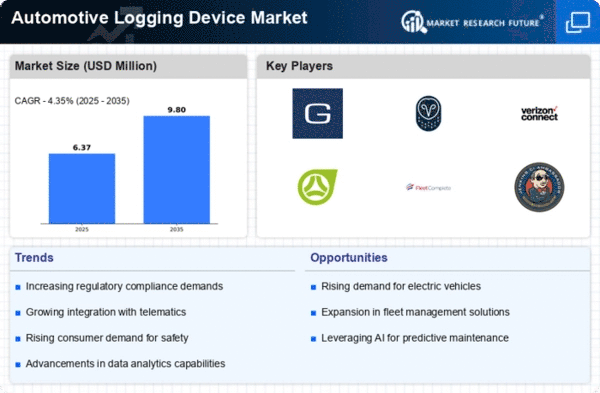
As per MRFR analysis, the Automotive Logging Device Market Size was estimated at 6.1 USD Million in 2024. The Automotive Logging Device industry is projected to grow from 6.4 in 2025 to 9.8 by 2035, exhibiting a compound annual growth rate (CAGR) of 4.35 during the forecast period 2025 - 2035.

Key Market Trends & Highlights

The Automotive Logging Device Market is poised for substantial growth driven by technological advancements and regulatory compliance.

  • Technological advancements are enhancing the capabilities of automotive logging devices, particularly in North America. Regulatory compliance is becoming increasingly stringent, pushing manufacturers to innovate and adapt their products. The fleet management segment remains the largest, while driver behavior monitoring is emerging as the fastest-growing segment in the market. Increased demand for fleet management solutions and a rising emphasis on vehicle safety are key drivers propelling market growth.

Market Size & Forecast

2024 Market Size 6.1 (USD Million)
2035 Market Size 9.8 (USD Million)
CAGR (2025 - 2035) 4.35%
Largest Regional Market Share in 2024 North America

Major Players

<a href="https://www.geotab.com/vehicle-tracking-device/">Geotab</a> (CA), Samsara (US), Verizon Connect (US), Teletrac Navman (NZ), <a href="https://www.fleetcomplete.com/products/electronic-logging-device/">Fleet Complete</a> (CA), Omnicomm (RU), Zubie (US), Motive (US), CalAmp (US)

Market Trends

The Automotive Logging Device Market is currently experiencing a transformative phase, driven by advancements in technology and increasing regulatory requirements. These devices, which monitor and record vehicle data, are becoming essential for fleet management and compliance with safety standards. The integration of telematics and real-time data analytics is enhancing the functionality of these devices, allowing for improved decision-making and operational efficiency. As the automotive industry shifts towards greater connectivity, the demand for sophisticated logging solutions is likely to rise, reflecting a broader trend towards digitalization in transportation. Moreover, the growing emphasis on sustainability and environmental responsibility is influencing the Automotive Logging Device Market. Companies are increasingly seeking solutions that not only enhance performance but also contribute to reducing carbon footprints. This shift is prompting manufacturers to innovate and develop devices that support eco-friendly practices. As the market evolves, it appears that the convergence of technology, regulatory frameworks, and environmental considerations will shape the future landscape of automotive logging devices, making them indispensable tools for modern transportation management.

Technological Advancements

The Automotive Logging Device Market is witnessing rapid technological progress, particularly in the areas of connectivity and data analytics. Enhanced features such as GPS tracking, real-time monitoring, and predictive maintenance are becoming standard. These innovations enable fleet operators to optimize routes, reduce fuel consumption, and improve overall vehicle performance.

Regulatory Compliance

Increasing regulatory pressures are driving the adoption of automotive logging devices. Governments worldwide are implementing stricter safety and environmental regulations, necessitating accurate data recording and reporting. This trend compels businesses to invest in logging solutions that ensure compliance, thereby fostering market growth.

Sustainability Focus

A growing emphasis on sustainability is influencing the Automotive Logging Device Market. Companies are increasingly prioritizing eco-friendly practices, leading to a demand for devices that help monitor emissions and fuel efficiency. This trend reflects a broader societal shift towards environmental responsibility, prompting manufacturers to innovate in this space.

Automotive Logging Device Market Market Drivers

Market Growth Projections

The Global Automotive Logging Device Market Industry is poised for remarkable growth, with projections indicating a substantial increase in market size over the next decade. The market is expected to reach 1.52 USD Billion in 2024 and is forecasted to expand to 40.5 USD Billion by 2035. This growth trajectory suggests a compound annual growth rate of 34.8% from 2025 to 2035, reflecting the increasing integration of logging devices across various automotive applications. The anticipated growth is driven by factors such as technological advancements, regulatory compliance, and the rising demand for fleet management solutions, positioning the market for significant expansion.

Rising Adoption of Electric Vehicles

The Global Automotive Logging Device Market Industry is also being propelled by the rising adoption of electric vehicles (EVs). As the automotive landscape shifts towards electrification, logging devices are becoming essential for monitoring battery performance, energy consumption, and overall vehicle health. EV manufacturers are integrating advanced logging systems to provide users with insights into their vehicle's efficiency and maintenance needs. This trend is expected to contribute significantly to market growth, with projections suggesting that the market could reach 40.5 USD Billion by 2035, reflecting the increasing importance of logging devices in the evolving automotive ecosystem.

Regulatory Compliance and Safety Standards

The Global Automotive Logging Device Market Industry is significantly influenced by stringent regulatory compliance and safety standards imposed by governments worldwide. Regulations mandating the use of logging devices for tracking vehicle emissions and performance are becoming more prevalent. For example, the European Union has implemented regulations that require logging devices to monitor carbon emissions in commercial vehicles. This regulatory landscape not only promotes the adoption of logging devices but also enhances vehicle safety and environmental sustainability. Consequently, the market is expected to expand as manufacturers and fleet operators align with these evolving standards.

Increasing Demand for Fleet Management Solutions

The Global Automotive Logging Device Market Industry is witnessing a surge in demand for fleet management solutions, driven by the need for enhanced operational efficiency and cost reduction. Companies are increasingly adopting logging devices to monitor vehicle performance, optimize routes, and reduce fuel consumption. For instance, the integration of logging devices enables fleet operators to track real-time data, leading to improved decision-making. As a result, the market is projected to reach 1.52 USD Billion in 2024, with expectations of substantial growth as businesses recognize the value of data-driven insights in managing their fleets.

Growing Consumer Awareness of Vehicle Maintenance

Consumer awareness regarding vehicle maintenance is influencing the Global Automotive Logging Device Market Industry positively. As vehicle owners become more informed about the benefits of regular maintenance and monitoring, the demand for logging devices is likely to increase. These devices provide critical data on vehicle health, enabling owners to address issues proactively and avoid costly repairs. The trend towards preventative maintenance is expected to drive market growth, as consumers seek tools that enhance their understanding of vehicle performance and longevity. This shift in consumer behavior is anticipated to further bolster the adoption of logging devices in the automotive sector.

Technological Advancements in Automotive Logging Devices

Technological advancements play a pivotal role in shaping the Global Automotive Logging Device Market Industry. Innovations such as GPS tracking, telematics, and real-time data analytics are enhancing the functionality of logging devices. These advancements allow for more accurate monitoring of vehicle performance and driver behavior, ultimately leading to improved safety and efficiency. As technology continues to evolve, the market is likely to experience rapid growth, with projections indicating a compound annual growth rate of 34.8% from 2025 to 2035. This growth trajectory underscores the increasing reliance on sophisticated logging devices in the automotive sector.

Market Segment Insights

By Application: Fleet Management (Largest) vs. Driver Behavior Monitoring (Fastest-Growing)

The Automotive Logging Device Market is characterized by a diverse range of applications, with <a href="https://www.marketresearchfuture.com/reports/fleet-management-market-2646">Fleet Management</a> holding the largest share. This segment not only leads in terms of market penetration but also significantly impacts operational efficiency for businesses managing vehicle fleets. In contrast, Driver Behavior Monitoring is the fastest-growing application within this market, driven by increasing regulatory requirements and a growing focus on safety and insurance incentives.

Fleet Management (Dominant) vs. Driver Behavior Monitoring (Emerging)

Fleet Management is recognized as the dominant application in the Automotive Logging Device Market, largely because of its role in enhancing logistics, tracking vehicle performance, and ensuring compliance with regulations. This segment focuses on optimizing routes, reducing operational costs, and improving fuel efficiency, thus offering substantial benefits to fleet operators. Conversely, Driver Behavior Monitoring is emerging rapidly, capitalizing on technological advancements in <a href="https://www.marketresearchfuture.com/reports/telematics-market-1121">telematics</a>. This segment emphasizes safety by assessing driving patterns and providing actionable feedback to drivers. As the industry leans towards greater safety measures and insurance cost reductions, the demand for Driver Behavior Monitoring devices is expected to rise significantly, marking it as a key area of growth.

By End Use: Commercial Vehicles (Largest) vs. Passenger Vehicles (Fastest-Growing)

In the Automotive Logging Device Market, the end-use segmentation reveals a significant distribution across commercial and passenger vehicles. Commercial vehicles hold the largest share due to the increasing emphasis on fleet management and regulatory compliance, which drives demand for logging devices that enhance operational efficiency. Passenger vehicles, while smaller in share, showcase a growing presence as consumers become more aware of vehicle health and performance monitoring, indicating a shifting trend in ownership preferences. The growth trajectory of automotive logging devices is bolstered by the expanding usage of connected technologies and the rise of independent mobility solutions. In the commercial segment, the need for telematics and real-time vehicle tracking systems amplifies device adoption. Meanwhile, the passenger vehicle segment propels growth through innovative applications such as eco-driving analytics, appealing to environmentally conscious consumers and urban dwellers seeking enhanced driving experiences.

Commercial Vehicles (Dominant) vs. Passenger Vehicles (Emerging)

The commercial vehicle segment stands out as the dominant player in the Automotive Logging Device Market, primarily driven by extensive regulatory requirements and the necessity for improved fleet management. This segment benefits from the integration of advanced telematics systems, which allow for comprehensive monitoring of vehicle performance and driver behavior. Features such as GPS tracking, fuel consumption analysis, and maintenance alerts elevate operational efficiency, making them indispensable for logistics and transportation businesses. In contrast, the passenger vehicle segment is emerging, focused on delivering personalized experiences. Consumers are increasingly demanding insights into vehicle health, performance metrics, and enhanced safety features. With advancements in connectivity and software solutions, this segment is rapidly adapting, capturing the attention of tech-savvy drivers and shaping future automotive trends.

By Technology: Telematics (Largest) vs. GPS Tracking (Fastest-Growing)

The Automotive Logging Device Market exhibits a diverse landscape within its Technology segment, where Telematics currently holds the largest market share, driven by its integration of advanced data analytics and real-time vehicle monitoring. Meanwhile, GPS Tracking has emerged as a prominent player, gaining traction due to the rising demand for location-based services and enhanced fleet management solutions. These technologies are pivotal in redefining operational efficiencies for automotive industries worldwide. In recent years, the growth trends within this segment are significantly influenced by technological advancements and increased regulatory mandates for vehicle safety and emissions control. As mobility solutions transition towards smarter, interconnected systems, the adoption rate for GPS Tracking is rapidly accelerating, indicating its position as the fastest-growing segment. This shift reflects an overarching industry trend towards digitalization, making vehicle monitoring and management capabilities more sophisticated and user-friendly.

Telematics: Dominant vs. GPS Tracking: Emerging

Telematics stands as a dominant force within the Automotive Logging Device Market, characterized by its extensive data collection capabilities that enhance vehicle performance and safety. This technology integrates GPS, onboard diagnostics, and communications systems, enabling fleet operators to optimize routes, reduce fuel consumption, and enhance operational efficiencies. As businesses increasingly seek to leverage data for informed decision-making, telematics usage is becoming ubiquitous in various automotive applications. In contrast, GPS Tracking represents an emerging segment that is gaining momentum due to its cost-effective implementation and real-time tracking features. It appeals particularly to small to mid-sized fleet operators looking to enhance security and manage assets efficiently. The rising consumer preference for personalized and location-based services positions GPS Tracking as a competitive player, poised for significant market growth.

By Device Type: Plug-and-Play Devices (Largest) vs. Hardwired Devices (Fastest-Growing)

The Automotive Logging Device Market demonstrates a diverse array of device types, with Plug-and-Play Devices consistently capturing the largest market share due to their user-friendly installation process, making them popular among consumers and fleet operators alike. In contrast, Hardwired Devices are emerging as the fastest-growing segment, driven by their robust performance and reliability, which appeal to businesses looking for long-term solutions in vehicle tracking and diagnostics. As technology evolves, the market continues to adapt to various consumer preferences and operational requirements.

Plug-and-Play Devices (Dominant) vs. Hardwired Devices (Emerging)

Plug-and-Play Devices are characterized by their ease of installation and portability, making them highly appealing to individual users and small fleets who prefer minimal complexity. This segment dominates the market due to its widespread adoption and versatility, accommodating both personal and commercial vehicles. On the other hand, Hardwired Devices are gaining traction quickly, especially within larger enterprises that prioritize enhanced data accuracy and integration capabilities. These devices offer superior durability and speed, positioning them as a preferred choice for tracking and monitoring large fleets, thus driving their emergence in the automotive sector.

By Connectivity: Cellular Connectivity (Largest) vs. Bluetooth Connectivity (Fastest-Growing)

In the Automotive Logging Device Market, Cellular Connectivity is currently the largest segment, holding a significant share due to its extensive coverage and reliability for real-time data transmission. Bluetooth Connectivity, while smaller in share, is rapidly gaining traction, driven by increasing demand for seamless integration with mobile devices and cost-effective solutions for data exchange during shorter distances. The growth trends in this segment are largely influenced by advancements in technology and the rise in connected vehicles. Additionally, the demand for better vehicle tracking and telematics solutions is propelling the adoption of Bluetooth Connectivity, which is emerging as a cost-efficient choice for manufacturers and consumers alike, ensuring more flexible options for data usage and connectivity.

Connectivity: Cellular (Dominant) vs. Bluetooth (Emerging)

Cellular Connectivity is the dominant force in the Automotive Logging Device Market due to its ability to provide reliable and continuous communication through extensive network coverage. Offerings often include 4G and emerging 5G technologies which enhance real-time data transmission capabilities. On the other hand, Bluetooth Connectivity is recognized as an emerging solution, appealing to users who prioritize easy integration with smartphones and other devices. This segment offers flexibility and cost-effectiveness, making it an attractive option for various applications, particularly in the aftermarket installation of logging devices. Both segments represent critical pathways for enhancing vehicular intelligence and telematics, catering to diverse consumer needs.

Get more detailed insights about Automotive Logging Device Market Research Report—Global Forecast till 2035

Regional Insights

North America : Market Leader in Innovation

North America continues to lead the automotive logging device market, holding a significant share of 3.1 billion in 2024. The growth is driven by increasing regulatory requirements for fleet management and safety, alongside a rising demand for telematics solutions. The region's advanced technological infrastructure and high adoption rates of IoT devices further catalyze market expansion. Additionally, government initiatives promoting smart transportation systems are expected to bolster growth in this sector. The competitive landscape in North America is robust, featuring key players such as Geotab, Samsara, and Verizon Connect. These companies are at the forefront of innovation, offering advanced solutions that enhance fleet efficiency and compliance. The U.S. remains the largest market, followed by Canada, where local firms like Fleet Complete are making significant strides. The presence of these leading companies ensures a dynamic market environment, fostering continuous advancements in automotive logging technology.

Europe : Emerging Market with Regulations

Europe's automotive logging device market is projected to reach 1.8 billion by 2025, driven by stringent regulations aimed at improving road safety and environmental standards. The European Union's commitment to reducing emissions and enhancing vehicle tracking systems has created a favorable environment for market growth. Additionally, the increasing focus on fleet efficiency and real-time data analytics is propelling demand for advanced logging devices across the region. Leading countries in this market include Germany, the UK, and France, where major players like Teletrac Navman and Omnicomm are establishing a strong presence. The competitive landscape is characterized by innovation and collaboration, with companies investing in R&D to meet regulatory demands. The European market is witnessing a surge in partnerships between technology firms and automotive manufacturers, enhancing the overall ecosystem for automotive logging devices.

Asia-Pacific : Rapid Growth and Adoption

The Asia-Pacific automotive logging device market is estimated at 1.0 billion, reflecting a growing demand for fleet management solutions. Factors such as urbanization, increasing vehicle ownership, and the need for efficient logistics are driving this growth. Governments in countries like China and India are implementing policies to enhance transportation safety and efficiency, further boosting the adoption of logging devices in the region. China leads the market, followed by India and Japan, with local companies like Motive and CalAmp gaining traction. The competitive landscape is evolving, with both established players and new entrants focusing on innovative solutions tailored to regional needs. The presence of a large number of vehicles and the push for smart city initiatives are expected to create significant opportunities for automotive logging device manufacturers in the Asia-Pacific region.

Middle East and Africa : Emerging Market Potential

The Middle East and Africa (MEA) automotive logging device market is valued at 0.2 billion, with significant growth potential driven by increasing vehicle fleets and a rising focus on fleet management solutions. The region's growing logistics and transportation sectors are key demand drivers, alongside government initiatives aimed at improving road safety and efficiency. As urbanization accelerates, the need for effective tracking and management systems is becoming more pronounced. Countries like South Africa and the UAE are leading the way in adopting automotive logging devices, with local firms beginning to emerge in the market. The competitive landscape is still developing, with opportunities for both global and regional players to establish a foothold. As awareness of the benefits of telematics grows, the MEA market is poised for substantial growth in the coming years.

Key Players and Competitive Insights

The Automotive Logging Device Market is currently characterized by a dynamic competitive landscape, driven by technological advancements and increasing regulatory requirements for fleet management. Key players are actively pursuing strategies that emphasize innovation, partnerships, and regional expansion to enhance their market presence. For instance, Geotab (CA) has positioned itself as a leader in telematics solutions, focusing on data analytics and integration with various fleet management systems. Similarly, Samsara (US) has adopted a strategy centered on digital transformation, leveraging IoT technology to provide comprehensive fleet visibility and operational efficiency. These strategic orientations collectively contribute to a competitive environment that is increasingly focused on technological differentiation and customer-centric solutions.In terms of business tactics, companies are increasingly localizing manufacturing and optimizing supply chains to enhance responsiveness to market demands. The Automotive Logging Device Market appears moderately fragmented, with several key players exerting influence over specific segments. This fragmentation allows for a diverse range of offerings, yet the collective impact of major companies like Verizon Connect (US) and Teletrac Navman (NZ) shapes the overall market dynamics, fostering competition that drives innovation and service improvements.
In November Verizon Connect (US) announced a strategic partnership with a leading AI firm to enhance its fleet management solutions through advanced predictive analytics. This move is likely to bolster Verizon's capabilities in providing actionable insights to fleet operators, thereby improving operational efficiency and reducing costs. The integration of AI into their offerings may also position Verizon Connect as a frontrunner in the market, appealing to customers seeking cutting-edge technology.
In October Teletrac Navman (NZ) launched a new suite of eco-friendly logging devices aimed at reducing carbon emissions for fleet operators. This initiative aligns with global sustainability trends and reflects a growing emphasis on environmental responsibility within the industry. By prioritizing eco-friendly solutions, Teletrac Navman not only addresses regulatory pressures but also appeals to a customer base increasingly concerned with sustainability.
In September Samsara (US) expanded its operations into the European market, establishing a new headquarters in Germany. This strategic move is indicative of Samsara's commitment to The Automotive Logging Device's potential for telematics solutions. By localizing its operations, Samsara aims to better serve European customers and adapt its offerings to meet regional regulatory requirements.
As of December the Automotive Logging Device Market is witnessing trends that emphasize digitalization, sustainability, and AI integration. Strategic alliances are becoming increasingly pivotal, as companies collaborate to enhance their technological capabilities and market reach. The competitive landscape is shifting from traditional price-based competition to a focus on innovation, technology, and supply chain reliability. This evolution suggests that future differentiation will hinge on the ability to deliver advanced, integrated solutions that meet the complex needs of fleet operators.

Key Companies in the Automotive Logging Device Market include

Industry Developments

Future Outlook

Automotive Logging Device Market Future Outlook

The Automotive Logging Device Market is projected to grow at a 4.35% CAGR from 2025 to 2035, driven by technological advancements, regulatory compliance, and increasing demand for fleet management solutions.

New opportunities lie in:

  • <p>Integration of AI-driven analytics for predictive maintenance Development of cloud-based data management platforms Expansion into emerging markets with tailored solutions</p>

By 2035, the market is expected to be robust, driven by innovation and strategic partnerships.

Market Segmentation

Automotive Logging Device Market End Use Outlook

  • Commercial Vehicles
  • Passenger Vehicles
  • Heavy-Duty Vehicles
  • Light-Duty Vehicles

Automotive Logging Device Market Technology Outlook

  • GPS Tracking
  • Telematics
  • On-Board Diagnostics
  • Cloud Computing

Automotive Logging Device Market Application Outlook

  • Fleet Management
  • Vehicle Tracking
  • Driver Behavior Monitoring
  • Fuel Management
  • Maintenance Management

Automotive Logging Device Market Device Type Outlook

  • Plug-and-Play Devices
  • Hardwired Devices
  • Portable Devices

Automotive Logging Device Market Connectivity Outlook

  • Cellular Connectivity
  • Bluetooth Connectivity
  • Wi-Fi Connectivity
  • Satellite Connectivity

Report Scope

MARKET SIZE 2024 6.1(USD Million)
MARKET SIZE 2025 6.4(USD Million)
MARKET SIZE 2035 9.8(USD Million)
COMPOUND ANNUAL GROWTH RATE (CAGR) 4.35% (2025 - 2035)
REPORT COVERAGE Revenue Forecast, Competitive Landscape, Growth Factors, and Trends
BASE YEAR 2024
Market Forecast Period 2025 - 2035
Historical Data 2019 - 2024
Market Forecast Units USD Million
Key Companies Profiled Geotab (CA), Samsara (US), Verizon Connect (US), Teletrac Navman (NZ), Fleet Complete (CA), Omnicomm (RU), Zubie (US), Motive (US), CalAmp (US)
Segments Covered Application, End Use, Technology, Device Type, Connectivity
Key Market Opportunities Integration of advanced telematics and real-time data analytics in the Automotive Logging Device Market.
Key Market Dynamics Rising regulatory requirements drive demand for advanced automotive logging devices to enhance vehicle compliance and safety.
Countries Covered North America, Europe, APAC, South America, MEA

FAQs

What is the study period of this market?

The study period of the global Automotive Logging Device market is 2024–2032

What is the growth rate of the global Automotive Logging Device market?

The global Automotive Logging Device market is growing at a CAGR of ~12.5% over the next 10 years

Which region has the highest growth rate in the global Automotive Logging Device market?

North America is expected to register the highest CAGR during 2024-2032

Which region has the largest share in the global Automotive Logging Device market?

Europe holds the largest share in 2024

Who are the key players in the global Automotive Logging Device market?

AT&amp;T Business, Blue Tree System, Coretex, DriverTech, ELD Solutions, Garmin International, Geotab Inc, Omnitracs LLC, Teletrac Navman, and Zonar Systems.

  1. SECTION I: EXECUTIVE SUMMARY AND KEY HIGHLIGHTS |
    1. EXECUTIVE SUMMARY |
      1. Market Overview |
      2. Key Findings |
      3. Market Segmentation |
      4. Competitive Landscape |
      5. Challenges and Opportunities |
      6. Future Outlook 2
  2. SECTION II: SCOPING, METHODOLOGY AND MARKET STRUCTURE |
    1. MARKET INTRODUCTION |
      1. Definition |
      2. Scope of the study |--
    2. RESEARCH METHODOLOGY |
      1. Overview |
      2. Data Mining |
      3. Secondary Research |
      4. Primary Research |--
      5. Forecasting Model |
      6. Market Size Estimation |--
      7. Data Triangulation |
      8. Validation 3
  3. SECTION III: QUALITATIVE ANALYSIS |
    1. MARKET DYNAMICS |
      1. Overview |
      2. Drivers |
      3. Restraints |
      4. Opportunities |
    2. MARKET FACTOR ANALYSIS |
      1. Value chain Analysis |
      2. Porter's Five Forces Analysis |--
      3. COVID-19 Impact Analysis |--
  4. SECTION IV: QUANTITATIVE ANALYSIS |
    1. Automobile, BY Application (USD Million) |
      1. Fleet Management |
      2. Vehicle Tracking |
      3. Driver Behavior Monitoring |
      4. Fuel Management |
      5. Maintenance Management |
    2. Automobile, BY End Use (USD Million) |
      1. Commercial Vehicles |
      2. Passenger Vehicles |
      3. Heavy-Duty Vehicles |
      4. Light-Duty Vehicles |
    3. Automobile, BY Technology (USD Million) |
      1. GPS Tracking |
      2. Telematics |
      3. On-Board Diagnostics |
      4. Cloud Computing |
    4. Automobile, BY Device Type (USD Million) |
      1. Plug-and-Play Devices |
      2. Hardwired Devices |
      3. Portable Devices |
    5. Automobile, BY Connectivity (USD Million) |
      1. Cellular Connectivity |
      2. Bluetooth Connectivity |
      3. Wi-Fi Connectivity |
      4. Satellite Connectivity |
    6. Automobile, BY Region (USD Million) |
      1. North America |--
      2. Europe |--
      3. APAC |--
      4. South America |--
      5. MEA |--
  5. SECTION V: COMPETITIVE ANALYSIS |
    1. Competitive Landscape |
      1. Overview |
      2. Competitive Analysis |
      3. Market share Analysis |
      4. Major Growth Strategy in the Automobile |
      5. Competitive Benchmarking |
      6. Leading Players in Terms of Number of Developments in the Automobile |
      7. Key developments and growth strategies |--
      8. Major Players Financial Matrix |--
    2. Company Profiles |
      1. Geotab (CA) |--
      2. Samsara (US) |--
      3. Verizon Connect (US) |--
      4. Teletrac Navman (NZ) |--
      5. Fleet Complete (CA) |--
      6. Omnicomm (RU) |--
      7. Zubie (US) |--
      8. Motive (US) |--
      9. CalAmp (US) |--
    3. Appendix |
      1. References |
      2. Related Reports

Automobile Market Segmentation

Automobile By Application (USD Million, 2025-2035)

  • Fleet Management
  • Vehicle Tracking
  • Driver Behavior Monitoring
  • Fuel Management
  • Maintenance Management

Automobile By End Use (USD Million, 2025-2035)

  • Commercial Vehicles
  • Passenger Vehicles
  • Heavy-Duty Vehicles
  • Light-Duty Vehicles

Automobile By Technology (USD Million, 2025-2035)

  • GPS Tracking
  • Telematics
  • On-Board Diagnostics
  • Cloud Computing

Automobile By Device Type (USD Million, 2025-2035)

  • Plug-and-Play Devices
  • Hardwired Devices
  • Portable Devices

Automobile By Connectivity (USD Million, 2025-2035)

  • Cellular Connectivity
  • Bluetooth Connectivity
  • Wi-Fi Connectivity
  • Satellite Connectivity
Infographic

Free Sample Request

Kindly complete the form below to receive a free sample of this Report

Get Free Sample

Customer Strories

Compare Licence

×
Features License Type
Single User Multiuser License Enterprise User
Price $4,950 $5,950 $7,250
Maximum User Access Limit 1 User Upto 10 Users Unrestricted Access Throughout the Organization
Free Customization
Direct Access to Analyst
Deliverable Format
Platform Access
Discount on Next Purchase 10% 15% 15%
Printable Versions