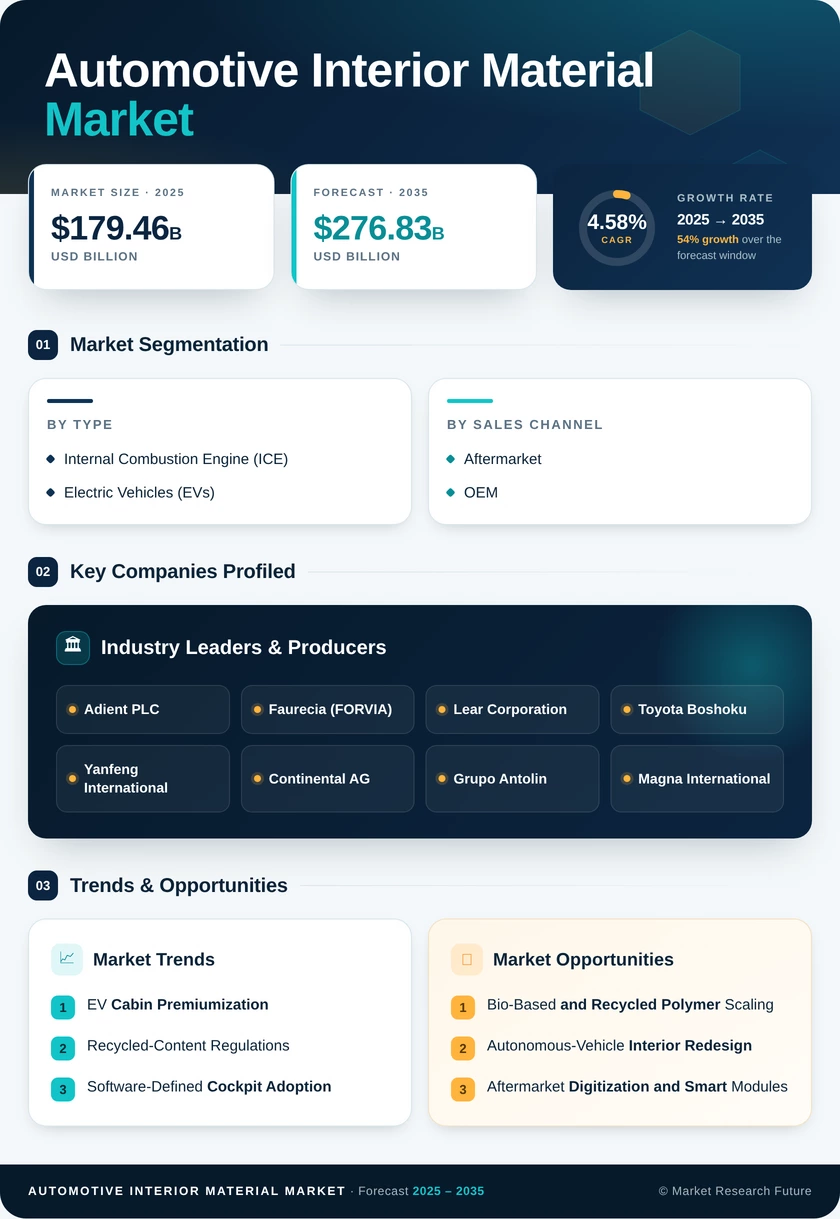
Automotive Interior Material Market

ID: MRFR/CnM/1988-CR
200 Pages
Chitranshi Jaiswal
Last Updated: June 04, 2026
Automotive Interior Material Market Research Report By Material Type (Textiles, Plastic, Leather, Wood, Metal), By Application (Seats, Dashboard, Door Panels, Headliners, Flooring), By Vehicle Type (Passenger Cars, Commercial Vehicles, Electric Vehicles, Luxury Vehicles), By End-use (OEM, Aftermarket), and By Regional (North America, Europe, South America, Asia Pacific, Middle East and Africa)-Forecast to 2035
Download PDF ×

We do not share your information with anyone. However, we may send you emails based on your report interest from time to time. You may contact us at any time to opt-out.

  1. 1 Market Overview |
    1. 1.1 Study Assumptions & Market Definition |
    2. 1.2 Scope of the Study |
    3. 1.3 Research Methodology
  2. 2 Market Summary & Key Takeaways
  3. 3 Market Dynamics |
    1. 3.1 Market Drivers Analysis | |
      1. 3.1.1 EV Cabin Premiumization | |
      2. 3.1.2 Recycled-Content Regulations | |
      3. 3.1.3 Software-Defined Cockpit Adoption | |
      4. 3.1.4 Aftermarket Refresh Demand | |
      5. 3.1.5 Lightweight Material Substitution | |
      6. 3.1.6 Autonomous-Vehicle Interior Redesign | |
      7. 3.1.7 Rising Per-Capita Income in Emerging Markets |
    2. 3.2 Market Restraints Analysis | |
      1. 3.2.1 Raw-Material Price Volatility | |
      2. 3.2.2 Shared-Mobility Cabin Utilization Concerns | |
      3. 3.2.3 Stringent VOC Emission Standards | |
      4. 3.2.4 Long Qualification Cycles for New Materials | |
      5. 3.2.5 Counterfeit Aftermarket Components |
    3. 3.3 Market Opportunity Analysis | |
      1. 3.3.1 Bio-Based and Recycled Polymer Scaling | |
      2. 3.3.2 Autonomous-Vehicle Interior Redesign | |
      3. 3.3.3 Aftermarket Digitization and Smart Modules | |
      4. 3.3.4 Emerging-Market Premiumization in India and Southeast Asia | |
      5. 3.3.5 Data-Driven Material Specification Platforms |
    4. 3.4 Industry Value Chain Analysis |
    5. 3.5 Porter's Five Forces Analysis
  4. 4 Global Automotive Interior Material Market Size & Forecast (2021–2035) |
    1. 4.1 Historical Market Size (2021–2025) |
    2. 4.2 Current & Forecast Market Size (2026–2035) |
    3. 4.3 Market Size by Revenue (USD Billion) |
    4. 4.4 Year-over-Year Growth Analysis
  5. 5 Segmentation Analysis |
    1. 5.1 By Vehicle Type | |
      1. 5.1.1 Passenger Cars | |
      2. 5.1.2 Commercial Vehicles | |
      3. 5.1.3 Electric Passenger Cars | |
      4. 5.1.4 Others (Two/Three-Wheelers) |
    2. 5.2 By Material Type | |
      1. 5.2.1 Synthetic Leather | |
      2. 5.2.2 Genuine Leather | |
      3. 5.2.3 Fabrics & Textiles | |
      4. 5.2.4 Natural & Recycled Materials |
    3. 5.3 By Component Type | |
      1. 5.3.1 Seating Systems | |
      2. 5.3.2 Instrument Panels & Cockpit Modules | |
      3. 5.3.3 Door Panels & Trim | |
      4. 5.3.4 Driver & Occupant Monitoring Systems |
    4. 5.4 By Sales Channel | |
      1. 5.4.1 OEM | |
      2. 5.4.2 Aftermarket |
    5. 5.5 By Propulsion Type | |
      1. 5.5.1 Internal Combustion Engine (ICE) | |
      2. 5.5.2 Electric Vehicles (EVs)
  6. 6 Regional Analysis |
    1. 6.1 North America | |
      1. 6.1.1 United States | |
      2. 6.1.2 Canada | |
      3. 6.1.3 Mexico |
    2. 6.2 Europe | |
      1. 6.2.1 Germany | |
      2. 6.2.2 United Kingdom | |
      3. 6.2.3 France | |
      4. 6.2.4 Italy | |
      5. 6.2.5 Spain | |
      6. 6.2.6 Nordic Countries | |
      7. 6.2.7 Russia | |
      8. 6.2.8 Rest of Europe |
    3. 6.3 Asia-Pacific | |
      1. 6.3.1 China | |
      2. 6.3.2 India | |
      3. 6.3.3 Japan | |
      4. 6.3.4 South Korea | |
      5. 6.3.5 ASEAN | |
      6. 6.3.6 Rest of Asia-Pacific |
    4. 6.4 South America | |
      1. 6.4.1 Brazil | |
      2. 6.4.2 Argentina | |
      3. 6.4.3 Rest of South America |
    5. 6.5 Middle East & Africa | |
      1. 6.5.1 Saudi Arabia | |
      2. 6.5.2 UAE | |
      3. 6.5.3 South Africa | |
      4. 6.5.4 Egypt | |
      5. 6.5.5 Rest of MEA
  7. 7 Competitive Landscape |
    1. 7.1 Market Share Analysis (2025) |
    2. 7.2 Competitive Benchmarking Matrix |
    3. 7.3 Company Profiles | |
      1. 7.3.1 Adient PLC | |
      2. 7.3.2 Faurecia (FORVIA) | |
      3. 7.3.3 Lear Corporation | |
      4. 7.3.4 Toyota Boshoku | |
      5. 7.3.5 Yanfeng International | |
      6. 7.3.6 Continental AG | |
      7. 7.3.7 Grupo Antolin | |
      8. 7.3.8 Magna International | |
      9. 7.3.9 Sage Automotive Interiors | |
      10. 7.3.10 Benecke-Kaliko (ContiTech)
  8. 8 Future Outlook & Strategic Recommendations (2026–2035) |
    1. 8.1 Near-Term Outlook (2026–2028) |
    2. 8.2 Medium-Term Outlook (2029–2031) |
    3. 8.3 Long-Term Outlook (2032–2035)
  9. 9 Recent Developments & News
  10. 10 Frequently Asked Questions (FAQs)
  11. 11 Report Scope & Methodology |
    1. 11.1 Study Period & Base Year |
    2. 11.2 Data Sources & Citations |
    3. 11.3 Abbreviations
  12. 12 LIST OF TABLES |
  13. TABLE 1 Global Automotive Interior Material Market Size & Forecast, by Revenue (USD Billion), 2021–2035 |
  14. TABLE 2 Global Automotive Interior Material Market – Year-over-Year Growth Analysis, 2021–2035 |
  15. TABLE 3 Driver Impact Analysis – Automotive Interior Material Market, 2026–2035 |
  16. TABLE 4 Restraint Impact Analysis – Automotive Interior Material Market, 2026–2035 |
  17. TABLE 5 Regional Market Share Summary – Automotive Interior Material Market, 2025 |
  18. TABLE 6 North America Automotive Interior Material Market Size, by Country, 2021–2035 (USD Billion) |
  19. TABLE 7 Europe Automotive Interior Material Market Size, by Country, 2021–2035 (USD Billion) |
  20. TABLE 8 Asia-Pacific Automotive Interior Material Market Size, by Country, 2021–2035 (USD Billion) |
  21. TABLE 9 South America Automotive Interior Material Market Size, by Country, 2021–2035 (USD Billion) |
  22. TABLE 10 Middle East & Africa Automotive Interior Material Market Size, by Country, 2021–2035 (USD Billion) |
  23. TABLE 11 Global Automotive Interior Material Market Size, by Vehicle Type, 2021–2035 (USD Billion) |
  24. TABLE 12 Global Automotive Interior Material Market Size, by Material Type, 2021–2035 (USD Billion) |
  25. TABLE 13 Global Automotive Interior Material Market Size, by Component Type, 2021–2035 (USD Billion) |
  26. TABLE 14 Global Automotive Interior Material Market Size, by Sales Channel, 2021–2035 (USD Billion) |
  27. TABLE 15 Global Automotive Interior Material Market Size, by Propulsion Type, 2021–2035 (USD Billion) |
  28. TABLE 16 Competitive Benchmarking Matrix – Global Automotive Interior Material Market, 2025 |
  29. TABLE 17 Company Profiles – Key Players, Automotive Interior Material Market |
  30. TABLE 18 Recent Developments & Strategic Announcements, 2023–2025 |
  31. TABLE 19 Report Scope & Methodology Summary |
  32. TABLE 20 Detailed Sources and Citations |
  33. TABLE 21 North America Automotive Interior Material Market Size, by Vehicle Type, 2021–2035 (USD Billion) |
  34. TABLE 22 North America Automotive Interior Material Market Size, by Material Type, 2021–2035 (USD Billion) |
  35. TABLE 23 North America Automotive Interior Material Market Size, by Component Type, 2021–2035 (USD Billion) |
  36. TABLE 24 North America Automotive Interior Material Market Size, by Sales Channel, 2021–2035 (USD Billion) |
  37. TABLE 25 North America Automotive Interior Material Market Size, by Propulsion Type, 2021–2035 (USD Billion) |
  38. TABLE 26 Europe Automotive Interior Material Market Size, by Vehicle Type, 2021–2035 (USD Billion) |
  39. TABLE 27 Europe Automotive Interior Material Market Size, by Material Type, 2021–2035 (USD Billion) |
  40. TABLE 28 Europe Automotive Interior Material Market Size, by Component Type, 2021–2035 (USD Billion) |
  41. TABLE 29 Europe Automotive Interior Material Market Size, by Sales Channel, 2021–2035 (USD Billion) |
  42. TABLE 30 Europe Automotive Interior Material Market Size, by Propulsion Type, 2021–2035 (USD Billion) |
  43. TABLE 31 Asia-Pacific Automotive Interior Material Market Size, by Vehicle Type, 2021–2035 (USD Billion) |
  44. TABLE 32 Asia-Pacific Automotive Interior Material Market Size, by Material Type, 2021–2035 (USD Billion) |
  45. TABLE 33 Asia-Pacific Automotive Interior Material Market Size, by Component Type, 2021–2035 (USD Billion) |
  46. TABLE 34 Asia-Pacific Automotive Interior Material Market Size, by Sales Channel, 2021–2035 (USD Billion) |
  47. TABLE 35 Asia-Pacific Automotive Interior Material Market Size, by Propulsion Type, 2021–2035 (USD Billion) |
  48. TABLE 36 South America Automotive Interior Material Market Size, by Vehicle Type, 2021–2035 (USD Billion) |
  49. TABLE 37 South America Automotive Interior Material Market Size, by Material Type, 2021–2035 (USD Billion) |
  50. TABLE 38 South America Automotive Interior Material Market Size, by Component Type, 2021–2035 (USD Billion) |
  51. TABLE 39 South America Automotive Interior Material Market Size, by Sales Channel, 2021–2035 (USD Billion) |
  52. TABLE 40 South America Automotive Interior Material Market Size, by Propulsion Type, 2021–2035 (USD Billion) |
  53. TABLE 41 Middle East & Africa Automotive Interior Material Market Size, by Vehicle Type, 2021–2035 (USD Billion) |
  54. TABLE 42 Middle East & Africa Automotive Interior Material Market Size, by Material Type, 2021–2035 (USD Billion) |
  55. TABLE 43 Middle East & Africa Automotive Interior Material Market Size, by Component Type, 2021–2035 (USD Billion) |
  56. TABLE 44 Middle East & Africa Automotive Interior Material Market Size, by Sales Channel, 2021–2035 (USD Billion) |
  57. TABLE 45 Middle East & Africa Automotive Interior Material Market Size, by Propulsion Type, 2021–2035 (USD Billion) |
  58. TABLE 46 United States Automotive Interior Material Market Size, by Vehicle Type, 2021–2035 (USD Billion) |
  59. TABLE 47 United States Automotive Interior Material Market Size, by Material Type, 2021–2035 (USD Billion) |
  60. TABLE 48 United States Automotive Interior Material Market Size, by Component Type, 2021–2035 (USD Billion) |
  61. TABLE 49 United States Automotive Interior Material Market Size, by Sales Channel, 2021–2035 (USD Billion) |
  62. TABLE 50 United States Automotive Interior Material Market Size, by Propulsion Type, 2021–2035 (USD Billion) |
  63. TABLE 51 China Automotive Interior Material Market Size, by Vehicle Type, 2021–2035 (USD Billion) |
  64. TABLE 52 China Automotive Interior Material Market Size, by Material Type, 2021–2035 (USD Billion) |
  65. TABLE 53 China Automotive Interior Material Market Size, by Component Type, 2021–2035 (USD Billion) |
  66. TABLE 54 China Automotive Interior Material Market Size, by Sales Channel, 2021–2035 (USD Billion) |
  67. TABLE 55 China Automotive Interior Material Market Size, by Propulsion Type, 2021–2035 (USD Billion) |
  68. TABLE 56 India Automotive Interior Material Market Size, by Vehicle Type, 2021–2035 (USD Billion) |
  69. TABLE 57 India Automotive Interior Material Market Size, by Material Type, 2021–2035 (USD Billion) |
  70. TABLE 58 India Automotive Interior Material Market Size, by Component Type, 2021–2035 (USD Billion) |
  71. TABLE 59 India Automotive Interior Material Market Size, by Sales Channel, 2021–2035 (USD Billion) |
  72. TABLE 60 India Automotive Interior Material Market Size, by Propulsion Type, 2021–2035 (USD Billion) |
  73. TABLE 61 Japan Automotive Interior Material Market Size, by Vehicle Type, 2021–2035 (USD Billion) |
  74. TABLE 62 Japan Automotive Interior Material Market Size, by Material Type, 2021–2035 (USD Billion) |
  75. TABLE 63 Japan Automotive Interior Material Market Size, by Component Type, 2021–2035 (USD Billion) |
  76. TABLE 64 Japan Automotive Interior Material Market Size, by Sales Channel, 2021–2035 (USD Billion) |
  77. TABLE 65 Japan Automotive Interior Material Market Size, by Propulsion Type, 2021–2035 (USD Billion) |
  78. TABLE 66 Germany Automotive Interior Material Market Size, by Vehicle Type, 2021–2035 (USD Billion) |
  79. TABLE 67 Germany Automotive Interior Material Market Size, by Material Type, 2021–2035 (USD Billion) |
  80. TABLE 68 Germany Automotive Interior Material Market Size, by Component Type, 2021–2035 (USD Billion) |
  81. TABLE 69 Germany Automotive Interior Material Market Size, by Sales Channel, 2021–2035 (USD Billion) |
  82. TABLE 70 Germany Automotive Interior Material Market Size, by Propulsion Type, 2021–2035 (USD Billion) |
  83. TABLE 71 South Korea Automotive Interior Material Market Size, by Vehicle Type, 2021–2035 (USD Billion) |
  84. TABLE 72 South Korea Automotive Interior Material Market Size, by Material Type, 2021–2035 (USD Billion) |
  85. TABLE 73 South Korea Automotive Interior Material Market Size, by Component Type, 2021–2035 (USD Billion) |
  86. TABLE 74 South Korea Automotive Interior Material Market Size, by Sales Channel, 2021–2035 (USD Billion) |
  87. TABLE 75 South Korea Automotive Interior Material Market Size, by Propulsion Type, 2021–2035 (USD Billion) |
  88. TABLE 76 Brazil Automotive Interior Material Market Size, by Vehicle Type, 2021–2035 (USD Billion) |
  89. TABLE 77 Brazil Automotive Interior Material Market Size, by Material Type, 2021–2035 (USD Billion) |
  90. TABLE 78 Brazil Automotive Interior Material Market Size, by Component Type, 2021–2035 (USD Billion) |
  91. TABLE 79 Brazil Automotive Interior Material Market Size, by Sales Channel, 2021–2035 (USD Billion) |
  92. TABLE 80 Brazil Automotive Interior Material Market Size, by Propulsion Type, 2021–2035 (USD Billion)
  93. 13 LIST OF FIGURES |
  94. FIGURE 1 Automotive Interior Material Market Dynamics – Drivers, Restraints, and Opportunities |
  95. FIGURE 2 Automotive Interior Material Market – Industry Value Chain Analysis |
  96. FIGURE 3 Porter's Five Forces Analysis – Automotive Interior Material Market |
  97. FIGURE 4 Global Automotive Interior Material Market Size Trend (USD Billion), 2021–2035 |
  98. FIGURE 5 Global Automotive Interior Material Market Size, by Vehicle Type (% Share), 2025 |
  99. FIGURE 6 Global Automotive Interior Material Market Size, by Material Type (% Share), 2025 |
  100. FIGURE 7 Global Automotive Interior Material Market Size, by Component Type (% Share), 2025 |
  101. FIGURE 8 Global Automotive Interior Material Market Size, by Sales Channel (% Share), 2025 |
  102. FIGURE 9 Global Automotive Interior Material Market Size, by Propulsion Type (% Share), 2025 |
  103. FIGURE 10 Global Automotive Interior Material Market Size, by Region (% Share), 2025 |
  104. FIGURE 11 North America Automotive Interior Material Market Size Trend, 2021–2035 |
  105. FIGURE 12 Europe Automotive Interior Material Market Size Trend, 2021–2035 |
  106. FIGURE 13 Asia-Pacific Automotive Interior Material Market Size Trend, 2021–2035 |
  107. FIGURE 14 South America Automotive Interior Material Market Size Trend, 2021–2035 |
  108. FIGURE 15 Middle East & Africa Automotive Interior Material Market Size Trend, 2021–2035 |
  109. FIGURE 16 Competitive Landscape – Market Share Analysis, 2025 |
  110. FIGURE 17 Competitive Benchmarking Radar Chart – Top 10 Players

Segmentation Quick Reference

DimensionSub-SegmentsDominant SegmentFastest Growing Segment
Vehicle TypePassenger Cars, Commercial Vehicles, Electric Passenger Cars, OthersPassenger CarsElectric Passenger Cars
Material TypeSynthetic Leather, Genuine Leather, Fabrics & Textiles, Natural & Recycled MaterialsSynthetic LeatherNatural & Recycled Materials
Component TypeSeating Systems, Instrument Panels & Cockpit Modules, Door Panels & Trim, Driver & Occupant Monitoring SystemsSeating SystemsDriver & Occupant Monitoring Systems
Sales ChannelOEM, AftermarketAftermarketOEM
Propulsion TypeInternal Combustion Engine (ICE), Electric Vehicles (EVs)ICEElectric Vehicles
RegionNorth America, Europe, Asia-Pacific, South America, Middle East & AfricaAsia-PacificAsia-Pacific


Market Segmentation Overview

By Vehicle Type

Sub-SegmentKey Trend
Passenger CarsPremiumization of cabin surfaces; soft-touch dashboard materials adoption
Commercial VehiclesDurability-first material selection; cost-efficient automotive fabric materials
Electric Passenger CarsSilent-cabin acoustic insulation; premium automotive seating materials
Others (Two/Three-Wheelers)Basic interior upgrades in the emerging-market motorization wave


Passenger cars continue to drive the bulk of material consumption. However, electric passenger cars are reshaping OEM specifications toward higher-value automotive upholstery materials and noise-dampening vehicle cabin materials as silent powertrains make surface quality the primary sensory differentiator.

By Material Type

Sub-SegmentKey Trend
Synthetic LeatherVegan-friendly positioning; cost parity with genuine leather in mid-range segments
Genuine LeatherLuxury-brand anchor; chrome-free tanning innovation
Fabrics & TextilesRecycled-polyester integration; digital printing customization
Natural & Recycled MaterialsCircular-economy mandates; bio-based polymer development


Synthetic leather's dominance reflects both cost efficiency and shifting consumer values, while natural and recycled materials are gaining regulatory tailwinds from EU end-of-life vehicle standards.

By Component Type

Sub-SegmentKey Trend
Seating SystemsIntegrated heating/cooling/massage; biometric sensor embedding
Instrument Panels & Cockpit ModulesWide-screen display integration; software-defined reconfiguration
Door Panels & TrimSound-insulation layering; ambient-lighting integration
Driver & Occupant Monitoring SystemsEuro NCAP and NHTSA mandates; IR camera and sensor substrates


Seating systems remain the highest-value component, consuming the largest volume of automotive seating materials. In contrast, driver and occupant monitoring systems represent the fastest-growing category, driven by regulatory mandates for in-cabin sensing technology.

By Sales Channel

Sub-SegmentKey Trend
OEMNew-platform cabin-content growth; sustainability certification requirements
AftermarketFleet interior refresh cycles; digitally-enabled predictive replacement


The aftermarket channel's large share reflects the aging global vehicle fleet, where replacement of worn interior trim materials and degraded automotive fabric materials sustains steady demand independent of new-vehicle sales cycles.

By Propulsion Type

Sub-SegmentKey Trend
Internal Combustion Engine (ICE)Installed-base dominance; incremental cabin upgrades
Electric Vehicles (EVs)Higher per-vehicle material content; premiumization of vehicle cabin materials


ICE vehicles maintain the majority share by installed base. However, EVs are converging rapidly as each new electric platform specifies higher-value lightweight automotive materials and premium automotive leather materials to justify elevated price points.