
Top Companies Insights in the Automotive Market
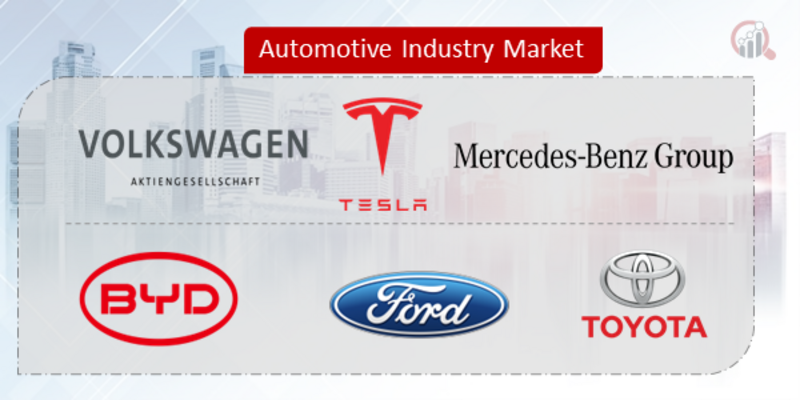
*Disclaimer: List of key companies in no particular order
Global Automotive Industry Detailed Statistics & Performance Analysis
Vehicle Production & Sales Worldwide
Toyota Motor Corporation (JP) maintains undisputed global leadership, with approximately 10.3 million vehicles produced in 2024 and worldwide sales reaching 11.0 million units. The Japanese giant commands roughly 13-14% global market share, with North America representing its largest revenue region at 2.52 million units sold in 2025—a robust 8% year-over-year increase.
Volkswagen AG (DE) ranks second globally with 8.95 million vehicles produced in 2024 and similar sales volumes. Despite trailing Toyota in unit volume, VW historically leads in revenue generation, previously reporting over $318 billion annually. The group maintains strong European dominance while facing headwinds in North America, where combined VW/Audi/Porsche sales reached 571,000 units in 2025.
General Motors Company (US) delivered 6.0 million global sales in 2024, securing its position as the third-largest manufacturer worldwide. GM dominates its home market with 2.85 million U.S. sales in 2025, capturing market leadership through Chevrolet, GMC, Cadillac, and Buick brands. The corporation generates approximately $170-180 billion in annual revenue.
Ford Motor Company (US) moved 4.47 million vehicles globally in 2024, with U.S. sales of 2.20 million units. The Ford F-Series remains America's best-selling vehicle model, anchoring the company's truck-heavy portfolio. Ford's annual revenue typically ranges $165-175 billion.
Hyundai Motor Company (KR)—including Kia—achieved 7.27 million combined sales in 2025, making it the world's third-largest automotive group by volume. Hyundai's U.S. sales surged 8% to 902,000 units, while the group maintains strong presence across Europe and emerging markets.
Honda Motor Co., Ltd. (JP) produced 3.73 million vehicles globally in 2024, with U.S. sales of 1.43 million units. The CR-V and Civic remain volume drivers, though Honda faces margin pressure from delayed electrification.
Nissan Motor Co., Ltd. (JP) recorded 3.35 million global sales in 2024, with U.S. volume of 926,000 units. The company struggles with profitability, posting minimal growth amid restructuring efforts.
BMW AG (DE) and Mercedes-Benz Group (DE) represent the premium segment, delivering 2.45 million and 2.39 million vehicles respectively in 2024. BMW's U.S. sales reached 389,000 units while Mercedes posted 304,000 units. Both maintain superior EBIT margins of 8-12% compared to mass-market competitors.
Profitability & EBIT Margins
The automotive industry faces significant margin compression. OEM EBIT margins peaked in 2023 but declined to approximately 6.2% by 2024, with projections showing further erosion to 4.8% in 2025. By Q3 2025, OEM margins hit 3.9%—down nearly 60% from 2021 peaks.
Conversely, automotive suppliers have reversed historical trends. After decades of trailing OEMs by 1-2 percentage points, supplier EBIT margins now exceed OEMs, reaching 6.4% in Q3 2025 compared to OEMs' 3.9%. Battery and semiconductor suppliers lead this charge with 15-45% revenue CAGR and structurally higher margins.
Regional Sales Distribution
Asia-Pacific dominates global production with 54.9 million units (60% of worldwide output), led by China's 31.3 million vehicles. Europe produced 17.2 million units in 2024 (down 5% YoY), while North America manufactured 19.2 million vehicles.
China represents the largest single market with 31.4 million sales in 2024, followed by the U.S. at 16.3 million units. Japanese and Korean domestic markets contracted 7% and 5.1% respectively in 2024.
Supplier Segment Dynamics
The supplier landscape shows dramatic divergence. Traditional component suppliers face stagnation while battery, semiconductor, and software suppliers capture disproportionate value creation. Chinese suppliers overtook European counterparts in profitability during 2024, reflecting the geographic shift in EV supply chains.
Brand Market Positioning
Toyota and Volkswagen compete for global volume leadership, while GM, Ford, and Stellantis battle for U.S. supremacy. Premium brands (BMW, Mercedes) sacrifice volume for margin, targeting 8-12% EBIT versus 4-6% for mass-market players. Korean manufacturers (Hyundai-Kia) demonstrate the strongest growth trajectory, gaining share across all major markets.
Top listed global companies in the industry are:
- Volkswagen AG
- Mercedes-Benz Group AG
- Ford Motor Company
- Tesla Inc.
- Toyota Motor Corporation
- BYD Company Ltd.
- Hyundai Motor Company
- SAIC Motor Corp Ltd.
- Nissan Motor Co Ltd
- Fiat S.P.A
- General Motors among others

 Noah Malgeri
Co-Founder
Noah Malgeri
Co-Founder

 Peter Groot koerkamp
Account and Business Manager
Peter Groot koerkamp
Account and Business Manager

 Younghwan Choi
Senior Retail Manager
Younghwan Choi
Senior Retail Manager

 Mark Irwin
Management Consultant
Mark Irwin
Management Consultant

 Akif Moroglu
Strategy & Business Development Director
Akif Moroglu
Strategy & Business Development Director

 Guilherme Gomes Martins
Product Management Director
Guilherme Gomes Martins
Product Management Director

 Joseph Aguayo
Sales Operations & Pricing Manager
Joseph Aguayo
Sales Operations & Pricing Manager

 La Terria Dodd
Program Support Specialist
La Terria Dodd
Program Support Specialist

 Rob Kooiker
Group Product Manager HVAC & Fire Protection GMA
Rob Kooiker
Group Product Manager HVAC & Fire Protection GMA

