
Request Free Sample ×

Kindly complete the form below to receive a free sample of this Report

* Please use a valid business email

Leading companies partner with us for data-driven Insights

clients tt-cursor
Hero Background
English
Chinese
French
Japanese
Korean
German
Spanish

Automotive Gear Shift System Market Analysis

ID: MRFR/AT/4714-HCR
100 Pages
Triveni Bhoyar
April 2026

Automotive Gear Shift System Market Research Report By Type (Manual Transmission, Automatic Transmission, Semi-Automatic Transmission, Dual-Clutch Transmission), By Technology (Electronic Gear Shift System, Hydraulic Gear Shift System, Mechanical Gear Shift System), By End Use (Passenger Vehicles, Commercial Vehicles, Two Wheelers), By Component (Gear Lever, Transmission Control Module, Electronic Control Unit, Shift Sensors) and By Regional (North America, Europe, South America, Asia Pacific, Middle East and Africa) - Forecast to 2035

Share:
Download PDF ×

We do not share your information with anyone. However, we may send you emails based on your report interest from time to time. You may contact us at any time to opt-out.

Automotive Gear Shift System Market Infographic
Purchase Options

Market Analysis

In-depth Analysis of Automotive Gear Shift System Market Industry Landscape

The Automotive Gear Shift System Market is significantly influenced by various market factors that play a crucial role in shaping its dynamics. One of the key determinants is the global automotive industry's overall performance, as the gear shift system market is intricately tied to the production and sales of vehicles. Fluctuations in consumer demand for automobiles, influenced by economic conditions, consumer preferences, and regulatory changes, directly impact the market for automotive gear shift systems.

Technological advancements also play a pivotal role in shaping the market landscape. The ongoing development of automated and semi-automated transmission systems has led to a shift in consumer preferences. As more vehicles incorporate advanced features such as automatic transmissions, continuously variable transmissions (CVTs), and dual-clutch transmissions (DCTs), the demand for traditional manual gear shift systems may experience changes. Innovations in materials, manufacturing processes, and design further contribute to the evolution of gear shift systems, influencing market dynamics.

Environmental considerations and regulatory standards are increasingly shaping the automotive industry, and the gear shift system market is no exception. Stringent emissions regulations and a growing emphasis on fuel efficiency have prompted manufacturers to explore new technologies, including hybrid and electric drivetrains. These developments impact the design and functionality of gear shift systems, with a potential shift towards electronic shift-by-wire systems to accommodate electric and hybrid vehicles.

Global economic conditions, including exchange rates, inflation, and trade policies, have a substantial impact on the automotive gear shift system market. As an interconnected global industry, any disruptions in the supply chain can affect the availability and pricing of components, influencing the overall market. Trade tensions and geopolitical factors also contribute to uncertainties, impacting the strategic decisions of market players and potentially altering the competitive landscape.

Consumer behavior and preferences are pivotal market factors. Shifts in demographics, lifestyles, and buying patterns influence the types of vehicles consumers choose, subsequently affecting the demand for specific gear shift systems. Preferences for enhanced driving experiences, increased safety features, and a focus on convenience contribute to the market's dynamism.

The competitive landscape within the automotive gear shift system market is shaped by factors such as industry consolidation, mergers and acquisitions, and partnerships. Companies strive to gain a competitive edge through innovations, cost-effective manufacturing processes, and strategic collaborations. Market leaders invest in research and development to introduce cutting-edge technologies that set them apart in terms of performance, reliability, and efficiency.

Lastly, the aftermarket segment plays a significant role in the automotive gear shift system market. The demand for replacement gear shift components, accessories, and upgrades is influenced by factors like vehicle age, wear and tear, and consumer preferences for customization. Market players often develop aftermarket products to cater to the evolving needs of consumers, contributing to the overall growth and sustainability of the market.

In conclusion, the Automotive Gear Shift System Market is a dynamic and interconnected space influenced by a multitude of factors. The industry's response to technological advancements, regulatory changes, economic conditions, and consumer preferences collectively shape the market's trajectory. Staying attuned to these market factors is crucial for industry players to navigate challenges, capitalize on opportunities, and remain competitive in this ever-evolving landscape.


Author
Author Profile
Triveni Bhoyar
Senior Research Analyst

Triveni Bhoyar has over 5 years of experience in the market research industry, specializing in the Automotive and Aerospace & Defense sectors. She has contributed to 200+ reports, including numerous custom projects for leading global companies, delivering solutions to complex business challenges. Renowned for her ability to generate valuable insights, Triveni excels in addressing unique market dynamics with precision and depth. Her expertise spans market sizing, competitive intelligence, and trend analysis, enabling clients to craft data-driven growth strategies. With strong analytical rigor and a client-centric approach, she plays a pivotal role in driving impactful, strategic decision-making.

Leave a Comment

FAQs

What is the projected market valuation for the Automotive Gear Shift System Market in 2035?

<p>The projected market valuation for the Automotive Gear Shift System Market in 2035 is 27.31 USD Billion.</p>

What was the overall market valuation for the Automotive Gear Shift System Market in 2024?

<p>The overall market valuation for the Automotive Gear Shift System Market in 2024 was 21.59 USD Billion.</p>

What is the expected CAGR for the Automotive Gear Shift System Market during the forecast period 2025 - 2035?

<p>The expected CAGR for the Automotive Gear Shift System Market during the forecast period 2025 - 2035 is 2.16%.</p>

Which segment is projected to have the highest valuation in the Automotive Gear Shift System Market by 2035?

<p>The Automatic Transmission segment is projected to have the highest valuation, expected to reach between 12.0 and 14.0 USD Billion by 2035.</p>

What are the key players in the Automotive Gear Shift System Market?

<p>Key players in the Automotive Gear Shift System Market include ZF Friedrichshafen AG, Aisin Seiki Co., Ltd., and BorgWarner Inc.</p>

How does the Electronic Gear Shift System segment perform in terms of valuation?

<p>The Electronic Gear Shift System segment is expected to grow, with a projected valuation between 10.0 and 12.0 USD Billion by 2035.</p>

What is the valuation range for the Dual-Clutch Transmission segment by 2035?

<p>The Dual-Clutch Transmission segment is projected to reach a valuation between 5.31 and 7.0 USD Billion by 2035.</p>

Which end-use segment is anticipated to dominate the Automotive Gear Shift System Market by 2035?

<p>The Passenger Vehicles segment is anticipated to dominate, with a projected valuation between 11.0 and 13.0 USD Billion by 2035.</p>

What is the expected growth trend for the Mechanical Gear Shift System segment?

<p>The Mechanical Gear Shift System segment is expected to grow, with a projected valuation between 9.81 and 11.0 USD Billion by 2035.</p>

What is the projected valuation for the Transmission Control Module component by 2035?

<p>The Transmission Control Module component is projected to reach a valuation between 5.8 and 7.0 USD Billion by 2035.</p>

Market Summary

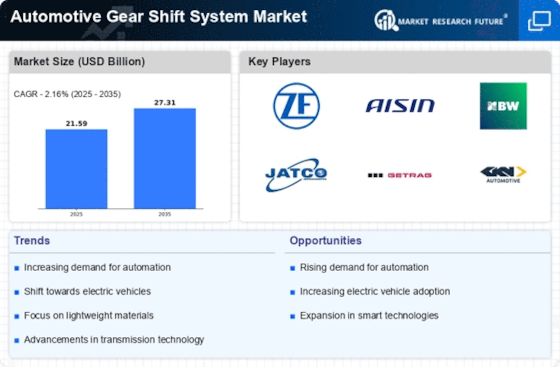
As per Market Research Future analysis, the Automotive Gear Shift System Market Size was estimated at 21.59 USD Billion in 2024. The Automotive Gear Shift System industry is projected to grow from 22.05 USD Billion in 2025 to 27.31 USD Billion by 2035, exhibiting a compound annual growth rate (CAGR) of 2.16% during the forecast period 2025 - 2035

Key Market Trends & Highlights

The Automotive Gear Shift System Market is poised for substantial growth driven by technological advancements and changing consumer preferences.

  • The integration of smart technologies is transforming gear shift systems, enhancing user experience and vehicle performance. Sustainability remains a focal point, with manufacturers increasingly adopting eco-friendly materials and processes in gear shift production. The electric vehicle segment is witnessing rapid advancements, particularly in automatic transmission systems, which dominate the market. Rising demand for advanced driver assistance systems and the growth of electric and hybrid vehicles are key drivers propelling market expansion.

Market Size & Forecast

2024 Market Size 21.59 (USD Billion)
2035 Market Size 27.31 (USD Billion)
CAGR (2025 - 2035) 2.16%
Largest Regional Market Share in 2024 North America

Major Players

ZF Friedrichshafen AG (DE), Aisin Seiki Co., Ltd. (JP), BorgWarner Inc. (US), Jatco Ltd. (JP), Getrag (DE), GKN Automotive (GB), Valeo SA (FR), Continental AG (DE), Magna International Inc. (CA)

Market Trends

The Automotive Gear Shift System Market is currently experiencing a transformative phase, driven by advancements in technology and evolving consumer preferences. The shift towards electric vehicles is reshaping the landscape, as manufacturers increasingly integrate sophisticated gear shift systems that enhance performance and efficiency. This transition appears to be influenced by a growing demand for seamless driving experiences, prompting innovations in automatic and semi-automatic systems. Furthermore, the emphasis on sustainability is likely to propel the development of lightweight materials and energy-efficient designs, which could redefine traditional gear shift mechanisms. In addition to technological advancements, the Automotive Gear Shift System Market is witnessing a notable shift in consumer expectations. As vehicles become more connected, the integration of smart technologies into gear shift systems is becoming more prevalent. This trend suggests that manufacturers are focusing on creating systems that not only improve driving dynamics but also enhance user interaction through intuitive interfaces. The market seems poised for further growth as these trends converge, indicating a future where gear shift systems are not merely functional components but integral parts of the overall driving experience.

Integration of Smart Technologies

The Automotive Gear Shift System Market is increasingly incorporating smart technologies, enhancing user interaction and driving dynamics. This trend reflects a shift towards more intuitive interfaces that cater to modern consumer expectations.

Focus on Sustainability

Sustainability is becoming a central theme in the Automotive Gear Shift System Market, with manufacturers exploring lightweight materials and energy-efficient designs. This focus may lead to innovative solutions that align with environmental goals.

Advancements in Electric Vehicle Systems

The rise of electric vehicles is driving significant changes in the Automotive Gear Shift System Market. Manufacturers are adapting their designs to accommodate the unique requirements of electric drivetrains, potentially leading to new gear shift technologies.

Automotive Gear Shift System Market Market Drivers

Growth of Electric and Hybrid Vehicles

The Automotive Gear Shift System Market is witnessing a transformation due to the rapid growth of electric and hybrid vehicles. These vehicles often utilize unique gear shift systems that differ from traditional internal combustion engines. The increasing adoption of electric vehicles (EVs) is expected to propel the market for specialized gear shift systems designed for optimal performance and efficiency. Reports indicate that the electric vehicle market is anticipated to reach a valuation of over 800 billion by 2027, which will likely necessitate advancements in gear shift technologies to accommodate the specific requirements of EVs. This shift presents a substantial opportunity for manufacturers to innovate and capture a larger market share.

Regulatory Push for Emission Reductions

The Automotive Gear Shift System Market is being shaped by stringent regulatory frameworks aimed at reducing vehicle emissions. Governments worldwide are implementing policies that encourage the adoption of cleaner technologies, which in turn influences the design and functionality of gear shift systems. As manufacturers strive to comply with these regulations, there is a growing emphasis on developing gear shift systems that optimize fuel efficiency and reduce emissions. The market is likely to see an increase in demand for innovative solutions that align with these regulatory requirements. This regulatory push not only drives technological advancements but also creates opportunities for manufacturers to differentiate their products in a competitive landscape.

Technological Advancements in Gear Shift Mechanisms

The Automotive Gear Shift System Market is significantly influenced by ongoing technological advancements in gear shift mechanisms. Innovations such as dual-clutch transmissions and continuously variable transmissions (CVTs) are becoming increasingly prevalent, offering improved efficiency and performance. These advancements not only enhance the driving experience but also contribute to better fuel economy, which is a critical factor for consumers today. The market for these advanced gear shift systems is projected to grow, with estimates suggesting a rise in demand for automated systems that provide smoother transitions and greater control. As manufacturers continue to invest in research and development, the landscape of gear shift technologies is likely to evolve, further driving market growth.

Rising Demand for Advanced Driver Assistance Systems

The Automotive Gear Shift System Market is experiencing a notable surge in demand for advanced driver assistance systems (ADAS). These systems enhance vehicle safety and performance, leading to a growing preference for automatic and semi-automatic gear shift systems. As consumers increasingly prioritize safety features, manufacturers are compelled to innovate and integrate sophisticated gear shift technologies. The market for ADAS is projected to grow significantly, with estimates suggesting a compound annual growth rate of over 20% in the coming years. This trend indicates a shift towards more automated driving experiences, thereby driving the demand for advanced gear shift systems that can seamlessly integrate with these technologies.

Increasing Consumer Preference for Automatic Transmissions

The Automotive Gear Shift System Market is experiencing a shift in consumer preferences, with a marked increase in the demand for automatic transmissions. This trend is largely driven by the convenience and ease of use that automatic systems offer, particularly in urban environments. Data indicates that automatic transmission vehicles account for over 70% of new car sales in many regions, reflecting a significant consumer inclination towards these systems. As a result, manufacturers are focusing on developing more efficient and reliable automatic gear shift systems to meet this growing demand. This shift not only enhances the driving experience but also positions manufacturers to capitalize on the expanding market for automatic transmissions.

Market Segment Insights

By Type: Automatic Transmission (Largest) vs. Manual Transmission (Fastest-Growing)

The Automotive Gear Shift System Market is primarily dominated by the Automatic Transmission segment, which is preferred for its convenience and enhanced driving experience. This segment captures a significant portion of the market share, reflecting the ongoing consumer trend towards comfort and ease of use. In contrast, Manual Transmission, traditionally favored for its driver engagement, is witnessing a resurgence, appealing particularly to enthusiasts seeking a more tactile driving experience. As the automotive industry evolves, the growth trajectory of Manual Transmission is notably impressive, making it the fastest-growing segment currently. This resurgence is driven by a niche market that values the authentic driving experience and advancements in hybrid technology. Consequently, businesses are tailoring their offerings to meet this demand while Automatic Transmission remains a staple for mass-market vehicles, ensuring a balance between tradition and innovation.

Automatic Transmission (Dominant) vs. Semi-Automatic Transmission (Emerging)

In the Automotive Gear Shift System Market, Automatic Transmission maintains its dominance due to its unmatched efficiency and user-friendliness, making it a popular choice among consumers. This type employs intricate hydraulic systems and electronic controls that optimize gear shifts, providing smooth acceleration and improved fuel economy. Conversely, Semi-Automatic Transmission is emerging as a viable alternative, attracting drivers who seek a blend of manual control with the convenience of automation. This innovative system offers the agility of gear selection while minimizing the physical effort required. As automakers introduce more Semi-Automatic options, the competitive landscape is shifting, offering drivers versatility without sacrifice, showcasing a trend towards embracing hybrid technologies that enhance both performance and driving pleasure.

By Technology: Electronic Gear Shift System (Largest) vs. Hydraulic Gear Shift System (Fastest-Growing)

In the Automotive Gear Shift System Market, the Electronic Gear Shift System commands a substantial market share, bolstered by its rising adoption in modern vehicles aimed at enhancing user convenience and driving experience. Meanwhile, the Hydraulic Gear Shift System, though traditionally popular, is witnessing significant growth, particularly in high-performance vehicles where rapid gear changes are essential. This diversity in preference highlights the ongoing evolution within the market, influenced by technological advancements and shifting consumer preferences. The growth trends within the Automotive Gear Shift System Market are primarily driven by the increasing demand for more efficient and responsive gear shifting solutions. Innovations in electronic systems, especially with the integration of driver-assistance technologies, have made them the clear choice for manufacturers aiming for competitive advantage. In contrast, the Hydraulic Gear Shift System is emerging as a favored option for performance-oriented applications, showcasing a trend where manufacturers are keen to combine traditional durability with cutting-edge performance characteristics.

Technology: Electronic Gear Shift System (Dominant) vs. Hydraulic Gear Shift System (Emerging)

The Electronic Gear Shift System stands out as the dominant technology within the Automotive Gear Shift System Market, characterized by its advanced electronic control mechanisms that offer precision and responsiveness. This system not only enhances the driving experience but also improves fuel efficiency by optimizing gear changes in real-time. On the other hand, the Hydraulic Gear Shift System is gaining traction as an emerging technology, particularly in high-performance and luxury vehicles. Its ability to deliver smooth and quick gear shifts under demanding conditions makes it an appealing choice for performance enthusiasts. As manufacturers increasingly seek to balance performance and efficiency, both systems are gaining attention, albeit with distinct advantages suited to different market needs.

By End Use: Passenger Vehicles (Largest) vs. Commercial Vehicles (Fastest-Growing)

In the Automotive Gear Shift System Market, passenger vehicles hold the largest share, driven by the increasing demand for personal mobility and the expansion of global automotive manufacturing. This segment accounts for a significant portion of gear shift system sales as consumer preferences shift towards automatic transmissions, enhancing comfort and convenience in driving. In contrast, commercial vehicles, although smaller in market share, exhibit rapid growth due to the rise in e-commerce and transportation services, leading to increased demand for efficient gear systems in heavy-duty applications.

Passenger Vehicles (Dominant) vs. Commercial Vehicles (Emerging)

Passenger vehicles dominate the automotive gear shift system market as they incorporate advanced transmission technologies that cater to consumer expectations for performance and efficiency. This dominance is attributed to a continuous shift towards automatic transmission systems, which offer ease of use and improved fuel efficiency. Conversely, the commercial vehicle segment is emerging, fueled by the growth of logistics and heavy transport industries, requiring robust gear shift systems designed for performance under demanding conditions. The transition to electric and hybrid vehicles further accelerates innovations in commercial gear shift technologies, making them an appealing option for manufacturers and fleet operators alike.

By Component: Gear Lever (Largest) vs. Transmission Control Module (Fastest-Growing)

In the Automotive Gear Shift System Market, the component values exhibit a varied distribution of market share. The Gear Lever is recognized as the dominant force within this segment due to its critical function in manual and automatic transmission systems. Contrarily, the Transmission Control Module is witnessing a rapid increase in market share, indicating a significant shift towards automation and advanced electronic control in vehicles. These trends highlight consumer preferences for enhanced performance and precision in gear shifting. Growth trends within this segment are primarily driven by the ongoing evolution of automotive technology and the increasing demand for electric and hybrid vehicles. As manufacturers strive to incorporate more sophisticated gear shift systems, the demand for Electronic Control Units and Shift Sensors is also rising. This shift aligns with global trends toward greater fuel efficiency and improved driving experiences, further establishing the market's trajectory toward advanced component integration.

Gear Lever (Dominant) vs. Electronic Control Unit (Emerging)

The Gear Lever remains the dominant component in the Automotive Gear Shift System Market, representing time-tested technology essential for traditional manual transmission systems. With its simplicity and reliability, it caters to a segment of consumers who prefer the tactile feedback and control associated with manual shifting. In contrast, the Electronic Control Unit is emerging as a pivotal component, particularly in newer vehicle models equipped with automatic and semi-automatic transmissions. Offering superior processing capabilities, it enables real-time control of gear shifts, enhancing performance and efficiency. The rising trend towards electronic systems in modern vehicles, prompted by advancements in technology and stricter environmental regulations, is pushing the Electronic Control Unit into a stronger market position, creating a dynamic interplay between traditional and modern automotive technologies.

Get more detailed insights about Automotive Gear Shift System Market Research Report – Forecast to 2035

Regional Insights

The Automotive Gear Shift System Market showcases significant regional diversification, with the total market valued at 21.13 USD Billion in 2023. North America leads this segmentation with a valuation of 8.5 USD Billion in 2023, highlighting its majority holding, primarily driven by advancements in automotive technology and consumer demand for efficient vehicles. Europe follows closely with a valuation of 6.0 USD Billion, emphasizing its strong automotive heritage and focus on regulatory standards promoting innovative gear systems. The APAC region, valued at 4.5 USD Billion, is also critical, benefiting from booming automobile production and rising disposable incomes.

South America and MEA hold smaller shares, with valuations of 1.8 USD Billion and 0.33 USD Billion, respectively; however, these regions present growth opportunities due to increasing vehicle ownership and urbanization trends. Overall, the Automotive Gear Shift System Market segmentation reflects varying regional strengths shaped by local market conditions and consumer preferences, indicating a diversified landscape that is evolving with technological advancements and changing consumer behavior.

Key Players and Competitive Insights

The Automotive Gear Shift System Market is characterized by a dynamic and competitive landscape, driven by technological innovations and shifting consumer preferences. As one of the essential components in the automotive industry, gear shift systems are crucial for enhancing vehicle performance and providing a better driving experience.
The market is influenced by various factors, including the increasing demand for automatic transmission systems, advancements in electric and hybrid vehicles, and stringent emission regulations that are pushing manufacturers to focus on efficiency and sustainability. Competitors in this arena are continually evolving, investing heavily in research and development to produce advanced gear shift systems that cater to various vehicle types and consumer needs. The rise of autonomous vehicles also presents opportunities for innovative gear shifting solutions, pushing companies to remain agile and adaptive in a rapidly changing market environment.
Schaeffler Group has established a strong foothold in the Automotive Gear Shift System Market thanks to its commitment to quality, innovation, and comprehensive product offerings. The company is well-recognized for its advanced engineering capabilities and strong R&D initiatives, enabling it to develop gear shift systems that not only meet but also exceed the performance demands of modern vehicles. Schaeffler's extensive manufacturing capabilities allow for efficient production processes and high-quality output, contributing to its reputation as a trusted supplier in the automotive sector.
The company’s ability to provide tailored solutions enhances its market presence, making Schaeffler Group a key player capable of adapting to the ever-evolving automotive landscape. Furthermore, their strategic partnerships with automakers facilitate collaborative development projects that expand their market reach and penetration.
GKN Automotive is another significant player in the Automotive Gear Shift System Market, renowned for its engineering excellence and innovation. The company specializes in a wide range of automotive components, including advanced gear shift systems designed for various applications and vehicle types. GKN Automotive is recognized for its strong focus on sustainability and efficiency, aligning with global trends towards electrification and improved fuel consumption.
The company leverages its extensive experience in the automotive sector to deliver high-performance products that meet strict regulatory requirements. GKN’s commitment to continuous improvement through technological advancements keeps it at the forefront of competition, making it a reliable partner for automakers seeking state-of-the-art gear shifting solutions. Their well-coordinated global supply chain and robust customer support further enhance their competitive edge, enabling them to maintain a significant presence in the market.

Key Companies in the Automotive Gear Shift System Market include

Industry Developments

  • Q1 2024: Tesla Introduces Voice-Activated Gear Shifter in 2024 Model S and Model X Tesla launched a new voice-activated gear shifter system in its 2024 Model S and Model X vehicles, aiming to enhance user convenience and cabin ergonomics by eliminating traditional gear stalks.

Future Outlook

Automotive Gear Shift System Market Future Outlook

The Automotive Gear Shift System Market is projected to grow at a 2.16% CAGR from 2025 to 2035, driven by technological advancements, increasing vehicle production, and rising consumer demand for automation.

New opportunities lie in:

  • Development of advanced electronic gear shift systems for electric vehicles.
  • Integration of AI-driven predictive maintenance solutions for gear shift systems.
  • Expansion into emerging markets with tailored gear shift solutions for local manufacturers.

By 2035, the market is expected to achieve robust growth, reflecting evolving automotive technologies and consumer preferences.

Market Segmentation

Automotive Gear Shift System Market Type Outlook

  • Manual Transmission
  • Automatic Transmission
  • Semi-Automatic Transmission
  • Dual-Clutch Transmission

Automotive Gear Shift System Market End Use Outlook

  • Passenger Vehicles
  • Commercial Vehicles
  • Two Wheelers

Automotive Gear Shift System Market Component Outlook

  • Gear Lever
  • Transmission Control Module
  • Electronic Control Unit
  • Shift Sensors

Automotive Gear Shift System Market Technology Outlook

  • Electronic Gear Shift System
  • Hydraulic Gear Shift System
  • Mechanical Gear Shift System

Report Scope

MARKET SIZE 2024 21.59(USD Billion)
MARKET SIZE 2025 22.05(USD Billion)
MARKET SIZE 2035 27.31(USD Billion)
COMPOUND ANNUAL GROWTH RATE (CAGR) 2.16% (2025 - 2035)
REPORT COVERAGE Revenue Forecast, Competitive Landscape, Growth Factors, and Trends
BASE YEAR 2024
Market Forecast Period 2025 - 2035
Historical Data 2019 - 2024
Market Forecast Units USD Billion
Key Companies Profiled ZF Friedrichshafen AG (DE), Aisin Seiki Co., Ltd. (JP), BorgWarner Inc. (US), Jatco Ltd. (JP), Getrag (DE), GKN Automotive (GB), Valeo SA (FR), Continental AG (DE), Magna International Inc. (CA)
Segments Covered Type, Technology, End Use, Component, Regional
Key Market Opportunities Integration of advanced automation technologies in the Automotive Gear Shift System Market presents substantial growth opportunities.
Key Market Dynamics Technological advancements in automated gear shift systems drive competitive dynamics and influence consumer preferences in the automotive sector.
Countries Covered North America, Europe, APAC, South America, MEA

FAQs

What is the projected market valuation for the Automotive Gear Shift System Market in 2035?

<p>The projected market valuation for the Automotive Gear Shift System Market in 2035 is 27.31 USD Billion.</p>

What was the overall market valuation for the Automotive Gear Shift System Market in 2024?

<p>The overall market valuation for the Automotive Gear Shift System Market in 2024 was 21.59 USD Billion.</p>

What is the expected CAGR for the Automotive Gear Shift System Market during the forecast period 2025 - 2035?

<p>The expected CAGR for the Automotive Gear Shift System Market during the forecast period 2025 - 2035 is 2.16%.</p>

Which segment is projected to have the highest valuation in the Automotive Gear Shift System Market by 2035?

<p>The Automatic Transmission segment is projected to have the highest valuation, expected to reach between 12.0 and 14.0 USD Billion by 2035.</p>

What are the key players in the Automotive Gear Shift System Market?

<p>Key players in the Automotive Gear Shift System Market include ZF Friedrichshafen AG, Aisin Seiki Co., Ltd., and BorgWarner Inc.</p>

How does the Electronic Gear Shift System segment perform in terms of valuation?

<p>The Electronic Gear Shift System segment is expected to grow, with a projected valuation between 10.0 and 12.0 USD Billion by 2035.</p>

What is the valuation range for the Dual-Clutch Transmission segment by 2035?

<p>The Dual-Clutch Transmission segment is projected to reach a valuation between 5.31 and 7.0 USD Billion by 2035.</p>

Which end-use segment is anticipated to dominate the Automotive Gear Shift System Market by 2035?

<p>The Passenger Vehicles segment is anticipated to dominate, with a projected valuation between 11.0 and 13.0 USD Billion by 2035.</p>

What is the expected growth trend for the Mechanical Gear Shift System segment?

<p>The Mechanical Gear Shift System segment is expected to grow, with a projected valuation between 9.81 and 11.0 USD Billion by 2035.</p>

What is the projected valuation for the Transmission Control Module component by 2035?

<p>The Transmission Control Module component is projected to reach a valuation between 5.8 and 7.0 USD Billion by 2035.</p>

  1. SECTION I: EXECUTIVE SUMMARY AND KEY HIGHLIGHTS
    1. | 1.1 EXECUTIVE SUMMARY
    2. | | 1.1.1 Market Overview
    3. | | 1.1.2 Key Findings
    4. | | 1.1.3 Market Segmentation
    5. | | 1.1.4 Competitive Landscape
    6. | | 1.1.5 Challenges and Opportunities
    7. | | 1.1.6 Future Outlook
  2. SECTION II: SCOPING, METHODOLOGY AND MARKET STRUCTURE
    1. | 2.1 MARKET INTRODUCTION
    2. | | 2.1.1 Definition
    3. | | 2.1.2 Scope of the study
    4. | | | 2.1.2.1 Research Objective
    5. | | | 2.1.2.2 Assumption
    6. | | | 2.1.2.3 Limitations
    7. | 2.2 RESEARCH METHODOLOGY
    8. | | 2.2.1 Overview
    9. | | 2.2.2 Data Mining
    10. | | 2.2.3 Secondary Research
    11. | | 2.2.4 Primary Research
    12. | | | 2.2.4.1 Primary Interviews and Information Gathering Process
    13. | | | 2.2.4.2 Breakdown of Primary Respondents
    14. | | 2.2.5 Forecasting Model
    15. | | 2.2.6 Market Size Estimation
    16. | | | 2.2.6.1 Bottom-Up Approach
    17. | | | 2.2.6.2 Top-Down Approach
    18. | | 2.2.7 Data Triangulation
    19. | | 2.2.8 Validation
  3. SECTION III: QUALITATIVE ANALYSIS
    1. | 3.1 MARKET DYNAMICS
    2. | | 3.1.1 Overview
    3. | | 3.1.2 Drivers
    4. | | 3.1.3 Restraints
    5. | | 3.1.4 Opportunities
    6. | 3.2 MARKET FACTOR ANALYSIS
    7. | | 3.2.1 Value chain Analysis
    8. | | 3.2.2 Porter's Five Forces Analysis
    9. | | | 3.2.2.1 Bargaining Power of Suppliers
    10. | | | 3.2.2.2 Bargaining Power of Buyers
    11. | | | 3.2.2.3 Threat of New Entrants
    12. | | | 3.2.2.4 Threat of Substitutes
    13. | | | 3.2.2.5 Intensity of Rivalry
    14. | | 3.2.3 COVID-19 Impact Analysis
    15. | | | 3.2.3.1 Market Impact Analysis
    16. | | | 3.2.3.2 Regional Impact
    17. | | | 3.2.3.3 Opportunity and Threat Analysis
  4. SECTION IV: QUANTITATIVE ANALYSIS
    1. | 4.1 Automobile, BY Type (USD Billion)
    2. | | 4.1.1 Manual Transmission
    3. | | 4.1.2 Automatic Transmission
    4. | | 4.1.3 Semi-Automatic Transmission
    5. | | 4.1.4 Dual-Clutch Transmission
    6. | 4.2 Automobile, BY Technology (USD Billion)
    7. | | 4.2.1 Electronic Gear Shift System
    8. | | 4.2.2 Hydraulic Gear Shift System
    9. | | 4.2.3 Mechanical Gear Shift System
    10. | 4.3 Automobile, BY End Use (USD Billion)
    11. | | 4.3.1 Passenger Vehicles
    12. | | 4.3.2 Commercial Vehicles
    13. | | 4.3.3 Two Wheelers
    14. | 4.4 Automobile, BY Component (USD Billion)
    15. | | 4.4.1 Gear Lever
    16. | | 4.4.2 Transmission Control Module
    17. | | 4.4.3 Electronic Control Unit
    18. | | 4.4.4 Shift Sensors
    19. | 4.5 Automobile, BY Region (USD Billion)
    20. | | 4.5.1 North America
    21. | | | 4.5.1.1 US
    22. | | | 4.5.1.2 Canada
    23. | | 4.5.2 Europe
    24. | | | 4.5.2.1 Germany
    25. | | | 4.5.2.2 UK
    26. | | | 4.5.2.3 France
    27. | | | 4.5.2.4 Russia
    28. | | | 4.5.2.5 Italy
    29. | | | 4.5.2.6 Spain
    30. | | | 4.5.2.7 Rest of Europe
    31. | | 4.5.3 APAC
    32. | | | 4.5.3.1 China
    33. | | | 4.5.3.2 India
    34. | | | 4.5.3.3 Japan
    35. | | | 4.5.3.4 South Korea
    36. | | | 4.5.3.5 Malaysia
    37. | | | 4.5.3.6 Thailand
    38. | | | 4.5.3.7 Indonesia
    39. | | | 4.5.3.8 Rest of APAC
    40. | | 4.5.4 South America
    41. | | | 4.5.4.1 Brazil
    42. | | | 4.5.4.2 Mexico
    43. | | | 4.5.4.3 Argentina
    44. | | | 4.5.4.4 Rest of South America
    45. | | 4.5.5 MEA
    46. | | | 4.5.5.1 GCC Countries
    47. | | | 4.5.5.2 South Africa
    48. | | | 4.5.5.3 Rest of MEA
  5. SECTION V: COMPETITIVE ANALYSIS
    1. | 5.1 Competitive Landscape
    2. | | 5.1.1 Overview
    3. | | 5.1.2 Competitive Analysis
    4. | | 5.1.3 Market share Analysis
    5. | | 5.1.4 Major Growth Strategy in the Automobile
    6. | | 5.1.5 Competitive Benchmarking
    7. | | 5.1.6 Leading Players in Terms of Number of Developments in the Automobile
    8. | | 5.1.7 Key developments and growth strategies
    9. | | | 5.1.7.1 New Product Launch/Service Deployment
    10. | | | 5.1.7.2 Merger & Acquisitions
    11. | | | 5.1.7.3 Joint Ventures
    12. | | 5.1.8 Major Players Financial Matrix
    13. | | | 5.1.8.1 Sales and Operating Income
    14. | | | 5.1.8.2 Major Players R&D Expenditure. 2023
    15. | 5.2 Company Profiles
    16. | | 5.2.1 ZF Friedrichshafen AG (DE)
    17. | | | 5.2.1.1 Financial Overview
    18. | | | 5.2.1.2 Products Offered
    19. | | | 5.2.1.3 Key Developments
    20. | | | 5.2.1.4 SWOT Analysis
    21. | | | 5.2.1.5 Key Strategies
    22. | | 5.2.2 Aisin Seiki Co., Ltd. (JP)
    23. | | | 5.2.2.1 Financial Overview
    24. | | | 5.2.2.2 Products Offered
    25. | | | 5.2.2.3 Key Developments
    26. | | | 5.2.2.4 SWOT Analysis
    27. | | | 5.2.2.5 Key Strategies
    28. | | 5.2.3 BorgWarner Inc. (US)
    29. | | | 5.2.3.1 Financial Overview
    30. | | | 5.2.3.2 Products Offered
    31. | | | 5.2.3.3 Key Developments
    32. | | | 5.2.3.4 SWOT Analysis
    33. | | | 5.2.3.5 Key Strategies
    34. | | 5.2.4 Jatco Ltd. (JP)
    35. | | | 5.2.4.1 Financial Overview
    36. | | | 5.2.4.2 Products Offered
    37. | | | 5.2.4.3 Key Developments
    38. | | | 5.2.4.4 SWOT Analysis
    39. | | | 5.2.4.5 Key Strategies
    40. | | 5.2.5 Getrag (DE)
    41. | | | 5.2.5.1 Financial Overview
    42. | | | 5.2.5.2 Products Offered
    43. | | | 5.2.5.3 Key Developments
    44. | | | 5.2.5.4 SWOT Analysis
    45. | | | 5.2.5.5 Key Strategies
    46. | | 5.2.6 GKN Automotive (GB)
    47. | | | 5.2.6.1 Financial Overview
    48. | | | 5.2.6.2 Products Offered
    49. | | | 5.2.6.3 Key Developments
    50. | | | 5.2.6.4 SWOT Analysis
    51. | | | 5.2.6.5 Key Strategies
    52. | | 5.2.7 Valeo SA (FR)
    53. | | | 5.2.7.1 Financial Overview
    54. | | | 5.2.7.2 Products Offered
    55. | | | 5.2.7.3 Key Developments
    56. | | | 5.2.7.4 SWOT Analysis
    57. | | | 5.2.7.5 Key Strategies
    58. | | 5.2.8 Continental AG (DE)
    59. | | | 5.2.8.1 Financial Overview
    60. | | | 5.2.8.2 Products Offered
    61. | | | 5.2.8.3 Key Developments
    62. | | | 5.2.8.4 SWOT Analysis
    63. | | | 5.2.8.5 Key Strategies
    64. | | 5.2.9 Magna International Inc. (CA)
    65. | | | 5.2.9.1 Financial Overview
    66. | | | 5.2.9.2 Products Offered
    67. | | | 5.2.9.3 Key Developments
    68. | | | 5.2.9.4 SWOT Analysis
    69. | | | 5.2.9.5 Key Strategies
    70. | 5.3 Appendix
    71. | | 5.3.1 References
    72. | | 5.3.2 Related Reports
  6. LIST OF FIGURES
    1. | 6.1 MARKET SYNOPSIS
    2. | 6.2 NORTH AMERICA MARKET ANALYSIS
    3. | 6.3 US MARKET ANALYSIS BY TYPE
    4. | 6.4 US MARKET ANALYSIS BY TECHNOLOGY
    5. | 6.5 US MARKET ANALYSIS BY END USE
    6. | 6.6 US MARKET ANALYSIS BY COMPONENT
    7. | 6.7 CANADA MARKET ANALYSIS BY TYPE
    8. | 6.8 CANADA MARKET ANALYSIS BY TECHNOLOGY
    9. | 6.9 CANADA MARKET ANALYSIS BY END USE
    10. | 6.10 CANADA MARKET ANALYSIS BY COMPONENT
    11. | 6.11 EUROPE MARKET ANALYSIS
    12. | 6.12 GERMANY MARKET ANALYSIS BY TYPE
    13. | 6.13 GERMANY MARKET ANALYSIS BY TECHNOLOGY
    14. | 6.14 GERMANY MARKET ANALYSIS BY END USE
    15. | 6.15 GERMANY MARKET ANALYSIS BY COMPONENT
    16. | 6.16 UK MARKET ANALYSIS BY TYPE
    17. | 6.17 UK MARKET ANALYSIS BY TECHNOLOGY
    18. | 6.18 UK MARKET ANALYSIS BY END USE
    19. | 6.19 UK MARKET ANALYSIS BY COMPONENT
    20. | 6.20 FRANCE MARKET ANALYSIS BY TYPE
    21. | 6.21 FRANCE MARKET ANALYSIS BY TECHNOLOGY
    22. | 6.22 FRANCE MARKET ANALYSIS BY END USE
    23. | 6.23 FRANCE MARKET ANALYSIS BY COMPONENT
    24. | 6.24 RUSSIA MARKET ANALYSIS BY TYPE
    25. | 6.25 RUSSIA MARKET ANALYSIS BY TECHNOLOGY
    26. | 6.26 RUSSIA MARKET ANALYSIS BY END USE
    27. | 6.27 RUSSIA MARKET ANALYSIS BY COMPONENT
    28. | 6.28 ITALY MARKET ANALYSIS BY TYPE
    29. | 6.29 ITALY MARKET ANALYSIS BY TECHNOLOGY
    30. | 6.30 ITALY MARKET ANALYSIS BY END USE
    31. | 6.31 ITALY MARKET ANALYSIS BY COMPONENT
    32. | 6.32 SPAIN MARKET ANALYSIS BY TYPE
    33. | 6.33 SPAIN MARKET ANALYSIS BY TECHNOLOGY
    34. | 6.34 SPAIN MARKET ANALYSIS BY END USE
    35. | 6.35 SPAIN MARKET ANALYSIS BY COMPONENT
    36. | 6.36 REST OF EUROPE MARKET ANALYSIS BY TYPE
    37. | 6.37 REST OF EUROPE MARKET ANALYSIS BY TECHNOLOGY
    38. | 6.38 REST OF EUROPE MARKET ANALYSIS BY END USE
    39. | 6.39 REST OF EUROPE MARKET ANALYSIS BY COMPONENT
    40. | 6.40 APAC MARKET ANALYSIS
    41. | 6.41 CHINA MARKET ANALYSIS BY TYPE
    42. | 6.42 CHINA MARKET ANALYSIS BY TECHNOLOGY
    43. | 6.43 CHINA MARKET ANALYSIS BY END USE
    44. | 6.44 CHINA MARKET ANALYSIS BY COMPONENT
    45. | 6.45 INDIA MARKET ANALYSIS BY TYPE
    46. | 6.46 INDIA MARKET ANALYSIS BY TECHNOLOGY
    47. | 6.47 INDIA MARKET ANALYSIS BY END USE
    48. | 6.48 INDIA MARKET ANALYSIS BY COMPONENT
    49. | 6.49 JAPAN MARKET ANALYSIS BY TYPE
    50. | 6.50 JAPAN MARKET ANALYSIS BY TECHNOLOGY
    51. | 6.51 JAPAN MARKET ANALYSIS BY END USE
    52. | 6.52 JAPAN MARKET ANALYSIS BY COMPONENT
    53. | 6.53 SOUTH KOREA MARKET ANALYSIS BY TYPE
    54. | 6.54 SOUTH KOREA MARKET ANALYSIS BY TECHNOLOGY
    55. | 6.55 SOUTH KOREA MARKET ANALYSIS BY END USE
    56. | 6.56 SOUTH KOREA MARKET ANALYSIS BY COMPONENT
    57. | 6.57 MALAYSIA MARKET ANALYSIS BY TYPE
    58. | 6.58 MALAYSIA MARKET ANALYSIS BY TECHNOLOGY
    59. | 6.59 MALAYSIA MARKET ANALYSIS BY END USE
    60. | 6.60 MALAYSIA MARKET ANALYSIS BY COMPONENT
    61. | 6.61 THAILAND MARKET ANALYSIS BY TYPE
    62. | 6.62 THAILAND MARKET ANALYSIS BY TECHNOLOGY
    63. | 6.63 THAILAND MARKET ANALYSIS BY END USE
    64. | 6.64 THAILAND MARKET ANALYSIS BY COMPONENT
    65. | 6.65 INDONESIA MARKET ANALYSIS BY TYPE
    66. | 6.66 INDONESIA MARKET ANALYSIS BY TECHNOLOGY
    67. | 6.67 INDONESIA MARKET ANALYSIS BY END USE
    68. | 6.68 INDONESIA MARKET ANALYSIS BY COMPONENT
    69. | 6.69 REST OF APAC MARKET ANALYSIS BY TYPE
    70. | 6.70 REST OF APAC MARKET ANALYSIS BY TECHNOLOGY
    71. | 6.71 REST OF APAC MARKET ANALYSIS BY END USE
    72. | 6.72 REST OF APAC MARKET ANALYSIS BY COMPONENT
    73. | 6.73 SOUTH AMERICA MARKET ANALYSIS
    74. | 6.74 BRAZIL MARKET ANALYSIS BY TYPE
    75. | 6.75 BRAZIL MARKET ANALYSIS BY TECHNOLOGY
    76. | 6.76 BRAZIL MARKET ANALYSIS BY END USE
    77. | 6.77 BRAZIL MARKET ANALYSIS BY COMPONENT
    78. | 6.78 MEXICO MARKET ANALYSIS BY TYPE
    79. | 6.79 MEXICO MARKET ANALYSIS BY TECHNOLOGY
    80. | 6.80 MEXICO MARKET ANALYSIS BY END USE
    81. | 6.81 MEXICO MARKET ANALYSIS BY COMPONENT
    82. | 6.82 ARGENTINA MARKET ANALYSIS BY TYPE
    83. | 6.83 ARGENTINA MARKET ANALYSIS BY TECHNOLOGY
    84. | 6.84 ARGENTINA MARKET ANALYSIS BY END USE
    85. | 6.85 ARGENTINA MARKET ANALYSIS BY COMPONENT
    86. | 6.86 REST OF SOUTH AMERICA MARKET ANALYSIS BY TYPE
    87. | 6.87 REST OF SOUTH AMERICA MARKET ANALYSIS BY TECHNOLOGY
    88. | 6.88 REST OF SOUTH AMERICA MARKET ANALYSIS BY END USE
    89. | 6.89 REST OF SOUTH AMERICA MARKET ANALYSIS BY COMPONENT
    90. | 6.90 MEA MARKET ANALYSIS
    91. | 6.91 GCC COUNTRIES MARKET ANALYSIS BY TYPE
    92. | 6.92 GCC COUNTRIES MARKET ANALYSIS BY TECHNOLOGY
    93. | 6.93 GCC COUNTRIES MARKET ANALYSIS BY END USE
    94. | 6.94 GCC COUNTRIES MARKET ANALYSIS BY COMPONENT
    95. | 6.95 SOUTH AFRICA MARKET ANALYSIS BY TYPE
    96. | 6.96 SOUTH AFRICA MARKET ANALYSIS BY TECHNOLOGY
    97. | 6.97 SOUTH AFRICA MARKET ANALYSIS BY END USE
    98. | 6.98 SOUTH AFRICA MARKET ANALYSIS BY COMPONENT
    99. | 6.99 REST OF MEA MARKET ANALYSIS BY TYPE
    100. | 6.100 REST OF MEA MARKET ANALYSIS BY TECHNOLOGY
    101. | 6.101 REST OF MEA MARKET ANALYSIS BY END USE
    102. | 6.102 REST OF MEA MARKET ANALYSIS BY COMPONENT
    103. | 6.103 KEY BUYING CRITERIA OF AUTOMOBILE
    104. | 6.104 RESEARCH PROCESS OF MRFR
    105. | 6.105 DRO ANALYSIS OF AUTOMOBILE
    106. | 6.106 DRIVERS IMPACT ANALYSIS: AUTOMOBILE
    107. | 6.107 RESTRAINTS IMPACT ANALYSIS: AUTOMOBILE
    108. | 6.108 SUPPLY / VALUE CHAIN: AUTOMOBILE
    109. | 6.109 AUTOMOBILE, BY TYPE, 2024 (% SHARE)
    110. | 6.110 AUTOMOBILE, BY TYPE, 2024 TO 2035 (USD Billion)
    111. | 6.111 AUTOMOBILE, BY TECHNOLOGY, 2024 (% SHARE)
    112. | 6.112 AUTOMOBILE, BY TECHNOLOGY, 2024 TO 2035 (USD Billion)
    113. | 6.113 AUTOMOBILE, BY END USE, 2024 (% SHARE)
    114. | 6.114 AUTOMOBILE, BY END USE, 2024 TO 2035 (USD Billion)
    115. | 6.115 AUTOMOBILE, BY COMPONENT, 2024 (% SHARE)
    116. | 6.116 AUTOMOBILE, BY COMPONENT, 2024 TO 2035 (USD Billion)
    117. | 6.117 BENCHMARKING OF MAJOR COMPETITORS
  7. LIST OF TABLES
    1. | 7.1 LIST OF ASSUMPTIONS
    2. | | 7.1.1
    3. | 7.2 North America MARKET SIZE ESTIMATES; FORECAST
    4. | | 7.2.1 BY TYPE, 2025-2035 (USD Billion)
    5. | | 7.2.2 BY TECHNOLOGY, 2025-2035 (USD Billion)
    6. | | 7.2.3 BY END USE, 2025-2035 (USD Billion)
    7. | | 7.2.4 BY COMPONENT, 2025-2035 (USD Billion)
    8. | 7.3 US MARKET SIZE ESTIMATES; FORECAST
    9. | | 7.3.1 BY TYPE, 2025-2035 (USD Billion)
    10. | | 7.3.2 BY TECHNOLOGY, 2025-2035 (USD Billion)
    11. | | 7.3.3 BY END USE, 2025-2035 (USD Billion)
    12. | | 7.3.4 BY COMPONENT, 2025-2035 (USD Billion)
    13. | 7.4 Canada MARKET SIZE ESTIMATES; FORECAST
    14. | | 7.4.1 BY TYPE, 2025-2035 (USD Billion)
    15. | | 7.4.2 BY TECHNOLOGY, 2025-2035 (USD Billion)
    16. | | 7.4.3 BY END USE, 2025-2035 (USD Billion)
    17. | | 7.4.4 BY COMPONENT, 2025-2035 (USD Billion)
    18. | 7.5 Europe MARKET SIZE ESTIMATES; FORECAST
    19. | | 7.5.1 BY TYPE, 2025-2035 (USD Billion)
    20. | | 7.5.2 BY TECHNOLOGY, 2025-2035 (USD Billion)
    21. | | 7.5.3 BY END USE, 2025-2035 (USD Billion)
    22. | | 7.5.4 BY COMPONENT, 2025-2035 (USD Billion)
    23. | 7.6 Germany MARKET SIZE ESTIMATES; FORECAST
    24. | | 7.6.1 BY TYPE, 2025-2035 (USD Billion)
    25. | | 7.6.2 BY TECHNOLOGY, 2025-2035 (USD Billion)
    26. | | 7.6.3 BY END USE, 2025-2035 (USD Billion)
    27. | | 7.6.4 BY COMPONENT, 2025-2035 (USD Billion)
    28. | 7.7 UK MARKET SIZE ESTIMATES; FORECAST
    29. | | 7.7.1 BY TYPE, 2025-2035 (USD Billion)
    30. | | 7.7.2 BY TECHNOLOGY, 2025-2035 (USD Billion)
    31. | | 7.7.3 BY END USE, 2025-2035 (USD Billion)
    32. | | 7.7.4 BY COMPONENT, 2025-2035 (USD Billion)
    33. | 7.8 France MARKET SIZE ESTIMATES; FORECAST
    34. | | 7.8.1 BY TYPE, 2025-2035 (USD Billion)
    35. | | 7.8.2 BY TECHNOLOGY, 2025-2035 (USD Billion)
    36. | | 7.8.3 BY END USE, 2025-2035 (USD Billion)
    37. | | 7.8.4 BY COMPONENT, 2025-2035 (USD Billion)
    38. | 7.9 Russia MARKET SIZE ESTIMATES; FORECAST
    39. | | 7.9.1 BY TYPE, 2025-2035 (USD Billion)
    40. | | 7.9.2 BY TECHNOLOGY, 2025-2035 (USD Billion)
    41. | | 7.9.3 BY END USE, 2025-2035 (USD Billion)
    42. | | 7.9.4 BY COMPONENT, 2025-2035 (USD Billion)
    43. | 7.10 Italy MARKET SIZE ESTIMATES; FORECAST
    44. | | 7.10.1 BY TYPE, 2025-2035 (USD Billion)
    45. | | 7.10.2 BY TECHNOLOGY, 2025-2035 (USD Billion)
    46. | | 7.10.3 BY END USE, 2025-2035 (USD Billion)
    47. | | 7.10.4 BY COMPONENT, 2025-2035 (USD Billion)
    48. | 7.11 Spain MARKET SIZE ESTIMATES; FORECAST
    49. | | 7.11.1 BY TYPE, 2025-2035 (USD Billion)
    50. | | 7.11.2 BY TECHNOLOGY, 2025-2035 (USD Billion)
    51. | | 7.11.3 BY END USE, 2025-2035 (USD Billion)
    52. | | 7.11.4 BY COMPONENT, 2025-2035 (USD Billion)
    53. | 7.12 Rest of Europe MARKET SIZE ESTIMATES; FORECAST
    54. | | 7.12.1 BY TYPE, 2025-2035 (USD Billion)
    55. | | 7.12.2 BY TECHNOLOGY, 2025-2035 (USD Billion)
    56. | | 7.12.3 BY END USE, 2025-2035 (USD Billion)
    57. | | 7.12.4 BY COMPONENT, 2025-2035 (USD Billion)
    58. | 7.13 APAC MARKET SIZE ESTIMATES; FORECAST
    59. | | 7.13.1 BY TYPE, 2025-2035 (USD Billion)
    60. | | 7.13.2 BY TECHNOLOGY, 2025-2035 (USD Billion)
    61. | | 7.13.3 BY END USE, 2025-2035 (USD Billion)
    62. | | 7.13.4 BY COMPONENT, 2025-2035 (USD Billion)
    63. | 7.14 China MARKET SIZE ESTIMATES; FORECAST
    64. | | 7.14.1 BY TYPE, 2025-2035 (USD Billion)
    65. | | 7.14.2 BY TECHNOLOGY, 2025-2035 (USD Billion)
    66. | | 7.14.3 BY END USE, 2025-2035 (USD Billion)
    67. | | 7.14.4 BY COMPONENT, 2025-2035 (USD Billion)
    68. | 7.15 India MARKET SIZE ESTIMATES; FORECAST
    69. | | 7.15.1 BY TYPE, 2025-2035 (USD Billion)
    70. | | 7.15.2 BY TECHNOLOGY, 2025-2035 (USD Billion)
    71. | | 7.15.3 BY END USE, 2025-2035 (USD Billion)
    72. | | 7.15.4 BY COMPONENT, 2025-2035 (USD Billion)
    73. | 7.16 Japan MARKET SIZE ESTIMATES; FORECAST
    74. | | 7.16.1 BY TYPE, 2025-2035 (USD Billion)
    75. | | 7.16.2 BY TECHNOLOGY, 2025-2035 (USD Billion)
    76. | | 7.16.3 BY END USE, 2025-2035 (USD Billion)
    77. | | 7.16.4 BY COMPONENT, 2025-2035 (USD Billion)
    78. | 7.17 South Korea MARKET SIZE ESTIMATES; FORECAST
    79. | | 7.17.1 BY TYPE, 2025-2035 (USD Billion)
    80. | | 7.17.2 BY TECHNOLOGY, 2025-2035 (USD Billion)
    81. | | 7.17.3 BY END USE, 2025-2035 (USD Billion)
    82. | | 7.17.4 BY COMPONENT, 2025-2035 (USD Billion)
    83. | 7.18 Malaysia MARKET SIZE ESTIMATES; FORECAST
    84. | | 7.18.1 BY TYPE, 2025-2035 (USD Billion)
    85. | | 7.18.2 BY TECHNOLOGY, 2025-2035 (USD Billion)
    86. | | 7.18.3 BY END USE, 2025-2035 (USD Billion)
    87. | | 7.18.4 BY COMPONENT, 2025-2035 (USD Billion)
    88. | 7.19 Thailand MARKET SIZE ESTIMATES; FORECAST
    89. | | 7.19.1 BY TYPE, 2025-2035 (USD Billion)
    90. | | 7.19.2 BY TECHNOLOGY, 2025-2035 (USD Billion)
    91. | | 7.19.3 BY END USE, 2025-2035 (USD Billion)
    92. | | 7.19.4 BY COMPONENT, 2025-2035 (USD Billion)
    93. | 7.20 Indonesia MARKET SIZE ESTIMATES; FORECAST
    94. | | 7.20.1 BY TYPE, 2025-2035 (USD Billion)
    95. | | 7.20.2 BY TECHNOLOGY, 2025-2035 (USD Billion)
    96. | | 7.20.3 BY END USE, 2025-2035 (USD Billion)
    97. | | 7.20.4 BY COMPONENT, 2025-2035 (USD Billion)
    98. | 7.21 Rest of APAC MARKET SIZE ESTIMATES; FORECAST
    99. | | 7.21.1 BY TYPE, 2025-2035 (USD Billion)
    100. | | 7.21.2 BY TECHNOLOGY, 2025-2035 (USD Billion)
    101. | | 7.21.3 BY END USE, 2025-2035 (USD Billion)
    102. | | 7.21.4 BY COMPONENT, 2025-2035 (USD Billion)
    103. | 7.22 South America MARKET SIZE ESTIMATES; FORECAST
    104. | | 7.22.1 BY TYPE, 2025-2035 (USD Billion)
    105. | | 7.22.2 BY TECHNOLOGY, 2025-2035 (USD Billion)
    106. | | 7.22.3 BY END USE, 2025-2035 (USD Billion)
    107. | | 7.22.4 BY COMPONENT, 2025-2035 (USD Billion)
    108. | 7.23 Brazil MARKET SIZE ESTIMATES; FORECAST
    109. | | 7.23.1 BY TYPE, 2025-2035 (USD Billion)
    110. | | 7.23.2 BY TECHNOLOGY, 2025-2035 (USD Billion)
    111. | | 7.23.3 BY END USE, 2025-2035 (USD Billion)
    112. | | 7.23.4 BY COMPONENT, 2025-2035 (USD Billion)
    113. | 7.24 Mexico MARKET SIZE ESTIMATES; FORECAST
    114. | | 7.24.1 BY TYPE, 2025-2035 (USD Billion)
    115. | | 7.24.2 BY TECHNOLOGY, 2025-2035 (USD Billion)
    116. | | 7.24.3 BY END USE, 2025-2035 (USD Billion)
    117. | | 7.24.4 BY COMPONENT, 2025-2035 (USD Billion)
    118. | 7.25 Argentina MARKET SIZE ESTIMATES; FORECAST
    119. | | 7.25.1 BY TYPE, 2025-2035 (USD Billion)
    120. | | 7.25.2 BY TECHNOLOGY, 2025-2035 (USD Billion)
    121. | | 7.25.3 BY END USE, 2025-2035 (USD Billion)
    122. | | 7.25.4 BY COMPONENT, 2025-2035 (USD Billion)
    123. | 7.26 Rest of South America MARKET SIZE ESTIMATES; FORECAST
    124. | | 7.26.1 BY TYPE, 2025-2035 (USD Billion)
    125. | | 7.26.2 BY TECHNOLOGY, 2025-2035 (USD Billion)
    126. | | 7.26.3 BY END USE, 2025-2035 (USD Billion)
    127. | | 7.26.4 BY COMPONENT, 2025-2035 (USD Billion)
    128. | 7.27 MEA MARKET SIZE ESTIMATES; FORECAST
    129. | | 7.27.1 BY TYPE, 2025-2035 (USD Billion)
    130. | | 7.27.2 BY TECHNOLOGY, 2025-2035 (USD Billion)
    131. | | 7.27.3 BY END USE, 2025-2035 (USD Billion)
    132. | | 7.27.4 BY COMPONENT, 2025-2035 (USD Billion)
    133. | 7.28 GCC Countries MARKET SIZE ESTIMATES; FORECAST
    134. | | 7.28.1 BY TYPE, 2025-2035 (USD Billion)
    135. | | 7.28.2 BY TECHNOLOGY, 2025-2035 (USD Billion)
    136. | | 7.28.3 BY END USE, 2025-2035 (USD Billion)
    137. | | 7.28.4 BY COMPONENT, 2025-2035 (USD Billion)
    138. | 7.29 South Africa MARKET SIZE ESTIMATES; FORECAST
    139. | | 7.29.1 BY TYPE, 2025-2035 (USD Billion)
    140. | | 7.29.2 BY TECHNOLOGY, 2025-2035 (USD Billion)
    141. | | 7.29.3 BY END USE, 2025-2035 (USD Billion)
    142. | | 7.29.4 BY COMPONENT, 2025-2035 (USD Billion)
    143. | 7.30 Rest of MEA MARKET SIZE ESTIMATES; FORECAST
    144. | | 7.30.1 BY TYPE, 2025-2035 (USD Billion)
    145. | | 7.30.2 BY TECHNOLOGY, 2025-2035 (USD Billion)
    146. | | 7.30.3 BY END USE, 2025-2035 (USD Billion)
    147. | | 7.30.4 BY COMPONENT, 2025-2035 (USD Billion)
    148. | 7.31 PRODUCT LAUNCH/PRODUCT DEVELOPMENT/APPROVAL
    149. | | 7.31.1
    150. | 7.32 ACQUISITION/PARTNERSHIP
    151. | | 7.32.1

Automobile Market Segmentation

Automobile By Type (USD Billion, 2025-2035)

  • Manual Transmission
  • Automatic Transmission
  • Semi-Automatic Transmission
  • Dual-Clutch Transmission

Automobile By Technology (USD Billion, 2025-2035)

  • Electronic Gear Shift System
  • Hydraulic Gear Shift System
  • Mechanical Gear Shift System

Automobile By End Use (USD Billion, 2025-2035)

  • Passenger Vehicles
  • Commercial Vehicles
  • Two Wheelers

Automobile By Component (USD Billion, 2025-2035)

  • Gear Lever
  • Transmission Control Module
  • Electronic Control Unit
  • Shift Sensors
Infographic

Free Sample Request

Kindly complete the form below to receive a free sample of this Report

Get Free Sample

Customer Strories

Compare Licence

×
Features License Type
Single User Multiuser License Enterprise User
Price $4,950 $5,950 $7,250
Maximum User Access Limit 1 User Upto 10 Users Unrestricted Access Throughout the Organization
Free Customization
Direct Access to Analyst
Deliverable Format
Platform Access
Discount on Next Purchase 10% 15% 15%
Printable Versions
%>