×
Request Free Sample ×

Kindly complete the form below to receive a free sample of this Report

* Please use a valid business email

Leading companies partner with us for data-driven Insights

clients tt-cursor
Hero Background
English
Chinese
French
Japanese
Korean
German
Spanish

Automotive Friction Brake System Market Trends

ID: MRFR/AT/1595-HCR
100 Pages
Sejal Akre
October 2025

Automotive Friction Brake System Market by Product Type (Disc Brake, Drum Brake), Vehicle Type (Passenger Cars, LCV, HCV), Sales Channel (OEM’s, Aftermarket) and Region (North America, South America, Asia-Pacific, Europe and Africa & Middle East) – Forecast to 2035

Share:
Download PDF ×

We do not share your information with anyone. However, we may send you emails based on your report interest from time to time. You may contact us at any time to opt-out.

Automotive Friction Brake System Market Infographic
×
Automotive Friction Brake System Market Infographic Full View
Purchase Options

Market Trends

Key Emerging Trends in the Automotive Friction Brake System Market

In the dynamic automotive industry, the friction brake system market is witnessing notable trends driven by technological advancements, safety regulations, and changing consumer preferences. Friction brake systems, crucial for vehicle safety, have undergone significant developments to enhance performance, durability, and efficiency. One prominent trend in this market is the increasing demand for disc brakes over traditional drum brakes. Disc brakes offer superior stopping power, heat dissipation, and are better suited for high-performance vehicles, contributing to their growing popularity among consumers.

Moreover, the growing emphasis on vehicle safety standards and regulations worldwide is driving the adoption of advanced braking technologies. Governments and regulatory bodies are mandating the implementation of safety features such as anti-lock braking systems (ABS), electronic stability control (ESC), and autonomous emergency braking (AEB) systems. These regulations are pushing automotive manufacturers to integrate advanced friction brake systems with electronic components to improve vehicle safety and reduce the risk of accidents.

Additionally, there is a rising trend towards lightweight materials and designs in friction brake systems to enhance fuel efficiency and reduce emissions. Manufacturers are exploring innovative materials such as carbon-ceramic composites and aluminum alloys to develop lighter and more durable brake components. These lightweight brake systems not only contribute to improved vehicle performance but also align with the industry's efforts towards sustainability and environmental conservation.

Furthermore, the increasing demand for electric vehicles (EVs) and hybrid electric vehicles (HEVs) is influencing the friction brake system market. Unlike internal combustion engine vehicles, EVs and HEVs utilize regenerative braking systems that harness kinetic energy during deceleration to recharge the battery. As a result, there is a shift towards integrating regenerative braking systems with traditional friction brakes to optimize energy recovery and extend the vehicle's range. This trend presents new opportunities for brake system manufacturers to develop innovative solutions tailored to the unique requirements of electric and hybrid vehicles.

In terms of regional trends, Asia Pacific is emerging as a significant market for automotive friction brake systems, driven by the rapid growth of the automotive industry in countries like China, India, and Japan. Rising vehicle production, increasing disposable income, and urbanization are fueling the demand for passenger cars and commercial vehicles equipped with advanced braking technologies. Similarly, North America and Europe remain key markets for friction brake systems, characterized by stringent safety regulations and a strong focus on vehicle performance and innovation.

Despite the promising outlook, the friction brake system market faces several challenges, including intense competition, pricing pressures, and supply chain disruptions. Automotive manufacturers are under pressure to reduce costs while maintaining high-quality standards, leading to increased consolidation and partnerships within the industry. Moreover, the ongoing global semiconductor shortage has impacted the production of electronic components used in advanced braking systems, affecting supply chains and production schedules.

In conclusion, the automotive friction brake system market is undergoing significant transformations driven by technological advancements, safety regulations, and evolving consumer preferences. The adoption of advanced braking technologies, lightweight materials, and integration with electronic systems are reshaping the landscape of the automotive industry. As the automotive industry continues to evolve towards electrification and automation, friction brake system manufacturers must innovate and adapt to meet the changing demands of vehicle manufacturers and consumers while ensuring safety, performance, and sustainability.

Author
Sejal Akre
Senior Research Analyst

She has over 5 years of rich experience, in market research and consulting providing valuable market insights to client. Hands on expertise in management consulting, and extensive knowledge in domain including ICT, Automotive & Transportation and Aerospace & Defense. She is skilled in Go-to market strategy, industry analysis, market sizing, in depth company profiling, competitive intelligence & benchmarking and value chain amongst others.

Leave a Comment

FAQs

What is the forecast year of growth of the market?

The market’s growth is 45,600 Million USD entitled for the year 2030.

What are the key players of the market mentioned in the study?

Brembo S.P.A, Akebono Braking Industry Corporation, Continental AG are the key players of the market mentioned in the study.

What are the regions included in the market’s study?

North America, Europe, APAC, and Africa & Middle-East are the key regions included in the market’s study.

What are the key segments included in the market?

by Product, by Vehicle, by sales channel

Which region to account the largest share?

North-America region is to account the largest share in the Global Automotive Friction Brake System market.

Market Summary

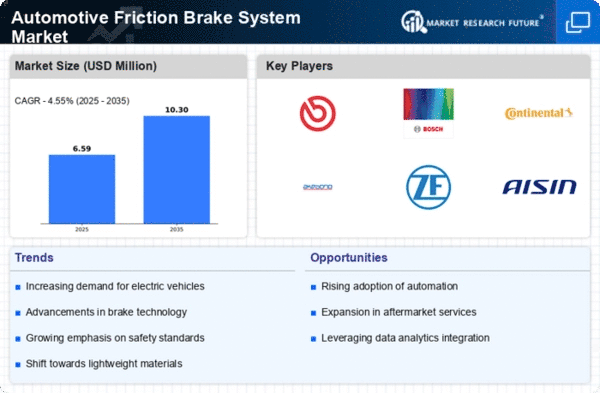
As per MRFR analysis, the Automotive Friction Brake System Market Size was estimated at 6.3 USD Million in 2024. The Automotive Friction Brake System industry is projected to grow from 6.6 in 2025 to 10.3 by 2035, exhibiting a compound annual growth rate (CAGR) of 4.55 during the forecast period 2025 - 2035.

Key Market Trends & Highlights

The Automotive Friction Brake System Market is poised for substantial growth driven by technological advancements and evolving consumer preferences.

  • Technological advancements in brake systems are reshaping the Automotive Friction Brake System Market, particularly in North America.
  • Sustainability initiatives are gaining traction, influencing the adoption of ceramic brake materials in the fastest-growing segments.
  • The adaptation to electric vehicles is driving demand for innovative braking solutions, especially in the commercial vehicle sector.
  • Key market drivers include rising demand for electric vehicles and a growing focus on vehicle safety and performance, particularly in the Asia-Pacific region.

Market Size & Forecast

2024 Market Size 6.3 (USD Million)
2035 Market Size 10.3 (USD Million)
CAGR (2025 - 2035) 4.55%
Largest Regional Market Share in 2024 North America

Major Players

<p>Brembo (IT), Bosch (DE), Continental (DE), Akebono Brake Industry (JP), TRW Automotive (US), Aisin Seiki (JP), Nisshinbo Holdings (JP), Haldex (SE), Mando Corporation (KR)</p>

Market Trends

The Automotive Friction Brake System Market is currently experiencing a transformative phase, driven by advancements in technology and increasing safety regulations. Manufacturers are focusing on enhancing the performance and durability of brake systems, which is crucial for meeting the demands of modern vehicles. Innovations such as electronic brake systems and regenerative braking are gaining traction, as they offer improved efficiency and reduced wear. Furthermore, the growing emphasis on sustainability is prompting companies to explore eco-friendly materials and processes in brake system production. This shift not only aligns with environmental goals but also appeals to a more conscious consumer base. In addition to technological advancements, the Automotive Friction Brake System Market is influenced by changing consumer preferences and regulatory frameworks. As electric and hybrid vehicles become more prevalent, the need for specialized braking solutions is becoming apparent. This trend suggests a potential shift in market dynamics, as traditional brake systems may need to adapt to the unique requirements of these vehicles. Overall, the market appears poised for growth, with a focus on innovation, sustainability, and adaptability to emerging automotive trends.

Technological Advancements

The Automotive Friction Brake System Market is witnessing rapid technological innovations, particularly in the realm of electronic and regenerative braking systems. These advancements enhance vehicle performance and safety, while also contributing to energy efficiency.

Sustainability Initiatives

There is a growing trend towards sustainability within the Automotive Friction Brake System Market, as manufacturers increasingly adopt eco-friendly materials and processes. This shift not only addresses environmental concerns but also meets the expectations of environmentally conscious consumers.

Adaptation to Electric Vehicles

As electric and hybrid vehicles gain popularity, the Automotive Friction Brake System Market is adapting to meet the specific needs of these vehicles. This adaptation may lead to the development of specialized braking solutions that cater to the unique characteristics of electric drivetrains.

Automotive Friction Brake System Market Market Drivers

Market Growth Projections

The Global Automotive Friction Brakes System Market Industry is poised for substantial growth, with projections indicating a market size of 59315.5 USD Million by 2035. This growth trajectory suggests a robust demand for innovative braking solutions, driven by advancements in technology and increasing vehicle production. The anticipated compound annual growth rate of 100.57% from 2025 to 2035 underscores the dynamic nature of this market, highlighting the potential for significant investment and development in automotive braking systems.

Increasing Vehicle Production

The Global Automotive Friction Brakes System Market Industry is closely tied to the rising production of vehicles worldwide. As automotive manufacturers ramp up production to meet consumer demand, the need for reliable braking systems becomes paramount. This trend is particularly evident in emerging markets, where vehicle ownership is on the rise. The projected growth in vehicle production is expected to drive the demand for friction brake systems, contributing to a market valuation of 59315.5 USD Million by 2035. This increase highlights the essential role of braking systems in ensuring vehicle safety and performance.

Growing Demand for Electric Vehicles

The Global Automotive Friction Brakes System Market Industry is experiencing a paradigm shift with the growing demand for electric vehicles (EVs). As the automotive landscape evolves, the braking systems in EVs require specialized designs to accommodate unique performance characteristics. This shift presents opportunities for manufacturers to innovate and develop braking solutions tailored for electric drivetrains. The increasing adoption of EVs is likely to contribute to the overall market growth, as these vehicles often require advanced braking technologies to enhance efficiency and safety, further expanding the market's potential.

Regulatory Compliance and Safety Standards

The Global Automotive Friction Brakes System Market Industry is significantly influenced by stringent regulatory compliance and safety standards. Governments worldwide are implementing rigorous regulations to enhance vehicle safety, which directly impacts the design and manufacturing of braking systems. Compliance with these standards necessitates the adoption of advanced technologies and materials, thereby driving innovation in the market. As a result, manufacturers are compelled to invest in research and development to meet these requirements, fostering a competitive landscape that could lead to a compound annual growth rate of 100.57% from 2025 to 2035.

Technological Advancements in Brake Systems

The Global Automotive Friction Brakes System Market Industry is witnessing rapid technological advancements, particularly in materials and design. Innovations such as carbon-ceramic brakes and advanced composites are enhancing performance and durability. These developments not only improve braking efficiency but also contribute to weight reduction, which is crucial for fuel efficiency. As manufacturers increasingly adopt these technologies, the market is expected to grow significantly. In 2024, the market is projected to reach 28.1 USD Million, indicating a robust demand for high-performance braking systems that meet stringent safety standards.

Consumer Awareness and Demand for Safety Features

The Global Automotive Friction Brakes System Market Industry is being propelled by heightened consumer awareness regarding vehicle safety features. As consumers become more informed about the importance of braking systems, there is a growing demand for advanced safety technologies, including anti-lock braking systems and electronic stability control. This trend is influencing manufacturers to prioritize the development of high-quality friction brake systems that meet consumer expectations. The increasing focus on safety is expected to drive market growth, as consumers are willing to invest in vehicles equipped with superior braking technologies.

Market Segment Insights

By Application: Passenger Vehicle (Largest) vs. Commercial Vehicle (Fastest-Growing)

<p>The Automotive Friction Brake System Market exhibits a diverse application segment, with the passenger vehicle category commanding the largest share. This dominance is primarily driven by the high volume of passenger vehicles on the road and the essential need for effective braking systems in ensuring safety. The commercial vehicle segment, while smaller in share, is witnessing rapid growth, propelled by increasing demands in logistics and transportation sectors, leading manufacturers to innovate in brake system technology.</p>

<p>Passenger Vehicle (Dominant) vs. Commercial Vehicle (Emerging)</p>

<p>Passenger vehicles dominate the automotive friction brake system market due to their extensive usage globally. These vehicles require advanced braking solutions to enhance safety and performance, prompting major automakers to invest in innovative brake technologies. In contrast, the commercial vehicle segment is emerging as a significant player, experiencing growth due to the growing logistics and delivery service industries. Advances in materials and design for commercial braking systems are also contributing to this segment's evolution, emphasizing safety and efficiency. As regulations tighten and performance expectations rise, both segments are likely to see shifts in technology adoption, shaping future market dynamics.</p>

By Friction Material Type: Semi-Metallic (Largest) vs. Ceramic (Fastest-Growing)

<p>In the Automotive Friction Brake System Market, the segment values for Friction Material Type are dominated by semi-metallic materials, which are known for their superior performance and durability. Organic materials, while still holding a significant share, have been gradually surpassed by the growing preference for semi-metallic options. Ceramic materials are now witnessing a rapid rise in market adoption due to their low dust emissions and reduced noise, carving out a notable share in the market.</p>

<p>Friction Material: Semi-Metallic (Dominant) vs. Ceramic (Emerging)</p>

<p>Semi-metallic brake pads continue to be the dominant choice in the automotive sector due to their excellent heat dissipation, consistent performance, and versatile applications across various vehicle types. These materials typically incorporate a blend of metallic fibers and other compounds, enhancing their braking efficacy, especially in high-performance vehicles. On the other hand, ceramic brake pads are emerging rapidly, appealing to environmentally-conscious consumers with their quieter operation and lower environmental impact. As automakers strive for improved fuel efficiency and reduced emissions, the trend towards ceramic options is expected to accelerate, positioning it as a significant competitor in the market.</p>

By Brake Type: Disc Brake (Largest) vs. Drum Brake (Fastest-Growing)

<p>The Automotive Friction Brake System Market showcases a diverse range of brake types, with the disc brake dominating the landscape due to its superior performance characteristics and widespread adoption in modern vehicles. The disc brake's robust design and effective heat dissipation properties contribute to its leadership in market share among brake types. Conversely, the drum brake, while historically less favored in newer vehicle designs, is witnessing a resurgence, particularly in cost-sensitive segments and certain hybrid vehicle applications where its simplicity and lower manufacturing costs shine.</p>

<p>Brake Type: Disc Brake (Dominant) vs. Drum Brake (Emerging)</p>

<p>Disc brakes, characterized by their high-performance capabilities, are favored in both passenger and commercial vehicles for their reliability and effective heat management. They provide better stopping power and are less prone to fade under extreme conditions compared to drum brakes. On the other hand, drum brakes, which are starting to emerge in various markets, are appreciated for their simplicity and cost-effectiveness, especially in lower-end or niche vehicles. As consumers and manufacturers move towards more affordable braking solutions, drum brakes are experiencing growth, notably in hybrid vehicles where weight and cost efficiency are crucial.</p>

By Vehicle Type: Internal Combustion Engine (Largest) vs. Electric Vehicle (Fastest-Growing)

<p>In the Automotive Friction Brake System Market, Internal Combustion Engine (ICE) vehicles hold the largest share, driven by the longstanding dominance of traditional vehicles in everyday transportation. The familiarity and widespread adoption of ICE vehicles have established a strong foundation for the friction brake system demand, ensuring its relevance in the market. Conversely, Electric Vehicles (EVs) are gaining traction rapidly, appealing to environmentally conscious consumers and benefiting from advancements in battery technology, which enhance their performance and autonomy. As the automotive landscape shifts towards more sustainable options, Hybrid Vehicles are also emerging as significant competitors, bridging the gap between ICE and EVs. This segment experiences steady growth fueled by manufacturers' strategic push for eco-friendly solutions and consumers' increasing preference for energy-efficient driving. The combination of traditional and innovative technologies positions the market for further evolution, with forecasts indicating a potential shift in dominance as more consumers transition to electric and hybrid options.</p>

<p>Internal Combustion Engine (Dominant) vs. Electric Vehicle (Emerging)</p>

<p>The Internal Combustion Engine (ICE) segment remains dominant in the Automotive Friction Brake System Market due to its established infrastructure and consumer acceptance. This segment's strength lies in its extensive production capabilities and the availability of parts, ensuring reliability and performance consistency. On the other hand, Electric Vehicles (EVs) represent an emerging force, driven by technological advancements and the global shift towards sustainability. The EV segment benefits from innovative brake technologies like regenerative braking, which increase energy efficiency. Both segments are at crucial junctures, with ICE vehicles focusing on efficiency improvements, while EVs gain momentum from increasing consumer demand and supportive government policies aimed at reducing emissions.</p>

By End User: OEM (Largest) vs. Aftermarket (Fastest-Growing)

<p>In the Automotive Friction Brake System Market, the distribution of market share among end-user segments reveals a clear leadership by the OEM sector. Original Equipment Manufacturers traditionally dominate, due to their extensive partnerships with automotive producers, ensuring that they supply the majority of friction brake systems required for newly manufactured vehicles. Conversely, the aftermarket segment has been witnessing significant growth, driven by increasing vehicle longevity and the demand for replacement parts, resulting in a broader consumer base willing to invest in aftermarket solutions.</p>

<p>Aftermarket (Emerging) vs. OEM (Dominant)</p>

<p>The OEM segment is characterized by its established presence and reliability, providing high-quality components integrated into vehicles at the manufacturing stage. OEM products usually adhere to stringent quality standards, benefiting from warranties and performance guarantees that attract car manufacturers. On the other hand, the aftermarket segment is emerging strongly, fueled by the rising number of vehicles on the road and greater consumer awareness of the benefits of upgrading or replacing brake systems. Aftermarket products often offer diverse pricing options and innovative solutions, catering to a variety of consumer preferences, which positions them as a dynamic force within the market.</p>

Get more detailed insights about Automotive Friction Brake System Market Research Report – Forecast to 2035

Regional Insights

North America : Market Leader in Innovation

North America is poised to maintain its leadership in the Automotive Friction Brake System market, holding a significant market share of 3.15 billion. The region's growth is driven by increasing vehicle production, stringent safety regulations, and a shift towards electric vehicles (EVs). The demand for advanced braking technologies is further fueled by consumer preferences for safety and performance, alongside government incentives for EV adoption. The competitive landscape is robust, with key players like Brembo, Bosch, and TRW Automotive leading the charge. The U.S. remains the largest market, supported by a strong automotive manufacturing base and innovation in braking technologies. The presence of major automotive OEMs and a growing aftermarket segment contribute to the region's dynamic market environment.

Europe : Regulatory-Driven Market Growth

Europe's Automotive Friction Brake System market is valued at 1.8 billion, driven by stringent environmental regulations and a strong push for sustainability. The European Union's focus on reducing CO2 emissions has catalyzed the development of eco-friendly braking systems, enhancing market growth. Additionally, the increasing adoption of hybrid and electric vehicles is reshaping demand dynamics, with consumers prioritizing energy efficiency and safety features. Leading countries such as Germany, France, and the UK are at the forefront of this transformation, with major players like Bosch and Continental investing heavily in R&D. The competitive landscape is characterized by innovation and collaboration among manufacturers, ensuring compliance with evolving regulations. The European market is expected to continue its upward trajectory as it embraces advanced braking technologies.

Asia-Pacific : Emerging Market Potential

The Asia-Pacific region, with a market size of 1.2 billion, is rapidly emerging as a key player in the Automotive Friction Brake System market. The growth is primarily driven by increasing vehicle production, urbanization, and rising disposable incomes. Countries like China and India are witnessing a surge in automotive sales, leading to heightened demand for advanced braking systems. Additionally, government initiatives to enhance road safety are propelling market expansion. China stands out as the largest market in the region, with significant investments in automotive manufacturing and technology. Key players such as Akebono Brake Industry and Aisin Seiki are actively expanding their presence to cater to the growing demand. The competitive landscape is evolving, with local manufacturers gaining traction alongside established global brands, fostering innovation and cost competitiveness.

Middle East and Africa : Untapped Market Opportunities

The Middle East and Africa region, with a market size of 0.15 billion, presents untapped opportunities in the Automotive Friction Brake System market. The growth is driven by increasing vehicle ownership, urbanization, and infrastructure development. Governments are investing in road safety initiatives, which are expected to boost demand for advanced braking systems. The region's automotive market is gradually evolving, with a focus on enhancing safety standards and performance. Countries like South Africa and the UAE are leading the charge, with a growing number of automotive manufacturers establishing operations. The competitive landscape is characterized by a mix of local and international players, including Mando Corporation and Haldex. As the region continues to develop, the demand for innovative braking solutions is anticipated to rise, creating a favorable environment for market growth.

Key Players and Competitive Insights

The Automotive Friction Brake System Market is characterized by a competitive landscape that is increasingly shaped by innovation, strategic partnerships, and a focus on sustainability. Key players such as Brembo (Italy), Bosch (Germany), and Akebono Brake Industry (Japan) are actively pursuing strategies that enhance their market positioning. Brembo (Italy), known for its high-performance braking systems, emphasizes innovation through advanced materials and technology, while Bosch (Germany) leverages its extensive R&D capabilities to integrate digital solutions into its braking systems. Akebono Brake Industry (Japan) focuses on expanding its footprint in electric vehicle (EV) braking solutions, indicating a shift towards meeting the demands of a rapidly evolving automotive landscape.

The market structure appears moderately fragmented, with several players vying for market share. Key business tactics include localizing manufacturing to reduce costs and optimize supply chains. This approach not only enhances operational efficiency but also allows companies to respond swiftly to regional market demands. The collective influence of these major players contributes to a dynamic competitive environment, where agility and responsiveness are paramount.

In November 2025, Bosch (Germany) announced a strategic partnership with a leading EV manufacturer to develop next-generation braking systems tailored for electric vehicles. This collaboration is significant as it positions Bosch at the forefront of the EV market, aligning with the growing trend towards electrification in the automotive sector. By integrating advanced braking technologies, Bosch aims to enhance vehicle safety and performance, thereby solidifying its competitive edge.

In October 2025, Brembo (Italy) unveiled a new line of lightweight brake components designed to improve vehicle efficiency and reduce emissions. This initiative reflects Brembo's commitment to sustainability and innovation, as lighter components contribute to overall vehicle performance. The introduction of these products is likely to attract environmentally conscious consumers and manufacturers, further enhancing Brembo's market presence.

In September 2025, Akebono Brake Industry (Japan) expanded its production capabilities in North America by investing in a new manufacturing facility. This move is indicative of Akebono's strategy to localize production and meet the increasing demand for high-quality braking systems in the region. The facility is expected to enhance supply chain reliability and reduce lead times, which are critical factors in maintaining competitiveness in the automotive sector.

As of December 2025, the competitive trends in the Automotive Friction Brake System Market are increasingly defined by digitalization, sustainability, and the integration of artificial intelligence (AI) into manufacturing processes. Strategic alliances are becoming more prevalent, as companies recognize the need to collaborate in order to innovate and meet evolving consumer demands. The shift from price-based competition to a focus on technological advancement and supply chain reliability is evident, suggesting that future competitive differentiation will hinge on the ability to innovate and adapt to changing market conditions.

Key Companies in the Automotive Friction Brake System Market include

Industry Developments

All passenger cars and light commercial vehicles run on a hydraulic automotive friction brakes system. This braking system works well in passenger cars with light construction and low overall weight. Additionally, hydraulic automotive friction brakes systems are the most accessible systems to repair due to the readily available brake parts in the aftermarket. The Asia Pacific is the largest hydraulic brake market. As the hydraulic brake market is directly linked to vehicle production, China and India are expected to hold the most significant market shares in the Asia Pacific.

Also, the Asian Pacific region is the second-fastest-growing hydraulic brake market, considering the growing adoption of hydraulic brakes in passenger cars and light commercial vehicles.

In July 2019, Continental and Knorr-Bremse entered into a partnership toward highly automated commercial vehicle driving for automated platooning (i.e., driving in a column). The cooperation partners show with this Platooning Demonstrator what driving functions they can develop for automated driving jointly with the vehicle manufacturers. It includes the formation of platoons, driving together, the emergency braking function, exiting by individual vehicles, and safe splitting up of the entire platoon.

In March 2020, ZF launched an industry-first Front Electric Park Brake, extending the range of Electric Park Brake (EPB) systems to a broader range of vehicles. The solution equips car manufacturers to equip smaller vehicles with an advanced braking system and design their interior without the classic handbrake lever or park brake pedal.

In November 2020, TRW's (ZF's aftermarket brand) market product portfolio for the independent aftermarket was expanded in the two-piece brake disc segment. These brake discs are also available for various Mercedes-Benz C- and E-Class models.

Future Outlook

Automotive Friction Brake System Market Future Outlook

<p>The Automotive Friction Brake System Market is projected to grow at a 4.55% CAGR from 2024 to 2035, driven by advancements in technology, increasing vehicle production, and stringent safety regulations.</p>

New opportunities lie in:

  • <p>Development of advanced ceramic brake pads for enhanced performance</p>
  • <p>Integration of regenerative braking systems in electric vehicles</p>
  • <p>Expansion of aftermarket services for brake system maintenance</p>

<p>By 2035, the market is expected to achieve robust growth, reflecting evolving automotive technologies and consumer demands.</p>

Market Segmentation

Automotive Friction Brake System Market End User Outlook

  • OEM
  • Aftermarket

Automotive Friction Brake System Market Brake Type Outlook

  • Disc Brake
  • Drum Brake
  • Regenerative Brake

Automotive Friction Brake System Market Application Outlook

  • Passenger Vehicle
  • Commercial Vehicle
  • Two-Wheeler
  • Heavy-Duty Vehicle

Automotive Friction Brake System Market Vehicle Type Outlook

  • Internal Combustion Engine
  • Electric Vehicle
  • Hybrid Vehicle

Automotive Friction Brake System Market Friction Material Type Outlook

  • Organic
  • Semi-Metallic
  • Ceramic
  • Metallic

Report Scope

MARKET SIZE 20246.3(USD Million)
MARKET SIZE 20256.6(USD Million)
MARKET SIZE 203510.3(USD Million)
COMPOUND ANNUAL GROWTH RATE (CAGR)4.55% (2024 - 2035)
REPORT COVERAGERevenue Forecast, Competitive Landscape, Growth Factors, and Trends
BASE YEAR2024
Market Forecast Period2025 - 2035
Historical Data2019 - 2024
Market Forecast UnitsUSD Million
Key Companies ProfiledBrembo (IT), Bosch (DE), Continental (DE), Akebono Brake Industry (JP), TRW Automotive (US), Aisin Seiki (JP), Nisshinbo Holdings (JP), Haldex (SE), Mando Corporation (KR)
Segments CoveredApplication, Friction Material Type, Brake Type, Vehicle Type, End User
Key Market OpportunitiesIntegration of advanced materials and smart technologies enhances performance in the Automotive Friction Brake System Market.
Key Market DynamicsTechnological advancements in materials and design are reshaping the Automotive Friction Brake System market dynamics.
Countries CoveredNorth America, Europe, APAC, South America, MEA

FAQs

What is the forecast year of growth of the market?

The market’s growth is 45,600 Million USD entitled for the year 2030.

What are the key players of the market mentioned in the study?

Brembo S.P.A, Akebono Braking Industry Corporation, Continental AG are the key players of the market mentioned in the study.

What are the regions included in the market’s study?

North America, Europe, APAC, and Africa &amp; Middle-East are the key regions included in the market’s study.

What are the key segments included in the market?

by Product, by Vehicle, by sales channel

Which region to account the largest share?

North-America region is to account the largest share in the Global Automotive Friction Brake System market.

  1. SECTION I: EXECUTIVE SUMMARY AND KEY HIGHLIGHTS
    1. | 1.1 EXECUTIVE SUMMARY
  2. SECTION II: SCOPING, METHODOLOGY AND MARKET STRUCTURE
    1. | 2.1 MARKET INTRODUCTION
    2. | 2.2 RESEARCH METHODOLOGY
  3. SECTION III: QUALITATIVE ANALYSIS
    1. | 3.1 MARKET DYNAMICS
    2. | 3.2 MARKET FACTOR ANALYSIS
  4. SECTION IV: QUANTITATIVE ANALYSIS
    1. | 4.1 Automobile, BY Application (USD Million)
    2. | 4.2 Automobile, BY Friction Material Type (USD Million)
    3. | 4.3 Automobile, BY Brake Type (USD Million)
    4. | 4.4 Automobile, BY Vehicle Type (USD Million)
    5. | 4.5 Automobile, BY End User (USD Million)
    6. | 4.6 Automobile, BY Region (USD Million)
  5. SECTION V: COMPETITIVE ANALYSIS
    1. | 5.1 Competitive Landscape
    2. | 5.2 Company Profiles
    3. | 5.3 Appendix

Automotive Friction Brake System Market Segmentation

Market Segmentation Overview

  • Detailed segmentation data will be available in the full report
  • Comprehensive analysis by multiple parameters
  • Regional and country-level breakdowns
  • Market size forecasts by segment
Infographic

Free Sample Request

Kindly complete the form below to receive a free sample of this Report

Get Free Sample

Customer Strories

Compare Licence

×
Features License Type
Single User Multiuser License Enterprise User
Price $4,950 $5,950 $7,250
Maximum User Access Limit 1 User Upto 10 Users Unrestricted Access Throughout the Organization
Free Customization
Direct Access to Analyst
Deliverable Format
Platform Access
Discount on Next Purchase 10% 15% 15%
Printable Versions