
Request Free Sample ×

Kindly complete the form below to receive a free sample of this Report

* Please use a valid business email

Leading companies partner with us for data-driven Insights

clients tt-cursor
Hero Background
English
Chinese
French
Japanese
Korean
German
Spanish

Automotive Fleet Leasing Market Analysis

ID: MRFR/AT/2942-CR
111 Pages
Triveni Bhoyar
October 2020

Automotive Fleet Leasing Market Research Report Information By Lease Type (Open Ended, and Close Ended), By Vehicle Type (Passenger Cars, LCV, and HCV), By Passenger Cars Type (SUV’s, Hatchback, and Sedan), And By Region (North America, Europe, Asia-Pacific, And Rest Of The World) - Growth & Industry Forecast to 2035

Share:
Download PDF ×

We do not share your information with anyone. However, we may send you emails based on your report interest from time to time. You may contact us at any time to opt-out.

Automotive Fleet Leasing Market Infographic
Purchase Options

Market Analysis

In-depth Analysis of Automotive Fleet Leasing Market Industry Landscape

The burgeoning demand for leased cars is poised to propel the growth of the leasing market significantly in the forecast period. The market exhibits immense growth potential, driven by a surge in the preference for leased vehicles, particularly among corporations opting for operating leases, which present an advantageous off-balance-sheet exposure.

As corporate entities increasingly gravitate towards operating leases, the vehicle leasing market stands to benefit from the associated advantages and expanded market opportunities. Operating leases, with their off-balance-sheet exposure, offer corporations a strategic financial approach that aligns with their operational needs and objectives.

According to data from the British Vehicle Rental and Leasing Association (BVRLA), the total fleet membership witnessed a noteworthy 5% increase, reaching a substantial 4.71 million vehicles. This upswing in fleet membership reflects a growing trend towards leasing solutions. The numerical growth in the total fleet was marked by a 5.4% increase in the number of vehicles in 2016, with a specific focus on Light Commercial Vehicles (LCVs), which experienced a commendable 3.9% growth. Moreover, the Heavy Goods Vehicle (HGV) sector exhibited an even more pronounced percentage rise, registering a substantial 6.1% growth.

The surge in leased car demand is driven by several factors contributing to the attractiveness of leasing arrangements for both businesses and individuals. Operating leases, in particular, offer lessees flexibility and financial advantages. By opting for operating leases, businesses can access a fleet of vehicles without the burden of ownership, enjoying the benefits of usage without the accompanying capital investment and associated risks.

The growing preference for leased cars is also fueled by the evolving nature of corporate strategies, with an increasing emphasis on optimizing financial structures and resource allocation. Operating leases align with this trend by providing a cost-effective solution that allows businesses to maintain financial agility, ultimately contributing to their overall efficiency and competitiveness in the market.

In conclusion, the escalating demand for leased cars is a key driver propelling the growth of the leasing market. The shift towards operating leases, underscored by the advantageous off-balance-sheet exposure they offer, positions the market for substantial expansion. The data from BVRLA reinforces this trend, portraying a significant increase in fleet membership and a growing appetite for leasing solutions across various vehicle segments, particularly in the corporate sector. As the demand for leased cars continues to rise, the leasing market is poised for robust growth in the foreseeable future.


Author
Author Profile
Triveni Bhoyar
Senior Research Analyst

Triveni Bhoyar has over 5 years of experience in the market research industry, specializing in the Automotive and Aerospace & Defense sectors. She has contributed to 200+ reports, including numerous custom projects for leading global companies, delivering solutions to complex business challenges. Renowned for her ability to generate valuable insights, Triveni excels in addressing unique market dynamics with precision and depth. Her expertise spans market sizing, competitive intelligence, and trend analysis, enabling clients to craft data-driven growth strategies. With strong analytical rigor and a client-centric approach, she plays a pivotal role in driving impactful, strategic decision-making.

Leave a Comment

FAQs

What is the current valuation of the Automotive Fleet Leasing Market?

<p>The Automotive Fleet Leasing Market was valued at 27.9 USD Billion in 2024.</p>

What is the projected market size for the Automotive Fleet Leasing Market by 2035?

<p>The market is projected to reach 53.18 USD Billion by 2035.</p>

What is the expected CAGR for the Automotive Fleet Leasing Market during the forecast period?

<p>The expected CAGR for the market from 2025 to 2035 is 6.04%.</p>

Which companies are considered key players in the Automotive Fleet Leasing Market?

<p>Key players include Enterprise Fleet Management, LeasePlan, Arval, ALD Automotive, Wheels, Inc., Donlen, Element Fleet Management, Sixt Leasing, and Ryder System, Inc.</p>

What are the different lease types in the Automotive Fleet Leasing Market?

<p>The market segments include Open Ended leases, valued at 21.12 USD Billion, and Close Ended leases, valued at 32.06 USD Billion.</p>

What vehicle types are included in the Automotive Fleet Leasing Market?

<p>The market encompasses Passenger Cars, valued at 20.0 USD Billion, Light Commercial Vehicles (LCV), valued at 15.0 USD Billion, and Heavy Commercial Vehicles (HCV), valued at 18.18 USD Billion.</p>

What are the different types of passenger cars in the Automotive Fleet Leasing Market?

<p>Passenger car types include SUVs, valued at 19.0 USD Billion, Hatchbacks, valued at 15.0 USD Billion, and Sedans, valued at 19.18 USD Billion.</p>

How does the Automotive Fleet Leasing Market compare to previous years?

<p>The market has shown substantial growth, increasing from 27.9 USD Billion in 2024 to a projected 53.18 USD Billion by 2035.</p>

What factors are driving growth in the Automotive Fleet Leasing Market?

<p>Growth appears driven by increasing demand for flexible leasing options and the expansion of vehicle types available for leasing.</p>

What trends are expected to shape the Automotive Fleet Leasing Market in the coming years?

<p>Trends may include a shift towards electric vehicles and enhanced digital solutions for fleet management.</p>

Market Summary

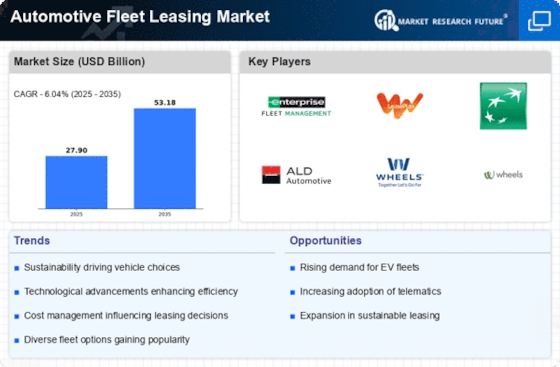
As per Market Research Future analysis, the Automotive Fleet Leasing Market Size was estimated at 27.9 USD Billion in 2024. The Automotive Fleet Leasing industry is projected to grow from 29.58 USD Billion in 2025 to 53.18 USD Billion by 2035, exhibiting a compound annual growth rate (CAGR) of 6.04% during the forecast period 2025 - 2035

Key Market Trends & Highlights

The Automotive Fleet Leasing Market is experiencing a transformative shift towards sustainability and digital innovation.

  • The market is witnessing a notable shift towards sustainability, driven by increasing environmental regulations. Digital transformation is reshaping fleet management practices, enhancing operational efficiency and data utilization. Customization and flexibility in leasing options are becoming essential to meet diverse client needs, particularly in the passenger car segment. The growth of e-commerce and delivery services, coupled with the demand for cost efficiency, is propelling the expansion of closed-ended leasing options.

Market Size & Forecast

2024 Market Size 27.9 (USD Billion)
2035 Market Size 53.18 (USD Billion)
CAGR (2025 - 2035) 6.04%
Largest Regional Market Share in 2024 North America

Major Players

<a href="https://www.efleets.com/en/how-it-works.html">Enterprise Fleet Management</a> (US), LeasePlan (NL), Arval (FR), ALD Automotive (FR), Wheels, Inc. (US), Donlen (US), <a href="https://www.elementfleet.com/manage/lease-vs-ownership">Element Fleet Management</a> (CA), Sixt Leasing (DE), Ryder System, Inc. (US)

Market Trends

The Automotive Fleet Leasing Market is currently experiencing a transformative phase, driven by evolving consumer preferences and advancements in technology. Companies are increasingly recognizing the benefits of leasing over purchasing vehicles, as it allows for greater flexibility and reduced financial burden. This shift is further influenced by the growing emphasis on sustainability, prompting businesses to consider eco-friendly vehicle options within their fleets. As a result, leasing companies are adapting their offerings to include electric and hybrid vehicles, aligning with global efforts to reduce carbon emissions and promote greener transportation solutions. Moreover, the competitive landscape of the Automotive Fleet Leasing Market is intensifying, with numerous players striving to differentiate themselves through innovative services and enhanced customer experiences.

Digital platforms are becoming integral to the leasing process, facilitating seamless transactions and improving fleet management efficiency. The integration of telematics and data analytics is also gaining traction, enabling companies to optimize their fleet operations and make informed decisions. Overall, the Automotive Fleet Leasing Market appears poised for continued growth, with expanding automotive fleet leasing market share as businesses seek to leverage leasing as a strategic tool for operational efficiency and sustainability in the years to come.

Shift Towards Sustainability

The Automotive Fleet Leasing Market is witnessing a notable shift towards sustainability, as businesses increasingly prioritize eco-friendly vehicle options. This trend is driven by heightened awareness of environmental issues and regulatory pressures, prompting companies to adopt greener practices. Leasing firms are responding by expanding their portfolios to include electric and hybrid vehicles, catering to the demand for sustainable transportation solutions.

Digital Transformation

Digital transformation is reshaping the Automotive Fleet Leasing Market, with technology playing a pivotal role in enhancing customer experiences. Companies are leveraging digital platforms to streamline leasing processes, making transactions more efficient and user-friendly. Additionally, the integration of telematics and data analytics is enabling businesses to optimize fleet management, leading to improved operational efficiency.

Customization and Flexibility

Customization and flexibility are emerging as key trends within the Automotive Fleet Leasing Market. Businesses are increasingly seeking tailored leasing solutions that align with their specific operational needs. This demand for flexibility is prompting leasing companies to offer a variety of options, including short-term leases and adaptable fleet configurations, allowing clients to respond swiftly to changing market conditions.

Automotive Fleet Leasing Market Market Drivers

Focus on Operational Flexibility

The Automotive Fleet Leasing Market is witnessing a growing focus on operational flexibility among businesses. Companies are increasingly seeking leasing solutions that allow them to scale their fleets up or down based on fluctuating demand. This flexibility is particularly crucial in industries with seasonal variations, where the need for vehicles can change dramatically. Leasing provides businesses with the agility to respond to market dynamics without the long-term commitment associated with vehicle ownership. As a result, the Automotive Fleet Leasing Market is expected to thrive as organizations prioritize adaptable solutions that align with their operational strategies.

Rising Environmental Regulations

The Automotive Fleet Leasing Market is being influenced by the rising environmental regulations imposed by governments worldwide. As concerns about climate change and air quality intensify, regulatory bodies are implementing stricter emissions standards for vehicles. This shift is prompting businesses to consider leasing electric and hybrid vehicles as part of their fleets. The demand for eco-friendly vehicles is expected to grow, with projections indicating that electric vehicle sales could reach 30% of total vehicle sales by 2030. Consequently, the Automotive Fleet Leasing Market is likely to adapt to these regulatory changes by offering more sustainable leasing options, thereby aligning with corporate social responsibility goals and enhancing brand reputation.

Increasing Demand for Cost Efficiency

The Automotive Fleet Leasing Market is experiencing a notable surge in demand for cost efficiency among businesses. Companies are increasingly recognizing the financial advantages of leasing vehicles rather than purchasing them outright. This trend is driven by the need to optimize operational costs and manage cash flow effectively. According to recent data, leasing can reduce upfront capital expenditures by up to 30%, allowing businesses to allocate resources more strategically. Furthermore, the flexibility of leasing agreements enables companies to adapt their fleets to changing market conditions without incurring significant financial burdens. As a result, the Automotive Fleet Leasing Market is likely to witness sustained growth as organizations prioritize cost-effective solutions in their transportation strategies.

Growth of E-commerce and Delivery Services

The growth of e-commerce and delivery services is significantly impacting the Automotive Fleet Leasing Market. As online shopping continues to gain traction, businesses are increasingly relying on efficient logistics and transportation solutions to meet consumer demands. This trend has led to a surge in demand for commercial vehicles, particularly vans and trucks, which are essential for last-mile delivery. Market data suggests that the logistics sector is expected to expand at a compound annual growth rate of over 8% in the next few years. Consequently, the Automotive Fleet Leasing Market is likely to see increased leasing activity as companies seek to enhance their delivery capabilities without the burden of vehicle ownership.

Technological Advancements in Fleet Management

Technological advancements are playing a pivotal role in shaping the Automotive Fleet Leasing Market. The integration of telematics and fleet management software has revolutionized how businesses manage their vehicle fleets. These technologies provide real-time data on vehicle performance, fuel consumption, and maintenance needs, allowing companies to make informed decisions. The market for fleet management software is projected to grow significantly, with estimates suggesting a compound annual growth rate of over 10% in the coming years. This trend indicates that businesses are increasingly leveraging technology to enhance operational efficiency and reduce costs. Consequently, the Automotive Fleet Leasing Market is likely to benefit from the growing adoption of these innovative solutions.

Market Segment Insights

By Lease Type: Open Ended (Largest) vs. Closed Ended (Fastest-Growing)

In the Automotive Fleet Leasing Market, the segment distribution reveals that Open Ended leases hold the largest share. This type of lease allows fleets flexibility and adaptability, making it highly appealing for businesses that require scalability in their operations. Closed Ended leases, while smaller in share compared to Open Ended, are gaining momentum due to their fixed-cost structure, which offers predictability for businesses managing their fleet expenses. As companies seek to optimize costs, understanding these lease types becomes critical. The growth trends in the Automotive Fleet Leasing Market indicate a significant rise in Closed Ended leases, which are seen as the fastest-growing segment. This shift is primarily driven by the increasing need for businesses to manage budget constraints effectively while ensuring fleet operational efficiency. Additionally, the rise of technology, such as telematics and fleet management solutions, has paved the way for businesses to better understand usage and optimize their leasing choices, thus favoring the closed-ended model for its predictability and convenience.

Lease Type: Open Ended (Dominant) vs. Closed Ended (Emerging)

Open Ended leases dominate the Automotive Fleet Leasing Market due to their flexibility, allowing lessees to negotiate terms and manage a fleet's value at the end of the lease period. This adaptability is particularly appealing for businesses with fluctuating needs and those looking to maximize asset utilization. In comparison, Closed Ended leases are emerging rapidly, characterized by fixed payments and predetermined terms. This model is attracting companies seeking budgeting predictability and lower financial risks. The trend towards electric and eco-friendly vehicles is also pushing businesses toward Closed Ended leases as it allows for easier asset management and turnover, aligning with green initiatives.

By Vehicle Type: Passenger Cars (Largest) vs. LCV (Fastest-Growing)

The Automotive Fleet Leasing Market exhibits a dynamic mix of vehicle types, with Passenger Cars currently dominating the landscape. This segment commands the largest share due to the high demand for economical and versatile transport solutions across personal and business uses. Following closely, <a href="https://www.marketresearchfuture.com/reports/light-commercial-vehicles-market-7726">Light Commercial Vehicles</a> (LCV) are emerging as a key player, appealing to businesses that require delivery and service vehicles for operations, thus indicating a healthy distribution of market presence among these segments. In terms of growth, LCVs are seeing a notable increase in adoption rates, attributed to the burgeoning ecommerce sector and the growing need for efficient logistics solutions. Additionally, Passenger Cars continue to maintain strong demand as consumer preferences shift towards more cost-effective leasing options. The continued rise in urbanization and changes in regulatory frameworks are also propelling the leasing market forward, particularly for LCVs, positioning them as crucial for future market strategies.

Passenger Cars (Dominant) vs. LCV (Emerging)

Passenger Cars dominate the Automotive Fleet Leasing Market due to their versatility and wide application across various consumer segments. They are preferred for personal use as well as by businesses looking for economical leasing options. The extensive range of models and affordability make them attractive for fleet purchases. In contrast, Light Commercial Vehicles (LCV) are rapidly emerging, driven by increased demand from sectors like e-commerce and delivery services. LC Vehicle leasing is appealing to businesses seeking flexibility and lower operational costs. The growth of online shopping and the need for efficient delivery systems bolster the LCV market. As a result, while Passenger Cars hold a commanding presence, LCVs are positioning themselves as a vital component in the evolving fleet landscape.

By Passenger Cars Type: SUV (Largest) vs. Hatchback (Fastest-Growing)

In the Automotive Fleet Leasing Market, the passenger cars segment is prominently led by SUVs, which command the largest market share. SUVs are increasingly favored by businesses due to their spaciousness, safety features, and versatility, making them ideal for various corporate needs. Conversely, hatchbacks have gained significant traction, attracting attention for their compact design and affordability, enabling them to capture a growing share of the market.

SUV (Dominant) vs. Hatchback (Emerging)

SUVs currently dominate the passenger car segment in the automotive fleet leasing market, offering numerous advantages such as ample cargo space and improved passenger comfort. Their popularity stems from a broader consumer preference for utility vehicles that provide both functionality and an appealing aesthetic. Hatchbacks, on the other hand, are emerging as a practical choice for urban businesses, characterized by their smaller size and better fuel efficiency. They appeal particularly to companies seeking cost-effective solutions for their fleet needs, merging convenience with economy, which has made them rising stars in this market segment.

Get more detailed insights about Automotive Fleet Leasing Market Research Report - Global Forecast to 2035

Regional Insights

North America : Market Leader in Fleet Leasing

North America is the largest market for automotive fleet leasing, accounting for approximately 45% of the global market share. The growth is driven by increasing demand for cost-effective transportation solutions and the rise of e-commerce, which necessitates efficient logistics. Regulatory support for green initiatives and tax incentives for fleet operators further catalyze market expansion. The United States and Canada are the leading countries in this region, with major players like Enterprise Fleet Management and Ryder System, Inc. dominating the landscape. The competitive environment is characterized by a mix of established firms and emerging players, all vying for market share through innovative service offerings and technology integration.

Europe : Emerging Trends in Fleet Leasing

Europe is witnessing a significant shift towards sustainable fleet leasing solutions, holding approximately 30% of the global market share. The demand is driven by stringent environmental regulations and a growing emphasis on reducing carbon footprints. Countries like Germany and France are at the forefront, implementing policies that encourage electric vehicle adoption and fleet modernization. Germany, France, and the Netherlands are key players in this market, with companies like LeasePlan and Arval leading the charge. The competitive landscape is evolving, with a focus on digital transformation and customer-centric services. The European market is characterized by a mix of traditional leasing companies and new entrants focusing on sustainability and technology.

Asia-Pacific : Rapid Growth in Fleet Leasing

Asia-Pacific is rapidly emerging as a significant player in the automotive fleet leasing market, accounting for about 20% of the global share. The region's growth is fueled by urbanization, increasing disposable incomes, and a burgeoning logistics sector. Countries like China and India are leading this trend, supported by favorable government policies and investments in infrastructure. China is the largest market in the region, with a growing number of local and international players entering the fleet leasing space. The competitive landscape is marked by both established firms and startups, focusing on technology-driven solutions to enhance operational efficiency. The presence of key players like Element Fleet Management further strengthens the market dynamics.

Middle East and Africa : Untapped Potential in Fleet Leasing

The Middle East and Africa (MEA) region is gradually emerging in the automotive fleet leasing market, holding around 5% of the global market share. The growth is driven by increasing investments in infrastructure and a rising demand for efficient transportation solutions. Countries like the UAE and South Africa are leading the charge, with government initiatives aimed at enhancing logistics and transportation networks. The competitive landscape is still developing, with a mix of local and international players. Companies are focusing on expanding their service offerings and leveraging technology to meet the unique needs of the region. The presence of key players is growing, indicating a positive outlook for future market expansion.

Key Players and Competitive Insights

Major market players are spending a lot of money on R&D to increase their product lines, which will help the automotive fleet leasing market grow even more. Market participants are also taking a range of strategic initiatives to grow their worldwide footprint, with key market developments such as new product launches, contractual agreements, mergers and acquisitions, increased investments, and collaboration with other organizations. Competitors in the automotive fleet leasing industry must offer cost-effective items to expand and survive in an increasingly competitive and rising market environment. One of the primary business strategies adopted by manufacturers in the Automotive Fleet Leasing industry to benefit clients and expand the market sector is to manufacture locally to reduce operating costs. The automotive fleet leasing market major player ARI (New Jersey), Glesby Marks (Texas), LeasePlan Corporation N.V. (Netherlands), and others are working to expand the market demand by investing in research and development activities. Maruti Suzuki India Limited, formerly known as Maruti Udyog Limited, is an Indian automobile manufacturer, based in New Delhi. It was founded in 1981 and owned by the Government of India until 2003, when it was sold to the Japanese automaker Suzuki Motor Corporation. As of September 2022 Maruti Suzuki has a market share of 42 percent in the Indian passenger car market. In July 2021, Maruti Suzuki expanded the country’s largest single-location automobile investment as it plans to invest up to INR 18,000 crore for new factory premises in Haryana, which may have a peak annual capacity of 10 lakh units. Also, BrightDrop is a subsidiary business created by the American manufacturer General Motors in 2021. The business offers a system of connected products targeting first- and last-mile delivery customers, including light commercial electric vehicles, ePallets, and cloud-based software In June 2022, BrightDrop Inc., the electric delivery van brand from General Motors Company, acquired Martin, a technology startup based in California. BrightDrop hopes to leverage Martin's AI capabilities to analyze, forecast, and identify multi-modal solutions for automotive fleet leasing customers as it plans its journey to full-fleet electrification.

Key Companies in the Automotive Fleet Leasing Market include

Industry Developments

September 2023: Flex Fleet Rental is overjoyed to announce a significant advancement that has the potential to revolutionize the commercial vehicle rental industry in North America. The firm has been acquired by Kaizen Automotive Group, an industry leader in innovative solutions for automobiles. The acquisition reached its definitive form on September 1, 2023, signifying a critical juncture in our trajectory. By combining forces, Flex Fleet Rental and Summit Fleet, a subsidiary of Kaizen Automotive Group, establish one of the most sizable and dynamic commercial truck fleet organizations on the continent. This strategic move introduces a new era of opportunities.

The collaborative effort is anticipated to generate synergies that will elevate the standard for outstanding service and groundbreaking solutions.

"We are thrilled to expand our product and service offerings throughout North America by partnering with Summit Fleet," said Brian Goldhardt, president and CEO of Flex Fleet Rental. "We couldn't be more excited about this acquisition with it positioning ourselves into our next chapter of growth." Regarding this significant event, Nate Clarke, the Chief Executive Officer of Kaizen Automotive Group, conveyed his elation: "Our outlook on the acquisition is extremely positive.

Our customers throughout North America will be able to benefit from our ability to continue providing technologically advanced commercial fleet management services that are at the forefront of our industry, thanks to the merger between Summit Fleet and Flex Fleet Rental.

Gene Weil, Managing Director of Waterfall Asset Management, stated, "We acquired Flex Fleet Rental in early 2019, anchored to a shared vision with management to institutionalize Flex Fleet Rental into the leading medium-term truck rental and logistics business with the ultimate customer experience." "The sale to Kaizen Automotive is an exciting advancement in Flex Fleet's growth story, both as an acknowledgment of the industry-leading status Flex Fleet Rental has achieved, as well as an opportunity for our customers, vendors and employees to take advantage of the scale, operational sophistication, and product depth of the combined enterprise in Canada and the U.S."

January 2021 Altrad Services UK announced a strategic partnership with Trakm8, a recognized leader in telematics data, to improve safety across fleet using Trakm8 technology and made significant improvements to combat poor driving & blowout best practices throughout the fleet drivers.

September 2022 Ford Motor Company broke ground on BlueOval, a USD 5.6 billion EV manufacturing facility in association with a battery company SK On, a wholly owned subsidiary of SK Innovation, a South Korean battery manufacturer to manufacture a new future electric truck and batteries in West Tennessee, United States. The facility will provide 6,000 jobs when it becomes fully operational.

Future Outlook

Automotive Fleet Leasing Market Future Outlook

The Automotive Fleet Leasing Market is projected to grow at a 6.04% CAGR from 2025 to 2035, driven by technological advancements, sustainability initiatives, and increasing demand for flexible leasing options.

New opportunities lie in:

  • <p>Integration of telematics for real-time fleet management Expansion of electric vehicle leasing programs Development of customized leasing solutions for SMEs</p>

By 2035, the automotive fleet leasing market is expected to be robust, reflecting evolving customer needs and technological innovations.

Market Segmentation

Automotive Fleet Leasing Market Lease Type Outlook

  • Open Ended
  • Close Ended

Automotive Fleet Leasing Market Vehicle Type Outlook

  • Passenger Cars
  • LCV
  • HCV

Automotive Fleet Leasing Market Passenger Cars Type Outlook

  • SUV’s
  • Hatchback
  • Sedan

Report Scope

MARKET SIZE 2024 27.9(USD Billion)
MARKET SIZE 2025 29.58(USD Billion)
MARKET SIZE 2035 53.18(USD Billion)
COMPOUND ANNUAL GROWTH RATE (CAGR) 6.04% (2025 - 2035)
REPORT COVERAGE Revenue Forecast, Competitive Landscape, Growth Factors, and Trends
BASE YEAR 2024
Market Forecast Period 2025 - 2035
Historical Data 2019 - 2024
Market Forecast Units USD Billion
Key Companies Profiled Enterprise Fleet Management (US), LeasePlan (NL), Arval (FR), ALD Automotive (FR), Wheels, Inc. (US), Donlen (US), Element Fleet Management (CA), Sixt Leasing (DE), Ryder System, Inc. (US)
Segments Covered Lease Type, Vehicle Type, Passenger Cars Type, Region
Key Market Opportunities Integration of electric vehicles and telematics enhances efficiency in the Automotive Fleet Leasing Market.
Key Market Dynamics Rising demand for electric vehicles drives transformation in automotive fleet leasing strategies and operational frameworks.
Countries Covered North America, Europe, APAC, South America, MEA

FAQs

What is the current valuation of the Automotive Fleet Leasing Market?

<p>The Automotive Fleet Leasing Market was valued at 27.9 USD Billion in 2024.</p>

What is the projected market size for the Automotive Fleet Leasing Market by 2035?

<p>The market is projected to reach 53.18 USD Billion by 2035.</p>

What is the expected CAGR for the Automotive Fleet Leasing Market during the forecast period?

<p>The expected CAGR for the market from 2025 to 2035 is 6.04%.</p>

Which companies are considered key players in the Automotive Fleet Leasing Market?

<p>Key players include Enterprise Fleet Management, LeasePlan, Arval, ALD Automotive, Wheels, Inc., Donlen, Element Fleet Management, Sixt Leasing, and Ryder System, Inc.</p>

What are the different lease types in the Automotive Fleet Leasing Market?

<p>The market segments include Open Ended leases, valued at 21.12 USD Billion, and Close Ended leases, valued at 32.06 USD Billion.</p>

What vehicle types are included in the Automotive Fleet Leasing Market?

<p>The market encompasses Passenger Cars, valued at 20.0 USD Billion, Light Commercial Vehicles (LCV), valued at 15.0 USD Billion, and Heavy Commercial Vehicles (HCV), valued at 18.18 USD Billion.</p>

What are the different types of passenger cars in the Automotive Fleet Leasing Market?

<p>Passenger car types include SUVs, valued at 19.0 USD Billion, Hatchbacks, valued at 15.0 USD Billion, and Sedans, valued at 19.18 USD Billion.</p>

How does the Automotive Fleet Leasing Market compare to previous years?

<p>The market has shown substantial growth, increasing from 27.9 USD Billion in 2024 to a projected 53.18 USD Billion by 2035.</p>

What factors are driving growth in the Automotive Fleet Leasing Market?

<p>Growth appears driven by increasing demand for flexible leasing options and the expansion of vehicle types available for leasing.</p>

What trends are expected to shape the Automotive Fleet Leasing Market in the coming years?

<p>Trends may include a shift towards electric vehicles and enhanced digital solutions for fleet management.</p>

  1. SECTION I: EXECUTIVE SUMMARY AND KEY HIGHLIGHTS
    1. | 1.1 EXECUTIVE SUMMARY
    2. | | 1.1.1 Market Overview
    3. | | 1.1.2 Key Findings
    4. | | 1.1.3 Market Segmentation
    5. | | 1.1.4 Competitive Landscape
    6. | | 1.1.5 Challenges and Opportunities
    7. | | 1.1.6 Future Outlook
  2. SECTION II: SCOPING, METHODOLOGY AND MARKET STRUCTURE
    1. | 2.1 MARKET INTRODUCTION
    2. | | 2.1.1 Definition
    3. | | 2.1.2 Scope of the study
    4. | | | 2.1.2.1 Research Objective
    5. | | | 2.1.2.2 Assumption
    6. | | | 2.1.2.3 Limitations
    7. | 2.2 RESEARCH METHODOLOGY
    8. | | 2.2.1 Overview
    9. | | 2.2.2 Data Mining
    10. | | 2.2.3 Secondary Research
    11. | | 2.2.4 Primary Research
    12. | | | 2.2.4.1 Primary Interviews and Information Gathering Process
    13. | | | 2.2.4.2 Breakdown of Primary Respondents
    14. | | 2.2.5 Forecasting Model
    15. | | 2.2.6 Market Size Estimation
    16. | | | 2.2.6.1 Bottom-Up Approach
    17. | | | 2.2.6.2 Top-Down Approach
    18. | | 2.2.7 Data Triangulation
    19. | | 2.2.8 Validation
  3. SECTION III: QUALITATIVE ANALYSIS
    1. | 3.1 MARKET DYNAMICS
    2. | | 3.1.1 Overview
    3. | | 3.1.2 Drivers
    4. | | 3.1.3 Restraints
    5. | | 3.1.4 Opportunities
    6. | 3.2 MARKET FACTOR ANALYSIS
    7. | | 3.2.1 Value chain Analysis
    8. | | 3.2.2 Porter's Five Forces Analysis
    9. | | | 3.2.2.1 Bargaining Power of Suppliers
    10. | | | 3.2.2.2 Bargaining Power of Buyers
    11. | | | 3.2.2.3 Threat of New Entrants
    12. | | | 3.2.2.4 Threat of Substitutes
    13. | | | 3.2.2.5 Intensity of Rivalry
    14. | | 3.2.3 COVID-19 Impact Analysis
    15. | | | 3.2.3.1 Market Impact Analysis
    16. | | | 3.2.3.2 Regional Impact
    17. | | | 3.2.3.3 Opportunity and Threat Analysis
  4. SECTION IV: QUANTITATIVE ANALYSIS
    1. | 4.1 Automobile, BY Lease Type (USD Billion)
    2. | | 4.1.1 Open Ended
    3. | | 4.1.2 Close Ended
    4. | 4.2 Automobile, BY Vehicle Type (USD Billion)
    5. | | 4.2.1 Passenger Cars
    6. | | 4.2.2 LCV
    7. | | 4.2.3 HCV
    8. | 4.3 Automobile, BY Passenger Cars Type (USD Billion)
    9. | | 4.3.1 SUV’s
    10. | | 4.3.2 Hatchback
    11. | | 4.3.3 Sedan
    12. | 4.4 Automobile, BY Region (USD Billion)
    13. | | 4.4.1 North America
    14. | | | 4.4.1.1 US
    15. | | | 4.4.1.2 Canada
    16. | | 4.4.2 Europe
    17. | | | 4.4.2.1 Germany
    18. | | | 4.4.2.2 UK
    19. | | | 4.4.2.3 France
    20. | | | 4.4.2.4 Russia
    21. | | | 4.4.2.5 Italy
    22. | | | 4.4.2.6 Spain
    23. | | | 4.4.2.7 Rest of Europe
    24. | | 4.4.3 APAC
    25. | | | 4.4.3.1 China
    26. | | | 4.4.3.2 India
    27. | | | 4.4.3.3 Japan
    28. | | | 4.4.3.4 South Korea
    29. | | | 4.4.3.5 Malaysia
    30. | | | 4.4.3.6 Thailand
    31. | | | 4.4.3.7 Indonesia
    32. | | | 4.4.3.8 Rest of APAC
    33. | | 4.4.4 South America
    34. | | | 4.4.4.1 Brazil
    35. | | | 4.4.4.2 Mexico
    36. | | | 4.4.4.3 Argentina
    37. | | | 4.4.4.4 Rest of South America
    38. | | 4.4.5 MEA
    39. | | | 4.4.5.1 GCC Countries
    40. | | | 4.4.5.2 South Africa
    41. | | | 4.4.5.3 Rest of MEA
  5. SECTION V: COMPETITIVE ANALYSIS
    1. | 5.1 Competitive Landscape
    2. | | 5.1.1 Overview
    3. | | 5.1.2 Competitive Analysis
    4. | | 5.1.3 Market share Analysis
    5. | | 5.1.4 Major Growth Strategy in the Automobile
    6. | | 5.1.5 Competitive Benchmarking
    7. | | 5.1.6 Leading Players in Terms of Number of Developments in the Automobile
    8. | | 5.1.7 Key developments and growth strategies
    9. | | | 5.1.7.1 New Product Launch/Service Deployment
    10. | | | 5.1.7.2 Merger & Acquisitions
    11. | | | 5.1.7.3 Joint Ventures
    12. | | 5.1.8 Major Players Financial Matrix
    13. | | | 5.1.8.1 Sales and Operating Income
    14. | | | 5.1.8.2 Major Players R&D Expenditure. 2023
    15. | 5.2 Company Profiles
    16. | | 5.2.1 Enterprise Fleet Management (US)
    17. | | | 5.2.1.1 Financial Overview
    18. | | | 5.2.1.2 Products Offered
    19. | | | 5.2.1.3 Key Developments
    20. | | | 5.2.1.4 SWOT Analysis
    21. | | | 5.2.1.5 Key Strategies
    22. | | 5.2.2 LeasePlan (NL)
    23. | | | 5.2.2.1 Financial Overview
    24. | | | 5.2.2.2 Products Offered
    25. | | | 5.2.2.3 Key Developments
    26. | | | 5.2.2.4 SWOT Analysis
    27. | | | 5.2.2.5 Key Strategies
    28. | | 5.2.3 Arval (FR)
    29. | | | 5.2.3.1 Financial Overview
    30. | | | 5.2.3.2 Products Offered
    31. | | | 5.2.3.3 Key Developments
    32. | | | 5.2.3.4 SWOT Analysis
    33. | | | 5.2.3.5 Key Strategies
    34. | | 5.2.4 ALD Automotive (FR)
    35. | | | 5.2.4.1 Financial Overview
    36. | | | 5.2.4.2 Products Offered
    37. | | | 5.2.4.3 Key Developments
    38. | | | 5.2.4.4 SWOT Analysis
    39. | | | 5.2.4.5 Key Strategies
    40. | | 5.2.5 Wheels, Inc. (US)
    41. | | | 5.2.5.1 Financial Overview
    42. | | | 5.2.5.2 Products Offered
    43. | | | 5.2.5.3 Key Developments
    44. | | | 5.2.5.4 SWOT Analysis
    45. | | | 5.2.5.5 Key Strategies
    46. | | 5.2.6 Donlen (US)
    47. | | | 5.2.6.1 Financial Overview
    48. | | | 5.2.6.2 Products Offered
    49. | | | 5.2.6.3 Key Developments
    50. | | | 5.2.6.4 SWOT Analysis
    51. | | | 5.2.6.5 Key Strategies
    52. | | 5.2.7 Element Fleet Management (CA)
    53. | | | 5.2.7.1 Financial Overview
    54. | | | 5.2.7.2 Products Offered
    55. | | | 5.2.7.3 Key Developments
    56. | | | 5.2.7.4 SWOT Analysis
    57. | | | 5.2.7.5 Key Strategies
    58. | | 5.2.8 Sixt Leasing (DE)
    59. | | | 5.2.8.1 Financial Overview
    60. | | | 5.2.8.2 Products Offered
    61. | | | 5.2.8.3 Key Developments
    62. | | | 5.2.8.4 SWOT Analysis
    63. | | | 5.2.8.5 Key Strategies
    64. | | 5.2.9 Ryder System, Inc. (US)
    65. | | | 5.2.9.1 Financial Overview
    66. | | | 5.2.9.2 Products Offered
    67. | | | 5.2.9.3 Key Developments
    68. | | | 5.2.9.4 SWOT Analysis
    69. | | | 5.2.9.5 Key Strategies
    70. | 5.3 Appendix
    71. | | 5.3.1 References
    72. | | 5.3.2 Related Reports
  6. LIST OF FIGURES
    1. | 6.1 MARKET SYNOPSIS
    2. | 6.2 NORTH AMERICA MARKET ANALYSIS
    3. | 6.3 US MARKET ANALYSIS BY LEASE TYPE
    4. | 6.4 US MARKET ANALYSIS BY VEHICLE TYPE
    5. | 6.5 US MARKET ANALYSIS BY PASSENGER CARS TYPE
    6. | 6.6 CANADA MARKET ANALYSIS BY LEASE TYPE
    7. | 6.7 CANADA MARKET ANALYSIS BY VEHICLE TYPE
    8. | 6.8 CANADA MARKET ANALYSIS BY PASSENGER CARS TYPE
    9. | 6.9 EUROPE MARKET ANALYSIS
    10. | 6.10 GERMANY MARKET ANALYSIS BY LEASE TYPE
    11. | 6.11 GERMANY MARKET ANALYSIS BY VEHICLE TYPE
    12. | 6.12 GERMANY MARKET ANALYSIS BY PASSENGER CARS TYPE
    13. | 6.13 UK MARKET ANALYSIS BY LEASE TYPE
    14. | 6.14 UK MARKET ANALYSIS BY VEHICLE TYPE
    15. | 6.15 UK MARKET ANALYSIS BY PASSENGER CARS TYPE
    16. | 6.16 FRANCE MARKET ANALYSIS BY LEASE TYPE
    17. | 6.17 FRANCE MARKET ANALYSIS BY VEHICLE TYPE
    18. | 6.18 FRANCE MARKET ANALYSIS BY PASSENGER CARS TYPE
    19. | 6.19 RUSSIA MARKET ANALYSIS BY LEASE TYPE
    20. | 6.20 RUSSIA MARKET ANALYSIS BY VEHICLE TYPE
    21. | 6.21 RUSSIA MARKET ANALYSIS BY PASSENGER CARS TYPE
    22. | 6.22 ITALY MARKET ANALYSIS BY LEASE TYPE
    23. | 6.23 ITALY MARKET ANALYSIS BY VEHICLE TYPE
    24. | 6.24 ITALY MARKET ANALYSIS BY PASSENGER CARS TYPE
    25. | 6.25 SPAIN MARKET ANALYSIS BY LEASE TYPE
    26. | 6.26 SPAIN MARKET ANALYSIS BY VEHICLE TYPE
    27. | 6.27 SPAIN MARKET ANALYSIS BY PASSENGER CARS TYPE
    28. | 6.28 REST OF EUROPE MARKET ANALYSIS BY LEASE TYPE
    29. | 6.29 REST OF EUROPE MARKET ANALYSIS BY VEHICLE TYPE
    30. | 6.30 REST OF EUROPE MARKET ANALYSIS BY PASSENGER CARS TYPE
    31. | 6.31 APAC MARKET ANALYSIS
    32. | 6.32 CHINA MARKET ANALYSIS BY LEASE TYPE
    33. | 6.33 CHINA MARKET ANALYSIS BY VEHICLE TYPE
    34. | 6.34 CHINA MARKET ANALYSIS BY PASSENGER CARS TYPE
    35. | 6.35 INDIA MARKET ANALYSIS BY LEASE TYPE
    36. | 6.36 INDIA MARKET ANALYSIS BY VEHICLE TYPE
    37. | 6.37 INDIA MARKET ANALYSIS BY PASSENGER CARS TYPE
    38. | 6.38 JAPAN MARKET ANALYSIS BY LEASE TYPE
    39. | 6.39 JAPAN MARKET ANALYSIS BY VEHICLE TYPE
    40. | 6.40 JAPAN MARKET ANALYSIS BY PASSENGER CARS TYPE
    41. | 6.41 SOUTH KOREA MARKET ANALYSIS BY LEASE TYPE
    42. | 6.42 SOUTH KOREA MARKET ANALYSIS BY VEHICLE TYPE
    43. | 6.43 SOUTH KOREA MARKET ANALYSIS BY PASSENGER CARS TYPE
    44. | 6.44 MALAYSIA MARKET ANALYSIS BY LEASE TYPE
    45. | 6.45 MALAYSIA MARKET ANALYSIS BY VEHICLE TYPE
    46. | 6.46 MALAYSIA MARKET ANALYSIS BY PASSENGER CARS TYPE
    47. | 6.47 THAILAND MARKET ANALYSIS BY LEASE TYPE
    48. | 6.48 THAILAND MARKET ANALYSIS BY VEHICLE TYPE
    49. | 6.49 THAILAND MARKET ANALYSIS BY PASSENGER CARS TYPE
    50. | 6.50 INDONESIA MARKET ANALYSIS BY LEASE TYPE
    51. | 6.51 INDONESIA MARKET ANALYSIS BY VEHICLE TYPE
    52. | 6.52 INDONESIA MARKET ANALYSIS BY PASSENGER CARS TYPE
    53. | 6.53 REST OF APAC MARKET ANALYSIS BY LEASE TYPE
    54. | 6.54 REST OF APAC MARKET ANALYSIS BY VEHICLE TYPE
    55. | 6.55 REST OF APAC MARKET ANALYSIS BY PASSENGER CARS TYPE
    56. | 6.56 SOUTH AMERICA MARKET ANALYSIS
    57. | 6.57 BRAZIL MARKET ANALYSIS BY LEASE TYPE
    58. | 6.58 BRAZIL MARKET ANALYSIS BY VEHICLE TYPE
    59. | 6.59 BRAZIL MARKET ANALYSIS BY PASSENGER CARS TYPE
    60. | 6.60 MEXICO MARKET ANALYSIS BY LEASE TYPE
    61. | 6.61 MEXICO MARKET ANALYSIS BY VEHICLE TYPE
    62. | 6.62 MEXICO MARKET ANALYSIS BY PASSENGER CARS TYPE
    63. | 6.63 ARGENTINA MARKET ANALYSIS BY LEASE TYPE
    64. | 6.64 ARGENTINA MARKET ANALYSIS BY VEHICLE TYPE
    65. | 6.65 ARGENTINA MARKET ANALYSIS BY PASSENGER CARS TYPE
    66. | 6.66 REST OF SOUTH AMERICA MARKET ANALYSIS BY LEASE TYPE
    67. | 6.67 REST OF SOUTH AMERICA MARKET ANALYSIS BY VEHICLE TYPE
    68. | 6.68 REST OF SOUTH AMERICA MARKET ANALYSIS BY PASSENGER CARS TYPE
    69. | 6.69 MEA MARKET ANALYSIS
    70. | 6.70 GCC COUNTRIES MARKET ANALYSIS BY LEASE TYPE
    71. | 6.71 GCC COUNTRIES MARKET ANALYSIS BY VEHICLE TYPE
    72. | 6.72 GCC COUNTRIES MARKET ANALYSIS BY PASSENGER CARS TYPE
    73. | 6.73 SOUTH AFRICA MARKET ANALYSIS BY LEASE TYPE
    74. | 6.74 SOUTH AFRICA MARKET ANALYSIS BY VEHICLE TYPE
    75. | 6.75 SOUTH AFRICA MARKET ANALYSIS BY PASSENGER CARS TYPE
    76. | 6.76 REST OF MEA MARKET ANALYSIS BY LEASE TYPE
    77. | 6.77 REST OF MEA MARKET ANALYSIS BY VEHICLE TYPE
    78. | 6.78 REST OF MEA MARKET ANALYSIS BY PASSENGER CARS TYPE
    79. | 6.79 KEY BUYING CRITERIA OF AUTOMOBILE
    80. | 6.80 RESEARCH PROCESS OF MRFR
    81. | 6.81 DRO ANALYSIS OF AUTOMOBILE
    82. | 6.82 DRIVERS IMPACT ANALYSIS: AUTOMOBILE
    83. | 6.83 RESTRAINTS IMPACT ANALYSIS: AUTOMOBILE
    84. | 6.84 SUPPLY / VALUE CHAIN: AUTOMOBILE
    85. | 6.85 AUTOMOBILE, BY LEASE TYPE, 2024 (% SHARE)
    86. | 6.86 AUTOMOBILE, BY LEASE TYPE, 2024 TO 2035 (USD Billion)
    87. | 6.87 AUTOMOBILE, BY VEHICLE TYPE, 2024 (% SHARE)
    88. | 6.88 AUTOMOBILE, BY VEHICLE TYPE, 2024 TO 2035 (USD Billion)
    89. | 6.89 AUTOMOBILE, BY PASSENGER CARS TYPE, 2024 (% SHARE)
    90. | 6.90 AUTOMOBILE, BY PASSENGER CARS TYPE, 2024 TO 2035 (USD Billion)
    91. | 6.91 BENCHMARKING OF MAJOR COMPETITORS
  7. LIST OF TABLES
    1. | 7.1 LIST OF ASSUMPTIONS
    2. | | 7.1.1
    3. | 7.2 North America MARKET SIZE ESTIMATES; FORECAST
    4. | | 7.2.1 BY LEASE TYPE, 2025-2035 (USD Billion)
    5. | | 7.2.2 BY VEHICLE TYPE, 2025-2035 (USD Billion)
    6. | | 7.2.3 BY PASSENGER CARS TYPE, 2025-2035 (USD Billion)
    7. | 7.3 US MARKET SIZE ESTIMATES; FORECAST
    8. | | 7.3.1 BY LEASE TYPE, 2025-2035 (USD Billion)
    9. | | 7.3.2 BY VEHICLE TYPE, 2025-2035 (USD Billion)
    10. | | 7.3.3 BY PASSENGER CARS TYPE, 2025-2035 (USD Billion)
    11. | 7.4 Canada MARKET SIZE ESTIMATES; FORECAST
    12. | | 7.4.1 BY LEASE TYPE, 2025-2035 (USD Billion)
    13. | | 7.4.2 BY VEHICLE TYPE, 2025-2035 (USD Billion)
    14. | | 7.4.3 BY PASSENGER CARS TYPE, 2025-2035 (USD Billion)
    15. | 7.5 Europe MARKET SIZE ESTIMATES; FORECAST
    16. | | 7.5.1 BY LEASE TYPE, 2025-2035 (USD Billion)
    17. | | 7.5.2 BY VEHICLE TYPE, 2025-2035 (USD Billion)
    18. | | 7.5.3 BY PASSENGER CARS TYPE, 2025-2035 (USD Billion)
    19. | 7.6 Germany MARKET SIZE ESTIMATES; FORECAST
    20. | | 7.6.1 BY LEASE TYPE, 2025-2035 (USD Billion)
    21. | | 7.6.2 BY VEHICLE TYPE, 2025-2035 (USD Billion)
    22. | | 7.6.3 BY PASSENGER CARS TYPE, 2025-2035 (USD Billion)
    23. | 7.7 UK MARKET SIZE ESTIMATES; FORECAST
    24. | | 7.7.1 BY LEASE TYPE, 2025-2035 (USD Billion)
    25. | | 7.7.2 BY VEHICLE TYPE, 2025-2035 (USD Billion)
    26. | | 7.7.3 BY PASSENGER CARS TYPE, 2025-2035 (USD Billion)
    27. | 7.8 France MARKET SIZE ESTIMATES; FORECAST
    28. | | 7.8.1 BY LEASE TYPE, 2025-2035 (USD Billion)
    29. | | 7.8.2 BY VEHICLE TYPE, 2025-2035 (USD Billion)
    30. | | 7.8.3 BY PASSENGER CARS TYPE, 2025-2035 (USD Billion)
    31. | 7.9 Russia MARKET SIZE ESTIMATES; FORECAST
    32. | | 7.9.1 BY LEASE TYPE, 2025-2035 (USD Billion)
    33. | | 7.9.2 BY VEHICLE TYPE, 2025-2035 (USD Billion)
    34. | | 7.9.3 BY PASSENGER CARS TYPE, 2025-2035 (USD Billion)
    35. | 7.10 Italy MARKET SIZE ESTIMATES; FORECAST
    36. | | 7.10.1 BY LEASE TYPE, 2025-2035 (USD Billion)
    37. | | 7.10.2 BY VEHICLE TYPE, 2025-2035 (USD Billion)
    38. | | 7.10.3 BY PASSENGER CARS TYPE, 2025-2035 (USD Billion)
    39. | 7.11 Spain MARKET SIZE ESTIMATES; FORECAST
    40. | | 7.11.1 BY LEASE TYPE, 2025-2035 (USD Billion)
    41. | | 7.11.2 BY VEHICLE TYPE, 2025-2035 (USD Billion)
    42. | | 7.11.3 BY PASSENGER CARS TYPE, 2025-2035 (USD Billion)
    43. | 7.12 Rest of Europe MARKET SIZE ESTIMATES; FORECAST
    44. | | 7.12.1 BY LEASE TYPE, 2025-2035 (USD Billion)
    45. | | 7.12.2 BY VEHICLE TYPE, 2025-2035 (USD Billion)
    46. | | 7.12.3 BY PASSENGER CARS TYPE, 2025-2035 (USD Billion)
    47. | 7.13 APAC MARKET SIZE ESTIMATES; FORECAST
    48. | | 7.13.1 BY LEASE TYPE, 2025-2035 (USD Billion)
    49. | | 7.13.2 BY VEHICLE TYPE, 2025-2035 (USD Billion)
    50. | | 7.13.3 BY PASSENGER CARS TYPE, 2025-2035 (USD Billion)
    51. | 7.14 China MARKET SIZE ESTIMATES; FORECAST
    52. | | 7.14.1 BY LEASE TYPE, 2025-2035 (USD Billion)
    53. | | 7.14.2 BY VEHICLE TYPE, 2025-2035 (USD Billion)
    54. | | 7.14.3 BY PASSENGER CARS TYPE, 2025-2035 (USD Billion)
    55. | 7.15 India MARKET SIZE ESTIMATES; FORECAST
    56. | | 7.15.1 BY LEASE TYPE, 2025-2035 (USD Billion)
    57. | | 7.15.2 BY VEHICLE TYPE, 2025-2035 (USD Billion)
    58. | | 7.15.3 BY PASSENGER CARS TYPE, 2025-2035 (USD Billion)
    59. | 7.16 Japan MARKET SIZE ESTIMATES; FORECAST
    60. | | 7.16.1 BY LEASE TYPE, 2025-2035 (USD Billion)
    61. | | 7.16.2 BY VEHICLE TYPE, 2025-2035 (USD Billion)
    62. | | 7.16.3 BY PASSENGER CARS TYPE, 2025-2035 (USD Billion)
    63. | 7.17 South Korea MARKET SIZE ESTIMATES; FORECAST
    64. | | 7.17.1 BY LEASE TYPE, 2025-2035 (USD Billion)
    65. | | 7.17.2 BY VEHICLE TYPE, 2025-2035 (USD Billion)
    66. | | 7.17.3 BY PASSENGER CARS TYPE, 2025-2035 (USD Billion)
    67. | 7.18 Malaysia MARKET SIZE ESTIMATES; FORECAST
    68. | | 7.18.1 BY LEASE TYPE, 2025-2035 (USD Billion)
    69. | | 7.18.2 BY VEHICLE TYPE, 2025-2035 (USD Billion)
    70. | | 7.18.3 BY PASSENGER CARS TYPE, 2025-2035 (USD Billion)
    71. | 7.19 Thailand MARKET SIZE ESTIMATES; FORECAST
    72. | | 7.19.1 BY LEASE TYPE, 2025-2035 (USD Billion)
    73. | | 7.19.2 BY VEHICLE TYPE, 2025-2035 (USD Billion)
    74. | | 7.19.3 BY PASSENGER CARS TYPE, 2025-2035 (USD Billion)
    75. | 7.20 Indonesia MARKET SIZE ESTIMATES; FORECAST
    76. | | 7.20.1 BY LEASE TYPE, 2025-2035 (USD Billion)
    77. | | 7.20.2 BY VEHICLE TYPE, 2025-2035 (USD Billion)
    78. | | 7.20.3 BY PASSENGER CARS TYPE, 2025-2035 (USD Billion)
    79. | 7.21 Rest of APAC MARKET SIZE ESTIMATES; FORECAST
    80. | | 7.21.1 BY LEASE TYPE, 2025-2035 (USD Billion)
    81. | | 7.21.2 BY VEHICLE TYPE, 2025-2035 (USD Billion)
    82. | | 7.21.3 BY PASSENGER CARS TYPE, 2025-2035 (USD Billion)
    83. | 7.22 South America MARKET SIZE ESTIMATES; FORECAST
    84. | | 7.22.1 BY LEASE TYPE, 2025-2035 (USD Billion)
    85. | | 7.22.2 BY VEHICLE TYPE, 2025-2035 (USD Billion)
    86. | | 7.22.3 BY PASSENGER CARS TYPE, 2025-2035 (USD Billion)
    87. | 7.23 Brazil MARKET SIZE ESTIMATES; FORECAST
    88. | | 7.23.1 BY LEASE TYPE, 2025-2035 (USD Billion)
    89. | | 7.23.2 BY VEHICLE TYPE, 2025-2035 (USD Billion)
    90. | | 7.23.3 BY PASSENGER CARS TYPE, 2025-2035 (USD Billion)
    91. | 7.24 Mexico MARKET SIZE ESTIMATES; FORECAST
    92. | | 7.24.1 BY LEASE TYPE, 2025-2035 (USD Billion)
    93. | | 7.24.2 BY VEHICLE TYPE, 2025-2035 (USD Billion)
    94. | | 7.24.3 BY PASSENGER CARS TYPE, 2025-2035 (USD Billion)
    95. | 7.25 Argentina MARKET SIZE ESTIMATES; FORECAST
    96. | | 7.25.1 BY LEASE TYPE, 2025-2035 (USD Billion)
    97. | | 7.25.2 BY VEHICLE TYPE, 2025-2035 (USD Billion)
    98. | | 7.25.3 BY PASSENGER CARS TYPE, 2025-2035 (USD Billion)
    99. | 7.26 Rest of South America MARKET SIZE ESTIMATES; FORECAST
    100. | | 7.26.1 BY LEASE TYPE, 2025-2035 (USD Billion)
    101. | | 7.26.2 BY VEHICLE TYPE, 2025-2035 (USD Billion)
    102. | | 7.26.3 BY PASSENGER CARS TYPE, 2025-2035 (USD Billion)
    103. | 7.27 MEA MARKET SIZE ESTIMATES; FORECAST
    104. | | 7.27.1 BY LEASE TYPE, 2025-2035 (USD Billion)
    105. | | 7.27.2 BY VEHICLE TYPE, 2025-2035 (USD Billion)
    106. | | 7.27.3 BY PASSENGER CARS TYPE, 2025-2035 (USD Billion)
    107. | 7.28 GCC Countries MARKET SIZE ESTIMATES; FORECAST
    108. | | 7.28.1 BY LEASE TYPE, 2025-2035 (USD Billion)
    109. | | 7.28.2 BY VEHICLE TYPE, 2025-2035 (USD Billion)
    110. | | 7.28.3 BY PASSENGER CARS TYPE, 2025-2035 (USD Billion)
    111. | 7.29 South Africa MARKET SIZE ESTIMATES; FORECAST
    112. | | 7.29.1 BY LEASE TYPE, 2025-2035 (USD Billion)
    113. | | 7.29.2 BY VEHICLE TYPE, 2025-2035 (USD Billion)
    114. | | 7.29.3 BY PASSENGER CARS TYPE, 2025-2035 (USD Billion)
    115. | 7.30 Rest of MEA MARKET SIZE ESTIMATES; FORECAST
    116. | | 7.30.1 BY LEASE TYPE, 2025-2035 (USD Billion)
    117. | | 7.30.2 BY VEHICLE TYPE, 2025-2035 (USD Billion)
    118. | | 7.30.3 BY PASSENGER CARS TYPE, 2025-2035 (USD Billion)
    119. | 7.31 PRODUCT LAUNCH/PRODUCT DEVELOPMENT/APPROVAL
    120. | | 7.31.1
    121. | 7.32 ACQUISITION/PARTNERSHIP
    122. | | 7.32.1

Automobile Market Segmentation

Automobile By Lease Type (USD Billion, 2025-2035)

  • Open Ended
  • Close Ended

Automobile By Vehicle Type (USD Billion, 2025-2035)

  • Passenger Cars
  • LCV
  • HCV

Automobile By Passenger Cars Type (USD Billion, 2025-2035)

  • SUV’s
  • Hatchback
  • Sedan
Infographic

Free Sample Request

Kindly complete the form below to receive a free sample of this Report

Get Free Sample

Customer Strories

Compare Licence

×
Features License Type
Single User Multiuser License Enterprise User
Price $4,950 $5,950 $7,250
Maximum User Access Limit 1 User Upto 10 Users Unrestricted Access Throughout the Organization
Free Customization
Direct Access to Analyst
Deliverable Format
Platform Access
Discount on Next Purchase 10% 15% 15%
Printable Versions