×
Hero Background
English
Chinese
French
Japanese
Korean
German
Spanish

Automotive Fascia Market Size

ID: MRFR/AT/10434-HCR
128 Pages
Garvit Vyas
October 2025

Automotive Fascia Market Research Report Information By Position Type (Front Fascia, Rear Fascia), By Material (Steel & Aluminium, Rubber, Plastic Covered Styrofoam, Plastic Covered Aluminium, Others), By Vehicle Type (Passenger Cars, Commercial Vehicles), By Sales Channel (OEM, Aftermarket), and By Region (North America, Europe, Asia-Pacific, And Rest Of The World) –Market Forecast Till 2035

Share:
Download PDF ×

We do not share your information with anyone. However, we may send you emails based on your report interest from time to time. You may contact us at any time to opt-out.

Automotive Fascia Market Infographic
Purchase Options

Automotive Fascia Size

Automotive Fascia Market Growth Projections and Opportunities

The Automotive Fascia market is influenced by using a number of elements that together form its dynamics and increase styles. Stringent safety regulations and the developing attention on pedestrian protection make contributions notably to the Automotive Fascia market. Bumpers, a high issue of the fascia, are designed now not only for classy functions but also to absorb effect strength at some point of collisions. Regulatory bodies worldwide impose standards to enhance automobile protection, and compliance with these policies requires automakers to design and manufacture fascia components that contribute to normal crashworthiness. The evolution of safety requirements continues to drive advancements in fascia materials and designs. Technological improvements and innovation in materials are pivotal aspects of the Automotive Fascia market. Automakers are progressively adopting lightweight and high-power substances, such as advanced plastics and composites, to enhance gasoline efficiency and typical car performance. The use of those substances in fascia components enables weight reduction without compromising safety or layout aesthetics. Additionally, technological innovations consisting of sensors, cameras, and superior driver-help systems (ADAS) are integrated into the fascia to beautify car capability, safety, and connectivity. Consumer possibilities and lifestyle trends play a crucial element in shaping the Automotive Fascia marketplace. Changing patron expectations regarding car appearance, customization options, and way-of-life integration have an impact on automakers' layout choices for fascia additives. As consumers are trying to find personalized and visually appealing motors, Automotive Fascia designs are adapted to cater to diverse tastes and possibilities, contributing to a dynamic and moving marketplace panorama. In this case, the Automotive Fascia marketplace is transformed with the aid of an aggregate of design trends, protection guidelines, technological advancements, marketplace dynamics, patron possibilities, and monetary factors. As the automotive enterprise undergoes transformative modifications, the fascia components extend beyond aesthetics to include safety, capability, and integration with emerging technologies. Adapting to those multifaceted market elements is critical for automakers and providers to thrive in an ever-shifting car landscape.

Automotive Fascia Market Size Graph
Author
Garvit Vyas
Analyst

Explore the profile of Garvit Vyas, one of our esteemed authors at Market Research Future, and access their expert research contributions in the field of market research and industry analysis

Leave a Comment

FAQs

What is the projected market valuation of the Automotive Fascia Market by 2035?

The Automotive Fascia Market is projected to reach a valuation of 37.1 USD Billion by 2035.

What was the market valuation of the Automotive Fascia Market in 2024?

In 2024, the Automotive Fascia Market was valued at 21.24 USD Billion.

What is the expected CAGR for the Automotive Fascia Market during the forecast period 2025 - 2035?

The expected CAGR for the Automotive Fascia Market during the forecast period 2025 - 2035 is 5.2%.

Which companies are considered key players in the Automotive Fascia Market?

Key players in the Automotive Fascia Market include Faurecia, Magna International, Lear Corporation, Continental AG, Valeo, Denso Corporation, Aisin Seiki, Plastic Omnium, and Yanfeng Automotive Interiors.

What are the projected valuations for Front and Rear Fascia segments by 2035?

The projected valuations for both Front and Rear Fascia segments are expected to reach 18.55 USD Billion by 2035.

How do the material segments of the Automotive Fascia Market compare in terms of projected growth?

The Plastic Covered Polystyrene segment is projected to grow from 5.0 USD Billion to 8.5 USD Billion, indicating a notable increase.

Market Summary

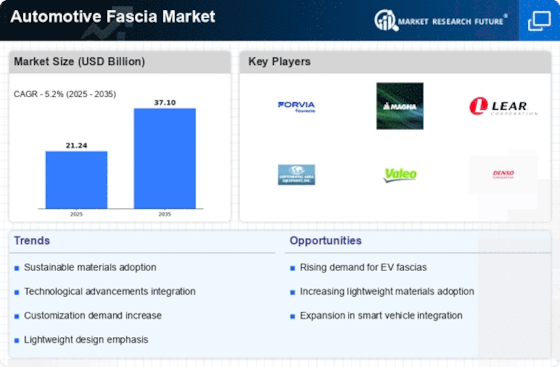
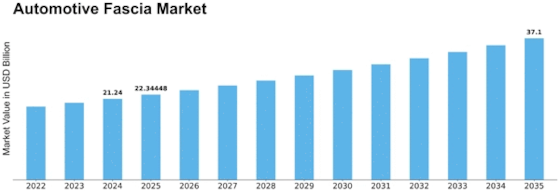
As per MRFR analysis, the Automotive Fascia Market Size was estimated at 21.24 USD Billion in 2024. The Automotive Fascia industry is projected to grow from 22.35 USD Billion in 2025 to 37.1 USD Billion by 2035, exhibiting a compound annual growth rate (CAGR) of 5.2 during the forecast period 2025 - 2035.

Key Market Trends & Highlights

The Automotive Fascia Market is poised for growth driven by sustainability and technological advancements.

  • North America remains the largest market for automotive fascia, driven by a robust automotive industry.
  • Asia-Pacific is emerging as the fastest-growing region, fueled by increasing vehicle production and demand.
  • The front fascia segment holds the largest market share, while the rear fascia segment is experiencing rapid growth.
  • Key market drivers include the rising demand for lightweight materials and the increasing focus on vehicle aesthetics.

Market Size & Forecast

2024 Market Size 21.24 (USD Billion)
2035 Market Size 37.1 (USD Billion)
CAGR (2025 - 2035) 5.2%
Largest Regional Market Share in 2024 North America

Major Players

<p>Faurecia (FR), Magna International (CA), Lear Corporation (US), Continental AG (DE), Valeo (FR), Denso Corporation (JP), Aisin Seiki (JP), Plastic Omnium (FR), Yanfeng Automotive Interiors (CN)</p>

Market Trends

The Automotive Fascia Market is currently experiencing a dynamic evolution, driven by various factors that influence consumer preferences and technological advancements. The increasing demand for lightweight materials and enhanced aesthetic appeal in vehicle design appears to be reshaping the landscape of this market. Manufacturers are focusing on integrating innovative materials that not only improve the visual aspects of vehicles but also contribute to overall performance and efficiency. Furthermore, the growing emphasis on sustainability and environmental considerations is prompting companies to explore eco-friendly alternatives in fascia production, which may lead to a shift in traditional manufacturing practices. In addition, the rise of electric vehicles and autonomous driving technology is likely to impact the Automotive Fascia Market significantly. As automakers adapt to new design paradigms, the fascia components are expected to evolve, reflecting the changing needs of modern vehicles. This transformation may also encourage collaboration between automotive manufacturers and material suppliers, fostering a more integrated approach to product development. Overall, the Automotive Fascia Market seems poised for substantial growth, driven by innovation, sustainability, and the ongoing evolution of vehicle design.

Sustainability Initiatives

The Automotive Fascia Market is increasingly influenced by sustainability initiatives, as manufacturers seek to reduce their environmental footprint. This trend involves the adoption of eco-friendly materials and production processes, which may appeal to environmentally conscious consumers. Companies are exploring bioplastics and recycled materials, potentially leading to a more sustainable approach in fascia design.

Technological Advancements

Technological advancements are playing a crucial role in shaping the Automotive Fascia Market. Innovations in materials science and manufacturing techniques are enabling the production of lighter, more durable fascias. These advancements may enhance vehicle performance and fuel efficiency, aligning with the industry's shift towards more efficient automotive solutions.

Customization and Aesthetic Appeal

Customization and aesthetic appeal are becoming increasingly important in the Automotive Fascia Market. Consumers are seeking unique designs that reflect their personal style, prompting manufacturers to offer a wider range of options. This trend may lead to more innovative designs and greater differentiation among automotive brands.

Automotive Fascia Market Market Drivers

Growth of Electric and Hybrid Vehicles

The Automotive Fascia Market is poised for growth due to the rising popularity of electric and hybrid vehicles. As these vehicles become more mainstream, manufacturers are increasingly focusing on designing fascias that cater to the unique requirements of electric drivetrains. This includes considerations for aerodynamics, cooling systems, and lightweight materials. Data suggests that the electric vehicle market is expected to grow at a compound annual growth rate of over 20% in the coming years, which will likely drive demand for specialized fascias. Consequently, the Automotive Fascia Market is adapting to these changes, presenting opportunities for innovation and collaboration among manufacturers to meet the evolving needs of the automotive landscape.

Increasing Focus on Vehicle Aesthetics

The Automotive Fascia Market is increasingly influenced by consumer preferences for vehicle aesthetics and design. As automotive manufacturers strive to differentiate their products in a competitive landscape, the fascia plays a crucial role in enhancing the overall visual appeal of vehicles. Recent surveys indicate that approximately 70% of consumers consider the exterior design of a vehicle as a key purchasing factor. This trend is prompting manufacturers to invest in innovative designs and finishes for fascias, thereby driving growth in the Automotive Fascia Market. Additionally, the rise of electric vehicles, which often feature unique design elements, further emphasizes the importance of fascias in creating a distinctive brand identity.

Rising Demand for Lightweight Materials

The Automotive Fascia Market is experiencing a notable shift towards lightweight materials, driven by the automotive sector's increasing focus on fuel efficiency and emissions reduction. Manufacturers are increasingly adopting materials such as thermoplastics and composites, which not only reduce vehicle weight but also enhance performance. According to recent data, the use of lightweight materials in automotive applications is projected to grow at a compound annual growth rate of approximately 5% over the next five years. This trend is likely to propel the Automotive Fascia Market, as fascias made from these materials contribute to overall vehicle efficiency and sustainability goals. Furthermore, the integration of lightweight fascias can lead to improved handling and acceleration, appealing to both manufacturers and consumers alike.

Regulatory Compliance and Safety Standards

The Automotive Fascia Market is significantly impacted by stringent regulatory compliance and safety standards imposed by various governing bodies. These regulations often mandate specific performance criteria for vehicle components, including fascias, to ensure safety and environmental sustainability. As a result, manufacturers are compelled to innovate and enhance the durability and impact resistance of fascias. The market is expected to see a rise in demand for fascias that meet these evolving standards, which could lead to increased investments in research and development. Furthermore, compliance with safety regulations not only enhances consumer trust but also positions manufacturers favorably in the Automotive Fascia Market.

Technological Innovations in Manufacturing

Technological advancements are significantly influencing the Automotive Fascia Market, particularly through the adoption of advanced manufacturing techniques such as 3D printing and automation. These innovations enable manufacturers to produce fascias with greater precision and reduced lead times, thereby enhancing overall production efficiency. The market is witnessing a shift towards smart manufacturing processes, which are expected to increase output while minimizing waste. As a result, the Automotive Fascia Market is likely to benefit from lower production costs and improved product quality. Furthermore, the integration of smart technologies allows for the development of customizable fascias that meet specific consumer preferences, thereby expanding market opportunities.

Market Segment Insights

By Position Type: Front Fascia (Largest) vs. Rear Fascia (Fastest-Growing)

<p>In the automotive fascia market, the front fascia segment holds the largest market share, primarily due to its critical role in vehicle aesthetics and aerodynamics. It serves as the first point of contact for visual appeal and is often integrated with advanced technologies, including lighting and sensors. Conversely, the rear fascia segment, while currently smaller in terms of market share, is rapidly gaining traction as automakers prioritize rear-end aesthetics and functionality, especially with the rising popularity of SUV and crossover vehicles, which have specific rear design requirements. Growth trends in the automotive fascia market are largely driven by the increasing demand for lightweight materials and innovative designs that enhance vehicle performance and style. Factors such as stringent regulations on vehicle emissions and improving fuel efficiency push manufacturers to adopt materials that reduce vehicle weight. Additionally, advancements in automotive technology, including the integration of electric components and autonomous driving features, contribute to the evolution of fascia designs, resulting in higher demand for rear fascias, which are becoming more intricate and essential for modern vehicles.</p>

<p>Front Fascia: Dominant vs. Rear Fascia: Emerging</p>

<p>The front fascia segment is recognized as the dominant force in the automotive fascia market. It is characterized by its intricate designs that not only enhance vehicle aesthetics but also incorporate essential features such as air intakes, headlight housings, and pedestrian safety measures. As vehicles evolve, the front fascia's role expands to include integration with advanced driver-assistance systems (ADAS), making it critical for both safety and functionality. In contrast, the rear fascia segment is emerging, driven by trends in SUV and crossover vehicles. It often showcases sleek designs that complement the overall styling of the vehicle while supporting technology like taillights and rear cameras. As consumer preferences shift towards more stylish and functional rear ends, the demand for rear fascias is set to grow significantly, marking its importance in the automotive market.</p>

By Material: Plastic Covered Polystyrene (Largest) vs. Rubber (Fastest-Growing)

<p>In the Automotive Fascia Market, the material segment is characterized by several prominent players, with Plastic Covered Polystyrene holding the largest market share due to its widespread application in vehicle manufacturing. Rubber is emerging as a significant contender, capturing interest because of its flexibility and durability, positioning it for substantial growth in the coming years. Other materials such as Plastic Covered Aluminium and Steel & Aluminium also contribute to the market, but they lag behind in both share and growth potential.</p>

<p>Rubber (Dominant) vs. Plastic Covered Aluminium (Emerging)</p>

<p>Rubber is a dominant force in the Automotive Fascia Market, renowned for its resilience and ability to provide shock absorption, making it ideal for various automotive applications. Its performance in adverse weather conditions further enhances its appeal to manufacturers. On the other hand, Plastic Covered Aluminium is an emerging segment that combines lightweight properties with structural strength, appealing to automotive designers focused on fuel efficiency and aesthetic appeal. While Rubber continues to maintain a strong foothold, Plastic Covered Aluminium is gaining traction as adherence to lightweight material trends in automotive design grows.</p>

By Vehicle Type: Passenger Cars (Largest) vs. Commercial Vehicles (Fastest-Growing)

<p>In the Automotive Fascia Market, the distribution of market share highlights that passenger cars represent the largest segment, capturing a significant portion of the overall market. This category is characterized by a strong demand due to increasing consumer preferences for personal vehicles, fuel efficiency, and advanced technologies integrated into car designs. On the other hand, commercial vehicles, while representing a smaller share, are gaining traction as businesses expand and look to invest in durable and efficient transport solutions for logistics and delivery purposes. The growth trends in the vehicle type segment showcase a robust increase in demand for commercial vehicles, making it the fastest-growing sector within the Automotive Fascia Market. This growth is driven by the rise in e-commerce, which requires efficient distribution networks, and an uptick in government initiatives promoting electric and environmentally friendly commercial vehicles. As logistics operations evolve, the emphasis on innovation in commercial vehicle designs will continue to serve as a catalyst for market expansion, challenging the traditional dominance of passenger cars.</p>

<p>Passenger Cars (Dominant) vs. Commercial Vehicles (Emerging)</p>

<p>The passenger car segment in the Automotive Fascia Market is currently dominant due to its established presence and significant consumer base. This segment is characterized by a vast array of designs, materials, and innovative features aimed at enhancing aesthetics and functionality. As manufacturers consistently strive to meet customer demands, developments such as lightweight materials for improved fuel efficiency and integrated technology for enhanced user experience have set the bar high. On the other hand, commercial vehicles are emerging within this market, driven by the growing logistics and transportation sector's evolving needs. These vehicles are increasingly designed to support advanced functionalities such as telematics and greater payload capabilities, responding to industry trends that prioritize efficiency and sustainability.</p>

By Sales Channel: OEM (Largest) vs. Aftermarket (Fastest-Growing)

<p>In the Automotive Fascia Market, the distribution of sales channels reveals that the OEM segment holds a dominant position, focusing on original equipment manufacturers that install fascias during vehicle assembly. This segment benefits from strong relationships with automakers and ensures quality control, contributing significantly to its market share. On the other hand, the aftermarket segment is gaining momentum, driven by increasing consumer demand for vehicle customization and repair. As more vehicle owners seek aesthetic and functional enhancements, the aftermarket's share continues to rise, reflecting evolving consumer preferences.</p>

<p>Sales Channels: OEM (Dominant) vs. Aftermarket (Emerging)</p>

<p>The OEM segment is characterized by its established relationships with vehicle manufacturers, delivering high-quality fascias that meet specific design and safety standards. This dominance is supported by continuous innovation and adherence to regulatory requirements, ensuring OEM products remain essential in new vehicle production. In contrast, the aftermarket segment is emerging as a powerful alternative, attracting consumers who prioritize personalization options and cost-effective solutions post-purchase. This shift pushes manufacturers to diversify product offerings, catering to a market keen on customization, thus significantly influencing purchasing trends.</p>

Get more detailed insights about Automotive Fascia Market Research Report—Global Forecast till 2035

Regional Insights

North America : Automotive Innovation Hub

North America is witnessing robust growth in the automotive fascia market, driven by increasing vehicle production and a shift towards lightweight materials. The region holds approximately 40% of the global market share, making it the largest market. Regulatory support for electric vehicles and sustainability initiatives further catalyze demand, enhancing the market landscape. The United States and Canada are the leading countries in this sector, with major players like Lear Corporation and Magna International dominating the landscape. The competitive environment is characterized by innovation and strategic partnerships, as companies focus on enhancing product offerings and meeting evolving consumer preferences. The presence of key players ensures a dynamic market, fostering continuous advancements in automotive fascia technology.

Europe : Sustainable Automotive Solutions

Europe is emerging as a significant player in the automotive fascia market, driven by stringent environmental regulations and a strong push for sustainability. The region accounts for approximately 30% of the global market share, making it the second largest market. The European Union's regulations on emissions and waste management are key catalysts for innovation in automotive design and materials. Leading countries such as Germany, France, and Italy are at the forefront, with companies like Faurecia and Continental AG leading the charge. The competitive landscape is marked by a focus on eco-friendly materials and advanced manufacturing techniques. Collaboration among industry stakeholders is common, as they strive to meet regulatory requirements while enhancing product performance and consumer appeal.

Asia-Pacific : Emerging Automotive Powerhouse

Asia-Pacific is rapidly becoming a powerhouse in the automotive fascia market, driven by increasing vehicle production and rising consumer demand. The region holds approximately 25% of the global market share, with countries like China and Japan leading the charge. Government initiatives promoting electric vehicles and advanced manufacturing are significant growth drivers, enhancing the market's potential. China is the largest market in the region, with key players like Denso Corporation and Aisin Seiki making substantial contributions. The competitive landscape is characterized by aggressive pricing strategies and a focus on innovation. As the region continues to expand, collaboration among local and international players is essential for meeting the growing demand and enhancing product offerings.

Middle East and Africa : Resource-Rich Automotive Sector

The Middle East and Africa (MEA) region presents unique growth opportunities in the automotive fascia market, driven by increasing urbanization and infrastructure development. The region holds approximately 5% of the global market share, with countries like South Africa and the UAE leading the way. Government investments in transportation infrastructure and a growing middle class are key factors driving demand for automotive components. South Africa is a notable player in the automotive sector, with local manufacturers and international companies establishing a presence. The competitive landscape is evolving, with a focus on enhancing local production capabilities and meeting international standards. As the market matures, collaboration among stakeholders will be crucial for leveraging growth opportunities and addressing regional challenges.

Key Players and Competitive Insights

Leading market players are investing heavily in research and development in order to expand their product lines, which will help the Automotive Fascia Market, grow even more. Market participants are also undertaking a variety of strategic activities to expand their global footprint, with important market developments including new product launches, contractual agreements, mergers and acquisitions, higher investments, and collaboration with other organizations. To expand and survive in a more competitive and rising market climate, Automotive Fascia industry must offer cost-effective items.

Manufacturing locally to minimize operational costs is one of the key business tactics used by manufacturers in the global Automotive Fascia industry to benefit clients and increase the market sector. In recent years, the Automotive Fascia industry has offered some of the most significant advantages to medicine. Major players in the Automotive Fascia Market, including Chiyoda Manufacturing, FLEX-N-GATE CORPORATION, Plastic Omnium, Inhance Technologies, Magna International Inc., MRC Manufacturing, Dongfeng Electronic Technology Co. Ltd., SANKO GOSEI, Eakas Corporation, Gestamp Automoción S.A., and others, are attempting to increase market demand by investing in research and development operations.

Compagnie Plastic Omnium SA (Plastic Omnium), a division of Burelle SA, produces and markets high-tech goods and automobile parts. It creates and sells bodywork modules, bumpers and front-end assemblies, body panels and spoilers, rear closure systems, semi-structural and structural elements, and other front-end modules. It also produces and sells painted external plastic and composite components. It provides goods to companies that make cars and trucks. The company conducts business across the Americas, Europe, and Asia. The headquarters of Plastic Omnium are located in Levallois, Ile-de-France, France.

Engineering company Chiyoda Corp (Chiyoda) is integrated. It offers services in engineering, planning, procurement, construction, operation, and maintenance. Asset management and business support services are also provided by the corporation. Chiyoda creates its own technology to offer cutting-edge solutions in the areas of chemical and environmental engineering. It runs through a network of sales bases, project execution bases, engineering centres, procurement bases, and operation support offices. Oil and gas, chemicals and petrochemicals, medicines, environmental technology, new and renewable energy, social infrastructure, and industrial sectors are just a few of the industries the company serves.

The headquarters of Chiyoda are in Yokohama, Kanagawa, Japan.

Key Companies in the Automotive Fascia Market market include

Industry Developments

March 2023 Magna International announced intentions to increase the size of its Puebla, Mexico, plant that makes automobile fascias. The addition is anticipated to add 100,000 square feet of manufacturing space and 500 new jobs.

April 2023 Cartrim, a producer of car fascias and other parts, was bought by Plastic Omnium. Plastic Omnium's position in the market for automobile fascias globally is anticipated to improve as a result of the acquisition.

Future Outlook

Automotive Fascia Market Future Outlook

<p>The Automotive Fascia Market is projected to grow at a 5.2% CAGR from 2024 to 2035, driven by technological advancements, increasing vehicle production, and rising consumer demand for aesthetics.</p>

New opportunities lie in:

  • <p>Integration of smart technology in fascia designs</p>
  • <p>Expansion into electric vehicle fascia solutions</p>
  • <p>Development of sustainable materials for fascia production</p>

<p>By 2035, the market is expected to achieve robust growth, reflecting evolving consumer preferences and technological innovations.</p>

Market Segmentation

Automotive Fascia Market Material Outlook

  • Rubber
  • Plastic Covered Polystyrene
  • Plastic Covered Aluminium
  • Steel & Aluminium
  • Others

Automotive Fascia Market Vehicle Type Outlook

  • Passenger Cars
  • Commercial Vehicles

Automotive Fascia Market Position Type Outlook

  • Front Fascia
  • Rear Fascia

Automotive Fascia Market Sales Channel Outlook

  • OEM
  • Aftermarket

Report Scope

MARKET SIZE 202421.24(USD Billion)
MARKET SIZE 202522.35(USD Billion)
MARKET SIZE 203537.1(USD Billion)
COMPOUND ANNUAL GROWTH RATE (CAGR)5.2% (2024 - 2035)
REPORT COVERAGERevenue Forecast, Competitive Landscape, Growth Factors, and Trends
BASE YEAR2024
Market Forecast Period2025 - 2035
Historical Data2019 - 2024
Market Forecast UnitsUSD Billion
Key Companies ProfiledMarket analysis in progress
Segments CoveredMarket segmentation analysis in progress
Key Market OpportunitiesIntegration of advanced materials and smart technologies in the Automotive Fascia Market enhances design and functionality.
Key Market DynamicsRising demand for lightweight materials in automotive fascia enhances fuel efficiency and meets regulatory standards.
Countries CoveredNorth America, Europe, APAC, South America, MEA

FAQs

What is the projected market valuation of the Automotive Fascia Market by 2035?

The Automotive Fascia Market is projected to reach a valuation of 37.1 USD Billion by 2035.

What was the market valuation of the Automotive Fascia Market in 2024?

In 2024, the Automotive Fascia Market was valued at 21.24 USD Billion.

What is the expected CAGR for the Automotive Fascia Market during the forecast period 2025 - 2035?

The expected CAGR for the Automotive Fascia Market during the forecast period 2025 - 2035 is 5.2%.

Which companies are considered key players in the Automotive Fascia Market?

Key players in the Automotive Fascia Market include Faurecia, Magna International, Lear Corporation, Continental AG, Valeo, Denso Corporation, Aisin Seiki, Plastic Omnium, and Yanfeng Automotive Interiors.

What are the projected valuations for Front and Rear Fascia segments by 2035?

The projected valuations for both Front and Rear Fascia segments are expected to reach 18.55 USD Billion by 2035.

How do the material segments of the Automotive Fascia Market compare in terms of projected growth?

The Plastic Covered Polystyrene segment is projected to grow from 5.0 USD Billion to 8.5 USD Billion, indicating a notable increase.

  1. SECTION I: EXECUTIVE SUMMARY AND KEY HIGHLIGHTS
    1. EXECUTIVE SUMMARY
      1. Market Overview
      2. Key Findings
      3. Market Segmentation
      4. Competitive Landscape
      5. Challenges and Opportunities
      6. Future Outlook
  2. SECTION II: SCOPING, METHODOLOGY AND MARKET STRUCTURE
    1. MARKET INTRODUCTION
      1. Definition
      2. Scope of the study
    2. RESEARCH METHODOLOGY
      1. Overview
      2. Data Mining
      3. Secondary Research
      4. Primary Research
      5. Forecasting Model
      6. Market Size Estimation
      7. Data Triangulation
      8. Validation
  3. SECTION III: QUALITATIVE ANALYSIS
    1. MARKET DYNAMICS
      1. Overview
      2. Drivers
      3. Restraints
      4. Opportunities
    2. MARKET FACTOR ANALYSIS
      1. Value chain Analysis
      2. Porter's Five Forces Analysis
      3. COVID-19 Impact Analysis
  4. SECTION IV: QUANTITATIVE ANALYSIS
    1. Automobile, BY Position Type (USD Billion)
      1. Front Fascia
      2. Rear Fascia
    2. Automobile, BY Material (USD Billion)
      1. Rubber
      2. Plastic Covered Polystyrene
      3. Plastic Covered Aluminium
      4. Steel & Aluminium
      5. Others
    3. Automobile, BY Vehicle Type (USD Billion)
      1. Passenger Cars
      2. Commercial Vehicles
    4. Automobile, BY Sales Channel (USD Billion)
      1. OEM
      2. Aftermarket
    5. Automobile, BY Region (USD Billion)
      1. North America
      2. Europe
      3. APAC
      4. South America
      5. MEA
  5. SECTION V: COMPETITIVE ANALYSIS
    1. Competitive Landscape
      1. Overview
      2. Competitive Analysis
      3. Market share Analysis
      4. Major Growth Strategy in the Automobile
      5. Competitive Benchmarking
      6. Leading Players in Terms of Number of Developments in the Automobile
      7. Key developments and growth strategies
      8. Major Players Financial Matrix
    2. Company Profiles
      1. Faurecia (FR)
      2. Magna International (CA)
      3. Lear Corporation (US)
      4. Continental AG (DE)
      5. Valeo (FR)
      6. Denso Corporation (JP)
      7. Aisin Seiki (JP)
      8. Plastic Omnium (FR)
      9. Yanfeng Automotive Interiors (CN)
    3. Appendix
      1. References
      2. Related Reports
  6. LIST OF FIGURES
    1. MARKET SYNOPSIS
    2. NORTH AMERICA MARKET ANALYSIS
    3. US MARKET ANALYSIS BY POSITION TYPE
    4. US MARKET ANALYSIS BY MATERIAL
    5. US MARKET ANALYSIS BY VEHICLE TYPE
    6. US MARKET ANALYSIS BY SALES CHANNEL
    7. CANADA MARKET ANALYSIS BY POSITION TYPE
    8. CANADA MARKET ANALYSIS BY MATERIAL
    9. CANADA MARKET ANALYSIS BY VEHICLE TYPE
    10. CANADA MARKET ANALYSIS BY SALES CHANNEL
    11. EUROPE MARKET ANALYSIS
    12. GERMANY MARKET ANALYSIS BY POSITION TYPE
    13. GERMANY MARKET ANALYSIS BY MATERIAL
    14. GERMANY MARKET ANALYSIS BY VEHICLE TYPE
    15. GERMANY MARKET ANALYSIS BY SALES CHANNEL
    16. UK MARKET ANALYSIS BY POSITION TYPE
    17. UK MARKET ANALYSIS BY MATERIAL
    18. UK MARKET ANALYSIS BY VEHICLE TYPE
    19. UK MARKET ANALYSIS BY SALES CHANNEL
    20. FRANCE MARKET ANALYSIS BY POSITION TYPE
    21. FRANCE MARKET ANALYSIS BY MATERIAL
    22. FRANCE MARKET ANALYSIS BY VEHICLE TYPE
    23. FRANCE MARKET ANALYSIS BY SALES CHANNEL
    24. RUSSIA MARKET ANALYSIS BY POSITION TYPE
    25. RUSSIA MARKET ANALYSIS BY MATERIAL
    26. RUSSIA MARKET ANALYSIS BY VEHICLE TYPE
    27. RUSSIA MARKET ANALYSIS BY SALES CHANNEL
    28. ITALY MARKET ANALYSIS BY POSITION TYPE
    29. ITALY MARKET ANALYSIS BY MATERIAL
    30. ITALY MARKET ANALYSIS BY VEHICLE TYPE
    31. ITALY MARKET ANALYSIS BY SALES CHANNEL
    32. SPAIN MARKET ANALYSIS BY POSITION TYPE
    33. SPAIN MARKET ANALYSIS BY MATERIAL
    34. SPAIN MARKET ANALYSIS BY VEHICLE TYPE
    35. SPAIN MARKET ANALYSIS BY SALES CHANNEL
    36. REST OF EUROPE MARKET ANALYSIS BY POSITION TYPE
    37. REST OF EUROPE MARKET ANALYSIS BY MATERIAL
    38. REST OF EUROPE MARKET ANALYSIS BY VEHICLE TYPE
    39. REST OF EUROPE MARKET ANALYSIS BY SALES CHANNEL
    40. APAC MARKET ANALYSIS
    41. CHINA MARKET ANALYSIS BY POSITION TYPE
    42. CHINA MARKET ANALYSIS BY MATERIAL
    43. CHINA MARKET ANALYSIS BY VEHICLE TYPE
    44. CHINA MARKET ANALYSIS BY SALES CHANNEL
    45. INDIA MARKET ANALYSIS BY POSITION TYPE
    46. INDIA MARKET ANALYSIS BY MATERIAL
    47. INDIA MARKET ANALYSIS BY VEHICLE TYPE
    48. INDIA MARKET ANALYSIS BY SALES CHANNEL
    49. JAPAN MARKET ANALYSIS BY POSITION TYPE
    50. JAPAN MARKET ANALYSIS BY MATERIAL
    51. JAPAN MARKET ANALYSIS BY VEHICLE TYPE
    52. JAPAN MARKET ANALYSIS BY SALES CHANNEL
    53. SOUTH KOREA MARKET ANALYSIS BY POSITION TYPE
    54. SOUTH KOREA MARKET ANALYSIS BY MATERIAL
    55. SOUTH KOREA MARKET ANALYSIS BY VEHICLE TYPE
    56. SOUTH KOREA MARKET ANALYSIS BY SALES CHANNEL
    57. MALAYSIA MARKET ANALYSIS BY POSITION TYPE
    58. MALAYSIA MARKET ANALYSIS BY MATERIAL
    59. MALAYSIA MARKET ANALYSIS BY VEHICLE TYPE
    60. MALAYSIA MARKET ANALYSIS BY SALES CHANNEL
    61. THAILAND MARKET ANALYSIS BY POSITION TYPE
    62. THAILAND MARKET ANALYSIS BY MATERIAL
    63. THAILAND MARKET ANALYSIS BY VEHICLE TYPE
    64. THAILAND MARKET ANALYSIS BY SALES CHANNEL
    65. INDONESIA MARKET ANALYSIS BY POSITION TYPE
    66. INDONESIA MARKET ANALYSIS BY MATERIAL
    67. INDONESIA MARKET ANALYSIS BY VEHICLE TYPE
    68. INDONESIA MARKET ANALYSIS BY SALES CHANNEL
    69. REST OF APAC MARKET ANALYSIS BY POSITION TYPE
    70. REST OF APAC MARKET ANALYSIS BY MATERIAL
    71. REST OF APAC MARKET ANALYSIS BY VEHICLE TYPE
    72. REST OF APAC MARKET ANALYSIS BY SALES CHANNEL
    73. SOUTH AMERICA MARKET ANALYSIS
    74. BRAZIL MARKET ANALYSIS BY POSITION TYPE
    75. BRAZIL MARKET ANALYSIS BY MATERIAL
    76. BRAZIL MARKET ANALYSIS BY VEHICLE TYPE
    77. BRAZIL MARKET ANALYSIS BY SALES CHANNEL
    78. MEXICO MARKET ANALYSIS BY POSITION TYPE
    79. MEXICO MARKET ANALYSIS BY MATERIAL
    80. MEXICO MARKET ANALYSIS BY VEHICLE TYPE
    81. MEXICO MARKET ANALYSIS BY SALES CHANNEL
    82. ARGENTINA MARKET ANALYSIS BY POSITION TYPE
    83. ARGENTINA MARKET ANALYSIS BY MATERIAL
    84. ARGENTINA MARKET ANALYSIS BY VEHICLE TYPE
    85. ARGENTINA MARKET ANALYSIS BY SALES CHANNEL
    86. REST OF SOUTH AMERICA MARKET ANALYSIS BY POSITION TYPE
    87. REST OF SOUTH AMERICA MARKET ANALYSIS BY MATERIAL
    88. REST OF SOUTH AMERICA MARKET ANALYSIS BY VEHICLE TYPE
    89. REST OF SOUTH AMERICA MARKET ANALYSIS BY SALES CHANNEL
    90. MEA MARKET ANALYSIS
    91. GCC COUNTRIES MARKET ANALYSIS BY POSITION TYPE
    92. GCC COUNTRIES MARKET ANALYSIS BY MATERIAL
    93. GCC COUNTRIES MARKET ANALYSIS BY VEHICLE TYPE
    94. GCC COUNTRIES MARKET ANALYSIS BY SALES CHANNEL
    95. SOUTH AFRICA MARKET ANALYSIS BY POSITION TYPE
    96. SOUTH AFRICA MARKET ANALYSIS BY MATERIAL
    97. SOUTH AFRICA MARKET ANALYSIS BY VEHICLE TYPE
    98. SOUTH AFRICA MARKET ANALYSIS BY SALES CHANNEL
    99. REST OF MEA MARKET ANALYSIS BY POSITION TYPE
    100. REST OF MEA MARKET ANALYSIS BY MATERIAL
    101. REST OF MEA MARKET ANALYSIS BY VEHICLE TYPE
    102. REST OF MEA MARKET ANALYSIS BY SALES CHANNEL
    103. KEY BUYING CRITERIA OF AUTOMOBILE
    104. RESEARCH PROCESS OF MRFR
    105. DRO ANALYSIS OF AUTOMOBILE
    106. DRIVERS IMPACT ANALYSIS: AUTOMOBILE
    107. RESTRAINTS IMPACT ANALYSIS: AUTOMOBILE
    108. SUPPLY / VALUE CHAIN: AUTOMOBILE
    109. AUTOMOBILE, BY POSITION TYPE, 2024 (% SHARE)
    110. AUTOMOBILE, BY POSITION TYPE, 2024 TO 2035 (USD Billion)
    111. AUTOMOBILE, BY MATERIAL, 2024 (% SHARE)
    112. AUTOMOBILE, BY MATERIAL, 2024 TO 2035 (USD Billion)
    113. AUTOMOBILE, BY VEHICLE TYPE, 2024 (% SHARE)
    114. AUTOMOBILE, BY VEHICLE TYPE, 2024 TO 2035 (USD Billion)
    115. AUTOMOBILE, BY SALES CHANNEL, 2024 (% SHARE)
    116. AUTOMOBILE, BY SALES CHANNEL, 2024 TO 2035 (USD Billion)
    117. BENCHMARKING OF MAJOR COMPETITORS
  7. LIST OF TABLES
    1. LIST OF ASSUMPTIONS
    2. North America MARKET SIZE ESTIMATES; FORECAST
      1. BY POSITION TYPE, 2025-2035 (USD Billion)
      2. BY MATERIAL, 2025-2035 (USD Billion)
      3. BY VEHICLE TYPE, 2025-2035 (USD Billion)
      4. BY SALES CHANNEL, 2025-2035 (USD Billion)
    3. US MARKET SIZE ESTIMATES; FORECAST
      1. BY POSITION TYPE, 2025-2035 (USD Billion)
      2. BY MATERIAL, 2025-2035 (USD Billion)
      3. BY VEHICLE TYPE, 2025-2035 (USD Billion)
      4. BY SALES CHANNEL, 2025-2035 (USD Billion)
    4. Canada MARKET SIZE ESTIMATES; FORECAST
      1. BY POSITION TYPE, 2025-2035 (USD Billion)
      2. BY MATERIAL, 2025-2035 (USD Billion)
      3. BY VEHICLE TYPE, 2025-2035 (USD Billion)
      4. BY SALES CHANNEL, 2025-2035 (USD Billion)
    5. Europe MARKET SIZE ESTIMATES; FORECAST
      1. BY POSITION TYPE, 2025-2035 (USD Billion)
      2. BY MATERIAL, 2025-2035 (USD Billion)
      3. BY VEHICLE TYPE, 2025-2035 (USD Billion)
      4. BY SALES CHANNEL, 2025-2035 (USD Billion)
    6. Germany MARKET SIZE ESTIMATES; FORECAST
      1. BY POSITION TYPE, 2025-2035 (USD Billion)
      2. BY MATERIAL, 2025-2035 (USD Billion)
      3. BY VEHICLE TYPE, 2025-2035 (USD Billion)
      4. BY SALES CHANNEL, 2025-2035 (USD Billion)
    7. UK MARKET SIZE ESTIMATES; FORECAST
      1. BY POSITION TYPE, 2025-2035 (USD Billion)
      2. BY MATERIAL, 2025-2035 (USD Billion)
      3. BY VEHICLE TYPE, 2025-2035 (USD Billion)
      4. BY SALES CHANNEL, 2025-2035 (USD Billion)
    8. France MARKET SIZE ESTIMATES; FORECAST
      1. BY POSITION TYPE, 2025-2035 (USD Billion)
      2. BY MATERIAL, 2025-2035 (USD Billion)
      3. BY VEHICLE TYPE, 2025-2035 (USD Billion)
      4. BY SALES CHANNEL, 2025-2035 (USD Billion)
    9. Russia MARKET SIZE ESTIMATES; FORECAST
      1. BY POSITION TYPE, 2025-2035 (USD Billion)
      2. BY MATERIAL, 2025-2035 (USD Billion)
      3. BY VEHICLE TYPE, 2025-2035 (USD Billion)
      4. BY SALES CHANNEL, 2025-2035 (USD Billion)
    10. Italy MARKET SIZE ESTIMATES; FORECAST
      1. BY POSITION TYPE, 2025-2035 (USD Billion)
      2. BY MATERIAL, 2025-2035 (USD Billion)
      3. BY VEHICLE TYPE, 2025-2035 (USD Billion)
      4. BY SALES CHANNEL, 2025-2035 (USD Billion)
    11. Spain MARKET SIZE ESTIMATES; FORECAST
      1. BY POSITION TYPE, 2025-2035 (USD Billion)
      2. BY MATERIAL, 2025-2035 (USD Billion)
      3. BY VEHICLE TYPE, 2025-2035 (USD Billion)
      4. BY SALES CHANNEL, 2025-2035 (USD Billion)
    12. Rest of Europe MARKET SIZE ESTIMATES; FORECAST
      1. BY POSITION TYPE, 2025-2035 (USD Billion)
      2. BY MATERIAL, 2025-2035 (USD Billion)
      3. BY VEHICLE TYPE, 2025-2035 (USD Billion)
      4. BY SALES CHANNEL, 2025-2035 (USD Billion)
    13. APAC MARKET SIZE ESTIMATES; FORECAST
      1. BY POSITION TYPE, 2025-2035 (USD Billion)
      2. BY MATERIAL, 2025-2035 (USD Billion)
      3. BY VEHICLE TYPE, 2025-2035 (USD Billion)
      4. BY SALES CHANNEL, 2025-2035 (USD Billion)
    14. China MARKET SIZE ESTIMATES; FORECAST
      1. BY POSITION TYPE, 2025-2035 (USD Billion)
      2. BY MATERIAL, 2025-2035 (USD Billion)
      3. BY VEHICLE TYPE, 2025-2035 (USD Billion)
      4. BY SALES CHANNEL, 2025-2035 (USD Billion)
    15. India MARKET SIZE ESTIMATES; FORECAST
      1. BY POSITION TYPE, 2025-2035 (USD Billion)
      2. BY MATERIAL, 2025-2035 (USD Billion)
      3. BY VEHICLE TYPE, 2025-2035 (USD Billion)
      4. BY SALES CHANNEL, 2025-2035 (USD Billion)
    16. Japan MARKET SIZE ESTIMATES; FORECAST
      1. BY POSITION TYPE, 2025-2035 (USD Billion)
      2. BY MATERIAL, 2025-2035 (USD Billion)
      3. BY VEHICLE TYPE, 2025-2035 (USD Billion)
      4. BY SALES CHANNEL, 2025-2035 (USD Billion)
    17. South Korea MARKET SIZE ESTIMATES; FORECAST
      1. BY POSITION TYPE, 2025-2035 (USD Billion)
      2. BY MATERIAL, 2025-2035 (USD Billion)
      3. BY VEHICLE TYPE, 2025-2035 (USD Billion)
      4. BY SALES CHANNEL, 2025-2035 (USD Billion)
    18. Malaysia MARKET SIZE ESTIMATES; FORECAST
      1. BY POSITION TYPE, 2025-2035 (USD Billion)
      2. BY MATERIAL, 2025-2035 (USD Billion)
      3. BY VEHICLE TYPE, 2025-2035 (USD Billion)
      4. BY SALES CHANNEL, 2025-2035 (USD Billion)
    19. Thailand MARKET SIZE ESTIMATES; FORECAST
      1. BY POSITION TYPE, 2025-2035 (USD Billion)
      2. BY MATERIAL, 2025-2035 (USD Billion)
      3. BY VEHICLE TYPE, 2025-2035 (USD Billion)
      4. BY SALES CHANNEL, 2025-2035 (USD Billion)
    20. Indonesia MARKET SIZE ESTIMATES; FORECAST
      1. BY POSITION TYPE, 2025-2035 (USD Billion)
      2. BY MATERIAL, 2025-2035 (USD Billion)
      3. BY VEHICLE TYPE, 2025-2035 (USD Billion)
      4. BY SALES CHANNEL, 2025-2035 (USD Billion)
    21. Rest of APAC MARKET SIZE ESTIMATES; FORECAST
      1. BY POSITION TYPE, 2025-2035 (USD Billion)
      2. BY MATERIAL, 2025-2035 (USD Billion)
      3. BY VEHICLE TYPE, 2025-2035 (USD Billion)
      4. BY SALES CHANNEL, 2025-2035 (USD Billion)
    22. South America MARKET SIZE ESTIMATES; FORECAST
      1. BY POSITION TYPE, 2025-2035 (USD Billion)
      2. BY MATERIAL, 2025-2035 (USD Billion)
      3. BY VEHICLE TYPE, 2025-2035 (USD Billion)
      4. BY SALES CHANNEL, 2025-2035 (USD Billion)
    23. Brazil MARKET SIZE ESTIMATES; FORECAST
      1. BY POSITION TYPE, 2025-2035 (USD Billion)
      2. BY MATERIAL, 2025-2035 (USD Billion)
      3. BY VEHICLE TYPE, 2025-2035 (USD Billion)
      4. BY SALES CHANNEL, 2025-2035 (USD Billion)
    24. Mexico MARKET SIZE ESTIMATES; FORECAST
      1. BY POSITION TYPE, 2025-2035 (USD Billion)
      2. BY MATERIAL, 2025-2035 (USD Billion)
      3. BY VEHICLE TYPE, 2025-2035 (USD Billion)
      4. BY SALES CHANNEL, 2025-2035 (USD Billion)
    25. Argentina MARKET SIZE ESTIMATES; FORECAST
      1. BY POSITION TYPE, 2025-2035 (USD Billion)
      2. BY MATERIAL, 2025-2035 (USD Billion)
      3. BY VEHICLE TYPE, 2025-2035 (USD Billion)
      4. BY SALES CHANNEL, 2025-2035 (USD Billion)
    26. Rest of South America MARKET SIZE ESTIMATES; FORECAST
      1. BY POSITION TYPE, 2025-2035 (USD Billion)
      2. BY MATERIAL, 2025-2035 (USD Billion)
      3. BY VEHICLE TYPE, 2025-2035 (USD Billion)
      4. BY SALES CHANNEL, 2025-2035 (USD Billion)
    27. MEA MARKET SIZE ESTIMATES; FORECAST
      1. BY POSITION TYPE, 2025-2035 (USD Billion)
      2. BY MATERIAL, 2025-2035 (USD Billion)
      3. BY VEHICLE TYPE, 2025-2035 (USD Billion)
      4. BY SALES CHANNEL, 2025-2035 (USD Billion)
    28. GCC Countries MARKET SIZE ESTIMATES; FORECAST
      1. BY POSITION TYPE, 2025-2035 (USD Billion)
      2. BY MATERIAL, 2025-2035 (USD Billion)
      3. BY VEHICLE TYPE, 2025-2035 (USD Billion)
      4. BY SALES CHANNEL, 2025-2035 (USD Billion)
    29. South Africa MARKET SIZE ESTIMATES; FORECAST
      1. BY POSITION TYPE, 2025-2035 (USD Billion)
      2. BY MATERIAL, 2025-2035 (USD Billion)
      3. BY VEHICLE TYPE, 2025-2035 (USD Billion)
      4. BY SALES CHANNEL, 2025-2035 (USD Billion)
    30. Rest of MEA MARKET SIZE ESTIMATES; FORECAST
      1. BY POSITION TYPE, 2025-2035 (USD Billion)
      2. BY MATERIAL, 2025-2035 (USD Billion)
      3. BY VEHICLE TYPE, 2025-2035 (USD Billion)
      4. BY SALES CHANNEL, 2025-2035 (USD Billion)
    31. PRODUCT LAUNCH/PRODUCT DEVELOPMENT/APPROVAL
    32. ACQUISITION/PARTNERSHIP

Automotive fascia Market Segmentation

Automotive fascia Market Position Type Outlook (USD Billion, 2018-2032)

Front Fascia

Rear Fascia

Automotive fascia Market Material Outlook (USD Billion, 2018-2032)

Steel & Aluminium

Rubber

Plastic Covered Styrofoam

Plastic Covered Aluminium

Others

Automotive fascia Market Vehicle Type Outlook (USD Billion, 2018-2032)

Passenger Cars

Commercial Vehicles

Automotive fascia Market Sales Channel Outlook (USD Billion, 2018-2032)

OEM

Aftermarket

Automotive fascia Market Regional Outlook (USD Billion, 2018-2032)

North America Outlook (USD Billion, 2018-2032)

Automotive fascia Market by Position Type

Front Fascia

Rear Fascia

Automotive fascia Market by Material

Steel & Aluminium

Rubber

Plastic Covered Styrofoam

Plastic Covered Aluminium

Others

Automotive fascia Market by Vehicle Type

Passenger Cars

Commercial Vehicles

Automotive fascia Market by Sales Channel

OEM

Aftermarket

US Outlook (USD Billion, 2018-2032)

Automotive fascia Market by Position Type

Front Fascia

Rear Fascia

Automotive fascia Market by Material

Steel & Aluminium

Rubber

Plastic Covered Styrofoam

Plastic Covered Aluminium

Others

Automotive fascia Market by Vehicle Type

Passenger Cars

Commercial Vehicles

Automotive fascia Market by Sales Channel

OEM

Aftermarket

Canada Outlook (USD Billion, 2018-2032)

Automotive fascia Market by Position Type

Front Fascia

Rear Fascia

Automotive fascia Market by Material

Steel & Aluminium

Rubber

Plastic Covered Styrofoam

Plastic Covered Aluminium

Others

Automotive fascia Market by Vehicle Type

Passenger Cars

Commercial Vehicles

Automotive fascia Market by Sales Channel

OEM

Aftermarket

Europe Outlook (USD Billion, 2018-2032)

Automotive fascia Market by Position Type

Front Fascia

Rear Fascia

Automotive fascia Market by Material

Steel & Aluminium

Rubber

Plastic Covered Styrofoam

Plastic Covered Aluminium

Others

Automotive fascia Market by Vehicle Type

Passenger Cars

Commercial Vehicles

Automotive fascia Market by Sales Channel

OEM

Aftermarket

Germany Outlook (USD Billion, 2018-2032)

Automotive fascia Market by Position Type

Front Fascia

Rear Fascia

Automotive fascia Market by Material

Steel & Aluminium

Rubber

Plastic Covered Styrofoam

Plastic Covered Aluminium

Others

Automotive fascia Market by Vehicle Type

Passenger Cars

Commercial Vehicles

Automotive fascia Market by Sales Channel

OEM

Aftermarket

France Outlook (USD Billion, 2018-2032)

Automotive fascia Market by Position Type

Front Fascia

Rear Fascia

Automotive fascia Market by Material

Steel & Aluminium

Rubber

Plastic Covered Styrofoam

Plastic Covered Aluminium

Others

Automotive fascia Market by Vehicle Type

Passenger Cars

Commercial Vehicles

Automotive fascia Market by Sales Channel

OEM

Aftermarket

UK Outlook (USD Billion, 2018-2032)

Automotive fascia Market by Position Type

Front Fascia

Rear Fascia

Automotive fascia Market by Material

Steel & Aluminium

Rubber

Plastic Covered Styrofoam

Plastic Covered Aluminium

Others

Automotive fascia Market by Vehicle Type

Passenger Cars

Commercial Vehicles

Automotive fascia Market by Sales Channel

OEM

Aftermarket

Italy Outlook (USD Billion, 2018-2032)

Automotive fascia Market by Position Type

Front Fascia

Rear Fascia

Automotive fascia Market by Material

Steel & Aluminium

Rubber

Plastic Covered Styrofoam

Plastic Covered Aluminium

Others

Automotive fascia Market by Vehicle Type

Passenger Cars

Commercial Vehicles

Automotive fascia Market by Sales Channel

OEM

Aftermarket

Spain Outlook (USD Billion, 2018-2032)

Automotive fascia Market by Position Type

Front Fascia

Rear Fascia

Automotive fascia Market by Material

Steel & Aluminium

Rubber

Plastic Covered Styrofoam

Plastic Covered Aluminium

Others

Automotive fascia Market by Vehicle Type

Passenger Cars

Commercial Vehicles

Automotive fascia Market by Sales Channel

OEM

Aftermarket

Rest Of Europe Outlook (USD Billion, 2018-2032)

Automotive fascia Market by Position Type

Front Fascia

Rear Fascia

Automotive fascia Market by Material

Steel & Aluminium

Rubber

Plastic Covered Styrofoam

Plastic Covered Aluminium

Others

Automotive fascia Market by Vehicle Type

Passenger Cars

Commercial Vehicles

Automotive fascia Market by Sales Channel

OEM

Aftermarket

Asia-Pacific Outlook (USD Billion, 2018-2032)

Automotive fascia Market by Position Type

Front Fascia

Rear Fascia

Automotive fascia Market by Material

Steel & Aluminium

Rubber

Plastic Covered Styrofoam

Plastic Covered Aluminium

Others

Automotive fascia Market by Vehicle Type

Passenger Cars

Commercial Vehicles

Automotive fascia Market by Sales Channel

OEM

Aftermarket

China Outlook (USD Billion, 2018-2032)

Automotive fascia Market by Position Type

Front Fascia

Rear Fascia

Automotive fascia Market by Material

Steel & Aluminium

Rubber

Plastic Covered Styrofoam

Plastic Covered Aluminium

Others

Automotive fascia Market by Vehicle Type

Passenger Cars

Commercial Vehicles

Automotive fascia Market by Sales Channel

OEM

Aftermarket

Japan Outlook (USD Billion, 2018-2032)

Automotive fascia Market by Position Type

Front Fascia

Rear Fascia

Automotive fascia Market by Material

Steel & Aluminium

Rubber

Plastic Covered Styrofoam

Plastic Covered Aluminium

Others

Automotive fascia Market by Vehicle Type

Passenger Cars

Commercial Vehicles

Automotive fascia Market by Sales Channel

OEM

Aftermarket

India Outlook (USD Billion, 2018-2032)

Automotive fascia Market by Position Type

Front Fascia

Rear Fascia

Automotive fascia Market by Material

Steel & Aluminium

Rubber

Plastic Covered Styrofoam

Plastic Covered Aluminium

Others

Automotive fascia Market by Vehicle Type

Passenger Cars

Commercial Vehicles

Automotive fascia Market by Sales Channel

OEM

Aftermarket

Australia Outlook (USD Billion, 2018-2032)

Automotive fascia Market by Position Type

Front Fascia

Rear Fascia

Automotive fascia Market by Material

Steel & Aluminium

Rubber

Plastic Covered Styrofoam

Plastic Covered Aluminium

Others

Automotive fascia Market by Vehicle Type

Passenger Cars

Commercial Vehicles

Automotive fascia Market by Sales Channel

OEM

Aftermarket

Rest of Asia-Pacific Outlook (USD Billion, 2018-2032)

Automotive fascia Market by Position Type

Front Fascia

Rear Fascia

Automotive fascia Market by Material

Steel & Aluminium

Rubber

Plastic Covered Styrofoam

Plastic Covered Aluminium

Others

Automotive fascia Market by Vehicle Type

Passenger Cars

Commercial Vehicles

Automotive fascia Market by Sales Channel

OEM

Aftermarket

Rest of the World Outlook (USD Billion, 2018-2032)

Automotive fascia Market by Position Type

Front Fascia

Rear Fascia

Automotive fascia Market by Material

Steel & Aluminium

Rubber

Plastic Covered Styrofoam

Plastic Covered Aluminium

Others

Automotive fascia Market by Vehicle Type

Passenger Cars

Commercial Vehicles

Automotive fascia Market by Sales Channel

OEM

Aftermarket

Middle East Outlook (USD Billion, 2018-2032)

Automotive fascia Market by Position Type

Front Fascia

Rear Fascia

Automotive fascia Market by Material

Steel & Aluminium

Rubber

Plastic Covered Styrofoam

Plastic Covered Aluminium

Others

Automotive fascia Market by Vehicle Type

Passenger Cars

Commercial Vehicles

Automotive fascia Market by Sales Channel

OEM

Aftermarket

Africa Outlook (USD Billion, 2018-2032)

Automotive fascia Market by Position Type

Front Fascia

Rear Fascia

Automotive fascia Market by Material

Steel & Aluminium

Rubber

Plastic Covered Styrofoam

Plastic Covered Aluminium

Others

Automotive fascia Market by Vehicle Type

Passenger Cars

Commercial Vehicles

Automotive fascia Market by Sales Channel

OEM

Aftermarket

Latin America Outlook (USD Billion, 2018-2032)

Automotive fascia Market by Position Type

Front Fascia

Rear Fascia

Automotive fascia Market by Material

Steel & Aluminium

Rubber

Plastic Covered Styrofoam

Plastic Covered Aluminium

Others

Automotive fascia Market by Vehicle Type

Passenger Cars

Commercial Vehicles

Automotive fascia Market by Sales Channel

OEM

Aftermarket


Infographic

Free Sample Request

Kindly complete the form below to receive a free sample of this Report

Get Free Sample

Customer Strories

Compare Licence

×
Features License Type
Single User Multiuser License Enterprise User
Price $4,950 $5,950 $7,250
Maximum User Access Limit 1 User Upto 10 Users Unrestricted Access Throughout the Organization
Free Customization
Direct Access to Analyst
Deliverable Format
Platform Access
Discount on Next Purchase 10% 15% 15%
Printable Versions