
Request Free Sample ×

Kindly complete the form below to receive a free sample of this Report

* Please use a valid business email

Leading companies partner with us for data-driven Insights

clients tt-cursor
Hero Background
English
Chinese
French
Japanese
Korean
German
Spanish

Automotive Electronics Market Analysis

ID: MRFR/AT/2847-HCR
188 Pages
Triveni Bhoyar
Last Updated: April 15, 2026

Automotive Electronics Market Research Report By Application (Infotainment Systems, Advanced Driver Assistance Systems, Powertrain Control Systems, Body Control Modules, Telematics), By Component Type (Sensors, Microcontrollers, Integrated Circuits, Connectors, Displays), By Vehicle Type (Passenger Vehicles, Commercial Vehicles, Electric Vehicles, Hybrid Vehicles, Luxury Vehicles), By End Use (OEM, Aftermarket) and By Regional (North America, Europe, South America, Asia Pacific, Middle East and Africa) - Forecast to 2035

Share:
Download PDF ×

We do not share your information with anyone. However, we may send you emails based on your report interest from time to time. You may contact us at any time to opt-out.

Automotive Electronics Market Infographic
Purchase Options

Market Analysis

In-depth Analysis of Automotive Electronics Market Industry Landscape

The market dynamics of the automotive electronics sector are undergoing a transformative journey driven by technological advancements, safety imperatives, and the global shift toward electric and autonomous vehicles. The automotive industry's increasing reliance on electronic components for enhanced vehicle performance, safety features, and connectivity has propelled the demand for automotive electronics. One significant driver is the growing emphasis on vehicle electrification, with the automotive sector witnessing a surge in the adoption of electric and hybrid vehicles. The shift toward electric powertrains necessitates sophisticated electronic systems to manage battery performance, energy distribution, and overall vehicle efficiency.

Safety mandates and consumer preferences for advanced safety features have also played a crucial role in shaping the automotive electronics market dynamics. Advanced driver assistance systems (ADAS), collision avoidance technologies, and autonomous driving capabilities rely heavily on electronic components such as sensors, cameras, and control units. Governments worldwide are implementing stringent safety regulations, compelling automakers to integrate cutting-edge electronic systems into their vehicles to meet compliance standards and enhance overall safety.

Connectivity features have become integral to modern vehicles, contributing significantly to the dynamics of the automotive electronics market. Consumers increasingly demand seamless integration of smartphones, in-car infotainment systems, and advanced communication technologies. This has led to a surge in the incorporation of advanced connectivity solutions, including telematics, vehicle-to-everything (V2X) communication, and in-car entertainment systems. The race to develop vehicles with robust connectivity features has intensified competition among automotive electronics manufacturers.

Furthermore, the rise of autonomous vehicles has ushered in a new era of automotive electronics market dynamics. The development and deployment of self-driving cars rely on a sophisticated network of sensors, radar systems, LiDAR, and powerful processing units. As autonomous technology progresses, the demand for high-performance electronic components capable of handling complex decision-making processes continues to grow. The automotive industry's pursuit of full autonomy is shaping the market dynamics, fostering collaborations between traditional automakers and technology companies to accelerate innovation in automotive electronics.

Global environmental concerns and regulatory initiatives aimed at reducing carbon emissions have fueled the market dynamics of automotive electronics in the realm of electric vehicles (EVs). The increasing adoption of electric powertrains requires advanced battery management systems, electric propulsion systems, and charging infrastructure, all heavily reliant on electronic components. As governments worldwide push for a greener automotive future, the demand for automotive electronics in the electric vehicle segment is expected to witness substantial growth.

The competitive landscape within the automotive electronics market is characterized by a mix of established players and new entrants, with traditional automotive suppliers collaborating with technology companies to create comprehensive solutions. The complexity of automotive electronics has led to a rise in strategic partnerships, mergers, and acquisitions, as companies seek to strengthen their expertise and expand their product portfolios.

Economic factors, such as global economic growth, consumer spending, and the overall health of the automotive industry, also influence market dynamics. Economic downturns can lead to a temporary reduction in vehicle production, impacting the demand for automotive electronics. Conversely, periods of economic recovery and increased consumer confidence tend to drive higher demand for technologically advanced vehicles, subsequently boosting the market for automotive electronics.

the market dynamics of automotive electronics are shaped by the interplay of technological innovation, safety imperatives, connectivity trends, and the transformative shift toward electric and autonomous vehicles. As the automotive industry continues to evolve, manufacturers in the automotive electronics sector must navigate these dynamics, anticipating and adapting to the changing landscape to remain competitive in a rapidly advancing and highly competitive market.


Author
Author Profile
Triveni Bhoyar
Senior Research Analyst

Triveni Bhoyar has over 5 years of experience in the market research industry, specializing in the Automotive and Aerospace & Defense sectors. She has contributed to 200+ reports, including numerous custom projects for leading global companies, delivering solutions to complex business challenges. Renowned for her ability to generate valuable insights, Triveni excels in addressing unique market dynamics with precision and depth. Her expertise spans market sizing, competitive intelligence, and trend analysis, enabling clients to craft data-driven growth strategies. With strong analytical rigor and a client-centric approach, she plays a pivotal role in driving impactful, strategic decision-making.

Leave a Comment

FAQs

What is the projected market valuation of the Automotive Electronics Market by 2035?

<p>The Automotive Electronics Market is projected to reach a valuation of 599.64 USD Billion by 2035.</p>

What was the market valuation of the Automotive Electronics Market in 2024?

<p>In 2024, the Automotive Electronics Market was valued at 319.51 USD Billion.</p>

What is the expected CAGR for the Automotive Electronics Market during the forecast period 2025 - 2035?

<p>The expected CAGR for the Automotive Electronics Market during the forecast period 2025 - 2035 is 5.89%.</p>

Which segment is projected to have the highest valuation in the Automotive Electronics Market by 2035?

<p>The Advanced Driver Assistance Systems segment is projected to reach 140.0 USD Billion by 2035.</p>

What are the key players in the Automotive Electronics Market?

<p>Key players in the Automotive Electronics Market include Robert Bosch GmbH, Denso Corporation, and Continental AG.</p>

How does the valuation of Infotainment Systems compare to that of Telematics by 2035?

<p>By 2035, Infotainment Systems are projected to reach 120.0 USD Billion, while Telematics is expected to reach 159.64 USD Billion.</p>

What is the projected valuation for Electric Vehicles in the Automotive Electronics Market by 2035?

<p>The projected valuation for Electric Vehicles in the Automotive Electronics Market by 2035 is 120.0 USD Billion.</p>

What is the expected market size for Integrated Circuits in the Automotive Electronics Market by 2035?

<p>The expected market size for Integrated Circuits in the Automotive Electronics Market by 2035 is 180.0 USD Billion.</p>

What is the anticipated valuation for the Aftermarket segment by 2035?

<p>The Aftermarket segment is anticipated to reach a valuation of 299.82 USD Billion by 2035.</p>

Which vehicle type is expected to have the lowest valuation in the Automotive Electronics Market by 2035?

<p>By 2035, Hybrid Vehicles are expected to have the lowest valuation at 80.0 USD Billion.</p>

Market Summary

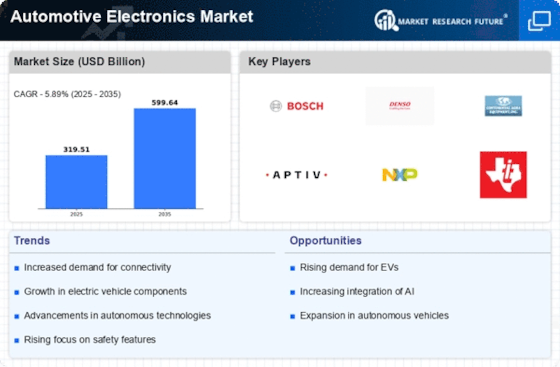
As per Market Research Future analysis, the Automotive Electronics Market Size was estimated at 319.51 USD Billion in 2024. The Automotive Electronics industry is projected to grow from 338.33 USD Billion in 2025 to 599.64 USD Billion by 2035, exhibiting a compound annual growth rate (CAGR) of 5.89% during the forecast period 2025 - 2035

Key Market Trends & Highlights

The Automotive Electronics Market is poised for substantial growth driven by technological advancements and increasing consumer demand.

  • The integration of Advanced Driver-Assistance Systems (ADAS) is becoming increasingly prevalent, enhancing vehicle safety and user experience. Electric vehicle components are witnessing significant growth, reflecting the shift towards sustainable transportation solutions. Connectivity and smart features are on the rise, as consumers demand more integrated and user-friendly infotainment systems. The increasing demand for safety features and advancements in electric vehicle technology are major drivers propelling market expansion.

Market Size & Forecast

2024 Market Size 319.51 (USD Billion)
2035 Market Size 599.64 (USD Billion)
CAGR (2025 - 2035) 5.89%
Largest Regional Market Share in 2024 Asia Pacific

Major Players

Robert Bosch GmbH (DE), Denso Corporation (JP), Continental AG (DE), <a href="https://www.aptiv.com/en/industries/automotive">Aptiv PLC</a> (IE), NXP Semiconductors (NL), Texas Instruments (US), Infineon Technologies AG (DE), Magna International Inc. (CA), Harman International (US)

Market Trends

The Automotive Electronics Market is currently experiencing a transformative phase, driven by advancements in technology and increasing consumer demand for enhanced vehicle features. This sector encompasses a wide array of electronic components, including infotainment systems, advanced driver-assistance systems (ADAS), and electric vehicle (EV) components highlighting the growing importance of automobile electronic, automobile electronics, and automobiles electronics across the broader automotive and electronics ecosystem.

As vehicles become more connected and automated, the integration of sophisticated electronics is becoming essential for improving safety, efficiency, and user experience particularly through solutions associated with the automotive electronic control unit market and the expanding automotive ECU market. The shift towards electric mobility is also propelling innovation within this market, as automotive electronics manufacturersseek to develop more efficient power management systems automotive powertrain electronics, and advanced automotive electronics parts. Moreover, the growing emphasis on sustainability and environmental concerns is influencing the Automotive Electronics Market. Consumers are increasingly prioritizing eco-friendly options, prompting manufacturers to invest in greener technologies.

This trend is likely to foster collaboration between automotive and technology companies, leading to the development of cutting-edge solutions that address both performance and environmental impact. As the market evolves, it appears poised for substantial growth, with new opportunities emerging in areas such as autonomous driving and smart vehicle connectivity. The future landscape of the Automotive Electronics Market seems to be characterized by rapid innovation and a focus on enhancing the overall driving experience.

Integration of Advanced Driver-Assistance Systems (ADAS)

The Automotive Electronics Market is witnessing a notable trend towards the integration of advanced driver-assistance systems which represent a critical application of electronics in vehicles. These systems enhance vehicle safety and convenience by providing features such as adaptive cruise control, lane-keeping assistance, and automatic emergency braking. relying heavily on automotive electronics parts and intelligent vehicle electronics architectures As consumer awareness of safety increases, the demand for these technologies is likely to rise, prompting manufacturers to prioritize their development.

Growth of Electric Vehicle Components

The shift towards electric vehicles is significantly impacting the Automotive Electronics Market. As more consumers opt for electric mobility, there is a growing need for specialized electronic components that support battery management, energy efficiency, and charging infrastructure. This trend suggests a potential for innovation in power electronics, which could redefine vehicle performance and sustainability.

Rise of Connectivity and Smart Features

The increasing demand for connectivity in vehicles is shaping the Automotive Electronics Market. Consumers are seeking seamless integration of smartphones and other devices, leading to the development of advanced infotainment systems and vehicle-to-everything (V2X) communication. This trend indicates a shift towards smarter vehicles that enhance user experience and provide real-time data.

Automotive Electronics Market Market Drivers

Integration of Infotainment Systems

The Automotive Electronics Market is witnessing a transformative shift with the integration of advanced infotainment systems. These systems are becoming essential features in modern vehicles, offering drivers and passengers enhanced connectivity and entertainment options. The demand for seamless integration of smartphones, navigation systems, and multimedia content is driving manufacturers to develop sophisticated electronic solutions. Recent market analysis suggests that the infotainment system segment is projected to grow significantly, potentially reaching 50 billion USD by 2027. This trend indicates a shift in consumer expectations, as they seek vehicles equipped with cutting-edge technology that enhances their driving experience. Consequently, the Automotive Electronics Market is adapting to meet these evolving consumer demands.

Increasing Demand for Safety Features

The Automotive Electronics Market is experiencing a notable surge in demand for advanced safety features. Consumers are increasingly prioritizing safety in their vehicle purchases, leading to a rise in the integration of electronic systems designed to enhance driver and passenger safety. This trend is reflected in the growing adoption of technologies such as collision avoidance systems, lane departure warnings, and adaptive cruise control. According to recent data, the market for automotive safety electronics is projected to reach approximately 30 billion USD by 2026. This increasing focus on safety is driving manufacturers to innovate and incorporate sophisticated electronic systems, thereby propelling the overall growth of the Automotive Electronics Market.

Regulatory Push for Emission Standards

The Automotive Electronics Market is also shaped by regulatory pressures aimed at reducing vehicle emissions. Governments worldwide are implementing stringent emission standards, compelling manufacturers to adopt advanced electronic systems that optimize fuel efficiency and reduce pollutants. This regulatory environment is fostering innovation in automotive electronics, particularly in areas such as engine control units and exhaust after-treatment systems. Data suggests that the market for automotive electronics related to emissions control is expected to grow substantially, driven by these regulatory requirements. As manufacturers strive to comply with these standards, the Automotive Electronics Market is likely to see increased investment in technologies that enhance environmental performance.

Growth of Autonomous Vehicle Technologies

The Automotive Electronics Market is on the brink of a revolution with the growth of autonomous vehicle technologies. As manufacturers invest in research and development for self-driving capabilities, the demand for sophisticated electronic systems is escalating. These systems include sensors, cameras, and artificial intelligence algorithms that enable vehicles to navigate and make decisions independently. Current projections indicate that the market for autonomous vehicle electronics could exceed 60 billion USD by 2030. This rapid advancement in technology is not only reshaping the Automotive Electronics Market but also influencing consumer perceptions and acceptance of autonomous driving solutions. The potential for increased safety and efficiency in transportation is driving this trend forward.

Advancements in Electric Vehicle Technology

The Automotive Electronics Market is significantly influenced by advancements in electric vehicle (EV) technology. As the automotive sector shifts towards electrification, the demand for electronic components that support EV functionality is escalating. This includes battery management systems, electric powertrains, and regenerative braking systems. Recent statistics indicate that the EV market is expected to grow at a compound annual growth rate of over 20% through the next decade. This growth is prompting automotive manufacturers to invest heavily in electronic innovations, thereby enhancing the overall landscape of the Automotive Electronics Market. The integration of these technologies not only improves vehicle performance but also aligns with the increasing consumer preference for sustainable transportation solutions.

Market Segment Insights

By Application: Infotainment Systems (Largest) vs. Advanced Driver Assistance Systems (Fastest-Growing)

The Automotive Electronics Market is predominantly driven by the Infotainment Systems segment, which holds the largest share due to the increasing consumer demand for advanced in-car entertainment solutions. This segment includes audio, video, navigation, and connectivity features that enhance the overall driving experience. In contrast, the Advanced Driver Assistance Systems (ADAS) is rapidly emerging as a significant segment, capturing the growing interest in safety features and autonomous driving technologies.

Infotainment Systems (Dominant) vs. Advanced Driver Assistance Systems (Emerging)

Infotainment Systems have established themselves as the dominant application in automotive electronics, focused on integrating multimedia and communication functionalities that enhance user experience. With features ranging from high-definition touchscreens, Bluetooth connectivity, and smartphone integration, these systems are designed to cater to the demands of modern consumers who prioritize connectivity and entertainment during transit. On the other hand, Advanced Driver Assistance Systems represent an emerging segment that is gaining traction due to the global push for safety regulations and the development of autonomous vehicles. These systems include adaptive cruise control, lane-keeping assistance, and automatic emergency braking, which not only improve safety but also appeal to tech-savvy consumers invested in the future of driving.

By Component Type: Sensors (Largest) vs. Microcontrollers (Fastest-Growing)

The Automotive Electronics Market exhibits notable diversity in its component type segment, with sensors holding the largest market share. This is primarily due to their essential role in advanced driver-assistance systems (ADAS), contributing significantly to safety and functionality in modern vehicles. Microcontrollers follow closely, particularly as they integrate more functionalities in automotive applications, enhancing performance, control, and communication in automotive systems. Integrated circuits, connectors, and displays also represent significant players, although they occupy a smaller share of the market relative to sensors and microcontrollers.

Sensors (Dominant) vs. Microcontrollers (Emerging)

In the realm of automotive electronics, sensors are undeniably the dominant component type, integral to a wide array of applications including collision avoidance, lane keeping, and autonomous driving technologies. Their reliability and precision make them a staple in the industry, responding to the growing demand for safety features in vehicles. Conversely, microcontrollers are emerging rapidly, driven by the need for complex functionalities in vehicle electronics such as infotainment systems and connectivity solutions. As microcontrollers become increasingly sophisticated, they are vital in enhancing vehicle intelligence, thus indicating a promising trajectory in the automotive sector.

By Vehicle Type: Passenger Vehicles (Largest) vs. Electric Vehicles (Fastest-Growing)

In the Automotive Electronics Market, the distribution of market share among vehicle types reveals a dominant presence of passenger vehicles, which constitute a substantial portion of the market. These vehicles are increasingly equipped with advanced electronic systems, enhancing connectivity, safety, and driving experience. Meanwhile, electric vehicles are gaining momentum and are projected to capture a larger share as consumer demand shifts toward sustainable mobility solutions.

Electric Vehicles (Emerging) vs. Hybrid Vehicles (Dominant)

Passenger vehicles remain the cornerstone of the automotive electronics landscape, characterized by significant investments in infotainment, safety, and automated features. In contrast, electric vehicles are emerging as a transformative force, driven by innovative technologies and environmental concerns, appealing to a new generation focused on sustainability. <a href="https://www.marketresearchfuture.com/reports/hybrid-vehicle-market-6025">Hybrid vehicles</a>, while well-established, offer a blend of traditional and electric powertrains, maintaining their relevance as consumers seek fuel efficiency and reduced emissions. The rapid advancement in battery technology and increased charging infrastructure are propelling electric vehicles into the spotlight, making them a key area for future growth in automotive electronics.

By End Use: OEM (Largest) vs. Aftermarket (Fastest-Growing)

The automotive electronics market is primarily divided into two end-use segments: Original Equipment Manufacturer (OEM) and Aftermarket. The OEM segment holds a dominant position, accounting for a significant share of the overall market. This is largely due to the rising demand for advanced electronics in new vehicle models, which include safety, navigation, and infotainment systems. Meanwhile, the Aftermarket segment is experiencing robust growth as consumers seek to upgrade their existing vehicles with innovative electronic components, thereby enhancing functionality and comfort.

End Use: OEM (Dominant) vs. Aftermarket (Emerging)

The OEM segment remains a steadfast leader in the automotive electronics market, characterized by a stable demand for cutting-edge technologies that ensure vehicle reliability and safety. It benefits from long-term contracts with automotive manufacturers and consistent investments in research and development. Conversely, the Aftermarket segment is emerging rapidly, driven by a growing trend of customization and consumer willingness to invest in enhancements. This includes the addition of advanced driver-assistance systems (ADAS) and connectivity features, which are shaping the industry landscape. The Aftermarket appeals particularly to tech-savvy consumers looking to personalize their driving experience, establishing itself as a significant contributor to the market's overall growth.

Get more detailed insights about Automotive Electronics Market Research Report - Global Forecast to 2035

Regional Insights

The Automotive Electronics Market showcased significant growth across various regions, with a value of 319.51 USD Billion in 2024. Within this spectrum, the Asia-Pacific (APAC) region is particularly noteworthy and held a remarkable valuation of 130.0 USD Billion in 2024, which underscores its dominance as a major contributor to the market's expansion. Following closely, North America and Europe presented strong valuations of 80.0 USD Billion and 75.0 USD Billion, respectively. North America's robust automotive manufacturing sector and strong consumer demand for advanced electronics bolster its position.

Meanwhile, Europe benefits from stringent regulations advocating for technological advancements in safety and emissions. South America and the Middle East and Africa (MEA) featured smaller yet growing segments, valued at 20.0 USD Billion and 14.51 USD Billion, respectively, in 2024. Challenges faced in these emerging markets, such as economic variability and infrastructure limitations, remain prevalent, but opportunities for growth abound as technology adoption increases. Overall, the regional segmentation of the Automotive Electronics Market indicates substantial growth potential, driven by innovation and the demand for smart automotive solutions.

Key Players and Competitive Insights

The Automotive Electronics Market is characterized by rapid innovation and intense competition, fueled by increasing demand for advanced vehicle features and functionalities. As the automotive industry continues to shift towards electrification, automation, and connected technologies, the market dynamics are evolving dramatically.  Major players are focusing on enhancing the safety, performance, and comfort of vehicles through the integration of cutting-edge electronics. This competitive landscape is influenced by factors such as technological advancements, regulatory changes focusing on environmental sustainability, and shifting consumer preferences towards electric and autonomous vehicles. Key participants are not only competing in product innovation but also in forming strategic alliances and partnerships to leverage their strengths and enhance their market presence on a global scale. Denso holds a significant position in the Automotive Electronics Market, showcasing its extensive capabilities in providing advanced automotive technology solutions. Known for its robust engineering expertise, Denso excels in producing high-quality electronic control units, sensors, and powertrain components that are integral to modern vehicles. The company's strengths lie in its commitment to research and development, driving innovations that align with global trends toward increased vehicle electrification and connectivity.  Denso’s global footprint ensures a widespread presence across various regions, enabling it to cater to a diverse array of automotive manufacturers. The company's emphasis on environmentally friendly products and sustainable practices further solidifies its reputation as a leader in the industry, positioning it favorably against its competitors. Renesas Electronics is another formidable player within the Automotive Electronics Market, focusing on a range of critical products and services essential for automotive applications. The company excels in the manufacturing of microcontrollers, semiconductor solutions, and integrated circuits, which play crucial roles in vehicle control systems, infotainment, and advanced driver-assistance systems.  With a strong market presence bolstered by strategic mergers and acquisitions, Renesas has been able to expand its portfolio and enhance its technological capabilities significantly. This growth strategy has allowed the company to remain agile in an evolving market, addressing the increasing demand for vehicle automation and connectivity. Renesas Electronics' commitment to innovation, reflected in its continuous investments in R&D and collaborative initiatives, positions it as a vital contributor to the ongoing transformation within the automotive sector globally.

Key Companies in the Automotive Electronics Market include

Industry Developments

  • Q2 2024: Renesas to Acquire Altium for $5.9 Billion to Boost Automotive Electronics Market Portfolio Renesas Electronics announced the acquisition of Altium, an Australian electronics design software company, for $5.9 billion, aiming to strengthen its automotive electronics and embedded systems offerings.
  • Q2 2024: Tesla Signs Multi-Year Chip Supply Agreement with STMicroelectronics Tesla entered a multi-year supply agreement with STMicroelectronics for advanced automotive microcontrollers and power electronics, supporting Tesla’s next-generation vehicle platforms.
  • Q2 2024: Infineon Opens New $1.8 Billion Power Semiconductor Plant in Malaysia Infineon Technologies inaugurated a new power semiconductor manufacturing facility in Kulim, Malaysia, to meet surging demand for automotive power electronics and electric vehicle components.
  • Q3 2024: NXP Semiconductors and Foxconn Announce Strategic Partnership for Smart Vehicle Platforms NXP Semiconductors and Foxconn announced a strategic partnership to co-develop next-generation automotive electronics platforms, focusing on connectivity, security, and electrification.
  • Q3 2024: Bosch Launches New Generation of Central Vehicle Computers for Automated Driving Bosch unveiled its latest central vehicle computer platform designed for advanced driver-assistance systems (ADAS) and automated driving, targeting mass-market vehicle integration starting in 2025.
  • Q3 2024: Valeo Wins Major Contract to Supply ADAS Sensors to Hyundai-Kia Valeo secured a multi-year contract to supply advanced driver-assistance system (ADAS) sensors and software to Hyundai-Kia for their upcoming electric and hybrid vehicle models.
  • Q4 2024: Texas Instruments Opens New 300mm Analog Wafer Fab in Utah Texas Instruments opened a new 300mm analog semiconductor wafer fabrication plant in Lehi, Utah, to expand capacity for automotive-grade analog and embedded processing chips.
  • Q4 2024: Aptiv Acquires Ottopia to Enhance Autonomous Vehicle Connectivity Solutions Aptiv completed the acquisition of Ottopia, an Israeli startup specializing in remote vehicle operation and connectivity, to bolster its autonomous vehicle electronics and teleoperation capabilities.
  • Q1 2025: Denso and Toyota Announce Joint Venture for Next-Gen Automotive Semiconductors Denso and Toyota established a new joint venture focused on developing and manufacturing advanced automotive semiconductors for electric and autonomous vehicles.
  • Q1 2025: Continental Launches New High-Performance Radar Sensors for Urban Mobility Continental introduced a new line of high-performance radar sensors designed for urban mobility and smart city vehicle applications, with production set to begin in mid-2025.
  • Q2 2025: ON Semiconductor Announces $600 Million Expansion of Czech Automotive Chip Plant ON Semiconductor announced a $600 million investment to expand its automotive chip manufacturing facility in the Czech Republic, aiming to meet growing demand for EV and ADAS components.
  • Q2 2025: Magna International Opens New Electronics Manufacturing Facility in Mexico Magna International opened a new electronics manufacturing plant in Querétaro, Mexico, to produce advanced driver-assistance and electrification modules for North American automakers.

Future Outlook

Automotive Electronics Market Future Outlook

The Automotive Electronics Market is projected to grow at a 5.89% CAGR from 2025 to 2035, driven by advancements in electric vehicles, autonomous driving technologies, and increasing consumer demand for connectivity.

New opportunities lie in:

  • <p>Development of advanced driver-assistance systems (ADAS) for enhanced safety features. Integration of IoT solutions for real-time vehicle diagnostics and maintenance. Expansion of in-vehicle infotainment systems to enhance user experience and connectivity.</p>

By 2035, the Automotive Electronics Market is expected to be robust, driven by innovation and consumer demand.

Market Segmentation

Automotive Electronics Market End Use Outlook

  • OEM
  • Aftermarket

Automotive Electronics Market Application Outlook

  • Infotainment Systems
  • Advanced Driver Assistance Systems
  • Powertrain Control Systems
  • Body Control Modules
  • Telematics

Automotive Electronics Market Vehicle Type Outlook

  • Passenger Vehicles
  • Commercial Vehicles
  • Electric Vehicles
  • Hybrid Vehicles
  • Luxury Vehicles

Automotive Electronics Market Component Type Outlook

  • Sensors
  • Microcontrollers
  • Integrated Circuits
  • Connectors
  • Displays

Report Scope

MARKET SIZE 2024 319.51(USD Billion)
MARKET SIZE 2025 338.33(USD Billion)
MARKET SIZE 2035 599.64(USD Billion)
COMPOUND ANNUAL GROWTH RATE (CAGR) 5.89% (2025 - 2035)
REPORT COVERAGE Revenue Forecast, Competitive Landscape, Growth Factors, and Trends
BASE YEAR 2024
Market Forecast Period 2025 - 2035
Historical Data 2019 - 2024
Market Forecast Units USD Billion
Key Companies Profiled Robert Bosch GmbH (DE), Denso Corporation (JP), Continental AG (DE), Aptiv PLC (IE), NXP Semiconductors (NL), Texas Instruments (US), Infineon Technologies AG (DE), Magna International Inc. (CA), Harman International (US)
Segments Covered Application, Component Type, Vehicle Type, End Use, Regional
Key Market Opportunities Integration of advanced driver-assistance systems (ADAS) enhances safety and drives demand in the Automotive Electronics Market.
Key Market Dynamics Rising demand for advanced driver assistance systems drives innovation in automotive electronics and enhances vehicle safety features.
Countries Covered North America, Europe, APAC, South America, MEA

FAQs

What is the projected market valuation of the Automotive Electronics Market by 2035?

<p>The Automotive Electronics Market is projected to reach a valuation of 599.64 USD Billion by 2035.</p>

What was the market valuation of the Automotive Electronics Market in 2024?

<p>In 2024, the Automotive Electronics Market was valued at 319.51 USD Billion.</p>

What is the expected CAGR for the Automotive Electronics Market during the forecast period 2025 - 2035?

<p>The expected CAGR for the Automotive Electronics Market during the forecast period 2025 - 2035 is 5.89%.</p>

Which segment is projected to have the highest valuation in the Automotive Electronics Market by 2035?

<p>The Advanced Driver Assistance Systems segment is projected to reach 140.0 USD Billion by 2035.</p>

What are the key players in the Automotive Electronics Market?

<p>Key players in the Automotive Electronics Market include Robert Bosch GmbH, Denso Corporation, and Continental AG.</p>

How does the valuation of Infotainment Systems compare to that of Telematics by 2035?

<p>By 2035, Infotainment Systems are projected to reach 120.0 USD Billion, while Telematics is expected to reach 159.64 USD Billion.</p>

What is the projected valuation for Electric Vehicles in the Automotive Electronics Market by 2035?

<p>The projected valuation for Electric Vehicles in the Automotive Electronics Market by 2035 is 120.0 USD Billion.</p>

What is the expected market size for Integrated Circuits in the Automotive Electronics Market by 2035?

<p>The expected market size for Integrated Circuits in the Automotive Electronics Market by 2035 is 180.0 USD Billion.</p>

What is the anticipated valuation for the Aftermarket segment by 2035?

<p>The Aftermarket segment is anticipated to reach a valuation of 299.82 USD Billion by 2035.</p>

Which vehicle type is expected to have the lowest valuation in the Automotive Electronics Market by 2035?

<p>By 2035, Hybrid Vehicles are expected to have the lowest valuation at 80.0 USD Billion.</p>

  1. SECTION I: EXECUTIVE SUMMARY AND KEY HIGHLIGHTS |
    1. EXECUTIVE SUMMARY | |
      1. Market Overview | |
      2. Key Findings | |
      3. Market Segmentation | |
      4. Competitive Landscape | |
      5. Challenges and Opportunities | |
      6. Future Outlook 2
  2. SECTION II: SCOPING, METHODOLOGY AND MARKET STRUCTURE |
    1. MARKET INTRODUCTION | |
      1. Definition | |
      2. Scope of the study | | |
    2. RESEARCH METHODOLOGY | |
      1. Overview | |
      2. Data Mining | |
      3. Secondary Research | |
      4. Primary Research | | |
      5. Forecasting Model | |
      6. Market Size Estimation | | |
      7. Data Triangulation | |
      8. Validation 3
  3. SECTION III: QUALITATIVE ANALYSIS |
    1. MARKET DYNAMICS | |
      1. Overview | |
      2. Drivers | |
      3. Restraints | |
      4. Opportunities |
    2. MARKET FACTOR ANALYSIS | |
      1. Value chain Analysis | |
      2. Porter's Five Forces Analysis | | |
      3. COVID-19 Impact Analysis | | |
  4. SECTION IV: QUANTITATIVE ANALYSIS |
    1. Automobile, BY Application (USD Billion) | |
      1. Infotainment Systems | |
      2. Advanced Driver Assistance Systems | |
      3. Powertrain Control Systems | |
      4. Body Control Modules | |
      5. Telematics |
    2. Automobile, BY Component Type (USD Billion) | |
      1. Sensors | |
      2. Microcontrollers | |
      3. Integrated Circuits | |
      4. Connectors | |
      5. Displays |
    3. Automobile, BY Vehicle Type (USD Billion) | |
      1. Passenger Vehicles | |
      2. Commercial Vehicles | |
      3. Electric Vehicles | |
      4. Hybrid Vehicles | |
      5. Luxury Vehicles |
    4. Automobile, BY End Use (USD Billion) | |
      1. OEM | |
      2. Aftermarket |
    5. Automobile, BY Region (USD Billion) | |
      1. North America | | |
      2. Europe | | |
      3. APAC | | |
      4. South America | | |
      5. MEA | | |
  5. SECTION V: COMPETITIVE ANALYSIS |
    1. Competitive Landscape | |
      1. Overview | |
      2. Competitive Analysis | |
      3. Market share Analysis | |
      4. Major Growth Strategy in the Automobile | |
      5. Competitive Benchmarking | |
      6. Leading Players in Terms of Number of Developments in the Automobile | |
      7. Key developments and growth strategies | | |
      8. Major Players Financial Matrix | | |
    2. Company Profiles | |
      1. Robert Bosch GmbH (DE) | | |
      2. Denso Corporation (JP) | | |
      3. Continental AG (DE) | | |
      4. Aptiv PLC (IE) | | |
      5. NXP Semiconductors (NL) | | |
      6. Texas Instruments (US) | | |
      7. Infineon Technologies AG (DE) | | |
      8. Magna International Inc. (CA) | | |
      9. Harman International (US) | | |
    3. Appendix | |
      1. References | |
      2. Related Reports 6 LIST OF FIGURES |
    4. MARKET SYNOPSIS |
    5. NORTH AMERICA MARKET ANALYSIS |
    6. US MARKET ANALYSIS BY APPLICATION |
    7. US MARKET ANALYSIS BY COMPONENT TYPE |
    8. US MARKET ANALYSIS BY VEHICLE TYPE |
    9. US MARKET ANALYSIS BY END USE |
    10. CANADA MARKET ANALYSIS BY APPLICATION |
    11. CANADA MARKET ANALYSIS BY COMPONENT TYPE |
    12. CANADA MARKET ANALYSIS BY VEHICLE TYPE |
    13. CANADA MARKET ANALYSIS BY END USE |
    14. EUROPE MARKET ANALYSIS |
    15. GERMANY MARKET ANALYSIS BY APPLICATION |
    16. GERMANY MARKET ANALYSIS BY COMPONENT TYPE |
    17. GERMANY MARKET ANALYSIS BY VEHICLE TYPE |
    18. GERMANY MARKET ANALYSIS BY END USE |
    19. UK MARKET ANALYSIS BY APPLICATION |
    20. UK MARKET ANALYSIS BY COMPONENT TYPE |
    21. UK MARKET ANALYSIS BY VEHICLE TYPE |
    22. UK MARKET ANALYSIS BY END USE |
    23. FRANCE MARKET ANALYSIS BY APPLICATION |
    24. FRANCE MARKET ANALYSIS BY COMPONENT TYPE |
    25. FRANCE MARKET ANALYSIS BY VEHICLE TYPE |
    26. FRANCE MARKET ANALYSIS BY END USE |
    27. RUSSIA MARKET ANALYSIS BY APPLICATION |
    28. RUSSIA MARKET ANALYSIS BY COMPONENT TYPE |
    29. RUSSIA MARKET ANALYSIS BY VEHICLE TYPE |
    30. RUSSIA MARKET ANALYSIS BY END USE |
    31. ITALY MARKET ANALYSIS BY APPLICATION |
    32. ITALY MARKET ANALYSIS BY COMPONENT TYPE |
    33. ITALY MARKET ANALYSIS BY VEHICLE TYPE |
    34. ITALY MARKET ANALYSIS BY END USE |
    35. SPAIN MARKET ANALYSIS BY APPLICATION |
    36. SPAIN MARKET ANALYSIS BY COMPONENT TYPE |
    37. SPAIN MARKET ANALYSIS BY VEHICLE TYPE |
    38. SPAIN MARKET ANALYSIS BY END USE |
    39. REST OF EUROPE MARKET ANALYSIS BY APPLICATION |
    40. REST OF EUROPE MARKET ANALYSIS BY COMPONENT TYPE |
    41. REST OF EUROPE MARKET ANALYSIS BY VEHICLE TYPE |
    42. REST OF EUROPE MARKET ANALYSIS BY END USE |
    43. APAC MARKET ANALYSIS |
    44. CHINA MARKET ANALYSIS BY APPLICATION |
    45. CHINA MARKET ANALYSIS BY COMPONENT TYPE |
    46. CHINA MARKET ANALYSIS BY VEHICLE TYPE |
    47. CHINA MARKET ANALYSIS BY END USE |
    48. INDIA MARKET ANALYSIS BY APPLICATION |
    49. INDIA MARKET ANALYSIS BY COMPONENT TYPE |
    50. INDIA MARKET ANALYSIS BY VEHICLE TYPE |
    51. INDIA MARKET ANALYSIS BY END USE |
    52. JAPAN MARKET ANALYSIS BY APPLICATION |
    53. JAPAN MARKET ANALYSIS BY COMPONENT TYPE |
    54. JAPAN MARKET ANALYSIS BY VEHICLE TYPE |
    55. JAPAN MARKET ANALYSIS BY END USE |
    56. SOUTH KOREA MARKET ANALYSIS BY APPLICATION |
    57. SOUTH KOREA MARKET ANALYSIS BY COMPONENT TYPE |
    58. SOUTH KOREA MARKET ANALYSIS BY VEHICLE TYPE |
    59. SOUTH KOREA MARKET ANALYSIS BY END USE |
    60. MALAYSIA MARKET ANALYSIS BY APPLICATION |
    61. MALAYSIA MARKET ANALYSIS BY COMPONENT TYPE |
    62. MALAYSIA MARKET ANALYSIS BY VEHICLE TYPE |
    63. MALAYSIA MARKET ANALYSIS BY END USE |
    64. THAILAND MARKET ANALYSIS BY APPLICATION |
    65. THAILAND MARKET ANALYSIS BY COMPONENT TYPE |
    66. THAILAND MARKET ANALYSIS BY VEHICLE TYPE |
    67. THAILAND MARKET ANALYSIS BY END USE |
    68. INDONESIA MARKET ANALYSIS BY APPLICATION |
    69. INDONESIA MARKET ANALYSIS BY COMPONENT TYPE |
    70. INDONESIA MARKET ANALYSIS BY VEHICLE TYPE |
    71. INDONESIA MARKET ANALYSIS BY END USE |
    72. REST OF APAC MARKET ANALYSIS BY APPLICATION |
    73. REST OF APAC MARKET ANALYSIS BY COMPONENT TYPE |
    74. REST OF APAC MARKET ANALYSIS BY VEHICLE TYPE |
    75. REST OF APAC MARKET ANALYSIS BY END USE |
    76. SOUTH AMERICA MARKET ANALYSIS |
    77. BRAZIL MARKET ANALYSIS BY APPLICATION |
    78. BRAZIL MARKET ANALYSIS BY COMPONENT TYPE |
    79. BRAZIL MARKET ANALYSIS BY VEHICLE TYPE |
    80. BRAZIL MARKET ANALYSIS BY END USE |
    81. MEXICO MARKET ANALYSIS BY APPLICATION |
    82. MEXICO MARKET ANALYSIS BY COMPONENT TYPE |
    83. MEXICO MARKET ANALYSIS BY VEHICLE TYPE |
    84. MEXICO MARKET ANALYSIS BY END USE |
    85. ARGENTINA MARKET ANALYSIS BY APPLICATION |
    86. ARGENTINA MARKET ANALYSIS BY COMPONENT TYPE |
    87. ARGENTINA MARKET ANALYSIS BY VEHICLE TYPE |
    88. ARGENTINA MARKET ANALYSIS BY END USE |
    89. REST OF SOUTH AMERICA MARKET ANALYSIS BY APPLICATION |
    90. REST OF SOUTH AMERICA MARKET ANALYSIS BY COMPONENT TYPE |
    91. REST OF SOUTH AMERICA MARKET ANALYSIS BY VEHICLE TYPE |
    92. REST OF SOUTH AMERICA MARKET ANALYSIS BY END USE |
    93. MEA MARKET ANALYSIS |
    94. GCC COUNTRIES MARKET ANALYSIS BY APPLICATION |
    95. GCC COUNTRIES MARKET ANALYSIS BY COMPONENT TYPE |
    96. GCC COUNTRIES MARKET ANALYSIS BY VEHICLE TYPE |
    97. GCC COUNTRIES MARKET ANALYSIS BY END USE |
    98. SOUTH AFRICA MARKET ANALYSIS BY APPLICATION |
    99. SOUTH AFRICA MARKET ANALYSIS BY COMPONENT TYPE |
    100. SOUTH AFRICA MARKET ANALYSIS BY VEHICLE TYPE |
    101. SOUTH AFRICA MARKET ANALYSIS BY END USE |
    102. REST OF MEA MARKET ANALYSIS BY APPLICATION |
    103. REST OF MEA MARKET ANALYSIS BY COMPONENT TYPE |
    104. REST OF MEA MARKET ANALYSIS BY VEHICLE TYPE |
    105. REST OF MEA MARKET ANALYSIS BY END USE |
    106. KEY BUYING CRITERIA OF AUTOMOBILE |
    107. RESEARCH PROCESS OF MRFR |
    108. DRO ANALYSIS OF AUTOMOBILE |
    109. DRIVERS IMPACT ANALYSIS: AUTOMOBILE |
    110. RESTRAINTS IMPACT ANALYSIS: AUTOMOBILE |
    111. SUPPLY / VALUE CHAIN: AUTOMOBILE |
    112. AUTOMOBILE, BY APPLICATION, 2024 (% SHARE) |
    113. AUTOMOBILE, BY APPLICATION, 2024 TO 2035 (USD Billion) |
    114. AUTOMOBILE, BY COMPONENT TYPE, 2024 (% SHARE) |
    115. AUTOMOBILE, BY COMPONENT TYPE, 2024 TO 2035 (USD Billion) |
    116. AUTOMOBILE, BY VEHICLE TYPE, 2024 (% SHARE) |
    117. AUTOMOBILE, BY VEHICLE TYPE, 2024 TO 2035 (USD Billion) |
    118. AUTOMOBILE, BY END USE, 2024 (% SHARE) |
    119. AUTOMOBILE, BY END USE, 2024 TO 2035 (USD Billion) |
    120. BENCHMARKING OF MAJOR COMPETITORS 7 LIST OF TABLES |
    121. LIST OF ASSUMPTIONS | |
      1. |
    122. North America MARKET SIZE ESTIMATES; FORECAST | |
      1. BY APPLICATION, 2025-2035 (USD Billion) | |
      2. BY COMPONENT TYPE, 2025-2035 (USD Billion) | |
      3. BY VEHICLE TYPE, 2025-2035 (USD Billion) | |
      4. BY END USE, 2025-2035 (USD Billion) |
    123. US MARKET SIZE ESTIMATES; FORECAST | |
      1. BY APPLICATION, 2025-2035 (USD Billion) | |
      2. BY COMPONENT TYPE, 2025-2035 (USD Billion) | |
      3. BY VEHICLE TYPE, 2025-2035 (USD Billion) | |
      4. BY END USE, 2025-2035 (USD Billion) |
    124. Canada MARKET SIZE ESTIMATES; FORECAST | |
      1. BY APPLICATION, 2025-2035 (USD Billion) | |
      2. BY COMPONENT TYPE, 2025-2035 (USD Billion) | |
      3. BY VEHICLE TYPE, 2025-2035 (USD Billion) | |
      4. BY END USE, 2025-2035 (USD Billion) |
    125. Europe MARKET SIZE ESTIMATES; FORECAST | |
      1. BY APPLICATION, 2025-2035 (USD Billion) | |
      2. BY COMPONENT TYPE, 2025-2035 (USD Billion) | |
      3. BY VEHICLE TYPE, 2025-2035 (USD Billion) | |
      4. BY END USE, 2025-2035 (USD Billion) |
    126. Germany MARKET SIZE ESTIMATES; FORECAST | |
      1. BY APPLICATION, 2025-2035 (USD Billion) | |
      2. BY COMPONENT TYPE, 2025-2035 (USD Billion) | |
      3. BY VEHICLE TYPE, 2025-2035 (USD Billion) | |
      4. BY END USE, 2025-2035 (USD Billion) |
    127. UK MARKET SIZE ESTIMATES; FORECAST | |
      1. BY APPLICATION, 2025-2035 (USD Billion) | |
      2. BY COMPONENT TYPE, 2025-2035 (USD Billion) | |
      3. BY VEHICLE TYPE, 2025-2035 (USD Billion) | |
      4. BY END USE, 2025-2035 (USD Billion) |
    128. France MARKET SIZE ESTIMATES; FORECAST | |
      1. BY APPLICATION, 2025-2035 (USD Billion) | |
      2. BY COMPONENT TYPE, 2025-2035 (USD Billion) | |
      3. BY VEHICLE TYPE, 2025-2035 (USD Billion) | |
      4. BY END USE, 2025-2035 (USD Billion) |
    129. Russia MARKET SIZE ESTIMATES; FORECAST | |
      1. BY APPLICATION, 2025-2035 (USD Billion) | |
      2. BY COMPONENT TYPE, 2025-2035 (USD Billion) | |
      3. BY VEHICLE TYPE, 2025-2035 (USD Billion) | |
      4. BY END USE, 2025-2035 (USD Billion) |
    130. Italy MARKET SIZE ESTIMATES; FORECAST | |
      1. BY APPLICATION, 2025-2035 (USD Billion) | |
      2. BY COMPONENT TYPE, 2025-2035 (USD Billion) | |
      3. BY VEHICLE TYPE, 2025-2035 (USD Billion) | |
      4. BY END USE, 2025-2035 (USD Billion) |
    131. Spain MARKET SIZE ESTIMATES; FORECAST | |
      1. BY APPLICATION, 2025-2035 (USD Billion) | |
      2. BY COMPONENT TYPE, 2025-2035 (USD Billion) | |
      3. BY VEHICLE TYPE, 2025-2035 (USD Billion) | |
      4. BY END USE, 2025-2035 (USD Billion) |
    132. Rest of Europe MARKET SIZE ESTIMATES; FORECAST | |
      1. BY APPLICATION, 2025-2035 (USD Billion) | |
      2. BY COMPONENT TYPE, 2025-2035 (USD Billion) | |
      3. BY VEHICLE TYPE, 2025-2035 (USD Billion) | |
      4. BY END USE, 2025-2035 (USD Billion) |
    133. APAC MARKET SIZE ESTIMATES; FORECAST | |
      1. BY APPLICATION, 2025-2035 (USD Billion) | |
      2. BY COMPONENT TYPE, 2025-2035 (USD Billion) | |
      3. BY VEHICLE TYPE, 2025-2035 (USD Billion) | |
      4. BY END USE, 2025-2035 (USD Billion) |
    134. China MARKET SIZE ESTIMATES; FORECAST | |
      1. BY APPLICATION, 2025-2035 (USD Billion) | |
      2. BY COMPONENT TYPE, 2025-2035 (USD Billion) | |
      3. BY VEHICLE TYPE, 2025-2035 (USD Billion) | |
      4. BY END USE, 2025-2035 (USD Billion) |
    135. India MARKET SIZE ESTIMATES; FORECAST | |
      1. BY APPLICATION, 2025-2035 (USD Billion) | |
      2. BY COMPONENT TYPE, 2025-2035 (USD Billion) | |
      3. BY VEHICLE TYPE, 2025-2035 (USD Billion) | |
      4. BY END USE, 2025-2035 (USD Billion) |
    136. Japan MARKET SIZE ESTIMATES; FORECAST | |
      1. BY APPLICATION, 2025-2035 (USD Billion) | |
      2. BY COMPONENT TYPE, 2025-2035 (USD Billion) | |
      3. BY VEHICLE TYPE, 2025-2035 (USD Billion) | |
      4. BY END USE, 2025-2035 (USD Billion) |
    137. South Korea MARKET SIZE ESTIMATES; FORECAST | |
      1. BY APPLICATION, 2025-2035 (USD Billion) | |
      2. BY COMPONENT TYPE, 2025-2035 (USD Billion) | |
      3. BY VEHICLE TYPE, 2025-2035 (USD Billion) | |
      4. BY END USE, 2025-2035 (USD Billion) |
    138. Malaysia MARKET SIZE ESTIMATES; FORECAST | |
      1. BY APPLICATION, 2025-2035 (USD Billion) | |
      2. BY COMPONENT TYPE, 2025-2035 (USD Billion) | |
      3. BY VEHICLE TYPE, 2025-2035 (USD Billion) | |
      4. BY END USE, 2025-2035 (USD Billion) |
    139. Thailand MARKET SIZE ESTIMATES; FORECAST | |
      1. BY APPLICATION, 2025-2035 (USD Billion) | |
      2. BY COMPONENT TYPE, 2025-2035 (USD Billion) | |
      3. BY VEHICLE TYPE, 2025-2035 (USD Billion) | |
      4. BY END USE, 2025-2035 (USD Billion) |
    140. Indonesia MARKET SIZE ESTIMATES; FORECAST | |
      1. BY APPLICATION, 2025-2035 (USD Billion) | |
      2. BY COMPONENT TYPE, 2025-2035 (USD Billion) | |
      3. BY VEHICLE TYPE, 2025-2035 (USD Billion) | |
      4. BY END USE, 2025-2035 (USD Billion) |
    141. Rest of APAC MARKET SIZE ESTIMATES; FORECAST | |
      1. BY APPLICATION, 2025-2035 (USD Billion) | |
      2. BY COMPONENT TYPE, 2025-2035 (USD Billion) | |
      3. BY VEHICLE TYPE, 2025-2035 (USD Billion) | |
      4. BY END USE, 2025-2035 (USD Billion) |
    142. South America MARKET SIZE ESTIMATES; FORECAST | |
      1. BY APPLICATION, 2025-2035 (USD Billion) | |
      2. BY COMPONENT TYPE, 2025-2035 (USD Billion) | |
      3. BY VEHICLE TYPE, 2025-2035 (USD Billion) | |
      4. BY END USE, 2025-2035 (USD Billion) |
    143. Brazil MARKET SIZE ESTIMATES; FORECAST | |
      1. BY APPLICATION, 2025-2035 (USD Billion) | |
      2. BY COMPONENT TYPE, 2025-2035 (USD Billion) | |
      3. BY VEHICLE TYPE, 2025-2035 (USD Billion) | |
      4. BY END USE, 2025-2035 (USD Billion) |
    144. Mexico MARKET SIZE ESTIMATES; FORECAST | |
      1. BY APPLICATION, 2025-2035 (USD Billion) | |
      2. BY COMPONENT TYPE, 2025-2035 (USD Billion) | |
      3. BY VEHICLE TYPE, 2025-2035 (USD Billion) | |
      4. BY END USE, 2025-2035 (USD Billion) |
    145. Argentina MARKET SIZE ESTIMATES; FORECAST | |
      1. BY APPLICATION, 2025-2035 (USD Billion) | |
      2. BY COMPONENT TYPE, 2025-2035 (USD Billion) | |
      3. BY VEHICLE TYPE, 2025-2035 (USD Billion) | |
      4. BY END USE, 2025-2035 (USD Billion) |
    146. Rest of South America MARKET SIZE ESTIMATES; FORECAST | |
      1. BY APPLICATION, 2025-2035 (USD Billion) | |
      2. BY COMPONENT TYPE, 2025-2035 (USD Billion) | |
      3. BY VEHICLE TYPE, 2025-2035 (USD Billion) | |
      4. BY END USE, 2025-2035 (USD Billion) |
    147. MEA MARKET SIZE ESTIMATES; FORECAST | |
      1. BY APPLICATION, 2025-2035 (USD Billion) | |
      2. BY COMPONENT TYPE, 2025-2035 (USD Billion) | |
      3. BY VEHICLE TYPE, 2025-2035 (USD Billion) | |
      4. BY END USE, 2025-2035 (USD Billion) |
    148. GCC Countries MARKET SIZE ESTIMATES; FORECAST | |
      1. BY APPLICATION, 2025-2035 (USD Billion) | |
      2. BY COMPONENT TYPE, 2025-2035 (USD Billion) | |
      3. BY VEHICLE TYPE, 2025-2035 (USD Billion) | |
      4. BY END USE, 2025-2035 (USD Billion) |
    149. South Africa MARKET SIZE ESTIMATES; FORECAST | |
      1. BY APPLICATION, 2025-2035 (USD Billion) | |
      2. BY COMPONENT TYPE, 2025-2035 (USD Billion) | |
      3. BY VEHICLE TYPE, 2025-2035 (USD Billion) | |
      4. BY END USE, 2025-2035 (USD Billion) |
    150. Rest of MEA MARKET SIZE ESTIMATES; FORECAST | |
      1. BY APPLICATION, 2025-2035 (USD Billion) | |
      2. BY COMPONENT TYPE, 2025-2035 (USD Billion) | |
      3. BY VEHICLE TYPE, 2025-2035 (USD Billion) | |
      4. BY END USE, 2025-2035 (USD Billion) |
    151. PRODUCT LAUNCH/PRODUCT DEVELOPMENT/APPROVAL | |
      1. |
    152. ACQUISITION/PARTNERSHIP | |

Automobile Market Segmentation

Automobile By Application (USD Billion, 2025-2035)

  • Infotainment Systems
  • Advanced Driver Assistance Systems
  • Powertrain Control Systems
  • Body Control Modules
  • Telematics

Automobile By Component Type (USD Billion, 2025-2035)

  • Sensors
  • Microcontrollers
  • Integrated Circuits
  • Connectors
  • Displays

Automobile By Vehicle Type (USD Billion, 2025-2035)

  • Passenger Vehicles
  • Commercial Vehicles
  • Electric Vehicles
  • Hybrid Vehicles
  • Luxury Vehicles

Automobile By End Use (USD Billion, 2025-2035)

  • OEM
  • Aftermarket
Infographic

Free Sample Request

Kindly complete the form below to receive a free sample of this Report

Get Free Sample

Customer Strories

Compare Licence

×
Features License Type
Single User Multiuser License Enterprise User
Price $4,950 $5,950 $7,250
Maximum User Access Limit 1 User Upto 10 Users Unrestricted Access Throughout the Organization
Free Customization
Direct Access to Analyst
Deliverable Format
Platform Access
Discount on Next Purchase 10% 15% 15%
Printable Versions