
×
Hero Background
English
Chinese
French
Japanese
Korean
German
Spanish

Automotive Bushing Technologies Market Share

ID: MRFR/AT/4747-HCR
100 Pages
Sejal Akre
October 2025

Automotive Bushing Technologies Market Research Report Information by Type (Damper Bushings, Bump stops, Top Mounts, Suspension Arm Bushings, Subframe Bushings, PT Mounts), Material, Sales, Application (PV, LCV, HCV) and Region - Forecast till 2035

Share:
Download PDF ×

We do not share your information with anyone. However, we may send you emails based on your report interest from time to time. You may contact us at any time to opt-out.

Automotive Bushing Technologies Market Infographic
Purchase Options

Market Share

Automotive Bushing Technologies Market Share Analysis

The Automotive Bushing Technologies Market has shown several significant trends affecting its general picture. Suspension bushings are essential in ensuring the efficient operation of a vehicle's suspension system. A main trend that is visible in the Automotive Bushing Technologies Market is an increase in the use of advanced materials. Manufacturers have continued to explore materials that provide better durability, resistance, and wear performance for improved performance characteristics of their products. Currently polyurethane stands out from other types because it may resist severe conditions and last much longer compared to typical rubber bushes. This move towards sophisticated materials is driven by the need for lightweight solutions and fuel efficiency, which were once crucial factors in the development of automobile manufacturing. Apart from that, the sudden upsurge in interest in electric and hybrid vehicles has become quite noticeable and influences the market for automotive bushing technologies. Since such cars are becoming more common, manufacturers have to revise their bushing designs to satisfy the special requirements of electromobiles. Apart from the shift towards electric mobility, there is also a tendency towards sustainability in car manufacturing, resulting in the choice of materials and methods of production for making bushings. Furthermore, smart technology integration into automotive bushings and sensors is gaining momentum at present. These smart bushings adjust road changes by giving real-time feedback to vehicle suspension systems. Manufacturers include sensors in order to improve ride quality and enhance vehicle stability and safety as well. The development of intelligent bushing technologies represents a step towards creating more responsive and adaptive suspension systems in modern vehicles. Globalization and expansion of automobile markets in developing countries are other major factors influencing trends within automotive bushing technology. As automakers venture into new markets, there is an increase in the demand for reliable and affordable suspension solutions. Therefore, the Automotive Bushing Technologies Market is going through significant changes driven by multiple factors, as stated above. These include the adoption of advanced materials riding on a wave of electric mobility integration of smart technologies leading to a focus on sustainability; these trends are changing how automotive bushes are designed, manufactured, and used today.


Author
Sejal Akre
Senior Research Analyst

She has over 5 years of rich experience, in market research and consulting providing valuable market insights to client. Hands on expertise in management consulting, and extensive knowledge in domain including ICT, Automotive & Transportation and Aerospace & Defense. She is skilled in Go-to market strategy, industry analysis, market sizing, in depth company profiling, competitive intelligence & benchmarking and value chain amongst others.

Leave a Comment

FAQs

What is the projected market valuation for the Automotive Bushing Technologies Market in 2035?

The projected market valuation for the Automotive Bushing Technologies Market in 2035 is 13685.68 USD Million.

What was the market valuation for the Automotive Bushing Technologies Market in 2024?

The market valuation for the Automotive Bushing Technologies Market in 2024 was 6881.2 USD Million.

What is the expected CAGR for the Automotive Bushing Technologies Market from 2025 to 2035?

The expected CAGR for the Automotive Bushing Technologies Market during the forecast period 2025 - 2035 is 6.45%.

Which materials dominate the Automotive Bushing Technologies Market?

Rubber and polyurethane are the dominant materials, with valuations of 2750.0 USD Million and 4131.2 USD Million, respectively.

What are the key segments in the Automotive Bushing Technologies Market?

Key segments include damper bushings, bump stops, top mounts, suspension arm bushings, subframe bushings, and PT mounts.

Market Summary

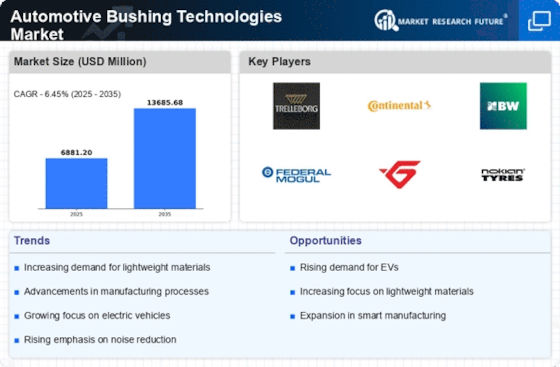
As per MRFR analysis, the Automotive Bushing Technologies Market was estimated at 6881.2 USD Million in 2024. The Automotive Bushing Technologies industry is projected to grow from 7325.04 USD Million in 2025 to 13685.68 USD Million by 2035, exhibiting a compound annual growth rate (CAGR) of 6.45 during the forecast period 2025 - 2035.

Key Market Trends & Highlights

The Automotive Bushing Technologies Market is poised for growth driven by sustainability and technological advancements.

  • North America remains the largest market for automotive bushing technologies, reflecting robust vehicle production rates.
  • Asia-Pacific is identified as the fastest-growing region, driven by increasing demand for innovative automotive solutions.
  • Damper bushings dominate the market, while bump stops are emerging as the fastest-growing segment due to evolving vehicle designs.
  • The rising demand for lightweight materials and the growth of electric and hybrid vehicles are key drivers influencing market dynamics.

Market Size & Forecast

2024 Market Size 6881.2 (USD Million)
2035 Market Size 13685.68 (USD Million)
CAGR (2025 - 2035) 6.45%
Largest Regional Market Share in 2024 Asia Pacific

Major Players

<p>Trelleborg (SE), Continental (DE), BorgWarner (US), Federal-Mogul (US), Hutchinson (FR), Nokian Tyres (FI), Sumitomo Rubber Industries (JP), ElringKlinger (DE)</p>

Market Trends

The Automotive Bushing Technologies Market is currently experiencing a transformative phase, driven by advancements in materials and manufacturing processes. As vehicles evolve towards greater efficiency and sustainability, the demand for high-performance bushings has intensified. These components play a crucial role in enhancing vehicle dynamics, reducing noise, and improving overall ride quality. Manufacturers are increasingly focusing on developing bushings that not only meet stringent regulatory standards but also contribute to weight reduction and energy efficiency. This shift is indicative of a broader trend towards integrating innovative technologies within automotive design, which appears to be reshaping the competitive landscape. Moreover, the Automotive Bushing Technologies Market is witnessing a growing emphasis on electric and hybrid vehicles. As the automotive industry pivots towards electrification, the requirements for bushings are evolving. These vehicles necessitate components that can withstand unique operational stresses while maintaining performance. Consequently, suppliers are investing in research and development to create specialized bushings that cater to the specific needs of electric drivetrains. This trend suggests a potential for significant growth in the market as manufacturers adapt to the changing dynamics of vehicle propulsion systems and consumer preferences.

Sustainability Initiatives

The Automotive Bushing Technologies Market is increasingly influenced by sustainability initiatives. Manufacturers are exploring eco-friendly materials and production methods to reduce environmental impact. This trend reflects a broader commitment to sustainable practices within the automotive sector.

Technological Advancements

Technological advancements are reshaping the Automotive Bushing Technologies Market. Innovations in materials science and manufacturing techniques are leading to the development of high-performance bushings. These advancements enhance vehicle performance and durability, catering to evolving consumer demands.

Electrification of Vehicles

The electrification of vehicles is a significant trend impacting the Automotive Bushing Technologies Market. As electric and hybrid vehicles gain popularity, the demand for specialized bushings that can handle unique operational requirements is increasing. This shift presents opportunities for manufacturers to innovate and expand their product offerings.

Automotive Bushing Technologies Market Market Drivers

Rising Vehicle Production Rates

The Automotive Bushing Technologies Market is poised for growth due to the rising production rates of vehicles across various segments. As manufacturers ramp up production to meet consumer demand, the need for high-quality bushing components becomes increasingly critical. In recent years, vehicle production has seen a steady increase, with millions of units produced annually. This surge in production directly correlates with the demand for automotive bushings, which play a vital role in vehicle performance and safety. The market is likely to benefit from this trend, as more vehicles on the road necessitate the replacement and upgrading of bushing technologies. Projections indicate that the automotive production sector may reach new heights, further propelling the bushing market forward.

Growth of Electric and Hybrid Vehicles

The Automotive Bushing Technologies Market is witnessing a transformation due to the growth of electric and hybrid vehicles. As the automotive landscape shifts towards electrification, the demand for specialized bushing technologies that cater to the unique requirements of electric drivetrains is increasing. These vehicles often require bushings that can withstand higher torque and provide better vibration damping. The rise in electric vehicle production is expected to create new opportunities for bushing manufacturers, as they adapt their products to meet the specific needs of this segment. Market forecasts suggest that the electric vehicle sector could account for a substantial share of the automotive market, thereby driving the demand for innovative bushing solutions tailored for electric and hybrid applications.

Regulatory Compliance and Safety Standards

The Automotive Bushing Technologies Market is significantly impacted by stringent regulatory compliance and safety standards imposed by governments worldwide. As safety regulations become more rigorous, manufacturers are compelled to enhance the quality and reliability of their bushing components. This has led to increased investments in research and development to ensure that products meet or exceed these standards. The emphasis on safety not only affects the design and materials used in bushings but also drives the demand for advanced technologies that can provide better performance under various conditions. Consequently, the market is likely to see a rise in the adoption of high-performance bushing technologies that align with evolving safety regulations, potentially increasing market value by several billion dollars in the next few years.

Increasing Demand for Lightweight Materials

The Automotive Bushing Technologies Market is experiencing a notable shift towards lightweight materials, driven by the automotive sector's focus on enhancing fuel efficiency and reducing emissions. Manufacturers are increasingly adopting materials such as polymers and composites, which offer superior performance while minimizing weight. This trend is underscored by the fact that lighter vehicles can achieve better fuel economy, which is becoming a critical factor for consumers and regulatory bodies alike. As a result, the demand for advanced bushing technologies that utilize these materials is expected to rise significantly. Analysts project that the market for lightweight automotive components, including bushings, could grow at a compound annual growth rate of over 5% in the coming years, reflecting the industry's commitment to sustainability and efficiency.

Technological Innovations in Bushing Design

Technological advancements are significantly influencing the Automotive Bushing Technologies Market, as manufacturers invest in innovative designs and materials. The introduction of advanced manufacturing techniques, such as 3D printing and computer-aided design, allows for the creation of more efficient and durable bushings. These innovations not only enhance the performance of automotive components but also reduce production costs and time. Furthermore, the integration of smart technologies into bushing systems is emerging, enabling real-time monitoring and improved vehicle dynamics. As the automotive industry continues to evolve, the demand for cutting-edge bushing technologies is expected to rise, with market analysts estimating a growth rate of approximately 4% annually in this segment.

Market Segment Insights

By Type: Damper Bushings (Largest) vs. Bump Stops (Fastest-Growing)

<p>In the Automotive Bushing Technologies Market, the segment distribution reveals that damper bushings hold the largest market share, owing to their crucial role in absorbing shocks and vibrations, thus enhancing vehicle stability and comfort. Following closely, bump stops are emerging rapidly as consumers increasingly prioritize ride quality and safety features, driving demand for innovative suspension designs that integrate these components for better vehicle performance.</p>

<p>Damper Bushings (Dominant) vs. Bump Stops (Emerging)</p>

<p>Damper bushings are well-established in the automotive industry, serving as key components in maintaining vehicle stability and controlling vibrations between various automotive parts. Their dominance is supported by technological advancements that enhance their functionality and durability. Conversely, bump stops are gaining traction as an emerging segment, evolving from basic rubber components to advanced materials designed to improve safety, prevent bottoming out, and extend the lifespan of suspension systems. Both segments play crucial roles, with damper bushings being integral to traditional vehicles while bump stops are becoming increasingly essential in newer, performance-oriented models.</p>

By Material: Rubber (Largest) vs. Polyurethane (Fastest-Growing)

<p>In the Automotive Bushing Technologies Market, the material segment is primarily dominated by rubber, which accounts for a significant share of the overall market due to its extensive applications in various automotive components. Rubber bushings are favored for their excellent vibration dampening characteristics and durability, making them a preferred choice among manufacturers. On the other hand, polyurethane has emerged as a notable player, continually gaining traction over recent years due to its superior performance and versatility in specialized applications, including performance vehicles and off-road applications.</p>

<p>Materials: Rubber (Dominant) vs. Polyurethane (Emerging)</p>

<p>Rubber bushings are well-established in the automotive industry; they provide excellent resilience, flexibility, and support in suspension systems. This material is known for its reliable performance in a variety of conditions. In contrast, polyurethane is viewed as an emerging alternative due to its enhanced strength and resistance to wear and tear. While not as widely used as rubber, polyurethane bushings are increasingly sought after in high-performance applications, where precision and reduced weight are critical. As OEMs and aftermarket tuners look for ways to improve vehicle handling, the demand for polyurethane is anticipated to surge.</p>

By Sales Channel: OEM (Largest) vs. Aftermarket (Fastest-Growing)

<p>In the Automotive Bushing Technologies Market, the distribution of sales channels is primarily dominated by the Original Equipment Manufacturer (OEM) sector. OEM accounts for a significant share, benefiting from strong relationships with automotive manufacturers and a consistent demand for high-quality components. In contrast, the aftermarket segment, while smaller in share, showcases the potential for substantial growth as vehicle owners increasingly seek replacements and upgrades beyond initial manufacturing. This dynamic is reflective of a broader trend within the automotive industry, where customization and enhanced performance are becoming paramount.</p>

<p>Sales Channel: OEM (Dominant) vs. Aftermarket (Emerging)</p>

<p>The OEM segment in the Automotive Bushing Technologies Market is characterized by its strong hold on traditional vehicle manufacturing, providing essential components that meet stringent quality and performance standards. This channel thrives on long-term partnerships with automakers that prioritize reliability and innovation. Conversely, the aftermarket segment represents a rapidly emerging market, fueled by an increasing number of vehicles on the road seeking maintenance and enhancements. With a rising trend in consumer DIY projects and a growing emphasis on vehicle longevity, aftermarket offerings are diversifying, making it a compelling avenue for industry players focusing on custom solutions and performance upgrades.</p>

By Vehicle Type: Passenger Cars (Largest) vs. Light Commercial Vehicle (Fastest-Growing)

<p>The Automotive Bushing Technologies Market is witnessing a significant market share distribution across various vehicle types. Passenger cars hold the largest share in the market, driven by the growing demand for personal transportation and the increasing production rates of compact vehicles. These cars are equipped with advanced bushing technologies to enhance performance and reliability, solidifying their market dominance. Conversely, the light commercial vehicle segment is identified as the fastest-growing category in the market. This growth is fueled by rising demand for delivery services and e-commerce, which require efficient logistics solutions. As manufacturers innovate to meet the demands for higher payloads and reduced emissions, the adoption of advanced bushing technologies in light commercial vehicles is projected to accelerate.</p>

<p>Passenger Cars (Dominant) vs. Heavy Commercial Vehicle (Emerging)</p>

<p>In the Automotive Bushing Technologies Market, passenger cars are recognized as the dominant segment due to their significant volume and continual evolution toward better efficiency and safety features. These vehicles benefit from innovations such as lightweight materials and enhanced durability in bushing designs, allowing automakers to meet regulatory requirements and consumer expectations. On the other hand, heavy commercial vehicles are considered an emerging segment with increasing relevance. They are gradually adopting advanced bushing technologies to improve vehicle stability and reduce maintenance costs. As urbanization and infrastructural developments drive the demand for heavy-duty transportation solutions, the role of advanced bushing solutions in enhancing performance and longevity in these vehicles is becoming more important.</p>

Get more detailed insights about Automotive Bushing Technologies Market Research Report – Forecast to 2035

Regional Insights

Key Companies in the Automotive Bushing Technologies Market market include

Industry Developments

Future Outlook

Automotive Bushing Technologies Market Future Outlook

<p>The Automotive Bushing Technologies Market is projected to grow at a 6.45% CAGR from 2024 to 2035, driven by advancements in materials, increasing vehicle production, and demand for enhanced performance.</p>

New opportunities lie in:

  • <p>Development of lightweight composite bushings for electric vehicles</p>
  • <p>Integration of smart sensors in bushing systems for predictive maintenance</p>
  • <p>Expansion into emerging markets with tailored bushing solutions</p>

<p>By 2035, the market is expected to achieve robust growth, positioning itself as a leader in automotive innovations.</p>

Market Segmentation

Automotive Bushing Technologies Market Type Outlook

  • damper bushings
  • bump stops
  • top mounts
  • suspension arm bushings
  • subframe bushings
  • PT mounts

Automotive Bushing Technologies Market Material Outlook

  • rubber
  • polyurethane

Automotive Bushing Technologies Market Vehicle Type Outlook

  • passenger cars
  • light commercial vehicle
  • heavy commercial vehicle

Automotive Bushing Technologies Market Sales Channel Outlook

  • OEM
  • aftermarket

Report Scope

MARKET SIZE 20246881.2(USD Million)
MARKET SIZE 20257325.04(USD Million)
MARKET SIZE 203513685.68(USD Million)
COMPOUND ANNUAL GROWTH RATE (CAGR)6.45% (2024 - 2035)
REPORT COVERAGERevenue Forecast, Competitive Landscape, Growth Factors, and Trends
BASE YEAR2024
Market Forecast Period2025 - 2035
Historical Data2019 - 2024
Market Forecast UnitsUSD Million
Key Companies ProfiledMarket analysis in progress
Segments CoveredMarket segmentation analysis in progress
Key Market OpportunitiesIntegration of advanced materials enhances performance and sustainability in the Automotive Bushing Technologies Market.
Key Market DynamicsTechnological advancements in materials and manufacturing processes drive innovation in the automotive bushing technologies market.
Countries CoveredNorth America, Europe, APAC, South America, MEA

FAQs

What is the projected market valuation for the Automotive Bushing Technologies Market in 2035?

The projected market valuation for the Automotive Bushing Technologies Market in 2035 is 13685.68 USD Million.

What was the market valuation for the Automotive Bushing Technologies Market in 2024?

The market valuation for the Automotive Bushing Technologies Market in 2024 was 6881.2 USD Million.

What is the expected CAGR for the Automotive Bushing Technologies Market from 2025 to 2035?

The expected CAGR for the Automotive Bushing Technologies Market during the forecast period 2025 - 2035 is 6.45%.

Which materials dominate the Automotive Bushing Technologies Market?

Rubber and polyurethane are the dominant materials, with valuations of 2750.0 USD Million and 4131.2 USD Million, respectively.

What are the key segments in the Automotive Bushing Technologies Market?

Key segments include damper bushings, bump stops, top mounts, suspension arm bushings, subframe bushings, and PT mounts.

  1. SECTION I: EXECUTIVE SUMMARY AND KEY HIGHLIGHTS
    1. EXECUTIVE SUMMARY
      1. Market Overview
      2. Key Findings
      3. Market Segmentation
      4. Competitive Landscape
      5. Challenges and Opportunities
      6. Future Outlook
  2. SECTION II: SCOPING, METHODOLOGY AND MARKET STRUCTURE
    1. MARKET INTRODUCTION
      1. Definition
      2. Scope of the study
    2. RESEARCH METHODOLOGY
      1. Overview
      2. Data Mining
      3. Secondary Research
      4. Primary Research
      5. Forecasting Model
      6. Market Size Estimation
      7. Data Triangulation
      8. Validation
  3. SECTION III: QUALITATIVE ANALYSIS
    1. MARKET DYNAMICS
      1. Overview
      2. Drivers
      3. Restraints
      4. Opportunities
    2. MARKET FACTOR ANALYSIS
      1. Value chain Analysis
      2. Porter's Five Forces Analysis
      3. COVID-19 Impact Analysis
  4. SECTION IV: QUANTITATIVE ANALYSIS
    1. Automobile, BY Type (USD Million)
      1. damper bushings
      2. bump stops
      3. top mounts
      4. suspension arm bushings
      5. subframe bushings
      6. PT mounts
    2. Automobile, BY Material (USD Million)
      1. rubber
      2. polyurethane
    3. Automobile, BY Sales Channel (USD Million)
      1. OEM
      2. aftermarket
    4. Automobile, BY Vehicle Type (USD Million)
      1. passenger cars
      2. light commercial vehicle
      3. heavy commercial vehicle
    5. Automobile, BY Region (USD Million)
      1. North America
      2. Europe
      3. APAC
      4. South America
      5. MEA
  5. SECTION V: COMPETITIVE ANALYSIS
    1. Competitive Landscape
      1. Overview
      2. Competitive Analysis
      3. Market share Analysis
      4. Major Growth Strategy in the Automobile
      5. Competitive Benchmarking
      6. Leading Players in Terms of Number of Developments in the Automobile
      7. Key developments and growth strategies
      8. Major Players Financial Matrix
    2. Company Profiles
      1. Trelleborg (SE)
      2. Continental (DE)
      3. BorgWarner (US)
      4. Federal-Mogul (US)
      5. Hutchinson (FR)
      6. Nokian Tyres (FI)
      7. Sumitomo Rubber Industries (JP)
      8. ElringKlinger (DE)
    3. Appendix
      1. References
      2. Related Reports
  6. LIST OF FIGURES
    1. MARKET SYNOPSIS
    2. NORTH AMERICA MARKET ANALYSIS
    3. US MARKET ANALYSIS BY TYPE
    4. US MARKET ANALYSIS BY MATERIAL
    5. US MARKET ANALYSIS BY SALES CHANNEL
    6. US MARKET ANALYSIS BY VEHICLE TYPE
    7. CANADA MARKET ANALYSIS BY TYPE
    8. CANADA MARKET ANALYSIS BY MATERIAL
    9. CANADA MARKET ANALYSIS BY SALES CHANNEL
    10. CANADA MARKET ANALYSIS BY VEHICLE TYPE
    11. EUROPE MARKET ANALYSIS
    12. GERMANY MARKET ANALYSIS BY TYPE
    13. GERMANY MARKET ANALYSIS BY MATERIAL
    14. GERMANY MARKET ANALYSIS BY SALES CHANNEL
    15. GERMANY MARKET ANALYSIS BY VEHICLE TYPE
    16. UK MARKET ANALYSIS BY TYPE
    17. UK MARKET ANALYSIS BY MATERIAL
    18. UK MARKET ANALYSIS BY SALES CHANNEL
    19. UK MARKET ANALYSIS BY VEHICLE TYPE
    20. FRANCE MARKET ANALYSIS BY TYPE
    21. FRANCE MARKET ANALYSIS BY MATERIAL
    22. FRANCE MARKET ANALYSIS BY SALES CHANNEL
    23. FRANCE MARKET ANALYSIS BY VEHICLE TYPE
    24. RUSSIA MARKET ANALYSIS BY TYPE
    25. RUSSIA MARKET ANALYSIS BY MATERIAL
    26. RUSSIA MARKET ANALYSIS BY SALES CHANNEL
    27. RUSSIA MARKET ANALYSIS BY VEHICLE TYPE
    28. ITALY MARKET ANALYSIS BY TYPE
    29. ITALY MARKET ANALYSIS BY MATERIAL
    30. ITALY MARKET ANALYSIS BY SALES CHANNEL
    31. ITALY MARKET ANALYSIS BY VEHICLE TYPE
    32. SPAIN MARKET ANALYSIS BY TYPE
    33. SPAIN MARKET ANALYSIS BY MATERIAL
    34. SPAIN MARKET ANALYSIS BY SALES CHANNEL
    35. SPAIN MARKET ANALYSIS BY VEHICLE TYPE
    36. REST OF EUROPE MARKET ANALYSIS BY TYPE
    37. REST OF EUROPE MARKET ANALYSIS BY MATERIAL
    38. REST OF EUROPE MARKET ANALYSIS BY SALES CHANNEL
    39. REST OF EUROPE MARKET ANALYSIS BY VEHICLE TYPE
    40. APAC MARKET ANALYSIS
    41. CHINA MARKET ANALYSIS BY TYPE
    42. CHINA MARKET ANALYSIS BY MATERIAL
    43. CHINA MARKET ANALYSIS BY SALES CHANNEL
    44. CHINA MARKET ANALYSIS BY VEHICLE TYPE
    45. INDIA MARKET ANALYSIS BY TYPE
    46. INDIA MARKET ANALYSIS BY MATERIAL
    47. INDIA MARKET ANALYSIS BY SALES CHANNEL
    48. INDIA MARKET ANALYSIS BY VEHICLE TYPE
    49. JAPAN MARKET ANALYSIS BY TYPE
    50. JAPAN MARKET ANALYSIS BY MATERIAL
    51. JAPAN MARKET ANALYSIS BY SALES CHANNEL
    52. JAPAN MARKET ANALYSIS BY VEHICLE TYPE
    53. SOUTH KOREA MARKET ANALYSIS BY TYPE
    54. SOUTH KOREA MARKET ANALYSIS BY MATERIAL
    55. SOUTH KOREA MARKET ANALYSIS BY SALES CHANNEL
    56. SOUTH KOREA MARKET ANALYSIS BY VEHICLE TYPE
    57. MALAYSIA MARKET ANALYSIS BY TYPE
    58. MALAYSIA MARKET ANALYSIS BY MATERIAL
    59. MALAYSIA MARKET ANALYSIS BY SALES CHANNEL
    60. MALAYSIA MARKET ANALYSIS BY VEHICLE TYPE
    61. THAILAND MARKET ANALYSIS BY TYPE
    62. THAILAND MARKET ANALYSIS BY MATERIAL
    63. THAILAND MARKET ANALYSIS BY SALES CHANNEL
    64. THAILAND MARKET ANALYSIS BY VEHICLE TYPE
    65. INDONESIA MARKET ANALYSIS BY TYPE
    66. INDONESIA MARKET ANALYSIS BY MATERIAL
    67. INDONESIA MARKET ANALYSIS BY SALES CHANNEL
    68. INDONESIA MARKET ANALYSIS BY VEHICLE TYPE
    69. REST OF APAC MARKET ANALYSIS BY TYPE
    70. REST OF APAC MARKET ANALYSIS BY MATERIAL
    71. REST OF APAC MARKET ANALYSIS BY SALES CHANNEL
    72. REST OF APAC MARKET ANALYSIS BY VEHICLE TYPE
    73. SOUTH AMERICA MARKET ANALYSIS
    74. BRAZIL MARKET ANALYSIS BY TYPE
    75. BRAZIL MARKET ANALYSIS BY MATERIAL
    76. BRAZIL MARKET ANALYSIS BY SALES CHANNEL
    77. BRAZIL MARKET ANALYSIS BY VEHICLE TYPE
    78. MEXICO MARKET ANALYSIS BY TYPE
    79. MEXICO MARKET ANALYSIS BY MATERIAL
    80. MEXICO MARKET ANALYSIS BY SALES CHANNEL
    81. MEXICO MARKET ANALYSIS BY VEHICLE TYPE
    82. ARGENTINA MARKET ANALYSIS BY TYPE
    83. ARGENTINA MARKET ANALYSIS BY MATERIAL
    84. ARGENTINA MARKET ANALYSIS BY SALES CHANNEL
    85. ARGENTINA MARKET ANALYSIS BY VEHICLE TYPE
    86. REST OF SOUTH AMERICA MARKET ANALYSIS BY TYPE
    87. REST OF SOUTH AMERICA MARKET ANALYSIS BY MATERIAL
    88. REST OF SOUTH AMERICA MARKET ANALYSIS BY SALES CHANNEL
    89. REST OF SOUTH AMERICA MARKET ANALYSIS BY VEHICLE TYPE
    90. MEA MARKET ANALYSIS
    91. GCC COUNTRIES MARKET ANALYSIS BY TYPE
    92. GCC COUNTRIES MARKET ANALYSIS BY MATERIAL
    93. GCC COUNTRIES MARKET ANALYSIS BY SALES CHANNEL
    94. GCC COUNTRIES MARKET ANALYSIS BY VEHICLE TYPE
    95. SOUTH AFRICA MARKET ANALYSIS BY TYPE
    96. SOUTH AFRICA MARKET ANALYSIS BY MATERIAL
    97. SOUTH AFRICA MARKET ANALYSIS BY SALES CHANNEL
    98. SOUTH AFRICA MARKET ANALYSIS BY VEHICLE TYPE
    99. REST OF MEA MARKET ANALYSIS BY TYPE
    100. REST OF MEA MARKET ANALYSIS BY MATERIAL
    101. REST OF MEA MARKET ANALYSIS BY SALES CHANNEL
    102. REST OF MEA MARKET ANALYSIS BY VEHICLE TYPE
    103. KEY BUYING CRITERIA OF AUTOMOBILE
    104. RESEARCH PROCESS OF MRFR
    105. DRO ANALYSIS OF AUTOMOBILE
    106. DRIVERS IMPACT ANALYSIS: AUTOMOBILE
    107. RESTRAINTS IMPACT ANALYSIS: AUTOMOBILE
    108. SUPPLY / VALUE CHAIN: AUTOMOBILE
    109. AUTOMOBILE, BY TYPE, 2024 (% SHARE)
    110. AUTOMOBILE, BY TYPE, 2024 TO 2035 (USD Million)
    111. AUTOMOBILE, BY MATERIAL, 2024 (% SHARE)
    112. AUTOMOBILE, BY MATERIAL, 2024 TO 2035 (USD Million)
    113. AUTOMOBILE, BY SALES CHANNEL, 2024 (% SHARE)
    114. AUTOMOBILE, BY SALES CHANNEL, 2024 TO 2035 (USD Million)
    115. AUTOMOBILE, BY VEHICLE TYPE, 2024 (% SHARE)
    116. AUTOMOBILE, BY VEHICLE TYPE, 2024 TO 2035 (USD Million)
    117. BENCHMARKING OF MAJOR COMPETITORS
  7. LIST OF TABLES
    1. LIST OF ASSUMPTIONS
    2. North America MARKET SIZE ESTIMATES; FORECAST
      1. BY TYPE, 2025-2035 (USD Million)
      2. BY MATERIAL, 2025-2035 (USD Million)
      3. BY SALES CHANNEL, 2025-2035 (USD Million)
      4. BY VEHICLE TYPE, 2025-2035 (USD Million)
    3. US MARKET SIZE ESTIMATES; FORECAST
      1. BY TYPE, 2025-2035 (USD Million)
      2. BY MATERIAL, 2025-2035 (USD Million)
      3. BY SALES CHANNEL, 2025-2035 (USD Million)
      4. BY VEHICLE TYPE, 2025-2035 (USD Million)
    4. Canada MARKET SIZE ESTIMATES; FORECAST
      1. BY TYPE, 2025-2035 (USD Million)
      2. BY MATERIAL, 2025-2035 (USD Million)
      3. BY SALES CHANNEL, 2025-2035 (USD Million)
      4. BY VEHICLE TYPE, 2025-2035 (USD Million)
    5. Europe MARKET SIZE ESTIMATES; FORECAST
      1. BY TYPE, 2025-2035 (USD Million)
      2. BY MATERIAL, 2025-2035 (USD Million)
      3. BY SALES CHANNEL, 2025-2035 (USD Million)
      4. BY VEHICLE TYPE, 2025-2035 (USD Million)
    6. Germany MARKET SIZE ESTIMATES; FORECAST
      1. BY TYPE, 2025-2035 (USD Million)
      2. BY MATERIAL, 2025-2035 (USD Million)
      3. BY SALES CHANNEL, 2025-2035 (USD Million)
      4. BY VEHICLE TYPE, 2025-2035 (USD Million)
    7. UK MARKET SIZE ESTIMATES; FORECAST
      1. BY TYPE, 2025-2035 (USD Million)
      2. BY MATERIAL, 2025-2035 (USD Million)
      3. BY SALES CHANNEL, 2025-2035 (USD Million)
      4. BY VEHICLE TYPE, 2025-2035 (USD Million)
    8. France MARKET SIZE ESTIMATES; FORECAST
      1. BY TYPE, 2025-2035 (USD Million)
      2. BY MATERIAL, 2025-2035 (USD Million)
      3. BY SALES CHANNEL, 2025-2035 (USD Million)
      4. BY VEHICLE TYPE, 2025-2035 (USD Million)
    9. Russia MARKET SIZE ESTIMATES; FORECAST
      1. BY TYPE, 2025-2035 (USD Million)
      2. BY MATERIAL, 2025-2035 (USD Million)
      3. BY SALES CHANNEL, 2025-2035 (USD Million)
      4. BY VEHICLE TYPE, 2025-2035 (USD Million)
    10. Italy MARKET SIZE ESTIMATES; FORECAST
      1. BY TYPE, 2025-2035 (USD Million)
      2. BY MATERIAL, 2025-2035 (USD Million)
      3. BY SALES CHANNEL, 2025-2035 (USD Million)
      4. BY VEHICLE TYPE, 2025-2035 (USD Million)
    11. Spain MARKET SIZE ESTIMATES; FORECAST
      1. BY TYPE, 2025-2035 (USD Million)
      2. BY MATERIAL, 2025-2035 (USD Million)
      3. BY SALES CHANNEL, 2025-2035 (USD Million)
      4. BY VEHICLE TYPE, 2025-2035 (USD Million)
    12. Rest of Europe MARKET SIZE ESTIMATES; FORECAST
      1. BY TYPE, 2025-2035 (USD Million)
      2. BY MATERIAL, 2025-2035 (USD Million)
      3. BY SALES CHANNEL, 2025-2035 (USD Million)
      4. BY VEHICLE TYPE, 2025-2035 (USD Million)
    13. APAC MARKET SIZE ESTIMATES; FORECAST
      1. BY TYPE, 2025-2035 (USD Million)
      2. BY MATERIAL, 2025-2035 (USD Million)
      3. BY SALES CHANNEL, 2025-2035 (USD Million)
      4. BY VEHICLE TYPE, 2025-2035 (USD Million)
    14. China MARKET SIZE ESTIMATES; FORECAST
      1. BY TYPE, 2025-2035 (USD Million)
      2. BY MATERIAL, 2025-2035 (USD Million)
      3. BY SALES CHANNEL, 2025-2035 (USD Million)
      4. BY VEHICLE TYPE, 2025-2035 (USD Million)
    15. India MARKET SIZE ESTIMATES; FORECAST
      1. BY TYPE, 2025-2035 (USD Million)
      2. BY MATERIAL, 2025-2035 (USD Million)
      3. BY SALES CHANNEL, 2025-2035 (USD Million)
      4. BY VEHICLE TYPE, 2025-2035 (USD Million)
    16. Japan MARKET SIZE ESTIMATES; FORECAST
      1. BY TYPE, 2025-2035 (USD Million)
      2. BY MATERIAL, 2025-2035 (USD Million)
      3. BY SALES CHANNEL, 2025-2035 (USD Million)
      4. BY VEHICLE TYPE, 2025-2035 (USD Million)
    17. South Korea MARKET SIZE ESTIMATES; FORECAST
      1. BY TYPE, 2025-2035 (USD Million)
      2. BY MATERIAL, 2025-2035 (USD Million)
      3. BY SALES CHANNEL, 2025-2035 (USD Million)
      4. BY VEHICLE TYPE, 2025-2035 (USD Million)
    18. Malaysia MARKET SIZE ESTIMATES; FORECAST
      1. BY TYPE, 2025-2035 (USD Million)
      2. BY MATERIAL, 2025-2035 (USD Million)
      3. BY SALES CHANNEL, 2025-2035 (USD Million)
      4. BY VEHICLE TYPE, 2025-2035 (USD Million)
    19. Thailand MARKET SIZE ESTIMATES; FORECAST
      1. BY TYPE, 2025-2035 (USD Million)
      2. BY MATERIAL, 2025-2035 (USD Million)
      3. BY SALES CHANNEL, 2025-2035 (USD Million)
      4. BY VEHICLE TYPE, 2025-2035 (USD Million)
    20. Indonesia MARKET SIZE ESTIMATES; FORECAST
      1. BY TYPE, 2025-2035 (USD Million)
      2. BY MATERIAL, 2025-2035 (USD Million)
      3. BY SALES CHANNEL, 2025-2035 (USD Million)
      4. BY VEHICLE TYPE, 2025-2035 (USD Million)
    21. Rest of APAC MARKET SIZE ESTIMATES; FORECAST
      1. BY TYPE, 2025-2035 (USD Million)
      2. BY MATERIAL, 2025-2035 (USD Million)
      3. BY SALES CHANNEL, 2025-2035 (USD Million)
      4. BY VEHICLE TYPE, 2025-2035 (USD Million)
    22. South America MARKET SIZE ESTIMATES; FORECAST
      1. BY TYPE, 2025-2035 (USD Million)
      2. BY MATERIAL, 2025-2035 (USD Million)
      3. BY SALES CHANNEL, 2025-2035 (USD Million)
      4. BY VEHICLE TYPE, 2025-2035 (USD Million)
    23. Brazil MARKET SIZE ESTIMATES; FORECAST
      1. BY TYPE, 2025-2035 (USD Million)
      2. BY MATERIAL, 2025-2035 (USD Million)
      3. BY SALES CHANNEL, 2025-2035 (USD Million)
      4. BY VEHICLE TYPE, 2025-2035 (USD Million)
    24. Mexico MARKET SIZE ESTIMATES; FORECAST
      1. BY TYPE, 2025-2035 (USD Million)
      2. BY MATERIAL, 2025-2035 (USD Million)
      3. BY SALES CHANNEL, 2025-2035 (USD Million)
      4. BY VEHICLE TYPE, 2025-2035 (USD Million)
    25. Argentina MARKET SIZE ESTIMATES; FORECAST
      1. BY TYPE, 2025-2035 (USD Million)
      2. BY MATERIAL, 2025-2035 (USD Million)
      3. BY SALES CHANNEL, 2025-2035 (USD Million)
      4. BY VEHICLE TYPE, 2025-2035 (USD Million)
    26. Rest of South America MARKET SIZE ESTIMATES; FORECAST
      1. BY TYPE, 2025-2035 (USD Million)
      2. BY MATERIAL, 2025-2035 (USD Million)
      3. BY SALES CHANNEL, 2025-2035 (USD Million)
      4. BY VEHICLE TYPE, 2025-2035 (USD Million)
    27. MEA MARKET SIZE ESTIMATES; FORECAST
      1. BY TYPE, 2025-2035 (USD Million)
      2. BY MATERIAL, 2025-2035 (USD Million)
      3. BY SALES CHANNEL, 2025-2035 (USD Million)
      4. BY VEHICLE TYPE, 2025-2035 (USD Million)
    28. GCC Countries MARKET SIZE ESTIMATES; FORECAST
      1. BY TYPE, 2025-2035 (USD Million)
      2. BY MATERIAL, 2025-2035 (USD Million)
      3. BY SALES CHANNEL, 2025-2035 (USD Million)
      4. BY VEHICLE TYPE, 2025-2035 (USD Million)
    29. South Africa MARKET SIZE ESTIMATES; FORECAST
      1. BY TYPE, 2025-2035 (USD Million)
      2. BY MATERIAL, 2025-2035 (USD Million)
      3. BY SALES CHANNEL, 2025-2035 (USD Million)
      4. BY VEHICLE TYPE, 2025-2035 (USD Million)
    30. Rest of MEA MARKET SIZE ESTIMATES; FORECAST
      1. BY TYPE, 2025-2035 (USD Million)
      2. BY MATERIAL, 2025-2035 (USD Million)
      3. BY SALES CHANNEL, 2025-2035 (USD Million)
      4. BY VEHICLE TYPE, 2025-2035 (USD Million)
    31. PRODUCT LAUNCH/PRODUCT DEVELOPMENT/APPROVAL
    32. ACQUISITION/PARTNERSHIP

Automotive Bushing Technologies Market Segmentation

Market Segmentation Overview

  • Detailed segmentation data will be available in the full report
  • Comprehensive analysis by multiple parameters
  • Regional and country-level breakdowns
  • Market size forecasts by segment
Infographic

Free Sample Request

Kindly complete the form below to receive a free sample of this Report

Get Free Sample

Customer Strories

Compare Licence

×
Features License Type
Single User Multiuser License Enterprise User
Price $4,950 $5,950 $7,250
Maximum User Access Limit 1 User Upto 10 Users Unrestricted Access Throughout the Organization
Free Customization
Direct Access to Analyst
Deliverable Format
Platform Access
Discount on Next Purchase 10% 15% 15%
Printable Versions