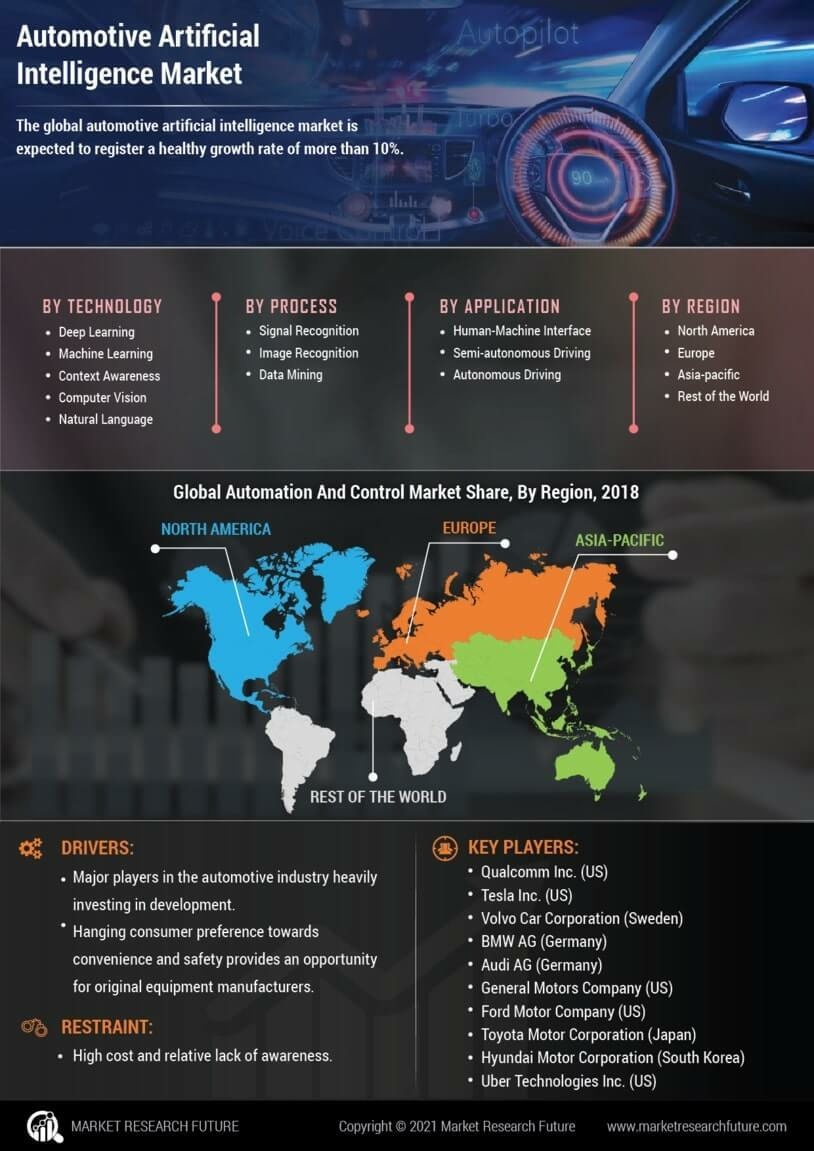
Automotive Artificial Intelligence Market Summary
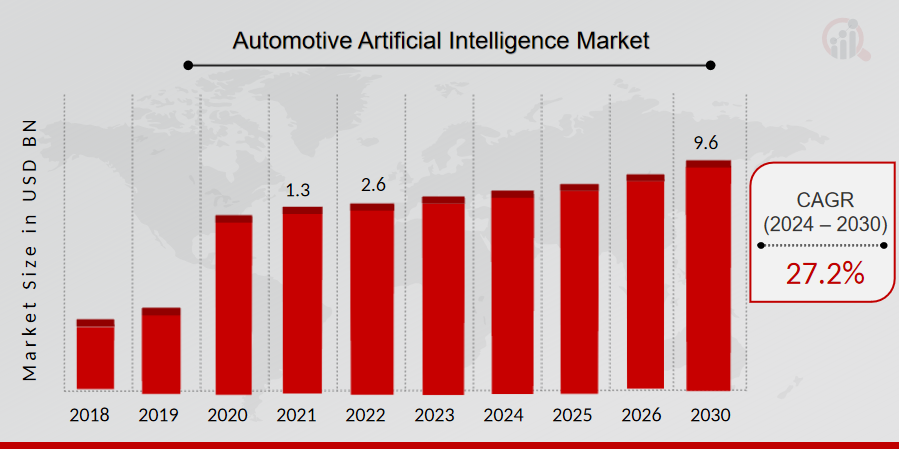
As per MRFR Analysis, the Global Automotive Artificial Intelligence Market was valued at USD 1.3 Billion in 2021 and is projected to reach USD 9.6 Billion by 2030, growing at a CAGR of 27.2% from 2024 to 2030. The market is driven by the increasing demand for autonomous vehicles, advanced automotive solutions, and government initiatives. However, challenges such as lack of infrastructure and high operational costs may hinder growth. Key technologies include Deep Learning, Machine Learning, and Computer Vision, with Deep Learning expected to dominate. North America is anticipated to lead the market by 2030, supported by major manufacturers and favorable regulations.
Key Market Trends & Highlights
The Automotive Artificial Intelligence Market is witnessing significant trends driven by technological advancements and consumer demand.
- Market Size in 2021: USD 1.3 Billion; projected to reach USD 9.6 Billion by 2030.
- CAGR of 27.2% during the forecast period (2024-2030).
- Growing demand for autonomous vehicles is a key driver.
- North America expected to dominate the market by 2030.
Market Size & Forecast
2021 Market Size: USD 1.3 Billion
2022 Market Size: USD 2.6 Billion
2030 Market Size: USD 9.6 Billion
CAGR: 27.2% (2024-2030)
Largest Regional Market Share in 2030: North America.
Major Players
Key players include Tesla Inc., Volvo Car Corporation, BMW AG, Audi AG, General Motors Company, Ford Motor Company, and Toyota Motor Corporation.
The adoption of automotive artificial intelligence is routing in a new era allowing companies to track their operations, augment business strategies, enhance in-car user experience, develop autonomous and semi-autonomous vehicles, and provide a better outcome in the digital world.
The growth of the automotive artificial intelligence market is primarily driven by factors, such as growing demand for autonomous vehicles, adoption of advanced automotive solutions, growing adoption of artificial intelligence for traffic management, government initiatives, and investments in connected and autonomous vehicles. However, the lack of infrastructure, coupled with the high procurement and operational costs are the major hindrances to market growth.
Source: Secondary Research, Primary Research, MRFR Database, and Analyst Review
Automotive Artificial Intelligence Market Trends
-
Growing Demand for Autonomous Vehicles is fueling the growth of the Automotive Artificial Intelligence Market.
The market for autonomous vehicles has witnessed remarkable growth in recent years. As the adoption of AI in autonomous vehicles progresses from needing driver assistance to having full autonomy, enhanced user experience, and convenience features, driverless cars are becoming a reality.
Autonomous vehicles are called self-driven or driverless vehicles that use artificial intelligence (AI) software, light detection & ranging (LiDAR), computer vision, GPS, and RADAR sensing technology and sensors to operate without any human interference. The growing demand and necessity for a safe, efficient, and convenient driving experience; increasing government focus on streamlined traffic infrastructure and regulations, rising demand for a reliable transportation system, and availability of advanced technologies relevant to the automotive industry are driving the demand for autonomous and semi-autonomous vehicles, globally.
Furthermore, an increase in demand for connected vehicles using the internet of things (IoT), a reduction in traffic congestion, and increased road safety measures, are contributing to the growth of the autonomous vehicles market. In the U.K. the government has committed an investment of $327.5 Billion (£250 Billion) towards R&D and test sites to accelerate the development of safe technologies for automotive vehicles for the U.K. market.
Additionally, Autonomous vehicle provide many features, such as adaptive cruise control, automatic emergency braking, automatic parking, lane departure warning systems, and adaptive headlights. With technological enhancements, the number of such features is continuously expanding. Automotive manufacturers are aggressively working towards incorporating advanced technologies in their vehicles for enhancing the user experience.
Automotive Artificial Intelligence Market Segment Insights
Automotive Artificial Intelligence Technology Insights
The Automotive AI market segmentation, based on Technology, includes Deep Learning, Machine Learning, Context Awareness, Computer Vision, and Natural Language Processing. Deep learning technology is expected to be the largest and fastest-growing technology.
Many companies are investing in the development of self-driving cars in which deep learning technology is used for image processing, speech recognition, and data analysis. For instance, Google is heavily investing in autonomous vehicles through its spin-off Waymo and has an active system integrated into its self-driving vehicle with deep learning technology to detect pedestrians in different situations.
Automotive Artificial Intelligence Process Insights
Based on Process, the Automotive AI market segmentation includes Signal Recognition, Image Recognition, and Data Mining. Data is collected from different sensors used in a semi-autonomous or autonomous vehicle, which can be used to train the vehicle to detect or recognize images, obstacles, and various scenarios one might encounter behind the wheel. Due to the huge volumes of data generated and processed in a vehicle, data mining is expected to be the fastest-growing process in the Automotive Artificial Intelligence Market.
Automotive Artificial Intelligence Application Insights
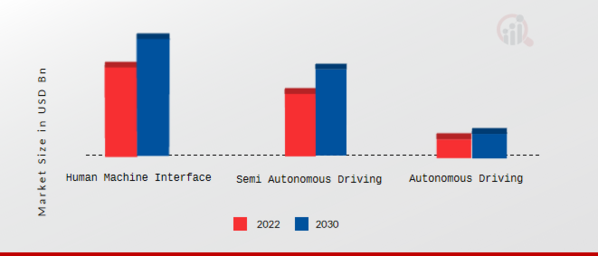
Based on Application, the AI in Automotive market segmentation includes Human-Machine Interface, Semi-autonomous Driving, and Autonomous Driving. Human-machine interface and Autonomous Driving. Automotive HMI has evolved drastically in the last few years and implemented disruptive technologies in various products, such as voice recognition systems and gesture recognition systems. This is a growing market where innovative AI technology is being used in upcoming models in premium segments.
Figure 2: Automotive Artificial Intelligence Market, by Application, 2021 & 2030 (USD Billion)
Source: Secondary Research, Primary Research, MRFR Database, and Analyst Review
Automotive Artificial Intelligence Regional Insights
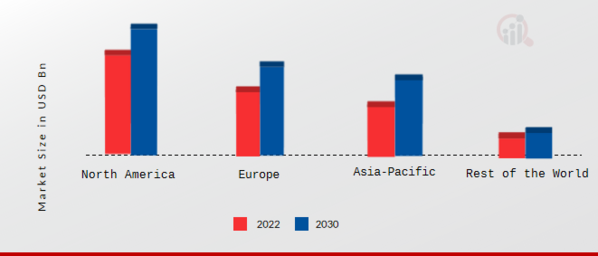
By region, the study provides market insights into North America, Europe, Asia-Pacific, and the Rest of the World North America is predicted to be the dominant sector in the Automotive AI industry by 2030, largely as a result of the existence of significant manufacturers in this area. Furthermore, as compared to other regions, this area has considerably greater access to advanced technology to develop artificial intelligence systems.
The increasing expectation of autonomous cars in the United States has made a substantial contribution to the expansion of the industry in this country. Favorable government regulations, combined with the fact that the automotive industry's leading companies, such as General Motors, Ford Motor Company, and Fiat Chrysler Automotive, are taking a stand in the advancement of artificial intelligence in automobiles by continuously enhancing their products, will have a better prospect in the market.
Figure 3: Automotive Artificial Intelligence Market Share By Region 2021 (%)
Source: Secondary Research, Primary Research, MRFR Database, and Analyst Review
Automotive Artificial Intelligence (AI) Key Market Players & Competitive Insights
Major market players are spending a lot of money on R&D to increase their product lines, which will help the Automotive Artificial Intelligence market grow even more. Market participants are also taking a range of strategic initiatives to grow their worldwide footprint, with key market developments such as new product launches, contractual agreements, mergers and acquisitions, increased investments, and collaboration with other organizations.
Competitors in the Automotive Artificial Intelligence industry must offer cost-effective items to expand and survive in an increasingly competitive and rising market environment. The major market players are investing a lot of money in R&D to expand their product lines, which will spur further market growth for Automotive Artificial Intelligence.
With significant market developments like new product releases, contractual agreements, mergers and acquisitions, increased investments, and collaboration with other organizations, market participants are also undertaking various strategic activities to expand their presence. To grow and thrive in a market climate that is becoming more competitive, competitors in the automotive artificial intelligence industry must offer affordable products.
Manufacturing locally to cut operating costs is one of the main business tactics manufacturers use in the Automotive Artificial Intelligence industry to benefit customers and expand the market. The Automotive Artificial Intelligence market has recently given medicine some of the most important advantages. Major hair care product market players, including Tesla Inc. (US), Volvo Car Corporation (Sweden), BMW AG (Germany), Audi AG (Germany), and others, are attempting to increase market demand by funding R&D initiatives.
Tesla aims to create AI-integrated chips that will enable cars to navigate through freeways and even traffic. Approximately 6 billion transistors constitute the circuit of each Tesla chip. These Tesla chips are 21 times faster than the original Nvidia chips and 20% cheaper too.
They have 32 megabytes of high-speed SRAM memory on the chip which fetches data faster and easier compared to DRAM. Also, Audi is one of the first car manufacturers to use artificial intelligence (AI) in production. AI experts Rüdiger Eck and Stefan Keckl report how Audi uses the technology and why people will remain indispensable, even in the factory of the future.
Key Companies in the Automotive Artificial Intelligence (AI) market include
-
Qualcomm Inc. (US)
- Tesla Inc. (US)
- Volvo Car Corporation (Sweden)
- BMW AG (Germany)
- Audi AG (Germany)
- General Motors Company (US)
-
Ford Motor Company (US)
- Toyota Motor Corporation (Japan)
- Hyundai Motor Corporation (South Korea)
- Uber Technologies Inc. (US)
Automotive Artificial Intelligence Industry Developments
January 2024
Volkswagen, a German carmaker, has launched its own AI lab, indicating the industry's increasing interest in adopting this technology. In a news statement, Volkswagen said that its new AI lab would function as a "globally networked competence center and incubator" to generate proofs of concept in the area of automotive technology. AI laboratories are centers of research and development dedicated to the advancement of artificial intelligence. Examples of such laboratories include Microsoft's billion-dollar investment in OpenAI and Google's acquisition of DeepMind in 2014.
Volkswagen said that it will incorporate its lab's AI technologies into its own automobiles to make them smarter. "We aim to provide our consumers with actual additional value using artificial intelligence. We want to connect external digital ecosystems to the automobile, resulting in an even better product experience," says Oliver Blume, CEO of Volkswagen Group and Porsche AG. "Collaboration with technological businesses is critical for us. In the future, we want to simplify organizational and cultural collaboration." Volkswagen has no plans to manufacture any production models of its own, but the corporation expects to negotiate with partners about licensing its proprietary AI technology for use in other cars.
Volkswagen did not mention any possible partners. The company said that some of the AI solutions researched by the lab would deal with improving electric vehicle charging, predictive maintenance for automobiles, and connecting vehicles to customers' homes via internet-connected gadgets. The business also said that it will investigate AI applications to allow in-car speech recognition. The news comes as other automakers invest extensively in artificial intelligence to improve their technological credentials and make their vehicles smarter.
Late this year, French automaker DS Automobiles started implementing ChatGPT into their cars. Mercedes-Benz and Microsoft began testing in-car ChatGPT capability as early as June 2023. Meanwhile, Chinese electric vehicle manufacturer BYD has introduced an AI-powered smart car system to better compete with competitors in sophisticated technologies such as autonomous parking.
In June 2024, MORAI Inc., a provider of autonomous vehicle simulation platforms, and Automotive Artificial Intelligence (AAI) GmbH, a developer of software for driverless vehicles, formed a partnership to advance autonomous driving technology. Companies may save time and improve the quality of autonomous vehicle systems by integrating MORAI Inc.'s cutting-edge simulation platforms with Automotive Artificial Intelligence (AAI) GmbH's specialist tools.
Automotive Artificial Intelligence Market Segmentation
Automotive Artificial Intelligence Technology Outlook
- Deep Learning
- Machine Learning
- Context Awareness
- Computer Vision
- Natural Language Processing
Automotive Artificial Intelligence Process Outlook
- Signal Recognition
- Image Recognition
- Data Mining
Automotive Artificial Intelligence Application Outlook
- Human-Machine Interface
- Semi-autonomous Driving
- Autonomous Driving
Automotive Artificial Intelligence Regional Outlook
North America
Europe
- Germany
- France
- UK
- Italy
- Spain
- Rest of Europe
Asia-Pacific
- China
- Japan
- India
- Australia
- South Korea
- Australia
- Rest of Asia-Pacific
Rest of the World
- Middle East
- Africa
- Latin America
| Attribute/Metric |
Details |
| Market Size 2021 |
USD 1.3 Billion |
| Market Size 2022 |
USD 2.6 Billion |
| Market Size 2030 |
USD 9.6 Billion |
| Compound Annual Growth Rate (CAGR) |
27.2% (2024-2030) |
| Base Year |
2023 |
| Market Forecast Period |
2024-2030 |
| Historical Data |
2018 & 2022 |
| Market Forecast Units |
Value (USD Billion) |
| Report Coverage |
Revenue Forecast, Market Competitive Landscape, Growth Factors, and Trends |
| Segments Covered |
By Technology, By Process, By Application, By Vehicle Type, and by Region |
| Geographies Covered |
North America, Europe, Asia Pacific, and the Rest of the World |
| Countries Covered |
The U.S, Canada, Germany, France, the UK, Italy, Spain, China, Japan, India, Australia, South Korea, and Brazil |
| Key Companies Profiled |
Qualcomm Inc. (US), Tesla Inc. (US), Volvo Car Corporation (Sweden), BMW AG (Germany), Audi AG (Germany), General Motors Company (US), Ford Motor Company (US), Toyota Motor Corporation (Japan), Hyundai Motor Corporation (South Korea), Uber Technologies Inc. (US) |
| Key Market Opportunities |
Cloud-hosted intelligenceDriver assist features Internet of thing |
| Key Market Dynamics |
Advanced driver assistance systems Blind spot alert |
Automotive Artificial Intelligence Market Highlights:
Frequently Asked Questions (FAQ) :
The Automotive Artificial Intelligence market size was valued at USD 1.3 Billion in 2021.
The market is projected to grow at a CAGR of 27.2% during the forecast period, 2024-2030.
North America had the largest share of the Automotive Artificial Intelligence market.
The key players in the market are Qualcomm Inc. (US), Tesla Inc. (US), Volvo Car Corporation (Sweden), BMW AG (Germany), Audi AG (Germany), General Motors Company (US), Ford Motor Company (US), Toyota Motor Corporation (Japan), Hyundai Motor Corporation (South Korea), Uber Technologies Inc. (US)
The Deep Learning category dominated the market in 2021.
The Data Mining base had the largest share in the market for Automotive Artificial Intelligence.