Request Free Sample ×

Kindly complete the form below to receive a free sample of this Report

* Please use a valid business email

Leading companies partner with us for data-driven Insights

clients tt-cursor
Hero Background
English
Chinese
French
Japanese
Korean
German
Spanish

Automotive Airbag Inflators Market Share

ID: MRFR/AT/3323-HCR
100 Pages
Triveni Bhoyar
Last Updated: April 20, 2026

Automotive Airbag Inflator Market Size, Share & Growth Analysis Report By Type (Chemical Airbag Inflators, Compressed Gas Airbag Inflators, Hybrid Airbag Inflators), By Vehicle Type (Passenger Vehicles, Commercial Vehicles, Motorcycles), By Deployment Mode (Single Stage, Multi-Stage), By Airbag Type (Frontal Airbags, Side Airbags, Curtain Airbags) and By Regional (North America, Europe, South America, Asia Pacific, Middle East and Africa) - Industry Trends & Forecast to 2035

Share:
Download PDF ×

We do not share your information with anyone. However, we may send you emails based on your report interest from time to time. You may contact us at any time to opt-out.

Automotive Airbag Inflators Market Infographic
Purchase Options

Market Share

Automotive Airbag Inflators Market Share Analysis

The automotive airbag inflator market has been experiencing dynamic trends in recent years, driven by advancements in vehicle safety technology and an increasing emphasis on passenger protection. One notable trend is the growing demand for advanced airbag inflators equipped with cutting-edge sensors and electronic components. These inflators are designed to respond to specific crash scenarios, deploying airbags in a more tailored and efficient manner. Manufacturers are investing heavily in research and development to enhance the precision and speed of airbag deployment, ensuring optimal protection for occupants in diverse collision situations.

Another significant trend shaping the automotive airbag inflator market is the rising adoption of smart airbag systems. These systems leverage sophisticated algorithms and artificial intelligence to analyze various factors such as occupant position, crash severity, and vehicle speed in real-time. By incorporating smart technology, airbag inflators can make split-second decisions to deploy airbags with the right force, reducing the risk of injury caused by improper deployment or unnecessary inflation. This trend aligns with the broader automotive industry's push towards intelligent and connected vehicles.

Furthermore, sustainability has emerged as a key factor influencing market dynamics. As the automotive sector strives to reduce its environmental footprint, manufacturers are exploring eco-friendly materials and manufacturing processes for airbag inflators. The development of inflators using recyclable materials and eco-conscious production methods is gaining traction. This trend reflects the industry's commitment to environmental responsibility and aligns with global efforts to create a more sustainable future.

In response to increasingly stringent safety regulations and standards worldwide, the automotive airbag inflator market is witnessing a shift towards more robust and reliable inflator designs. Manufacturers are focusing on engineering inflators that meet or exceed safety requirements while also ensuring durability and long-term reliability. This trend is particularly evident in the development of inflators for electric and autonomous vehicles, where safety considerations are paramount, and the automotive landscape is undergoing significant transformation.

The market is also witnessing a regional shift in demand, with emerging economies playing a more significant role. As these economies experience rapid urbanization and an increase in disposable income, there is a growing awareness of and demand for advanced safety features in vehicles. This includes a heightened interest in vehicles equipped with the latest airbag inflator technologies. Manufacturers are strategically targeting these regions, adapting their product offerings to meet the specific safety needs and preferences of consumers in these expanding markets.

Collaborations and partnerships within the automotive ecosystem are shaping the market's trajectory. Manufacturers are increasingly teaming up with technology companies, research institutions, and other stakeholders to leverage expertise and resources. These collaborations accelerate innovation and enhance the development of state-of-the-art airbag inflator technologies. The industry's collective approach to safety underscores the importance of collaboration in addressing complex challenges and driving continuous improvement in automotive safety systems.

In conclusion, the automotive airbag inflator market is evolving in response to technological advancements, sustainability considerations, stringent safety regulations, regional shifts in demand, and collaborative efforts within the industry. As vehicle safety remains a top priority for consumers and regulatory bodies alike, the market is expected to continue its dynamic growth, with ongoing innovations shaping the future of automotive safety systems.

Author
Author Profile
Triveni Bhoyar
Senior Research Analyst

Triveni Bhoyar has over 5 years of experience in the market research industry, specializing in the Automotive and Aerospace & Defense sectors. She has contributed to 200+ reports, including numerous custom projects for leading global companies, delivering solutions to complex business challenges. Renowned for her ability to generate valuable insights, Triveni excels in addressing unique market dynamics with precision and depth. Her expertise spans market sizing, competitive intelligence, and trend analysis, enabling clients to craft data-driven growth strategies. With strong analytical rigor and a client-centric approach, she plays a pivotal role in driving impactful, strategic decision-making.

Leave a Comment

FAQs

What is the projected market valuation for the Automotive Airbag Inflator Market in 2035?

<p>The projected market valuation for the Automotive Airbag Inflator Market in 2035 is 9.689 USD Billion.</p>

What was the market valuation for the Automotive Airbag Inflator Market in 2024?

<p>The market valuation for the Automotive Airbag Inflator Market in 2024 was 5.977 USD Billion.</p>

What is the expected CAGR for the Automotive Airbag Inflator Market from 2025 to 2035?

<p>The expected CAGR for the Automotive Airbag Inflator Market during the forecast period 2025 - 2035 is 4.49%.</p>

Which company is a key player in the Automotive Airbag Inflator Market?

<p>Takata, Autoliv, and Denso are among the key players in the Automotive Airbag Inflator Market.</p>

What are the projected values for Chemical Airbag Inflators by 2035?

<p>The projected value for Chemical Airbag Inflators is expected to reach 3.8 USD Billion by 2035.</p>

How do the valuations of Passenger Vehicles compare to Commercial Vehicles in 2035?

<p>By 2035, the valuation for Passenger Vehicles is projected to be 5.5 USD Billion, significantly higher than the 2.1 USD Billion for Commercial Vehicles.</p>

What is the expected market size for Multi-Stage deployment mode by 2035?

<p>The expected market size for Multi-Stage deployment mode is projected to reach 4.0 USD Billion by 2035.</p>

What is the projected value for Frontal Airbags in 2035?

<p>The projected value for Frontal Airbags is anticipated to be 4.8445 USD Billion by 2035.</p>

What is the expected growth for Hybrid Airbag Inflators from 2024 to 2035?

<p>The expected growth for Hybrid Airbag Inflators is projected to increase from 1.677 USD Billion in 2024 to 3.189 USD Billion by 2035.</p>

What is the market outlook for Side Airbags by 2035?

<p>The market outlook for Side Airbags indicates a projected value of 1.8925 USD Billion by 2035.</p>

Market Summary

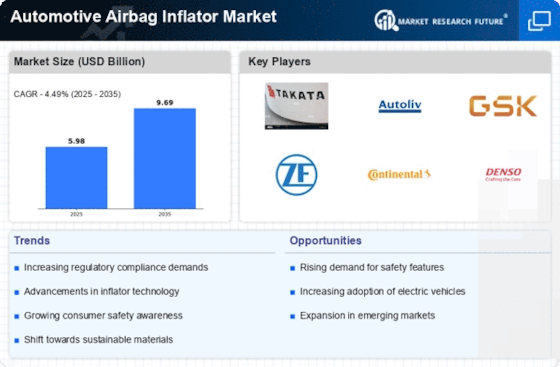
As per Market Research Future analysis, the Automotive Airbag Inflator Market Size was estimated at 5.977 USD Billion in 2024. The Automotive Airbag Inflator industry is projected to grow from 6.245 USD Billion in 2025 to 9.689 USD Billion by 2035, exhibiting a compound annual growth rate (CAGR) of 4.49% during the forecast period 2025 - 2035

Key Market Trends & Highlights

The Automotive Airbag Inflator Market is poised for growth driven by technological advancements and increasing safety awareness.

  • Technological advancements in airbag systems are reshaping the market landscape, particularly in North America. Consumer safety awareness continues to rise, influencing purchasing decisions in the automotive sector. Regulatory changes are becoming more stringent, particularly impacting the production of airbag inflators in the Asia-Pacific region. The growth in automotive production and the emergence of electric and autonomous vehicles are key drivers for the market, especially in the chemical airbag inflator segment.

Market Size & Forecast

2024 Market Size 5.977 (USD Billion)
2035 Market Size 9.689 (USD Billion)
CAGR (2025 - 2035) 4.49%
Largest Regional Market Share in 2024 North America

Major Players

Takata (JP), Autoliv (SE), Zhejiang GSK (CN), TRW Automotive (US), Continental (DE), Denso (JP), Nissan Chemical (JP), Hyundai Mobis (KR), Joyson Safety Systems (CN)

Market Trends

The Automotive Airbag Inflator Market is currently experiencing a transformative phase, driven by advancements in safety regulations and technological innovations. Manufacturers are increasingly focusing on enhancing the efficiency and reliability of airbag systems, which are critical for passenger safety. The integration of smart technologies, such as sensors and electronic control units, appears to be a key trend, as these innovations can potentially improve the performance of inflators during deployment.

Furthermore, the growing emphasis on lightweight materials is likely to influence the design and manufacturing processes, aiming to reduce overall vehicle weight while maintaining safety standards. In addition to technological advancements, the automotive airbag inflator market is also shaped by shifting consumer preferences towards enhanced safety features in vehicles. As awareness of road safety increases, consumers are more inclined to choose vehicles equipped with advanced airbag systems.

This trend is reflected in recent automotive airbag inflator market analysis, which highlights growing demand for inflators that offer superior performance and reliability . Moreover, regulatory bodies are continuously updating safety standards, which may compel manufacturers to innovate and adapt their products accordingly. Overall, the Automotive Airbag Inflator Market is poised for growth, driven by a combination of technological progress and evolving consumer expectations.

Technological Advancements

The automotive airbag inflator market trends indicate a surge in technological innovations, particularly in the integration of smart systems. These advancements enhance the responsiveness and reliability of airbag deployment, ensuring optimal safety for passengers. Notably, the rise of electric vehicles (EVs) is influencing new airbag inflator designs, as manufacturers adapt to the unique requirements of EVs iea.org.

Consumer Safety Awareness

There is a noticeable increase in consumer awareness regarding vehicle safety features. This heightened focus on safety is driving demand for advanced airbag systems, prompting manufacturers to prioritize the development of more effective inflators. Emerging markets have seen a 5% increase in vehicle ownership in 2022, further driving demand in the automotive airbag parts market worldbank.org.

Regulatory Changes

Ongoing updates to safety regulations are influencing the Automotive Airbag Inflator Market. Manufacturers are compelled to adapt their products to meet new standards, which may lead to innovations in inflator technology and design. Global vehicle production increased by 3% in 2022, highlighting the expanding market for airbag inflators iea.org.

Automotive Airbag Inflators Market Market Drivers

Growth in Automotive Production

The Automotive Airbag Inflator Market is poised for growth, driven by the overall increase in automotive production. As vehicle manufacturing ramps up, the demand for essential safety components, including airbag inflators, is expected to rise correspondingly. Recent statistics reveal that global vehicle production has seen a steady increase, with millions of units produced annually. This trend is likely to continue as emerging markets expand their automotive sectors, further propelling the need for advanced airbag systems. Consequently, manufacturers are anticipated to enhance their production capabilities to meet the growing demand for airbag inflators, thereby contributing to market expansion.

Stringent Regulatory Frameworks

The Automotive Airbag Inflator Market is significantly influenced by stringent regulatory frameworks that mandate the inclusion of advanced safety features in vehicles. Regulatory bodies across various regions have established comprehensive guidelines that require manufacturers to adhere to specific safety standards, particularly concerning airbag systems. For instance, regulations may dictate the performance criteria for inflators, ensuring they deploy effectively in a range of collision scenarios. Compliance with these regulations not only enhances consumer trust but also drives manufacturers to innovate and improve their inflator technologies. As a result, the market for airbag inflators is likely to expand as companies strive to meet these evolving regulatory demands.

Rising Consumer Safety Awareness

Consumer safety awareness is a pivotal driver for the Automotive Airbag Inflator Market. As individuals become more informed about vehicle safety features, there is a growing expectation for manufacturers to provide advanced safety systems, including reliable airbag inflators. Surveys indicate that a significant percentage of consumers prioritize safety ratings when purchasing vehicles, which directly influences manufacturers to invest in high-quality inflator technologies. This trend is further supported by the increasing number of safety campaigns and educational initiatives aimed at highlighting the importance of airbags in reducing fatalities during accidents. Consequently, the demand for innovative airbag inflators is expected to escalate.

Technological Innovations in Airbag Systems

The Automotive Airbag Inflator Market is experiencing a surge in technological innovations, particularly in the development of advanced inflator systems. These innovations include the integration of smart sensors and adaptive deployment mechanisms that enhance the effectiveness of airbags during collisions. As manufacturers strive to improve safety features, the demand for sophisticated inflators is likely to rise. Recent data indicates that the market for automotive safety systems, including airbag inflators, is projected to grow at a compound annual growth rate of approximately 7% over the next five years. This growth is driven by the increasing emphasis on passenger safety and the need for compliance with stringent safety regulations.

Emergence of Electric and Autonomous Vehicles

The emergence of electric and autonomous vehicles is reshaping the Automotive Airbag Inflator Market. As the automotive landscape evolves, manufacturers are increasingly focusing on integrating advanced safety features into these new vehicle types. Electric vehicles, in particular, present unique challenges and opportunities for airbag inflator design, necessitating innovations that cater to different crash dynamics. Furthermore, autonomous vehicles require sophisticated inflator systems that can adapt to various driving scenarios. This shift towards electrification and automation is likely to drive research and development efforts in the airbag inflator sector, leading to enhanced safety solutions that align with the future of mobility.

Market Segment Insights

By Type: Chemical Airbag Inflators (Largest) vs. Compressed Gas Airbag Inflators (Fastest-Growing)

In the automotive airbag inflator market, Chemical Airbag Inflators hold the largest share, attributed to their reliability and effectiveness in inflating airbags quickly during a collision. These inflators utilize a chemical reaction to produce gas, which is advantageous for maintaining consistent performance across varying conditions. Compressed Gas Airbag Inflators, while not as dominant, are rapidly gaining traction due to their simplicity and lower weight, making them attractive for manufacturers looking to enhance vehicle efficiency. The growth of Compressed Gas Airbag Inflators is driven by advancements in technology and increasing safety regulations in the automotive industry. As automakers strive to enhance passenger safety, the demand for efficient and lightweight airbag systems is rising. Furthermore, consumer preferences for modern, high-tech vehicles have led to innovations within this segment, enabling compressed gas inflators to emerge as a viable choice for future automotive applications.

Chemical Airbag Inflators (Dominant) vs. Hybrid Airbag Inflators (Emerging)

Chemical Airbag Inflators represent the dominant technology in the automotive airbag inflator market, characterized by their ability to rapidly deploy airbags using a chemical reaction that generates gas. This technology ensures rapid inflation times, which is crucial during vehicle collisions, not only meeting but exceeding regulatory standards for safety. In contrast, Hybrid Airbag Inflators, which blend the principles of chemical and compressed gas technologies, are emerging as innovative alternatives. These inflators promise to combine the benefits of both technologies, offering greater control over inflation rates and enhanced safety features. As manufacturers increasingly explore hybrid solutions to meet consumer demands for advanced safety systems, Hybrid Airbag Inflators are anticipated to gain a more significant market presence, appealing with their unique advantages.

By Vehicle Type: Passenger Vehicles (Largest) vs. Commercial Vehicles (Fastest-Growing)

The Automotive Airbag Inflator Market showcases a notable distribution of market shares across various vehicle types. Passenger vehicles represent the largest segment, driven by the continuous demand for enhanced safety features and regulations mandating the installation of airbags. This segment significantly dominates the market due to its large consumer base and has seen steady growth in recent years. Meanwhile, commercial vehicles are witnessing increasing adoption of airbag inflators, spurred by a rise in safety awareness and regulations aiming to minimize road accidents involving larger vehicles.

Passenger Vehicles (Dominant) vs. Motorcycles (Emerging)

Passenger vehicles have solidified their position as the dominant segment in the Automotive Airbag Inflator Market, benefiting from stringent safety regulations and a growing consumer emphasis on vehicle safety enhancements. On the other hand, the motorcycle segment, categorized as an emerging market, is gradually gaining traction as manufacturers prioritize safety features amid rising accident rates. The airbag inflator technology in motorcycles is evolving, with manufacturers innovating to integrate lightweight and compact solutions that fit the design constraints of two-wheeled vehicles, thus creating a new niche in the market.

By Deployment Mode: Single Stage (Largest) vs. Multi-Stage (Fastest-Growing)

In the Automotive Airbag Inflator Market, the deployment mode segment is primarily characterized by Single Stage and Multi-Stage inflators. Single Stage inflators currently dominate the market, capturing a significant portion of the demand due to their simplicity, reliability, and effectiveness in various airbag applications. Multi-Stage inflators, while representing a smaller market share, are gaining traction as automotive manufacturers seek advanced safety solutions to meet increasing regulatory standards and consumer safety expectations.

Deployment Mode: Single Stage (Dominant) vs. Multi-Stage (Emerging)

Single Stage inflators have long been recognized as the standard in vehicle safety systems, offering a robust and efficient solution for airbag deployment. They are favored for their straightforward design and lower production costs, making them an attractive option for many automakers. Conversely, Multi-Stage inflators are quickly emerging in the market as vehicle designs evolve to incorporate more complex safety systems. These inflators provide enhanced deployable strategies, allowing for varying inflations based on collision severity, thus improving passenger protection. The transition towards more sophisticated airbag systems is being driven by the rising demand for better safety technologies in modern vehicles.

By Airbag Type: Frontal Airbags (Largest) vs. Side Airbags (Fastest-Growing)

In the Automotive Airbag Inflator Market, Frontal Airbags command the largest share, reflecting their critical role in providing driver and passenger safety during collisions. They have established themselves as a standard feature in most vehicles, contributing significantly to market penetration and adoption rates among consumers. Conversely, Side Airbags, while traditionally less prominent, are observing rapid growth due to increasing awareness of passenger safety and enhanced regulatory standards mandating their inclusion in new vehicle models.

Frontal Airbags (Dominant) vs. Curtain Airbags (Emerging)

Frontal Airbags are fundamental to modern vehicle safety, designed to deploy during frontal collisions to protect occupants from hitting the dashboard or steering wheel. Their dominance in the market is attributed to widespread regulatory requirements and consumer recognition of their effectiveness. In contrast, Curtain Airbags, which offer protection in side-impact crashes and during rollovers, are emerging as vital safety features in vehicles. They are gaining traction owing to advancements in automotive safety technology and rising consumer demand for comprehensive safety solutions, making them an essential focus for automotive manufacturers.

Get more detailed insights about Automotive Airbag Inflator Market Research Report- Forecast 2035

Regional Insights

The  Automotive Airbag Inflator Market experienced a significant transformation across various regions. In 2023, North America led the market with a valuation of 2.15 USD Billion, dominating due to advanced automotive safety regulations and high consumer awareness. Following closely was Europe, valued at 1.5 USD Billion, where strong automotive manufacturing and stringent safety standards bolster market growth.

The APAC region, valued at 1.7 USD Billion, showcased a growing automotive sector and rising disposable income, contributing to increased airbag installations.

 South America and MEA represented smaller shares, with valuations of 0.25 USD Billion and 0.12 USD Billion, respectively.

However, these markets presented opportunities for growth driven by rising safety awareness and improving infrastructure. The overall  Automotive Airbag Inflator Market statistics indicated a robust evolution, with regional segments adapting to trends such as technological advancements and increased vehicle production, strategic for market growth in the future.

Key Players and Competitive Insights

The  Automotive Airbag Inflator Market is characterized by intense competition among numerous players striving to gain market share through innovation, quality improvement, and strategic collaborations. With growing concerns about vehicle safety and increasing regulatory standards worldwide, companies in this market focus on developing advanced inflator technologies that not only enhance the effectiveness of airbags but also comply with stringent safety requirements. As consumer awareness regarding automotive safety features surges, the demand for advanced airbag inflators is anticipated to rise. Competitive dynamics are shaped by factors such as technological advancements, product launches, partnerships, and the ability to adapt to changing market demands. The landscape is also influenced by geographic considerations, as manufacturers aim to expand their reach into emerging markets where the automotive sector is rapidly evolving, thus presenting new opportunities for growth and competitive advantage. Takata has established a significant presence within the  Automotive Airbag Inflator Market due to its long history and deep expertise in airbag systems and safety technology. The company's strengths lie in its commitment to research and development, enabling it to continually innovate and enhance its product offerings. Takata's robust supply chain management ensures efficiency in production while maintaining high-quality standards. The emphasis on safety and reliability in its inflator designs has helped Takata build a solid reputation among vehicle manufacturers ly. Furthermore, the company has a track record of collaborating effectively with automotive producers, allowing it to tailor its inflators to meet specific requirements, thereby strengthening relationships and expanding its market influence. Despite facing challenges, Takata's ongoing focus on developing innovative technology and ensuring safety compliance positions it as a key player in the airbag inflator sector. The East Japan Railway Company, while primarily known for its transportation services, has made strategic forays into the  Automotive Airbag Inflator Market. Though its core business is rail transport, the company benefits from extensive engineering expertise and a strong commitment to safety, which are crucial in airbag systems. East Japan Railway Company's strategic partnerships and investment in research allow it to explore opportunities in automotive safety, particularly in the domain of airbag inflators. With an eye on the growing safety concerns in the automotive industry, the company's technological advancements in materials and safety features position it uniquely to capture opportunities within this market segment. By leveraging its strong market presence in Japan and potentially expanding into international markets, East Japan Railway Company aims to innovate and offer reliable airbag inflator solutions, thereby enhancing its competitive edge in this dynamic sector.

Key Companies in the Automotive Airbag Inflators Market include

Industry Developments

Recent developments in the  Automotive Airbag Inflator Market have been significant, particularly concerning safety standards and evolving technology. Takata, after facing issues related to defective inflators, continues to navigate its recovery and restructuring efforts.

Autoliv and Daicel Corporation are showing robust growth, bolstered by increasing demand for advanced airbag systems that enhance vehicle safety. Meanwhile, Continental and Honeywell are investing in innovative airbag technologies, focusing on lighter and more efficient inflators.

In the realm of mergers and acquisitions, KSS has been exploring opportunities for expansion, while Joyson Safety Systems continues to integrate new technologies following acquisitions to enhance its product offerings. Additionally, companies like Aisin Seiki and TRW Automotive are collaborating to develop next-generation inflator systems that comply with stringent regulations.

The market is witnessing a surge in valuation, driven by heightened awareness of vehicle safety and regulatory changes, significantly impacting the trajectory of the automotive airbag inflator sector. Companies like Nisshinbo Holdings and Ashimori Industry are also adapting to these changes by enhancing their production capabilities and expanding their  reach.

Future Outlook

Automotive Airbag Inflators Market Future Outlook

The Automotive Airbag Inflator Market is projected to grow at a 4.49% CAGR from 2025 to 2035, driven by advancements in safety regulations, technological innovations, and increasing vehicle production.

New opportunities lie in:

  • <p>Development of smart inflator systems with real-time diagnostics. Expansion into emerging markets with tailored inflator solutions. Partnerships with electric vehicle manufacturers for integrated safety systems.</p>

By 2035, the market is expected to be robust, reflecting significant advancements and strategic growth.

Market Segmentation

Automotive Airbag Inflators Market Type Outlook

  • Chemical Airbag Inflators
  • Compressed Gas Airbag Inflators
  • Hybrid Airbag Inflators

Automotive Airbag Inflators Market Airbag Type Outlook

  • Frontal Airbags
  • Side Airbags
  • Curtain Airbags

Automotive Airbag Inflators Market Vehicle Type Outlook

  • Passenger Vehicles
  • Commercial Vehicles
  • Motorcycles

Automotive Airbag Inflators Market Deployment Mode Outlook

  • Single Stage
  • Multi-Stage

Report Scope

MARKET SIZE 2024 5.977(USD Billion)
MARKET SIZE 2025 6.245(USD Billion)
MARKET SIZE 2035 9.689(USD Billion)
COMPOUND ANNUAL GROWTH RATE (CAGR) 4.49% (2025 - 2035)
REPORT COVERAGE Revenue Forecast, Competitive Landscape, Growth Factors, and Trends
BASE YEAR 2024
Market Forecast Period 2025 - 2035
Historical Data 2019 - 2024
Market Forecast Units USD Billion
Key Companies Profiled Takata (JP), Autoliv (SE), Zhejiang GSK (CN), TRW Automotive (US), Continental (DE), Denso (JP), Nissan Chemical (JP), Hyundai Mobis (KR), Joyson Safety Systems (CN)
Segments Covered Type, Vehicle Type, Deployment Mode, Airbag Type, Regional
Key Market Opportunities Integration of advanced materials and smart technologies enhances safety in the Automotive Airbag Inflator Market.
Key Market Dynamics Technological advancements and stringent safety regulations drive innovation in the automotive airbag inflator market.
Countries Covered North America, Europe, APAC, South America, MEA

FAQs

What is the projected market valuation for the Automotive Airbag Inflator Market in 2035?

<p>The projected market valuation for the Automotive Airbag Inflator Market in 2035 is 9.689 USD Billion.</p>

What was the market valuation for the Automotive Airbag Inflator Market in 2024?

<p>The market valuation for the Automotive Airbag Inflator Market in 2024 was 5.977 USD Billion.</p>

What is the expected CAGR for the Automotive Airbag Inflator Market from 2025 to 2035?

<p>The expected CAGR for the Automotive Airbag Inflator Market during the forecast period 2025 - 2035 is 4.49%.</p>

Which company is a key player in the Automotive Airbag Inflator Market?

<p>Takata, Autoliv, and Denso are among the key players in the Automotive Airbag Inflator Market.</p>

What are the projected values for Chemical Airbag Inflators by 2035?

<p>The projected value for Chemical Airbag Inflators is expected to reach 3.8 USD Billion by 2035.</p>

How do the valuations of Passenger Vehicles compare to Commercial Vehicles in 2035?

<p>By 2035, the valuation for Passenger Vehicles is projected to be 5.5 USD Billion, significantly higher than the 2.1 USD Billion for Commercial Vehicles.</p>

What is the expected market size for Multi-Stage deployment mode by 2035?

<p>The expected market size for Multi-Stage deployment mode is projected to reach 4.0 USD Billion by 2035.</p>

What is the projected value for Frontal Airbags in 2035?

<p>The projected value for Frontal Airbags is anticipated to be 4.8445 USD Billion by 2035.</p>

What is the expected growth for Hybrid Airbag Inflators from 2024 to 2035?

<p>The expected growth for Hybrid Airbag Inflators is projected to increase from 1.677 USD Billion in 2024 to 3.189 USD Billion by 2035.</p>

What is the market outlook for Side Airbags by 2035?

<p>The market outlook for Side Airbags indicates a projected value of 1.8925 USD Billion by 2035.</p>

  1. SECTION I: EXECUTIVE SUMMARY AND KEY HIGHLIGHTS |
    1. EXECUTIVE SUMMARY | |
      1. Market Overview | |
      2. Key Findings | |
      3. Market Segmentation | |
      4. Competitive Landscape | |
      5. Challenges and Opportunities | |
      6. Future Outlook 2
  2. SECTION II: SCOPING, METHODOLOGY AND MARKET STRUCTURE |
    1. MARKET INTRODUCTION | |
      1. Definition | |
      2. Scope of the study | | |
    2. RESEARCH METHODOLOGY | |
      1. Overview | |
      2. Data Mining | |
      3. Secondary Research | |
      4. Primary Research | | |
      5. Forecasting Model | |
      6. Market Size Estimation | | |
      7. Data Triangulation | |
      8. Validation 3
  3. SECTION III: QUALITATIVE ANALYSIS |
    1. MARKET DYNAMICS | |
      1. Overview | |
      2. Drivers | |
      3. Restraints | |
      4. Opportunities |
    2. MARKET FACTOR ANALYSIS | |
      1. Value chain Analysis | |
      2. Porter's Five Forces Analysis | | |
      3. COVID-19 Impact Analysis | | |
  4. SECTION IV: QUANTITATIVE ANALYSIS |
    1. Automobile, BY Type (USD Billion) | |
      1. Chemical Airbag Inflators | |
      2. Compressed Gas Airbag Inflators | |
      3. Hybrid Airbag Inflators |
    2. Automobile, BY Vehicle Type (USD Billion) | |
      1. Passenger Vehicles | |
      2. Commercial Vehicles | |
      3. Motorcycles |
    3. Automobile, BY Deployment Mode (USD Billion) | |
      1. Single Stage | |
      2. Multi-Stage |
    4. Automobile, BY Airbag Type (USD Billion) | |
      1. Frontal Airbags | |
      2. Side Airbags | |
      3. Curtain Airbags |
    5. Automobile, BY Region (USD Billion) | |
      1. North America | | |
      2. Europe | | |
      3. APAC | | |
      4. South America | | |
      5. MEA | | |
  5. SECTION V: COMPETITIVE ANALYSIS |
    1. Competitive Landscape | |
      1. Overview | |
      2. Competitive Analysis | |
      3. Market share Analysis | |
      4. Major Growth Strategy in the Automobile | |
      5. Competitive Benchmarking | |
      6. Leading Players in Terms of Number of Developments in the Automobile | |
      7. Key developments and growth strategies | | |
      8. Major Players Financial Matrix | | |
    2. Company Profiles | |
      1. Takata (JP) | | |
      2. Autoliv (SE) | | |
      3. Zhejiang GSK (CN) | | |
      4. TRW Automotive (US) | | |
      5. Continental (DE) | | |
      6. Denso (JP) | | |
      7. Nissan Chemical (JP) | | |
      8. Hyundai Mobis (KR) | | |
      9. Joyson Safety Systems (CN) | | |
    3. Appendix | |
      1. References | |
      2. Related Reports 6 LIST OF FIGURES |
    4. MARKET SYNOPSIS |
    5. NORTH AMERICA MARKET ANALYSIS |
    6. US MARKET ANALYSIS BY TYPE |
    7. US MARKET ANALYSIS BY VEHICLE TYPE |
    8. US MARKET ANALYSIS BY DEPLOYMENT MODE |
    9. US MARKET ANALYSIS BY AIRBAG TYPE |
    10. CANADA MARKET ANALYSIS BY TYPE |
    11. CANADA MARKET ANALYSIS BY VEHICLE TYPE |
    12. CANADA MARKET ANALYSIS BY DEPLOYMENT MODE |
    13. CANADA MARKET ANALYSIS BY AIRBAG TYPE |
    14. EUROPE MARKET ANALYSIS |
    15. GERMANY MARKET ANALYSIS BY TYPE |
    16. GERMANY MARKET ANALYSIS BY VEHICLE TYPE |
    17. GERMANY MARKET ANALYSIS BY DEPLOYMENT MODE |
    18. GERMANY MARKET ANALYSIS BY AIRBAG TYPE |
    19. UK MARKET ANALYSIS BY TYPE |
    20. UK MARKET ANALYSIS BY VEHICLE TYPE |
    21. UK MARKET ANALYSIS BY DEPLOYMENT MODE |
    22. UK MARKET ANALYSIS BY AIRBAG TYPE |
    23. FRANCE MARKET ANALYSIS BY TYPE |
    24. FRANCE MARKET ANALYSIS BY VEHICLE TYPE |
    25. FRANCE MARKET ANALYSIS BY DEPLOYMENT MODE |
    26. FRANCE MARKET ANALYSIS BY AIRBAG TYPE |
    27. RUSSIA MARKET ANALYSIS BY TYPE |
    28. RUSSIA MARKET ANALYSIS BY VEHICLE TYPE |
    29. RUSSIA MARKET ANALYSIS BY DEPLOYMENT MODE |
    30. RUSSIA MARKET ANALYSIS BY AIRBAG TYPE |
    31. ITALY MARKET ANALYSIS BY TYPE |
    32. ITALY MARKET ANALYSIS BY VEHICLE TYPE |
    33. ITALY MARKET ANALYSIS BY DEPLOYMENT MODE |
    34. ITALY MARKET ANALYSIS BY AIRBAG TYPE |
    35. SPAIN MARKET ANALYSIS BY TYPE |
    36. SPAIN MARKET ANALYSIS BY VEHICLE TYPE |
    37. SPAIN MARKET ANALYSIS BY DEPLOYMENT MODE |
    38. SPAIN MARKET ANALYSIS BY AIRBAG TYPE |
    39. REST OF EUROPE MARKET ANALYSIS BY TYPE |
    40. REST OF EUROPE MARKET ANALYSIS BY VEHICLE TYPE |
    41. REST OF EUROPE MARKET ANALYSIS BY DEPLOYMENT MODE |
    42. REST OF EUROPE MARKET ANALYSIS BY AIRBAG TYPE |
    43. APAC MARKET ANALYSIS |
    44. CHINA MARKET ANALYSIS BY TYPE |
    45. CHINA MARKET ANALYSIS BY VEHICLE TYPE |
    46. CHINA MARKET ANALYSIS BY DEPLOYMENT MODE |
    47. CHINA MARKET ANALYSIS BY AIRBAG TYPE |
    48. INDIA MARKET ANALYSIS BY TYPE |
    49. INDIA MARKET ANALYSIS BY VEHICLE TYPE |
    50. INDIA MARKET ANALYSIS BY DEPLOYMENT MODE |
    51. INDIA MARKET ANALYSIS BY AIRBAG TYPE |
    52. JAPAN MARKET ANALYSIS BY TYPE |
    53. JAPAN MARKET ANALYSIS BY VEHICLE TYPE |
    54. JAPAN MARKET ANALYSIS BY DEPLOYMENT MODE |
    55. JAPAN MARKET ANALYSIS BY AIRBAG TYPE |
    56. SOUTH KOREA MARKET ANALYSIS BY TYPE |
    57. SOUTH KOREA MARKET ANALYSIS BY VEHICLE TYPE |
    58. SOUTH KOREA MARKET ANALYSIS BY DEPLOYMENT MODE |
    59. SOUTH KOREA MARKET ANALYSIS BY AIRBAG TYPE |
    60. MALAYSIA MARKET ANALYSIS BY TYPE |
    61. MALAYSIA MARKET ANALYSIS BY VEHICLE TYPE |
    62. MALAYSIA MARKET ANALYSIS BY DEPLOYMENT MODE |
    63. MALAYSIA MARKET ANALYSIS BY AIRBAG TYPE |
    64. THAILAND MARKET ANALYSIS BY TYPE |
    65. THAILAND MARKET ANALYSIS BY VEHICLE TYPE |
    66. THAILAND MARKET ANALYSIS BY DEPLOYMENT MODE |
    67. THAILAND MARKET ANALYSIS BY AIRBAG TYPE |
    68. INDONESIA MARKET ANALYSIS BY TYPE |
    69. INDONESIA MARKET ANALYSIS BY VEHICLE TYPE |
    70. INDONESIA MARKET ANALYSIS BY DEPLOYMENT MODE |
    71. INDONESIA MARKET ANALYSIS BY AIRBAG TYPE |
    72. REST OF APAC MARKET ANALYSIS BY TYPE |
    73. REST OF APAC MARKET ANALYSIS BY VEHICLE TYPE |
    74. REST OF APAC MARKET ANALYSIS BY DEPLOYMENT MODE |
    75. REST OF APAC MARKET ANALYSIS BY AIRBAG TYPE |
    76. SOUTH AMERICA MARKET ANALYSIS |
    77. BRAZIL MARKET ANALYSIS BY TYPE |
    78. BRAZIL MARKET ANALYSIS BY VEHICLE TYPE |
    79. BRAZIL MARKET ANALYSIS BY DEPLOYMENT MODE |
    80. BRAZIL MARKET ANALYSIS BY AIRBAG TYPE |
    81. MEXICO MARKET ANALYSIS BY TYPE |
    82. MEXICO MARKET ANALYSIS BY VEHICLE TYPE |
    83. MEXICO MARKET ANALYSIS BY DEPLOYMENT MODE |
    84. MEXICO MARKET ANALYSIS BY AIRBAG TYPE |
    85. ARGENTINA MARKET ANALYSIS BY TYPE |
    86. ARGENTINA MARKET ANALYSIS BY VEHICLE TYPE |
    87. ARGENTINA MARKET ANALYSIS BY DEPLOYMENT MODE |
    88. ARGENTINA MARKET ANALYSIS BY AIRBAG TYPE |
    89. REST OF SOUTH AMERICA MARKET ANALYSIS BY TYPE |
    90. REST OF SOUTH AMERICA MARKET ANALYSIS BY VEHICLE TYPE |
    91. REST OF SOUTH AMERICA MARKET ANALYSIS BY DEPLOYMENT MODE |
    92. REST OF SOUTH AMERICA MARKET ANALYSIS BY AIRBAG TYPE |
    93. MEA MARKET ANALYSIS |
    94. GCC COUNTRIES MARKET ANALYSIS BY TYPE |
    95. GCC COUNTRIES MARKET ANALYSIS BY VEHICLE TYPE |
    96. GCC COUNTRIES MARKET ANALYSIS BY DEPLOYMENT MODE |
    97. GCC COUNTRIES MARKET ANALYSIS BY AIRBAG TYPE |
    98. SOUTH AFRICA MARKET ANALYSIS BY TYPE |
    99. SOUTH AFRICA MARKET ANALYSIS BY VEHICLE TYPE |
    100. SOUTH AFRICA MARKET ANALYSIS BY DEPLOYMENT MODE |
    101. SOUTH AFRICA MARKET ANALYSIS BY AIRBAG TYPE |
    102. REST OF MEA MARKET ANALYSIS BY TYPE |
    103. REST OF MEA MARKET ANALYSIS BY VEHICLE TYPE |
    104. REST OF MEA MARKET ANALYSIS BY DEPLOYMENT MODE |
    105. REST OF MEA MARKET ANALYSIS BY AIRBAG TYPE |
    106. KEY BUYING CRITERIA OF AUTOMOBILE |
    107. RESEARCH PROCESS OF MRFR |
    108. DRO ANALYSIS OF AUTOMOBILE |
    109. DRIVERS IMPACT ANALYSIS: AUTOMOBILE |
    110. RESTRAINTS IMPACT ANALYSIS: AUTOMOBILE |
    111. SUPPLY / VALUE CHAIN: AUTOMOBILE |
    112. AUTOMOBILE, BY TYPE, 2024 (% SHARE) |
    113. AUTOMOBILE, BY TYPE, 2024 TO 2035 (USD Billion) |
    114. AUTOMOBILE, BY VEHICLE TYPE, 2024 (% SHARE) |
    115. AUTOMOBILE, BY VEHICLE TYPE, 2024 TO 2035 (USD Billion) |
    116. AUTOMOBILE, BY DEPLOYMENT MODE, 2024 (% SHARE) |
    117. AUTOMOBILE, BY DEPLOYMENT MODE, 2024 TO 2035 (USD Billion) |
    118. AUTOMOBILE, BY AIRBAG TYPE, 2024 (% SHARE) |
    119. AUTOMOBILE, BY AIRBAG TYPE, 2024 TO 2035 (USD Billion) |
    120. BENCHMARKING OF MAJOR COMPETITORS 7 LIST OF TABLES |
    121. LIST OF ASSUMPTIONS | |
      1. |
    122. North America MARKET SIZE ESTIMATES; FORECAST | |
      1. BY TYPE, 2025-2035 (USD Billion) | |
      2. BY VEHICLE TYPE, 2025-2035 (USD Billion) | |
      3. BY DEPLOYMENT MODE, 2025-2035 (USD Billion) | |
      4. BY AIRBAG TYPE, 2025-2035 (USD Billion) |
    123. US MARKET SIZE ESTIMATES; FORECAST | |
      1. BY TYPE, 2025-2035 (USD Billion) | |
      2. BY VEHICLE TYPE, 2025-2035 (USD Billion) | |
      3. BY DEPLOYMENT MODE, 2025-2035 (USD Billion) | |
      4. BY AIRBAG TYPE, 2025-2035 (USD Billion) |
    124. Canada MARKET SIZE ESTIMATES; FORECAST | |
      1. BY TYPE, 2025-2035 (USD Billion) | |
      2. BY VEHICLE TYPE, 2025-2035 (USD Billion) | |
      3. BY DEPLOYMENT MODE, 2025-2035 (USD Billion) | |
      4. BY AIRBAG TYPE, 2025-2035 (USD Billion) |
    125. Europe MARKET SIZE ESTIMATES; FORECAST | |
      1. BY TYPE, 2025-2035 (USD Billion) | |
      2. BY VEHICLE TYPE, 2025-2035 (USD Billion) | |
      3. BY DEPLOYMENT MODE, 2025-2035 (USD Billion) | |
      4. BY AIRBAG TYPE, 2025-2035 (USD Billion) |
    126. Germany MARKET SIZE ESTIMATES; FORECAST | |
      1. BY TYPE, 2025-2035 (USD Billion) | |
      2. BY VEHICLE TYPE, 2025-2035 (USD Billion) | |
      3. BY DEPLOYMENT MODE, 2025-2035 (USD Billion) | |
      4. BY AIRBAG TYPE, 2025-2035 (USD Billion) |
    127. UK MARKET SIZE ESTIMATES; FORECAST | |
      1. BY TYPE, 2025-2035 (USD Billion) | |
      2. BY VEHICLE TYPE, 2025-2035 (USD Billion) | |
      3. BY DEPLOYMENT MODE, 2025-2035 (USD Billion) | |
      4. BY AIRBAG TYPE, 2025-2035 (USD Billion) |
    128. France MARKET SIZE ESTIMATES; FORECAST | |
      1. BY TYPE, 2025-2035 (USD Billion) | |
      2. BY VEHICLE TYPE, 2025-2035 (USD Billion) | |
      3. BY DEPLOYMENT MODE, 2025-2035 (USD Billion) | |
      4. BY AIRBAG TYPE, 2025-2035 (USD Billion) |
    129. Russia MARKET SIZE ESTIMATES; FORECAST | |
      1. BY TYPE, 2025-2035 (USD Billion) | |
      2. BY VEHICLE TYPE, 2025-2035 (USD Billion) | |
      3. BY DEPLOYMENT MODE, 2025-2035 (USD Billion) | |
      4. BY AIRBAG TYPE, 2025-2035 (USD Billion) |
    130. Italy MARKET SIZE ESTIMATES; FORECAST | |
      1. BY TYPE, 2025-2035 (USD Billion) | |
      2. BY VEHICLE TYPE, 2025-2035 (USD Billion) | |
      3. BY DEPLOYMENT MODE, 2025-2035 (USD Billion) | |
      4. BY AIRBAG TYPE, 2025-2035 (USD Billion) |
    131. Spain MARKET SIZE ESTIMATES; FORECAST | |
      1. BY TYPE, 2025-2035 (USD Billion) | |
      2. BY VEHICLE TYPE, 2025-2035 (USD Billion) | |
      3. BY DEPLOYMENT MODE, 2025-2035 (USD Billion) | |
      4. BY AIRBAG TYPE, 2025-2035 (USD Billion) |
    132. Rest of Europe MARKET SIZE ESTIMATES; FORECAST | |
      1. BY TYPE, 2025-2035 (USD Billion) | |
      2. BY VEHICLE TYPE, 2025-2035 (USD Billion) | |
      3. BY DEPLOYMENT MODE, 2025-2035 (USD Billion) | |
      4. BY AIRBAG TYPE, 2025-2035 (USD Billion) |
    133. APAC MARKET SIZE ESTIMATES; FORECAST | |
      1. BY TYPE, 2025-2035 (USD Billion) | |
      2. BY VEHICLE TYPE, 2025-2035 (USD Billion) | |
      3. BY DEPLOYMENT MODE, 2025-2035 (USD Billion) | |
      4. BY AIRBAG TYPE, 2025-2035 (USD Billion) |
    134. China MARKET SIZE ESTIMATES; FORECAST | |
      1. BY TYPE, 2025-2035 (USD Billion) | |
      2. BY VEHICLE TYPE, 2025-2035 (USD Billion) | |
      3. BY DEPLOYMENT MODE, 2025-2035 (USD Billion) | |
      4. BY AIRBAG TYPE, 2025-2035 (USD Billion) |
    135. India MARKET SIZE ESTIMATES; FORECAST | |
      1. BY TYPE, 2025-2035 (USD Billion) | |
      2. BY VEHICLE TYPE, 2025-2035 (USD Billion) | |
      3. BY DEPLOYMENT MODE, 2025-2035 (USD Billion) | |
      4. BY AIRBAG TYPE, 2025-2035 (USD Billion) |
    136. Japan MARKET SIZE ESTIMATES; FORECAST | |
      1. BY TYPE, 2025-2035 (USD Billion) | |
      2. BY VEHICLE TYPE, 2025-2035 (USD Billion) | |
      3. BY DEPLOYMENT MODE, 2025-2035 (USD Billion) | |
      4. BY AIRBAG TYPE, 2025-2035 (USD Billion) |
    137. South Korea MARKET SIZE ESTIMATES; FORECAST | |
      1. BY TYPE, 2025-2035 (USD Billion) | |
      2. BY VEHICLE TYPE, 2025-2035 (USD Billion) | |
      3. BY DEPLOYMENT MODE, 2025-2035 (USD Billion) | |
      4. BY AIRBAG TYPE, 2025-2035 (USD Billion) |
    138. Malaysia MARKET SIZE ESTIMATES; FORECAST | |
      1. BY TYPE, 2025-2035 (USD Billion) | |
      2. BY VEHICLE TYPE, 2025-2035 (USD Billion) | |
      3. BY DEPLOYMENT MODE, 2025-2035 (USD Billion) | |
      4. BY AIRBAG TYPE, 2025-2035 (USD Billion) |
    139. Thailand MARKET SIZE ESTIMATES; FORECAST | |
      1. BY TYPE, 2025-2035 (USD Billion) | |
      2. BY VEHICLE TYPE, 2025-2035 (USD Billion) | |
      3. BY DEPLOYMENT MODE, 2025-2035 (USD Billion) | |
      4. BY AIRBAG TYPE, 2025-2035 (USD Billion) |
    140. Indonesia MARKET SIZE ESTIMATES; FORECAST | |
      1. BY TYPE, 2025-2035 (USD Billion) | |
      2. BY VEHICLE TYPE, 2025-2035 (USD Billion) | |
      3. BY DEPLOYMENT MODE, 2025-2035 (USD Billion) | |
      4. BY AIRBAG TYPE, 2025-2035 (USD Billion) |
    141. Rest of APAC MARKET SIZE ESTIMATES; FORECAST | |
      1. BY TYPE, 2025-2035 (USD Billion) | |
      2. BY VEHICLE TYPE, 2025-2035 (USD Billion) | |
      3. BY DEPLOYMENT MODE, 2025-2035 (USD Billion) | |
      4. BY AIRBAG TYPE, 2025-2035 (USD Billion) |
    142. South America MARKET SIZE ESTIMATES; FORECAST | |
      1. BY TYPE, 2025-2035 (USD Billion) | |
      2. BY VEHICLE TYPE, 2025-2035 (USD Billion) | |
      3. BY DEPLOYMENT MODE, 2025-2035 (USD Billion) | |
      4. BY AIRBAG TYPE, 2025-2035 (USD Billion) |
    143. Brazil MARKET SIZE ESTIMATES; FORECAST | |
      1. BY TYPE, 2025-2035 (USD Billion) | |
      2. BY VEHICLE TYPE, 2025-2035 (USD Billion) | |
      3. BY DEPLOYMENT MODE, 2025-2035 (USD Billion) | |
      4. BY AIRBAG TYPE, 2025-2035 (USD Billion) |
    144. Mexico MARKET SIZE ESTIMATES; FORECAST | |
      1. BY TYPE, 2025-2035 (USD Billion) | |
      2. BY VEHICLE TYPE, 2025-2035 (USD Billion) | |
      3. BY DEPLOYMENT MODE, 2025-2035 (USD Billion) | |
      4. BY AIRBAG TYPE, 2025-2035 (USD Billion) |
    145. Argentina MARKET SIZE ESTIMATES; FORECAST | |
      1. BY TYPE, 2025-2035 (USD Billion) | |
      2. BY VEHICLE TYPE, 2025-2035 (USD Billion) | |
      3. BY DEPLOYMENT MODE, 2025-2035 (USD Billion) | |
      4. BY AIRBAG TYPE, 2025-2035 (USD Billion) |
    146. Rest of South America MARKET SIZE ESTIMATES; FORECAST | |
      1. BY TYPE, 2025-2035 (USD Billion) | |
      2. BY VEHICLE TYPE, 2025-2035 (USD Billion) | |
      3. BY DEPLOYMENT MODE, 2025-2035 (USD Billion) | |
      4. BY AIRBAG TYPE, 2025-2035 (USD Billion) |
    147. MEA MARKET SIZE ESTIMATES; FORECAST | |
      1. BY TYPE, 2025-2035 (USD Billion) | |
      2. BY VEHICLE TYPE, 2025-2035 (USD Billion) | |
      3. BY DEPLOYMENT MODE, 2025-2035 (USD Billion) | |
      4. BY AIRBAG TYPE, 2025-2035 (USD Billion) |
    148. GCC Countries MARKET SIZE ESTIMATES; FORECAST | |
      1. BY TYPE, 2025-2035 (USD Billion) | |
      2. BY VEHICLE TYPE, 2025-2035 (USD Billion) | |
      3. BY DEPLOYMENT MODE, 2025-2035 (USD Billion) | |
      4. BY AIRBAG TYPE, 2025-2035 (USD Billion) |
    149. South Africa MARKET SIZE ESTIMATES; FORECAST | |
      1. BY TYPE, 2025-2035 (USD Billion) | |
      2. BY VEHICLE TYPE, 2025-2035 (USD Billion) | |
      3. BY DEPLOYMENT MODE, 2025-2035 (USD Billion) | |
      4. BY AIRBAG TYPE, 2025-2035 (USD Billion) |
    150. Rest of MEA MARKET SIZE ESTIMATES; FORECAST | |
      1. BY TYPE, 2025-2035 (USD Billion) | |
      2. BY VEHICLE TYPE, 2025-2035 (USD Billion) | |
      3. BY DEPLOYMENT MODE, 2025-2035 (USD Billion) | |
      4. BY AIRBAG TYPE, 2025-2035 (USD Billion) |
    151. PRODUCT LAUNCH/PRODUCT DEVELOPMENT/APPROVAL | |
      1. |
    152. ACQUISITION/PARTNERSHIP | |

Automobile Market Segmentation

Automobile By Type (USD Billion, 2025-2035)

  • Chemical Airbag Inflators
  • Compressed Gas Airbag Inflators
  • Hybrid Airbag Inflators

Automobile By Vehicle Type (USD Billion, 2025-2035)

  • Passenger Vehicles
  • Commercial Vehicles
  • Motorcycles

Automobile By Deployment Mode (USD Billion, 2025-2035)

  • Single Stage
  • Multi-Stage

Automobile By Airbag Type (USD Billion, 2025-2035)

  • Frontal Airbags
  • Side Airbags
  • Curtain Airbags
Infographic

Free Sample Request

Kindly complete the form below to receive a free sample of this Report

Get Free Sample

Customer Strories

Compare Licence

×
Features License Type
Single User Multiuser License Enterprise User
Price $4,950 $5,950 $7,250
Maximum User Access Limit 1 User Upto 10 Users Unrestricted Access Throughout the Organization
Free Customization
Direct Access to Analyst
Deliverable Format
Platform Access
Discount on Next Purchase 10% 15% 15%
Printable Versions