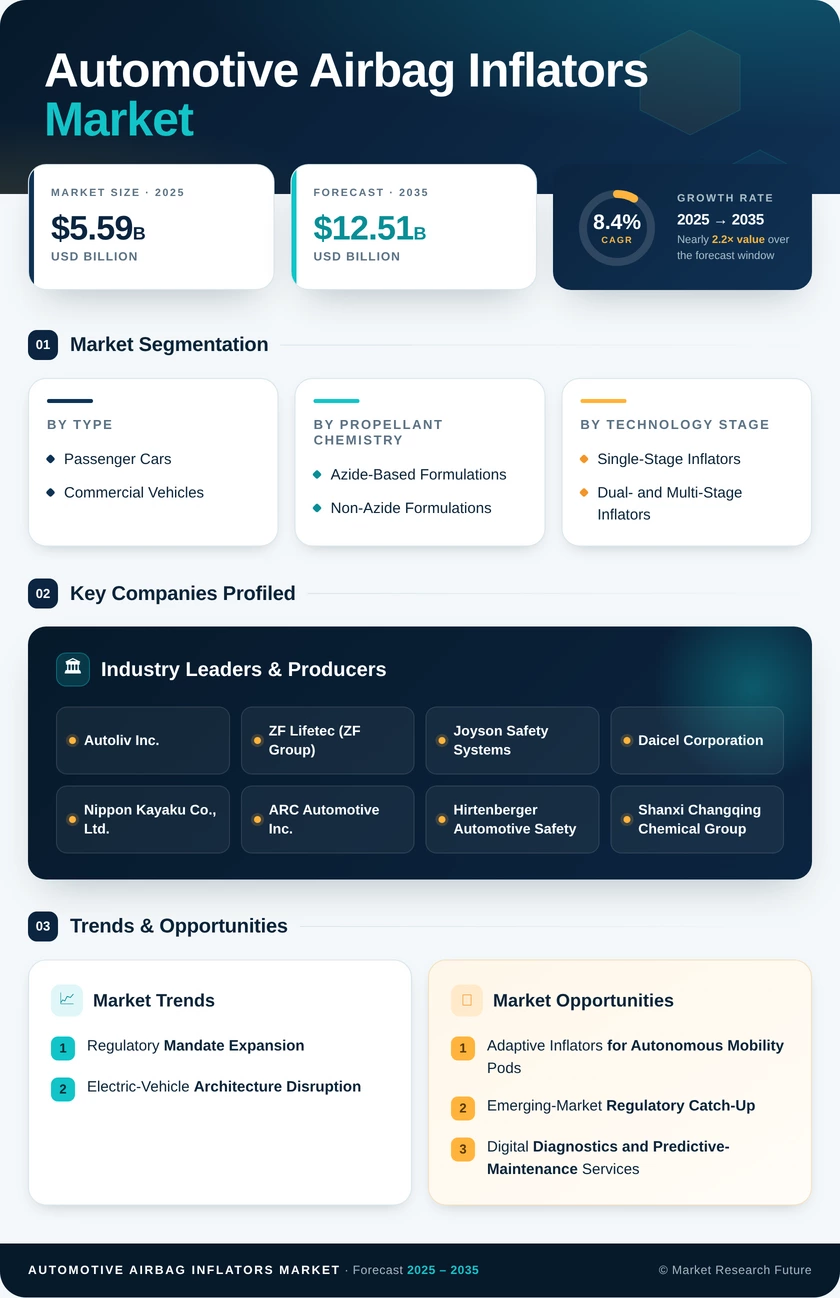
Segmentation Quick Reference
| Dimension | Sub-Segments | Dominant Segment | Fastest Growing Segment |
| By Airbag Type | Passenger, Curtain, Knee, Pedestrian-Protection, Other | Passenger Airbags | Pedestrian-Protection Airbags |
| By Inflator Type | Pyrotechnic, Hybrid, Stored-Gas | Pyrotechnic Inflators | Hybrid Inflators |
| By Vehicle Type | Passenger Cars, Commercial Vehicles | Passenger Cars | Commercial Vehicles |
| By Propellant Chemistry | Azide-Based, Non-Azide | Azide-Based Formulations | Non-Azide Formulations |
| By Technology Stage | Single-Stage, Dual- and Multi-Stage | Single-Stage Inflators | Dual- and Multi-Stage Inflators |
| By Sales Channel | OEM-Fitted, Aftermarket & Recall Replacements | OEM-Fitted Units | Aftermarket & Recall Replacements |
Market Segmentation Overview
By Airbag Type
| Sub-Segment | Key Trend |
| Passenger Airbags | Continued volume leadership driven by universal frontal-protection mandates |
| Curtain Airbags | EU GSR side-curtain requirements expanding addressable vehicle base |
| Knee Airbags | Euro NCAP lower-leg scoring increasing OEM adoption rates |
| Pedestrian-Protection Airbags | External deployment systems gaining traction via vulnerable-road-user protocols |
| Other (Side Torso, Center, Rear) | Far-side and rear-seat protection standards driving new installations |
Passenger airbags maintain the highest revenue contribution due to their universal presence across all regulated markets, while pedestrian-protection airbags represent the category's most dynamic growth frontier as Euro NCAP and JNCAP expand scoring for external occupant safety.
By Inflator Type
| Sub-Segment | Key Trend |
| Pyrotechnic Inflators | Cost-advantaged technology sustaining dominant market position |
| Hybrid Inflators | Premium and EV platforms favoring tunable gas-output characteristics |
| Stored-Gas Inflators | Niche usage in low-force deployment applications |
Pyrotechnic inflators benefit from decades of field data and the lowest per-unit manufacturing cost, while hybrid designs are gaining ground in platforms where thermal consistency and multi-stage output flexibility justify higher price points.
By Vehicle Type
| Sub-Segment | Key Trend |
| Passenger Cars | High per-vehicle airbag counts (10–14 units in premium models) |
| Commercial Vehicles | Updated UN R94 cab-protection protocols and fleet-insurance incentives |
Passenger cars dominate inflator consumption through sheer airbag density, while commercial vehicles represent the fastest-growing vehicle-type category as regulatory and insurance pressures increase cab-mounted protection requirements.
By Propellant Chemistry
| Sub-Segment | Key Trend |
| Azide-Based Formulations | Legacy reliability sustaining installed-base share |
| Non-Azide Formulations | REACH and CSCL compliance driving substitution toward organic compounds |
Azide-based propellants retain meaningful share through proven performance data, but the regulatory trajectory strongly favors non-azide alternatives that produce fewer toxic byproducts upon combustion.
By Technology Stage
| Sub-Segment | Key Trend |
| Single-Stage Inflators | Cost-effective solution for high-volume emerging-market platforms |
| Dual- and Multi-Stage Inflators | ISO/TS 5083 adaptive-restraint framework accelerating adoption |
Single-stage inflators remain the volume leader in cost-sensitive segments, whereas dual- and multi-stage architectures are becoming essential for vehicles designed with autonomous-driving and adaptive-safety capabilities.
By Sales Channel
| Sub-Segment | Key Trend |
| OEM-Fitted Units | Integrated into vehicle type-approval and production processes |
| Aftermarket & Recall Replacements | Sustained by active recall campaigns and aging vehicle fleets |
OEM procurement constitutes the bulk of inflator shipments, while the aftermarket channel benefits from structurally elevated demand driven by ongoing recall programs in North America, Japan, and Australia.