Request Free Sample ×

Kindly complete the form below to receive a free sample of this Report

* Please use a valid business email

Leading companies partner with us for data-driven Insights

clients tt-cursor
Hero Background
English
Chinese
French
Japanese
Korean
German
Spanish

Automatic Molding Machine Market Analysis

ID: MRFR/SEM/11183-HCR
200 Pages
Ankit Gupta
April 2026

Automatic Molding Machine Market Size, Share and Research Report By Material (Plastics, Metals, and Others), By End Use (Automotive, Consumer Goods, Packaging, Electronics, and Others), And By Region (North America, Europe, Asia-Pacific, And Rest Of The World) – Industry Forecast Till 2035

Share:
Download PDF ×

We do not share your information with anyone. However, we may send you emails based on your report interest from time to time. You may contact us at any time to opt-out.

Automatic Molding Machine Market Infographic
Purchase Options

Market Analysis

In-depth Analysis of Automatic Molding Machine Market Industry Landscape

The global automatic molding machine market is set to reach US$ 25.07 BN by 2032, at a 4.70% CAGR between years 2023-2032. Real dynamics of automatic molding machine market indicate twisted laws where numerous factors determine manufacturing models not only in industries, which use high-speed and mass manufactures. Automatic molding machines are an essential part of the system, and they serve as a metal injection molding machine, metalworking machinery and equipment that automatically molds materials like plastic, rubber, or metals. The growing need for accuracy and effectiveness in manufacturing particularly, in automotive, packaging and consumer goods alike has been among the major factors driving this market. Panicked with pressing attention to achieve the greatest productivity of manufacturing processes along with eliminating manual laboring, they choose automatic molding machines that have a great impact on creating market growth. The development of technology has an important role in determining automation system parameter in the automatic molding machine market. The innovativeness in control systems, robotics, and material processing machines produces for advancement automatic molding techniques that are highly complex.

In addition, these machines not only increase the accuracy and consistency manufacturing process but also have capabilities such as machine monitoring in an instant, predictive maintenance to prevent necessity of maintenance action before occurrence of failure within its equipment or a collection having common definitions that allows for changes depending on the variety of material and mold. Holding the view of manufacturers in this market is to provide solutions to industry needs with easy, cost-saving production at high speed. The market’s dynamics for automatic molding machines include many global economic factors that also contribute considerably to the same. Investment in advanced manufacturing equipment is based on the prevailing economic conditions of a country, demand for products and raw material availability that dictates the decision-making process. Large demand for increased production, by economic development or technological advancement, usually accompanies rapid growth of economy and this demands the need for efficient molds that can accomplish high volumes.

On the other hand, it is a more conservative reaction under re-cessions when they try to find cost-effective alternatives that would help them stay competitive. That in the automatic molding machine market, there are several competitive players offering multiple solution. Competing factors among the manufacturers and suppliers of molding machines include productivity, repeatability in precision work replacing people with machines that are imbedded systems while being energy-saving, maintaining material integrity. The maintenance equipment must be able to run on materials ranging from non-metals to carbon graphite metal. First, innovations in technology are one outlet of differentiation that is achieved via providing and development customization capabilities as well beside the provision of support services. Competition plays a tremendous role by inducing advanced automatic molding machine technology that grows continuously. Government rules and standards as well as those promulgated in the industry are all important mechanisms shaping the market of automatic molding machines. To guarantee the reliability and safety of molding, manufacturers have to make sure that they abide by the rules meant for the health and sustainability of their surroundings as well as ensure compliance with quality certifications.

Author
Author Profile
Ankit Gupta
Team Lead - Research

Ankit Gupta is a seasoned market intelligence and strategic research professional with over six plus years of experience in the ICT and Semiconductor industries. With academic roots in Telecom, Marketing, and Electronics, he blends technical insight with business strategy. Ankit has led 200+ projects, including work for Fortune 500 clients like Microsoft and Rio Tinto, covering market sizing, tech forecasting, and go-to-market strategies. Known for bridging engineering and enterprise decision-making, his insights support growth, innovation, and investment planning across diverse technology markets.

Leave a Comment

FAQs

What is the current market valuation of the Automatic Molding Machine Market?

<p>The market valuation of the Automatic Molding Machine Market was 17.53 USD Billion in 2024.</p>

What is the projected market size for the Automatic Molding Machine Market by 2035?

<p>The market is projected to reach 29.05 USD Billion by 2035.</p>

What is the expected CAGR for the Automatic Molding Machine Market during the forecast period?

<p>The expected CAGR for the market from 2025 to 2035 is 4.7%.</p>

Which materials are the primary segments in the Automatic Molding Machine Market?

<p>The primary material segments include Plastics, Metals, and Others, with Plastics valued at 7.02 USD Billion in 2024.</p>

How do the valuations of the material segments compare in 2024?

<p>In 2024, Plastics were valued at 7.02 USD Billion, Metals at 5.21 USD Billion, and Others at 5.3 USD Billion.</p>

What are the key end-use segments in the Automatic Molding Machine Market?

<p>Key end-use segments include Automotive, Consumer Goods, Packaging, Electronics, and Others.</p>

What was the valuation of the Automotive segment in 2024?

<p>The Automotive segment was valued at 5.26 USD Billion in 2024.</p>

What is the projected valuation for the Packaging segment by 2035?

<p>The Packaging segment is projected to reach 6.5 USD Billion by 2035.</p>

Who are the leading players in the Automatic Molding Machine Market?

<p>Key players include Haitian International, KraussMaffei, Milacron, Sumitomo, Battenfeld, Engel, Toshiba Machine, and Nissei Plastic Industrial.</p>

What trends are influencing the growth of the Automatic Molding Machine Market?

<p>The growth appears influenced by advancements in technology and increasing demand across various sectors, particularly in Automotive and Consumer Goods.</p>

Market Summary

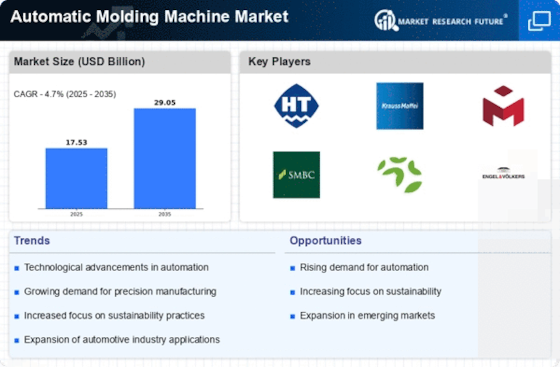
As per Market Research Future analysis, the Automatic Molding Machine Market Size was estimated at 17.53 USD Billion in 2024. The Automatic Molding Machine industry is projected to grow from 18.35 USD Billion in 2025 to 29.05 USD Billion by 2035, exhibiting a compound annual growth rate (CAGR) of 4.7% during the forecast period 2025 - 2035

Key Market Trends & Highlights

The Automatic Molding Machine Market is poised for robust growth driven by technological advancements and sustainability initiatives.

  • North America remains the largest market for automatic molding machines, driven by its established manufacturing base. Asia-Pacific is emerging as the fastest-growing region, fueled by rapid industrialization and increasing demand for automation. The plastics segment continues to dominate the market, while the metals segment is witnessing the fastest growth due to rising applications in various industries. Technological innovations and sustainability initiatives are key drivers, as industries seek to optimize production and reduce environmental impact.

Market Size & Forecast

2024 Market Size 17.53 (USD Billion)
2035 Market Size 29.05 (USD Billion)
CAGR (2025 - 2035) 4.7%
Largest Regional Market Share in 2024 North America

Major Players

Haitian International (CN), KraussMaffei (DE), Milacron (US), Sumitomo (JP), Battenfeld (AT), Engel (AT), Toshiba Machine (JP), Nissei Plastic Industrial (JP)

Market Trends

The Automatic Molding Machine Market is currently experiencing a transformative phase, driven by advancements in technology and increasing demand for precision manufacturing. The integration of automation and artificial intelligence into molding processes appears to enhance efficiency and reduce operational costs. Manufacturers are increasingly adopting these machines to meet the growing expectations for high-quality production and rapid turnaround times. Furthermore, the trend towards sustainability is influencing the market, as companies seek to minimize waste and energy consumption in their operations. This shift not only aligns with global environmental goals but also appeals to consumers who prioritize eco-friendly practices. In addition, the Automatic Molding Machine Market is witnessing a diversification of applications across various industries, including automotive, aerospace, and consumer goods. This broadening scope suggests that the market is not only resilient but also adaptable to changing industrial needs. As companies continue to innovate and refine their molding techniques, the potential for growth remains substantial. The ongoing evolution of materials used in molding processes, such as biodegradable plastics, indicates a promising future for the market, as it aligns with the increasing emphasis on sustainability and resource efficiency. Overall, the Automatic Molding Machine Market is poised for continued expansion, driven by technological advancements and a commitment to sustainable practices.

Technological Advancements

The Automatic Molding Machine Market is significantly influenced by rapid technological advancements. Innovations in automation and artificial intelligence are enhancing production efficiency and precision. These developments enable manufacturers to optimize their processes, reduce waste, and improve product quality, thereby meeting the evolving demands of various industries.

Sustainability Focus

A growing emphasis on sustainability is shaping the Automatic Molding Machine Market. Companies are increasingly adopting eco-friendly practices, such as utilizing energy-efficient machines and biodegradable materials. This trend not only addresses environmental concerns but also aligns with consumer preferences for sustainable products, potentially driving market growth.

Diverse Applications

The Automatic Molding Machine Market is expanding its reach across diverse sectors, including automotive, aerospace, and consumer goods. This diversification indicates a robust adaptability to various industrial requirements. As manufacturers explore new applications, the market is likely to witness increased demand and innovation in molding technologies.

Automatic Molding Machine Market Market Drivers

Technological Innovations

The Automatic Molding Machine Market is experiencing a surge in technological innovations that enhance production efficiency and precision. Advanced automation technologies, such as artificial intelligence and machine learning, are being integrated into molding machines, allowing for real-time monitoring and adjustments. This not only reduces waste but also improves the quality of molded products. According to recent data, the adoption of smart manufacturing practices is projected to increase productivity by up to 30% in the coming years. As manufacturers seek to optimize their operations, the demand for technologically advanced automatic molding machines is likely to rise, driving growth in the market.

Sustainability Initiatives

Sustainability initiatives are becoming a pivotal driver in the Automatic Molding Machine Market. As environmental concerns gain prominence, manufacturers are increasingly adopting eco-friendly practices, including the use of recyclable materials and energy-efficient machines. The shift towards sustainable production methods is not only beneficial for the environment but also aligns with regulatory requirements in many regions. Recent statistics suggest that companies implementing sustainable practices can reduce operational costs by up to 20%. This growing emphasis on sustainability is likely to influence purchasing decisions, leading to a higher demand for automatic molding machines that support green manufacturing.

Rising Demand for Customization

In the Automatic Molding Machine Market, there is a notable increase in demand for customized products across various sectors, including automotive, consumer goods, and electronics. This trend is largely driven by consumer preferences for personalized items, which necessitates flexible manufacturing processes. Automatic molding machines that can easily adapt to different designs and specifications are becoming essential. Market data indicates that the customization segment is expected to grow at a compound annual growth rate of 5% over the next five years. Consequently, manufacturers are investing in versatile molding technologies to meet this evolving demand, further propelling the market.

Expansion of End-User Industries

The expansion of end-user industries is significantly influencing the Automatic Molding Machine Market. Sectors such as automotive, aerospace, and consumer electronics are witnessing robust growth, which in turn drives the demand for efficient molding solutions. For instance, the automotive industry is increasingly utilizing automatic molding machines to produce lightweight components that enhance fuel efficiency. Market analysis indicates that the automotive sector alone is expected to account for over 30% of the total market share by 2026. This expansion across various industries is likely to create new opportunities for manufacturers of automatic molding machines, fostering market growth.

Global Supply Chain Optimization

The optimization of The Automatic Molding Machine Industry. As companies strive to enhance their operational efficiency, there is a growing focus on streamlining supply chains to reduce lead times and costs. Automatic molding machines that facilitate faster production cycles and minimize downtime are becoming increasingly valuable. Recent data suggests that companies that optimize their supply chains can achieve a reduction in production costs by approximately 15%. This trend is likely to drive the demand for advanced automatic molding machines that support efficient supply chain management, thereby contributing to market growth.

Market Segment Insights

By Material: Plastics (Largest) vs. Metals (Fastest-Growing)

In the Automatic Molding Machine Market, the Material segment showcases a diverse distribution with Plastics holding the largest market share due to its versatility and widespread adoption in various industries. This segment has established a substantial foothold as manufacturers prioritize lightweight and durable materials in production processes. Metals, on the other hand, have seen a notable increase in market share as they become the preferred choice for applications requiring enhanced strength and durability, fueled by advancements in molding technology.

Plastics (Dominant) vs. Metals (Emerging)

Plastics have emerged as the dominant choice in the Automatic Molding Machine Market, largely attributed to their lightweight properties, resistance to corrosion, and versatility in application across various industries including automotive and consumer goods. These characteristics make Plastic molding solutions ideal for high-volume production. Meanwhile, Metals are gaining traction as an emerging segment, driven by their robustness and ability to withstand harsher working conditions. As industries demand higher performance and durability, metallic materials are increasingly leveraged for molding machines, particularly in sectors like aerospace and heavy machinery, indicating a shift in material preference.

By End Use: Automotive (Largest) vs. Consumer Goods (Fastest-Growing)

<p>In the Automatic Molding Machine Market, the end use segment exhibits diverse applications across various industries. The automotive sector holds the largest market share, driven by the robust demand for lightweight and durable materials in vehicle manufacturing. Following closely, the consumer goods sector is gaining momentum, reflecting shifts in manufacturing preferences towards automated solutions that enhance efficiency and precision in production processes. Other segments such as packaging, electronics, and others play supportive roles in the overall market dynamics.</p>

<p>Automotive: Dominant vs. Consumer Goods: Emerging</p>

<p>Within the Automatic Molding Machine Market, the automotive end-use segment is characterized by its significant impact on manufacturing processes, emphasizing the need for high efficiency and production speed. Automotive manufacturers increasingly rely on advanced molding technologies to produce complex components and reduce time-to-market. Conversely, the consumer goods segment is emerging rapidly, fueled by innovation and the trend towards sustainable production. Companies in this segment are adopting automatic molding machines to meet the growing consumer demand for high-quality molded products, showcasing versatility and adaptability to changing market requirements.</p>

Get more detailed insights about Automatic Molding Machine Market Research Report—Global Forecast till 2035

Regional Insights

North America : Innovation and Demand Surge

The North American automatic molding machine market is driven by technological advancements and increasing demand from the automotive and consumer goods sectors. The region holds the largest market share at approximately 40%, with the U.S. leading the charge due to its robust manufacturing base and investment in automation technologies. Regulatory support for advanced manufacturing practices further fuels this growth. Key players such as Milacron and KraussMaffei dominate the landscape, supported by a network of suppliers and service providers. The competitive environment is characterized by innovation, with companies focusing on energy-efficient and high-precision molding solutions. The U.S. market is expected to continue its upward trajectory, driven by ongoing investments in smart manufacturing and sustainability initiatives.

Europe : Sustainability and Innovation Focus

Europe is witnessing a significant transformation in the automatic molding machine market, driven by sustainability initiatives and regulatory frameworks aimed at reducing carbon footprints. The region holds the second-largest market share at around 30%. Countries like Germany and Italy are at the forefront, with stringent regulations promoting energy-efficient technologies and innovative manufacturing processes. Leading companies such as Engel and KraussMaffei are investing heavily in R&D to meet these regulatory demands. The competitive landscape is marked by a strong emphasis on sustainability, with firms developing eco-friendly molding solutions. The European market is expected to grow as manufacturers adapt to changing consumer preferences and regulatory pressures, ensuring a balance between innovation and environmental responsibility.

Asia-Pacific : Rapid Growth and Expansion

The Asia-Pacific region is rapidly emerging as a powerhouse in the automatic molding machine market, driven by industrialization and increasing demand from sectors like packaging and electronics. This region is projected to hold a market share of approximately 25%, with China and Japan leading the way. Government initiatives aimed at boosting manufacturing capabilities and foreign investments are key growth drivers. China's robust manufacturing sector, coupled with Japan's technological advancements, creates a competitive landscape rich in innovation. Key players such as Sumitomo and Nissei Plastic Industrial are expanding their operations to cater to the growing demand. The region's market dynamics are characterized by a focus on automation and efficiency, positioning Asia-Pacific as a critical player in the global market.

Middle East and Africa : Emerging Opportunities and Challenges

The Middle East and Africa region is gradually developing its automatic molding machine market, driven by increasing industrialization and investment in manufacturing infrastructure. The market share is currently around 5%, with countries like South Africa and the UAE showing promising growth potential. Government initiatives aimed at diversifying economies and reducing reliance on oil are catalyzing this growth. The competitive landscape is still in its nascent stages, with local and international players vying for market share. Companies are focusing on establishing manufacturing facilities to meet regional demand. The presence of key players is limited, but as the market matures, opportunities for growth and investment are expected to increase, particularly in sectors like construction and consumer goods.

Key Players and Competitive Insights

Leading market players are investing heavily in the research and development in order to spread their product lines, which will help the Automatic Molding Machine Market grow even more. Market players are also undertaking a variety of strategic activities to spread their global footprint, with important market developments including mergers and acquisitions, new product launches, contractual agreements, higher investments, and collaboration with other organizations. To spread and survive in a more competitive and rising market climate, the Automatic Molding Machine industry must offer cost-effective items.Manufacturing locally to minimize the operational costs is one of the key business tactics used by the manufacturers in the global Automatic Molding Machine industry to benefit the clients and increase the market sector. In recent years, the Automatic Molding Machine industry has offered some of the most significant advantages to several industries. Major players in the Automatic Molding Machine Market, including Haitian International Holdings Limited, Nissei Plastic Industrial Co., Limited, Engel Austria GmbH, Chen Hsong Holdings Limited, Toyo Machinery & Metal Co., Ltd, Husky Injection Molding Systems Ltd, Japan Steel Works Limited, KraussMaffei Group, UBE Machinery, Shibaura Machine Co.Ltd., Wittmann Battenfeld, Hillenbrand, INC, and others, are attempting to increase market demand by investing in the research and development operations.Yizumi Precision Machinery Co., Ltd. is based in China and is a prominent player in the global market for plastic injection molding and die-casting machinery. The company is known for producing a range of machinery, including injection molding machines and die-casting machines, which are used in various industries for the manufacturing of plastic and metal components. Yizumi Precision Machinery serves industries such as automotive, consumer electronics, packaging, and more, providing solutions for the production of a wider range of plastic and metal parts.

In September Yizumi Precision Machinery (Ningbo) Co., Ltd. announced a partnership with Siemens AG to develop new digital manufacturing solutions for plastic injection molding. The two companies will compile their expertise in plastics processing and industrial automation to develop new solutions that help manufacturers improve the efficiency, quality, and sustainability of their plastic injection molding operations.Husky Injection Molding Systems Ltd., is the leading global supplier of injection molding equipment and the services for the plastic industry. Established in 1953, the Canadian-based company has evolved into a key player in the manufacturing sector. Specializing in the design and manufacture of the injection molding systems, molds, and related services, Husky is known for its innovative technologies that enhance the efficiency and precision of plastic molding processes. The company caters to a wider range of industries, including packaging, medical, automotive, and consumer goods, providing comprehensive solutions to meet the broader needs of its global clientele.

In July Husky Injection Molding Systems Ltd. announced a partnership with Microsoft Corporation to develop new cloud-based solutions for the management and optimization of plastic injection molding operations. The two companies will compile their expertise in plastics processing and cloud computing to develop new solutions that help manufacturers improve the efficiency, quality, and sustainability of their plastic injection molding operations.

Key Companies in the Automatic Molding Machine Market include

Industry Developments

September 2023: Engel Austria announced a partnership with Siemens to develop and manufacture new automatic molding machines. The two companies will compile their expertise in materials science, machine engineering, and automation to develop new automatic molding machines that meet the stringent requirements of advanced manufacturing.

August 2023: Wittmann Battenfeld announced the acquisition of Milacron for approximately $1.5 billion. Milacron is a leading manufacturer of injection molding machines, including automatic molding machines. This acquisition expands Wittmann Battenfeld's product portfolio into new markets and strengthens its position in the growing injection molding market.

July 2023: Chen Hsong Machinery Corporation announced a partnership with Mitsui Chemicals to develop and manufacture new automatic molding machines. The two companies will compile their expertise in materials science, machine engineering, and application development to develop new automatic molding machines that can be used to process a wide range of materials.

Future Outlook

Automatic Molding Machine Market Future Outlook

The Automatic Molding Machine Market is projected to grow at a 4.7% CAGR from 2025 to 2035, driven by technological advancements, increasing automation, and rising demand for precision manufacturing.

New opportunities lie in:

  • Integration of AI-driven predictive maintenance solutions</p><p>Expansion into emerging markets with tailored product offerings</p><p>Development of eco-friendly molding materials and processes

By 2035, the market is expected to achieve robust growth, positioning itself as a leader in manufacturing innovation.

Market Segmentation

Automatic Molding Machine Market End Use Outlook

  • Automotive
  • Consumer Goods
  • Packaging
  • Electronics
  • Others

Automatic Molding Machine Market Material Outlook

  • Plastics
  • Metals
  • Others

Report Scope

MARKET SIZE 2024 17.53(USD Billion)
MARKET SIZE 2025 18.35(USD Billion)
MARKET SIZE 2035 29.05(USD Billion)
COMPOUND ANNUAL GROWTH RATE (CAGR) 4.7% (2025 - 2035)
REPORT COVERAGE Revenue Forecast, Competitive Landscape, Growth Factors, and Trends
BASE YEAR 2024
Market Forecast Period 2025 - 2035
Historical Data 2019 - 2024
Market Forecast Units USD Billion
Key Companies Profiled Haitian International (CN), KraussMaffei (DE), Milacron (US), Sumitomo (JP), Battenfeld (AT), Engel (AT), Toshiba Machine (JP), Nissei Plastic Industrial (JP)
Segments Covered Material, End Use, Region
Key Market Opportunities Integration of advanced automation technologies enhances efficiency in the Automatic Molding Machine Market.
Key Market Dynamics Technological advancements and automation drive efficiency and competitiveness in the Automatic Molding Machine market.
Countries Covered North America, Europe, APAC, South America, MEA

FAQs

What is the current market valuation of the Automatic Molding Machine Market?

<p>The market valuation of the Automatic Molding Machine Market was 17.53 USD Billion in 2024.</p>

What is the projected market size for the Automatic Molding Machine Market by 2035?

<p>The market is projected to reach 29.05 USD Billion by 2035.</p>

What is the expected CAGR for the Automatic Molding Machine Market during the forecast period?

<p>The expected CAGR for the market from 2025 to 2035 is 4.7%.</p>

Which materials are the primary segments in the Automatic Molding Machine Market?

<p>The primary material segments include Plastics, Metals, and Others, with Plastics valued at 7.02 USD Billion in 2024.</p>

How do the valuations of the material segments compare in 2024?

<p>In 2024, Plastics were valued at 7.02 USD Billion, Metals at 5.21 USD Billion, and Others at 5.3 USD Billion.</p>

What are the key end-use segments in the Automatic Molding Machine Market?

<p>Key end-use segments include Automotive, Consumer Goods, Packaging, Electronics, and Others.</p>

What was the valuation of the Automotive segment in 2024?

<p>The Automotive segment was valued at 5.26 USD Billion in 2024.</p>

What is the projected valuation for the Packaging segment by 2035?

<p>The Packaging segment is projected to reach 6.5 USD Billion by 2035.</p>

Who are the leading players in the Automatic Molding Machine Market?

<p>Key players include Haitian International, KraussMaffei, Milacron, Sumitomo, Battenfeld, Engel, Toshiba Machine, and Nissei Plastic Industrial.</p>

What trends are influencing the growth of the Automatic Molding Machine Market?

<p>The growth appears influenced by advancements in technology and increasing demand across various sectors, particularly in Automotive and Consumer Goods.</p>

  1. SECTION I: EXECUTIVE SUMMARY AND KEY HIGHLIGHTS
    1. | 1.1 EXECUTIVE SUMMARY
    2. | | 1.1.1 Market Overview
    3. | | 1.1.2 Key Findings
    4. | | 1.1.3 Market Segmentation
    5. | | 1.1.4 Competitive Landscape
    6. | | 1.1.5 Challenges and Opportunities
    7. | | 1.1.6 Future Outlook
  2. SECTION II: SCOPING, METHODOLOGY AND MARKET STRUCTURE
    1. | 2.1 MARKET INTRODUCTION
    2. | | 2.1.1 Definition
    3. | | 2.1.2 Scope of the study
    4. | | | 2.1.2.1 Research Objective
    5. | | | 2.1.2.2 Assumption
    6. | | | 2.1.2.3 Limitations
    7. | 2.2 RESEARCH METHODOLOGY
    8. | | 2.2.1 Overview
    9. | | 2.2.2 Data Mining
    10. | | 2.2.3 Secondary Research
    11. | | 2.2.4 Primary Research
    12. | | | 2.2.4.1 Primary Interviews and Information Gathering Process
    13. | | | 2.2.4.2 Breakdown of Primary Respondents
    14. | | 2.2.5 Forecasting Model
    15. | | 2.2.6 Market Size Estimation
    16. | | | 2.2.6.1 Bottom-Up Approach
    17. | | | 2.2.6.2 Top-Down Approach
    18. | | 2.2.7 Data Triangulation
    19. | | 2.2.8 Validation
  3. SECTION III: QUALITATIVE ANALYSIS
    1. | 3.1 MARKET DYNAMICS
    2. | | 3.1.1 Overview
    3. | | 3.1.2 Drivers
    4. | | 3.1.3 Restraints
    5. | | 3.1.4 Opportunities
    6. | 3.2 MARKET FACTOR ANALYSIS
    7. | | 3.2.1 Value chain Analysis
    8. | | 3.2.2 Porter's Five Forces Analysis
    9. | | | 3.2.2.1 Bargaining Power of Suppliers
    10. | | | 3.2.2.2 Bargaining Power of Buyers
    11. | | | 3.2.2.3 Threat of New Entrants
    12. | | | 3.2.2.4 Threat of Substitutes
    13. | | | 3.2.2.5 Intensity of Rivalry
    14. | | 3.2.3 COVID-19 Impact Analysis
    15. | | | 3.2.3.1 Market Impact Analysis
    16. | | | 3.2.3.2 Regional Impact
    17. | | | 3.2.3.3 Opportunity and Threat Analysis
  4. SECTION IV: QUANTITATIVE ANALYSIS
    1. | 4.1 Semiconductor & Electronics, BY Material (USD Billion)
    2. | | 4.1.1 Plastics
    3. | | 4.1.2 Metals
    4. | | 4.1.3 Others
    5. | 4.2 Semiconductor & Electronics, BY End Use (USD Billion)
    6. | | 4.2.1 Automotive
    7. | | 4.2.2 Consumer Goods
    8. | | 4.2.3 Packaging
    9. | | 4.2.4 Electronics
    10. | | 4.2.5 Others
    11. | 4.3 Semiconductor & Electronics, BY Region (USD Billion)
    12. | | 4.3.1 North America
    13. | | | 4.3.1.1 US
    14. | | | 4.3.1.2 Canada
    15. | | 4.3.2 Europe
    16. | | | 4.3.2.1 Germany
    17. | | | 4.3.2.2 UK
    18. | | | 4.3.2.3 France
    19. | | | 4.3.2.4 Russia
    20. | | | 4.3.2.5 Italy
    21. | | | 4.3.2.6 Spain
    22. | | | 4.3.2.7 Rest of Europe
    23. | | 4.3.3 APAC
    24. | | | 4.3.3.1 China
    25. | | | 4.3.3.2 India
    26. | | | 4.3.3.3 Japan
    27. | | | 4.3.3.4 South Korea
    28. | | | 4.3.3.5 Malaysia
    29. | | | 4.3.3.6 Thailand
    30. | | | 4.3.3.7 Indonesia
    31. | | | 4.3.3.8 Rest of APAC
    32. | | 4.3.4 South America
    33. | | | 4.3.4.1 Brazil
    34. | | | 4.3.4.2 Mexico
    35. | | | 4.3.4.3 Argentina
    36. | | | 4.3.4.4 Rest of South America
    37. | | 4.3.5 MEA
    38. | | | 4.3.5.1 GCC Countries
    39. | | | 4.3.5.2 South Africa
    40. | | | 4.3.5.3 Rest of MEA
  5. SECTION V: COMPETITIVE ANALYSIS
    1. | 5.1 Competitive Landscape
    2. | | 5.1.1 Overview
    3. | | 5.1.2 Competitive Analysis
    4. | | 5.1.3 Market share Analysis
    5. | | 5.1.4 Major Growth Strategy in the Semiconductor & Electronics
    6. | | 5.1.5 Competitive Benchmarking
    7. | | 5.1.6 Leading Players in Terms of Number of Developments in the Semiconductor & Electronics
    8. | | 5.1.7 Key developments and growth strategies
    9. | | | 5.1.7.1 New Product Launch/Service Deployment
    10. | | | 5.1.7.2 Merger & Acquisitions
    11. | | | 5.1.7.3 Joint Ventures
    12. | | 5.1.8 Major Players Financial Matrix
    13. | | | 5.1.8.1 Sales and Operating Income
    14. | | | 5.1.8.2 Major Players R&D Expenditure. 2023
    15. | 5.2 Company Profiles
    16. | | 5.2.1 Haitian International (CN)
    17. | | | 5.2.1.1 Financial Overview
    18. | | | 5.2.1.2 Products Offered
    19. | | | 5.2.1.3 Key Developments
    20. | | | 5.2.1.4 SWOT Analysis
    21. | | | 5.2.1.5 Key Strategies
    22. | | 5.2.2 KraussMaffei (DE)
    23. | | | 5.2.2.1 Financial Overview
    24. | | | 5.2.2.2 Products Offered
    25. | | | 5.2.2.3 Key Developments
    26. | | | 5.2.2.4 SWOT Analysis
    27. | | | 5.2.2.5 Key Strategies
    28. | | 5.2.3 Milacron (US)
    29. | | | 5.2.3.1 Financial Overview
    30. | | | 5.2.3.2 Products Offered
    31. | | | 5.2.3.3 Key Developments
    32. | | | 5.2.3.4 SWOT Analysis
    33. | | | 5.2.3.5 Key Strategies
    34. | | 5.2.4 Sumitomo (JP)
    35. | | | 5.2.4.1 Financial Overview
    36. | | | 5.2.4.2 Products Offered
    37. | | | 5.2.4.3 Key Developments
    38. | | | 5.2.4.4 SWOT Analysis
    39. | | | 5.2.4.5 Key Strategies
    40. | | 5.2.5 Battenfeld (AT)
    41. | | | 5.2.5.1 Financial Overview
    42. | | | 5.2.5.2 Products Offered
    43. | | | 5.2.5.3 Key Developments
    44. | | | 5.2.5.4 SWOT Analysis
    45. | | | 5.2.5.5 Key Strategies
    46. | | 5.2.6 Engel (AT)
    47. | | | 5.2.6.1 Financial Overview
    48. | | | 5.2.6.2 Products Offered
    49. | | | 5.2.6.3 Key Developments
    50. | | | 5.2.6.4 SWOT Analysis
    51. | | | 5.2.6.5 Key Strategies
    52. | | 5.2.7 Toshiba Machine (JP)
    53. | | | 5.2.7.1 Financial Overview
    54. | | | 5.2.7.2 Products Offered
    55. | | | 5.2.7.3 Key Developments
    56. | | | 5.2.7.4 SWOT Analysis
    57. | | | 5.2.7.5 Key Strategies
    58. | | 5.2.8 Nissei Plastic Industrial (JP)
    59. | | | 5.2.8.1 Financial Overview
    60. | | | 5.2.8.2 Products Offered
    61. | | | 5.2.8.3 Key Developments
    62. | | | 5.2.8.4 SWOT Analysis
    63. | | | 5.2.8.5 Key Strategies
    64. | 5.3 Appendix
    65. | | 5.3.1 References
    66. | | 5.3.2 Related Reports
  6. LIST OF FIGURES
    1. | 6.1 MARKET SYNOPSIS
    2. | 6.2 NORTH AMERICA MARKET ANALYSIS
    3. | 6.3 US MARKET ANALYSIS BY MATERIAL
    4. | 6.4 US MARKET ANALYSIS BY END USE
    5. | 6.5 CANADA MARKET ANALYSIS BY MATERIAL
    6. | 6.6 CANADA MARKET ANALYSIS BY END USE
    7. | 6.7 EUROPE MARKET ANALYSIS
    8. | 6.8 GERMANY MARKET ANALYSIS BY MATERIAL
    9. | 6.9 GERMANY MARKET ANALYSIS BY END USE
    10. | 6.10 UK MARKET ANALYSIS BY MATERIAL
    11. | 6.11 UK MARKET ANALYSIS BY END USE
    12. | 6.12 FRANCE MARKET ANALYSIS BY MATERIAL
    13. | 6.13 FRANCE MARKET ANALYSIS BY END USE
    14. | 6.14 RUSSIA MARKET ANALYSIS BY MATERIAL
    15. | 6.15 RUSSIA MARKET ANALYSIS BY END USE
    16. | 6.16 ITALY MARKET ANALYSIS BY MATERIAL
    17. | 6.17 ITALY MARKET ANALYSIS BY END USE
    18. | 6.18 SPAIN MARKET ANALYSIS BY MATERIAL
    19. | 6.19 SPAIN MARKET ANALYSIS BY END USE
    20. | 6.20 REST OF EUROPE MARKET ANALYSIS BY MATERIAL
    21. | 6.21 REST OF EUROPE MARKET ANALYSIS BY END USE
    22. | 6.22 APAC MARKET ANALYSIS
    23. | 6.23 CHINA MARKET ANALYSIS BY MATERIAL
    24. | 6.24 CHINA MARKET ANALYSIS BY END USE
    25. | 6.25 INDIA MARKET ANALYSIS BY MATERIAL
    26. | 6.26 INDIA MARKET ANALYSIS BY END USE
    27. | 6.27 JAPAN MARKET ANALYSIS BY MATERIAL
    28. | 6.28 JAPAN MARKET ANALYSIS BY END USE
    29. | 6.29 SOUTH KOREA MARKET ANALYSIS BY MATERIAL
    30. | 6.30 SOUTH KOREA MARKET ANALYSIS BY END USE
    31. | 6.31 MALAYSIA MARKET ANALYSIS BY MATERIAL
    32. | 6.32 MALAYSIA MARKET ANALYSIS BY END USE
    33. | 6.33 THAILAND MARKET ANALYSIS BY MATERIAL
    34. | 6.34 THAILAND MARKET ANALYSIS BY END USE
    35. | 6.35 INDONESIA MARKET ANALYSIS BY MATERIAL
    36. | 6.36 INDONESIA MARKET ANALYSIS BY END USE
    37. | 6.37 REST OF APAC MARKET ANALYSIS BY MATERIAL
    38. | 6.38 REST OF APAC MARKET ANALYSIS BY END USE
    39. | 6.39 SOUTH AMERICA MARKET ANALYSIS
    40. | 6.40 BRAZIL MARKET ANALYSIS BY MATERIAL
    41. | 6.41 BRAZIL MARKET ANALYSIS BY END USE
    42. | 6.42 MEXICO MARKET ANALYSIS BY MATERIAL
    43. | 6.43 MEXICO MARKET ANALYSIS BY END USE
    44. | 6.44 ARGENTINA MARKET ANALYSIS BY MATERIAL
    45. | 6.45 ARGENTINA MARKET ANALYSIS BY END USE
    46. | 6.46 REST OF SOUTH AMERICA MARKET ANALYSIS BY MATERIAL
    47. | 6.47 REST OF SOUTH AMERICA MARKET ANALYSIS BY END USE
    48. | 6.48 MEA MARKET ANALYSIS
    49. | 6.49 GCC COUNTRIES MARKET ANALYSIS BY MATERIAL
    50. | 6.50 GCC COUNTRIES MARKET ANALYSIS BY END USE
    51. | 6.51 SOUTH AFRICA MARKET ANALYSIS BY MATERIAL
    52. | 6.52 SOUTH AFRICA MARKET ANALYSIS BY END USE
    53. | 6.53 REST OF MEA MARKET ANALYSIS BY MATERIAL
    54. | 6.54 REST OF MEA MARKET ANALYSIS BY END USE
    55. | 6.55 KEY BUYING CRITERIA OF SEMICONDUCTOR & ELECTRONICS
    56. | 6.56 RESEARCH PROCESS OF MRFR
    57. | 6.57 DRO ANALYSIS OF SEMICONDUCTOR & ELECTRONICS
    58. | 6.58 DRIVERS IMPACT ANALYSIS: SEMICONDUCTOR & ELECTRONICS
    59. | 6.59 RESTRAINTS IMPACT ANALYSIS: SEMICONDUCTOR & ELECTRONICS
    60. | 6.60 SUPPLY / VALUE CHAIN: SEMICONDUCTOR & ELECTRONICS
    61. | 6.61 SEMICONDUCTOR & ELECTRONICS, BY MATERIAL, 2024 (% SHARE)
    62. | 6.62 SEMICONDUCTOR & ELECTRONICS, BY MATERIAL, 2024 TO 2035 (USD Billion)
    63. | 6.63 SEMICONDUCTOR & ELECTRONICS, BY END USE, 2024 (% SHARE)
    64. | 6.64 SEMICONDUCTOR & ELECTRONICS, BY END USE, 2024 TO 2035 (USD Billion)
    65. | 6.65 BENCHMARKING OF MAJOR COMPETITORS
  7. LIST OF TABLES
    1. | 7.1 LIST OF ASSUMPTIONS
    2. | | 7.1.1
    3. | 7.2 North America MARKET SIZE ESTIMATES; FORECAST
    4. | | 7.2.1 BY MATERIAL, 2025-2035 (USD Billion)
    5. | | 7.2.2 BY END USE, 2025-2035 (USD Billion)
    6. | 7.3 US MARKET SIZE ESTIMATES; FORECAST
    7. | | 7.3.1 BY MATERIAL, 2025-2035 (USD Billion)
    8. | | 7.3.2 BY END USE, 2025-2035 (USD Billion)
    9. | 7.4 Canada MARKET SIZE ESTIMATES; FORECAST
    10. | | 7.4.1 BY MATERIAL, 2025-2035 (USD Billion)
    11. | | 7.4.2 BY END USE, 2025-2035 (USD Billion)
    12. | 7.5 Europe MARKET SIZE ESTIMATES; FORECAST
    13. | | 7.5.1 BY MATERIAL, 2025-2035 (USD Billion)
    14. | | 7.5.2 BY END USE, 2025-2035 (USD Billion)
    15. | 7.6 Germany MARKET SIZE ESTIMATES; FORECAST
    16. | | 7.6.1 BY MATERIAL, 2025-2035 (USD Billion)
    17. | | 7.6.2 BY END USE, 2025-2035 (USD Billion)
    18. | 7.7 UK MARKET SIZE ESTIMATES; FORECAST
    19. | | 7.7.1 BY MATERIAL, 2025-2035 (USD Billion)
    20. | | 7.7.2 BY END USE, 2025-2035 (USD Billion)
    21. | 7.8 France MARKET SIZE ESTIMATES; FORECAST
    22. | | 7.8.1 BY MATERIAL, 2025-2035 (USD Billion)
    23. | | 7.8.2 BY END USE, 2025-2035 (USD Billion)
    24. | 7.9 Russia MARKET SIZE ESTIMATES; FORECAST
    25. | | 7.9.1 BY MATERIAL, 2025-2035 (USD Billion)
    26. | | 7.9.2 BY END USE, 2025-2035 (USD Billion)
    27. | 7.10 Italy MARKET SIZE ESTIMATES; FORECAST
    28. | | 7.10.1 BY MATERIAL, 2025-2035 (USD Billion)
    29. | | 7.10.2 BY END USE, 2025-2035 (USD Billion)
    30. | 7.11 Spain MARKET SIZE ESTIMATES; FORECAST
    31. | | 7.11.1 BY MATERIAL, 2025-2035 (USD Billion)
    32. | | 7.11.2 BY END USE, 2025-2035 (USD Billion)
    33. | 7.12 Rest of Europe MARKET SIZE ESTIMATES; FORECAST
    34. | | 7.12.1 BY MATERIAL, 2025-2035 (USD Billion)
    35. | | 7.12.2 BY END USE, 2025-2035 (USD Billion)
    36. | 7.13 APAC MARKET SIZE ESTIMATES; FORECAST
    37. | | 7.13.1 BY MATERIAL, 2025-2035 (USD Billion)
    38. | | 7.13.2 BY END USE, 2025-2035 (USD Billion)
    39. | 7.14 China MARKET SIZE ESTIMATES; FORECAST
    40. | | 7.14.1 BY MATERIAL, 2025-2035 (USD Billion)
    41. | | 7.14.2 BY END USE, 2025-2035 (USD Billion)
    42. | 7.15 India MARKET SIZE ESTIMATES; FORECAST
    43. | | 7.15.1 BY MATERIAL, 2025-2035 (USD Billion)
    44. | | 7.15.2 BY END USE, 2025-2035 (USD Billion)
    45. | 7.16 Japan MARKET SIZE ESTIMATES; FORECAST
    46. | | 7.16.1 BY MATERIAL, 2025-2035 (USD Billion)
    47. | | 7.16.2 BY END USE, 2025-2035 (USD Billion)
    48. | 7.17 South Korea MARKET SIZE ESTIMATES; FORECAST
    49. | | 7.17.1 BY MATERIAL, 2025-2035 (USD Billion)
    50. | | 7.17.2 BY END USE, 2025-2035 (USD Billion)
    51. | 7.18 Malaysia MARKET SIZE ESTIMATES; FORECAST
    52. | | 7.18.1 BY MATERIAL, 2025-2035 (USD Billion)
    53. | | 7.18.2 BY END USE, 2025-2035 (USD Billion)
    54. | 7.19 Thailand MARKET SIZE ESTIMATES; FORECAST
    55. | | 7.19.1 BY MATERIAL, 2025-2035 (USD Billion)
    56. | | 7.19.2 BY END USE, 2025-2035 (USD Billion)
    57. | 7.20 Indonesia MARKET SIZE ESTIMATES; FORECAST
    58. | | 7.20.1 BY MATERIAL, 2025-2035 (USD Billion)
    59. | | 7.20.2 BY END USE, 2025-2035 (USD Billion)
    60. | 7.21 Rest of APAC MARKET SIZE ESTIMATES; FORECAST
    61. | | 7.21.1 BY MATERIAL, 2025-2035 (USD Billion)
    62. | | 7.21.2 BY END USE, 2025-2035 (USD Billion)
    63. | 7.22 South America MARKET SIZE ESTIMATES; FORECAST
    64. | | 7.22.1 BY MATERIAL, 2025-2035 (USD Billion)
    65. | | 7.22.2 BY END USE, 2025-2035 (USD Billion)
    66. | 7.23 Brazil MARKET SIZE ESTIMATES; FORECAST
    67. | | 7.23.1 BY MATERIAL, 2025-2035 (USD Billion)
    68. | | 7.23.2 BY END USE, 2025-2035 (USD Billion)
    69. | 7.24 Mexico MARKET SIZE ESTIMATES; FORECAST
    70. | | 7.24.1 BY MATERIAL, 2025-2035 (USD Billion)
    71. | | 7.24.2 BY END USE, 2025-2035 (USD Billion)
    72. | 7.25 Argentina MARKET SIZE ESTIMATES; FORECAST
    73. | | 7.25.1 BY MATERIAL, 2025-2035 (USD Billion)
    74. | | 7.25.2 BY END USE, 2025-2035 (USD Billion)
    75. | 7.26 Rest of South America MARKET SIZE ESTIMATES; FORECAST
    76. | | 7.26.1 BY MATERIAL, 2025-2035 (USD Billion)
    77. | | 7.26.2 BY END USE, 2025-2035 (USD Billion)
    78. | 7.27 MEA MARKET SIZE ESTIMATES; FORECAST
    79. | | 7.27.1 BY MATERIAL, 2025-2035 (USD Billion)
    80. | | 7.27.2 BY END USE, 2025-2035 (USD Billion)
    81. | 7.28 GCC Countries MARKET SIZE ESTIMATES; FORECAST
    82. | | 7.28.1 BY MATERIAL, 2025-2035 (USD Billion)
    83. | | 7.28.2 BY END USE, 2025-2035 (USD Billion)
    84. | 7.29 South Africa MARKET SIZE ESTIMATES; FORECAST
    85. | | 7.29.1 BY MATERIAL, 2025-2035 (USD Billion)
    86. | | 7.29.2 BY END USE, 2025-2035 (USD Billion)
    87. | 7.30 Rest of MEA MARKET SIZE ESTIMATES; FORECAST
    88. | | 7.30.1 BY MATERIAL, 2025-2035 (USD Billion)
    89. | | 7.30.2 BY END USE, 2025-2035 (USD Billion)
    90. | 7.31 PRODUCT LAUNCH/PRODUCT DEVELOPMENT/APPROVAL
    91. | | 7.31.1
    92. | 7.32 ACQUISITION/PARTNERSHIP
    93. | | 7.32.1

Semiconductor & Electronics Market Segmentation

Semiconductor & Electronics By Material (USD Billion, 2025-2035)

  • Plastics
  • Metals
  • Others

Semiconductor & Electronics By End Use (USD Billion, 2025-2035)

  • Automotive
  • Consumer Goods
  • Packaging
  • Electronics
  • Others
Infographic

Free Sample Request

Kindly complete the form below to receive a free sample of this Report

Get Free Sample

Customer Strories

Compare Licence

×
Features License Type
Single User Multiuser License Enterprise User
Price $4,950 $5,950 $7,250
Maximum User Access Limit 1 User Upto 10 Users Unrestricted Access Throughout the Organization
Free Customization
Direct Access to Analyst
Deliverable Format
Platform Access
Discount on Next Purchase 10% 15% 15%
Printable Versions