Automated Cell Counters Market (2026 - 2035)

ID: MRFR/MED/10561-HCR 128 Pages Rahul Gotadki Last Updated: November 16, 2026
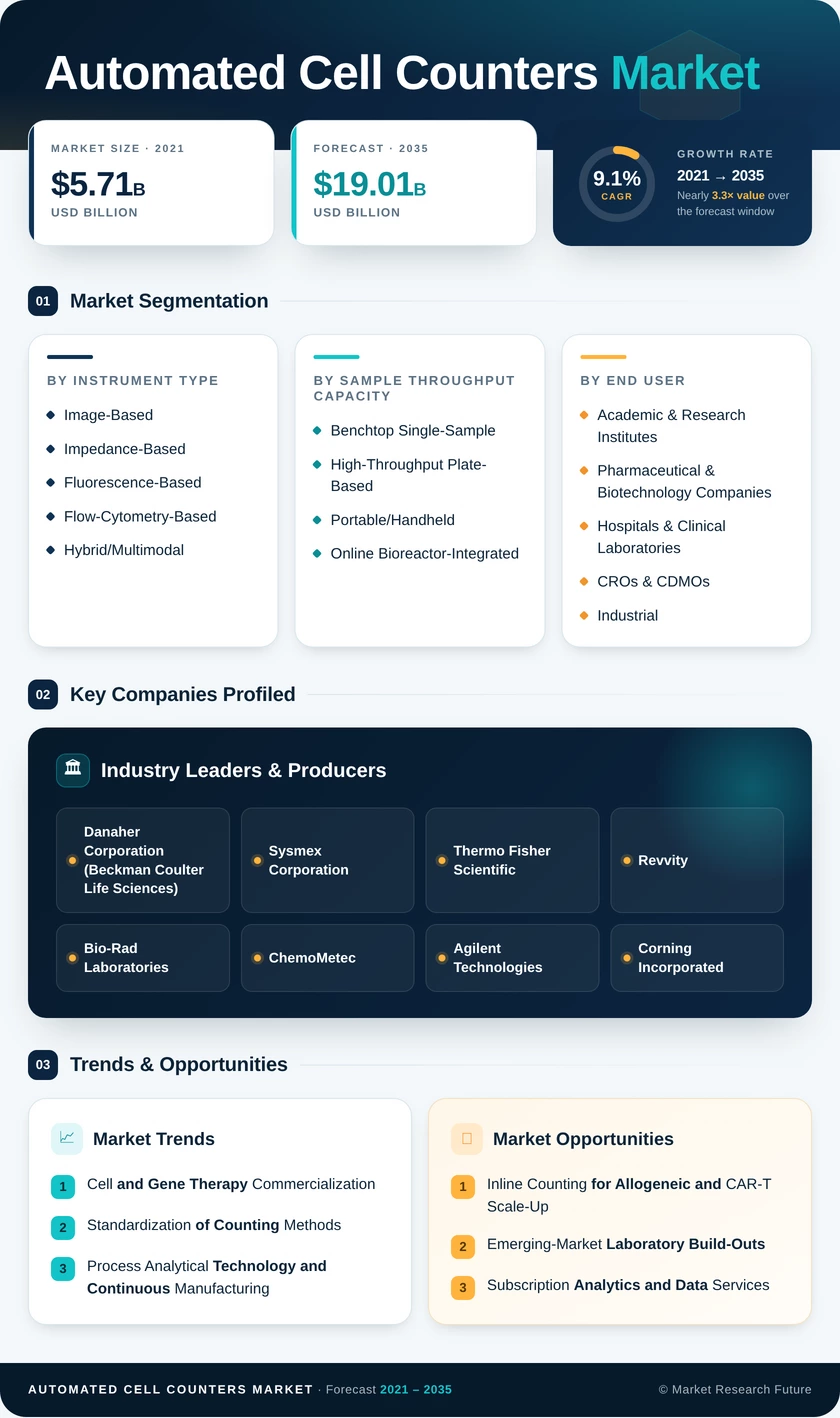
Automated Cell Counters Market Research Report By Instrument Type (Image-Based, Impedance-Based, Fluorescence-Based, Flow-Cytometry-Based, Hybrid/Multimodal), By Sample Throughput Capacity (Benchtop Single-Sample, High-Throughput Plate-Based, Portable/Handheld, Online Bioreactor-Integrated), By End User (Academic & Research Institutes, Pharmaceutical & Biotechnology Companies, Hospitals & Clinical Laboratories, CROs & CDMOs, Industrial), By Application (Cell Viability, Hematology, Stem Cell Research, Cancer Research, Bioprocessing) and By Region (North America, Europe, South America, Asia-Pacific, Middle East and Africa) – Growth Outlook & Industry Forecast 2025 To 2035
Automated Cell Counters Market
Market Size
Forecast Period2026-2035
CAGR (2026-2035)9.1%
2025 Market SizeUSD 7.92 Billion
2035 Market SizeUSD 19.01 Billion
Key Players
Danaher Corporation
Sysmex Corporation
Thermo Fisher Scientific
Revvity
Bio-Rad Laboratories
ChemoMetec
Opportunities
  • Inline Counting for Allogeneic and CAR-T Scale-Up
  • Emerging-Market Laboratory Build-Outs
  • Subscription Analytics and Data Services
  1. 1 Market Summary | |
  2. 2 Key Report Takeaways | |
    1. 2.1 By Instrument Type | |
    2. 2.2 By Sample Throughput Capacity | |
    3. 2.3 By End User | |
    4. 2.4 By Application | |
    5. 2.5 By Region | |
  3. 3 Market Size and Forecast (2021–2035) | |
  4. 4 Driver Impact Analysis | |
    1. 4.1 Cell and Gene Therapy Commercialization | |
    2. 4.2 Standardization of Counting Methods | |
    3. 4.3 Process Analytical Technology and Continuous Manufacturing | |
    4. 4.4 Rising Oncology Research Volume | |
    5. 4.5 Asia-Pacific Biomanufacturing Policy | |
    6. 4.6 AI-Enabled Image Analysis | |
    7. 4.7 Laboratory Automation and Robotics | |
  5. 5 Restraints Impact Analysis | |
    1. 5.1 US Research Funding Uncertainty | |
    2. 5.2 Capital and Consumable Costs | |
    3. 5.3 Tariffs and Supply Chain Exposure | |
    4. 5.4 European IVDR Compliance Burden | |
    5. 5.5 Method Comparability Gaps | |
  6. 6 Opportunities | |
    1. 6.1 Inline Counting for Allogeneic and CAR-T Scale-Up | |
    2. 6.2 Emerging-Market Laboratory Build-Outs | |
    3. 6.3 Subscription Analytics and Data Services | |
    4. 6.4 Convergence of Counting, Phenotyping and Molecular Readouts | |
    5. 6.5 Entry-Tier Platforms with Upgrade Paths | |
  7. 7 Regional Market Share and Country-Level Analysis | |
    1. 7.1 North America | | |
      1. 7.1.1 United States | | |
      2. 7.1.2 Canada | | |
      3. 7.1.3 Mexico | |
    2. 7.2 Europe | | |
      1. 7.2.1 Germany | | |
      2. 7.2.2 UK | | |
      3. 7.2.3 France | | |
      4. 7.2.4 Italy | | |
      5. 7.2.5 Spain | | |
      6. 7.2.6 Nordic Countries | | |
      7. 7.2.7 Russia | | |
      8. 7.2.8 Rest of Europe | |
    3. 7.3 Asia-Pacific | | |
      1. 7.3.1 China | | |
      2. 7.3.2 India | | |
      3. 7.3.3 Japan | | |
      4. 7.3.4 South Korea | | |
      5. 7.3.5 ASEAN | | |
      6. 7.3.6 Rest of Asia-Pacific | |
    4. 7.4 South America | | |
      1. 7.4.1 Brazil | | |
      2. 7.4.2 Argentina | | |
      3. 7.4.3 Rest of South America | |
    5. 7.5 Middle East & Africa | | |
      1. 7.5.1 Saudi Arabia | | |
      2. 7.5.2 UAE | | |
      3. 7.5.3 South Africa | | |
      4. 7.5.4 Egypt | | |
      5. 7.5.5 Rest of Middle East & Africa | |
  8. 8 Future Outlook (2026–2035) | |
    1. 8.1 AI-Driven Autonomous Quality Control | |
    2. 8.2 Platform Economics and Recurring Revenue | |
    3. 8.3 Industrialization of Cell Therapy | |
    4. 8.4 Sustainability and Plastic Reduction | |
  9. 9 Segmentation Analysis | |
    1. 9.1 By Instrument Type | | |
      1. 9.1.1 Image-Based | | |
      2. 9.1.2 Impedance-Based | | |
      3. 9.1.3 Fluorescence-Based | | |
      4. 9.1.4 Flow-Cytometry-Based | | |
      5. 9.1.5 Hybrid/Multimodal | |
    2. 9.2 By Sample Throughput Capacity | | |
      1. 9.2.1 Benchtop Single-Sample | | |
      2. 9.2.2 High-Throughput Plate-Based | | |
      3. 9.2.3 Portable/Handheld | | |
      4. 9.2.4 Online Bioreactor-Integrated | | |
      5. 9.2.5 Fully-Automated Workstation-Integrated | |
    3. 9.3 By End User | | |
      1. 9.3.1 Academic & Research Institutes | | |
      2. 9.3.2 Pharmaceutical & Biotechnology Companies | | |
      3. 9.3.3 Hospitals & Clinical Laboratories | | |
      4. 9.3.4 CROs & CDMOs | | |
      5. 9.3.5 Industrial | |
    4. 9.4 By Application | | |
      1. 9.4.1 Cell Viability | | |
      2. 9.4.2 Hematology | | |
      3. 9.4.3 Stem Cell Research | | |
      4. 9.4.4 Cancer Research | | |
      5. 9.4.5 Bioprocessing | |
  10. 10 Competitive Landscape | |
    1. 10.1 Market Concentration Analysis | |
    2. 10.2 Competitive Benchmarking Table | |
  11. 11 Recent News & Developments | |
  12. 12 Report Scope and Methodology | |
  13. 13 Detailed Sources and Citations | |
  14. 14 Frequently Asked Questions (FAQs) | | LIST OF TABLES | |
  15. TABLE 1 Report Summary Snapshot, 2025–2035 | |
  16. TABLE 2 Global Automated Cell Counters Revenue and YoY Growth, 2021–2035 (USD Billion) | |
  17. TABLE 3 Driver Impact Analysis on Forecast CAGR | |
  18. TABLE 4 Restraint Impact Analysis on Forecast CAGR | |
  19. TABLE 5 Regional Summary — Key Metric and Investment Themes, 2025 | |
  20. TABLE 6 North America — Country-Level Analysis, 2025 | |
  21. TABLE 7 Europe — Country-Level Analysis, 2025 | |
  22. TABLE 8 Asia-Pacific — Country-Level Analysis, 2025 | |
  23. TABLE 9 South America — Country-Level Analysis, 2025 | |
  24. TABLE 10 Middle East & Africa — Country-Level Analysis, 2025 | |
  25. TABLE 11 Segmentation by Instrument Type, 2025 | |
  26. TABLE 12 Segmentation by Sample Throughput Capacity, 2025 | |
  27. TABLE 13 Segmentation by End User, 2025 | |
  28. TABLE 14 Segmentation by Application, 2025 | |
  29. TABLE 15 Competitive Benchmarking — Key Players | |
  30. TABLE 16 Report Scope and Methodology | |
  31. TABLE 17 Detailed Sources and Citations | | LIST OF FIGURES | |
  32. FIGURE 1 Market Dynamics Overview — Drivers, Restraints and Opportunities | |
  33. FIGURE 2 Industry Value Chain Analysis | |
  34. FIGURE 3 Porter's Five Forces Analysis | |
  35. FIGURE 4 Global Revenue Trend, 2021–2035 (USD Billion) | |
  36. FIGURE 5 Revenue Share by Instrument Type, 2025 | |
  37. FIGURE 6 Revenue Share by Sample Throughput Capacity, 2025 | |
  38. FIGURE 7 Revenue Share by End User, 2025 | |
  39. FIGURE 8 Revenue Share by Application, 2025 | |
  40. FIGURE 9 Revenue Share by Region, 2025 | |
  41. FIGURE 10 Competitive Landscape — Estimated Revenue Share Ranges of Key Players

Segmentation Quick Reference

DimensionSub-SegmentsDominant SegmentFastest Growing Segment
By Instrument TypeImage-Based; Impedance-Based; Fluorescence-Based; Flow-Cytometry-Based; Hybrid/MultimodalImage-Based (38.6% share)Fluorescence-Based (11.0% CAGR)
By Sample Throughput CapacityBenchtop Single-Sample; High-Throughput Plate-Based; Portable/Handheld; Online Bioreactor-IntegratedBenchtop Single-Sample (43.6% share)Online Bioreactor-Integrated (13.0% CAGR)
By End UserAcademic & Research Institutes; Pharmaceutical & Biotechnology Companies; Hospitals & Clinical Laboratories; CROs & CDMOs; IndustrialAcademic & Research Institutes (31.6% share)CROs & CDMOs (11.6% CAGR)
By ApplicationCell Viability; Hematology; Stem Cell Research; Cancer Research; BioprocessingCell Viability (34.8% share)Bioprocessing (12.1% CAGR)
By RegionNorth America; Europe; Asia-Pacific; South America; Middle East & AfricaNorth America (38.4% share)Asia-Pacific (10.8% CAGR)

Market Segmentation Overview

By Instrument Type

Sub-SegmentKey Trend
Image-BasedAI-driven focus, declustering and debris rejection
Impedance-BasedStable demand from high-volume clinical hematology
Fluorescence-BasedLineage-specific markers for cell therapy identity testing
Flow-Cytometry-BasedRobotic integration and molecular assay convergence
Hybrid/MultimodalBrightfield, fluorescence and impedance in one footprint

Image-Based counters lead with a 38.6% share because one scan returns counts, viability and morphology for academic and biotech users. Fluorescence-Based systems grow fastest at an 11.0% CAGR, as regulators expect cell therapy makers to confirm product identity with lineage-specific markers. Impedance-Based units hold their clinical niche, where throughput matters more than multiparameter detail.

By Sample Throughput Capacity

Sub-SegmentKey Trend
Benchtop Single-SampleMachine-learning algorithms reach entry price tiers
High-Throughput Plate-Based24- to 384-well formats for screening workcells
Portable/HandheldField use limited by precision trade-offs
Online Bioreactor-IntegratedRetrofit kits for stainless-steel and single-use bioreactors

Benchtop Single-Sample devices dominate with a 43.6% share thanks to low consumable costs and minimal training. Online Bioreactor-Integrated counters grow fastest at a 13.0% CAGR because continuous readings let manufacturers automate feeds and harvests, a capability ChemoMetec targeted with its Ovizio purchase. High-Throughput Plate-Based systems benefit as screening labs wire counting into robotic schedules.

By End User

Sub-SegmentKey Trend
Academic & Research InstitutesGrant rules favor digital records and reproducibility
Pharmaceutical & Biotechnology CompaniesEarly assays aligned with cGMP for smoother tech transfer
Hospitals & Clinical LaboratoriesCleared models with locked software and audit trails
CROs & CDMOsMulti-site fleets with remote diagnostics
IndustrialMicrobial and fermentation counting in food and cosmetics

Academic & Research Institutes remain the largest buyers with a 31.6% share, though US funding uncertainty tempers near-term orders. CROs & CDMOs grow fastest at an 11.6% CAGR, buying standardized fleets so release metrics match across sites during sponsor audits. Pharmaceutical & Biotechnology Companies sit between the two, paying premiums for GMP-ready software.

By Application

Sub-SegmentKey Trend
Cell ViabilityStain-free and AI-based live/dead discrimination
HematologyIVDR-driven replacement of clinical analyzers in Europe
Stem Cell ResearchDifferentiation and confluence tracking alongside counts
Cancer ResearchImmune-cell profiling for immuno-oncology programs
BioprocessingInline monitoring tied to automated feed control

Cell Viability leads with a 34.8% share because nearly every culture workflow checks live-cell fraction before passaging. Bioprocessing grows fastest at a 12.1% CAGR as biologics and cell therapy producers move from periodic manual sampling to automated and inline measurement. Hematology stays large and steady, anchored by clinical blood-count volumes.


Download PDF ×

We do not share your information with anyone. However, we may send you emails based on your report interest from time to time. You may contact us at any time to opt-out.