
Request Free Sample ×

Kindly complete the form below to receive a free sample of this Report

* Please use a valid business email

Leading companies partner with us for data-driven Insights

clients tt-cursor
Hero Background
English
Chinese
French
Japanese
Korean
German
Spanish

Augmented Reality and Virtual Reality Market Trends

ID: MRFR/ICT/5419-CR
200 Pages
Kiran Jinkalwad
Last Updated: April 21, 2026

Augmented Reality and Virtual Reality Market Size, Share and Research Report: By Application (Gaming, Healthcare, Education, Retail, Real Estate), By Device Type (Head-Mounted Displays, Smart Glasses, Handheld Devices, Projectors, Display Walls), By Technology (Augmented Reality, Virtual Reality, Mixed Reality), By End Use (Consumer, Commercial, Industrial) and By Regional (North America, Europe, South America, Asia Pacific, Middle East and Africa) - Industry Forecast to 2035

Share:
Download PDF ×

We do not share your information with anyone. However, we may send you emails based on your report interest from time to time. You may contact us at any time to opt-out.

Augmented Reality Virtual Reality Market Infographic
Purchase Options

Market Trends

Key Emerging Trends in the Augmented Reality Virtual Reality Market

Transforming Entertainment: The Rise of Head-Mounted Displays (HMDs) in Gaming

The gaming landscape has undergone a revolutionary transformation propelled by advancements in technology, particularly the development of head-mounted displays (HMDs). HMDs, wearable computer displays worn on the head, have become integral to the entertainment and gaming sectors, offering users an immersive experience that transcends traditional gaming boundaries.

The evolution of the gaming industry has been marked by a series of technological shifts, progressing from arcade games to the current era of computer and mobile gaming. This technological journey has given rise to various components and innovations, with virtual reality (VR) emerging as a pivotal force in reshaping the gaming experience. At the forefront of this VR revolution are head-mounted displays, exemplified by Oculus Rift, a product of Oculus VR, a subsidiary of Facebook, Inc.

Oculus Rift, considered a trailblazer in HMD technology, has played a crucial role in driving the adoption of immersive virtual experiences in the gaming industry. As gaming enthusiasts embrace VR technology, HMDs have become a gateway to virtual worlds, allowing users to not just play games but to live and experience them in a way that was once only conceivable in science fiction.

The key advantage of HMDs lies in their ability to track the motion and orientation of the user's head. This feature is a game-changer, enabling users to engage with virtual environments by simply moving their heads, creating a level of interactivity and realism previously unimaginable. Game developers, recognizing the unique benefits of HMDs, have increasingly embraced this technology as a primary means of delivering immersive gaming experiences.

One notable aspect driving the adoption of HMD technology is its standalone nature. Unlike some other immersive technologies that may require additional hardware for control, HMDs offer a compact and lightweight solution that requires minimal setup. This simplicity, combined with the immersive potential, has positioned HMDs as a preferred choice for gaming and entertainment applications worldwide. The gaming industry's evolution has not been confined to HMDs alone; it has also witnessed advancements in control and display technologies. The integration of augmented reality (AR), virtual reality (VR), and mixed reality into gaming experiences has expanded the possibilities for gamers. The immersive nature of HMDs, in particular, has played a pivotal role in delivering captivating and engaging gaming environments.

In recent years, the gaming industry has embraced virtual reality and augmented reality, propelling advancements in head-mounted display technology. This synergy between immersive technologies and HMDs has given rise to experiences that blur the lines between the real and virtual worlds. As technology continues to progress, further upgrades in immersive technology-based head-mounted displays are anticipated, promising even more groundbreaking developments in the gaming sector.

Looking ahead, the trajectory of gaming experiences is poised for continuous innovation and expansion, with HMDs playing a central role in shaping the future of entertainment. The gaming industry is on a trajectory where virtual reality is not just a technological novelty but a fundamental element of the gaming experience, and HMDs are the vessels through which this transformation unfolds. As technology continues to advance, the immersive potential of HMDs is expected to drive new dimensions of engagement, making virtual reality an integral part of the gaming landscape.


Author
Author Profile
Kiran Jinkalwad
Research Associate Level - II

Kiran Jinkalwad brings over four years of experience in market research, specializing in the ICT and Semiconductor sectors. She has worked on 50+ projects, including custom studies for companies like Microsoft and Huawei, addressing complex business challenges. With a background in Electronics and Telecommunication, Kiran excels in market estimation, forecasting, and strategic analysis. His sharp analytical skills and industry knowledge consistently deliver actionable insights for diverse clients.

Leave a Comment

FAQs

What is the projected market valuation of the Augmented Reality and Virtual Reality (ARVR) Market by 2035?

<p>The projected market valuation for the ARVR Market by 2035 is 299.99 USD Billion.</p>

What was the overall market valuation of the ARVR Market in 2024?

<p>The overall market valuation of the ARVR Market in 2024 was 44.68 USD Billion.</p>

What is the expected CAGR for the ARVR Market during the forecast period 2025 - 2035?

<p>The expected CAGR for the ARVR Market during the forecast period 2025 - 2035 is 18.9%.</p>

Which application segment is projected to have the highest valuation in 2035?

<p>The Gaming application segment is projected to reach 70.0 USD Billion by 2035.</p>

What are the key players in the ARVR Market?

<p>Key players in the ARVR Market include Meta Platforms, Microsoft, Apple, Google, Sony, NVIDIA, Samsung, HTC, and Qualcomm.</p>

How does the valuation of the Virtual Reality segment compare to Augmented Reality in 2035?

<p>In 2035, the Virtual Reality segment is projected to reach 150.0 USD Billion, significantly higher than the Augmented Reality segment at 100.0 USD Billion.</p>

What is the projected valuation for the Industrial end-use segment by 2035?

<p>The Industrial end-use segment is projected to reach 129.99 USD Billion by 2035.</p>

Which device type is expected to dominate the ARVR Market by 2035?

<p>Head-Mounted Displays are expected to dominate the ARVR Market with a projected valuation of 90.0 USD Billion by 2035.</p>

What is the projected valuation for the Healthcare application segment by 2035?

<p>The Healthcare application segment is projected to reach 50.0 USD Billion by 2035.</p>

How does the projected growth of the ARVR Market reflect on consumer versus commercial end-use segments?

<p>By 2035, the Consumer end-use segment is projected at 90.0 USD Billion, while the Commercial segment is expected to reach 80.0 USD Billion, indicating robust growth in both areas.</p>

Market Summary

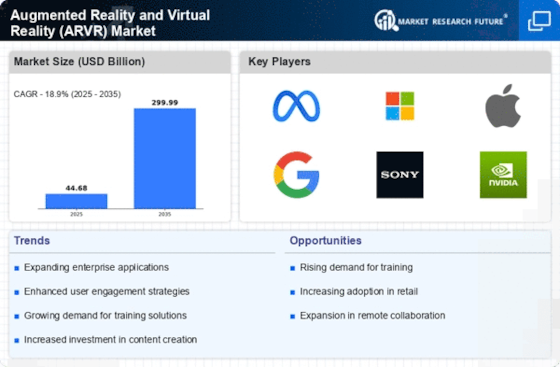
As per Market Research Future analysis, the Augmented Reality and Virtual Reality (ARVR) Market Size was estimated at 44.68 USD Billion in 2024. The ARVR industry is projected to grow from 53.12 USD Billion in 2025 to 299.99 USD Billion by 2035, exhibiting a compound annual growth rate (CAGR) of 18.9% during the forecast period 2025 - 2035

Key Market Trends & Highlights

The Augmented Reality and Virtual Reality (ARVR) market is experiencing robust growth driven by technological advancements and increasing demand for immersive experiences.

  • The North American region remains the largest market for ARVR technologies, showcasing a strong demand across various sectors. The Asia-Pacific region is emerging as the fastest-growing market, fueled by rapid technological adoption and investment in ARVR solutions. The gaming segment continues to dominate the market, while healthcare applications are witnessing the fastest growth due to their innovative uses in training and patient care. Technological advancements in ARVR devices and rising demand for immersive experiences are key drivers propelling market expansion.

Market Size & Forecast

2024 Market Size 44.68 (USD Billion)
2035 Market Size 299.99 (USD Billion)
CAGR (2025 - 2035) 18.9%
Largest Regional Market Share in 2024 North America

Major Players

<a title="Meta Platforms" href="https://forwork.meta.com/blog/difference-between-vr-ar-and-mr/" target="_blank" rel="noopener">Meta Platforms</a> (US), Microsoft (US), Apple (US), <a title="Google" href="https://arvr.google.com/" target="_blank" rel="noopener">Google</a> (US), Sony (JP), NVIDIA (US), Samsung (KR), HTC (TW), Qualcomm (US)

Market Trends

The Augmented Reality and Virtual Reality (ARVR) Market is currently experiencing a transformative phase, characterized by rapid advancements in technology and increasing adoption across various sectors. Industries such as healthcare, education, and entertainment are integrating AR and VR solutions to enhance user experiences and improve operational efficiency. This integration appears to be driven by the growing demand for immersive experiences, which could potentially reshape how consumers interact with digital content. Furthermore, the proliferation of mobile devices and advancements in hardware are likely to facilitate broader access to AR and VR applications, making these technologies more mainstream. The virtual reality industry is evolving rapidly, supported by strong investments, expanding use cases, and increasing enterprise adoption. Overall, the VR industry and augmented reality market are expected to play a central role in future digital transformation strategies.

In addition, the Augmented Reality and Virtual Reality (ARVR) Market is witnessing a surge in investment from both private and public sectors, indicating a strong belief in the future potential of these technologies. Companies are increasingly focusing on developing innovative applications that cater to diverse consumer needs, which may lead to the emergence of new business models. As the market evolves, it seems that collaboration between technology providers and end-users will be crucial in driving the next wave of growth, ensuring that solutions are tailored to meet specific demands and preferences. This collaborative approach could foster a more robust ecosystem, ultimately benefiting all stakeholders involved. The global augmented reality market and virtual reality market are expanding rapidly, driven by strong demand across gaming, healthcare, education, and enterprise applications. According to recent augmented reality stats, the ARVR market generated significant augmented reality revenue in 2024, reflecting the growing maturity of the virtual reality industry and the broader VR industry ecosystem.

Increased Adoption in Education

The integration of Augmented Reality and Virtual Reality (ARVR) technologies in educational settings is becoming more prevalent. Institutions are exploring these tools to create engaging learning environments that enhance student participation and retention. By providing immersive experiences, AR and VR can facilitate complex concepts, making them more accessible to learners. Advancements in augmented reality components, including sensors, processors, and display technologies, are enhancing performance and user immersion across AR applications. Leading augmented reality technology companies are investing heavily in R&D to develop advanced VR headsets that offer improved resolution, comfort, and real-time interaction. The rise of enterprise virtual reality solutions is transforming corporate training, remote collaboration, and industrial simulations.

Expansion in Healthcare Applications

The healthcare sector is increasingly leveraging AR and VR for training, surgical simulations, and patient treatment. These technologies offer innovative solutions that improve medical training and enhance patient care. The potential for AR and VR to visualize complex medical data and procedures suggests a promising future for their application in this field. The use of augmented reality for consumer exhibitions is increasing as brands adopt interactive digital experiences to engage audiences at trade shows and events. Many global augmented reality brands are leveraging augmented reality in consumer exhibitions to deliver immersive product demonstrations and personalized customer experiences.

Growth of Remote Collaboration Tools

As remote work becomes more common, the demand for AR and VR solutions that facilitate collaboration is rising. These technologies enable teams to interact in virtual environments, enhancing communication and productivity. The ability to simulate real-world scenarios in a virtual space may redefine how organizations approach teamwork and project management. The adoption of augmented reality for industry is accelerating in manufacturing, logistics, and maintenance, enabling real-time data visualization and workflow optimization. In parallel, enterprise virtual reality is being used for safety training, equipment simulation, and operational planning across industrial environments.

Augmented Reality Virtual Reality Market Market Drivers

Increased Investment in ARVR Startups

Investment in the Augmented Reality and Virtual Reality (ARVR) Market is witnessing a notable increase, as venture capitalists and tech giants recognize the potential of ARVR technologies. In recent years, funding for ARVR startups has surged, with billions of dollars allocated to innovative companies developing cutting-edge applications. This influx of capital is likely to accelerate the pace of innovation, leading to the emergence of new products and services that cater to diverse consumer needs. The growing interest from investors suggests a strong belief in the long-term viability of ARVR technologies, which could further stimulate market growth and encourage the development of more sophisticated ARVR solutions.

Rising Demand for Immersive Experiences

Consumer demand for immersive experiences is a significant driver in the Augmented Reality and Virtual Reality (ARVR) Market. As individuals seek more engaging and interactive content, businesses are increasingly adopting ARVR technologies to enhance customer experiences. This trend is particularly evident in sectors such as retail, where AR applications allow customers to visualize products in their environment before making a purchase. Market data indicates that the ARVR market is expected to grow at a compound annual growth rate of over 30% in the coming years, reflecting the increasing consumer appetite for immersive experiences that ARVR technologies can provide.

Technological Advancements in ARVR Devices

The Augmented Reality and Virtual Reality (ARVR) Market is experiencing a surge in technological advancements, particularly in hardware and software. Innovations such as improved display technologies, enhanced processing power, and more sophisticated sensors are driving the development of ARVR devices. For instance, the introduction of lightweight headsets with higher resolution displays has made immersive experiences more accessible. According to recent data, the market for ARVR devices is projected to reach a valuation of over 200 billion dollars by 2025, indicating a robust growth trajectory. These advancements not only enhance user experience but also expand the potential applications of ARVR across various sectors, including gaming, education, and training.

Expansion of ARVR in Entertainment and Gaming

The entertainment and gaming sectors are pivotal in driving the growth of the Augmented Reality and Virtual Reality (ARVR) Market. With the increasing popularity of immersive gaming experiences, developers are investing heavily in ARVR technologies to create captivating content. The rise of multiplayer ARVR games and interactive storytelling is attracting a broader audience, thereby expanding the market. Recent estimates suggest that the gaming segment alone could account for a substantial portion of the overall ARVR market revenue, highlighting its significance. As technology continues to evolve, the potential for innovative gaming experiences will likely further propel the growth of the ARVR market.

Integration of ARVR in Training and Simulation

The integration of Augmented Reality and Virtual Reality (ARVR) technologies in training and simulation is transforming the way organizations approach employee development. Industries such as aviation, healthcare, and manufacturing are leveraging ARVR to create realistic training environments that enhance learning outcomes. For example, ARVR simulations allow trainees to practice complex procedures in a safe and controlled setting, reducing the risk of errors in real-world applications. The Augmented Reality and Virtual Reality (ARVR) Market is likely to benefit from this trend, as more companies recognize the effectiveness of ARVR in improving training efficiency and effectiveness, potentially leading to a more skilled workforce.

Market Segment Insights

By Application: Gaming (Largest) vs. Healthcare (Fastest-Growing)

The Augmented Reality and Virtual Reality (ARVR) market is marked by diverse applications, with gaming leading the charge as the largest segment. <a title="Gaming applications" href="https://www.marketresearchfuture.com/reports/game-application-market-31927" target="_blank" rel="noopener">Gaming applications</a> leverage AR and VR technologies to enhance user experiences, drawing a considerable share of market interest and investment. Following closely, healthcare is emerging as a significant player in this space, incorporating AR and VR for training, surgical simulations, and patient treatment, thereby capturing attention from investors and stakeholders alike. The <a title="augmented reality gaming" href="https://www.marketresearchfuture.com/reports/augmented-reality-gaming-market-23604" target="_blank" rel="noopener">augmented reality gaming</a> market continues to gain momentum as developers leverage immersive overlays to enhance real-world gameplay experiences.

Gaming (Dominant) vs. Healthcare (Emerging)

The gaming segment in the ARVR market stands as the dominant force, providing immersive experiences that engage users and redefine entertainment. This segment capitalizes on advancements in technology to offer high-quality graphics and interactive gameplay that captivate audiences globally. Conversely, the healthcare sector is rapidly emerging, harnessing AR and VR to revolutionize medical training and patient care. This application enhances realism in simulations and promotes better learning outcomes for medical professionals, posing a disruptive potential in traditional healthcare practices. The growing acceptance of digital tools in healthcare and a drive towards innovative patient treatment solutions contribute to its accelerated growth.

By Device Type: Head-Mounted Displays (Largest) vs. Smart Glasses (Fastest-Growing)

The Augmented Reality and Virtual Reality (ARVR) market is primarily dominated by Head-Mounted Displays (HMDs), which currently capture the largest share due to their widespread adoption in gaming, training, and simulation applications. Smart Glasses, while still gaining traction, have emerged as the fastest-growing segment as they cater to enterprise solutions, enhancing productivity in industries such as healthcare, logistics, and remote assistance. As organizations increasingly integrate AR and VR technologies into their workflows, the interest in these devices continues to expand significantly.

HMDs (Dominant) vs. Smart Glasses (Emerging)

Head-Mounted Displays (HMDs) remain the dominant force in the ARVR device market, primarily due to their immersive experiences and broader application range in entertainment and training. Their technological advancements, including improved graphics and reduced latency, enhance their appeal to consumers and businesses alike. Conversely, Smart Glasses are emerging rapidly, characterized by their lightweight design and hands-free capabilities, making them popular for industrial use cases and hands-on tasks. As organizations recognize their potential to improve workflow efficiency, <a href="https://www.marketresearchfuture.com/reports/smart-glass-market-1830">Smart Glasses</a> are becoming an essential tool for skilled trades and field operations, indicating a notable shift towards more functional, wearable technologies.

By Technology: Augmented Reality (Largest) vs. Virtual Reality (Fastest-Growing)

In the Augmented Reality and Virtual Reality (ARVR) Market, Augmented Reality (AR) holds the largest share among the technology segments, as it is widely adopted across several industries. Industries such as retail, healthcare, and education leverage AR to enhance user experiences, driving its popularity among users and businesses alike. Meanwhile, Virtual Reality (VR) has emerged as the fastest-growing segment, capturing the attention of gamers, educators, and corporate trainers looking for immersive experiences that VR technology uniquely enables. Simultaneously, the virtual reality market remains dominant in console and PC-based gaming, supported by high-performance hardware and immersive content ecosystems. From a virtual reality analyst perspective, continued hardware innovation and enterprise adoption are expected to sustain long-term market growth. Industry-level augmented reality stats indicate rising investments in both consumer and commercial AR applications globally.

Technology: Augmented Reality (Dominant) vs. Virtual Reality (Emerging)

Augmented Reality (AR) remains a dominant force in the ARVR market due to its versatility and broad applications across various sectors. It enhances the real world by overlaying digital information, which appeals significantly to consumers and businesses alike. In contrast, Virtual Reality (VR) is positioned as an emerging technology rapidly gaining traction, primarily driven by advancements in hardware and software that provide increasingly immersive experiences. VR is becoming essential in gaming and training programs, aimed at fostering experiential learning and enhancing entertainment value. As both technologies evolve, their roles in enhancing user interaction and engagement in diverse applications will continue to expand.

By End Use: Consumer (Largest) vs. Commercial (Fastest-Growing)

The Augmented Reality and Virtual Reality (ARVR) Market is increasingly shaped by distinct end-use segments, predominantly the consumer segment, which commands the largest share in market distribution. This segment encompasses gaming, entertainment, and personal use, making it a key driver of technological adoption. In contrast, the commercial segment, focusing on applications like training, marketing, and product visualization, demonstrates rapid growth, indicating a shift towards broader industry applications and increasing integration of ARVR technologies across various business sectors.

Consumer (Dominant) vs. Commercial (Emerging)

The consumer segment in the ARVR market is characterized by user-friendly applications that cater to entertainment and leisure activities, making it dominant in market presence. Products like gaming headsets and mobile AR applications are widely adopted, driven by a growing demand for immersive experiences. On the other hand, the commercial segment is rapidly emerging, with businesses recognizing the potential of ARVR for enhancing customer engagement and streamlining operations. Industries such as retail, training, and <a href="https://www.marketresearchfuture.com/reports/real-estate-software-market-9559">real estate</a> are leveraging ARVR solutions for training simulations, virtual tours, and product showcases, positioning this segment as a critical area for growth and innovation.

Get more detailed insights about Augmented Reality and Virtual Reality Market Research Report - Global Forecast to 2035

Regional Insights

The Augmented Reality and Virtual Reality (ARVR) Market exhibits substantial growth within its regional segmentation, projected to be valued at 44.68 USD Billion in 2024 and increasing significantly by 2035. North America holds a majority with a valuation of 18.5 USD Billion in 2024, expected to reach 120.0 USD Billion by 2035, fueled by advanced technological adoption and significant investment in ARVR applications across various sectors.

Europe follows closely, valued at 12.0 USD Billion in 2024 and anticipated to grow to 80.0 USD Billion, driven by an increasing number of startups and corporate ventures in immersive technologies.Asia Pacific, with 9.0 USD Billion in 2024 and a valuation of 70.0 USD Billion in 2035, showcases a rapid adoption rate in industries like gaming and education, highlighting its importance in the global landscape.

South America and the Middle East and Africa represent emerging markets, valued at 2.5 USD Billion and 2.68 USD Billion, respectively, in 2024, with anticipated growth to 10.0 USD Billion and 20.0 USD Billion by 2035. These regions are gradually recognizing the potential of ARVR technologies, influenced by an increase in digitalization and mobile device penetration, thus creating significant opportunities for stakeholders.

Key Players and Competitive Insights

The competitive landscape of the Augmented Reality and Virtual Reality (ARVR) Market is rapidly evolving, characterized by the emergence of innovative technologies and an increasing number of industry players. This market has gained significant traction due to advancements in hardware, software, and user experience, leading to a proliferation of applications across various sectors, including gaming, healthcare, education, and retail. As companies strive to differentiate themselves, strategic partnerships, technological advancements, and consumer engagement efforts are paramount. The integration of AR and VR in everyday applications is opening new avenues for stakeholders, making the market increasingly competitive. In this vibrant environment, understanding the capabilities and strategies of leading players becomes essential for businesses aiming to secure a foothold in this dynamic market.Valve Corporation, a prominent player in the Augmented Reality and Virtual Reality (ARVR) Market, has established itself through a strong commitment to innovation and quality. The company is renowned for its SteamVR platform, which serves as a robust ecosystem for developers and users alike. Valve’s strengths lie in its immersive gaming experiences and its ability to create compelling virtual environments that resonate with consumers. The company’s pioneering work in virtual reality technology, including the development of the HTC Vive, has significantly influenced the industry. Furthermore, Valve’s active engagement in community feedback and developer support allows it to maintain a competitive edge, continuously refining its products to meet the evolving demands of the market. This proactive approach has solidified Valve Corporation's position as a key player in the ARVR space on a global scale.Meta Platforms, formerly known as Facebook, has made substantial strides in the Augmented Reality and Virtual Reality (ARVR) Market with its extensive portfolio of products and services. This includes the Oculus VR headset series, which offers a suite of immersive experiences tailored for gaming, social interaction, and educational purposes. Meta's focus on creating a metaverse, where users can connect and interact in virtual spaces, underscores its commitment to revolutionizing the way people engage with technology. The company has strategically positioned itself through various mergers and acquisitions, enhancing its capabilities in both AR and VR. By integrating advanced technologies and visionary concepts, Meta Platforms has cultivated a strong market presence. Its substantial investment in research and development, coupled with its expansive community of developers and users, enables the company to stay at the forefront of the ARVR market globally.

Key Companies in the Augmented Reality Virtual Reality Market include

Industry Developments

The Augmented Reality and Virtual Reality (ARVR) Market has observed significant developments recently. In October 2023, Meta Platforms announced advancements in its AR platform, aiming to enhance user engagement through immersive experiences, while Microsoft launched an updated version of its HoloLens, enhancing mixed reality applications in enterprise settings. Moreover, Samsung Electronics is making strides in AR wearable technology, showcasing prototypes that are set to revolutionize the consumer market.

In terms of mergers and acquisitions, Google's acquisition of a prominent AR development firm in September 2023 signifies a strategic move to bolster its AR capabilities, further supported by widespread industry acknowledgment. Nvidia continues to see growth in its market valuation due to its powerful graphics processing units, which are crucial for AR and VR applications. The overall ARVR market is predicted to expand significantly, with various companies like Unity Technologies and Adobe Systems making strides in software development to meet increasing demand for immersive technologies.

Over the last few years, key milestones included Sony's launch of the PlayStation VR2 in February 2023, highlighting the industry's momentum and commitment to enhancing user experiences in virtual environments.


Future Outlook

Augmented Reality Virtual Reality Market Future Outlook

The Augmented Reality and Virtual Reality (ARVR) Market is projected to grow at an 18.9% CAGR from 2025 to 2035, driven by technological advancements, increased adoption in various sectors, and enhanced user experiences.

New opportunities lie in:

  • <p>Development of immersive training programs for corporate sectors Integration of AR in retail for enhanced customer engagement Creation of VR platforms for remote collaboration and virtual events</p>

By 2035, the ARVR market is expected to be a pivotal component of digital transformation strategies.

Market Segmentation

Augmented Reality Virtual Reality Market End Use Outlook

  • Consumer
  • Commercial
  • Industrial

Augmented Reality Virtual Reality Market Technology Outlook

  • Augmented Reality
  • Virtual Reality
  • Mixed Reality

Augmented Reality Virtual Reality Market Application Outlook

  • Gaming
  • Healthcare
  • Education
  • Retail
  • Real Estate

Augmented Reality Virtual Reality Market Device Type Outlook

  • Head-Mounted Displays
  • Smart Glasses
  • Handheld Devices
  • Projectors
  • Display Walls

Report Scope

MARKET SIZE 2024 44.68(USD Billion)
MARKET SIZE 2025 53.12(USD Billion)
MARKET SIZE 2035 299.99(USD Billion)
COMPOUND ANNUAL GROWTH RATE (CAGR) 18.9% (2025 - 2035)
REPORT COVERAGE Revenue Forecast, Competitive Landscape, Growth Factors, and Trends
BASE YEAR 2024
Market Forecast Period 2025 - 2035
Historical Data 2019 - 2024
Market Forecast Units USD Billion
Key Companies Profiled Meta Platforms (US), Microsoft (US), Apple (US), Google (US), Sony (JP), NVIDIA (US), Samsung (KR), HTC (TW), Qualcomm (US)
Segments Covered Application, Device Type, Technology, End Use, Regional
Key Market Opportunities Integration of Augmented Reality and Virtual Reality (ARVR) in education enhances immersive learning experiences.
Key Market Dynamics Technological advancements and consumer behavior shifts drive rapid growth in the Augmented Reality and Virtual Reality market.
Countries Covered North America, Europe, APAC, South America, MEA

FAQs

What is the projected market valuation of the Augmented Reality and Virtual Reality (ARVR) Market by 2035?

<p>The projected market valuation for the ARVR Market by 2035 is 299.99 USD Billion.</p>

What was the overall market valuation of the ARVR Market in 2024?

<p>The overall market valuation of the ARVR Market in 2024 was 44.68 USD Billion.</p>

What is the expected CAGR for the ARVR Market during the forecast period 2025 - 2035?

<p>The expected CAGR for the ARVR Market during the forecast period 2025 - 2035 is 18.9%.</p>

Which application segment is projected to have the highest valuation in 2035?

<p>The Gaming application segment is projected to reach 70.0 USD Billion by 2035.</p>

What are the key players in the ARVR Market?

<p>Key players in the ARVR Market include Meta Platforms, Microsoft, Apple, Google, Sony, NVIDIA, Samsung, HTC, and Qualcomm.</p>

How does the valuation of the Virtual Reality segment compare to Augmented Reality in 2035?

<p>In 2035, the Virtual Reality segment is projected to reach 150.0 USD Billion, significantly higher than the Augmented Reality segment at 100.0 USD Billion.</p>

What is the projected valuation for the Industrial end-use segment by 2035?

<p>The Industrial end-use segment is projected to reach 129.99 USD Billion by 2035.</p>

Which device type is expected to dominate the ARVR Market by 2035?

<p>Head-Mounted Displays are expected to dominate the ARVR Market with a projected valuation of 90.0 USD Billion by 2035.</p>

What is the projected valuation for the Healthcare application segment by 2035?

<p>The Healthcare application segment is projected to reach 50.0 USD Billion by 2035.</p>

How does the projected growth of the ARVR Market reflect on consumer versus commercial end-use segments?

<p>By 2035, the Consumer end-use segment is projected at 90.0 USD Billion, while the Commercial segment is expected to reach 80.0 USD Billion, indicating robust growth in both areas.</p>

  1. SECTION I: EXECUTIVE SUMMARY AND KEY HIGHLIGHTS |
    1. EXECUTIVE SUMMARY | |
      1. Market Overview | |
      2. Key Findings | |
      3. Market Segmentation | |
      4. Competitive Landscape | |
      5. Challenges and Opportunities | |
      6. Future Outlook 2
  2. SECTION II: SCOPING, METHODOLOGY AND MARKET STRUCTURE |
    1. MARKET INTRODUCTION | |
      1. Definition | |
      2. Scope of the study | | |
    2. RESEARCH METHODOLOGY | |
      1. Overview | |
      2. Data Mining | |
      3. Secondary Research | |
      4. Primary Research | | |
      5. Forecasting Model | |
      6. Market Size Estimation | | |
      7. Data Triangulation | |
      8. Validation 3
  3. SECTION III: QUALITATIVE ANALYSIS |
    1. MARKET DYNAMICS | |
      1. Overview | |
      2. Drivers | |
      3. Restraints | |
      4. Opportunities |
    2. MARKET FACTOR ANALYSIS | |
      1. Value chain Analysis | |
      2. Porter's Five Forces Analysis | | |
      3. COVID-19 Impact Analysis | | |
  4. SECTION IV: QUANTITATIVE ANALYSIS |
    1. Information and Communications Technology, BY Application (USD Billion) | |
      1. Gaming | |
      2. Healthcare | |
      3. Education | |
      4. Retail | |
      5. Real Estate |
    2. Information and Communications Technology, BY Device Type (USD Billion) | |
      1. Head-Mounted Displays | |
      2. Smart Glasses | |
      3. Handheld Devices | |
      4. Projectors | |
      5. Display Walls |
    3. Information and Communications Technology, BY Technology (USD Billion) | |
      1. Augmented Reality | |
      2. Virtual Reality | |
      3. Mixed Reality |
    4. Information and Communications Technology, BY End Use (USD Billion) | |
      1. Consumer | |
      2. Commercial | |
      3. Industrial |
    5. Information and Communications Technology, BY Region (USD Billion) | |
      1. North America | | |
      2. Europe | | |
      3. APAC | | |
      4. South America | | |
      5. MEA | | |
  5. SECTION V: COMPETITIVE ANALYSIS |
    1. Competitive Landscape | |
      1. Overview | |
      2. Competitive Analysis | |
      3. Market share Analysis | |
      4. Major Growth Strategy in the Information and Communications Technology | |
      5. Competitive Benchmarking | |
      6. Leading Players in Terms of Number of Developments in the Information and Communications Technology | |
      7. Key developments and growth strategies | | |
      8. Major Players Financial Matrix | | |
    2. Company Profiles | |
      1. Meta Platforms (US) | | |
      2. Microsoft (US) | | |
      3. Apple (US) | | |
      4. Google (US) | | |
      5. Sony (JP) | | |
      6. NVIDIA (US) | | |
      7. Samsung (KR) | | |
      8. HTC (TW) | | |
      9. Qualcomm (US) | | |
    3. Appendix | |
      1. References | |
      2. Related Reports 6 LIST OF FIGURES |
    4. MARKET SYNOPSIS |
    5. NORTH AMERICA MARKET ANALYSIS |
    6. US MARKET ANALYSIS BY APPLICATION |
    7. US MARKET ANALYSIS BY DEVICE TYPE |
    8. US MARKET ANALYSIS BY TECHNOLOGY |
    9. US MARKET ANALYSIS BY END USE |
    10. CANADA MARKET ANALYSIS BY APPLICATION |
    11. CANADA MARKET ANALYSIS BY DEVICE TYPE |
    12. CANADA MARKET ANALYSIS BY TECHNOLOGY |
    13. CANADA MARKET ANALYSIS BY END USE |
    14. EUROPE MARKET ANALYSIS |
    15. GERMANY MARKET ANALYSIS BY APPLICATION |
    16. GERMANY MARKET ANALYSIS BY DEVICE TYPE |
    17. GERMANY MARKET ANALYSIS BY TECHNOLOGY |
    18. GERMANY MARKET ANALYSIS BY END USE |
    19. UK MARKET ANALYSIS BY APPLICATION |
    20. UK MARKET ANALYSIS BY DEVICE TYPE |
    21. UK MARKET ANALYSIS BY TECHNOLOGY |
    22. UK MARKET ANALYSIS BY END USE |
    23. FRANCE MARKET ANALYSIS BY APPLICATION |
    24. FRANCE MARKET ANALYSIS BY DEVICE TYPE |
    25. FRANCE MARKET ANALYSIS BY TECHNOLOGY |
    26. FRANCE MARKET ANALYSIS BY END USE |
    27. RUSSIA MARKET ANALYSIS BY APPLICATION |
    28. RUSSIA MARKET ANALYSIS BY DEVICE TYPE |
    29. RUSSIA MARKET ANALYSIS BY TECHNOLOGY |
    30. RUSSIA MARKET ANALYSIS BY END USE |
    31. ITALY MARKET ANALYSIS BY APPLICATION |
    32. ITALY MARKET ANALYSIS BY DEVICE TYPE |
    33. ITALY MARKET ANALYSIS BY TECHNOLOGY |
    34. ITALY MARKET ANALYSIS BY END USE |
    35. SPAIN MARKET ANALYSIS BY APPLICATION |
    36. SPAIN MARKET ANALYSIS BY DEVICE TYPE |
    37. SPAIN MARKET ANALYSIS BY TECHNOLOGY |
    38. SPAIN MARKET ANALYSIS BY END USE |
    39. REST OF EUROPE MARKET ANALYSIS BY APPLICATION |
    40. REST OF EUROPE MARKET ANALYSIS BY DEVICE TYPE |
    41. REST OF EUROPE MARKET ANALYSIS BY TECHNOLOGY |
    42. REST OF EUROPE MARKET ANALYSIS BY END USE |
    43. APAC MARKET ANALYSIS |
    44. CHINA MARKET ANALYSIS BY APPLICATION |
    45. CHINA MARKET ANALYSIS BY DEVICE TYPE |
    46. CHINA MARKET ANALYSIS BY TECHNOLOGY |
    47. CHINA MARKET ANALYSIS BY END USE |
    48. INDIA MARKET ANALYSIS BY APPLICATION |
    49. INDIA MARKET ANALYSIS BY DEVICE TYPE |
    50. INDIA MARKET ANALYSIS BY TECHNOLOGY |
    51. INDIA MARKET ANALYSIS BY END USE |
    52. JAPAN MARKET ANALYSIS BY APPLICATION |
    53. JAPAN MARKET ANALYSIS BY DEVICE TYPE |
    54. JAPAN MARKET ANALYSIS BY TECHNOLOGY |
    55. JAPAN MARKET ANALYSIS BY END USE |
    56. SOUTH KOREA MARKET ANALYSIS BY APPLICATION |
    57. SOUTH KOREA MARKET ANALYSIS BY DEVICE TYPE |
    58. SOUTH KOREA MARKET ANALYSIS BY TECHNOLOGY |
    59. SOUTH KOREA MARKET ANALYSIS BY END USE |
    60. MALAYSIA MARKET ANALYSIS BY APPLICATION |
    61. MALAYSIA MARKET ANALYSIS BY DEVICE TYPE |
    62. MALAYSIA MARKET ANALYSIS BY TECHNOLOGY |
    63. MALAYSIA MARKET ANALYSIS BY END USE |
    64. THAILAND MARKET ANALYSIS BY APPLICATION |
    65. THAILAND MARKET ANALYSIS BY DEVICE TYPE |
    66. THAILAND MARKET ANALYSIS BY TECHNOLOGY |
    67. THAILAND MARKET ANALYSIS BY END USE |
    68. INDONESIA MARKET ANALYSIS BY APPLICATION |
    69. INDONESIA MARKET ANALYSIS BY DEVICE TYPE |
    70. INDONESIA MARKET ANALYSIS BY TECHNOLOGY |
    71. INDONESIA MARKET ANALYSIS BY END USE |
    72. REST OF APAC MARKET ANALYSIS BY APPLICATION |
    73. REST OF APAC MARKET ANALYSIS BY DEVICE TYPE |
    74. REST OF APAC MARKET ANALYSIS BY TECHNOLOGY |
    75. REST OF APAC MARKET ANALYSIS BY END USE |
    76. SOUTH AMERICA MARKET ANALYSIS |
    77. BRAZIL MARKET ANALYSIS BY APPLICATION |
    78. BRAZIL MARKET ANALYSIS BY DEVICE TYPE |
    79. BRAZIL MARKET ANALYSIS BY TECHNOLOGY |
    80. BRAZIL MARKET ANALYSIS BY END USE |
    81. MEXICO MARKET ANALYSIS BY APPLICATION |
    82. MEXICO MARKET ANALYSIS BY DEVICE TYPE |
    83. MEXICO MARKET ANALYSIS BY TECHNOLOGY |
    84. MEXICO MARKET ANALYSIS BY END USE |
    85. ARGENTINA MARKET ANALYSIS BY APPLICATION |
    86. ARGENTINA MARKET ANALYSIS BY DEVICE TYPE |
    87. ARGENTINA MARKET ANALYSIS BY TECHNOLOGY |
    88. ARGENTINA MARKET ANALYSIS BY END USE |
    89. REST OF SOUTH AMERICA MARKET ANALYSIS BY APPLICATION |
    90. REST OF SOUTH AMERICA MARKET ANALYSIS BY DEVICE TYPE |
    91. REST OF SOUTH AMERICA MARKET ANALYSIS BY TECHNOLOGY |
    92. REST OF SOUTH AMERICA MARKET ANALYSIS BY END USE |
    93. MEA MARKET ANALYSIS |
    94. GCC COUNTRIES MARKET ANALYSIS BY APPLICATION |
    95. GCC COUNTRIES MARKET ANALYSIS BY DEVICE TYPE |
    96. GCC COUNTRIES MARKET ANALYSIS BY TECHNOLOGY |
    97. GCC COUNTRIES MARKET ANALYSIS BY END USE |
    98. SOUTH AFRICA MARKET ANALYSIS BY APPLICATION |
    99. SOUTH AFRICA MARKET ANALYSIS BY DEVICE TYPE |
    100. SOUTH AFRICA MARKET ANALYSIS BY TECHNOLOGY |
    101. SOUTH AFRICA MARKET ANALYSIS BY END USE |
    102. REST OF MEA MARKET ANALYSIS BY APPLICATION |
    103. REST OF MEA MARKET ANALYSIS BY DEVICE TYPE |
    104. REST OF MEA MARKET ANALYSIS BY TECHNOLOGY |
    105. REST OF MEA MARKET ANALYSIS BY END USE |
    106. KEY BUYING CRITERIA OF INFORMATION AND COMMUNICATIONS TECHNOLOGY |
    107. RESEARCH PROCESS OF MRFR |
    108. DRO ANALYSIS OF INFORMATION AND COMMUNICATIONS TECHNOLOGY |
    109. DRIVERS IMPACT ANALYSIS: INFORMATION AND COMMUNICATIONS TECHNOLOGY |
    110. RESTRAINTS IMPACT ANALYSIS: INFORMATION AND COMMUNICATIONS TECHNOLOGY |
    111. SUPPLY / VALUE CHAIN: INFORMATION AND COMMUNICATIONS TECHNOLOGY |
    112. INFORMATION AND COMMUNICATIONS TECHNOLOGY, BY APPLICATION, 2024 (% SHARE) |
    113. INFORMATION AND COMMUNICATIONS TECHNOLOGY, BY APPLICATION, 2024 TO 2035 (USD Billion) |
    114. INFORMATION AND COMMUNICATIONS TECHNOLOGY, BY DEVICE TYPE, 2024 (% SHARE) |
    115. INFORMATION AND COMMUNICATIONS TECHNOLOGY, BY DEVICE TYPE, 2024 TO 2035 (USD Billion) |
    116. INFORMATION AND COMMUNICATIONS TECHNOLOGY, BY TECHNOLOGY, 2024 (% SHARE) |
    117. INFORMATION AND COMMUNICATIONS TECHNOLOGY, BY TECHNOLOGY, 2024 TO 2035 (USD Billion) |
    118. INFORMATION AND COMMUNICATIONS TECHNOLOGY, BY END USE, 2024 (% SHARE) |
    119. INFORMATION AND COMMUNICATIONS TECHNOLOGY, BY END USE, 2024 TO 2035 (USD Billion) |
    120. BENCHMARKING OF MAJOR COMPETITORS 7 LIST OF TABLES |
    121. LIST OF ASSUMPTIONS | |
      1. |
    122. North America MARKET SIZE ESTIMATES; FORECAST | |
      1. BY APPLICATION, 2025-2035 (USD Billion) | |
      2. BY DEVICE TYPE, 2025-2035 (USD Billion) | |
      3. BY TECHNOLOGY, 2025-2035 (USD Billion) | |
      4. BY END USE, 2025-2035 (USD Billion) |
    123. US MARKET SIZE ESTIMATES; FORECAST | |
      1. BY APPLICATION, 2025-2035 (USD Billion) | |
      2. BY DEVICE TYPE, 2025-2035 (USD Billion) | |
      3. BY TECHNOLOGY, 2025-2035 (USD Billion) | |
      4. BY END USE, 2025-2035 (USD Billion) |
    124. Canada MARKET SIZE ESTIMATES; FORECAST | |
      1. BY APPLICATION, 2025-2035 (USD Billion) | |
      2. BY DEVICE TYPE, 2025-2035 (USD Billion) | |
      3. BY TECHNOLOGY, 2025-2035 (USD Billion) | |
      4. BY END USE, 2025-2035 (USD Billion) |
    125. Europe MARKET SIZE ESTIMATES; FORECAST | |
      1. BY APPLICATION, 2025-2035 (USD Billion) | |
      2. BY DEVICE TYPE, 2025-2035 (USD Billion) | |
      3. BY TECHNOLOGY, 2025-2035 (USD Billion) | |
      4. BY END USE, 2025-2035 (USD Billion) |
    126. Germany MARKET SIZE ESTIMATES; FORECAST | |
      1. BY APPLICATION, 2025-2035 (USD Billion) | |
      2. BY DEVICE TYPE, 2025-2035 (USD Billion) | |
      3. BY TECHNOLOGY, 2025-2035 (USD Billion) | |
      4. BY END USE, 2025-2035 (USD Billion) |
    127. UK MARKET SIZE ESTIMATES; FORECAST | |
      1. BY APPLICATION, 2025-2035 (USD Billion) | |
      2. BY DEVICE TYPE, 2025-2035 (USD Billion) | |
      3. BY TECHNOLOGY, 2025-2035 (USD Billion) | |
      4. BY END USE, 2025-2035 (USD Billion) |
    128. France MARKET SIZE ESTIMATES; FORECAST | |
      1. BY APPLICATION, 2025-2035 (USD Billion) | |
      2. BY DEVICE TYPE, 2025-2035 (USD Billion) | |
      3. BY TECHNOLOGY, 2025-2035 (USD Billion) | |
      4. BY END USE, 2025-2035 (USD Billion) |
    129. Russia MARKET SIZE ESTIMATES; FORECAST | |
      1. BY APPLICATION, 2025-2035 (USD Billion) | |
      2. BY DEVICE TYPE, 2025-2035 (USD Billion) | |
      3. BY TECHNOLOGY, 2025-2035 (USD Billion) | |
      4. BY END USE, 2025-2035 (USD Billion) |
    130. Italy MARKET SIZE ESTIMATES; FORECAST | |
      1. BY APPLICATION, 2025-2035 (USD Billion) | |
      2. BY DEVICE TYPE, 2025-2035 (USD Billion) | |
      3. BY TECHNOLOGY, 2025-2035 (USD Billion) | |
      4. BY END USE, 2025-2035 (USD Billion) |
    131. Spain MARKET SIZE ESTIMATES; FORECAST | |
      1. BY APPLICATION, 2025-2035 (USD Billion) | |
      2. BY DEVICE TYPE, 2025-2035 (USD Billion) | |
      3. BY TECHNOLOGY, 2025-2035 (USD Billion) | |
      4. BY END USE, 2025-2035 (USD Billion) |
    132. Rest of Europe MARKET SIZE ESTIMATES; FORECAST | |
      1. BY APPLICATION, 2025-2035 (USD Billion) | |
      2. BY DEVICE TYPE, 2025-2035 (USD Billion) | |
      3. BY TECHNOLOGY, 2025-2035 (USD Billion) | |
      4. BY END USE, 2025-2035 (USD Billion) |
    133. APAC MARKET SIZE ESTIMATES; FORECAST | |
      1. BY APPLICATION, 2025-2035 (USD Billion) | |
      2. BY DEVICE TYPE, 2025-2035 (USD Billion) | |
      3. BY TECHNOLOGY, 2025-2035 (USD Billion) | |
      4. BY END USE, 2025-2035 (USD Billion) |
    134. China MARKET SIZE ESTIMATES; FORECAST | |
      1. BY APPLICATION, 2025-2035 (USD Billion) | |
      2. BY DEVICE TYPE, 2025-2035 (USD Billion) | |
      3. BY TECHNOLOGY, 2025-2035 (USD Billion) | |
      4. BY END USE, 2025-2035 (USD Billion) |
    135. India MARKET SIZE ESTIMATES; FORECAST | |
      1. BY APPLICATION, 2025-2035 (USD Billion) | |
      2. BY DEVICE TYPE, 2025-2035 (USD Billion) | |
      3. BY TECHNOLOGY, 2025-2035 (USD Billion) | |
      4. BY END USE, 2025-2035 (USD Billion) |
    136. Japan MARKET SIZE ESTIMATES; FORECAST | |
      1. BY APPLICATION, 2025-2035 (USD Billion) | |
      2. BY DEVICE TYPE, 2025-2035 (USD Billion) | |
      3. BY TECHNOLOGY, 2025-2035 (USD Billion) | |
      4. BY END USE, 2025-2035 (USD Billion) |
    137. South Korea MARKET SIZE ESTIMATES; FORECAST | |
      1. BY APPLICATION, 2025-2035 (USD Billion) | |
      2. BY DEVICE TYPE, 2025-2035 (USD Billion) | |
      3. BY TECHNOLOGY, 2025-2035 (USD Billion) | |
      4. BY END USE, 2025-2035 (USD Billion) |
    138. Malaysia MARKET SIZE ESTIMATES; FORECAST | |
      1. BY APPLICATION, 2025-2035 (USD Billion) | |
      2. BY DEVICE TYPE, 2025-2035 (USD Billion) | |
      3. BY TECHNOLOGY, 2025-2035 (USD Billion) | |
      4. BY END USE, 2025-2035 (USD Billion) |
    139. Thailand MARKET SIZE ESTIMATES; FORECAST | |
      1. BY APPLICATION, 2025-2035 (USD Billion) | |
      2. BY DEVICE TYPE, 2025-2035 (USD Billion) | |
      3. BY TECHNOLOGY, 2025-2035 (USD Billion) | |
      4. BY END USE, 2025-2035 (USD Billion) |
    140. Indonesia MARKET SIZE ESTIMATES; FORECAST | |
      1. BY APPLICATION, 2025-2035 (USD Billion) | |
      2. BY DEVICE TYPE, 2025-2035 (USD Billion) | |
      3. BY TECHNOLOGY, 2025-2035 (USD Billion) | |
      4. BY END USE, 2025-2035 (USD Billion) |
    141. Rest of APAC MARKET SIZE ESTIMATES; FORECAST | |
      1. BY APPLICATION, 2025-2035 (USD Billion) | |
      2. BY DEVICE TYPE, 2025-2035 (USD Billion) | |
      3. BY TECHNOLOGY, 2025-2035 (USD Billion) | |
      4. BY END USE, 2025-2035 (USD Billion) |
    142. South America MARKET SIZE ESTIMATES; FORECAST | |
      1. BY APPLICATION, 2025-2035 (USD Billion) | |
      2. BY DEVICE TYPE, 2025-2035 (USD Billion) | |
      3. BY TECHNOLOGY, 2025-2035 (USD Billion) | |
      4. BY END USE, 2025-2035 (USD Billion) |
    143. Brazil MARKET SIZE ESTIMATES; FORECAST | |
      1. BY APPLICATION, 2025-2035 (USD Billion) | |
      2. BY DEVICE TYPE, 2025-2035 (USD Billion) | |
      3. BY TECHNOLOGY, 2025-2035 (USD Billion) | |
      4. BY END USE, 2025-2035 (USD Billion) |
    144. Mexico MARKET SIZE ESTIMATES; FORECAST | |
      1. BY APPLICATION, 2025-2035 (USD Billion) | |
      2. BY DEVICE TYPE, 2025-2035 (USD Billion) | |
      3. BY TECHNOLOGY, 2025-2035 (USD Billion) | |
      4. BY END USE, 2025-2035 (USD Billion) |
    145. Argentina MARKET SIZE ESTIMATES; FORECAST | |
      1. BY APPLICATION, 2025-2035 (USD Billion) | |
      2. BY DEVICE TYPE, 2025-2035 (USD Billion) | |
      3. BY TECHNOLOGY, 2025-2035 (USD Billion) | |
      4. BY END USE, 2025-2035 (USD Billion) |
    146. Rest of South America MARKET SIZE ESTIMATES; FORECAST | |
      1. BY APPLICATION, 2025-2035 (USD Billion) | |
      2. BY DEVICE TYPE, 2025-2035 (USD Billion) | |
      3. BY TECHNOLOGY, 2025-2035 (USD Billion) | |
      4. BY END USE, 2025-2035 (USD Billion) |
    147. MEA MARKET SIZE ESTIMATES; FORECAST | |
      1. BY APPLICATION, 2025-2035 (USD Billion) | |
      2. BY DEVICE TYPE, 2025-2035 (USD Billion) | |
      3. BY TECHNOLOGY, 2025-2035 (USD Billion) | |
      4. BY END USE, 2025-2035 (USD Billion) |
    148. GCC Countries MARKET SIZE ESTIMATES; FORECAST | |
      1. BY APPLICATION, 2025-2035 (USD Billion) | |
      2. BY DEVICE TYPE, 2025-2035 (USD Billion) | |
      3. BY TECHNOLOGY, 2025-2035 (USD Billion) | |
      4. BY END USE, 2025-2035 (USD Billion) |
    149. South Africa MARKET SIZE ESTIMATES; FORECAST | |
      1. BY APPLICATION, 2025-2035 (USD Billion) | |
      2. BY DEVICE TYPE, 2025-2035 (USD Billion) | |
      3. BY TECHNOLOGY, 2025-2035 (USD Billion) | |
      4. BY END USE, 2025-2035 (USD Billion) |
    150. Rest of MEA MARKET SIZE ESTIMATES; FORECAST | |
      1. BY APPLICATION, 2025-2035 (USD Billion) | |
      2. BY DEVICE TYPE, 2025-2035 (USD Billion) | |
      3. BY TECHNOLOGY, 2025-2035 (USD Billion) | |
      4. BY END USE, 2025-2035 (USD Billion) |
    151. PRODUCT LAUNCH/PRODUCT DEVELOPMENT/APPROVAL | |
      1. |
    152. ACQUISITION/PARTNERSHIP | |

Information and Communications Technology Market Segmentation

Information and Communications Technology By Application (USD Billion, 2025-2035)

  • Gaming
  • Healthcare
  • Education
  • Retail
  • Real Estate

Information and Communications Technology By Device Type (USD Billion, 2025-2035)

  • Head-Mounted Displays
  • Smart Glasses
  • Handheld Devices
  • Projectors
  • Display Walls

Information and Communications Technology By Technology (USD Billion, 2025-2035)

  • Augmented Reality
  • Virtual Reality
  • Mixed Reality

Information and Communications Technology By End Use (USD Billion, 2025-2035)

  • Consumer
  • Commercial
  • Industrial
Infographic

Free Sample Request

Kindly complete the form below to receive a free sample of this Report

Get Free Sample

Customer Strories

Compare Licence

×
Features License Type
Single User Multiuser License Enterprise User
Price $4,950 $5,950 $7,250
Maximum User Access Limit 1 User Upto 10 Users Unrestricted Access Throughout the Organization
Free Customization
Direct Access to Analyst
Deliverable Format
Platform Access
Discount on Next Purchase 10% 15% 15%
Printable Versions