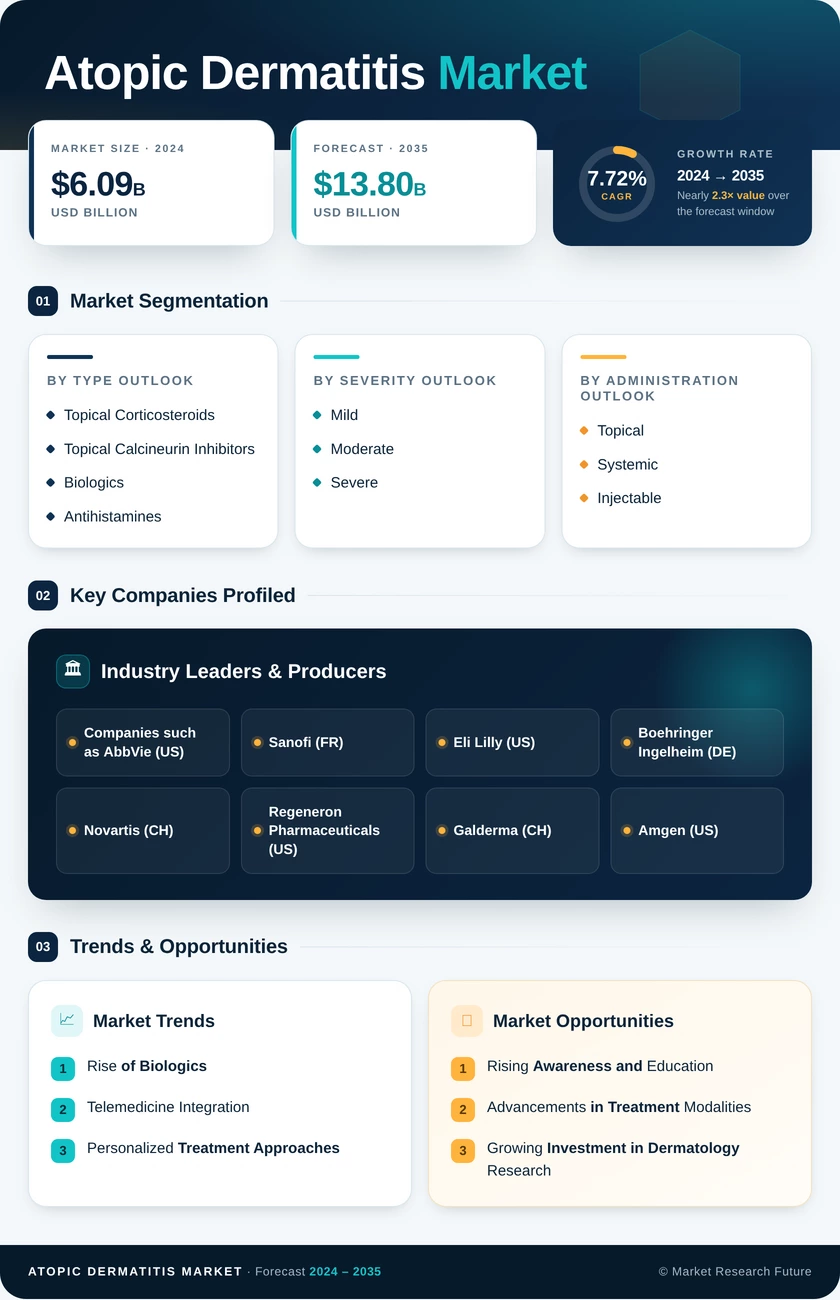
Segmentation Quick Reference
| Dimension | Sub-Segments | Dominant Segment | Fastest Growing Segment |
| By Drug Class | Corticosteroids; Topical Calcineurin Inhibitors; PDE-4 Inhibitors; Biologics (IL-4/IL-13 Inhibitors); JAK Inhibitors; Emollients and Others | Corticosteroids | JAK Inhibitors |
| By Route of Administration | Topical; Oral; Injectable | Topical | Injectable |
| By Patient Age Group | Pediatric (0–17 Yrs); Adult (18+ Yrs) | Adult (18+ Yrs) | Pediatric (0–17 Yrs) |
| By Distribution Channel | Hospital Pharmacy; Retail Pharmacy; Online / Tele-Dermatology | Retail Pharmacy | Online / Tele-Dermatology |
| By Geography | North America; Europe; Asia-Pacific; South America; Middle East & Africa | North America | Asia-Pacific |
Market Segmentation Overview
By Drug Class
| Sub-Segment | Key Trend |
| Corticosteroids | Share erosion as guidelines discourage prolonged use; potency-tiered generics compete on price. |
| Topical Calcineurin Inhibitors | Steady demand for facial and intertriginous application where atrophy risk rules out steroids |
| PDE-4 Inhibitors | Expanding pediatric maintenance use on the strength of a benign long-term safety profile |
| Biologics (IL-4/IL-13 Inhibitors) | Competition shifting from efficacy toward dosing interval and conjunctivitis differentiation. |
| JAK Inhibitors | Rapid itch onset drives second-line adoption; boxed warnings cap first-line conversion. |
| Emollients and Others | Positioned as adjunct barrier repair, increasingly bundled into adherence support programs |
Drug class remains the axis where value concentrates most unevenly. Corticosteroids move the most units and the least money; biologics invert that ratio entirely. The decisive question for the next decade is whether OX40-directed agents can prove remission durability strong enough to justify displacing an entrenched IL-13 standard of care.
By Route of Administration
| Sub-Segment | Key Trend |
| Topical | Non-steroidal formulations gaining share within the segment as steroid-sparing pressure builds |
| Oral | Constrained by laboratory monitoring requirements despite convenience advantages |
| Injectable | Home self-administration and quarterly dosing formats removing the last adherence barriers |
Route of administration increasingly signals disease severity rather than patient preference. Injectables have absorbed the moderate-to-severe pool, oral agents occupy a narrow refractory niche, and topicals continue to serve the large mild-to-moderate majority that never escalates.
By Patient Age Group
| Sub-Segment | Key Trend |
| Pediatric (0–17 Yrs) | Infant-age approvals extending treatment duration and lifetime revenue per patient |
| Adult (18+ Yrs) | Higher systemic conversion rates sustain revenue leadership despite similar prevalence. |
Age-group economics diverge on conversion, not incidence. Adults escalate to systemic therapy roughly twice as often. Still, pediatric initiation locks in far longer treatment horizons — and the atopic march prevention argument is beginning to earn traction with health technology assessment bodies.
By Distribution Channel
| Sub-Segment | Key Trend |
| Hospital Pharmacy | Anchors biologic initiation, first-dose training and specialist-supervised switching |
| Retail Pharmacy | Dominates topical and oral volume; margin pressure from generic substitution |
| Online / Tele-Dermatology | Bundling teleconsultation with fulfillment and adherence coaching to capture refill share |
Channel strategy is now a genuine competitive variable. Manufacturers integrating early with tele-dermatology platforms gain first-fill visibility and adherence data that specialty pharmacy contracts alone no longer provide.
By Geography
| Sub-Segment | Key Trend |
| North America | Outcomes-based contracting spreading from integrated delivery networks into commercial plans. |
| Europe | Health technology assessment severity thresholds gating access; biosimilar preparation underway |
| Asia-Pacific | Volume-for-price reimbursement models delivering the fastest treated-population expansion |
| South America | Private health plans funding most biologic use ahead of slow public incorporation |
| Middle East & Africa | Gulf abridged registration pathways accelerating access; specialist capacity remains the constraint. |
Geographic strategy has stopped being a sequencing exercise and become a pricing-architecture problem. Companies that can defend reference prices in high-income markets while capturing Asian and African volume through tiered structures will hold a structural advantage through 2035.


 Noah Malgeri
Co-Founder

 Peter Groot koerkamp
Account and Business Manager

 Younghwan Choi
Senior Retail Manager

 Mark Irwin
Management Consultant

 Akif Moroglu
Strategy & Business Development Director

 Guilherme Gomes Martins
Product Management Director

 Joseph Aguayo
Sales Operations & Pricing Manager

 La Terria Dodd
Program Support Specialist

 Rob Kooiker
Group Product Manager HVAC & Fire Protection GMA