×
Request Free Sample ×

Kindly complete the form below to receive a free sample of this Report

* Please use a valid business email

Leading companies partner with us for data-driven Insights

clients tt-cursor
Hero Background
English
Chinese
French
Japanese
Korean
German
Spanish

Astigmatism Market Trends

ID: MRFR/MED/1202-HCR
90 Pages
Rahul Gotadki
October 2025

Astigmatism Market Research Report Information, by type (Myopic Astigmatism, Hyperopic Astigmatism and others), by treatment (Corrective Lenses, Orthokeratology (Ortho-K), Surgeries and others), by end user (Hospital, Clinics and others) - Growth & Industry Forecast 2025 To 2035

Share:
Download PDF ×

We do not share your information with anyone. However, we may send you emails based on your report interest from time to time. You may contact us at any time to opt-out.

Astigmatism Market Infographic
Purchase Options

Market Trends

Key Emerging Trends in the Astigmatism Market

The astigmatism market is experiencing growth due to the increasing prevalence of astigmatism globally. Astigmatism, a refractive error characterized by irregular corneal shape, is becoming more common, necessitating a growing demand for effective diagnostic tools and corrective solutions. The process of evolution involving technical breakthroughs in diagnostic instruments is the driving force in shaping the market. The field of visual optics has advanced with the introduction of corneal topography, wavefront analysis and aberrometry. Advancement in those techniques has resulted in precise diagnosis of astigmatisms including detailed assessment of corneal irregularities and improved treatment planning. Significant decrease in the demand for laser vision correction can be due to the increased diagnosis rate of acuity in astigmatism market. The market conditions are now experiencing a transformation with the advanced technologies being introduced into the market for the treatments of astigmatism that are guided by waves. They do this by way of advanced mapping, which accounts for the unique features of different corneas, accorinding to which, laser vision correction procedures are customized to the individual, improving the quality of outcomes and lessening the chances of side effects. The culture of continuous innovation in contemporary toric contact lenses is influencing the astigmatism market today. Recognizing the need, manufacturers are working on toric lens that are more stable, comfortable and spana the entire range of prescriptions, thereby, giving people with astigmatism more choices for vision correction without surgery. Clearly, the orthokeratology, often known as ortho-k, is mastering the recently developed concept of non-surgical management of astigmatism. There are contact lenses intended for overnight wear that are gas permeable (like spectacles), wet and reshaping the cornea temporarily so that people with astigmatism can see well during the day without having to wear any corrective lenses.

Collaborations among ophthalmic researchers, institutions, and industry players are driving research in the astigmatism market. Joint efforts aim to understand the genetic and environmental factors influencing astigmatism, leading to the development of more targeted interventions and preventive strategies. Initiatives focused on patient education and awareness are gaining prominence in the astigmatism market. Educational campaigns aim to inform the public about astigmatism, its symptoms, available treatment options, and the importance of regular eye examinations for early detection and management.

Author
Rahul Gotadki
Assistant Manager

He holds an experience of about 7+ years in Market Research and Business Consulting, working under the spectrum of Life Sciences and Healthcare domains. Rahul conceptualizes and implements a scalable business strategy and provides strategic leadership to the clients. His expertise lies in market estimation, competitive intelligence, pipeline analysis, customer assessment, etc. In addition to the above, his other responsibility includes strategic tracking of high growth markets & advising clients on the potential areas of focus they could direct their business initiatives

Leave a Comment

FAQs

Which region will lead the astigmatism market?

North America will lead the astigmatism market.

Name the key end users of astigmatism market.

Key end users of astigmatism market include clinics, hospitals, and others.

Who are the key players profiled in the astigmatism market?

Key players profiled in the astigmatism market include Orion Vision Group, CooperVision, Bausch & Lomb Incorporated, Johnson & Johnson Services, Inc., SeaVision USA, and Novartis AG, among others.

What are the key factors driving the astigmatism market?

Ageing population and rising prevalence of eye disease are the key factors driving the astigmatism market.

Market Summary

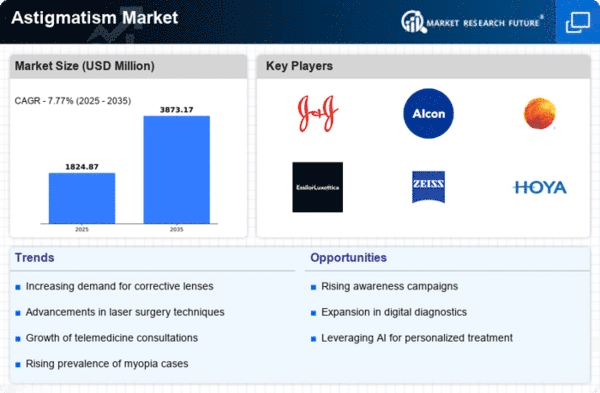
As per MRFR analysis, the Astigmatism Market Size was estimated at 1693.3 USD Million in 2024. The Astigmatism industry is projected to grow from 1844.27 USD Million in 2025 to 3873.17 USD Million by 2035, exhibiting a compound annual growth rate (CAGR) of 7.77 during the forecast period 2025 - 2035.

Key Market Trends & Highlights

The Astigmatism Market is experiencing robust growth driven by technological advancements and increasing awareness of eye health.

  • North America remains the largest market for astigmatism treatments, driven by advanced healthcare infrastructure. The Asia-Pacific region is emerging as the fastest-growing market, fueled by rising disposable incomes and increasing access to eye care services. Contact lenses dominate the market as the largest segment, while surgical procedures are witnessing the fastest growth due to innovations in vision correction. Key market drivers include technological innovations in vision correction and the increasing prevalence of astigmatism, which are shaping demand for customized eye care solutions.

Market Size & Forecast

2024 Market Size 1693.3 (USD Million)
2035 Market Size 3873.17 (USD Million)
CAGR (2025 - 2035) 7.77%
Largest Regional Market Share in 2024 North America

Major Players

Johnson & Johnson (US), Alcon (CH), Bausch + Lomb (US), CooperVision (US), EssilorLuxottica (FR), Carl Zeiss AG (DE), Hoya Corporation (JP), Ray-Ban (IT)

Market Trends

The Astigmatism Market is currently experiencing a notable evolution, driven by advancements in optical technology and an increasing awareness of eye health among the global population. As more individuals seek corrective solutions for visual impairments, the demand for innovative products such as specialized contact lenses and advanced surgical procedures is on the rise.

This shift is further supported by a growing emphasis on preventive healthcare, which encourages regular eye examinations and early detection of astigmatism. Consequently, the market landscape is becoming increasingly competitive, with various stakeholders striving to enhance their offerings and cater to diverse consumer needs.

Moreover, the Astigmatism Market is witnessing a surge in research and development activities aimed at improving treatment options. Companies are investing in cutting-edge technologies, such as wavefront-guided laser systems and customized lens designs, which promise to deliver superior visual outcomes.

Additionally, the integration of telemedicine in eye care is emerging as a potential game-changer, allowing patients to access consultations and follow-ups remotely. This trend not only enhances convenience but also expands the reach of eye care services, particularly in underserved regions.

As the market continues to evolve, it appears poised for sustained growth, driven by innovation and a heightened focus on patient-centric solutions.

Technological Advancements in Treatment

The Astigmatism Market is increasingly influenced by technological innovations that enhance treatment efficacy. New laser systems and advanced lens designs are being developed, offering patients improved visual clarity and comfort.

These advancements are likely to attract more individuals seeking effective solutions for their astigmatism.

Growing Awareness of Eye Health

There is a noticeable increase in public awareness regarding eye health, which is contributing to the growth of the Astigmatism Market. Educational campaigns and initiatives aimed at promoting regular eye check-ups are encouraging individuals to seek corrective measures, thereby expanding the consumer base.

Rise of Telemedicine in Eye Care

The integration of telemedicine into eye care services is emerging as a significant trend within the Astigmatism Market. This approach facilitates remote consultations and follow-ups, making eye care more accessible, particularly for those in remote or underserved areas. It may lead to increased patient engagement and satisfaction.

Astigmatism Market Market Drivers

Rising Geriatric Population

The global increase in the geriatric population is another significant driver of the Global Astigmatism Market Industry. As individuals age, the likelihood of developing refractive errors, including astigmatism, increases. This demographic shift is expected to lead to a higher demand for vision correction solutions.

The World Health Organization indicates that by 2030, the number of people aged 60 years and older will reach 1.4 billion, further emphasizing the need for effective eye care solutions.

Consequently, the Global Astigmatism Market Industry is likely to experience substantial growth as more elderly individuals seek corrective measures to maintain their quality of life.

Expansion of Distribution Channels

The expansion of distribution channels for vision correction products is enhancing the accessibility of solutions within the Global Astigmatism Market Industry. Retail chains, online platforms, and specialized eye care clinics are increasingly offering a variety of corrective lenses and surgical options.

This diversification in distribution not only improves availability but also fosters competitive pricing, making treatments more affordable for consumers. 

As e-commerce continues to grow, particularly in the healthcare sector, the market is expected to witness increased sales and consumer engagement. This trend is likely to support the overall growth trajectory of the market in the coming years.

Increasing Prevalence of Astigmatism

The rising prevalence of astigmatism globally is a primary driver of the Global Astigmatism Market Industry. Current estimates suggest that approximately 30% of the global population is affected by this refractive error, which can lead to blurred vision and discomfort.

As awareness of eye health increases, more individuals seek corrective measures, thereby expanding the market.

The Global Astigmatism Market Industry is projected to reach 1.83 USD Billion in 2024, indicating a robust demand for corrective lenses and surgical interventions. This trend is likely to continue as more people undergo vision screenings and seek treatment options.

Growing Awareness and Education on Eye Health

The increasing awareness and education regarding eye health are pivotal in driving the Global Astigmatism Market Industry.

Public health campaigns and initiatives by various organizations aim to inform individuals about the importance of regular eye examinations and the implications of untreated astigmatism. This heightened awareness encourages more people to seek corrective solutions, thereby expanding the market.

Additionally, educational programs in schools and communities are fostering a culture of proactive eye care. As a result, the demand for corrective lenses and surgical options is likely to rise, contributing to the projected CAGR of 6.62% from 2025 to 2035.

Technological Advancements in Treatment Options

Technological innovations in the field of ophthalmology diagnostic are significantly influencing the Global Astigmatism Market Industry.

Advancements in laser-assisted surgeries, such as LASIK and PRK, have improved the precision and outcomes of astigmatism correction. These procedures are becoming more accessible and affordable, attracting a broader demographic.

Furthermore, the development of advanced contact lenses designed specifically for astigmatism correction is also contributing to market growth. As these technologies evolve, they are expected to enhance patient satisfaction and drive the market value, which is anticipated to grow to 3.71 USD Billion by 2035.

Market Segment Insights

By Application: Contact Lenses (Largest) vs. Surgical Procedures (Fastest-Growing)

In the astigmatism market, the application segment is primarily dominated by <a href="https://www.marketresearchfuture.com/reports/contact-lenses-market-6210">contact lenses</a>, which have established themselves as the preferred choice among consumers due to their convenience and aesthetic appeal.</p> <p>Eyeglasses also hold a significant portion of the market share, but contact lenses continue to outpace them in popularity. Surgical procedures have gained traction as the market evolves, particularly with advancements in technology, appealing to a niche segment seeking long-term vision correction solutions.</p> <p> </p> <p>Diagnostic equipment plays a supporting role, providing essential tools for accurate diagnosis and treatment planning. The growth trends in this segment reveal a marked shift towards minimally invasive surgical options, with increasing consumer awareness regarding the efficiency of procedures such as LASIK and PRK.</p> <p> </p> <p>The rising acceptance of contact lenses, especially among the younger demographic seeking lifestyle compatibility, is propelling their sales.</p> <p> </p> <p>Additionally, the increasing prevalence of astigmatism and the corresponding rise in demand for personalized treatment options are further driving the growth of the surgical segment, positioning it as the fastest-growing application in the market.

<h4 style="margin-top: 25px; margin-bottom: 15px;">Contact Lenses (Dominant) vs. Eyeglasses (Emerging)</h4>

Contact lenses are currently the dominant segment in the astigmatism market due to their versatility, comfort, and the ability to provide unobstructed vision. They cater to a broad audience, including those with active lifestyles and aesthetic preferences, making them a staple choice for vision correction. On the other hand, eyeglasses are emerging as a viable option, particularly for individuals seeking a more traditional approach to vision correction.</p> <p> </p> <p>This segment is gaining popularity among older adults who may prefer the simplicity and durability of glasses. Innovations in frame design and lens technology are enhancing eyewear appeal, creating a robust market presence. As both segments evolve, the competition will intensify, leading to increased quality and varied offerings for consumers.

By End Use: Hospitals (Largest) vs. Optometry Clinics (Fastest-Growing)

In the Astigmatism Market, hospitals hold the largest share as they provide comprehensive ophthalmology services, crucial for diagnosing and treating astigmatism effectively. They are equipped with advanced diagnostic equipment and skilled ophthalmologists, ensuring high-quality care for patients.</p> <p> </p> <p>Additionally, eye care centers and optometry clinics also play significant roles, delivering specialized assessments and treatments that cater to a growing patient base. The distribution reflects a well-rounded approach to eye health, with hospitals leading the charge due to their resources and capabilities. On the other hand, optometry clinics are emerging as the fastest-growing segment within the Astigmatism Market.</p> <p> </p> <p>As more individuals seek specialized eye care, these clinics are increasingly becoming the preferred choice for timely and accessible treatments. The rise in awareness about eye health, coupled with technological advancements in optometry practices, is driving this growth.</p> <p> </p> <p>Furthermore, home care solutions are gaining traction, especially among patients preferring convenience and personalized attention in managing astigmatism-related issues.

<h4 style="margin-top: 25px; margin-bottom: 15px;">Hospitals (Dominant) vs. Home Care (Emerging)</h4>

Within the Astigmatism Market, hospitals are recognized as the dominant players, providing extensive resources and a full spectrum of services, including surgeries and consultation for astigmatism management. Their ability to offer specialized care and advanced technology underlines their significant role in treating this condition.</p> <p> </p> <p>In contrast, home care is emerging as a notable alternative, particularly for patients who prioritize convenience. It allows for personalized management of astigmatism, with initiatives aimed at remote monitoring and consultation. As home care options expand, they present an attractive avenue for individuals seeking to manage their eye health outside traditional clinical environments.

By Type of Astigmatism: Corneal Astigmatism (Largest) vs. Lenticular Astigmatism (Fastest-Growing)

In the Astigmatism Market, Corneal Astigmatism has emerged as the largest segment, owing to its high prevalence among the population. Its dominance is further solidified by the widespread adoption of corrective measures such as glasses and contact lenses specifically designed for this type.</p> <p> </p> <p>On the other hand, Lenticular Astigmatism, while lesser in market share, is recognized as the fastest-growing segment, driven by advances in targeted vision therapies and a rising awareness amongst individuals about the different forms of astigmatism that can affect vision quality.

<h4 style="margin-top: 25px; margin-bottom: 15px;">Corneal Astigmatism (Dominant) vs. Lenticular Astigmatism (Emerging)</h4>

Corneal Astigmatism is characterized by an irregular curvature of the cornea, leading to distorted vision that is commonly corrected with lenses or surgical interventions. This segment remains dominant due to its high incidence rate and the continual need for vision correction solutions.</p> <p> </p> <p>In comparison, Lenticular Astigmatism, which results from irregularities in the lens, is emerging rapidly due to technological advancements in diagnosis and treatment.</p> <p> </p> <p>As patients gain more knowledge about their options for managing astigmatism, the demand for specialized treatments for Lenticular Astigmatism grows, positioning it as a significant area for future development in the astigmatism market.

By Age Group: Adults (Largest) vs. Children (Fastest-Growing)

In the Astigmatism Market, adults represent the largest segment, often due to a combination of lifestyle factors and increased screen time that can exacerbate vision problems. This group generally accounts for the majority of prescriptions and treatment modalities, making it a focus for healthcare providers.</p> <p> </p> <p>In contrast, the children’s segment, while currently smaller, is gaining traction as awareness about eye health grows among parents. Efforts at schools to screen for vision issues are contributing to an increase in diagnoses among younger individuals. Growth trends in the astigmatism market are evolving as more adults seek corrective solutions, alongside a rising awareness of the importance of early detection in children.</p> <p> </p> <p>The market is witnessing a shift towards more personalized treatments and advanced technology, such as customized contact lenses and myopia management strategies for kids. This dual focus on adult treatment while nurturing an emerging segment in children points to a well-rounded growth trajectory, with each age group's distinct dynamics driving overall market expansion.

<h4 style="margin-top: 25px; margin-bottom: 15px;">Adults (Dominant) vs. Children (Emerging)</h4>

The adult segment is characterized by a greater prevalence of astigmatism, often linked to age-related changes in the eye. Adults typically seek comprehensive solutions that accommodate their busy lifestyles, leading to predictions of continued dominance in the market.</p> <p> </p> <p>On the other hand, the children’s segment is emerging rapidly, driven by increasing parental awareness and investment in ocular health. Specific interventions are being tailored towards children to help manage and mitigate astigmatism early on.</p> <p> </p> <p>As a result, while adults maintain a dominant role in market metrics, children are becoming a focal point for future growth, with innovative solutions designed to engage this younger demographic effectively.

By Severity Level: Mild Astigmatism (Largest) vs. Severe Astigmatism (Fastest-Growing)

In the astigmatism market, the distribution of severity levels reveals that mild astigmatism holds the largest share among patients, accounting for a significant portion of diagnosed cases. This segment's prevalence is mainly attributed to the relatively less complex visual correction needed, which appeals to many individuals seeking timely interventions.</p> <p> </p> <p>Moderate astigmatism also captures a notable share but is overshadowed by mild cases. Severe astigmatism, while less common, is gaining traction as more individuals recognize the critical need for treatment as their visual acuity declines.

<h4 style="margin-top: 25px; margin-bottom: 15px;">Mild Astigmatism (Dominant) vs. Severe Astigmatism (Emerging)</h4>

Mild astigmatism represents the most dominant segment in the astigmatism market, with a wider patient pool typically seeking correction through glasses or contact lenses. This segment is characterized by its less severe effect on vision, leading to fewer complications and a higher acceptance rate of visual aids.</p> <p> </p> <p>On the other hand, severe astigmatism is emerging rapidly as more individuals realize its impact on their lifestyle and visual functionality. Driven by advances in corrective procedures and increased awareness, the segment for severe astigmatism is evolving, with more patients opting for surgical corrections and specialized lenses to manage their condition effectively.

Get more detailed insights about Astigmatism Market Research Report- Forecast to 2035

Regional Insights

North America : Market Leader in Innovation

North America is poised to maintain its leadership in the astigmatism market, holding a significant market share of $850.0 million. The region's growth is driven by increasing awareness of eye health, advancements in optical technology, and a robust healthcare infrastructure.

Regulatory support for innovative treatments and products further fuels demand, making it a key player in the global market. 

The competitive landscape in North America is characterized by the presence of major players such as Johnson & Johnson, Bausch + Lomb, and CooperVision.

These companies are at the forefront of developing cutting-edge solutions for astigmatism, including specialized contact lenses and surgical options. The U.S. remains the largest market, supported by high healthcare spending and a focus on preventive care.

Europe : Emerging Market with Growth Potential

Europe's astigmatism market is valued at $500.0 million, driven by an aging population and increasing prevalence of vision disorders. Regulatory frameworks in countries like Germany and France are evolving to support innovative eye care solutions, enhancing market growth.

The demand for personalized vision correction options is also on the rise, contributing to the region's expansion. Leading countries in Europe include Germany, France, and the UK, where key players like EssilorLuxottica and Carl Zeiss AG are actively innovating.

The competitive landscape is marked by collaborations and partnerships aimed at enhancing product offerings. The region's focus on quality and regulatory compliance positions it well for future growth in the astigmatism market.

Asia-Pacific : Rapidly Growing Market Segment

The Asia-Pacific astigmatism market, valued at $280.0 million, is experiencing rapid growth due to rising disposable incomes and increasing awareness of eye health. Countries like Japan and Australia are leading the way, supported by government initiatives promoting eye care.

The region's diverse population and varying healthcare access levels create unique demand trends, driving market expansion. Key players such as Hoya Corporation and Alcon are capitalizing on the growing demand for innovative vision correction solutions.

The competitive landscape is evolving, with local manufacturers also entering the market. As the region continues to develop its healthcare infrastructure, the astigmatism market is expected to flourish, presenting significant opportunities for growth.

Middle East and Africa : Untapped Market Potential

The Middle East and Africa astigmatism market, valued at $63.3 million, is in its nascent stages but shows promising growth potential. Factors such as increasing urbanization, rising healthcare expenditure, and a growing awareness of eye health are driving demand.

Regulatory bodies are beginning to implement frameworks that support the introduction of advanced eye care solutions, which is crucial for market development. Countries like South Africa and the UAE are emerging as key players in the market, with local and international companies exploring opportunities.

The competitive landscape is characterized by a mix of established brands and new entrants, focusing on affordable and accessible vision correction options. As healthcare systems improve, the region is likely to see a surge in demand for astigmatism solutions.

Key Players and Competitive Insights

The Astigmatism Market is characterized by a dynamic competitive landscape, driven by increasing awareness of eye health and advancements in optical technology. Key players such as Johnson & Johnson (US), Alcon (CH), and Bausch + Lomb (US) are at the forefront, each adopting distinct strategies to enhance their market presence.
Johnson & Johnson (US) focuses on innovation in contact lens technology, particularly with their Acuvue brand, which has seen a surge in demand due to its comfort and effectiveness.
Alcon (CH), on the other hand, emphasizes surgical solutions, particularly in refractive surgery, which aligns with the growing trend towards corrective procedures. Bausch + Lomb (US) is leveraging its extensive portfolio to cater to diverse consumer needs, indicating a multifaceted approach to market engagement.
The business tactics employed by these companies include localizing manufacturing to reduce costs and optimize supply chains, which is particularly crucial in a moderately fragmented market. This competitive structure allows for a variety of players to coexist, yet the influence of major companies remains substantial, shaping market dynamics through their strategic initiatives.
In November 2025, Alcon (CH) announced a partnership with a leading telehealth provider to enhance access to eye care services, which is a significant move towards integrating digital health solutions into traditional eye care. This partnership is likely to expand Alcon's reach and improve patient outcomes, reflecting a broader trend towards digitalization in healthcare.
In October 2025, Bausch + Lomb (US) launched a new line of toric contact lenses designed specifically for astigmatism, which incorporates advanced moisture technology. This product introduction not only addresses a specific consumer need but also positions Bausch + Lomb as a leader in innovation within the astigmatism segment, potentially increasing market share.
In September 2025, Johnson & Johnson (US) expanded its Acuvue brand with a new subscription model for contact lenses, allowing consumers to receive lenses directly to their homes. This strategic move aligns with the growing trend of convenience in consumer purchasing behaviors and may enhance customer loyalty while driving sales growth.
As of December 2025, the Astigmatism Market is witnessing trends such as digitalization, sustainability, and the integration of AI technologies. Strategic alliances are increasingly shaping the competitive landscape, enabling companies to leverage shared resources and expertise.
The shift from price-based competition to a focus on innovation, technology, and supply chain reliability is evident, suggesting that future competitive differentiation will hinge on these factors.

Key Companies in the Astigmatism Market include

Industry Developments

The rise in the demand for treatment effectiveness and the various convenient approaches that are available for the treatment of astigmatism is propelling the market demand for astigmatism treatment and hence, playing an important role in the propelling rate and size of the market.

Bausch Lomb Incorporated, another prominent market company has announced the availability of Ultra for Astigmatism Market contact lenses with a cylinder power of -2.75 D. These lenses are demanded and available in power ranges from +6.00 D to -9.00 D.

These lenses are equipped with features like MoistureSeal technology that helps them to maintain 95% of their moisture for about 16 years.

Johnson Johnson is another prominent market player that has announced the US launch of expanded parameters for 1-Day Acuvue Moist brand contact lenses for astigmatism. These lenses have features like daily disposable modality with a blink-stabilized design for clear and stable vision.


Future Outlook

Astigmatism Market Future Outlook

The Astigmatism Market is projected to grow at a 7.77% CAGR from 2025 to 2035, driven by technological advancements, increasing awareness, and rising prevalence of vision disorders.

New opportunities lie in:

  • Development of advanced toric contact lenses for astigmatism correction.
  • Expansion of telemedicine platforms for remote eye examinations.
  • Investment in AI-driven diagnostic tools for personalized treatment plans.

By 2035, the Astigmatism Market is expected to achieve substantial growth and innovation.

Market Segmentation

Astigmatism Market End Use Outlook

  • Hospitals
  • Optometry Clinics
  • Eye Care Centers
  • Home Care

Astigmatism Market Age Group Outlook

  • Children
  • Adults
  • Elderly

Astigmatism Market Application Outlook

  • Contact Lenses
  • Eyeglasses
  • Surgical Procedures
  • Diagnostic Equipment

Astigmatism Market Severity Level Outlook

  • Mild Astigmatism
  • Moderate Astigmatism
  • Severe Astigmatism

Astigmatism Market Type of Astigmatism Outlook

  • Corneal Astigmatism
  • Lenticular Astigmatism
  • Mixed Astigmatism

Report Scope

MARKET SIZE 2024 1693.3(USD Million)
MARKET SIZE 2025 1844.27(USD Million)
MARKET SIZE 2035 3873.17(USD Million)
COMPOUND ANNUAL GROWTH RATE (CAGR) 7.77% (2025 - 2035)
REPORT COVERAGE Revenue Forecast, Competitive Landscape, Growth Factors, and Trends
BASE YEAR 2024
Market Forecast Period 2025 - 2035
Historical Data 2019 - 2024
Market Forecast Units USD Million
Key Companies Profiled Johnson & Johnson (US), Alcon (CH), Bausch + Lomb (US), CooperVision (US), EssilorLuxottica (FR), Carl Zeiss AG (DE), Hoya Corporation (JP), Ray-Ban (IT)
Segments Covered Application, End Use, Type of Astigmatism, Age Group, Severity Level
Key Market Opportunities Advancements in digital eye examination technologies enhance diagnosis and treatment options in the Astigmatism Market.
Key Market Dynamics Rising demand for advanced corrective lenses drives innovation and competition in the astigmatism market.
Countries Covered North America, Europe, APAC, South America, MEA

FAQs

Which region will lead the astigmatism market?

North America will lead the astigmatism market.

Name the key end users of astigmatism market.

Key end users of astigmatism market include clinics, hospitals, and others.

Who are the key players profiled in the astigmatism market?

Key players profiled in the astigmatism market include Orion Vision Group, CooperVision, Bausch &amp; Lomb Incorporated, Johnson &amp; Johnson Services, Inc., SeaVision USA, and Novartis AG, among others.

What are the key factors driving the astigmatism market?

Ageing population and rising prevalence of eye disease are the key factors driving the astigmatism market.

  1. SECTION I: EXECUTIVE SUMMARY AND KEY HIGHLIGHTS
    1. | 1.1 EXECUTIVE SUMMARY
    2. | 1.1.1 Market Overview
    3. | 1.1.2 Key Findings
    4. | 1.1.3 Market Segmentation
    5. | 1.1.4 Competitive Landscape
    6. | 1.1.5 Challenges and Opportunities
    7. | 1.1.6 Future Outlook
  2. SECTION II: SCOPING, METHODOLOGY AND MARKET STRUCTURE
    1. | 2.1 MARKET INTRODUCTION
    2. | 2.1.1 Definition
    3. | 2.1.2 Scope of the study
    4. |-- 2.1.2.1 Research Objective
    5. |-- 2.1.2.2 Assumption
    6. |-- 2.1.2.3 Limitations
    7. | 2.2 RESEARCH METHODOLOGY
    8. | 2.2.1 Overview
    9. | 2.2.2 Data Mining
    10. | 2.2.3 Secondary Research
    11. | 2.2.4 Primary Research
    12. |-- 2.2.4.1 Primary Interviews and Information Gathering Process
    13. |-- 2.2.4.2 Breakdown of Primary Respondents
    14. | 2.2.5 Forecasting Model
    15. | 2.2.6 Market Size Estimation
    16. |-- 2.2.6.1 Bottom-Up Approach
    17. |-- 2.2.6.2 Top-Down Approach
    18. | 2.2.7 Data Triangulation
    19. | 2.2.8 Validation
  3. SECTION III: QUALITATIVE ANALYSIS
    1. | 3.1 MARKET DYNAMICS
    2. | 3.1.1 Overview
    3. | 3.1.2 Drivers
    4. | 3.1.3 Restraints
    5. | 3.1.4 Opportunities
    6. | 3.2 MARKET FACTOR ANALYSIS
    7. | 3.2.1 Value chain Analysis
    8. | 3.2.2 Porter's Five Forces Analysis
    9. |-- 3.2.2.1 Bargaining Power of Suppliers
    10. |-- 3.2.2.2 Bargaining Power of Buyers
    11. |-- 3.2.2.3 Threat of New Entrants
    12. |-- 3.2.2.4 Threat of Substitutes
    13. |-- 3.2.2.5 Intensity of Rivalry
    14. | 3.2.3 COVID-19 Impact Analysis
    15. |-- 3.2.3.1 Market Impact Analysis
    16. |-- 3.2.3.2 Regional Impact
    17. |-- 3.2.3.3 Opportunity and Threat Analysis
  4. SECTION IV: QUANTITATIVE ANALYSIS
    1. | 4.1 Healthcare, BY Application (USD Million)
    2. | 4.1.1 Contact Lenses
    3. | 4.1.2 Eyeglasses
    4. | 4.1.3 Surgical Procedures
    5. | 4.1.4 Diagnostic Equipment
    6. | 4.2 Healthcare, BY End Use (USD Million)
    7. | 4.2.1 Hospitals
    8. | 4.2.2 Optometry Clinics
    9. | 4.2.3 Eye Care Centers
    10. | 4.2.4 Home Care
    11. | 4.3 Healthcare, BY Type of Astigmatism (USD Million)
    12. | 4.3.1 Corneal Astigmatism
    13. | 4.3.2 Lenticular Astigmatism
    14. | 4.3.3 Mixed Astigmatism
    15. | 4.4 Healthcare, BY Age Group (USD Million)
    16. | 4.4.1 Children
    17. | 4.4.2 Adults
    18. | 4.4.3 Elderly
    19. | 4.5 Healthcare, BY Severity Level (USD Million)
    20. | 4.5.1 Mild Astigmatism
    21. | 4.5.2 Moderate Astigmatism
    22. | 4.5.3 Severe Astigmatism
    23. | 4.6 Healthcare, BY Region (USD Million)
    24. | 4.6.1 North America
    25. |-- 4.6.1.1 US
    26. |-- 4.6.1.2 Canada
    27. | 4.6.2 Europe
    28. |-- 4.6.2.1 Germany
    29. |-- 4.6.2.2 UK
    30. |-- 4.6.2.3 France
    31. |-- 4.6.2.4 Russia
    32. |-- 4.6.2.5 Italy
    33. |-- 4.6.2.6 Spain
    34. |-- 4.6.2.7 Rest of Europe
    35. | 4.6.3 APAC
    36. |-- 4.6.3.1 China
    37. |-- 4.6.3.2 India
    38. |-- 4.6.3.3 Japan
    39. |-- 4.6.3.4 South Korea
    40. |-- 4.6.3.5 Malaysia
    41. |-- 4.6.3.6 Thailand
    42. |-- 4.6.3.7 Indonesia
    43. |-- 4.6.3.8 Rest of APAC
    44. | 4.6.4 South America
    45. |-- 4.6.4.1 Brazil
    46. |-- 4.6.4.2 Mexico
    47. |-- 4.6.4.3 Argentina
    48. |-- 4.6.4.4 Rest of South America
    49. | 4.6.5 MEA
    50. |-- 4.6.5.1 GCC Countries
    51. |-- 4.6.5.2 South Africa
    52. |-- 4.6.5.3 Rest of MEA
  5. SECTION V: COMPETITIVE ANALYSIS
    1. | 5.1 Competitive Landscape
    2. | 5.1.1 Overview
    3. | 5.1.2 Competitive Analysis
    4. | 5.1.3 Market share Analysis
    5. | 5.1.4 Major Growth Strategy in the Healthcare
    6. | 5.1.5 Competitive Benchmarking
    7. | 5.1.6 Leading Players in Terms of Number of Developments in the Healthcare
    8. | 5.1.7 Key developments and growth strategies
    9. |-- 5.1.7.1 New Product Launch/Service Deployment
    10. |-- 5.1.7.2 Merger & Acquisitions
    11. |-- 5.1.7.3 Joint Ventures
    12. | 5.1.8 Major Players Financial Matrix
    13. |-- 5.1.8.1 Sales and Operating Income
    14. |-- 5.1.8.2 Major Players R&D Expenditure. 2023
    15. | 5.2 Company Profiles
    16. | 5.2.1 Johnson & Johnson (US)
    17. |-- 5.2.1.1 Financial Overview
    18. |-- 5.2.1.2 Products Offered
    19. |-- 5.2.1.3 Key Developments
    20. |-- 5.2.1.4 SWOT Analysis
    21. |-- 5.2.1.5 Key Strategies
    22. | 5.2.2 Alcon (CH)
    23. |-- 5.2.2.1 Financial Overview
    24. |-- 5.2.2.2 Products Offered
    25. |-- 5.2.2.3 Key Developments
    26. |-- 5.2.2.4 SWOT Analysis
    27. |-- 5.2.2.5 Key Strategies
    28. | 5.2.3 Bausch + Lomb (US)
    29. |-- 5.2.3.1 Financial Overview
    30. |-- 5.2.3.2 Products Offered
    31. |-- 5.2.3.3 Key Developments
    32. |-- 5.2.3.4 SWOT Analysis
    33. |-- 5.2.3.5 Key Strategies
    34. | 5.2.4 CooperVision (US)
    35. |-- 5.2.4.1 Financial Overview
    36. |-- 5.2.4.2 Products Offered
    37. |-- 5.2.4.3 Key Developments
    38. |-- 5.2.4.4 SWOT Analysis
    39. |-- 5.2.4.5 Key Strategies
    40. | 5.2.5 EssilorLuxottica (FR)
    41. |-- 5.2.5.1 Financial Overview
    42. |-- 5.2.5.2 Products Offered
    43. |-- 5.2.5.3 Key Developments
    44. |-- 5.2.5.4 SWOT Analysis
    45. |-- 5.2.5.5 Key Strategies
    46. | 5.2.6 Carl Zeiss AG (DE)
    47. |-- 5.2.6.1 Financial Overview
    48. |-- 5.2.6.2 Products Offered
    49. |-- 5.2.6.3 Key Developments
    50. |-- 5.2.6.4 SWOT Analysis
    51. |-- 5.2.6.5 Key Strategies
    52. | 5.2.7 Hoya Corporation (JP)
    53. |-- 5.2.7.1 Financial Overview
    54. |-- 5.2.7.2 Products Offered
    55. |-- 5.2.7.3 Key Developments
    56. |-- 5.2.7.4 SWOT Analysis
    57. |-- 5.2.7.5 Key Strategies
    58. | 5.2.8 Ray-Ban (IT)
    59. |-- 5.2.8.1 Financial Overview
    60. |-- 5.2.8.2 Products Offered
    61. |-- 5.2.8.3 Key Developments
    62. |-- 5.2.8.4 SWOT Analysis
    63. |-- 5.2.8.5 Key Strategies
    64. | 5.3 Appendix
    65. | 5.3.1 References
    66. | 5.3.2 Related Reports

Healthcare Market Segmentation

Healthcare By Application (USD Million, 2025-2035)

  • Contact Lenses
  • Eyeglasses
  • Surgical Procedures
  • Diagnostic Equipment

Healthcare By End Use (USD Million, 2025-2035)

  • Hospitals
  • Optometry Clinics
  • Eye Care Centers
  • Home Care

Healthcare By Type of Astigmatism (USD Million, 2025-2035)

  • Corneal Astigmatism
  • Lenticular Astigmatism
  • Mixed Astigmatism

Healthcare By Age Group (USD Million, 2025-2035)

  • Children
  • Adults
  • Elderly

Healthcare By Severity Level (USD Million, 2025-2035)

  • Mild Astigmatism
  • Moderate Astigmatism
  • Severe Astigmatism
Infographic

Free Sample Request

Kindly complete the form below to receive a free sample of this Report

Get Free Sample

Customer Strories

Compare Licence

×
Features License Type
Single User Multiuser License Enterprise User
Price $4,950 $5,950 $7,250
Maximum User Access Limit 1 User Upto 10 Users Unrestricted Access Throughout the Organization
Free Customization
Direct Access to Analyst
Deliverable Format
Platform Access
Discount on Next Purchase 10% 15% 15%
Printable Versions