×
Request Free Sample ×

Kindly complete the form below to receive a free sample of this Report

* Please use a valid business email

Leading companies partner with us for data-driven Insights

clients tt-cursor
Hero Background
English
Chinese
French
Japanese
Korean
German
Spanish

Asperger Syndrome Market Trends

ID: MRFR/Pharma/4383-HCR
100 Pages
Rahul Gotadki
October 2025

Asperger Syndrome Market Research Report Information By Diagnosis (DSM-IV, Differential Diagnosis, GADS, KADI, Childhood Asperger Syndrome Test), by Treatment (Speech-Language Therapy, Occupational Therapy, Medication), and by End-User - Forecast Till 2035

Share:
Download PDF ×

We do not share your information with anyone. However, we may send you emails based on your report interest from time to time. You may contact us at any time to opt-out.

Asperger Syndrome Market Infographic
×
Asperger Syndrome Market Infographic Full View
Purchase Options

Market Trends

Key Emerging Trends in the Asperger Syndrome Market

It's essential to note that what was previously referred to as Asperger Syndrome is now often subsumed within Autism Spectrum Disorder (ASD) in the DSM-V diagnostic classification. Many changes have been witnessed in response to current trends in the Autism Spectrum Disorder market, including higher awareness of the condition itself, increased research into it, and growing demand for more specific treatments. One prominent trend has been early diagnosis and intervention. Improved screening tools, together with diagnostic methods, go hand-in-hand with research emphasizing benefits related to early support and therapy for people living with ASD. Such a shift will make sure that the children diagnosed with Asperger's syndrome or other forms of ASD receive the necessary support during their formative years. Personalized therapies and targeted therapies have become central focus areas within the autism spectrum markets today. In response to this variation within the spectrum, there has been an increasing movement towards individualized interventions that take into account the needs and characteristics of sufferers of Asperger Syndrome, namely PDD-NOS (pervasive developmental disorder not otherwise specified). Service provision through telehealth platforms is recognized for its potential benefits, particularly where resources are scarce, such as in remote areas. Telematics or telecommunication technology enables access to specialized care via telemedicine platforms, especially where there may be a scarcity of resources locally. "There is also the emergence of digital tools and apps to support social communication, emotional regulation, and daily living skills, which are invaluable in the management of Asperger's syndrome. Such a growth path is aligned with the bigger trend toward technology integration in healthcare, thus making such services more accessible. Inclusive education and employment initiatives are shaping trends in the market, emphasizing the importance of creating environments that accommodate individuals with Asperger Syndrome. There has been increased recognition among employers and academic institutions of skills possessed by persons who have ASD. Progress made so far in genetic research has helped understand what causes Asperger's syndrome. The impact of advocacy groups on raising awareness and increasing public knowledge is significant for the Autism Spectrum Disorder market. This means that these organizations play an important role in terms of sensitizing people about this condition, fighting stigma, and advocating for policies aimed at supporting people who are diagnosed with Asperger's syndrome or other forms of ASDs. This trend enhances a supportive society that is receptive to all its members, hence enhancing acceptance and inclusion.

Author
Rahul Gotadki
Assistant Manager

He holds an experience of about 7+ years in Market Research and Business Consulting, working under the spectrum of Life Sciences and Healthcare domains. Rahul conceptualizes and implements a scalable business strategy and provides strategic leadership to the clients. His expertise lies in market estimation, competitive intelligence, pipeline analysis, customer assessment, etc. In addition to the above, his other responsibility includes strategic tracking of high growth markets & advising clients on the potential areas of focus they could direct their business initiatives

Leave a Comment

FAQs

What is Asperger Syndrome?

Asperger syndrome is a developmental disorder characterized by repetitive behaviors, unusual preoccupations or rituals, limited range of interests, problems with social skills, communication difficulties, and coordination problems.

What is the CAGR of the Asperger Syndrome Market?

Asperger Syndrome Market is expected to exhibit a strong 3.96% CAGR over the forecast period from 2024 to 2032.

What is the major driver for the Asperger Syndrome Market?

Growing awareness about autism spectrum disorders is the major driver for the Asperger Syndrome Market.

Which is the leading regional Asperger Syndrome Market?

Americas dominate the Global Asperger Syndrome Market due to growing awareness about developmental disorders in the region.

What are the leading market players?

Leading players in the Asperger Syndrome Market include Eli Lilly, Bristol-Myers Squibb, and Shire, among others.

Market Summary

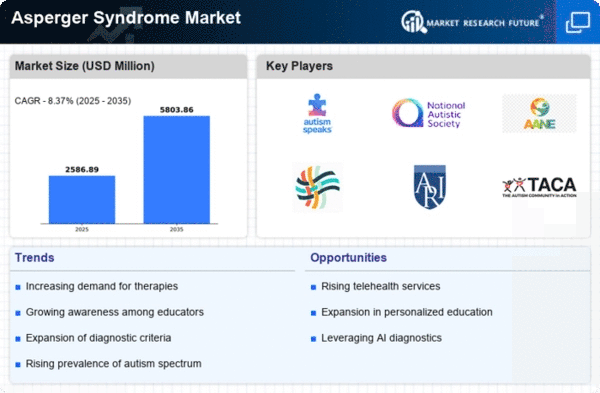
As per MRFR analysis, the Asperger Syndrome Market Size was estimated at 2387.09 USD Million in 2024. The Asperger Syndrome industry is projected to grow from 2614.25 in 2025 to 5803.86 by 2035, exhibiting a compound annual growth rate (CAGR) of 8.37 during the forecast period 2025 - 2035.

Key Market Trends & Highlights

The Asperger Syndrome Market is experiencing notable growth driven by increased awareness and technological advancements.

  • North America remains the largest market for Asperger Syndrome services, reflecting a robust demand for clinical assessments.
  • The Asia-Pacific region is emerging as the fastest-growing market, driven by rising awareness and acceptance of Asperger Syndrome.
  • The clinical assessment segment continues to dominate the market, while the behavioral evaluation segment is witnessing rapid growth.
  • Key market drivers include the rising prevalence of Asperger Syndrome and advancements in diagnostic tools, which are fueling demand across various segments.

Market Size & Forecast

2024 Market Size 2387.09 (USD Million)
2035 Market Size 5803.86 (USD Million)
CAGR (2025 - 2035) 8.37%
Largest Regional Market Share in 2024 North America

Major Players

Autism Speaks (US), National Autistic Society (GB), Asperger/Autism Network (US), Autism Society (US), Autism Research Institute (US), The Autism Community in Action (US), Autism Support Network (US), Autism Spectrum Australia (AU)

Market Trends

The Asperger Syndrome Market is currently experiencing a notable evolution, driven by a growing awareness of neurodiversity and the unique needs of individuals with Asperger Syndrome. This market encompasses a range of services, therapies, and educational resources aimed at supporting those affected by the condition. As society becomes increasingly inclusive, there is a heightened demand for tailored interventions that address the specific challenges faced by individuals on the autism spectrum. Furthermore, advancements in technology and research are contributing to a deeper understanding of Asperger Syndrome, which may lead to more effective treatment options and support mechanisms. In addition, the Asperger Syndrome Market is witnessing a shift towards holistic approaches that integrate mental health support, social skills training, and educational accommodations. Stakeholders, including healthcare providers, educators, and families, are recognizing the importance of a comprehensive strategy that fosters the development of social competencies and emotional well-being. This trend suggests a potential for collaboration among various sectors to create a more supportive environment for individuals with Asperger Syndrome, ultimately enhancing their quality of life and integration into society.

Increased Awareness and Acceptance

There is a growing recognition of Asperger Syndrome within society, leading to enhanced acceptance and understanding. This trend is fostering a more inclusive environment, which may encourage individuals to seek diagnosis and support.

Technological Advancements in Therapy

Innovations in technology are paving the way for new therapeutic tools and resources tailored for individuals with Asperger Syndrome. These advancements could improve accessibility and effectiveness of interventions.

Holistic Support Approaches

A shift towards comprehensive support strategies is emerging, emphasizing the integration of mental health services, social skills training, and educational support. This trend indicates a more collaborative effort to address the multifaceted needs of individuals with Asperger Syndrome.

Asperger Syndrome Market Market Drivers

Growing Research and Development

The increasing focus on research and development related to Asperger Syndrome Market is a notable driver for the Global Asperger Syndrome Market Industry. Academic institutions and healthcare organizations are investing in studies to better understand the condition and develop new interventions. This commitment to research is likely to yield innovative treatment options and improve diagnostic criteria. The market is projected to grow from 0.46 USD Billion in 2024 to 1.0 USD Billion by 2035, reflecting the positive impact of ongoing research efforts on the industry.

Government Initiatives and Funding

Government initiatives aimed at supporting individuals with Asperger Syndrome Market play a crucial role in shaping the Global Asperger Syndrome Market Industry. Various countries are implementing policies that promote early intervention and provide funding for research and support services. These initiatives not only enhance the availability of resources but also foster a supportive environment for affected individuals and their families. The market's growth trajectory, starting at 0.46 USD Billion in 2024, is likely to be bolstered by these efforts, with projections indicating a rise to 1.0 USD Billion by 2035, reflecting the impact of governmental support on the overall landscape.

Increasing Awareness and Diagnosis

The rising awareness surrounding Asperger Syndrome Market is a pivotal driver for the Global Asperger Syndrome Market Industry. As educational institutions and healthcare providers enhance their understanding of autism spectrum disorders, more individuals are being diagnosed. This trend is particularly evident in regions where awareness campaigns have been implemented, leading to increased identification of cases. In 2024, the market is valued at 0.46 USD Billion, reflecting the growing recognition of Asperger Syndrome Market. The proactive approach in diagnosis is expected to contribute to a compound annual growth rate of 7.31% from 2025 to 2035, potentially reaching 1.0 USD Billion by 2035.

Advancements in Therapeutic Options

Ongoing advancements in therapeutic options for individuals with Asperger Syndrome Market significantly influence the Global Asperger Syndrome Market Industry. Innovative therapies, including cognitive behavioral therapy and social skills training, are being developed and refined to cater to the unique needs of this population. These advancements not only improve the quality of life for individuals but also encourage families to seek professional help. As a result, the market is projected to grow steadily, with a valuation of 0.46 USD Billion in 2024 and an anticipated increase to 1.0 USD Billion by 2035, driven by the demand for effective treatment solutions.

Integration of Technology in Treatment

The integration of technology into treatment modalities for Asperger Syndrome Market is emerging as a significant driver in the Global Asperger Syndrome Market Industry. Teletherapy and mobile applications designed to assist individuals in developing social skills are gaining traction. These technological solutions offer accessible and flexible options for therapy, catering to a broader audience. As the market evolves, the valuation is expected to rise from 0.46 USD Billion in 2024 to 1.0 USD Billion by 2035, with a compound annual growth rate of 7.31% from 2025 to 2035. This trend underscores the potential of technology to enhance therapeutic outcomes.

Market Segment Insights

By Diagnosis Method: Clinical Assessment (Largest) vs. Behavioral Evaluation (Fastest-Growing)

In the Asperger Syndrome Market, the segmentation by diagnosis method reveals that Clinical Assessment holds the largest share, commanding the attention of practitioners and stakeholders. Meanwhile, Behavioral Evaluation is recognized as the fastest-growing segment, attracting increasing interest from both healthcare professionals and families seeking effective diagnostic avenues. These methods vary in approach and application, indicating distinct roles in the overall diagnostic landscape. As the awareness of Asperger Syndrome continues to rise, the demand for comprehensive assessment techniques strengthens as well. Behavioral Evaluation, in particular, shows significant growth potential driven by advancements in understanding autism spectrum disorders, leading to improved diagnostic frameworks. This evolution is supported by significant research investments focusing on optimizing these methods to enhance practice effectiveness and ensure timely, accurate diagnoses.

Clinical Assessment: Dominant vs. Behavioral Evaluation: Emerging

Clinical Assessment remains the dominant method in the diagnosis of Asperger Syndrome, characterized by its systematic, structured approach that combines clinical interviews and observational assessments conducted by trained professionals. This method's established credibility and familiarity among clinicians foster its widespread use, reinforcing its position in practice. Conversely, Behavioral Evaluation is emerging as a pivotal tool in the market, characterized by a more flexible approach that allows for real-time assessments based on observed behaviors and interactions. This adaptability resonates well with contemporary diagnostic needs, especially to align with the varying presentations of Asperger syndrome. With ongoing advancements in behavioral analysis techniques, this segment is poised for rapid growth, appealing to more progressive modalities in autism diagnosis.

By Age Group: Children (Largest) vs. Adults (Fastest-Growing)

In the Asperger Syndrome Market, the distribution among age groups reveals a significant concentration within the 'Children' segment. This demographic accounts for a predominant share as early diagnosis and intervention can lead to better management of symptoms, making it a focal point for many healthcare providers and resources. Meanwhile, 'Adolescents' and 'Adults' represent smaller yet crucial segments of the market, with trends indicating an increasing recognition of the condition in older age groups, aided by greater awareness and improved diagnostic measures.

Children (Dominant) vs. Adults (Emerging)

The 'Children' segment remains the dominant group in the Asperger Syndrome Market due to the early age of diagnosis and the global focus on treating and supporting children with autism spectrum disorders. Early intervention programs, parental awareness, and educational support have propelled this segment to the forefront, ensuring a plethora of resources is dedicated to it. Conversely, the 'Adults' segment is emerging rapidly as awareness of Asperger Syndrome expands, leading to a better understanding of adult diagnosis. As more adults seek help for late-diagnosed Asperger Syndrome, support networks and therapy tailored to adult needs are becoming more prominent, indicating a significant shift towards recognizing and addressing this age group’s unique challenges.

By Treatment Type: Behavioral Therapy (Largest) vs. Medication (Fastest-Growing)

In the Asperger Syndrome Market, the distribution of treatment types reveals that Behavioral Therapy holds the largest share, embraced widely due to its focus on modulating behaviors and enhancing social skills. Meanwhile, Medication has seen a rapid rise in adoption, becoming the fastest-growing segment as more healthcare providers incorporate pharmacological options to assist with related symptoms. Additionally, both Educational Support and Social Skills Training are also gaining traction, contributing to a holistic treatment approach for individuals with Asperger Syndrome. The growth trends within the Asperger Syndrome treatment landscape are influenced by a greater emphasis on personalized treatment plans that cater to the unique needs of each individual. Behavioral Therapy remains steady and reliable, while Medication is gaining momentum due to ongoing research highlighting its effectiveness in conjunction with behavioral interventions. Additionally, the increasing awareness and understanding of Asperger Syndrome among caregivers and educators further fosters demand for Educational Support and Social Skills Training, driving innovation and adoption in these areas.

Behavioral Therapy (Dominant) vs. Social Skills Training (Emerging)

Behavioral Therapy is regarded as the dominant approach in the Asperger Syndrome Market, effectively reducing maladaptive behaviors and improving emotional regulation through structured interventions and parental involvement. Its structured nature allows for customized strategies tailored to individual needs, making it a widely preferred choice among practitioners and families. On the other hand, Social Skills Training is emerging as a vital complement to Behavioral Therapy. This approach focuses on enhancing interpersonal skills and contextual social understanding, which are essential for success in real-world social interactions. As societal awareness grows, more practitioners recognize the importance of integrating Social Skills Training into comprehensive treatment plans, making it a key area of growth and development in the market.

By Support Services: Counseling (Largest) vs. Occupational Therapy (Fastest-Growing)

In the Asperger Syndrome Market, support services play a crucial role in improving the quality of life for individuals affected by this condition. Counseling is currently the largest segment, accounting for the majority share due to its foundational role in providing emotional and psychological support. Support groups also have a notable presence, offering peer support vital for social connection and shared experiences, while family therapy and occupational therapy contribute significantly by addressing familial dynamics and practical skill development, respectively. The growth trends for these services indicate a strong demand for tailored approaches in therapeutic interventions. Counseling remains essential, but occupational therapy is rapidly gaining prominence, driven by an increasing recognition of the need for practical life skills. Support groups and family therapy are also evolving, driven by the movement toward holistic care and community support, establishing a comprehensive network for individuals with Asperger syndrome.

Counseling (Dominant) vs. Support Groups (Emerging)

Counseling serves as the dominant support service in the Asperger Syndrome Market, focusing on individual emotional needs and cognitive-behavioral strategies that help manage symptoms. Therapists work closely with patients to build coping mechanisms, enhancing their ability to navigate social situations. In comparison, support groups are emerging as vital community resources, providing a platform for individuals and families to share experiences and coping strategies. These groups foster a sense of belonging and understanding, playing an essential role in social integration. As mental health awareness increases, both services are adapting; counseling continues to refine its methodologies, while support groups expand their reach, including virtual platforms, making them more accessible to a broader audience. The combination of these services enhances the overall care spectrum for those affected by Asperger syndrome.

Get more detailed insights about Asperger Syndrome Market Research Report - Forecast to 2035

Regional Insights

North America : Leading Market Innovators

North America holds a commanding position in the Asperger Syndrome market, with a market size of $1192.83M in 2024. The region benefits from robust healthcare infrastructure, increasing awareness, and supportive policies that drive demand for services and therapies. Regulatory frameworks are evolving to enhance access to care, which further propels market growth. The rising prevalence of autism spectrum disorders is also a significant driver, leading to increased funding and research initiatives. The United States is the primary contributor to this market, hosting key players such as Autism Speaks and the Autism Society. These organizations play a crucial role in advocacy, research, and support services, fostering a competitive landscape that prioritizes innovation and comprehensive care. The presence of numerous support networks and research institutions enhances collaboration, ensuring that the needs of individuals with Asperger Syndrome are met effectively.

Europe : Growing Awareness and Support

Europe's Asperger Syndrome market is witnessing significant growth, with a market size of €715.0M in 2024. The region is characterized by increasing awareness and advocacy for autism spectrum disorders, leading to enhanced support services and educational programs. Regulatory bodies are implementing policies to improve access to diagnosis and treatment, which is crucial for market expansion. The focus on early intervention and tailored therapies is also gaining traction, driving demand across various countries. Leading countries in this market include the UK, Germany, and France, where organizations like the National Autistic Society are pivotal in promoting awareness and providing resources. The competitive landscape is marked by collaborations between healthcare providers and non-profits, ensuring a comprehensive approach to care. The presence of various initiatives aimed at improving the quality of life for individuals with Asperger Syndrome further strengthens the market's growth potential.

Asia-Pacific : Emerging Market Potential

The Asia-Pacific region is emerging as a significant player in the Asperger Syndrome market, with a market size of $392.26M in 2024. Factors such as increasing awareness of autism spectrum disorders and the growing demand for specialized services are driving market growth. Governments are beginning to recognize the importance of mental health and are implementing policies to support diagnosis and treatment, which is crucial for expanding access to care in this diverse region. Countries like Australia and Japan are leading the way in developing support systems for individuals with Asperger Syndrome. Organizations such as Autism Spectrum Australia are instrumental in providing resources and advocacy. The competitive landscape is evolving, with a mix of local and international players entering the market, enhancing service offerings and fostering innovation in treatment approaches.

Middle East and Africa : Developing Support Frameworks

The Middle East and Africa region is gradually developing its Asperger Syndrome market, with a market size of $87.0M in 2024. The growth is driven by increasing awareness of autism spectrum disorders and the need for specialized services. Governments are beginning to implement policies aimed at improving mental health services, which is essential for enhancing access to care. The focus on education and community support is also gaining momentum, contributing to market development in this region. Countries such as South Africa and the UAE are taking steps to improve support for individuals with Asperger Syndrome. Local organizations are emerging to provide resources and advocacy, although the market remains fragmented. The competitive landscape is characterized by a mix of non-profits and healthcare providers working together to create a more supportive environment for individuals and families affected by Asperger Syndrome.

Key Players and Competitive Insights

The Asperger Syndrome Market is characterized by a dynamic competitive landscape, driven by increasing awareness and advocacy for autism spectrum disorders. Key players are actively engaging in various strategies to enhance their market presence and operational efficiency. Notably, Autism Speaks (US) has positioned itself as a leader in advocacy and research funding, focusing on innovative outreach programs to raise awareness and support for individuals with Asperger Syndrome. Meanwhile, the National Autistic Society (GB) emphasizes community engagement and educational initiatives, aiming to foster inclusivity and understanding within society. These strategic focuses collectively shape a competitive environment that prioritizes advocacy, education, and community support.In terms of business tactics, companies are increasingly localizing their operations to better serve specific communities, optimizing supply chains to ensure timely delivery of resources and support. The market appears moderately fragmented, with several organizations vying for influence and recognition. The collective influence of these key players is significant, as they work collaboratively and competitively to address the needs of individuals with Asperger Syndrome and their families.

In November Autism Research Institute (US) launched a new digital platform aimed at providing resources and support for families affected by Asperger Syndrome. This initiative is strategically important as it leverages technology to enhance accessibility to information and community support, reflecting a broader trend towards digital transformation in the sector. The platform is expected to facilitate better communication and resource sharing among families, thereby strengthening the community.

In October Asperger/Autism Network (US) announced a partnership with local schools to implement specialized training programs for educators. This strategic move underscores the organization's commitment to improving educational outcomes for students with Asperger Syndrome. By equipping teachers with the necessary tools and knowledge, the organization aims to foster a more inclusive educational environment, which is crucial for the development of these individuals.

In September Autism Spectrum Australia (AU) expanded its outreach programs to include remote and underserved communities. This expansion is indicative of a growing recognition of the need for equitable access to support services. By targeting these areas, the organization not only enhances its service delivery but also positions itself as a leader in addressing disparities in access to care and support for individuals with Asperger Syndrome.

As of December current trends in the Asperger Syndrome Market are increasingly defined by digitalization, sustainability, and the integration of artificial intelligence (AI) in support services. Strategic alliances among organizations are shaping the landscape, fostering collaboration that enhances resource sharing and advocacy efforts. Looking ahead, competitive differentiation is likely to evolve, with a shift from price-based competition to a focus on innovation, technology, and supply chain reliability. This evolution suggests that organizations that prioritize these aspects will be better positioned to meet the needs of individuals with Asperger Syndrome and their families.

Key Companies in the Asperger Syndrome Market include

Industry Developments

The advent of gene therapy in the Asperger syndrome industry has created tremendous growth in recent years. The modification of a defective gene or changing the characterization of the gene in the patient with the help of a harmless virus carrying a healthy gene is a very effective way of treating the condition. The FDA approval for the gene therapy in treating the Asperger syndrome is bolstering the growth of the Asperger syndrome market value.

The QBM-001 drug which helps in treating the minimal verbal disorder is considered a supreme invention in treating autism and Asperger syndrome. The RNA biomarkers combined with PMVA is utilized to accelerate the efficacy of QBM-001 is another clinical development that has received huge appreciation in the industry.


Future Outlook

Asperger Syndrome Market Future Outlook

The Asperger Syndrome Market is projected to grow at 8.37% CAGR from 2025 to 2035, driven by increased awareness, improved diagnostic tools, and enhanced therapeutic options.

New opportunities lie in:

  • Development of telehealth platforms for remote therapy sessions.
  • Creation of specialized educational programs for schools.
  • Investment in AI-driven diagnostic tools for early detection.

By 2035, the Asperger Syndrome Market is expected to be robust, reflecting substantial growth and innovation.

Market Segmentation

Asperger Syndrome Market Age Group Outlook

  • Children
  • Adolescents
  • Adults

Asperger Syndrome Market Treatment Type Outlook

  • Behavioral Therapy
  • Medication
  • Educational Support
  • Social Skills Training

Asperger Syndrome Market Diagnosis Method Outlook

  • Clinical Assessment
  • Behavioral Evaluation
  • Standardized Testing
  • Parent Interviews

Asperger Syndrome Market Support Services Outlook

  • Counseling
  • Support Groups
  • Family Therapy
  • Occupational Therapy

Report Scope

MARKET SIZE 20242387.09(USD Million)
MARKET SIZE 20252614.25(USD Million)
MARKET SIZE 20355803.86(USD Million)
COMPOUND ANNUAL GROWTH RATE (CAGR)8.37% (2025 - 2035)
REPORT COVERAGERevenue Forecast, Competitive Landscape, Growth Factors, and Trends
BASE YEAR2024
Market Forecast Period2025 - 2035
Historical Data2019 - 2024
Market Forecast UnitsUSD Million
Key Companies ProfiledAutism Speaks (US), National Autistic Society (GB), Asperger/Autism Network (US), Autism Society (US), Autism Research Institute (US), The Autism Community in Action (US), Autism Support Network (US), Autism Spectrum Australia (AU)
Segments CoveredDiagnosis Method, Age Group, Treatment Type, Support Services
Key Market OpportunitiesIntegration of digital therapeutics and personalized interventions in the Asperger Syndrome Market.
Key Market DynamicsRising awareness and acceptance of Asperger Syndrome drive demand for tailored therapeutic interventions and support services.
Countries CoveredNorth America, Europe, APAC, South America, MEA

FAQs

What is Asperger Syndrome?

Asperger syndrome is a developmental disorder characterized by repetitive behaviors, unusual preoccupations or rituals, limited range of interests, problems with social skills, communication difficulties, and coordination problems.

What is the CAGR of the Asperger Syndrome Market?

Asperger Syndrome Market is expected to exhibit a strong 3.96% CAGR over the forecast period from 2024 to 2032.

What is the major driver for the Asperger Syndrome Market?

Growing awareness about autism spectrum disorders is the major driver for the Asperger Syndrome Market.

Which is the leading regional Asperger Syndrome Market?

Americas dominate the Global Asperger Syndrome Market due to growing awareness about developmental disorders in the region.

What are the leading market players?

Leading players in the Asperger Syndrome Market include Eli Lilly, Bristol-Myers Squibb, and Shire, among others.

  1. SECTION I: EXECUTIVE SUMMARY AND KEY HIGHLIGHTS
    1. | 1.1 EXECUTIVE SUMMARY
    2. | 1.1.1 Market Overview
    3. | 1.1.2 Key Findings
    4. | 1.1.3 Market Segmentation
    5. | 1.1.4 Competitive Landscape
    6. | 1.1.5 Challenges and Opportunities
    7. | 1.1.6 Future Outlook
  2. SECTION II: SCOPING, METHODOLOGY AND MARKET STRUCTURE
    1. | 2.1 MARKET INTRODUCTION
    2. | 2.1.1 Definition
    3. | 2.1.2 Scope of the study
    4. |-- 2.1.2.1 Research Objective
    5. |-- 2.1.2.2 Assumption
    6. |-- 2.1.2.3 Limitations
    7. | 2.2 RESEARCH METHODOLOGY
    8. | 2.2.1 Overview
    9. | 2.2.2 Data Mining
    10. | 2.2.3 Secondary Research
    11. | 2.2.4 Primary Research
    12. |-- 2.2.4.1 Primary Interviews and Information Gathering Process
    13. |-- 2.2.4.2 Breakdown of Primary Respondents
    14. | 2.2.5 Forecasting Model
    15. | 2.2.6 Market Size Estimation
    16. |-- 2.2.6.1 Bottom-Up Approach
    17. |-- 2.2.6.2 Top-Down Approach
    18. | 2.2.7 Data Triangulation
    19. | 2.2.8 Validation
  3. SECTION III: QUALITATIVE ANALYSIS
    1. | 3.1 MARKET DYNAMICS
    2. | 3.1.1 Overview
    3. | 3.1.2 Drivers
    4. | 3.1.3 Restraints
    5. | 3.1.4 Opportunities
    6. | 3.2 MARKET FACTOR ANALYSIS
    7. | 3.2.1 Value chain Analysis
    8. | 3.2.2 Porter's Five Forces Analysis
    9. |-- 3.2.2.1 Bargaining Power of Suppliers
    10. |-- 3.2.2.2 Bargaining Power of Buyers
    11. |-- 3.2.2.3 Threat of New Entrants
    12. |-- 3.2.2.4 Threat of Substitutes
    13. |-- 3.2.2.5 Intensity of Rivalry
    14. | 3.2.3 COVID-19 Impact Analysis
    15. |-- 3.2.3.1 Market Impact Analysis
    16. |-- 3.2.3.2 Regional Impact
    17. |-- 3.2.3.3 Opportunity and Threat Analysis
  4. SECTION IV: QUANTITATIVE ANALYSIS
    1. | 4.1 Healthcare, BY Diagnosis Method (USD Million)
    2. | 4.1.1 Clinical Assessment
    3. | 4.1.2 Behavioral Evaluation
    4. | 4.1.3 Standardized Testing
    5. | 4.1.4 Parent Interviews
    6. | 4.2 Healthcare, BY Age Group (USD Million)
    7. | 4.2.1 Children
    8. | 4.2.2 Adolescents
    9. | 4.2.3 Adults
    10. | 4.3 Healthcare, BY Treatment Type (USD Million)
    11. | 4.3.1 Behavioral Therapy
    12. | 4.3.2 Medication
    13. | 4.3.3 Educational Support
    14. | 4.3.4 Social Skills Training
    15. | 4.4 Healthcare, BY Support Services (USD Million)
    16. | 4.4.1 Counseling
    17. | 4.4.2 Support Groups
    18. | 4.4.3 Family Therapy
    19. | 4.4.4 Occupational Therapy
    20. | 4.5 Healthcare, BY Region (USD Million)
    21. | 4.5.1 North America
    22. |-- 4.5.1.1 US
    23. |-- 4.5.1.2 Canada
    24. | 4.5.2 Europe
    25. |-- 4.5.2.1 Germany
    26. |-- 4.5.2.2 UK
    27. |-- 4.5.2.3 France
    28. |-- 4.5.2.4 Russia
    29. |-- 4.5.2.5 Italy
    30. |-- 4.5.2.6 Spain
    31. |-- 4.5.2.7 Rest of Europe
    32. | 4.5.3 APAC
    33. |-- 4.5.3.1 China
    34. |-- 4.5.3.2 India
    35. |-- 4.5.3.3 Japan
    36. |-- 4.5.3.4 South Korea
    37. |-- 4.5.3.5 Malaysia
    38. |-- 4.5.3.6 Thailand
    39. |-- 4.5.3.7 Indonesia
    40. |-- 4.5.3.8 Rest of APAC
    41. | 4.5.4 South America
    42. |-- 4.5.4.1 Brazil
    43. |-- 4.5.4.2 Mexico
    44. |-- 4.5.4.3 Argentina
    45. |-- 4.5.4.4 Rest of South America
    46. | 4.5.5 MEA
    47. |-- 4.5.5.1 GCC Countries
    48. |-- 4.5.5.2 South Africa
    49. |-- 4.5.5.3 Rest of MEA
  5. SECTION V: COMPETITIVE ANALYSIS
    1. | 5.1 Competitive Landscape
    2. | 5.1.1 Overview
    3. | 5.1.2 Competitive Analysis
    4. | 5.1.3 Market share Analysis
    5. | 5.1.4 Major Growth Strategy in the Healthcare
    6. | 5.1.5 Competitive Benchmarking
    7. | 5.1.6 Leading Players in Terms of Number of Developments in the Healthcare
    8. | 5.1.7 Key developments and growth strategies
    9. |-- 5.1.7.1 New Product Launch/Service Deployment
    10. |-- 5.1.7.2 Merger & Acquisitions
    11. |-- 5.1.7.3 Joint Ventures
    12. | 5.1.8 Major Players Financial Matrix
    13. |-- 5.1.8.1 Sales and Operating Income
    14. |-- 5.1.8.2 Major Players R&D Expenditure. 2023
    15. | 5.2 Company Profiles
    16. | 5.2.1 Autism Speaks (US)
    17. |-- 5.2.1.1 Financial Overview
    18. |-- 5.2.1.2 Products Offered
    19. |-- 5.2.1.3 Key Developments
    20. |-- 5.2.1.4 SWOT Analysis
    21. |-- 5.2.1.5 Key Strategies
    22. | 5.2.2 National Autistic Society (GB)
    23. |-- 5.2.2.1 Financial Overview
    24. |-- 5.2.2.2 Products Offered
    25. |-- 5.2.2.3 Key Developments
    26. |-- 5.2.2.4 SWOT Analysis
    27. |-- 5.2.2.5 Key Strategies
    28. | 5.2.3 Asperger/Autism Network (US)
    29. |-- 5.2.3.1 Financial Overview
    30. |-- 5.2.3.2 Products Offered
    31. |-- 5.2.3.3 Key Developments
    32. |-- 5.2.3.4 SWOT Analysis
    33. |-- 5.2.3.5 Key Strategies
    34. | 5.2.4 Autism Society (US)
    35. |-- 5.2.4.1 Financial Overview
    36. |-- 5.2.4.2 Products Offered
    37. |-- 5.2.4.3 Key Developments
    38. |-- 5.2.4.4 SWOT Analysis
    39. |-- 5.2.4.5 Key Strategies
    40. | 5.2.5 Autism Research Institute (US)
    41. |-- 5.2.5.1 Financial Overview
    42. |-- 5.2.5.2 Products Offered
    43. |-- 5.2.5.3 Key Developments
    44. |-- 5.2.5.4 SWOT Analysis
    45. |-- 5.2.5.5 Key Strategies
    46. | 5.2.6 The Autism Community in Action (US)
    47. |-- 5.2.6.1 Financial Overview
    48. |-- 5.2.6.2 Products Offered
    49. |-- 5.2.6.3 Key Developments
    50. |-- 5.2.6.4 SWOT Analysis
    51. |-- 5.2.6.5 Key Strategies
    52. | 5.2.7 Autism Support Network (US)
    53. |-- 5.2.7.1 Financial Overview
    54. |-- 5.2.7.2 Products Offered
    55. |-- 5.2.7.3 Key Developments
    56. |-- 5.2.7.4 SWOT Analysis
    57. |-- 5.2.7.5 Key Strategies
    58. | 5.2.8 Autism Spectrum Australia (AU)
    59. |-- 5.2.8.1 Financial Overview
    60. |-- 5.2.8.2 Products Offered
    61. |-- 5.2.8.3 Key Developments
    62. |-- 5.2.8.4 SWOT Analysis
    63. |-- 5.2.8.5 Key Strategies
    64. | 5.3 Appendix
    65. | 5.3.1 References
    66. | 5.3.2 Related Reports

Healthcare Market Segmentation

Healthcare By Diagnosis Method (USD Million, 2025-2035)

  • Clinical Assessment
  • Behavioral Evaluation
  • Standardized Testing
  • Parent Interviews

Healthcare By Age Group (USD Million, 2025-2035)

  • Children
  • Adolescents
  • Adults

Healthcare By Treatment Type (USD Million, 2025-2035)

  • Behavioral Therapy
  • Medication
  • Educational Support
  • Social Skills Training

Healthcare By Support Services (USD Million, 2025-2035)

  • Counseling
  • Support Groups
  • Family Therapy
  • Occupational Therapy
Infographic

Free Sample Request

Kindly complete the form below to receive a free sample of this Report

Get Free Sample

Customer Strories

Compare Licence

×
Features License Type
Single User Multiuser License Enterprise User
Price $4,950 $5,950 $7,250
Maximum User Access Limit 1 User Upto 10 Users Unrestricted Access Throughout the Organization
Free Customization
Direct Access to Analyst
Deliverable Format
Platform Access
Discount on Next Purchase 10% 15% 15%
Printable Versions