Request Free Sample ×

Kindly complete the form below to receive a free sample of this Report

* Please use a valid business email

Leading companies partner with us for data-driven Insights

clients tt-cursor
Hero Background
English
Chinese
French
Japanese
Korean
German
Spanish

Asia Pacific Polylactic Acid PLA Packaging Market Analysis

ID: MRFR/PCM/11158-HCR
128 Pages
Sakshi Gupta
April 2026

Asia Pacific Polylactic Acid [PLA] Packaging Market Research Report: Information By Type (Racemic PLLA (Poly-l-lactic acid), PDLA (Poly-d-lactic acid), Regular PLLA (Poly-l-lactic acid), PDLLA (Poly-dl-lactic acid) and PLA Blends), By Raw Material (Sugarcane, Corn, Cassava, Sugar Beet and Others), By Form (Films and Sheets, Coatings, Fibre and Others), By Application (Packaging, Transport, Agriculture, Medical, Electronics, Textile, Hygiene and Others), By End User (Plastic Films, Bottles and Biodegradable Medical Devices) – and Asia Pacific Market Forecast Till 2035

Share:
Download PDF ×

We do not share your information with anyone. However, we may send you emails based on your report interest from time to time. You may contact us at any time to opt-out.

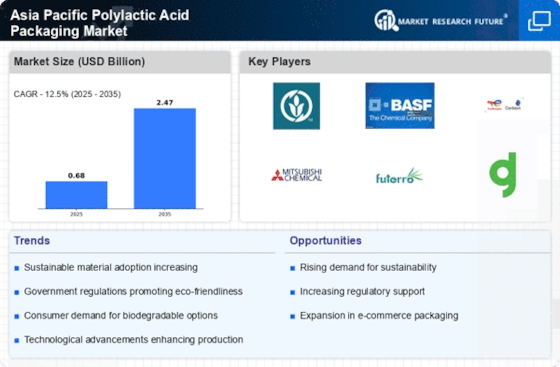
Asia Pacific Polylactic Acid PLA Packaging Market Infographic
Purchase Options

Market Analysis

In-depth Analysis of Asia Pacific Polylactic Acid PLA Packaging Market Industry Landscape

The Asia Pacific Polylactic Acid packaging industry is changing due to supply, demand, and market trends. Growing awareness and emphasis on environmental sustainability drives regional market dynamics.

Regulations encouraging bio-based and biodegradable materials also affect the region's business dynamics. Policies and laws in China, Japan, and South Korea promote sustainable packaging. This legislative drive has spurred PLA packaging producers to invest in innovative technology and broaden their product lines.

The shifting customer tastes and growing knowledge of the environmental impact of traditional packaging materials also affect market dynamics. Asia Pacific customers are becoming increasingly environmentally concerned, driving demand for sustainable products. This customer behavior shift is prompting manufacturers and retailers to adopt PLA packaging solutions, growing the market.

As disposable income and urbanization rise in Asia Pacific, consumer consumption patterns and preferences change. This is driving demand for convenient, attractive, and eco-friendly packaging. PLA packaging's adaptability and eco-friendliness make it ideal for meeting these changing customer expectations, fueling its market dynamics.

Competition in the Asia Pacific PLA packaging industry is split between established and growing local manufacturers. Global corporations are partnering, collaborating, and acquiring in the region to benefit on the growing demand for sustainable packaging solutions. Regional players are also concentrating on product differentiation and cost-effectiveness to compete.

The Asia Pacific PLA packaging industry is also influenced by raw material availability. The availability and cost of PLA basic materials like corn starch affect packaging pricing and profitability. Market actors must be agile and adaptable to raw material price fluctuations and supply chain interruptions.

Author
Author Profile
Sakshi Gupta
Team Lead - Research

Currently a Team Lead in consumer goods, FMCG, and F&B, she translates rigorous research into decisive strategy. She develops GTM roadmaps, pricing architectures, and competitive benchmarks for companies across Europe, the US, and APAC. She synthesize insights, align cross-functional teams, and drive execution from brief to measurable outcomes. She leads end-to-end engagements with crisp analysis, compelling storytelling, and a strong command of Power BI, Tableau, SQL, and advanced research platforms.

Leave a Comment

FAQs

What is the projected market valuation of the Asia Pacific Polylactic Acid (PLA) Packaging Market by 2035?

<p>The projected market valuation for the Asia Pacific PLA Packaging Market is 2.466 USD Billion by 2035.</p>

What was the market valuation of the Asia Pacific PLA Packaging Market in 2024?

<p>The overall market valuation of the Asia Pacific PLA Packaging Market was 0.675 USD Billion in 2024.</p>

What is the expected CAGR for the Asia Pacific PLA Packaging Market during the forecast period 2025 - 2035?

<p>The expected CAGR for the Asia Pacific PLA Packaging Market during the forecast period 2025 - 2035 is 12.5%.</p>

Which companies are considered key players in the Asia Pacific PLA Packaging Market?

<p>Key players in the Asia Pacific PLA Packaging Market include NatureWorks LLC, BASF SE, TotalEnergies Corbion, and Mitsubishi Chemical Corporation.</p>

What are the main segments of the Asia Pacific PLA Packaging Market?

<p>The main segments of the Asia Pacific PLA Packaging Market include Type, Raw Material, Form, Application, and End User.</p>

What is the valuation of the Regular PLLA segment in the Asia Pacific PLA Packaging Market?

The valuation of the Regular PLLA (Poly-l-lactic acid) segment was 0.225 USD Billion in 2024 and is projected to reach 0.845 USD Billion by 2035.

How does the valuation of Corn as a raw material compare to other materials in the Asia Pacific PLA Packaging Market?

Corn had a valuation of 0.225 USD Billion in 2024, which is higher than Cassava and Sugar Beet, but lower than Others, which was valued at 0.195 USD Billion.

What applications are driving growth in the Asia Pacific PLA Packaging Market?

The primary applications driving growth in the Asia Pacific PLA Packaging Market include Packaging, Transport, and Medical, with Packaging valued at 0.25 USD Billion in 2024.

What is the projected valuation for the Films and Sheets segment by 2035?

The projected valuation for the Films and Sheets segment in the Asia Pacific PLA Packaging Market is 1.025 USD Billion by 2035.

What is the significance of biodegradable medical devices in the Asia Pacific PLA Packaging Market?

Biodegradable medical devices are projected to have a valuation of 0.766 USD Billion by 2035, indicating their growing importance in the market.

Market Summary

As per Market Research Future analysis, the Asia Pacific Polylactic Acid [PLA] Packaging Market was estimated at 0.675 USD Billion in 2024. The PLA packaging industry is projected to grow from USD 0.7594 Billion in 2025 to USD 2.466 Billion by 2035, exhibiting a compound annual growth rate (CAGR) of 12.5% during the forecast period 2025 - 2035

Key Market Trends & Highlights

The Asia Pacific Polylactic Acid (PLA) Packaging Market is poised for substantial growth driven by sustainability and technological advancements.

  • The market is increasingly characterized by a strong focus on sustainability, reflecting a broader global trend.
  • Technological advancements in bioplastics are enhancing the performance and applications of PLA packaging.
  • North America remains the largest market, while Asia-Pacific is recognized as the fastest-growing region in PLA packaging.
  • Key drivers such as consumer awareness and demand for sustainable products, alongside regulatory support, are propelling market expansion.

Market Size & Forecast

2024 Market Size 0.675 (USD Billion)
2035 Market Size 2.466 (USD Billion)
CAGR (2025 - 2035) 12.5%
Largest Regional Market Share in 2024 Asia Pacific

Major Players

NatureWorks LLC (US), BASF SE (DE), TotalEnergies Corbion (NL), Mitsubishi Chemical Corporation (JP), Futerro (BE), Green Dot Bioplastics (US), Novamont S.p.A. (IT), Bioplastics International (AU), Plantic Technologies Limited (AU)

Market Trends

The Asia Pacific Polylactic Acid [PLA] Packaging Market is currently experiencing a notable shift towards sustainable materials, driven by increasing environmental awareness among consumers and businesses alike. This trend appears to be fostering a growing demand for biodegradable and compostable packaging solutions, which are perceived as more eco-friendly alternatives to traditional plastics. As companies strive to enhance their sustainability profiles, the adoption of PLA packaging is likely to gain momentum, particularly in sectors such as food and beverage, cosmetics, and consumer goods. Furthermore, regulatory frameworks across various countries in the Asia Pacific region are increasingly favoring the use of bioplastics, which may further bolster market growth. In addition to sustainability, innovation in manufacturing processes is emerging as a key factor influencing the Asia Pacific Polylactic Acid [PLA] Packaging Market. Advances in technology are enabling the production of PLA materials that exhibit improved performance characteristics, such as enhanced barrier properties and durability. This evolution could potentially expand the applications of PLA packaging, making it a viable option for a broader range of products. As the market continues to evolve, collaboration between manufacturers, researchers, and policymakers will likely play a crucial role in addressing challenges and unlocking new opportunities for growth in this dynamic sector.

Sustainability Focus

The emphasis on sustainable packaging solutions is becoming increasingly pronounced, as consumers and businesses prioritize eco-friendly options. This trend is likely to drive the demand for PLA packaging, which is recognized for its biodegradable properties.

Technological Advancements

Innovations in production techniques are enhancing the performance of PLA materials, making them more competitive with traditional packaging options. These advancements may lead to broader applications and increased market penetration.

Regulatory Support

Government policies across the Asia Pacific region are increasingly favoring bioplastics, including PLA. This regulatory support could create a more favorable environment for the growth of the PLA packaging market.

Asia Pacific Polylactic Acid PLA Packaging Market Market Drivers

Regulatory Support

Regulatory support is emerging as a significant driver for the Asia Pacific Polylactic Acid [PLA] Packaging Market. Governments across the region are implementing stringent regulations aimed at reducing plastic waste and promoting sustainable packaging solutions. Initiatives such as bans on single-use plastics and incentives for biodegradable materials are encouraging businesses to transition towards PLA packaging. For instance, several countries in Asia Pacific have introduced policies that favor the use of bioplastics, which is likely to boost the adoption of PLA in various sectors. Market data indicates that regions with supportive regulatory frameworks are experiencing a faster growth rate in PLA packaging adoption, with projections suggesting a potential increase of 20% in market size over the next few years. This regulatory landscape not only fosters innovation but also aligns with global sustainability goals.

Sustainability Focus

The increasing emphasis on sustainability is a primary driver for the Asia Pacific Polylactic Acid [PLA] Packaging Market. As consumers become more environmentally conscious, there is a growing demand for biodegradable and compostable packaging solutions. This shift is evident in various sectors, including food and beverage, where companies are actively seeking alternatives to traditional plastic packaging. The Asia Pacific region is witnessing a surge in investments aimed at developing sustainable packaging materials, with PLA being at the forefront due to its renewable nature. Market data indicates that the demand for sustainable packaging is projected to grow at a compound annual growth rate (CAGR) of over 10% in the coming years, further solidifying PLA's position in the packaging landscape. This trend not only aligns with consumer preferences but also encourages manufacturers to innovate and adopt eco-friendly practices.

Investment in Bioplastics

Investment in bioplastics is a pivotal driver for the Asia Pacific Polylactic Acid [PLA] Packaging Market. With the increasing recognition of the environmental benefits of bioplastics, investors are channeling funds into the development and production of PLA materials. This influx of capital is facilitating advancements in production technologies and expanding the capacity for PLA manufacturing. Market data indicates that investments in bioplastics are projected to reach USD 5 billion by 2027, with a significant portion allocated to PLA packaging solutions. This financial backing is likely to enhance the competitiveness of PLA in the packaging sector, as manufacturers are better equipped to innovate and meet the rising demand for sustainable alternatives. As investment continues to grow, the PLA packaging market is poised for substantial expansion, potentially doubling its market size within the next decade.

Technological Advancements

Technological advancements play a crucial role in shaping the Asia Pacific Polylactic Acid [PLA] Packaging Market. Innovations in production processes and material formulations are enhancing the performance characteristics of PLA, making it a more viable option for various applications. Recent developments in biopolymer technology have led to improved barrier properties and thermal resistance of PLA, expanding its usability in packaging. Furthermore, advancements in recycling technologies are facilitating the recovery and reuse of PLA materials, thereby promoting a circular economy. Market data suggests that the introduction of new processing techniques could potentially increase the market share of PLA packaging by 15% over the next five years. As manufacturers continue to invest in research and development, the technological landscape of PLA packaging is expected to evolve, offering more efficient and sustainable solutions.

Consumer Awareness and Demand

Consumer awareness and demand for eco-friendly products are driving the Asia Pacific Polylactic Acid [PLA] Packaging Market. As consumers become more informed about the environmental impact of packaging materials, there is a noticeable shift towards products that utilize sustainable packaging solutions. This trend is particularly pronounced among younger demographics, who are increasingly prioritizing sustainability in their purchasing decisions. Market data reveals that approximately 70% of consumers in the Asia Pacific region are willing to pay a premium for products packaged in environmentally friendly materials, including PLA. This growing consumer preference is prompting manufacturers to adopt PLA packaging as a means to differentiate their products in a competitive market. As awareness continues to rise, the demand for PLA packaging is expected to escalate, potentially leading to a market growth rate of 12% annually.


Market Segment Insights

By Type: Racemic PLLA (Largest) vs. PDLA (Fastest-Growing)

In the Asia Pacific Polylactic Acid (PLA) Packaging Market, the type segment showcases a diverse distribution of products, prominently featuring Racemic PLLA as the largest player. This segment benefits from a wide application in various packaging forms, appealing to manufacturers focused on sustainability. Meanwhile, PDLA emerges as the fastest-growing segment, driven by its advantages in thermoplastic properties and its increasing use in innovative packaging solutions, making it appealing to a wider array of consumers and industries. Recent trends indicate a significant shift towards more environmentally friendly packaging solutions, with all types of PLA being favored due to their biocompatibility and biodegradability. The demand for <a href="https://www.marketresearchfuture.com/reports/sustainable-packaging-solutions-market-67956" target="_blank" title="sustainable packaging solutions">sustainable packaging solutions</a> has surged, driven by regulatory changes and consumer preferences in the Asia Pacific region. This growing awareness coupled with technological advancements in the production of PLA is poised to further enhance the competitiveness of these segments within the market.

Racemic PLLA (Dominant) vs. PDLA (Emerging)

Racemic PLLA is currently the dominant type in the Asia Pacific PLA Packaging Market due to its well-established production processes and cost-effectiveness. Its versatility in applications, from food packaging to medical applications, reinforces its position in the market. On the other hand, PDLA is recognized as an emerging player, thanks to its superior mechanical properties and the potential for biodegradable applications. As sustainability becomes a pressing concern, PDLA is gaining traction among manufacturers who aim to produce high-performance yet eco-friendly packaging. The growth trajectory for PDLA suggests a burgeoning interest from industries seeking innovative solutions, paving the way for it to capture a significant share of the market in the coming years.

By Raw Material: Corn (Largest) vs. Sugarcane (Fastest-Growing)

In the Asia Pacific Polylactic Acid (PLA) Packaging Market, the raw material segment showcases a diverse range of sources, with corn leading as the largest contributor. Corn's inherent advantages, such as high yield and established processing techniques, have solidified its position in the market. Following corn, sugarcane is gaining traction, particularly in regions focused on sustainable practices and renewable resources. Other materials, including cassava and sugar beet, though smaller in market share, are valued for their unique properties and are steadily contributing to the market's evolution. The growth trends within the raw material segment are influenced by increasing demand for eco-friendly packaging solutions and a shift towards using renewable resources. As consumer awareness around sustainability heightens, materials like sugarcane are poised to accelerate in growth, appealing to companies aiming to enhance their environmental footprint. Corn's dominance is expected to be challenged as innovations and investment in alternative raw materials drive their emergence, creating a dynamic competitive landscape within the PLA packaging sector.

Corn (Dominant) vs. Sugarcane (Emerging)

The dominant position of corn in the Asia Pacific PLA packaging market is attributed to its widespread availability and robust supply chain. Its high starch content enables efficient fermentation processes, making it an ideal candidate for PLA production. Corn's established infrastructure and processing capabilities offer manufacturers reliability in sourcing. In contrast, sugarcane is an emerging player, marked by rapid growth and increasing interest among eco-conscious companies. Characterized by a lower carbon footprint, sugarcane gets attention for its sustainable attributes. Emerging innovations in extraction and processing methods enhance its viability as a raw material for PLA. As manufacturers look for alternatives to traditional fossil fuels, the competitive dynamics between corn and sugarcane will remain a focal point, illustrating the need for versatility in sourcing raw materials.

By Form: Films and Sheets (Largest) vs. Coatings (Fastest-Growing)

In the Asia Pacific Polylactic Acid (PLA) Packaging Market, the Forms segment is key to understanding material selection, with 'Films and Sheets' acquiring the largest market share. This segment benefits from the high demand for sustainable packaging solutions across various industries, including food and beverage, consumer goods, and pharmaceuticals. The availability of innovative films and sheets tailored for specific applications further consolidates its dominant position in the market. Conversely, 'Coatings' are emerging as the fastest-growing category within this segment, spurred by the increasing need for biodegradable solutions that enhance product protection and shelf life. As environmental concerns drive the demand for sustainable options, manufacturers are keen to develop advanced coatings that provide functional benefits while aligning with eco-friendly practices, propelling the segment to new heights in the competitive landscape.

Films and Sheets (Dominant) vs. Coatings (Emerging)

The Films and Sheets segment holds a dominant position in the Asia Pacific PLA Packaging Market, driven by its versatility and effectiveness in various applications. Films are widely used in food packaging, providing barrier properties that extend shelf life while being biodegradable. This segment is expected to thrive due to continuous innovations in film technology, focusing on customized solutions that meet diverse customer needs. On the other hand, the Coatings segment is characterized by emerging trends that emphasize sustainability and enhanced performance. Coatings are rapidly gaining traction for their ability to provide moisture barrier protection and serve as a surface treatment that maintains the integrity of the packaging. This shift towards eco-friendly coating solutions highlights a growing preference for sustainable practices among consumers and manufacturers alike.

By Application: Packaging (Largest) vs. Agriculture (Fastest-Growing)

In the Asia Pacific Polylactic Acid (PLA) Packaging Market, the application segment is diverse, with packaging holding the largest share. This segment is primarily driven by the increasing demand for sustainable and biodegradable materials among consumers and industries. As businesses align with environmental sustainability goals, the preference for PLA in packaging applications has surged significantly. Agriculture, while smaller in comparison, is emerging rapidly due to innovations in farming practices and the adoption of biodegradable mulch and plant pots, which supports eco-friendly agricultural methods.

Packaging: Dominant vs. Agriculture: Emerging

The packaging segment stands out as the dominant application in the Asia Pacific PLA market. It leverages the growing consumer awareness of environmental concerns, leading to increased use in food and beverage packaging, where biodegradability is a priority. In contrast, the agriculture segment has shown significant potential for growth, being recognized for its utility in producing compostable films and containers for farming use. This trend is propelled by the escalating need for sustainable farming solutions. Both segments illustrate how PLA can cater to environmentally conscious sectors, yet they target different consumer needs and market demands.

By End User: Plastic Films (Largest) vs. Bottles (Fastest-Growing)

In the Asia Pacific Polylactic Acid (PLA) Packaging Market, the distribution of market share value among the end user segments is primarily led by <a href="https://www.marketresearchfuture.com/reports/plastic-films-market-3002" target="_blank" title="plastic films">plastic films</a>, which capture the largest portion. This segment has gained significant traction due to its widespread application in food packaging, which demands eco-friendly alternatives. Bottles follow as the fastest-growing segment, fueled by the rising consumer preference for sustainable packaging solutions in beverages and personal care items.

Plastic Films (Dominant) vs. Bottles (Emerging)

Plastic films are currently the dominant segment in the Asia Pacific PLA packaging market, known for their versatility and superior performance in protecting products. They cater primarily to the food industry, where the demand for biodegradable and environmentally friendly materials is surging. On the other hand, bottles represent an emerging category, experiencing rapid growth as brands pivot towards sustainable packaging. The introduction of new regulations and increasing awareness around plastic waste have catalyzed this shift, leading to innovation in the design and application of PLA bottles, making them a competitive choice for manufacturers aiming to appeal to eco-conscious consumers.

Get more detailed insights about Asia Pacific Polylactic Acid [PLA] Packaging Market Research Report—Forecast till 2035

Regional Insights

North America : Sustainable Innovation Leader

The North American Polylactic Acid (PLA) packaging market is driven by increasing consumer awareness regarding sustainability and stringent regulations on plastic waste. The U.S. holds the largest market share at approximately 60%, followed by Canada at around 25%. Regulatory initiatives, such as the U.S. Environmental Protection Agency's focus on reducing plastic pollution, are further propelling market growth. Key players like NatureWorks LLC and Green Dot Bioplastics are leading the charge in innovation and production capacity. The competitive landscape is characterized by significant investments in R&D to enhance PLA properties and applications. The presence of established companies and a growing number of startups is fostering a dynamic market environment, making North America a hub for sustainable packaging solutions.

Europe : Regulatory-Driven Market Growth

The European Polylactic Acid (PLA) packaging market is significantly influenced by the European Union's stringent regulations on single-use plastics and a strong commitment to sustainability. Germany and France are the largest markets, holding approximately 35% and 20% of the market share, respectively. The EU's Green Deal aims to make Europe climate-neutral by 2050, which is a major catalyst for the growth of bioplastics. Leading countries are investing heavily in bioplastics technology, with companies like BASF SE and TotalEnergies Corbion at the forefront. The competitive landscape is marked by collaborations between manufacturers and research institutions to innovate and improve PLA applications. The presence of a robust regulatory framework is driving investments and consumer acceptance, positioning Europe as a leader in the sustainable packaging sector.

Asia-Pacific : Emerging Market Potential

The Asia-Pacific Polylactic Acid (PLA) packaging market is witnessing rapid growth, driven by increasing environmental concerns and government initiatives promoting biodegradable materials. China and Japan are the largest markets, accounting for approximately 40% and 25% of the market share, respectively. The region's focus on reducing plastic waste and enhancing recycling capabilities is a significant growth driver. Countries like Australia and South Korea are also emerging as key players in the PLA market, with a growing number of local manufacturers entering the space. The competitive landscape features companies such as Mitsubishi Chemical Corporation and Bioplastics International, which are investing in expanding production capacities. The region's diverse applications for PLA packaging, from food to consumer goods, are further fueling market expansion.

Middle East and Africa : Untapped Market Opportunities

The Middle East and Africa (MEA) Polylactic Acid (PLA) packaging market is still in its nascent stages but presents significant growth opportunities. The region is gradually recognizing the importance of sustainable packaging solutions, driven by increasing environmental awareness and regulatory pressures. South Africa and the UAE are the leading markets, holding approximately 30% and 20% of the market share, respectively. Government initiatives aimed at reducing plastic waste are beginning to catalyze market growth. The competitive landscape is characterized by a limited number of key players, with companies like Plantic Technologies Limited and Futerro starting to establish a presence. The region's potential for growth is further enhanced by increasing investments in bioplastics technology and a growing demand for eco-friendly packaging solutions across various sectors, including food and beverage.

Key Players and Competitive Insights

Leading market players are investing heavily in research and development in order to expand their product lines, which will help the polylactic acid [PLA] packaging market, grow even more. Market participants are also undertaking a variety of strategic activities to expand their  footprint, with important market developments including new product launches, contractual agreements, mergers and acquisitions, higher investments, and collaboration with other organizations. To expand and survive in a more competitive and rising market climate, polylactic acid [PLA] packaging industry must offer cost-effective items.

Key Companies in the Asia Pacific Polylactic Acid PLA Packaging Market include

Industry Developments

Future Outlook

Asia Pacific Polylactic Acid PLA Packaging Market Future Outlook

The Asia Pacific Polylactic Acid (PLA) Packaging Market is projected to grow at a 12.5% CAGR from 2025 to 2035, driven by sustainability trends, regulatory support, and increasing consumer demand for eco-friendly packaging solutions.

New opportunities lie in:

  • Developing biodegradable packaging solutions for the food service industry.
  • Investing in advanced manufacturing technologies to reduce production costs.
  • Forming strategic partnerships with e-commerce platforms for sustainable packaging solutions.

By 2035, the market is expected to solidify its position as a leader in sustainable packaging solutions.

Market Segmentation

Asia Pacific Polylactic Acid PLA Packaging Market Form Outlook

  • Films and Sheets
  • Coatings
  • Fibre
  • Others

Asia Pacific Polylactic Acid PLA Packaging Market Type Outlook

  • Racemic PLLA (Poly-l-lactic acid)
  • PDLA (Poly-d-lactic acid)
  • Regular PLLA (Poly-l-lactic acid)
  • PDLLA (Poly-dl-lactic acid)
  • PLA Blends

Asia Pacific Polylactic Acid PLA Packaging Market End User Outlook

  • Plastic Films
  • Bottles
  • Biodegradable Medical Devices

Asia Pacific Polylactic Acid PLA Packaging Market Application Outlook

  • Packaging
  • Transport
  • Agriculture
  • Medical
  • Electronics
  • Textile
  • Hygiene
  • Others

Asia Pacific Polylactic Acid PLA Packaging Market Raw Material Outlook

  • Sugarcane
  • Corn
  • Cassava
  • Sugar Beet
  • Others

Report Scope

MARKET SIZE 2024 0.675(USD Billion)
MARKET SIZE 2025 0.7594(USD Billion)
MARKET SIZE 2035 2.466(USD Billion)
COMPOUND ANNUAL GROWTH RATE (CAGR) 12.5% (2025 - 2035)
REPORT COVERAGE Revenue Forecast, Competitive Landscape, Growth Factors, and Trends
BASE YEAR 2024
Market Forecast Period 2025 - 2035
Historical Data 2019 - 2024
Market Forecast Units USD Billion
Key Companies Profiled NatureWorks LLC (US), BASF SE (DE), TotalEnergies Corbion (NL), Mitsubishi Chemical Corporation (JP), Futerro (BE), Green Dot Bioplastics (US), Novamont S.p.A. (IT), Bioplastics International (AU), Plantic Technologies Limited (AU)
Segments Covered Type, Raw Material, Form, Application, End User
Key Market Opportunities Growing demand for sustainable packaging solutions drives innovation in the Asia Pacific Polylactic Acid [PLA] Packaging Market.
Key Market Dynamics Rising consumer demand for sustainable packaging drives innovation and competition in the Asia Pacific Polylactic Acid Packaging Market.
Countries Covered North America, Europe, APAC, South America, MEA

FAQs

What is the projected market valuation of the Asia Pacific Polylactic Acid (PLA) Packaging Market by 2035?

<p>The projected market valuation for the Asia Pacific PLA Packaging Market is 2.466 USD Billion by 2035.</p>

What was the market valuation of the Asia Pacific PLA Packaging Market in 2024?

<p>The overall market valuation of the Asia Pacific PLA Packaging Market was 0.675 USD Billion in 2024.</p>

What is the expected CAGR for the Asia Pacific PLA Packaging Market during the forecast period 2025 - 2035?

<p>The expected CAGR for the Asia Pacific PLA Packaging Market during the forecast period 2025 - 2035 is 12.5%.</p>

Which companies are considered key players in the Asia Pacific PLA Packaging Market?

<p>Key players in the Asia Pacific PLA Packaging Market include NatureWorks LLC, BASF SE, TotalEnergies Corbion, and Mitsubishi Chemical Corporation.</p>

What are the main segments of the Asia Pacific PLA Packaging Market?

<p>The main segments of the Asia Pacific PLA Packaging Market include Type, Raw Material, Form, Application, and End User.</p>

What is the valuation of the Regular PLLA segment in the Asia Pacific PLA Packaging Market?

The valuation of the Regular PLLA (Poly-l-lactic acid) segment was 0.225 USD Billion in 2024 and is projected to reach 0.845 USD Billion by 2035.

How does the valuation of Corn as a raw material compare to other materials in the Asia Pacific PLA Packaging Market?

Corn had a valuation of 0.225 USD Billion in 2024, which is higher than Cassava and Sugar Beet, but lower than Others, which was valued at 0.195 USD Billion.

What applications are driving growth in the Asia Pacific PLA Packaging Market?

The primary applications driving growth in the Asia Pacific PLA Packaging Market include Packaging, Transport, and Medical, with Packaging valued at 0.25 USD Billion in 2024.

What is the projected valuation for the Films and Sheets segment by 2035?

The projected valuation for the Films and Sheets segment in the Asia Pacific PLA Packaging Market is 1.025 USD Billion by 2035.

What is the significance of biodegradable medical devices in the Asia Pacific PLA Packaging Market?

Biodegradable medical devices are projected to have a valuation of 0.766 USD Billion by 2035, indicating their growing importance in the market.

  1. SECTION I: EXECUTIVE SUMMARY AND KEY HIGHLIGHTS
    1. | 1.1 EXECUTIVE SUMMARY
    2. | | 1.1.1 Market Overview
    3. | | 1.1.2 Key Findings
    4. | | 1.1.3 Market Segmentation
    5. | | 1.1.4 Competitive Landscape
    6. | | 1.1.5 Challenges and Opportunities
    7. | | 1.1.6 Future Outlook
  2. SECTION II: SCOPING, METHODOLOGY AND MARKET STRUCTURE
    1. | 2.1 MARKET INTRODUCTION
    2. | | 2.1.1 Definition
    3. | | 2.1.2 Scope of the study
    4. | | | 2.1.2.1 Research Objective
    5. | | | 2.1.2.2 Assumption
    6. | | | 2.1.2.3 Limitations
    7. | 2.2 RESEARCH METHODOLOGY
    8. | | 2.2.1 Overview
    9. | | 2.2.2 Data Mining
    10. | | 2.2.3 Secondary Research
    11. | | 2.2.4 Primary Research
    12. | | | 2.2.4.1 Primary Interviews and Information Gathering Process
    13. | | | 2.2.4.2 Breakdown of Primary Respondents
    14. | | 2.2.5 Forecasting Model
    15. | | 2.2.6 Market Size Estimation
    16. | | | 2.2.6.1 Bottom-Up Approach
    17. | | | 2.2.6.2 Top-Down Approach
    18. | | 2.2.7 Data Triangulation
    19. | | 2.2.8 Validation
  3. SECTION III: QUALITATIVE ANALYSIS
    1. | 3.1 MARKET DYNAMICS
    2. | | 3.1.1 Overview
    3. | | 3.1.2 Drivers
    4. | | 3.1.3 Restraints
    5. | | 3.1.4 Opportunities
    6. | 3.2 MARKET FACTOR ANALYSIS
    7. | | 3.2.1 Value chain Analysis
    8. | | 3.2.2 Porter's Five Forces Analysis
    9. | | | 3.2.2.1 Bargaining Power of Suppliers
    10. | | | 3.2.2.2 Bargaining Power of Buyers
    11. | | | 3.2.2.3 Threat of New Entrants
    12. | | | 3.2.2.4 Threat of Substitutes
    13. | | | 3.2.2.5 Intensity of Rivalry
    14. | | 3.2.3 COVID-19 Impact Analysis
    15. | | | 3.2.3.1 Market Impact Analysis
    16. | | | 3.2.3.2 Regional Impact
    17. | | | 3.2.3.3 Opportunity and Threat Analysis
  4. SECTION IV: QUANTITATIVE ANALYSIS
    1. | 4.1 Packaging & Transport, BY Type (USD Billion)
    2. | | 4.1.1 Racemic PLLA (Poly-l-lactic acid)
    3. | | 4.1.2 PDLA (Poly-d-lactic acid)
    4. | | 4.1.3 Regular PLLA (Poly-l-lactic acid)
    5. | | 4.1.4 PDLLA (Poly-dl-lactic acid)
    6. | | 4.1.5 PLA Blends
    7. | 4.2 Packaging & Transport, BY Raw Material (USD Billion)
    8. | | 4.2.1 Sugarcane
    9. | | 4.2.2 Corn
    10. | | 4.2.3 Cassava
    11. | | 4.2.4 Sugar Beet
    12. | | 4.2.5 Others
    13. | 4.3 Packaging & Transport, BY Form (USD Billion)
    14. | | 4.3.1 Films and Sheets
    15. | | 4.3.2 Coatings
    16. | | 4.3.3 Fibre
    17. | | 4.3.4 Others
    18. | 4.4 Packaging & Transport, BY Application (USD Billion)
    19. | | 4.4.1 Packaging
    20. | | 4.4.2 Transport
    21. | | 4.4.3 Agriculture
    22. | | 4.4.4 Medical
    23. | | 4.4.5 Electronics
    24. | | 4.4.6 Textile
    25. | | 4.4.7 Hygiene
    26. | | 4.4.8 Others
    27. | 4.5 Packaging & Transport, BY End User (USD Billion)
    28. | | 4.5.1 Plastic Films
    29. | | 4.5.2 Bottles
    30. | | 4.5.3 Biodegradable Medical Devices
    31. | 4.6 Packaging & Transport, BY Region (USD Billion)
    32. | | 4.6.1 North America
    33. | | | 4.6.1.1 US
    34. | | | 4.6.1.2 Canada
    35. | | 4.6.2 Europe
    36. | | | 4.6.2.1 Germany
    37. | | | 4.6.2.2 UK
    38. | | | 4.6.2.3 France
    39. | | | 4.6.2.4 Russia
    40. | | | 4.6.2.5 Italy
    41. | | | 4.6.2.6 Spain
    42. | | | 4.6.2.7 Rest of Europe
    43. | | 4.6.3 APAC
    44. | | | 4.6.3.1 China
    45. | | | 4.6.3.2 India
    46. | | | 4.6.3.3 Japan
    47. | | | 4.6.3.4 South Korea
    48. | | | 4.6.3.5 Malaysia
    49. | | | 4.6.3.6 Thailand
    50. | | | 4.6.3.7 Indonesia
    51. | | | 4.6.3.8 Rest of APAC
    52. | | 4.6.4 South America
    53. | | | 4.6.4.1 Brazil
    54. | | | 4.6.4.2 Mexico
    55. | | | 4.6.4.3 Argentina
    56. | | | 4.6.4.4 Rest of South America
    57. | | 4.6.5 MEA
    58. | | | 4.6.5.1 GCC Countries
    59. | | | 4.6.5.2 South Africa
    60. | | | 4.6.5.3 Rest of MEA
  5. SECTION V: COMPETITIVE ANALYSIS
    1. | 5.1 Competitive Landscape
    2. | | 5.1.1 Overview
    3. | | 5.1.2 Competitive Analysis
    4. | | 5.1.3 Market share Analysis
    5. | | 5.1.4 Major Growth Strategy in the Packaging & Transport
    6. | | 5.1.5 Competitive Benchmarking
    7. | | 5.1.6 Leading Players in Terms of Number of Developments in the Packaging & Transport
    8. | | 5.1.7 Key developments and growth strategies
    9. | | | 5.1.7.1 New Product Launch/Service Deployment
    10. | | | 5.1.7.2 Merger & Acquisitions
    11. | | | 5.1.7.3 Joint Ventures
    12. | | 5.1.8 Major Players Financial Matrix
    13. | | | 5.1.8.1 Sales and Operating Income
    14. | | | 5.1.8.2 Major Players R&D Expenditure. 2023
    15. | 5.2 Company Profiles
    16. | | 5.2.1 NatureWorks LLC (US)
    17. | | | 5.2.1.1 Financial Overview
    18. | | | 5.2.1.2 Products Offered
    19. | | | 5.2.1.3 Key Developments
    20. | | | 5.2.1.4 SWOT Analysis
    21. | | | 5.2.1.5 Key Strategies
    22. | | 5.2.2 BASF SE (DE)
    23. | | | 5.2.2.1 Financial Overview
    24. | | | 5.2.2.2 Products Offered
    25. | | | 5.2.2.3 Key Developments
    26. | | | 5.2.2.4 SWOT Analysis
    27. | | | 5.2.2.5 Key Strategies
    28. | | 5.2.3 TotalEnergies Corbion (NL)
    29. | | | 5.2.3.1 Financial Overview
    30. | | | 5.2.3.2 Products Offered
    31. | | | 5.2.3.3 Key Developments
    32. | | | 5.2.3.4 SWOT Analysis
    33. | | | 5.2.3.5 Key Strategies
    34. | | 5.2.4 Mitsubishi Chemical Corporation (JP)
    35. | | | 5.2.4.1 Financial Overview
    36. | | | 5.2.4.2 Products Offered
    37. | | | 5.2.4.3 Key Developments
    38. | | | 5.2.4.4 SWOT Analysis
    39. | | | 5.2.4.5 Key Strategies
    40. | | 5.2.5 Futerro (BE)
    41. | | | 5.2.5.1 Financial Overview
    42. | | | 5.2.5.2 Products Offered
    43. | | | 5.2.5.3 Key Developments
    44. | | | 5.2.5.4 SWOT Analysis
    45. | | | 5.2.5.5 Key Strategies
    46. | | 5.2.6 Green Dot Bioplastics (US)
    47. | | | 5.2.6.1 Financial Overview
    48. | | | 5.2.6.2 Products Offered
    49. | | | 5.2.6.3 Key Developments
    50. | | | 5.2.6.4 SWOT Analysis
    51. | | | 5.2.6.5 Key Strategies
    52. | | 5.2.7 Novamont S.p.A. (IT)
    53. | | | 5.2.7.1 Financial Overview
    54. | | | 5.2.7.2 Products Offered
    55. | | | 5.2.7.3 Key Developments
    56. | | | 5.2.7.4 SWOT Analysis
    57. | | | 5.2.7.5 Key Strategies
    58. | | 5.2.8 Bioplastics International (AU)
    59. | | | 5.2.8.1 Financial Overview
    60. | | | 5.2.8.2 Products Offered
    61. | | | 5.2.8.3 Key Developments
    62. | | | 5.2.8.4 SWOT Analysis
    63. | | | 5.2.8.5 Key Strategies
    64. | | 5.2.9 Plantic Technologies Limited (AU)
    65. | | | 5.2.9.1 Financial Overview
    66. | | | 5.2.9.2 Products Offered
    67. | | | 5.2.9.3 Key Developments
    68. | | | 5.2.9.4 SWOT Analysis
    69. | | | 5.2.9.5 Key Strategies
    70. | 5.3 Appendix
    71. | | 5.3.1 References
    72. | | 5.3.2 Related Reports
  6. LIST OF FIGURES
    1. | 6.1 MARKET SYNOPSIS
    2. | 6.2 NORTH AMERICA MARKET ANALYSIS
    3. | 6.3 US MARKET ANALYSIS BY TYPE
    4. | 6.4 US MARKET ANALYSIS BY RAW MATERIAL
    5. | 6.5 US MARKET ANALYSIS BY FORM
    6. | 6.6 US MARKET ANALYSIS BY APPLICATION
    7. | 6.7 US MARKET ANALYSIS BY END USER
    8. | 6.8 CANADA MARKET ANALYSIS BY TYPE
    9. | 6.9 CANADA MARKET ANALYSIS BY RAW MATERIAL
    10. | 6.10 CANADA MARKET ANALYSIS BY FORM
    11. | 6.11 CANADA MARKET ANALYSIS BY APPLICATION
    12. | 6.12 CANADA MARKET ANALYSIS BY END USER
    13. | 6.13 EUROPE MARKET ANALYSIS
    14. | 6.14 GERMANY MARKET ANALYSIS BY TYPE
    15. | 6.15 GERMANY MARKET ANALYSIS BY RAW MATERIAL
    16. | 6.16 GERMANY MARKET ANALYSIS BY FORM
    17. | 6.17 GERMANY MARKET ANALYSIS BY APPLICATION
    18. | 6.18 GERMANY MARKET ANALYSIS BY END USER
    19. | 6.19 UK MARKET ANALYSIS BY TYPE
    20. | 6.20 UK MARKET ANALYSIS BY RAW MATERIAL
    21. | 6.21 UK MARKET ANALYSIS BY FORM
    22. | 6.22 UK MARKET ANALYSIS BY APPLICATION
    23. | 6.23 UK MARKET ANALYSIS BY END USER
    24. | 6.24 FRANCE MARKET ANALYSIS BY TYPE
    25. | 6.25 FRANCE MARKET ANALYSIS BY RAW MATERIAL
    26. | 6.26 FRANCE MARKET ANALYSIS BY FORM
    27. | 6.27 FRANCE MARKET ANALYSIS BY APPLICATION
    28. | 6.28 FRANCE MARKET ANALYSIS BY END USER
    29. | 6.29 RUSSIA MARKET ANALYSIS BY TYPE
    30. | 6.30 RUSSIA MARKET ANALYSIS BY RAW MATERIAL
    31. | 6.31 RUSSIA MARKET ANALYSIS BY FORM
    32. | 6.32 RUSSIA MARKET ANALYSIS BY APPLICATION
    33. | 6.33 RUSSIA MARKET ANALYSIS BY END USER
    34. | 6.34 ITALY MARKET ANALYSIS BY TYPE
    35. | 6.35 ITALY MARKET ANALYSIS BY RAW MATERIAL
    36. | 6.36 ITALY MARKET ANALYSIS BY FORM
    37. | 6.37 ITALY MARKET ANALYSIS BY APPLICATION
    38. | 6.38 ITALY MARKET ANALYSIS BY END USER
    39. | 6.39 SPAIN MARKET ANALYSIS BY TYPE
    40. | 6.40 SPAIN MARKET ANALYSIS BY RAW MATERIAL
    41. | 6.41 SPAIN MARKET ANALYSIS BY FORM
    42. | 6.42 SPAIN MARKET ANALYSIS BY APPLICATION
    43. | 6.43 SPAIN MARKET ANALYSIS BY END USER
    44. | 6.44 REST OF EUROPE MARKET ANALYSIS BY TYPE
    45. | 6.45 REST OF EUROPE MARKET ANALYSIS BY RAW MATERIAL
    46. | 6.46 REST OF EUROPE MARKET ANALYSIS BY FORM
    47. | 6.47 REST OF EUROPE MARKET ANALYSIS BY APPLICATION
    48. | 6.48 REST OF EUROPE MARKET ANALYSIS BY END USER
    49. | 6.49 APAC MARKET ANALYSIS
    50. | 6.50 CHINA MARKET ANALYSIS BY TYPE
    51. | 6.51 CHINA MARKET ANALYSIS BY RAW MATERIAL
    52. | 6.52 CHINA MARKET ANALYSIS BY FORM
    53. | 6.53 CHINA MARKET ANALYSIS BY APPLICATION
    54. | 6.54 CHINA MARKET ANALYSIS BY END USER
    55. | 6.55 INDIA MARKET ANALYSIS BY TYPE
    56. | 6.56 INDIA MARKET ANALYSIS BY RAW MATERIAL
    57. | 6.57 INDIA MARKET ANALYSIS BY FORM
    58. | 6.58 INDIA MARKET ANALYSIS BY APPLICATION
    59. | 6.59 INDIA MARKET ANALYSIS BY END USER
    60. | 6.60 JAPAN MARKET ANALYSIS BY TYPE
    61. | 6.61 JAPAN MARKET ANALYSIS BY RAW MATERIAL
    62. | 6.62 JAPAN MARKET ANALYSIS BY FORM
    63. | 6.63 JAPAN MARKET ANALYSIS BY APPLICATION
    64. | 6.64 JAPAN MARKET ANALYSIS BY END USER
    65. | 6.65 SOUTH KOREA MARKET ANALYSIS BY TYPE
    66. | 6.66 SOUTH KOREA MARKET ANALYSIS BY RAW MATERIAL
    67. | 6.67 SOUTH KOREA MARKET ANALYSIS BY FORM
    68. | 6.68 SOUTH KOREA MARKET ANALYSIS BY APPLICATION
    69. | 6.69 SOUTH KOREA MARKET ANALYSIS BY END USER
    70. | 6.70 MALAYSIA MARKET ANALYSIS BY TYPE
    71. | 6.71 MALAYSIA MARKET ANALYSIS BY RAW MATERIAL
    72. | 6.72 MALAYSIA MARKET ANALYSIS BY FORM
    73. | 6.73 MALAYSIA MARKET ANALYSIS BY APPLICATION
    74. | 6.74 MALAYSIA MARKET ANALYSIS BY END USER
    75. | 6.75 THAILAND MARKET ANALYSIS BY TYPE
    76. | 6.76 THAILAND MARKET ANALYSIS BY RAW MATERIAL
    77. | 6.77 THAILAND MARKET ANALYSIS BY FORM
    78. | 6.78 THAILAND MARKET ANALYSIS BY APPLICATION
    79. | 6.79 THAILAND MARKET ANALYSIS BY END USER
    80. | 6.80 INDONESIA MARKET ANALYSIS BY TYPE
    81. | 6.81 INDONESIA MARKET ANALYSIS BY RAW MATERIAL
    82. | 6.82 INDONESIA MARKET ANALYSIS BY FORM
    83. | 6.83 INDONESIA MARKET ANALYSIS BY APPLICATION
    84. | 6.84 INDONESIA MARKET ANALYSIS BY END USER
    85. | 6.85 REST OF APAC MARKET ANALYSIS BY TYPE
    86. | 6.86 REST OF APAC MARKET ANALYSIS BY RAW MATERIAL
    87. | 6.87 REST OF APAC MARKET ANALYSIS BY FORM
    88. | 6.88 REST OF APAC MARKET ANALYSIS BY APPLICATION
    89. | 6.89 REST OF APAC MARKET ANALYSIS BY END USER
    90. | 6.90 SOUTH AMERICA MARKET ANALYSIS
    91. | 6.91 BRAZIL MARKET ANALYSIS BY TYPE
    92. | 6.92 BRAZIL MARKET ANALYSIS BY RAW MATERIAL
    93. | 6.93 BRAZIL MARKET ANALYSIS BY FORM
    94. | 6.94 BRAZIL MARKET ANALYSIS BY APPLICATION
    95. | 6.95 BRAZIL MARKET ANALYSIS BY END USER
    96. | 6.96 MEXICO MARKET ANALYSIS BY TYPE
    97. | 6.97 MEXICO MARKET ANALYSIS BY RAW MATERIAL
    98. | 6.98 MEXICO MARKET ANALYSIS BY FORM
    99. | 6.99 MEXICO MARKET ANALYSIS BY APPLICATION
    100. | 6.100 MEXICO MARKET ANALYSIS BY END USER
    101. | 6.101 ARGENTINA MARKET ANALYSIS BY TYPE
    102. | 6.102 ARGENTINA MARKET ANALYSIS BY RAW MATERIAL
    103. | 6.103 ARGENTINA MARKET ANALYSIS BY FORM
    104. | 6.104 ARGENTINA MARKET ANALYSIS BY APPLICATION
    105. | 6.105 ARGENTINA MARKET ANALYSIS BY END USER
    106. | 6.106 REST OF SOUTH AMERICA MARKET ANALYSIS BY TYPE
    107. | 6.107 REST OF SOUTH AMERICA MARKET ANALYSIS BY RAW MATERIAL
    108. | 6.108 REST OF SOUTH AMERICA MARKET ANALYSIS BY FORM
    109. | 6.109 REST OF SOUTH AMERICA MARKET ANALYSIS BY APPLICATION
    110. | 6.110 REST OF SOUTH AMERICA MARKET ANALYSIS BY END USER
    111. | 6.111 MEA MARKET ANALYSIS
    112. | 6.112 GCC COUNTRIES MARKET ANALYSIS BY TYPE
    113. | 6.113 GCC COUNTRIES MARKET ANALYSIS BY RAW MATERIAL
    114. | 6.114 GCC COUNTRIES MARKET ANALYSIS BY FORM
    115. | 6.115 GCC COUNTRIES MARKET ANALYSIS BY APPLICATION
    116. | 6.116 GCC COUNTRIES MARKET ANALYSIS BY END USER
    117. | 6.117 SOUTH AFRICA MARKET ANALYSIS BY TYPE
    118. | 6.118 SOUTH AFRICA MARKET ANALYSIS BY RAW MATERIAL
    119. | 6.119 SOUTH AFRICA MARKET ANALYSIS BY FORM
    120. | 6.120 SOUTH AFRICA MARKET ANALYSIS BY APPLICATION
    121. | 6.121 SOUTH AFRICA MARKET ANALYSIS BY END USER
    122. | 6.122 REST OF MEA MARKET ANALYSIS BY TYPE
    123. | 6.123 REST OF MEA MARKET ANALYSIS BY RAW MATERIAL
    124. | 6.124 REST OF MEA MARKET ANALYSIS BY FORM
    125. | 6.125 REST OF MEA MARKET ANALYSIS BY APPLICATION
    126. | 6.126 REST OF MEA MARKET ANALYSIS BY END USER
    127. | 6.127 KEY BUYING CRITERIA OF PACKAGING & TRANSPORT
    128. | 6.128 RESEARCH PROCESS OF MRFR
    129. | 6.129 DRO ANALYSIS OF PACKAGING & TRANSPORT
    130. | 6.130 DRIVERS IMPACT ANALYSIS: PACKAGING & TRANSPORT
    131. | 6.131 RESTRAINTS IMPACT ANALYSIS: PACKAGING & TRANSPORT
    132. | 6.132 SUPPLY / VALUE CHAIN: PACKAGING & TRANSPORT
    133. | 6.133 PACKAGING & TRANSPORT, BY TYPE, 2024 (% SHARE)
    134. | 6.134 PACKAGING & TRANSPORT, BY TYPE, 2024 TO 2035 (USD Billion)
    135. | 6.135 PACKAGING & TRANSPORT, BY RAW MATERIAL, 2024 (% SHARE)
    136. | 6.136 PACKAGING & TRANSPORT, BY RAW MATERIAL, 2024 TO 2035 (USD Billion)
    137. | 6.137 PACKAGING & TRANSPORT, BY FORM, 2024 (% SHARE)
    138. | 6.138 PACKAGING & TRANSPORT, BY FORM, 2024 TO 2035 (USD Billion)
    139. | 6.139 PACKAGING & TRANSPORT, BY APPLICATION, 2024 (% SHARE)
    140. | 6.140 PACKAGING & TRANSPORT, BY APPLICATION, 2024 TO 2035 (USD Billion)
    141. | 6.141 PACKAGING & TRANSPORT, BY END USER, 2024 (% SHARE)
    142. | 6.142 PACKAGING & TRANSPORT, BY END USER, 2024 TO 2035 (USD Billion)
    143. | 6.143 BENCHMARKING OF MAJOR COMPETITORS
  7. LIST OF TABLES
    1. | 7.1 LIST OF ASSUMPTIONS
    2. | | 7.1.1
    3. | 7.2 North America MARKET SIZE ESTIMATES; FORECAST
    4. | | 7.2.1 BY TYPE, 2025-2035 (USD Billion)
    5. | | 7.2.2 BY RAW MATERIAL, 2025-2035 (USD Billion)
    6. | | 7.2.3 BY FORM, 2025-2035 (USD Billion)
    7. | | 7.2.4 BY APPLICATION, 2025-2035 (USD Billion)
    8. | | 7.2.5 BY END USER, 2025-2035 (USD Billion)
    9. | 7.3 US MARKET SIZE ESTIMATES; FORECAST
    10. | | 7.3.1 BY TYPE, 2025-2035 (USD Billion)
    11. | | 7.3.2 BY RAW MATERIAL, 2025-2035 (USD Billion)
    12. | | 7.3.3 BY FORM, 2025-2035 (USD Billion)
    13. | | 7.3.4 BY APPLICATION, 2025-2035 (USD Billion)
    14. | | 7.3.5 BY END USER, 2025-2035 (USD Billion)
    15. | 7.4 Canada MARKET SIZE ESTIMATES; FORECAST
    16. | | 7.4.1 BY TYPE, 2025-2035 (USD Billion)
    17. | | 7.4.2 BY RAW MATERIAL, 2025-2035 (USD Billion)
    18. | | 7.4.3 BY FORM, 2025-2035 (USD Billion)
    19. | | 7.4.4 BY APPLICATION, 2025-2035 (USD Billion)
    20. | | 7.4.5 BY END USER, 2025-2035 (USD Billion)
    21. | 7.5 Europe MARKET SIZE ESTIMATES; FORECAST
    22. | | 7.5.1 BY TYPE, 2025-2035 (USD Billion)
    23. | | 7.5.2 BY RAW MATERIAL, 2025-2035 (USD Billion)
    24. | | 7.5.3 BY FORM, 2025-2035 (USD Billion)
    25. | | 7.5.4 BY APPLICATION, 2025-2035 (USD Billion)
    26. | | 7.5.5 BY END USER, 2025-2035 (USD Billion)
    27. | 7.6 Germany MARKET SIZE ESTIMATES; FORECAST
    28. | | 7.6.1 BY TYPE, 2025-2035 (USD Billion)
    29. | | 7.6.2 BY RAW MATERIAL, 2025-2035 (USD Billion)
    30. | | 7.6.3 BY FORM, 2025-2035 (USD Billion)
    31. | | 7.6.4 BY APPLICATION, 2025-2035 (USD Billion)
    32. | | 7.6.5 BY END USER, 2025-2035 (USD Billion)
    33. | 7.7 UK MARKET SIZE ESTIMATES; FORECAST
    34. | | 7.7.1 BY TYPE, 2025-2035 (USD Billion)
    35. | | 7.7.2 BY RAW MATERIAL, 2025-2035 (USD Billion)
    36. | | 7.7.3 BY FORM, 2025-2035 (USD Billion)
    37. | | 7.7.4 BY APPLICATION, 2025-2035 (USD Billion)
    38. | | 7.7.5 BY END USER, 2025-2035 (USD Billion)
    39. | 7.8 France MARKET SIZE ESTIMATES; FORECAST
    40. | | 7.8.1 BY TYPE, 2025-2035 (USD Billion)
    41. | | 7.8.2 BY RAW MATERIAL, 2025-2035 (USD Billion)
    42. | | 7.8.3 BY FORM, 2025-2035 (USD Billion)
    43. | | 7.8.4 BY APPLICATION, 2025-2035 (USD Billion)
    44. | | 7.8.5 BY END USER, 2025-2035 (USD Billion)
    45. | 7.9 Russia MARKET SIZE ESTIMATES; FORECAST
    46. | | 7.9.1 BY TYPE, 2025-2035 (USD Billion)
    47. | | 7.9.2 BY RAW MATERIAL, 2025-2035 (USD Billion)
    48. | | 7.9.3 BY FORM, 2025-2035 (USD Billion)
    49. | | 7.9.4 BY APPLICATION, 2025-2035 (USD Billion)
    50. | | 7.9.5 BY END USER, 2025-2035 (USD Billion)
    51. | 7.10 Italy MARKET SIZE ESTIMATES; FORECAST
    52. | | 7.10.1 BY TYPE, 2025-2035 (USD Billion)
    53. | | 7.10.2 BY RAW MATERIAL, 2025-2035 (USD Billion)
    54. | | 7.10.3 BY FORM, 2025-2035 (USD Billion)
    55. | | 7.10.4 BY APPLICATION, 2025-2035 (USD Billion)
    56. | | 7.10.5 BY END USER, 2025-2035 (USD Billion)
    57. | 7.11 Spain MARKET SIZE ESTIMATES; FORECAST
    58. | | 7.11.1 BY TYPE, 2025-2035 (USD Billion)
    59. | | 7.11.2 BY RAW MATERIAL, 2025-2035 (USD Billion)
    60. | | 7.11.3 BY FORM, 2025-2035 (USD Billion)
    61. | | 7.11.4 BY APPLICATION, 2025-2035 (USD Billion)
    62. | | 7.11.5 BY END USER, 2025-2035 (USD Billion)
    63. | 7.12 Rest of Europe MARKET SIZE ESTIMATES; FORECAST
    64. | | 7.12.1 BY TYPE, 2025-2035 (USD Billion)
    65. | | 7.12.2 BY RAW MATERIAL, 2025-2035 (USD Billion)
    66. | | 7.12.3 BY FORM, 2025-2035 (USD Billion)
    67. | | 7.12.4 BY APPLICATION, 2025-2035 (USD Billion)
    68. | | 7.12.5 BY END USER, 2025-2035 (USD Billion)
    69. | 7.13 APAC MARKET SIZE ESTIMATES; FORECAST
    70. | | 7.13.1 BY TYPE, 2025-2035 (USD Billion)
    71. | | 7.13.2 BY RAW MATERIAL, 2025-2035 (USD Billion)
    72. | | 7.13.3 BY FORM, 2025-2035 (USD Billion)
    73. | | 7.13.4 BY APPLICATION, 2025-2035 (USD Billion)
    74. | | 7.13.5 BY END USER, 2025-2035 (USD Billion)
    75. | 7.14 China MARKET SIZE ESTIMATES; FORECAST
    76. | | 7.14.1 BY TYPE, 2025-2035 (USD Billion)
    77. | | 7.14.2 BY RAW MATERIAL, 2025-2035 (USD Billion)
    78. | | 7.14.3 BY FORM, 2025-2035 (USD Billion)
    79. | | 7.14.4 BY APPLICATION, 2025-2035 (USD Billion)
    80. | | 7.14.5 BY END USER, 2025-2035 (USD Billion)
    81. | 7.15 India MARKET SIZE ESTIMATES; FORECAST
    82. | | 7.15.1 BY TYPE, 2025-2035 (USD Billion)
    83. | | 7.15.2 BY RAW MATERIAL, 2025-2035 (USD Billion)
    84. | | 7.15.3 BY FORM, 2025-2035 (USD Billion)
    85. | | 7.15.4 BY APPLICATION, 2025-2035 (USD Billion)
    86. | | 7.15.5 BY END USER, 2025-2035 (USD Billion)
    87. | 7.16 Japan MARKET SIZE ESTIMATES; FORECAST
    88. | | 7.16.1 BY TYPE, 2025-2035 (USD Billion)
    89. | | 7.16.2 BY RAW MATERIAL, 2025-2035 (USD Billion)
    90. | | 7.16.3 BY FORM, 2025-2035 (USD Billion)
    91. | | 7.16.4 BY APPLICATION, 2025-2035 (USD Billion)
    92. | | 7.16.5 BY END USER, 2025-2035 (USD Billion)
    93. | 7.17 South Korea MARKET SIZE ESTIMATES; FORECAST
    94. | | 7.17.1 BY TYPE, 2025-2035 (USD Billion)
    95. | | 7.17.2 BY RAW MATERIAL, 2025-2035 (USD Billion)
    96. | | 7.17.3 BY FORM, 2025-2035 (USD Billion)
    97. | | 7.17.4 BY APPLICATION, 2025-2035 (USD Billion)
    98. | | 7.17.5 BY END USER, 2025-2035 (USD Billion)
    99. | 7.18 Malaysia MARKET SIZE ESTIMATES; FORECAST
    100. | | 7.18.1 BY TYPE, 2025-2035 (USD Billion)
    101. | | 7.18.2 BY RAW MATERIAL, 2025-2035 (USD Billion)
    102. | | 7.18.3 BY FORM, 2025-2035 (USD Billion)
    103. | | 7.18.4 BY APPLICATION, 2025-2035 (USD Billion)
    104. | | 7.18.5 BY END USER, 2025-2035 (USD Billion)
    105. | 7.19 Thailand MARKET SIZE ESTIMATES; FORECAST
    106. | | 7.19.1 BY TYPE, 2025-2035 (USD Billion)
    107. | | 7.19.2 BY RAW MATERIAL, 2025-2035 (USD Billion)
    108. | | 7.19.3 BY FORM, 2025-2035 (USD Billion)
    109. | | 7.19.4 BY APPLICATION, 2025-2035 (USD Billion)
    110. | | 7.19.5 BY END USER, 2025-2035 (USD Billion)
    111. | 7.20 Indonesia MARKET SIZE ESTIMATES; FORECAST
    112. | | 7.20.1 BY TYPE, 2025-2035 (USD Billion)
    113. | | 7.20.2 BY RAW MATERIAL, 2025-2035 (USD Billion)
    114. | | 7.20.3 BY FORM, 2025-2035 (USD Billion)
    115. | | 7.20.4 BY APPLICATION, 2025-2035 (USD Billion)
    116. | | 7.20.5 BY END USER, 2025-2035 (USD Billion)
    117. | 7.21 Rest of APAC MARKET SIZE ESTIMATES; FORECAST
    118. | | 7.21.1 BY TYPE, 2025-2035 (USD Billion)
    119. | | 7.21.2 BY RAW MATERIAL, 2025-2035 (USD Billion)
    120. | | 7.21.3 BY FORM, 2025-2035 (USD Billion)
    121. | | 7.21.4 BY APPLICATION, 2025-2035 (USD Billion)
    122. | | 7.21.5 BY END USER, 2025-2035 (USD Billion)
    123. | 7.22 South America MARKET SIZE ESTIMATES; FORECAST
    124. | | 7.22.1 BY TYPE, 2025-2035 (USD Billion)
    125. | | 7.22.2 BY RAW MATERIAL, 2025-2035 (USD Billion)
    126. | | 7.22.3 BY FORM, 2025-2035 (USD Billion)
    127. | | 7.22.4 BY APPLICATION, 2025-2035 (USD Billion)
    128. | | 7.22.5 BY END USER, 2025-2035 (USD Billion)
    129. | 7.23 Brazil MARKET SIZE ESTIMATES; FORECAST
    130. | | 7.23.1 BY TYPE, 2025-2035 (USD Billion)
    131. | | 7.23.2 BY RAW MATERIAL, 2025-2035 (USD Billion)
    132. | | 7.23.3 BY FORM, 2025-2035 (USD Billion)
    133. | | 7.23.4 BY APPLICATION, 2025-2035 (USD Billion)
    134. | | 7.23.5 BY END USER, 2025-2035 (USD Billion)
    135. | 7.24 Mexico MARKET SIZE ESTIMATES; FORECAST
    136. | | 7.24.1 BY TYPE, 2025-2035 (USD Billion)
    137. | | 7.24.2 BY RAW MATERIAL, 2025-2035 (USD Billion)
    138. | | 7.24.3 BY FORM, 2025-2035 (USD Billion)
    139. | | 7.24.4 BY APPLICATION, 2025-2035 (USD Billion)
    140. | | 7.24.5 BY END USER, 2025-2035 (USD Billion)
    141. | 7.25 Argentina MARKET SIZE ESTIMATES; FORECAST
    142. | | 7.25.1 BY TYPE, 2025-2035 (USD Billion)
    143. | | 7.25.2 BY RAW MATERIAL, 2025-2035 (USD Billion)
    144. | | 7.25.3 BY FORM, 2025-2035 (USD Billion)
    145. | | 7.25.4 BY APPLICATION, 2025-2035 (USD Billion)
    146. | | 7.25.5 BY END USER, 2025-2035 (USD Billion)
    147. | 7.26 Rest of South America MARKET SIZE ESTIMATES; FORECAST
    148. | | 7.26.1 BY TYPE, 2025-2035 (USD Billion)
    149. | | 7.26.2 BY RAW MATERIAL, 2025-2035 (USD Billion)
    150. | | 7.26.3 BY FORM, 2025-2035 (USD Billion)
    151. | | 7.26.4 BY APPLICATION, 2025-2035 (USD Billion)
    152. | | 7.26.5 BY END USER, 2025-2035 (USD Billion)
    153. | 7.27 MEA MARKET SIZE ESTIMATES; FORECAST
    154. | | 7.27.1 BY TYPE, 2025-2035 (USD Billion)
    155. | | 7.27.2 BY RAW MATERIAL, 2025-2035 (USD Billion)
    156. | | 7.27.3 BY FORM, 2025-2035 (USD Billion)
    157. | | 7.27.4 BY APPLICATION, 2025-2035 (USD Billion)
    158. | | 7.27.5 BY END USER, 2025-2035 (USD Billion)
    159. | 7.28 GCC Countries MARKET SIZE ESTIMATES; FORECAST
    160. | | 7.28.1 BY TYPE, 2025-2035 (USD Billion)
    161. | | 7.28.2 BY RAW MATERIAL, 2025-2035 (USD Billion)
    162. | | 7.28.3 BY FORM, 2025-2035 (USD Billion)
    163. | | 7.28.4 BY APPLICATION, 2025-2035 (USD Billion)
    164. | | 7.28.5 BY END USER, 2025-2035 (USD Billion)
    165. | 7.29 South Africa MARKET SIZE ESTIMATES; FORECAST
    166. | | 7.29.1 BY TYPE, 2025-2035 (USD Billion)
    167. | | 7.29.2 BY RAW MATERIAL, 2025-2035 (USD Billion)
    168. | | 7.29.3 BY FORM, 2025-2035 (USD Billion)
    169. | | 7.29.4 BY APPLICATION, 2025-2035 (USD Billion)
    170. | | 7.29.5 BY END USER, 2025-2035 (USD Billion)
    171. | 7.30 Rest of MEA MARKET SIZE ESTIMATES; FORECAST
    172. | | 7.30.1 BY TYPE, 2025-2035 (USD Billion)
    173. | | 7.30.2 BY RAW MATERIAL, 2025-2035 (USD Billion)
    174. | | 7.30.3 BY FORM, 2025-2035 (USD Billion)
    175. | | 7.30.4 BY APPLICATION, 2025-2035 (USD Billion)
    176. | | 7.30.5 BY END USER, 2025-2035 (USD Billion)
    177. | 7.31 PRODUCT LAUNCH/PRODUCT DEVELOPMENT/APPROVAL
    178. | | 7.31.1
    179. | 7.32 ACQUISITION/PARTNERSHIP
    180. | | 7.32.1

Packaging & Transport Market Segmentation

Packaging & Transport By Type (USD Billion, 2025-2035)

  • Racemic PLLA (Poly-l-lactic acid)
  • PDLA (Poly-d-lactic acid)
  • Regular PLLA (Poly-l-lactic acid)
  • PDLLA (Poly-dl-lactic acid)
  • PLA Blends

Packaging & Transport By Raw Material (USD Billion, 2025-2035)

  • Sugarcane
  • Corn
  • Cassava
  • Sugar Beet
  • Others

Packaging & Transport By Form (USD Billion, 2025-2035)

  • Films and Sheets
  • Coatings
  • Fibre
  • Others

Packaging & Transport By Application (USD Billion, 2025-2035)

  • Packaging
  • Transport
  • Agriculture
  • Medical
  • Electronics
  • Textile
  • Hygiene
  • Others

Packaging & Transport By End User (USD Billion, 2025-2035)

  • Plastic Films
  • Bottles
  • Biodegradable Medical Devices
Infographic

Free Sample Request

Kindly complete the form below to receive a free sample of this Report

Get Free Sample

Customer Strories

Compare Licence

×
Features License Type
Single User Multiuser License Enterprise User
Price $4,950 $5,950 $7,250
Maximum User Access Limit 1 User Upto 10 Users Unrestricted Access Throughout the Organization
Free Customization
Direct Access to Analyst
Deliverable Format
Platform Access
Discount on Next Purchase 10% 15% 15%
Printable Versions