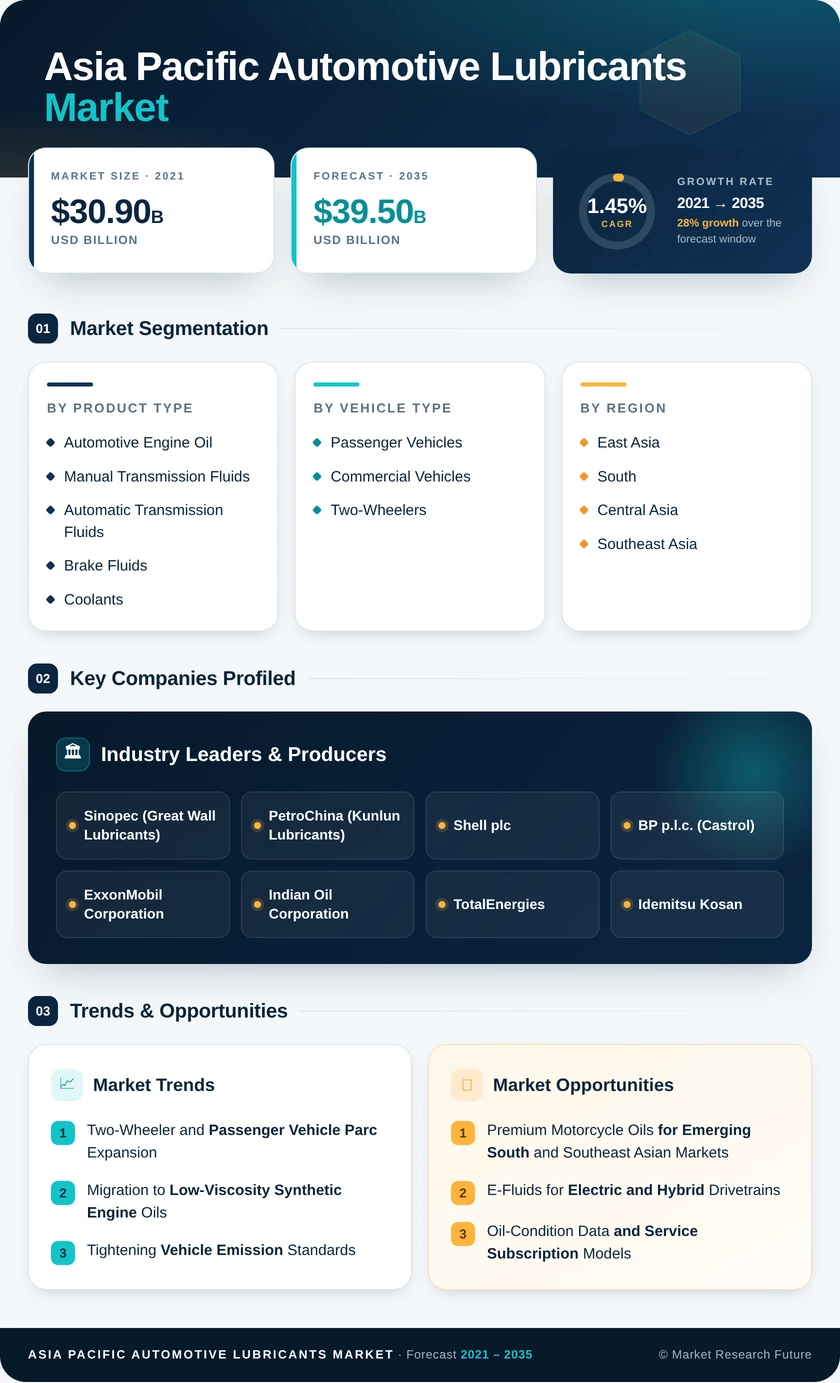
Asia Pacific Automotive Lubricants Market (2026 - 2035)

ID: MRFR/CnM/12397-HCR 128 Pages Anshula Mandaokar Last Updated: November 05, 2026
Asia Pacific Automotive Lubricants Market Research Report Information By Product Type (Automotive Engine Oil, Manual Transmission Fluids, Automatic Transmission Fluids, Brake Fluids, Coolants, and Automotive Greases), By Vehicle Type (Passenger Vehicles, Commercial Vehicles, and Two-Wheelers), And By Region (China, India, Japan, South Korea, Australia, and Rest of Asia-Pacific) – Market Forecast Till 2035.
Asia Pacific Automotive Lubricants Market
Market Size
Forecast Period2026-2035
CAGR (2026-2035)1.45%
2025 Market SizeUSD 34.20 Billion
2035 Market SizeUSD 39.50 Billion
Key Players
Sinopec
PetroChina
Shell plc
BP p.l.c.
ExxonMobil Corporation
Indian Oil Corporation
Opportunities
  • Premium Motorcycle Oils for Emerging South and Southeast Asian Markets
  • E-Fluids for Electric and Hybrid Drivetrains
  • Oil-Condition Data and Service Subscription Models
  1. 1 Market Summary | |
  2. 2 Key Report Takeaways | |
    1. 2.1 By Product Type | |
    2. 2.2 By Vehicle Type | |
    3. 2.3 By Region | |
  3. 3 Market Size and Forecast (2021–2035) | |
    1. 3.1 Historical Market Size (2021–2025) | |
    2. 3.2 Forecast Market Size (2026–2035) | |
    3. 3.3 Year-over-Year Growth Analysis | |
  4. 4 Driver Impact Analysis | |
    1. 4.1 Two-Wheeler and Passenger Vehicle Parc Expansion | |
    2. 4.2 Migration to Low-Viscosity Synthetic Engine Oils | |
    3. 4.3 Tightening Vehicle Emission Standards | |
    4. 4.4 Automatic, CVT and Dual-Clutch Transmission Penetration | |
    5. 4.5 Freight, Infrastructure and E-Commerce Growth | |
    6. 4.6 Organized Aftermarket and Aging Vehicle Parc | |
    7. 4.7 Biodiesel Blending Mandates | |
  5. 5 Restraints Impact Analysis | |
    1. 5.1 Electric Vehicle and Electric Two-Wheeler Adoption | |
    2. 5.2 Extended Drain Intervals and Fill-for-Life Fluids | |
    3. 5.3 Base Oil and Additive Price Volatility | |
    4. 5.4 Counterfeit and Spurious Lubricants | |
    5. 5.5 Engine Downsizing and Fuel-Economy Rules | |
  6. 6 Opportunities | |
    1. 6.1 Premium Motorcycle Oils for Emerging South and Southeast Asian Markets | |
    2. 6.2 E-Fluids for Electric and Hybrid Drivetrains | |
    3. 6.3 Oil-Condition Data and Service Subscription Models | |
    4. 6.4 Re-Refined Base Oils under Extended Producer Responsibility | |
  7. 7 Regional Market Share and Country-Level Analysis | |
    1. 7.1 East Asia | | |
      1. 7.1.1 China | | |
      2. 7.1.2 South Korea | | |
      3. 7.1.3 Rest of East Asia | |
    2. 7.2 South and Central Asia | | |
      1. 7.2.1 India | | |
      2. 7.2.2 Uzbekistan | | |
      3. 7.2.3 Rest of South and Central Asia | |
    3. 7.3 Southeast Asia | | |
      1. 7.3.1 Thailand | | |
      2. 7.3.2 Indonesia | | |
      3. 7.3.3 Malaysia | | |
      4. 7.3.4 Philippines | | |
      5. 7.3.5 Vietnam | | |
      6. 7.3.6 Rest of Southeast Asia | |
  8. 8 Future Outlook (2026–2035) | |
    1. 8.1 Electrification and the Hybrid Bridge | |
    2. 8.2 Specification Upgrades and Formulation Science | |
    3. 8.3 Digital Channels and AI-Driven Demand Planning | |
    4. 8.4 Sustainability and ESG Reporting | |
  9. 9 Segmentation Analysis | |
    1. 9.1 By Product Type | | |
      1. 9.1.1 Automotive Engine Oil | | |
      2. 9.1.2 Manual Transmission Fluids | | |
      3. 9.1.3 Automatic Transmission Fluids | | |
      4. 9.1.4 Brake Fluids | | |
      5. 9.1.5 Coolants | | |
      6. 9.1.6 Automotive Greases | |
    2. 9.2 By Vehicle Type | | |
      1. 9.2.1 Passenger Vehicles | | |
      2. 9.2.2 Commercial Vehicles | | |
      3. 9.2.3 Two-Wheelers | |
  10. 10 Competitive Landscape | |
    1. 10.1 Market Concentration Analysis | |
    2. 10.2 Competitive Benchmarking Matrix | |
    3. 10.3 Company Profiles | | |
      1. 10.3.1 Sinopec (Great Wall Lubricants) | | |
      2. 10.3.2 PetroChina (Kunlun Lubricants) | | |
      3. 10.3.3 Shell plc | | |
      4. 10.3.4 BP p.l.c. (Castrol) | | |
      5. 10.3.5 ExxonMobil Corporation | | |
      6. 10.3.6 Indian Oil Corporation | | |
      7. 10.3.7 TotalEnergies | | |
      8. 10.3.8 Idemitsu Kosan | | |
      9. 10.3.9 ENEOS Holdings | | |
      10. 10.3.10 SK Enmove | | |
      11. 10.3.11 Gulf Oil Lubricants India | |
  11. 11 Recent News & Developments | |
  12. 12 Report Scope and Methodology | |
  13. 13 Detailed Sources and Citations | |
  14. 14 Frequently Asked Questions (FAQs) | | LIST OF TABLES | |
  15. TABLE 1 Market Snapshot Summary, 2025–2035 | |
  16. TABLE 2 Market Size and Forecast, 2021–2035 (USD Billion) | |
  17. TABLE 3 Driver Impact Analysis, 2026–2035 | |
  18. TABLE 4 Restraints Impact Analysis, 2026–2035 | |
  19. TABLE 5 Regional Summary, by Sub-Region, 2025 | |
  20. TABLE 6 East Asia Market, by Country, 2025 | |
  21. TABLE 7 South and Central Asia Market, by Country, 2025 | |
  22. TABLE 8 Southeast Asia Market, by Country, 2025 | |
  23. TABLE 9 Market Segmentation, by Product Type, 2025 | |
  24. TABLE 10 Market Segmentation, by Vehicle Type, 2025 | |
  25. TABLE 11 Competitive Benchmarking Matrix, 2025 | |
  26. TABLE 12 Report Scope and Methodology | |
  27. TABLE 13 Detailed Sources and Citations | |
  28. TABLE 14 Segmentation Quick Reference | | LIST OF FIGURES | |
  29. FIGURE 1 Market Dynamics Overview (Drivers, Restraints, Opportunities) | |
  30. FIGURE 2 Industry Value Chain Analysis | |
  31. FIGURE 3 Porter's Five Forces Analysis | |
  32. FIGURE 4 Market Size Trend, 2021–2035 (USD Billion) | |
  33. FIGURE 5 Market Share by Product Type, 2025 | |
  34. FIGURE 6 Market Share by Vehicle Type, 2025 | |
  35. FIGURE 7 Market Share by Sub-Region, 2025 | |
  36. FIGURE 8 Country-Level Market Comparison, 2025 | |
  37. FIGURE 9 Competitive Landscape, Estimated Revenue Share Ranges, 2025

Segmentation Quick Reference

DimensionSub-SegmentsDominant SegmentFastest Growing Segment
By Product TypeAutomotive Engine Oil, Manual Transmission Fluids, Automatic Transmission Fluids, Brake Fluids, Coolants, Automotive GreasesAutomotive Engine Oil — 61.4% shareAutomatic Transmission Fluids — 1.7% CAGR
By Vehicle TypePassenger Vehicles, Commercial Vehicles, Two-WheelersPassenger Vehicles — 62.4% shareCommercial Vehicles — 1.8% CAGR
By RegionEast Asia, South and Central Asia, Southeast AsiaEast Asia — 46.8% shareSouth and Central Asia — 2.3% CAGR

Market Segmentation Overview

The dimensions below follow the segmentation used throughout the Asia Pacific Automotive Lubricants Market report.

By Product Type

Sub-SegmentKey Trend
Automotive Engine OilShift to 0W-20 and 0W-16 Group III synthetics
Manual Transmission FluidsGradual decline as automatic gearboxes spread
Automatic Transmission FluidsOEM-specific CVT and dual-clutch fluid approvals
Brake FluidsUpgrade from DOT 3 to DOT 4 with ABS fitment
CoolantsLong-life and hybrid-compatible thermal fluids
Automotive GreasesHeavy-truck wheel-bearing and chassis relubrication

Automotive Engine Oil leads this dimension with a 61.4% share because the region's ICE fleet still needs regular oil changes, especially in India, Indonesia and rural China. Automatic Transmission Fluids grow fastest at a 1.7% CAGR, as CVT and dual-clutch gearboxes in Chinese, Korean and Thai models require OEM-approved fluids that sell at a premium. Manual Transmission Fluids lose ground as entry-level cars adopt automated gearboxes.

By Vehicle Type

Sub-SegmentKey Trend
Passenger VehiclesPremium synthetic upgrades and organized aftermarket service
Commercial VehiclesLow-ash CK-4 oils for BS-VI and China 6 trucks
Two-WheelersJASO MA2 wet-clutch oils for commuter motorcycles

Passenger Vehicles dominate with a 62.4% share as car ownership spreads across China, India and Southeast Asia and owners trade up to synthetic grades. Commercial Vehicles grow fastest at a 1.8% CAGR because infrastructure spending and parcel delivery increase truck use and require low-ash diesel oils that meet BS-VI and China 6 rules. Two-Wheelers remain a large pool in India and Indonesia, where frequent oil changes offset low fill volumes.


Download PDF ×

We do not share your information with anyone. However, we may send you emails based on your report interest from time to time. You may contact us at any time to opt-out.