Request Free Sample ×

Kindly complete the form below to receive a free sample of this Report

* Please use a valid business email

Leading companies partner with us for data-driven Insights

clients tt-cursor
Hero Background
English
Chinese
French
Japanese
Korean
German
Spanish

Armored Vehicles Market Size

ID: MRFR/AD/2347-HCR
200 Pages
Shubham Munde
April 2026

Armored Vehicle Market Size, Share, Industry Trend & Analysis Research Report By Application (Military, Law Enforcement, Civil Defense, Private Security, Emergency Services), By Vehicle Type (Personnel Carriers, Main Battle Tanks, Armored Personnel Carriers, Mine-Resistant Ambush Protected Vehicles, Light Tactical Vehicles), By Mobility Type (Wheeled, Tracked, Hybrid), By Armor Type (Composite Armor, Ceramic Armor, Steel Armor, Spall Liner), and By Regional (North America, Europe, South America, Asia Pacific, Middle East and Africa)-Forecast to 2035

Share:
Download PDF ×

We do not share your information with anyone. However, we may send you emails based on your report interest from time to time. You may contact us at any time to opt-out.

Armored Vehicles Market Infographic
Purchase Options

Armored Vehicles Size

Armored Vehicles Market Growth Projections and Opportunities

The market dynamics of the Armored Vehicle market are shaped by a multitude of factors that reflect the evolving landscape of military capabilities, geopolitical considerations, and technological advancements. One key driver is the global security environment, characterized by persistent threats, regional conflicts, and the need for military preparedness. Nations across the world invest in armored vehicles to enhance their defense capabilities, respond to potential threats, and maintain strategic readiness, driving the overall demand and market dynamics of armored vehicles.

Technological advancements play a pivotal role in shaping the market dynamics of armored vehicles. The ongoing evolution of armor materials, communication systems, surveillance technologies, and mobility solutions contributes to the development of more sophisticated and capable armored vehicles. The integration of advanced technologies, such as artificial intelligence, unmanned systems, and digital communication networks, enhances the effectiveness and versatility of armored vehicles, influencing market dynamics by fostering innovation and driving competition among manufacturers.

Geopolitical considerations significantly impact the market dynamics of the Armored Vehicle market. The security policies and defense strategies of nations are influenced by regional tensions, territorial disputes, and the perceived threats from potential adversaries. The geopolitical landscape drives procurement decisions, military modernization efforts, and the overall demand for armored vehicles. Heightened geopolitical tensions can lead to increased investments in armored vehicle capabilities, shaping market dynamics by creating spikes in demand and influencing the strategic priorities of defense establishments.

The diverse spectrum of threats, ranging from conventional warfare to asymmetric and insurgent tactics, contributes to the demand for versatile armored vehicles. Modern armored vehicles are designed to provide protection against a wide array of threats, including ballistic and explosive attacks, mines, and improvised explosive devices (IEDs). The capability of armored vehicles to adapt to various operational environments and address diverse threats influences market dynamics by making them indispensable assets for military forces and security agencies globally.

The pursuit of enhanced mobility and maneuverability is a crucial factor shaping the market dynamics of armored vehicles. Military forces seek armored platforms that can navigate diverse terrains, including urban environments, deserts, and rugged landscapes. The demand for armored vehicles with increased agility, speed, and off-road capabilities drives innovation in mobility solutions, impacting market dynamics by influencing design trends and the development of next-generation armored platforms capable of meeting the evolving operational requirements.

Budget constraints and cost considerations are fundamental market dynamics influencing the procurement of armored vehicles. Governments and defense establishments seek cost-effective solutions that provide optimal performance and protection. Manufacturers that can deliver reliable, technologically advanced armored vehicles while addressing budget constraints stand to capture a significant market share. Cost-effectiveness influences market dynamics by shaping purchasing decisions and driving competition among manufacturers to offer efficient and affordable armored vehicle solutions.

The trend toward modular and scalable armored vehicle designs is an emerging market dynamic. Military forces increasingly value platforms that allow for easy integration of additional features, upgrades, and mission-specific equipment. Modular designs enhance the adaptability and versatility of armored vehicles, enabling them to evolve and meet changing operational requirements over time. The demand for modular solutions influences market dynamics by fostering the development of customizable armored platforms that cater to the diverse needs of defense forces.

The growing interest in unmanned and autonomous armored vehicles is reshaping the market dynamics of the industry. The integration of artificial intelligence and autonomous technologies enables the development of unmanned ground vehicles that can perform reconnaissance, surveillance, and other mission-critical tasks. The trend toward autonomous armored vehicles influences market dynamics by opening new possibilities for military operations, reducing the risk to human personnel, and driving research and development efforts in autonomous vehicle technologies.

Armored Vehicles Market Size Graph
Author
Author Profile
Shubham Munde
Team Lead - Research

Shubham brings over 7 years of expertise in Market Intelligence and Strategic Consulting, with a strong focus on the Automotive, Aerospace, and Defense sectors. Backed by a solid foundation in semiconductors, electronics, and software, he has successfully delivered high-impact syndicated and custom research on a global scale. His core strengths include market sizing, forecasting, competitive intelligence, consumer insights, and supply chain mapping. Widely recognized for developing scalable growth strategies, Shubham empowers clients to navigate complex markets and achieve a lasting competitive edge. Trusted by start-ups and Fortune 500 companies alike, he consistently converts challenges into strategic opportunities that drive sustainable growth.

Leave a Comment

FAQs

What is the projected market valuation of the Armored Vehicle Market by 2035?

<p>The Armored Vehicle Market is projected to reach a valuation of 49.29 USD Billion by 2035.</p>

What was the market valuation of the Armored Vehicle Market in 2024?

<p>In 2024, the overall market valuation of the Armored Vehicle Market was 33.26 USD Billion.</p>

What is the expected CAGR for the Armored Vehicle Market during the forecast period 2025 - 2035?

<p>The expected CAGR for the Armored Vehicle Market during the forecast period 2025 - 2035 is 3.64%.</p>

Which application segment had the highest valuation in 2024?

<p>The Military application segment had the highest valuation at 12.0 USD Billion in 2024.</p>

What are the projected valuations for the Law Enforcement segment by 2035?

<p>The Law Enforcement segment is projected to reach a valuation of 12.0 USD Billion by 2035.</p>

Which vehicle type is expected to see the most growth from 2025 to 2035?

<p>The Main Battle Tanks segment, valued at 10.0 USD Billion in 2024, is expected to see substantial growth by 2035.</p>

What is the valuation range for Wheeled mobility types in 2024?

<p>In 2024, the valuation for Wheeled mobility types ranged from 12.0 to 18.0 USD Billion.</p>

How does the projected valuation of Composite Armor compare to Steel Armor by 2035?

<p>By 2035, Composite Armor is projected to be valued between 10.0 and 14.0 USD Billion, while Steel Armor is expected to range from 10.0 to 15.0 USD Billion.</p>

Which key players are leading the Armored Vehicle Market?

<p>Key players in the Armored Vehicle Market include General Dynamics, BAE Systems, Rheinmetall, and Oshkosh Defense.</p>

What is the projected valuation for Mine-Resistant Ambush Protected Vehicles by 2035?

<p>The Mine-Resistant Ambush Protected Vehicles segment is projected to reach a valuation of 7.5 USD Billion by 2035.</p>

Market Summary

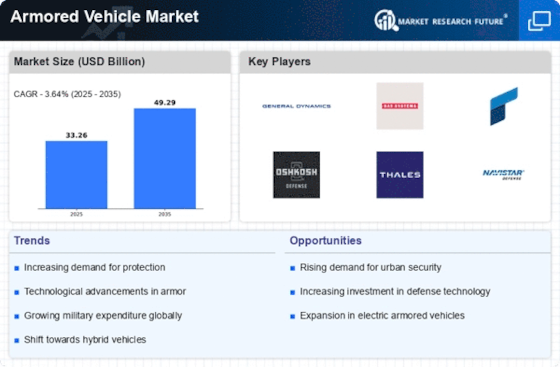
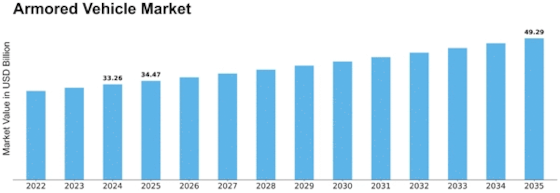
As per Market Research Future analysis, the Armored Vehicle Market Size was estimated at 33.26 USD Billion in 2024. The Armored Vehicle industry is projected to grow from 34.47 USD Billion in 2025 to 49.29 USD Billion by 2035, exhibiting a compound annual growth rate (CAGR) of 3.64% during the forecast period 2025 - 2035

Key Market Trends & Highlights

The Armored Vehicle Market is experiencing robust growth driven by technological advancements and increasing demand across various sectors.

  • North America remains the largest market for armored vehicles, driven by ongoing defense modernization efforts. The Asia-Pacific region is emerging as the fastest-growing market, fueled by rising geopolitical tensions and urban warfare. Military applications dominate the market, while law enforcement segments are witnessing the fastest growth due to heightened security needs. Key market drivers include increasing geopolitical tensions and a focus on technological innovations in armored vehicles.

Market Size & Forecast

2024 Market Size 33.26 (USD Billion)
2035 Market Size 49.29 (USD Billion)
CAGR (2025 - 2035) 3.64%
Largest Regional Market Share in 2024 North America

Major Players

General Dynamics (US), <a href="https://www.baesystems.com/en/newsroom/news-releases">BAE Systems</a> (GB), Rheinmetall (DE), Oshkosh Defense (US), Thales Group (FR), Navistar Defense (US), Krauss-Maffei Wegmann (DE), MOWAG (CH), Textron Systems (US)

Market Trends

The armored vehicle market trends indicate a dynamic evolution driven by geopolitical tensions, modernization programs, and rising security concerns. Nations are expanding procurement programs under the armored vehicle procurement upgrade market, while civilian demand is supporting growth in the civilian security armored vehicle market. This trend is not merely confined to military applications; there is a growing interest in armored vehicles for civilian use, particularly in regions facing high crime rates or civil unrest. Manufacturers are increasingly integrating advanced electronics, situational awareness tools, and armored vehicles navigation systems market solutions to enhance battlefield effectiveness. Additionally, safety enhancements such as fire detection and suppression are gaining importance, aligning with armored vehicle fire suppression systems market trends and armored vehicles automatic fire extinguishing systems market adoption. Moreover, the Armored Vehicle Market is witnessing a shift towards electric and hybrid technologies, reflecting a broader trend towards sustainability in defense. This transition may not only reduce the environmental impact but also improve operational efficiency. Additionally, partnerships between defense contractors and technology firms are becoming increasingly common, as the integration of advanced systems such as artificial intelligence and autonomous capabilities is seen as a way to enhance the effectiveness of armored vehicles. Overall, the market appears poised for continued growth, with various factors influencing its trajectory in the coming years.

Technological Advancements

The armored vehicle market analysis highlights rapid innovation in vehicle survivability, mobility, and digital systems. Integration of advanced armor solutions supports growth in the vehicle armor market, while evolving materials are influencing vehicle armor materials market trends and vehicle armor panel market development.

Rising Demand for Civilian Applications

Civil unrest and internal security needs are driving adoption beyond defense forces, strengthening demand within the civilian security armored vehicle market for law enforcement, private security, and emergency services. This trend suggests a shift in perception, where armored vehicles are not solely viewed as military assets but also as viable solutions for personal and corporate security.

Sustainability Initiatives

The armored vehicle market is gradually incorporating hybrid propulsion and energy-efficient technologies, supporting operational efficiency while aligning with sustainability goals. This shift indicates a growing awareness of environmental impacts and a desire to reduce carbon footprints, potentially reshaping the future landscape of armored vehicle design and production.

Armored Vehicles Market Market Drivers

Increasing Geopolitical Tensions

The Armored Vehicle Market appears to be significantly influenced by rising geopolitical tensions across various regions. Nations are increasingly investing in defense capabilities to safeguard their borders and maintain national security. This trend is evidenced by a reported increase in military budgets, with many countries allocating substantial funds for the procurement of armored vehicles. For instance, defense spending in regions such as Eastern Europe and the Asia-Pacific has seen a marked rise, reflecting the urgency to enhance military readiness. As a result, the demand for advanced armored vehicles, which offer superior protection and mobility, is likely to grow, thereby driving the Armored Vehicle Market forward.

Focus on Modernization of Defense Forces

The modernization of defense forces is a key driver of the Armored Vehicle Market. Many nations are undertaking comprehensive defense reforms aimed at upgrading their military capabilities, which includes the replacement of outdated armored vehicles with modern alternatives. This modernization effort is often accompanied by increased defense budgets, allowing for the procurement of state-of-the-art armored vehicles that meet contemporary operational requirements. Reports indicate that several countries are prioritizing investments in next-generation armored vehicles, which are designed to enhance survivability and combat effectiveness. This focus on modernization is likely to sustain growth in the Armored Vehicle Market as nations strive to maintain a competitive edge.

Growing Urban Warfare and Asymmetric Threats

The Armored Vehicle Market is experiencing growth due to the increasing prevalence of urban warfare and asymmetric threats. As conflicts shift towards urban environments, the demand for armored vehicles that can operate effectively in such settings is rising. These vehicles must be capable of navigating narrow streets and providing protection against improvised explosive devices and small arms fire. Market analysis indicates that the demand for light and medium armored vehicles is particularly strong, as they offer the necessary balance between mobility and protection. This shift in warfare dynamics is likely to continue influencing the Armored Vehicle Market, as military forces adapt to new operational challenges.

Technological Innovations in Armored Vehicles

Technological advancements are reshaping the Armored Vehicle Market, as manufacturers integrate cutting-edge technologies to enhance vehicle performance and survivability. Innovations such as active protection systems, advanced armor materials, and autonomous driving capabilities are becoming increasingly prevalent. The introduction of these technologies not only improves the operational effectiveness of armored vehicles but also attracts interest from military and civilian sectors alike. Market data indicates that the segment of armored vehicles equipped with advanced technology is projected to witness a compound annual growth rate of over 5% in the coming years. This trend suggests that the Armored Vehicle Market is evolving rapidly, driven by the need for enhanced capabilities.

Rising Demand for Law Enforcement and Security Applications

The Armored Vehicle Market is witnessing a surge in demand from law enforcement and security agencies. As concerns over public safety and civil unrest grow, police and security forces are increasingly turning to armored vehicles for crowd control and protection during high-risk operations. The market for armored vehicles designed for civilian applications is projected to expand, with a notable increase in orders from various governmental and private security entities. Data suggests that this segment could account for a significant portion of the overall market share in the coming years. This trend indicates a diversification of the Armored Vehicle Market beyond traditional military applications.

Market Segment Insights

By Application: Military (Largest) vs. Law Enforcement (Fastest-Growing)

The military segment dominates the armored fighting vehicle market, while law enforcement demand is accelerating due to increased urban security needs, reinforcing growth in the armored vehicles market.  This segment encompasses various vehicles designed for combat operations, troop transport, and logistics. On the other hand, the law enforcement segment is rapidly gaining traction, primarily attributed to rising concerns over public safety and urban violence, resulting in increased procurement of armored vehicles by police and security agencies.<br>In recent years, the growth trends have shown the military segment evolving with advanced technologies, aiming for enhanced protection and operational effectiveness. Conversely, the law enforcement segment is expected to witness the fastest growth as jurisdictions worldwide invest in armored vehicles to improve response capabilities during civil unrest and terrorist threats, highlighting a clear shift towards increased safety measures in civilian environments.

Military (Dominant) vs. Law Enforcement (Emerging)

The military segment remains dominant in the Armored Vehicle Market, marked by substantial investments in advanced armored personnel carriers and combat vehicles aimed at boosting battlefield resilience and effectiveness. These military vehicles are equipped with high-tech armament and protective systems, making them essential for contemporary warfare. In contrast, the law enforcement segment is emerging rapidly, focusing on lighter, more versatile armored vehicles that can be deployed in various scenarios ranging from riot control to high-risk operations. This shift reflects a growing public demand for robust security measures, and law enforcement agencies are increasingly prioritizing armored solutions in their strategic planning, leading to innovation and expansion within this segment.

By Vehicle Type: Armored Personnel Carriers (Largest) vs. Mine-Resistant Ambush Protected Vehicles (Fastest-Growing)

Armored Personnel Carriers lead the armored vehicle market, while MRAPs are gaining traction as part of upgrade initiatives under the <a href="https://www.marketresearchfuture.com/reports/armored-vehicle-procurement-upgrade-market-42318" target="_blank" title="armored vehicle procurement upgrade">armored vehicle procurement upgrade</a> market. Armored Personnel Carriers (APCs) hold the largest share, attributed to their versatility and critical role in troop mobility and protection in combat zones. Following closely, Main Battle Tanks are also prominent due to their combat capabilities and historical reliance in warfare. The other vehicle types, including Light Tactical Vehicles and Mine-Resistant Ambush Protected Vehicles (MRAPs), are growing but represent smaller shares in terms of market uptake.

Armored Personnel Carriers (Dominant) vs. Mine-Resistant Ambush Protected Vehicles (Emerging)

Armored Personnel Carriers (APCs) are recognized as the dominant force in the Armored Vehicle Market, primarily due to their all-encompassing role in military operations, providing both troop transport and armored protection against various threats. Their adaptability to various combat scenarios and environments makes them indispensable to military forces worldwide. Conversely, Mine-Resistant Ambush Protected Vehicles (MRAPs) are emerging as a critical class, particularly in conflict zones where improvised explosive devices (IEDs) are prevalent. MRAPs feature enhanced armor and a distinctive V-shaped hull design, making them resistant to blasts, thereby increasing their demand among military operators who prioritize troop survival in high-risk situations.

By Mobility Type: Wheeled (Largest) vs. Tracked (Fastest-Growing)

Wheeled platforms dominate due to flexibility, while tracked systems support heavy combat roles within the armored fighting vehicle market. Wheeled armored vehicles are favored for their versatility and ease of deployment across various terrains. On the other hand, tracked vehicles serve as a critical component, specifically within military applications, due to their superior off-road capabilities, often preferred in challenging environments where maneuverability is crucial.

Mobility Type: Wheeled (Dominant) vs. Tracked (Emerging)

Wheeled armored vehicles are recognized for their mobility, maintenance efficiency, and operational flexibility, making them the preferred choice in many scenarios, including urban warfare and peacekeeping missions. They are designed for high-speed movement on paved roads while remaining capable of traversing rugged landscapes. Conversely, tracked armored vehicles offer unmatched stability and traction, particularly in rough terrain, and are emerging rapidly in response to increased demand for heavy combat capabilities. As military operations evolve, the adaptability of tracked vehicles positions them as a notable growth area, catering to defense forces looking to enhance their ground maneuverability.

By Armor Type: Composite Armor (Largest) vs. Ceramic Armor (Fastest-Growing)

Composite armor dominates due to performance and weight advantages, driving demand across the vehicle armor market. Ceramic armor adoption reflects evolving <a href="https://www.marketresearchfuture.com/reports/vehicle-armor-materials-market-22185" target="_blank" title="vehicle armor materials">vehicle armor materials</a> market trends focused on enhanced protection. It is favored for its combination of lightweight properties and superior ballistic protection, making it the go-to choice for many military applications. On the other hand, Ceramic Armor is gaining traction, particularly among defense manufacturers seeking enhanced protection levels without compromising mobility. These shifts in preference are indicative of changing operational demands in combat situations.<br>The growth trends in the armor type segment are primarily influenced by advancements in materials technology and increasing defense budgets across various nations. The demand for lighter and more efficient armor solutions has spurred the development of new composite materials, while the rise of asymmetric warfare has propelled Ceramic Armor to the forefront as the fastest-growing choice. As militaries evolve their strategies, the focus on modernizing armored vehicles is expected to continue, creating a dynamic landscape for armor technologies.

Composite Armor (Dominant) vs. Ceramic Armor (Emerging)

Composite Armor is recognized as the dominant player in the armored vehicle market, distinguished by its innovative use of advanced materials that provide excellent protection while minimizing weight. This type of armor typically combines layers of different materials, including aramid fibers, polyethylene, and metals, which together enhance its ballistic performance and overall durability. In contrast, Ceramic Armor is seen as the emerging option, increasingly popular for its effectiveness against high-velocity projectiles. Composed primarily of ceramic tiles mounted on a lightweight backing, this armor type offers superior protection levels, making it a favored choice for next-generation military vehicles that require agility without sacrificing safety. Both armor types are crucial for maintaining strategic advantages in modern warfare.

Get more detailed insights about Armored Vehicle Market Research Report - Global Forecast till 2035

Regional Insights

The Armored Vehicle Market was primarily categorized into diverse regions, showcasing significant variations in market dynamics. North America leads the armored vehicle market, supported by high defense spending. Europe and Asia Pacific follow, driven by modernization initiatives, reinforcing the strength of the global armored vehicle market across regions. In 2024, North America led this segment with a valuation of 10.0 USD Billion, expected to grow to 14.5 USD Billion by 2035, driven by robust defense budgets and a necessity for advanced security solutions.

Europe followed closely, valued at 9.0 USD Billion in 2024 and projected to reach 13.0 USD Billion in 2035, reflecting ongoing geopolitical tensions that necessitate enhanced armored capabilities. The Asia Pacific region held a similar valuation of 9.0 USD Billion in 2024 and is projected to grow to 13.0 USD Billion by 2035, supported by expansive military modernization initiatives.

South America, while smaller, showed steady growth with a value of 2.0 USD Billion in 2024 rising to 3.0 USD Billion by 2035, underscoring increasing investments in regional defense. The Middle East and Africa, valued at 3.26 USD Billion in 2024, is anticipated to reach 5.8 USD Billion by 2035, driven by the region's need for security amidst persistent conflicts.

Each region's market growth reflected local defense strategies and geopolitical landscapes, highlighting the Armored Vehicle Market's critical role in contemporary military readiness.

Key Players and Competitive Insights

Leading manufacturers are investing in armor innovation, digital systems, and survivability enhancements to strengthen their position in the armored vehicles market and capitalize on long-term defense contracts. With various stakeholders including government bodies, defense contractors, and private sector firms operating in this space, the competitive landscape is characterized by a mix of established and emerging players. The market is shaped by technological advancements in vehicle manufacturing and design, necessitating continuous innovation to cater to changing defense and security needs. It is also influenced by geopolitical factors that elevate defense budgets, thereby promoting investments in armored vehicles that provide mobility and defense capabilities.The landscape sees companies engaging in strategic partnerships, collaborations, and mergers to enhance their competitive position, expand their product offerings, and leverage new technologies that improve performance.BAE Systems holds a strong position in the Armored Vehicle Market, characterized by its robust portfolio of armored vehicle solutions tailored for military applications. The company boasts a diverse range of products, including armored personnel carriers, infantry fighting vehicles, and main battle tanks, which are prominent in various defense strategies worldwide.Its advanced manufacturing capabilities and emphasis on research and development have enabled BAE Systems to implement innovative technologies that enhance vehicle durability, mobility, and protection. The company prides itself on strong relationships with defense ministries and armed forces, which bolster its market presence globally.Furthermore, BAE Systems benefits from a formidable supply chain and logistics network that ensures timely delivery and support, making it a favored choice for many nations looking to upgrade their defense capabilities while ensuring operational effectiveness.Navistar Defense operates successfully within the Armored Vehicle Market, focusing on designing and manufacturing wheeled armored vehicles that meet the demands of military and law enforcement agencies.The company’s key offerings include Mine-Resistant Ambush Protected vehicles, tactical vehicles, and armored personnel carriers, all engineered to withstand threats in diverse operational environments. Navistar Defense has established strong market presence, especially within the United States and allied defense sectors, owing to its commitment to providing tailored solutions for end-users.A core strength of the company is its agility in responding to evolving operational needs, coupled with an emphasis on reliability and cost-effectiveness. Additionally, Navistar Defense has engaged in strategic mergers and collaborations that have expanded its technological capabilities and market reach, allowing it to remain competitive in the rapidly evolving landscape of armored vehicle manufacturing.

Key Companies in the Armored Vehicles Market include

Industry Developments

Recent developments include upgrades in survivability systems, digital navigation, and fire suppression technologies, reinforcing armored vehicle market trends and growth in armored vehicles upgrade and retrofit market trends. Companies such as BAE Systems, Navistar Defense, and Elbit Systems are actively participating in advancements related to armored vehicle technology.

In September 2023, Rheinmetall announced plans to enhance its offerings through innovation in electronic warfare capabilities, which aligns with increased defense spending globally. Lockheed Martin, along with Hanwha Defense, reported a strategic partnership that aims to co-develop advanced armored systems for enhanced battlefield performance.

The market has seen significant growth, evidenced by a projected valuation increase reflecting heightened demand for modernized armored solutions amid escalating geopolitical tensions. Notable mergers include the acquisition of Textron’s armored vehicle division by General Dynamics in July 2023, a move aimed at consolidating capabilities and boosting production efficiencies.

In March 2022, KraussMaffei Wegmann expanded its reach by acquiring assets from Thales Group to bolster its artillery capabilities. This consolidation and collaboration among key players signal a dynamic evolution in the market, driven strongly by an emphasis on innovation and adapting to emerging threats on a global scale.

Future Outlook

Armored Vehicles Market Future Outlook

The Global Armored Vehicle Market is projected to grow at a 3.64% CAGR from 2025 to 2035, driven by increasing defense budgets, rising geopolitical tensions, and technological advancements.

New opportunities lie in:

  • <p>Development of hybrid armored vehicles for enhanced fuel efficiency. Integration of advanced surveillance systems for real-time threat assessment. Expansion into emerging markets with tailored armored solutions.</p>

By 2035, the market is expected to solidify its position as a critical component of global defense strategies.

Market Segmentation

Armored Vehicles Market Armor Type Outlook

  • Composite Armor
  • Ceramic Armor
  • Steel Armor
  • Spall Liner

Armored Vehicles Market Application Outlook

  • Military
  • Law Enforcement
  • Civil Defense
  • Private Security
  • Emergency Services

Armored Vehicles Market Vehicle Type Outlook

  • Personnel Carriers
  • Main Battle Tanks
  • Armored Personnel Carriers
  • Mine-Resistant Ambush Protected Vehicles
  • Light Tactical Vehicles

Armored Vehicles Market Mobility Type Outlook

  • Wheeled
  • Tracked
  • Hybrid

Report Scope

MARKET SIZE 2024 33.26(USD Billion)
MARKET SIZE 2025 34.47(USD Billion)
MARKET SIZE 2035 49.29(USD Billion)
COMPOUND ANNUAL GROWTH RATE (CAGR) 3.64% (2025 - 2035)
REPORT COVERAGE Revenue Forecast, Competitive Landscape, Growth Factors, and Trends
BASE YEAR 2024
Market Forecast Period 2025 - 2035
Historical Data 2019 - 2024
Market Forecast Units USD Billion
Key Companies Profiled General Dynamics (US), BAE Systems (GB), Rheinmetall (DE), Oshkosh Defense (US), Thales Group (FR), Navistar Defense (US), Krauss-Maffei Wegmann (DE), MOWAG (CH), Textron Systems (US)
Segments Covered Application, Vehicle Type, Mobility Type, Armor Type, Regional
Key Market Opportunities Integration of advanced technologies for enhanced protection and mobility in the Armored Vehicle Market.
Key Market Dynamics Rising demand for advanced armored vehicles driven by geopolitical tensions and evolving security threats.
Countries Covered North America, Europe, APAC, South America, MEA

FAQs

What is the projected market valuation of the Armored Vehicle Market by 2035?

<p>The Armored Vehicle Market is projected to reach a valuation of 49.29 USD Billion by 2035.</p>

What was the market valuation of the Armored Vehicle Market in 2024?

<p>In 2024, the overall market valuation of the Armored Vehicle Market was 33.26 USD Billion.</p>

What is the expected CAGR for the Armored Vehicle Market during the forecast period 2025 - 2035?

<p>The expected CAGR for the Armored Vehicle Market during the forecast period 2025 - 2035 is 3.64%.</p>

Which application segment had the highest valuation in 2024?

<p>The Military application segment had the highest valuation at 12.0 USD Billion in 2024.</p>

What are the projected valuations for the Law Enforcement segment by 2035?

<p>The Law Enforcement segment is projected to reach a valuation of 12.0 USD Billion by 2035.</p>

Which vehicle type is expected to see the most growth from 2025 to 2035?

<p>The Main Battle Tanks segment, valued at 10.0 USD Billion in 2024, is expected to see substantial growth by 2035.</p>

What is the valuation range for Wheeled mobility types in 2024?

<p>In 2024, the valuation for Wheeled mobility types ranged from 12.0 to 18.0 USD Billion.</p>

How does the projected valuation of Composite Armor compare to Steel Armor by 2035?

<p>By 2035, Composite Armor is projected to be valued between 10.0 and 14.0 USD Billion, while Steel Armor is expected to range from 10.0 to 15.0 USD Billion.</p>

Which key players are leading the Armored Vehicle Market?

<p>Key players in the Armored Vehicle Market include General Dynamics, BAE Systems, Rheinmetall, and Oshkosh Defense.</p>

What is the projected valuation for Mine-Resistant Ambush Protected Vehicles by 2035?

<p>The Mine-Resistant Ambush Protected Vehicles segment is projected to reach a valuation of 7.5 USD Billion by 2035.</p>

  1. SECTION I: EXECUTIVE SUMMARY AND KEY HIGHLIGHTS
    1. | 1.1 EXECUTIVE SUMMARY
    2. | | 1.1.1 Market Overview
    3. | | 1.1.2 Key Findings
    4. | | 1.1.3 Market Segmentation
    5. | | 1.1.4 Competitive Landscape
    6. | | 1.1.5 Challenges and Opportunities
    7. | | 1.1.6 Future Outlook
  2. SECTION II: SCOPING, METHODOLOGY AND MARKET STRUCTURE
    1. | 2.1 MARKET INTRODUCTION
    2. | | 2.1.1 Definition
    3. | | 2.1.2 Scope of the study
    4. | | | 2.1.2.1 Research Objective
    5. | | | 2.1.2.2 Assumption
    6. | | | 2.1.2.3 Limitations
    7. | 2.2 RESEARCH METHODOLOGY
    8. | | 2.2.1 Overview
    9. | | 2.2.2 Data Mining
    10. | | 2.2.3 Secondary Research
    11. | | 2.2.4 Primary Research
    12. | | | 2.2.4.1 Primary Interviews and Information Gathering Process
    13. | | | 2.2.4.2 Breakdown of Primary Respondents
    14. | | 2.2.5 Forecasting Model
    15. | | 2.2.6 Market Size Estimation
    16. | | | 2.2.6.1 Bottom-Up Approach
    17. | | | 2.2.6.2 Top-Down Approach
    18. | | 2.2.7 Data Triangulation
    19. | | 2.2.8 Validation
  3. SECTION III: QUALITATIVE ANALYSIS
    1. | 3.1 MARKET DYNAMICS
    2. | | 3.1.1 Overview
    3. | | 3.1.2 Drivers
    4. | | 3.1.3 Restraints
    5. | | 3.1.4 Opportunities
    6. | 3.2 MARKET FACTOR ANALYSIS
    7. | | 3.2.1 Value chain Analysis
    8. | | 3.2.2 Porter's Five Forces Analysis
    9. | | | 3.2.2.1 Bargaining Power of Suppliers
    10. | | | 3.2.2.2 Bargaining Power of Buyers
    11. | | | 3.2.2.3 Threat of New Entrants
    12. | | | 3.2.2.4 Threat of Substitutes
    13. | | | 3.2.2.5 Intensity of Rivalry
    14. | | 3.2.3 COVID-19 Impact Analysis
    15. | | | 3.2.3.1 Market Impact Analysis
    16. | | | 3.2.3.2 Regional Impact
    17. | | | 3.2.3.3 Opportunity and Threat Analysis
  4. SECTION IV: QUANTITATIVE ANALYSIS
    1. | 4.1 Aerospace & Defense, BY Application (USD Billion)
    2. | | 4.1.1 Military
    3. | | 4.1.2 Law Enforcement
    4. | | 4.1.3 Civil Defense
    5. | | 4.1.4 Private Security
    6. | | 4.1.5 Emergency Services
    7. | 4.2 Aerospace & Defense, BY Vehicle Type (USD Billion)
    8. | | 4.2.1 Personnel Carriers
    9. | | 4.2.2 Main Battle Tanks
    10. | | 4.2.3 Armored Personnel Carriers
    11. | | 4.2.4 Mine-Resistant Ambush Protected Vehicles
    12. | | 4.2.5 Light Tactical Vehicles
    13. | 4.3 Aerospace & Defense, BY Mobility Type (USD Billion)
    14. | | 4.3.1 Wheeled
    15. | | 4.3.2 Tracked
    16. | | 4.3.3 Hybrid
    17. | 4.4 Aerospace & Defense, BY Armor Type (USD Billion)
    18. | | 4.4.1 Composite Armor
    19. | | 4.4.2 Ceramic Armor
    20. | | 4.4.3 Steel Armor
    21. | | 4.4.4 Spall Liner
    22. | 4.5 Aerospace & Defense, BY Region (USD Billion)
    23. | | 4.5.1 North America
    24. | | | 4.5.1.1 US
    25. | | | 4.5.1.2 Canada
    26. | | 4.5.2 Europe
    27. | | | 4.5.2.1 Germany
    28. | | | 4.5.2.2 UK
    29. | | | 4.5.2.3 France
    30. | | | 4.5.2.4 Russia
    31. | | | 4.5.2.5 Italy
    32. | | | 4.5.2.6 Spain
    33. | | | 4.5.2.7 Rest of Europe
    34. | | 4.5.3 APAC
    35. | | | 4.5.3.1 China
    36. | | | 4.5.3.2 India
    37. | | | 4.5.3.3 Japan
    38. | | | 4.5.3.4 South Korea
    39. | | | 4.5.3.5 Malaysia
    40. | | | 4.5.3.6 Thailand
    41. | | | 4.5.3.7 Indonesia
    42. | | | 4.5.3.8 Rest of APAC
    43. | | 4.5.4 South America
    44. | | | 4.5.4.1 Brazil
    45. | | | 4.5.4.2 Mexico
    46. | | | 4.5.4.3 Argentina
    47. | | | 4.5.4.4 Rest of South America
    48. | | 4.5.5 MEA
    49. | | | 4.5.5.1 GCC Countries
    50. | | | 4.5.5.2 South Africa
    51. | | | 4.5.5.3 Rest of MEA
  5. SECTION V: COMPETITIVE ANALYSIS
    1. | 5.1 Competitive Landscape
    2. | | 5.1.1 Overview
    3. | | 5.1.2 Competitive Analysis
    4. | | 5.1.3 Market share Analysis
    5. | | 5.1.4 Major Growth Strategy in the Aerospace & Defense
    6. | | 5.1.5 Competitive Benchmarking
    7. | | 5.1.6 Leading Players in Terms of Number of Developments in the Aerospace & Defense
    8. | | 5.1.7 Key developments and growth strategies
    9. | | | 5.1.7.1 New Product Launch/Service Deployment
    10. | | | 5.1.7.2 Merger & Acquisitions
    11. | | | 5.1.7.3 Joint Ventures
    12. | | 5.1.8 Major Players Financial Matrix
    13. | | | 5.1.8.1 Sales and Operating Income
    14. | | | 5.1.8.2 Major Players R&D Expenditure. 2023
    15. | 5.2 Company Profiles
    16. | | 5.2.1 General Dynamics (US)
    17. | | | 5.2.1.1 Financial Overview
    18. | | | 5.2.1.2 Products Offered
    19. | | | 5.2.1.3 Key Developments
    20. | | | 5.2.1.4 SWOT Analysis
    21. | | | 5.2.1.5 Key Strategies
    22. | | 5.2.2 BAE Systems (GB)
    23. | | | 5.2.2.1 Financial Overview
    24. | | | 5.2.2.2 Products Offered
    25. | | | 5.2.2.3 Key Developments
    26. | | | 5.2.2.4 SWOT Analysis
    27. | | | 5.2.2.5 Key Strategies
    28. | | 5.2.3 Rheinmetall (DE)
    29. | | | 5.2.3.1 Financial Overview
    30. | | | 5.2.3.2 Products Offered
    31. | | | 5.2.3.3 Key Developments
    32. | | | 5.2.3.4 SWOT Analysis
    33. | | | 5.2.3.5 Key Strategies
    34. | | 5.2.4 Oshkosh Defense (US)
    35. | | | 5.2.4.1 Financial Overview
    36. | | | 5.2.4.2 Products Offered
    37. | | | 5.2.4.3 Key Developments
    38. | | | 5.2.4.4 SWOT Analysis
    39. | | | 5.2.4.5 Key Strategies
    40. | | 5.2.5 Thales Group (FR)
    41. | | | 5.2.5.1 Financial Overview
    42. | | | 5.2.5.2 Products Offered
    43. | | | 5.2.5.3 Key Developments
    44. | | | 5.2.5.4 SWOT Analysis
    45. | | | 5.2.5.5 Key Strategies
    46. | | 5.2.6 Navistar Defense (US)
    47. | | | 5.2.6.1 Financial Overview
    48. | | | 5.2.6.2 Products Offered
    49. | | | 5.2.6.3 Key Developments
    50. | | | 5.2.6.4 SWOT Analysis
    51. | | | 5.2.6.5 Key Strategies
    52. | | 5.2.7 Krauss-Maffei Wegmann (DE)
    53. | | | 5.2.7.1 Financial Overview
    54. | | | 5.2.7.2 Products Offered
    55. | | | 5.2.7.3 Key Developments
    56. | | | 5.2.7.4 SWOT Analysis
    57. | | | 5.2.7.5 Key Strategies
    58. | | 5.2.8 MOWAG (CH)
    59. | | | 5.2.8.1 Financial Overview
    60. | | | 5.2.8.2 Products Offered
    61. | | | 5.2.8.3 Key Developments
    62. | | | 5.2.8.4 SWOT Analysis
    63. | | | 5.2.8.5 Key Strategies
    64. | | 5.2.9 Textron Systems (US)
    65. | | | 5.2.9.1 Financial Overview
    66. | | | 5.2.9.2 Products Offered
    67. | | | 5.2.9.3 Key Developments
    68. | | | 5.2.9.4 SWOT Analysis
    69. | | | 5.2.9.5 Key Strategies
    70. | 5.3 Appendix
    71. | | 5.3.1 References
    72. | | 5.3.2 Related Reports
  6. LIST OF FIGURES
    1. | 6.1 MARKET SYNOPSIS
    2. | 6.2 NORTH AMERICA MARKET ANALYSIS
    3. | 6.3 US MARKET ANALYSIS BY APPLICATION
    4. | 6.4 US MARKET ANALYSIS BY VEHICLE TYPE
    5. | 6.5 US MARKET ANALYSIS BY MOBILITY TYPE
    6. | 6.6 US MARKET ANALYSIS BY ARMOR TYPE
    7. | 6.7 CANADA MARKET ANALYSIS BY APPLICATION
    8. | 6.8 CANADA MARKET ANALYSIS BY VEHICLE TYPE
    9. | 6.9 CANADA MARKET ANALYSIS BY MOBILITY TYPE
    10. | 6.10 CANADA MARKET ANALYSIS BY ARMOR TYPE
    11. | 6.11 EUROPE MARKET ANALYSIS
    12. | 6.12 GERMANY MARKET ANALYSIS BY APPLICATION
    13. | 6.13 GERMANY MARKET ANALYSIS BY VEHICLE TYPE
    14. | 6.14 GERMANY MARKET ANALYSIS BY MOBILITY TYPE
    15. | 6.15 GERMANY MARKET ANALYSIS BY ARMOR TYPE
    16. | 6.16 UK MARKET ANALYSIS BY APPLICATION
    17. | 6.17 UK MARKET ANALYSIS BY VEHICLE TYPE
    18. | 6.18 UK MARKET ANALYSIS BY MOBILITY TYPE
    19. | 6.19 UK MARKET ANALYSIS BY ARMOR TYPE
    20. | 6.20 FRANCE MARKET ANALYSIS BY APPLICATION
    21. | 6.21 FRANCE MARKET ANALYSIS BY VEHICLE TYPE
    22. | 6.22 FRANCE MARKET ANALYSIS BY MOBILITY TYPE
    23. | 6.23 FRANCE MARKET ANALYSIS BY ARMOR TYPE
    24. | 6.24 RUSSIA MARKET ANALYSIS BY APPLICATION
    25. | 6.25 RUSSIA MARKET ANALYSIS BY VEHICLE TYPE
    26. | 6.26 RUSSIA MARKET ANALYSIS BY MOBILITY TYPE
    27. | 6.27 RUSSIA MARKET ANALYSIS BY ARMOR TYPE
    28. | 6.28 ITALY MARKET ANALYSIS BY APPLICATION
    29. | 6.29 ITALY MARKET ANALYSIS BY VEHICLE TYPE
    30. | 6.30 ITALY MARKET ANALYSIS BY MOBILITY TYPE
    31. | 6.31 ITALY MARKET ANALYSIS BY ARMOR TYPE
    32. | 6.32 SPAIN MARKET ANALYSIS BY APPLICATION
    33. | 6.33 SPAIN MARKET ANALYSIS BY VEHICLE TYPE
    34. | 6.34 SPAIN MARKET ANALYSIS BY MOBILITY TYPE
    35. | 6.35 SPAIN MARKET ANALYSIS BY ARMOR TYPE
    36. | 6.36 REST OF EUROPE MARKET ANALYSIS BY APPLICATION
    37. | 6.37 REST OF EUROPE MARKET ANALYSIS BY VEHICLE TYPE
    38. | 6.38 REST OF EUROPE MARKET ANALYSIS BY MOBILITY TYPE
    39. | 6.39 REST OF EUROPE MARKET ANALYSIS BY ARMOR TYPE
    40. | 6.40 APAC MARKET ANALYSIS
    41. | 6.41 CHINA MARKET ANALYSIS BY APPLICATION
    42. | 6.42 CHINA MARKET ANALYSIS BY VEHICLE TYPE
    43. | 6.43 CHINA MARKET ANALYSIS BY MOBILITY TYPE
    44. | 6.44 CHINA MARKET ANALYSIS BY ARMOR TYPE
    45. | 6.45 INDIA MARKET ANALYSIS BY APPLICATION
    46. | 6.46 INDIA MARKET ANALYSIS BY VEHICLE TYPE
    47. | 6.47 INDIA MARKET ANALYSIS BY MOBILITY TYPE
    48. | 6.48 INDIA MARKET ANALYSIS BY ARMOR TYPE
    49. | 6.49 JAPAN MARKET ANALYSIS BY APPLICATION
    50. | 6.50 JAPAN MARKET ANALYSIS BY VEHICLE TYPE
    51. | 6.51 JAPAN MARKET ANALYSIS BY MOBILITY TYPE
    52. | 6.52 JAPAN MARKET ANALYSIS BY ARMOR TYPE
    53. | 6.53 SOUTH KOREA MARKET ANALYSIS BY APPLICATION
    54. | 6.54 SOUTH KOREA MARKET ANALYSIS BY VEHICLE TYPE
    55. | 6.55 SOUTH KOREA MARKET ANALYSIS BY MOBILITY TYPE
    56. | 6.56 SOUTH KOREA MARKET ANALYSIS BY ARMOR TYPE
    57. | 6.57 MALAYSIA MARKET ANALYSIS BY APPLICATION
    58. | 6.58 MALAYSIA MARKET ANALYSIS BY VEHICLE TYPE
    59. | 6.59 MALAYSIA MARKET ANALYSIS BY MOBILITY TYPE
    60. | 6.60 MALAYSIA MARKET ANALYSIS BY ARMOR TYPE
    61. | 6.61 THAILAND MARKET ANALYSIS BY APPLICATION
    62. | 6.62 THAILAND MARKET ANALYSIS BY VEHICLE TYPE
    63. | 6.63 THAILAND MARKET ANALYSIS BY MOBILITY TYPE
    64. | 6.64 THAILAND MARKET ANALYSIS BY ARMOR TYPE
    65. | 6.65 INDONESIA MARKET ANALYSIS BY APPLICATION
    66. | 6.66 INDONESIA MARKET ANALYSIS BY VEHICLE TYPE
    67. | 6.67 INDONESIA MARKET ANALYSIS BY MOBILITY TYPE
    68. | 6.68 INDONESIA MARKET ANALYSIS BY ARMOR TYPE
    69. | 6.69 REST OF APAC MARKET ANALYSIS BY APPLICATION
    70. | 6.70 REST OF APAC MARKET ANALYSIS BY VEHICLE TYPE
    71. | 6.71 REST OF APAC MARKET ANALYSIS BY MOBILITY TYPE
    72. | 6.72 REST OF APAC MARKET ANALYSIS BY ARMOR TYPE
    73. | 6.73 SOUTH AMERICA MARKET ANALYSIS
    74. | 6.74 BRAZIL MARKET ANALYSIS BY APPLICATION
    75. | 6.75 BRAZIL MARKET ANALYSIS BY VEHICLE TYPE
    76. | 6.76 BRAZIL MARKET ANALYSIS BY MOBILITY TYPE
    77. | 6.77 BRAZIL MARKET ANALYSIS BY ARMOR TYPE
    78. | 6.78 MEXICO MARKET ANALYSIS BY APPLICATION
    79. | 6.79 MEXICO MARKET ANALYSIS BY VEHICLE TYPE
    80. | 6.80 MEXICO MARKET ANALYSIS BY MOBILITY TYPE
    81. | 6.81 MEXICO MARKET ANALYSIS BY ARMOR TYPE
    82. | 6.82 ARGENTINA MARKET ANALYSIS BY APPLICATION
    83. | 6.83 ARGENTINA MARKET ANALYSIS BY VEHICLE TYPE
    84. | 6.84 ARGENTINA MARKET ANALYSIS BY MOBILITY TYPE
    85. | 6.85 ARGENTINA MARKET ANALYSIS BY ARMOR TYPE
    86. | 6.86 REST OF SOUTH AMERICA MARKET ANALYSIS BY APPLICATION
    87. | 6.87 REST OF SOUTH AMERICA MARKET ANALYSIS BY VEHICLE TYPE
    88. | 6.88 REST OF SOUTH AMERICA MARKET ANALYSIS BY MOBILITY TYPE
    89. | 6.89 REST OF SOUTH AMERICA MARKET ANALYSIS BY ARMOR TYPE
    90. | 6.90 MEA MARKET ANALYSIS
    91. | 6.91 GCC COUNTRIES MARKET ANALYSIS BY APPLICATION
    92. | 6.92 GCC COUNTRIES MARKET ANALYSIS BY VEHICLE TYPE
    93. | 6.93 GCC COUNTRIES MARKET ANALYSIS BY MOBILITY TYPE
    94. | 6.94 GCC COUNTRIES MARKET ANALYSIS BY ARMOR TYPE
    95. | 6.95 SOUTH AFRICA MARKET ANALYSIS BY APPLICATION
    96. | 6.96 SOUTH AFRICA MARKET ANALYSIS BY VEHICLE TYPE
    97. | 6.97 SOUTH AFRICA MARKET ANALYSIS BY MOBILITY TYPE
    98. | 6.98 SOUTH AFRICA MARKET ANALYSIS BY ARMOR TYPE
    99. | 6.99 REST OF MEA MARKET ANALYSIS BY APPLICATION
    100. | 6.100 REST OF MEA MARKET ANALYSIS BY VEHICLE TYPE
    101. | 6.101 REST OF MEA MARKET ANALYSIS BY MOBILITY TYPE
    102. | 6.102 REST OF MEA MARKET ANALYSIS BY ARMOR TYPE
    103. | 6.103 KEY BUYING CRITERIA OF AEROSPACE & DEFENSE
    104. | 6.104 RESEARCH PROCESS OF MRFR
    105. | 6.105 DRO ANALYSIS OF AEROSPACE & DEFENSE
    106. | 6.106 DRIVERS IMPACT ANALYSIS: AEROSPACE & DEFENSE
    107. | 6.107 RESTRAINTS IMPACT ANALYSIS: AEROSPACE & DEFENSE
    108. | 6.108 SUPPLY / VALUE CHAIN: AEROSPACE & DEFENSE
    109. | 6.109 AEROSPACE & DEFENSE, BY APPLICATION, 2024 (% SHARE)
    110. | 6.110 AEROSPACE & DEFENSE, BY APPLICATION, 2024 TO 2035 (USD Billion)
    111. | 6.111 AEROSPACE & DEFENSE, BY VEHICLE TYPE, 2024 (% SHARE)
    112. | 6.112 AEROSPACE & DEFENSE, BY VEHICLE TYPE, 2024 TO 2035 (USD Billion)
    113. | 6.113 AEROSPACE & DEFENSE, BY MOBILITY TYPE, 2024 (% SHARE)
    114. | 6.114 AEROSPACE & DEFENSE, BY MOBILITY TYPE, 2024 TO 2035 (USD Billion)
    115. | 6.115 AEROSPACE & DEFENSE, BY ARMOR TYPE, 2024 (% SHARE)
    116. | 6.116 AEROSPACE & DEFENSE, BY ARMOR TYPE, 2024 TO 2035 (USD Billion)
    117. | 6.117 BENCHMARKING OF MAJOR COMPETITORS
  7. LIST OF TABLES
    1. | 7.1 LIST OF ASSUMPTIONS
    2. | | 7.1.1
    3. | 7.2 North America MARKET SIZE ESTIMATES; FORECAST
    4. | | 7.2.1 BY APPLICATION, 2025-2035 (USD Billion)
    5. | | 7.2.2 BY VEHICLE TYPE, 2025-2035 (USD Billion)
    6. | | 7.2.3 BY MOBILITY TYPE, 2025-2035 (USD Billion)
    7. | | 7.2.4 BY ARMOR TYPE, 2025-2035 (USD Billion)
    8. | 7.3 US MARKET SIZE ESTIMATES; FORECAST
    9. | | 7.3.1 BY APPLICATION, 2025-2035 (USD Billion)
    10. | | 7.3.2 BY VEHICLE TYPE, 2025-2035 (USD Billion)
    11. | | 7.3.3 BY MOBILITY TYPE, 2025-2035 (USD Billion)
    12. | | 7.3.4 BY ARMOR TYPE, 2025-2035 (USD Billion)
    13. | 7.4 Canada MARKET SIZE ESTIMATES; FORECAST
    14. | | 7.4.1 BY APPLICATION, 2025-2035 (USD Billion)
    15. | | 7.4.2 BY VEHICLE TYPE, 2025-2035 (USD Billion)
    16. | | 7.4.3 BY MOBILITY TYPE, 2025-2035 (USD Billion)
    17. | | 7.4.4 BY ARMOR TYPE, 2025-2035 (USD Billion)
    18. | 7.5 Europe MARKET SIZE ESTIMATES; FORECAST
    19. | | 7.5.1 BY APPLICATION, 2025-2035 (USD Billion)
    20. | | 7.5.2 BY VEHICLE TYPE, 2025-2035 (USD Billion)
    21. | | 7.5.3 BY MOBILITY TYPE, 2025-2035 (USD Billion)
    22. | | 7.5.4 BY ARMOR TYPE, 2025-2035 (USD Billion)
    23. | 7.6 Germany MARKET SIZE ESTIMATES; FORECAST
    24. | | 7.6.1 BY APPLICATION, 2025-2035 (USD Billion)
    25. | | 7.6.2 BY VEHICLE TYPE, 2025-2035 (USD Billion)
    26. | | 7.6.3 BY MOBILITY TYPE, 2025-2035 (USD Billion)
    27. | | 7.6.4 BY ARMOR TYPE, 2025-2035 (USD Billion)
    28. | 7.7 UK MARKET SIZE ESTIMATES; FORECAST
    29. | | 7.7.1 BY APPLICATION, 2025-2035 (USD Billion)
    30. | | 7.7.2 BY VEHICLE TYPE, 2025-2035 (USD Billion)
    31. | | 7.7.3 BY MOBILITY TYPE, 2025-2035 (USD Billion)
    32. | | 7.7.4 BY ARMOR TYPE, 2025-2035 (USD Billion)
    33. | 7.8 France MARKET SIZE ESTIMATES; FORECAST
    34. | | 7.8.1 BY APPLICATION, 2025-2035 (USD Billion)
    35. | | 7.8.2 BY VEHICLE TYPE, 2025-2035 (USD Billion)
    36. | | 7.8.3 BY MOBILITY TYPE, 2025-2035 (USD Billion)
    37. | | 7.8.4 BY ARMOR TYPE, 2025-2035 (USD Billion)
    38. | 7.9 Russia MARKET SIZE ESTIMATES; FORECAST
    39. | | 7.9.1 BY APPLICATION, 2025-2035 (USD Billion)
    40. | | 7.9.2 BY VEHICLE TYPE, 2025-2035 (USD Billion)
    41. | | 7.9.3 BY MOBILITY TYPE, 2025-2035 (USD Billion)
    42. | | 7.9.4 BY ARMOR TYPE, 2025-2035 (USD Billion)
    43. | 7.10 Italy MARKET SIZE ESTIMATES; FORECAST
    44. | | 7.10.1 BY APPLICATION, 2025-2035 (USD Billion)
    45. | | 7.10.2 BY VEHICLE TYPE, 2025-2035 (USD Billion)
    46. | | 7.10.3 BY MOBILITY TYPE, 2025-2035 (USD Billion)
    47. | | 7.10.4 BY ARMOR TYPE, 2025-2035 (USD Billion)
    48. | 7.11 Spain MARKET SIZE ESTIMATES; FORECAST
    49. | | 7.11.1 BY APPLICATION, 2025-2035 (USD Billion)
    50. | | 7.11.2 BY VEHICLE TYPE, 2025-2035 (USD Billion)
    51. | | 7.11.3 BY MOBILITY TYPE, 2025-2035 (USD Billion)
    52. | | 7.11.4 BY ARMOR TYPE, 2025-2035 (USD Billion)
    53. | 7.12 Rest of Europe MARKET SIZE ESTIMATES; FORECAST
    54. | | 7.12.1 BY APPLICATION, 2025-2035 (USD Billion)
    55. | | 7.12.2 BY VEHICLE TYPE, 2025-2035 (USD Billion)
    56. | | 7.12.3 BY MOBILITY TYPE, 2025-2035 (USD Billion)
    57. | | 7.12.4 BY ARMOR TYPE, 2025-2035 (USD Billion)
    58. | 7.13 APAC MARKET SIZE ESTIMATES; FORECAST
    59. | | 7.13.1 BY APPLICATION, 2025-2035 (USD Billion)
    60. | | 7.13.2 BY VEHICLE TYPE, 2025-2035 (USD Billion)
    61. | | 7.13.3 BY MOBILITY TYPE, 2025-2035 (USD Billion)
    62. | | 7.13.4 BY ARMOR TYPE, 2025-2035 (USD Billion)
    63. | 7.14 China MARKET SIZE ESTIMATES; FORECAST
    64. | | 7.14.1 BY APPLICATION, 2025-2035 (USD Billion)
    65. | | 7.14.2 BY VEHICLE TYPE, 2025-2035 (USD Billion)
    66. | | 7.14.3 BY MOBILITY TYPE, 2025-2035 (USD Billion)
    67. | | 7.14.4 BY ARMOR TYPE, 2025-2035 (USD Billion)
    68. | 7.15 India MARKET SIZE ESTIMATES; FORECAST
    69. | | 7.15.1 BY APPLICATION, 2025-2035 (USD Billion)
    70. | | 7.15.2 BY VEHICLE TYPE, 2025-2035 (USD Billion)
    71. | | 7.15.3 BY MOBILITY TYPE, 2025-2035 (USD Billion)
    72. | | 7.15.4 BY ARMOR TYPE, 2025-2035 (USD Billion)
    73. | 7.16 Japan MARKET SIZE ESTIMATES; FORECAST
    74. | | 7.16.1 BY APPLICATION, 2025-2035 (USD Billion)
    75. | | 7.16.2 BY VEHICLE TYPE, 2025-2035 (USD Billion)
    76. | | 7.16.3 BY MOBILITY TYPE, 2025-2035 (USD Billion)
    77. | | 7.16.4 BY ARMOR TYPE, 2025-2035 (USD Billion)
    78. | 7.17 South Korea MARKET SIZE ESTIMATES; FORECAST
    79. | | 7.17.1 BY APPLICATION, 2025-2035 (USD Billion)
    80. | | 7.17.2 BY VEHICLE TYPE, 2025-2035 (USD Billion)
    81. | | 7.17.3 BY MOBILITY TYPE, 2025-2035 (USD Billion)
    82. | | 7.17.4 BY ARMOR TYPE, 2025-2035 (USD Billion)
    83. | 7.18 Malaysia MARKET SIZE ESTIMATES; FORECAST
    84. | | 7.18.1 BY APPLICATION, 2025-2035 (USD Billion)
    85. | | 7.18.2 BY VEHICLE TYPE, 2025-2035 (USD Billion)
    86. | | 7.18.3 BY MOBILITY TYPE, 2025-2035 (USD Billion)
    87. | | 7.18.4 BY ARMOR TYPE, 2025-2035 (USD Billion)
    88. | 7.19 Thailand MARKET SIZE ESTIMATES; FORECAST
    89. | | 7.19.1 BY APPLICATION, 2025-2035 (USD Billion)
    90. | | 7.19.2 BY VEHICLE TYPE, 2025-2035 (USD Billion)
    91. | | 7.19.3 BY MOBILITY TYPE, 2025-2035 (USD Billion)
    92. | | 7.19.4 BY ARMOR TYPE, 2025-2035 (USD Billion)
    93. | 7.20 Indonesia MARKET SIZE ESTIMATES; FORECAST
    94. | | 7.20.1 BY APPLICATION, 2025-2035 (USD Billion)
    95. | | 7.20.2 BY VEHICLE TYPE, 2025-2035 (USD Billion)
    96. | | 7.20.3 BY MOBILITY TYPE, 2025-2035 (USD Billion)
    97. | | 7.20.4 BY ARMOR TYPE, 2025-2035 (USD Billion)
    98. | 7.21 Rest of APAC MARKET SIZE ESTIMATES; FORECAST
    99. | | 7.21.1 BY APPLICATION, 2025-2035 (USD Billion)
    100. | | 7.21.2 BY VEHICLE TYPE, 2025-2035 (USD Billion)
    101. | | 7.21.3 BY MOBILITY TYPE, 2025-2035 (USD Billion)
    102. | | 7.21.4 BY ARMOR TYPE, 2025-2035 (USD Billion)
    103. | 7.22 South America MARKET SIZE ESTIMATES; FORECAST
    104. | | 7.22.1 BY APPLICATION, 2025-2035 (USD Billion)
    105. | | 7.22.2 BY VEHICLE TYPE, 2025-2035 (USD Billion)
    106. | | 7.22.3 BY MOBILITY TYPE, 2025-2035 (USD Billion)
    107. | | 7.22.4 BY ARMOR TYPE, 2025-2035 (USD Billion)
    108. | 7.23 Brazil MARKET SIZE ESTIMATES; FORECAST
    109. | | 7.23.1 BY APPLICATION, 2025-2035 (USD Billion)
    110. | | 7.23.2 BY VEHICLE TYPE, 2025-2035 (USD Billion)
    111. | | 7.23.3 BY MOBILITY TYPE, 2025-2035 (USD Billion)
    112. | | 7.23.4 BY ARMOR TYPE, 2025-2035 (USD Billion)
    113. | 7.24 Mexico MARKET SIZE ESTIMATES; FORECAST
    114. | | 7.24.1 BY APPLICATION, 2025-2035 (USD Billion)
    115. | | 7.24.2 BY VEHICLE TYPE, 2025-2035 (USD Billion)
    116. | | 7.24.3 BY MOBILITY TYPE, 2025-2035 (USD Billion)
    117. | | 7.24.4 BY ARMOR TYPE, 2025-2035 (USD Billion)
    118. | 7.25 Argentina MARKET SIZE ESTIMATES; FORECAST
    119. | | 7.25.1 BY APPLICATION, 2025-2035 (USD Billion)
    120. | | 7.25.2 BY VEHICLE TYPE, 2025-2035 (USD Billion)
    121. | | 7.25.3 BY MOBILITY TYPE, 2025-2035 (USD Billion)
    122. | | 7.25.4 BY ARMOR TYPE, 2025-2035 (USD Billion)
    123. | 7.26 Rest of South America MARKET SIZE ESTIMATES; FORECAST
    124. | | 7.26.1 BY APPLICATION, 2025-2035 (USD Billion)
    125. | | 7.26.2 BY VEHICLE TYPE, 2025-2035 (USD Billion)
    126. | | 7.26.3 BY MOBILITY TYPE, 2025-2035 (USD Billion)
    127. | | 7.26.4 BY ARMOR TYPE, 2025-2035 (USD Billion)
    128. | 7.27 MEA MARKET SIZE ESTIMATES; FORECAST
    129. | | 7.27.1 BY APPLICATION, 2025-2035 (USD Billion)
    130. | | 7.27.2 BY VEHICLE TYPE, 2025-2035 (USD Billion)
    131. | | 7.27.3 BY MOBILITY TYPE, 2025-2035 (USD Billion)
    132. | | 7.27.4 BY ARMOR TYPE, 2025-2035 (USD Billion)
    133. | 7.28 GCC Countries MARKET SIZE ESTIMATES; FORECAST
    134. | | 7.28.1 BY APPLICATION, 2025-2035 (USD Billion)
    135. | | 7.28.2 BY VEHICLE TYPE, 2025-2035 (USD Billion)
    136. | | 7.28.3 BY MOBILITY TYPE, 2025-2035 (USD Billion)
    137. | | 7.28.4 BY ARMOR TYPE, 2025-2035 (USD Billion)
    138. | 7.29 South Africa MARKET SIZE ESTIMATES; FORECAST
    139. | | 7.29.1 BY APPLICATION, 2025-2035 (USD Billion)
    140. | | 7.29.2 BY VEHICLE TYPE, 2025-2035 (USD Billion)
    141. | | 7.29.3 BY MOBILITY TYPE, 2025-2035 (USD Billion)
    142. | | 7.29.4 BY ARMOR TYPE, 2025-2035 (USD Billion)
    143. | 7.30 Rest of MEA MARKET SIZE ESTIMATES; FORECAST
    144. | | 7.30.1 BY APPLICATION, 2025-2035 (USD Billion)
    145. | | 7.30.2 BY VEHICLE TYPE, 2025-2035 (USD Billion)
    146. | | 7.30.3 BY MOBILITY TYPE, 2025-2035 (USD Billion)
    147. | | 7.30.4 BY ARMOR TYPE, 2025-2035 (USD Billion)
    148. | 7.31 PRODUCT LAUNCH/PRODUCT DEVELOPMENT/APPROVAL
    149. | | 7.31.1
    150. | 7.32 ACQUISITION/PARTNERSHIP
    151. | | 7.32.1

Aerospace & Defense Market Segmentation

Aerospace & Defense By Application (USD Billion, 2025-2035)

  • Military
  • Law Enforcement
  • Civil Defense
  • Private Security
  • Emergency Services

Aerospace & Defense By Vehicle Type (USD Billion, 2025-2035)

  • Personnel Carriers
  • Main Battle Tanks
  • Armored Personnel Carriers
  • Mine-Resistant Ambush Protected Vehicles
  • Light Tactical Vehicles

Aerospace & Defense By Mobility Type (USD Billion, 2025-2035)

  • Wheeled
  • Tracked
  • Hybrid

Aerospace & Defense By Armor Type (USD Billion, 2025-2035)

  • Composite Armor
  • Ceramic Armor
  • Steel Armor
  • Spall Liner
Infographic

Free Sample Request

Kindly complete the form below to receive a free sample of this Report

Get Free Sample

Customer Strories

Compare Licence

×
Features License Type
Single User Multiuser License Enterprise User
Price $4,950 $5,950 $7,250
Maximum User Access Limit 1 User Upto 10 Users Unrestricted Access Throughout the Organization
Free Customization
Direct Access to Analyst
Deliverable Format
Platform Access
Discount on Next Purchase 10% 15% 15%
Printable Versions
%>