Request Free Sample ×

Kindly complete the form below to receive a free sample of this Report

* Please use a valid business email

Leading companies partner with us for data-driven Insights

clients tt-cursor
Hero Background
English
Chinese
French
Japanese
Korean
German
Spanish

Argan Oil Market Share

ID: MRFR/CG/2487-HCR
110 Pages
Snehal Singh
March 2026

Argan Oil Market Size, Share, Industry Trend & Analysis Size, Share Industry Research Report: Information by Category (Organic and Conventional), by Application (Food (Bakery & Confectionery, Dairy & Frozen Desserts, Sweet & Savory Snacks and Others), Pharmaceuticals & Nutraceuticals, Cosmetics & Personal care and Others) and Region (North America, Europe, Asia-Pacific and the Rest of the World) - Forecast till 2035

Share:
Download PDF ×

We do not share your information with anyone. However, we may send you emails based on your report interest from time to time. You may contact us at any time to opt-out.

Argan Oil Market Infographic
Purchase Options

Market Share

Argan Oil Market Share Analysis

The Argan Oil market is witnessing huge developments driven by the growing recognition of herbal and holistic skin care answers, resulting in a surge in demand for Argan Oil, regularly called "liquid gold" for its several beauty benefits. One distinguished trend is the developing reputation of Argan Oil in the splendor and cosmetics industry. Consumers are increasingly searching for herbal options for synthetic skin care products, and Argan Oil has gained a reputation for its rich content of important fatty acids, antioxidants, and nutrients. Sustainability and ethical sourcing are vital factors shaping tendencies in the Argan Oil market. As clients become more conscious of the environmental and social effects of their purchases, they're looking for ethically produced and sustainably sourced leading products. Brands in the Argan Oil market are responding by emphasizing truthful change practices, assisting nearby communities involved in Argan Oil manufacturing, and the usage of eco-friendly packaging. Innovation in Argan Oil formulations is a considerable trend, with manufacturers exploring new ways to enhance the user experience and effectiveness of the oil. E-commerce is gambling a crucial position in shaping how purchasers find out and buy Argan Oil merchandise. Online systems provide a handy manner for clients to discover a wide range of Argan Oil alternatives, read evaluations, and get entry to virtual demonstrations of product utilization. This e-trade trend reflects the changing landscape of leading retail, with more purchasers embracing virtual structures for their skincare and haircare desires. The surge in beauty attention is driving up demand for the Argan Oil market. Argan Oil is in high demand in confectionaries, frozen cakes, goodies, and snacks, where it provides taste and boosts the boom. The demand for organic and natural Argan Oil is developing as clients prioritize clean beauty and are seeking merchandise free from synthetic components. Brands that provide licensed natural and one hundred pure Argan Oil are assemblies of the options of clients who prioritize the greatness and authenticity of their beauty picks. Inclusive beauty is gaining prominence within the Argan Oil market, with manufacturers spotting the want formulations that cater to various pores and skin kinds, tones, and hair textures. Argan Oil merchandise is being evolved to cope with various beauty needs, embracing the inclusivity trend in the leading enterprise. This acknowledgment displays the know-how that Argan Oil can give an advantage to individuals with exceptional skin and hair issues, fostering a more inclusive technique to leading.

Author
Author Profile
Snehal Singh
Manager - Research

High acumen in analyzing complex macro & micro markets with more than 6 years of work experience in the field of market research. By implementing her analytical skills in forecasting and estimation into market research reports, she has expertise in Packaging, Construction, and Equipment domains. She handles a team size of 20-25 resources and ensures smooth running of the projects, associated marketing activities, and client servicing.

Leave a Comment

FAQs

What is the current valuation of the Argan Oil Market as of 2024?

<p>The Argan Oil Market was valued at 371.0 USD Million in 2024.</p>

What is the projected market valuation for the Argan Oil Market in 2035?

<p>The projected valuation for the Argan Oil Market in 2035 is 1220.0 USD Million.</p>

What is the expected CAGR for the Argan Oil Market during the forecast period 2025 - 2035?

<p>The expected CAGR for the Argan Oil Market during the forecast period 2025 - 2035 is 11.5%.</p>

Which companies are considered key players in the Argan Oil Market?

<p>Key players in the Argan Oil Market include Argan Oil Morocco, Kahina Giving Beauty, and Josie Maran Cosmetics.</p>

What are the main applications of Argan Oil in the market?

<p>The main applications of Argan Oil include Cosmetic, Food, Pharmaceutical, and Industrial sectors.</p>

How does the Argan Oil Market perform in the personal care segment?

<p>The personal care segment of the Argan Oil Market was valued between 111.0 and 370.0 USD Million.</p>

What is the market size for organic Argan Oil compared to conventional and wild harvested sources?

<p>Organic Argan Oil is valued between 100.0 and 350.0 USD Million, while conventional sources range from 200.0 to 600.0 USD Million.</p>

What distribution channels are utilized in the Argan Oil Market?

<p>Distribution channels in the Argan Oil Market include Online, Retail, and Wholesale, with retail valued between 185.0 and 615.0 USD Million.</p>

What forms of Argan Oil are available in the market?

<p>Forms of Argan Oil available include Liquid, Capsule, Cream, and Oil, with Liquid valued between 148.0 and 480.0 USD Million.</p>

How does the food industry utilize Argan Oil?

<p>The food industry segment of the Argan Oil Market was valued between 74.0 and 240.0 USD Million.</p>

Market Summary

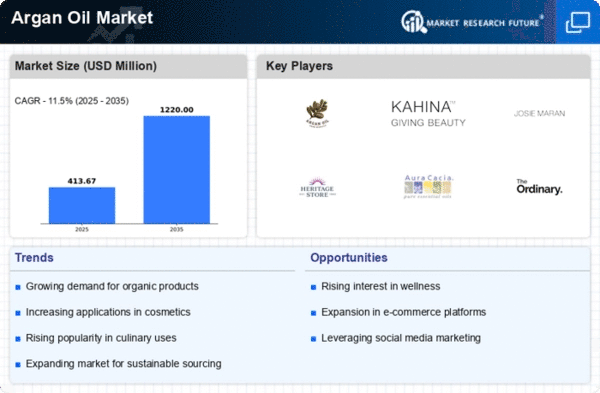
As per MRFR analysis, the Argan Oil Market Size was estimated at 371.0 USD Million in 2024. The Argan Oil industry is projected to grow from 413.0 in 2025 to 1220.0 by 2035, exhibiting a compound annual growth rate (CAGR) of 11.5% during the forecast period 2025 - 2035.

Key Market Trends & Highlights

The Argan Oil Market is experiencing robust growth driven by rising demand for organic products and innovative applications.

  • North America remains the largest market for argan oil, driven by increasing consumer awareness of its health benefits. The Asia-Pacific region is the fastest-growing market, reflecting a surge in demand for natural and organic products. The cosmetic segment continues to dominate, while the food segment is witnessing rapid growth due to changing consumer preferences. Key market drivers include the rising popularity of argan oil in cosmetic applications and the increasing focus on sustainability and ethical sourcing.

Market Size & Forecast

2024 Market Size 371.0 (USD Million)
2035 Market Size 1220.0 (USD Million)
CAGR (2025 - 2035) 11.5%
Largest Regional Market Share in 2024 Europe

Major Players

Argan Oil Morocco (MA), Kahina Giving Beauty (US), Josie Maran Cosmetics (US), Heritage Store (US), Aura Cacia (US), The Ordinary (CA), Pura D'or (US), Acure Organics (US), Eden's Semilla (US)

Market Trends

The Argan Oil Market is currently experiencing a notable evolution, driven by increasing consumer awareness regarding natural and organic products. This shift in preference is largely attributed to the growing inclination towards sustainable and eco-friendly alternatives in personal care and culinary applications. As a result, the demand for argan oil, known for its nourishing properties and versatility, appears to be on the rise. Furthermore, the market is witnessing a surge in product innovation, with brands exploring new formulations and packaging to attract a broader audience. This trend suggests that companies are keen to capitalize on the health and wellness movement, which emphasizes the importance of clean ingredients in everyday products. In addition to the aforementioned factors, the Argan Oil Market is also influenced by the expansion of e-commerce platforms, which facilitate easier access to a diverse range of products. Consumers are increasingly turning to online shopping for convenience and variety, allowing them to discover and purchase argan oil products from various brands. This shift in purchasing behavior indicates a potential for growth in the market, as more consumers become aware of the benefits associated with argan oil. Overall, the Argan Oil Market appears poised for continued growth, driven by evolving consumer preferences and innovative marketing strategies.

Rising Demand for Natural Ingredients

There is a growing trend towards the use of natural ingredients in personal care and food products. Consumers are increasingly seeking out argan oil for its perceived health benefits and eco-friendly profile, which aligns with their desire for sustainable options.

E-commerce Growth

The expansion of online retail channels is transforming the way consumers access argan oil products. E-commerce platforms provide a convenient shopping experience, enabling consumers to explore a wider variety of offerings and brands.

Product Innovation

Brands are actively engaging in product innovation, developing new formulations and packaging for argan oil. This trend reflects a response to consumer demands for unique and effective products, enhancing market competitiveness.

Argan Oil Market Market Drivers

Expansion of E-commerce Platforms

The Argan Oil Market is witnessing a significant transformation due to the expansion of e-commerce platforms. With the rise of online shopping, consumers are now able to access a wider range of argan oil products from various brands, often at competitive prices. This shift towards digital retailing has facilitated greater market penetration, allowing smaller brands to reach a global audience. Data suggests that e-commerce sales of beauty and personal care products, including argan oil, have seen exponential growth, contributing to the overall market expansion. As more consumers turn to online platforms for their purchasing needs, the Argan Oil Market is poised to capitalize on this trend, potentially leading to increased sales and brand visibility.

Growth in the Personal Care Sector

The Argan Oil Market is benefiting from the robust growth in the personal care sector, where argan oil is increasingly utilized in a variety of products, including moisturizers, shampoos, and conditioners. The versatility of argan oil, combined with its perceived benefits, has made it a sought-after ingredient among consumers. Recent market analysis indicates that the personal care segment is projected to witness substantial growth, with argan oil products playing a pivotal role in this expansion. As consumers continue to prioritize self-care and wellness, the demand for high-quality, natural ingredients like argan oil is likely to rise, further propelling the Argan Oil Market forward.

Innovations in Product Formulation

The Argan Oil Market is experiencing a wave of innovations in product formulation, as manufacturers seek to enhance the efficacy and appeal of argan oil products. This includes the development of new blends that combine argan oil with other beneficial ingredients, such as hyaluronic acid and essential oils, to create multifunctional products. Market trends indicate that consumers are increasingly drawn to products that offer multiple benefits, which is driving brands to innovate continuously. As a result, the Argan Oil Market is likely to see a diversification of product offerings, catering to a broader range of consumer preferences and needs, thereby fostering growth and competitiveness.

Rising Demand for Sustainable Products

The Argan Oil Market is increasingly influenced by the rising demand for sustainable and ethically sourced products. Consumers are becoming more discerning about the origins of the products they purchase, favoring those that support environmental sustainability and fair trade practices. Argan oil, often sourced from cooperatives in Morocco, aligns well with these consumer values, as it promotes local economies and sustainable harvesting practices. Market data indicates that brands emphasizing sustainability in their argan oil offerings are likely to attract a loyal customer base, thereby enhancing their market share. This trend towards sustainability is expected to drive innovation within the Argan Oil Market, as companies seek to differentiate themselves through eco-friendly practices.

Increasing Awareness of Health Benefits

The Argan Oil Market is experiencing a notable surge in consumer awareness regarding the health benefits associated with argan oil. Rich in essential fatty acids, antioxidants, and vitamins, argan oil is recognized for its potential to enhance skin hydration, improve hair health, and provide anti-aging properties. This growing awareness is driving demand across various sectors, including cosmetics, food, and dietary supplements. According to recent data, the market for argan oil in the cosmetic sector alone is projected to reach substantial figures, indicating a robust growth trajectory. As consumers increasingly seek natural and organic products, the Argan Oil Market is likely to benefit from this trend, positioning itself as a preferred choice for health-conscious individuals.

Market Segment Insights

By Application: Cosmetic (Largest) vs. Food (Fastest-Growing)

<p>The Argan Oil Market showcases a diverse application landscape, prominently featuring the cosmetic sector, which holds the largest market share. This dominance is attributed to the increasing demand for natural and organic beauty products, driven by consumer preferences for sustainable and skin-friendly formulations. The food segment, while smaller, is rapidly gaining traction, with an expanding consumer base embracing the health benefits associated with argan oil, particularly in culinary uses.</p>

<p>Cosmetic: Largest vs. Food: Fastest-Growing</p>

<p>The cosmetic segment of the Argan Oil Market is characterized by its extensive range of products, including skincare, haircare, and personal care items. This segment benefits from a robust consumer trend towards natural ingredients that promote healthy skin and hair. The food segment, although emerging, reflects a significant shift towards organic and healthy cooking practices, with argan oil being recognized for its nutritional benefits and culinary versatility. As such, while the cosmetic segment maintains its dominance, the food segment is poised for impressive growth, supported by evolving consumer preferences that favor health-focused and gourmet culinary experiences.</p>

By End Use: Personal Care (Largest) vs. Food Industry (Fastest-Growing)

<p>The Argan Oil Market segmentation by end use reveals that the personal care sector holds the largest share, driven by the growing demand for natural and organic ingredients in skin and <a href="https://www.marketresearchfuture.com/reports/hair-care-products-market-8406" target="_blank" title="hair care products">hair care products</a>. This segment is heavily influenced by consumer preferences shifting towards eco-friendly and sustainable beauty solutions, leading to a surge in argan oil-infused products. The food industry, while smaller, is emerging rapidly with increasing interest in the nutritional benefits of argan oil, particularly in culinary applications.</p>

<p>Personal Care: Dominant vs. Food Industry: Emerging</p>

<p>In the Argan Oil Market, the personal care sector is the dominant player, characterized by its wide array of products including moisturizers, shampoos, and oils that cater to health-conscious consumers. This segment capitalizes on argan oil's properties such as its high vitamin E content and antioxidant benefits, appealing to a market increasingly focused on skin and hair health. Conversely, the food industry is an emerging segment, where argan oil is gaining traction for its unique flavor and health benefits, including heart-healthy fats and anti-inflammatory properties. With an expansion of gourmet and health-focused products incorporating argan oil, this sector is expected to see significant growth driven by culinary innovation and consumer trends favoring natural ingredients.</p>

By Form: Liquid (Largest) vs. Capsule (Fastest-Growing)

<p>In the Argan Oil Market, the 'Form' segment showcases a diverse range of products including liquid oils, capsules, creams, and oils. Liquid Argan Oil holds the largest market share, owing to its versatility and high consumer acceptance across various applications, from culinary to cosmetic. Capsules, on the other hand, are emerging rapidly as a preferred choice for consumers seeking convenience and health benefits, contributing to a shift in market dynamics as they gain traction among health-conscious demographics.</p>

<p>Liquid (Dominant) vs. Capsule (Emerging)</p>

<p>Liquid Argan Oil is the dominant form in the market, favored for its multi-purpose utility and natural properties that appeal to both beauty and culinary sectors. Its smooth texture and high absorbability make it a preferred choice for topical applications. Conversely, Capsule Argan Oil offers a more targeted health approach, encapsulating the benefits of the oil for dietary supplementation. This form is gaining momentum among consumers seeking ease of use and effective dosing, establishing itself as an emerging favorite in the nutraceutical segment. The growth of the Capsule format is driven by increasing health trends and an interest in natural wellness solutions.</p>

By Source: Organic (Largest) vs. Wild Harvested (Fastest-Growing)

<p>In the Argan Oil Market, the source segment is primarily divided into Organic, Conventional, and Wild Harvested. Among these, Organic Argan Oil holds the largest market share, driven by the increasing consumer demand for natural and organic products. The rising awareness of the benefits of organic ingredients in personal care and wellness products enhances the position of this segment. Conventional Argan Oil, while still significant, is gradually being overshadowed by the organic options that appeal to health-conscious consumers. Wild Harvested Argan Oil is emerging as the fastest-growing segment due to its sustainable sourcing practices and the rising trend for ethical consumerism. As consumers seek products that are both effective and environmentally friendly, the demand for Wild Harvested options is surging. Furthermore, the unique characteristics associated with Wild Harvested Argan Oil add to its appeal, allowing it to capture market interest rapidly. Overall, the Source segment is evolving with a clear tilt towards more sustainable and organic choices.</p>

<p>Organic: Dominant vs. Wild Harvested: Emerging</p>

<p>Organic Argan Oil is characterized by its production through sustainable and chemical-free farming practices, appealing to environmentally-conscious consumers looking for high-quality, natural products. This segment’s dominance is attributed to the increasing awareness of organic ingredients' benefits and a shift in consumer preferences towards health and wellness. In contrast, Wild Harvested Argan Oil, while still emerging, is gaining traction due to its ethical sourcing and unique properties. This segment appeals to consumers seeking authenticity and sustainable options, making it a key player in the market. Both Organic and Wild Harvested segments are pivotal in shaping the Argan Oil landscape, as they respond to consumer demands for quality, sustainability, and ethical practices.</p>

By Distribution Channel: Online (Largest) vs. Retail (Fastest-Growing)

<p>In the Argan Oil Market, the distribution channels are segmented primarily into online, retail, and wholesale. Among these, the online channel stands out as the largest, capturing a significant share of the market due to its widespread accessibility and convenience. Consumers are increasingly turning to e-commerce platforms for their shopping needs, which has propelled online sales of argan oil-related products. Retail, on the other hand, has demonstrated robust growth as more consumers prefer to purchase beauty and wellness products from physical stores where they can experience the products firsthand before purchase.</p>

<p>Retail (Dominant) vs. Wholesale (Emerging)</p>

<p>The retail distribution channel emerges as the dominant force in the argan oil market, serving a diverse customer base that includes both health-conscious individuals and beauty enthusiasts. Retailers provide a tangible shopping experience that allows consumers to evaluate products directly. Meanwhile, wholesale distribution is considered an emerging channel, as it facilitates bulk buying for businesses and value-added services. As the demand for argan oil continues to rise, wholesalers are expanding their offerings to include organic and sustainably-sourced options, appealing to both retailers and end consumers who prioritize ethical sourcing. Both channels show promise, with retail maintaining significant engagement and wholesale tapping into new markets.</p>

Get more detailed insights about Argan Oil Market Research Report- Forecast till 2035

Regional Insights

North America : Growing Demand for Natural Products

The North American Argan Oil market is witnessing significant growth, driven by increasing consumer preference for natural and organic beauty products. With a market size of $60.0 million, the region is capitalizing on trends favoring sustainability and ethical sourcing. Regulatory support for organic certifications and clean beauty initiatives further catalyze this growth, encouraging brands to innovate and expand their product lines. Leading countries in this region include the US and Canada, where key players like Josie Maran Cosmetics and Kahina Giving Beauty are making substantial impacts. The competitive landscape is characterized by a mix of established brands and emerging startups, all vying for market share. The presence of major retailers and e-commerce platforms enhances accessibility, making Argan Oil products increasingly popular among consumers seeking quality and efficacy.

Europe : Market Leader in Argan Oil

Europe holds the largest share of the Argan Oil market, valued at $200.0 million, reflecting a robust demand for high-quality natural products. The region's growth is fueled by increasing awareness of the benefits of Argan Oil in skincare and haircare, alongside stringent regulations promoting organic and sustainable sourcing. The European market is also benefiting from rising disposable incomes, allowing consumers to invest in premium beauty products. Countries like France, Germany, and the UK are leading the charge, with a competitive landscape featuring brands such as The Ordinary and Aura Cacia. The presence of established retailers and a strong online marketplace further supports growth. Regulatory bodies emphasize quality and safety, ensuring that products meet high standards, which enhances consumer trust and drives sales.

Asia-Pacific : Emerging Market with High Potential

The Asia-Pacific Argan Oil market is on an upward trajectory, with a market size of $80.0 million. This growth is driven by increasing consumer awareness of natural beauty products and a shift towards organic ingredients in cosmetics. The region's diverse population and rising middle class are contributing to a surge in demand for premium beauty products, supported by favorable regulatory frameworks that encourage the use of natural ingredients. Leading countries in this region include Australia, Japan, and China, where brands are increasingly incorporating Argan Oil into their offerings. The competitive landscape is evolving, with both local and international players vying for market share. Key players like Pura D'or and Now Foods are expanding their presence, leveraging e-commerce platforms to reach a broader audience and cater to the growing demand for natural beauty solutions.

Middle East and Africa : Niche Market with Growth Opportunities

The Middle East and Africa Argan Oil market, valued at $31.0 million, is gradually expanding, driven by increasing interest in natural and organic products. The region's growth is supported by rising health consciousness among consumers and a growing beauty industry that values sustainable sourcing. Regulatory frameworks are becoming more favorable, promoting the use of natural ingredients in cosmetics and personal care products. Countries like South Africa and the UAE are leading the market, with a competitive landscape that includes both local and international brands. Key players such as Argan Oil Morocco are establishing a strong foothold, focusing on quality and authenticity. The region's unique cultural appreciation for natural remedies further enhances the appeal of Argan Oil, creating opportunities for growth in niche markets.

Key Players and Competitive Insights

The Argan Oil Market is characterized by a dynamic competitive landscape, driven by increasing consumer awareness regarding natural and organic products. Key players are strategically positioning themselves through innovation, sustainability initiatives, and digital transformation. Companies such as Josie Maran Cosmetics (US) and Kahina Giving Beauty (US) are particularly focused on enhancing their product offerings with ethically sourced ingredients, which resonates well with the environmentally conscious consumer base. This collective emphasis on sustainability and quality is shaping a competitive environment that prioritizes brand loyalty and consumer trust.

In terms of business tactics, many companies are localizing their manufacturing processes to reduce costs and improve supply chain efficiency. The market appears moderately fragmented, with several players vying for market share. However, the influence of major companies like Argan Oil Morocco (MA) and The Ordinary (CA) is significant, as they leverage their established brand recognition and distribution networks to maintain a competitive edge. This competitive structure suggests that while there is room for new entrants, the established players are likely to dominate through strategic partnerships and operational efficiencies.

In November 2025, Josie Maran Cosmetics (US) announced a new partnership with a Moroccan cooperative to enhance the traceability of their argan oil supply chain. This strategic move not only strengthens their commitment to sustainability but also ensures that the local communities benefit economically. Such initiatives are likely to enhance brand loyalty and consumer trust, positioning Josie Maran as a leader in ethical sourcing within the market.

In October 2025, Kahina Giving Beauty (US) launched a new line of argan oil-infused skincare products that utilize advanced formulation techniques. This innovation reflects a growing trend towards integrating technology in product development, which may attract a broader consumer base seeking effective and high-quality skincare solutions. The introduction of this line could potentially elevate Kahina's market position by appealing to both existing and new customers.

In September 2025, The Ordinary (CA) expanded its product range to include a new argan oil serum, emphasizing affordability without compromising quality. This strategic decision appears to target a price-sensitive segment of the market, which may intensify competition among brands. The Ordinary's focus on providing high-quality products at competitive prices could disrupt the market dynamics, compelling other players to reassess their pricing strategies.

As of December 2025, the Argan Oil Market is witnessing trends that emphasize digitalization, sustainability, and the integration of AI in product development and marketing strategies. Strategic alliances are increasingly shaping the competitive landscape, as companies collaborate to enhance their product offerings and market reach. Looking ahead, competitive differentiation is likely to evolve from traditional price-based competition to a focus on innovation, technology, and supply chain reliability. This shift suggests that companies that prioritize these aspects may gain a substantial advantage in the increasingly competitive market.

Key Companies in the Argan Oil Market include

Industry Developments

Future Outlook

Argan Oil Market Future Outlook

The Argan Oil Market is projected to grow at an 11.5% CAGR from 2024 to 2035, driven by rising demand in cosmetics, food, and health sectors.

New opportunities lie in:

  • Expansion into emerging markets through localized production facilities.
  • Development of premium product lines targeting luxury <a href="https://www.marketresearchfuture.com/reports/skincare-market-14012" target="_blank" title="skincare">skincare</a> segments.
  • Strategic partnerships with health and wellness brands for co-branded products.

By 2035, the Argan Oil Market is expected to solidify its position as a leading natural oil segment.

Market Segmentation

Argan Oil Market Form Outlook

  • Liquid
  • Capsule
  • Cream
  • Oil

Argan Oil Market Source Outlook

  • Organic
  • Conventional
  • Wild Harvested

Argan Oil Market End Use Outlook

  • Personal Care
  • Food Industry
  • Healthcare
  • Household

Argan Oil Market Application Outlook

  • Cosmetic
  • Food
  • Pharmaceutical
  • Industrial

Argan Oil Market Distribution Channel Outlook

  • Online
  • Retail
  • Wholesale

Report Scope

MARKET SIZE 2024371.0(USD Million)
MARKET SIZE 2025413.0(USD Million)
MARKET SIZE 20351220.0(USD Million)
COMPOUND ANNUAL GROWTH RATE (CAGR)11.5% (2024 - 2035)
REPORT COVERAGERevenue Forecast, Competitive Landscape, Growth Factors, and Trends
BASE YEAR2024
Market Forecast Period2025 - 2035
Historical Data2019 - 2024
Market Forecast UnitsUSD Million
Key Companies ProfiledArgan Oil Morocco (MA), Kahina Giving Beauty (US), Josie Maran Cosmetics (US), Aura Cacia (US), Heritage Store (US), The Ordinary (CA), Pura D'or (US), Now Foods (US), Eden Foods (US)
Segments CoveredApplication, End Use, Form, Source, Distribution Channel
Key Market OpportunitiesGrowing demand for natural cosmetics and personal care products fuels Argan Oil Market expansion.
Key Market DynamicsRising consumer demand for natural beauty products drives competition and innovation in the Argan Oil Market.
Countries CoveredNorth America, Europe, APAC, South America, MEA

FAQs

What is the current valuation of the Argan Oil Market as of 2024?

<p>The Argan Oil Market was valued at 371.0 USD Million in 2024.</p>

What is the projected market valuation for the Argan Oil Market in 2035?

<p>The projected valuation for the Argan Oil Market in 2035 is 1220.0 USD Million.</p>

What is the expected CAGR for the Argan Oil Market during the forecast period 2025 - 2035?

<p>The expected CAGR for the Argan Oil Market during the forecast period 2025 - 2035 is 11.5%.</p>

Which companies are considered key players in the Argan Oil Market?

<p>Key players in the Argan Oil Market include Argan Oil Morocco, Kahina Giving Beauty, and Josie Maran Cosmetics.</p>

What are the main applications of Argan Oil in the market?

<p>The main applications of Argan Oil include Cosmetic, Food, Pharmaceutical, and Industrial sectors.</p>

How does the Argan Oil Market perform in the personal care segment?

<p>The personal care segment of the Argan Oil Market was valued between 111.0 and 370.0 USD Million.</p>

What is the market size for organic Argan Oil compared to conventional and wild harvested sources?

<p>Organic Argan Oil is valued between 100.0 and 350.0 USD Million, while conventional sources range from 200.0 to 600.0 USD Million.</p>

What distribution channels are utilized in the Argan Oil Market?

<p>Distribution channels in the Argan Oil Market include Online, Retail, and Wholesale, with retail valued between 185.0 and 615.0 USD Million.</p>

What forms of Argan Oil are available in the market?

<p>Forms of Argan Oil available include Liquid, Capsule, Cream, and Oil, with Liquid valued between 148.0 and 480.0 USD Million.</p>

How does the food industry utilize Argan Oil?

<p>The food industry segment of the Argan Oil Market was valued between 74.0 and 240.0 USD Million.</p>

  1. SECTION I: EXECUTIVE SUMMARY AND KEY HIGHLIGHTS
    1. | 1.1 EXECUTIVE SUMMARY
    2. | | 1.1.1 Market Overview
    3. | | 1.1.2 Key Findings
    4. | | 1.1.3 Market Segmentation
    5. | | 1.1.4 Competitive Landscape
    6. | | 1.1.5 Challenges and Opportunities
    7. | | 1.1.6 Future Outlook
  2. SECTION II: SCOPING, METHODOLOGY AND MARKET STRUCTURE
    1. | 2.1 MARKET INTRODUCTION
    2. | | 2.1.1 Definition
    3. | | 2.1.2 Scope of the study
    4. | | | 2.1.2.1 Research Objective
    5. | | | 2.1.2.2 Assumption
    6. | | | 2.1.2.3 Limitations
    7. | 2.2 RESEARCH METHODOLOGY
    8. | | 2.2.1 Overview
    9. | | 2.2.2 Data Mining
    10. | | 2.2.3 Secondary Research
    11. | | 2.2.4 Primary Research
    12. | | | 2.2.4.1 Primary Interviews and Information Gathering Process
    13. | | | 2.2.4.2 Breakdown of Primary Respondents
    14. | | 2.2.5 Forecasting Model
    15. | | 2.2.6 Market Size Estimation
    16. | | | 2.2.6.1 Bottom-Up Approach
    17. | | | 2.2.6.2 Top-Down Approach
    18. | | 2.2.7 Data Triangulation
    19. | | 2.2.8 Validation
  3. SECTION III: QUALITATIVE ANALYSIS
    1. | 3.1 MARKET DYNAMICS
    2. | | 3.1.1 Overview
    3. | | 3.1.2 Drivers
    4. | | 3.1.3 Restraints
    5. | | 3.1.4 Opportunities
    6. | 3.2 MARKET FACTOR ANALYSIS
    7. | | 3.2.1 Value chain Analysis
    8. | | 3.2.2 Porter's Five Forces Analysis
    9. | | | 3.2.2.1 Bargaining Power of Suppliers
    10. | | | 3.2.2.2 Bargaining Power of Buyers
    11. | | | 3.2.2.3 Threat of New Entrants
    12. | | | 3.2.2.4 Threat of Substitutes
    13. | | | 3.2.2.5 Intensity of Rivalry
    14. | | 3.2.3 COVID-19 Impact Analysis
    15. | | | 3.2.3.1 Market Impact Analysis
    16. | | | 3.2.3.2 Regional Impact
    17. | | | 3.2.3.3 Opportunity and Threat Analysis
  4. SECTION IV: QUANTITATIVE ANALYSIS
    1. | 4.1 Consumer and Retail, BY Application (USD Million)
    2. | | 4.1.1 Cosmetic
    3. | | 4.1.2 Food
    4. | | 4.1.3 Pharmaceutical
    5. | | 4.1.4 Industrial
    6. | 4.2 Consumer and Retail, BY End Use (USD Million)
    7. | | 4.2.1 Personal Care
    8. | | 4.2.2 Food Industry
    9. | | 4.2.3 Healthcare
    10. | | 4.2.4 Household
    11. | 4.3 Consumer and Retail, BY Form (USD Million)
    12. | | 4.3.1 Liquid
    13. | | 4.3.2 Capsule
    14. | | 4.3.3 Cream
    15. | | 4.3.4 Oil
    16. | 4.4 Consumer and Retail, BY Source (USD Million)
    17. | | 4.4.1 Organic
    18. | | 4.4.2 Conventional
    19. | | 4.4.3 Wild Harvested
    20. | 4.5 Consumer and Retail, BY Distribution Channel (USD Million)
    21. | | 4.5.1 Online
    22. | | 4.5.2 Retail
    23. | | 4.5.3 Wholesale
    24. | 4.6 Consumer and Retail, BY Region (USD Million)
    25. | | 4.6.1 North America
    26. | | | 4.6.1.1 US
    27. | | | 4.6.1.2 Canada
    28. | | 4.6.2 Europe
    29. | | | 4.6.2.1 Germany
    30. | | | 4.6.2.2 UK
    31. | | | 4.6.2.3 France
    32. | | | 4.6.2.4 Russia
    33. | | | 4.6.2.5 Italy
    34. | | | 4.6.2.6 Spain
    35. | | | 4.6.2.7 Rest of Europe
    36. | | 4.6.3 APAC
    37. | | | 4.6.3.1 China
    38. | | | 4.6.3.2 India
    39. | | | 4.6.3.3 Japan
    40. | | | 4.6.3.4 South Korea
    41. | | | 4.6.3.5 Malaysia
    42. | | | 4.6.3.6 Thailand
    43. | | | 4.6.3.7 Indonesia
    44. | | | 4.6.3.8 Rest of APAC
    45. | | 4.6.4 South America
    46. | | | 4.6.4.1 Brazil
    47. | | | 4.6.4.2 Mexico
    48. | | | 4.6.4.3 Argentina
    49. | | | 4.6.4.4 Rest of South America
    50. | | 4.6.5 MEA
    51. | | | 4.6.5.1 GCC Countries
    52. | | | 4.6.5.2 South Africa
    53. | | | 4.6.5.3 Rest of MEA
  5. SECTION V: COMPETITIVE ANALYSIS
    1. | 5.1 Competitive Landscape
    2. | | 5.1.1 Overview
    3. | | 5.1.2 Competitive Analysis
    4. | | 5.1.3 Market share Analysis
    5. | | 5.1.4 Major Growth Strategy in the Consumer and Retail
    6. | | 5.1.5 Competitive Benchmarking
    7. | | 5.1.6 Leading Players in Terms of Number of Developments in the Consumer and Retail
    8. | | 5.1.7 Key developments and growth strategies
    9. | | | 5.1.7.1 New Product Launch/Service Deployment
    10. | | | 5.1.7.2 Merger & Acquisitions
    11. | | | 5.1.7.3 Joint Ventures
    12. | | 5.1.8 Major Players Financial Matrix
    13. | | | 5.1.8.1 Sales and Operating Income
    14. | | | 5.1.8.2 Major Players R&D Expenditure. 2023
    15. | 5.2 Company Profiles
    16. | | 5.2.1 Argan Oil Morocco (MA)
    17. | | | 5.2.1.1 Financial Overview
    18. | | | 5.2.1.2 Products Offered
    19. | | | 5.2.1.3 Key Developments
    20. | | | 5.2.1.4 SWOT Analysis
    21. | | | 5.2.1.5 Key Strategies
    22. | | 5.2.2 Kahina Giving Beauty (US)
    23. | | | 5.2.2.1 Financial Overview
    24. | | | 5.2.2.2 Products Offered
    25. | | | 5.2.2.3 Key Developments
    26. | | | 5.2.2.4 SWOT Analysis
    27. | | | 5.2.2.5 Key Strategies
    28. | | 5.2.3 Josie Maran Cosmetics (US)
    29. | | | 5.2.3.1 Financial Overview
    30. | | | 5.2.3.2 Products Offered
    31. | | | 5.2.3.3 Key Developments
    32. | | | 5.2.3.4 SWOT Analysis
    33. | | | 5.2.3.5 Key Strategies
    34. | | 5.2.4 Aura Cacia (US)
    35. | | | 5.2.4.1 Financial Overview
    36. | | | 5.2.4.2 Products Offered
    37. | | | 5.2.4.3 Key Developments
    38. | | | 5.2.4.4 SWOT Analysis
    39. | | | 5.2.4.5 Key Strategies
    40. | | 5.2.5 Heritage Store (US)
    41. | | | 5.2.5.1 Financial Overview
    42. | | | 5.2.5.2 Products Offered
    43. | | | 5.2.5.3 Key Developments
    44. | | | 5.2.5.4 SWOT Analysis
    45. | | | 5.2.5.5 Key Strategies
    46. | | 5.2.6 The Ordinary (CA)
    47. | | | 5.2.6.1 Financial Overview
    48. | | | 5.2.6.2 Products Offered
    49. | | | 5.2.6.3 Key Developments
    50. | | | 5.2.6.4 SWOT Analysis
    51. | | | 5.2.6.5 Key Strategies
    52. | | 5.2.7 Pura D'or (US)
    53. | | | 5.2.7.1 Financial Overview
    54. | | | 5.2.7.2 Products Offered
    55. | | | 5.2.7.3 Key Developments
    56. | | | 5.2.7.4 SWOT Analysis
    57. | | | 5.2.7.5 Key Strategies
    58. | | 5.2.8 Now Foods (US)
    59. | | | 5.2.8.1 Financial Overview
    60. | | | 5.2.8.2 Products Offered
    61. | | | 5.2.8.3 Key Developments
    62. | | | 5.2.8.4 SWOT Analysis
    63. | | | 5.2.8.5 Key Strategies
    64. | | 5.2.9 Eden Foods (US)
    65. | | | 5.2.9.1 Financial Overview
    66. | | | 5.2.9.2 Products Offered
    67. | | | 5.2.9.3 Key Developments
    68. | | | 5.2.9.4 SWOT Analysis
    69. | | | 5.2.9.5 Key Strategies
    70. | 5.3 Appendix
    71. | | 5.3.1 References
    72. | | 5.3.2 Related Reports
  6. LIST OF FIGURES
    1. | 6.1 MARKET SYNOPSIS
    2. | 6.2 NORTH AMERICA MARKET ANALYSIS
    3. | 6.3 US MARKET ANALYSIS BY APPLICATION
    4. | 6.4 US MARKET ANALYSIS BY END USE
    5. | 6.5 US MARKET ANALYSIS BY FORM
    6. | 6.6 US MARKET ANALYSIS BY SOURCE
    7. | 6.7 US MARKET ANALYSIS BY DISTRIBUTION CHANNEL
    8. | 6.8 CANADA MARKET ANALYSIS BY APPLICATION
    9. | 6.9 CANADA MARKET ANALYSIS BY END USE
    10. | 6.10 CANADA MARKET ANALYSIS BY FORM
    11. | 6.11 CANADA MARKET ANALYSIS BY SOURCE
    12. | 6.12 CANADA MARKET ANALYSIS BY DISTRIBUTION CHANNEL
    13. | 6.13 EUROPE MARKET ANALYSIS
    14. | 6.14 GERMANY MARKET ANALYSIS BY APPLICATION
    15. | 6.15 GERMANY MARKET ANALYSIS BY END USE
    16. | 6.16 GERMANY MARKET ANALYSIS BY FORM
    17. | 6.17 GERMANY MARKET ANALYSIS BY SOURCE
    18. | 6.18 GERMANY MARKET ANALYSIS BY DISTRIBUTION CHANNEL
    19. | 6.19 UK MARKET ANALYSIS BY APPLICATION
    20. | 6.20 UK MARKET ANALYSIS BY END USE
    21. | 6.21 UK MARKET ANALYSIS BY FORM
    22. | 6.22 UK MARKET ANALYSIS BY SOURCE
    23. | 6.23 UK MARKET ANALYSIS BY DISTRIBUTION CHANNEL
    24. | 6.24 FRANCE MARKET ANALYSIS BY APPLICATION
    25. | 6.25 FRANCE MARKET ANALYSIS BY END USE
    26. | 6.26 FRANCE MARKET ANALYSIS BY FORM
    27. | 6.27 FRANCE MARKET ANALYSIS BY SOURCE
    28. | 6.28 FRANCE MARKET ANALYSIS BY DISTRIBUTION CHANNEL
    29. | 6.29 RUSSIA MARKET ANALYSIS BY APPLICATION
    30. | 6.30 RUSSIA MARKET ANALYSIS BY END USE
    31. | 6.31 RUSSIA MARKET ANALYSIS BY FORM
    32. | 6.32 RUSSIA MARKET ANALYSIS BY SOURCE
    33. | 6.33 RUSSIA MARKET ANALYSIS BY DISTRIBUTION CHANNEL
    34. | 6.34 ITALY MARKET ANALYSIS BY APPLICATION
    35. | 6.35 ITALY MARKET ANALYSIS BY END USE
    36. | 6.36 ITALY MARKET ANALYSIS BY FORM
    37. | 6.37 ITALY MARKET ANALYSIS BY SOURCE
    38. | 6.38 ITALY MARKET ANALYSIS BY DISTRIBUTION CHANNEL
    39. | 6.39 SPAIN MARKET ANALYSIS BY APPLICATION
    40. | 6.40 SPAIN MARKET ANALYSIS BY END USE
    41. | 6.41 SPAIN MARKET ANALYSIS BY FORM
    42. | 6.42 SPAIN MARKET ANALYSIS BY SOURCE
    43. | 6.43 SPAIN MARKET ANALYSIS BY DISTRIBUTION CHANNEL
    44. | 6.44 REST OF EUROPE MARKET ANALYSIS BY APPLICATION
    45. | 6.45 REST OF EUROPE MARKET ANALYSIS BY END USE
    46. | 6.46 REST OF EUROPE MARKET ANALYSIS BY FORM
    47. | 6.47 REST OF EUROPE MARKET ANALYSIS BY SOURCE
    48. | 6.48 REST OF EUROPE MARKET ANALYSIS BY DISTRIBUTION CHANNEL
    49. | 6.49 APAC MARKET ANALYSIS
    50. | 6.50 CHINA MARKET ANALYSIS BY APPLICATION
    51. | 6.51 CHINA MARKET ANALYSIS BY END USE
    52. | 6.52 CHINA MARKET ANALYSIS BY FORM
    53. | 6.53 CHINA MARKET ANALYSIS BY SOURCE
    54. | 6.54 CHINA MARKET ANALYSIS BY DISTRIBUTION CHANNEL
    55. | 6.55 INDIA MARKET ANALYSIS BY APPLICATION
    56. | 6.56 INDIA MARKET ANALYSIS BY END USE
    57. | 6.57 INDIA MARKET ANALYSIS BY FORM
    58. | 6.58 INDIA MARKET ANALYSIS BY SOURCE
    59. | 6.59 INDIA MARKET ANALYSIS BY DISTRIBUTION CHANNEL
    60. | 6.60 JAPAN MARKET ANALYSIS BY APPLICATION
    61. | 6.61 JAPAN MARKET ANALYSIS BY END USE
    62. | 6.62 JAPAN MARKET ANALYSIS BY FORM
    63. | 6.63 JAPAN MARKET ANALYSIS BY SOURCE
    64. | 6.64 JAPAN MARKET ANALYSIS BY DISTRIBUTION CHANNEL
    65. | 6.65 SOUTH KOREA MARKET ANALYSIS BY APPLICATION
    66. | 6.66 SOUTH KOREA MARKET ANALYSIS BY END USE
    67. | 6.67 SOUTH KOREA MARKET ANALYSIS BY FORM
    68. | 6.68 SOUTH KOREA MARKET ANALYSIS BY SOURCE
    69. | 6.69 SOUTH KOREA MARKET ANALYSIS BY DISTRIBUTION CHANNEL
    70. | 6.70 MALAYSIA MARKET ANALYSIS BY APPLICATION
    71. | 6.71 MALAYSIA MARKET ANALYSIS BY END USE
    72. | 6.72 MALAYSIA MARKET ANALYSIS BY FORM
    73. | 6.73 MALAYSIA MARKET ANALYSIS BY SOURCE
    74. | 6.74 MALAYSIA MARKET ANALYSIS BY DISTRIBUTION CHANNEL
    75. | 6.75 THAILAND MARKET ANALYSIS BY APPLICATION
    76. | 6.76 THAILAND MARKET ANALYSIS BY END USE
    77. | 6.77 THAILAND MARKET ANALYSIS BY FORM
    78. | 6.78 THAILAND MARKET ANALYSIS BY SOURCE
    79. | 6.79 THAILAND MARKET ANALYSIS BY DISTRIBUTION CHANNEL
    80. | 6.80 INDONESIA MARKET ANALYSIS BY APPLICATION
    81. | 6.81 INDONESIA MARKET ANALYSIS BY END USE
    82. | 6.82 INDONESIA MARKET ANALYSIS BY FORM
    83. | 6.83 INDONESIA MARKET ANALYSIS BY SOURCE
    84. | 6.84 INDONESIA MARKET ANALYSIS BY DISTRIBUTION CHANNEL
    85. | 6.85 REST OF APAC MARKET ANALYSIS BY APPLICATION
    86. | 6.86 REST OF APAC MARKET ANALYSIS BY END USE
    87. | 6.87 REST OF APAC MARKET ANALYSIS BY FORM
    88. | 6.88 REST OF APAC MARKET ANALYSIS BY SOURCE
    89. | 6.89 REST OF APAC MARKET ANALYSIS BY DISTRIBUTION CHANNEL
    90. | 6.90 SOUTH AMERICA MARKET ANALYSIS
    91. | 6.91 BRAZIL MARKET ANALYSIS BY APPLICATION
    92. | 6.92 BRAZIL MARKET ANALYSIS BY END USE
    93. | 6.93 BRAZIL MARKET ANALYSIS BY FORM
    94. | 6.94 BRAZIL MARKET ANALYSIS BY SOURCE
    95. | 6.95 BRAZIL MARKET ANALYSIS BY DISTRIBUTION CHANNEL
    96. | 6.96 MEXICO MARKET ANALYSIS BY APPLICATION
    97. | 6.97 MEXICO MARKET ANALYSIS BY END USE
    98. | 6.98 MEXICO MARKET ANALYSIS BY FORM
    99. | 6.99 MEXICO MARKET ANALYSIS BY SOURCE
    100. | 6.100 MEXICO MARKET ANALYSIS BY DISTRIBUTION CHANNEL
    101. | 6.101 ARGENTINA MARKET ANALYSIS BY APPLICATION
    102. | 6.102 ARGENTINA MARKET ANALYSIS BY END USE
    103. | 6.103 ARGENTINA MARKET ANALYSIS BY FORM
    104. | 6.104 ARGENTINA MARKET ANALYSIS BY SOURCE
    105. | 6.105 ARGENTINA MARKET ANALYSIS BY DISTRIBUTION CHANNEL
    106. | 6.106 REST OF SOUTH AMERICA MARKET ANALYSIS BY APPLICATION
    107. | 6.107 REST OF SOUTH AMERICA MARKET ANALYSIS BY END USE
    108. | 6.108 REST OF SOUTH AMERICA MARKET ANALYSIS BY FORM
    109. | 6.109 REST OF SOUTH AMERICA MARKET ANALYSIS BY SOURCE
    110. | 6.110 REST OF SOUTH AMERICA MARKET ANALYSIS BY DISTRIBUTION CHANNEL
    111. | 6.111 MEA MARKET ANALYSIS
    112. | 6.112 GCC COUNTRIES MARKET ANALYSIS BY APPLICATION
    113. | 6.113 GCC COUNTRIES MARKET ANALYSIS BY END USE
    114. | 6.114 GCC COUNTRIES MARKET ANALYSIS BY FORM
    115. | 6.115 GCC COUNTRIES MARKET ANALYSIS BY SOURCE
    116. | 6.116 GCC COUNTRIES MARKET ANALYSIS BY DISTRIBUTION CHANNEL
    117. | 6.117 SOUTH AFRICA MARKET ANALYSIS BY APPLICATION
    118. | 6.118 SOUTH AFRICA MARKET ANALYSIS BY END USE
    119. | 6.119 SOUTH AFRICA MARKET ANALYSIS BY FORM
    120. | 6.120 SOUTH AFRICA MARKET ANALYSIS BY SOURCE
    121. | 6.121 SOUTH AFRICA MARKET ANALYSIS BY DISTRIBUTION CHANNEL
    122. | 6.122 REST OF MEA MARKET ANALYSIS BY APPLICATION
    123. | 6.123 REST OF MEA MARKET ANALYSIS BY END USE
    124. | 6.124 REST OF MEA MARKET ANALYSIS BY FORM
    125. | 6.125 REST OF MEA MARKET ANALYSIS BY SOURCE
    126. | 6.126 REST OF MEA MARKET ANALYSIS BY DISTRIBUTION CHANNEL
    127. | 6.127 KEY BUYING CRITERIA OF CONSUMER AND RETAIL
    128. | 6.128 RESEARCH PROCESS OF MRFR
    129. | 6.129 DRO ANALYSIS OF CONSUMER AND RETAIL
    130. | 6.130 DRIVERS IMPACT ANALYSIS: CONSUMER AND RETAIL
    131. | 6.131 RESTRAINTS IMPACT ANALYSIS: CONSUMER AND RETAIL
    132. | 6.132 SUPPLY / VALUE CHAIN: CONSUMER AND RETAIL
    133. | 6.133 CONSUMER AND RETAIL, BY APPLICATION, 2024 (% SHARE)
    134. | 6.134 CONSUMER AND RETAIL, BY APPLICATION, 2024 TO 2035 (USD Million)
    135. | 6.135 CONSUMER AND RETAIL, BY END USE, 2024 (% SHARE)
    136. | 6.136 CONSUMER AND RETAIL, BY END USE, 2024 TO 2035 (USD Million)
    137. | 6.137 CONSUMER AND RETAIL, BY FORM, 2024 (% SHARE)
    138. | 6.138 CONSUMER AND RETAIL, BY FORM, 2024 TO 2035 (USD Million)
    139. | 6.139 CONSUMER AND RETAIL, BY SOURCE, 2024 (% SHARE)
    140. | 6.140 CONSUMER AND RETAIL, BY SOURCE, 2024 TO 2035 (USD Million)
    141. | 6.141 CONSUMER AND RETAIL, BY DISTRIBUTION CHANNEL, 2024 (% SHARE)
    142. | 6.142 CONSUMER AND RETAIL, BY DISTRIBUTION CHANNEL, 2024 TO 2035 (USD Million)
    143. | 6.143 BENCHMARKING OF MAJOR COMPETITORS
  7. LIST OF TABLES
    1. | 7.1 LIST OF ASSUMPTIONS
    2. | | 7.1.1
    3. | 7.2 North America MARKET SIZE ESTIMATES; FORECAST
    4. | | 7.2.1 BY APPLICATION, 2025-2035 (USD Million)
    5. | | 7.2.2 BY END USE, 2025-2035 (USD Million)
    6. | | 7.2.3 BY FORM, 2025-2035 (USD Million)
    7. | | 7.2.4 BY SOURCE, 2025-2035 (USD Million)
    8. | | 7.2.5 BY DISTRIBUTION CHANNEL, 2025-2035 (USD Million)
    9. | 7.3 US MARKET SIZE ESTIMATES; FORECAST
    10. | | 7.3.1 BY APPLICATION, 2025-2035 (USD Million)
    11. | | 7.3.2 BY END USE, 2025-2035 (USD Million)
    12. | | 7.3.3 BY FORM, 2025-2035 (USD Million)
    13. | | 7.3.4 BY SOURCE, 2025-2035 (USD Million)
    14. | | 7.3.5 BY DISTRIBUTION CHANNEL, 2025-2035 (USD Million)
    15. | 7.4 Canada MARKET SIZE ESTIMATES; FORECAST
    16. | | 7.4.1 BY APPLICATION, 2025-2035 (USD Million)
    17. | | 7.4.2 BY END USE, 2025-2035 (USD Million)
    18. | | 7.4.3 BY FORM, 2025-2035 (USD Million)
    19. | | 7.4.4 BY SOURCE, 2025-2035 (USD Million)
    20. | | 7.4.5 BY DISTRIBUTION CHANNEL, 2025-2035 (USD Million)
    21. | 7.5 Europe MARKET SIZE ESTIMATES; FORECAST
    22. | | 7.5.1 BY APPLICATION, 2025-2035 (USD Million)
    23. | | 7.5.2 BY END USE, 2025-2035 (USD Million)
    24. | | 7.5.3 BY FORM, 2025-2035 (USD Million)
    25. | | 7.5.4 BY SOURCE, 2025-2035 (USD Million)
    26. | | 7.5.5 BY DISTRIBUTION CHANNEL, 2025-2035 (USD Million)
    27. | 7.6 Germany MARKET SIZE ESTIMATES; FORECAST
    28. | | 7.6.1 BY APPLICATION, 2025-2035 (USD Million)
    29. | | 7.6.2 BY END USE, 2025-2035 (USD Million)
    30. | | 7.6.3 BY FORM, 2025-2035 (USD Million)
    31. | | 7.6.4 BY SOURCE, 2025-2035 (USD Million)
    32. | | 7.6.5 BY DISTRIBUTION CHANNEL, 2025-2035 (USD Million)
    33. | 7.7 UK MARKET SIZE ESTIMATES; FORECAST
    34. | | 7.7.1 BY APPLICATION, 2025-2035 (USD Million)
    35. | | 7.7.2 BY END USE, 2025-2035 (USD Million)
    36. | | 7.7.3 BY FORM, 2025-2035 (USD Million)
    37. | | 7.7.4 BY SOURCE, 2025-2035 (USD Million)
    38. | | 7.7.5 BY DISTRIBUTION CHANNEL, 2025-2035 (USD Million)
    39. | 7.8 France MARKET SIZE ESTIMATES; FORECAST
    40. | | 7.8.1 BY APPLICATION, 2025-2035 (USD Million)
    41. | | 7.8.2 BY END USE, 2025-2035 (USD Million)
    42. | | 7.8.3 BY FORM, 2025-2035 (USD Million)
    43. | | 7.8.4 BY SOURCE, 2025-2035 (USD Million)
    44. | | 7.8.5 BY DISTRIBUTION CHANNEL, 2025-2035 (USD Million)
    45. | 7.9 Russia MARKET SIZE ESTIMATES; FORECAST
    46. | | 7.9.1 BY APPLICATION, 2025-2035 (USD Million)
    47. | | 7.9.2 BY END USE, 2025-2035 (USD Million)
    48. | | 7.9.3 BY FORM, 2025-2035 (USD Million)
    49. | | 7.9.4 BY SOURCE, 2025-2035 (USD Million)
    50. | | 7.9.5 BY DISTRIBUTION CHANNEL, 2025-2035 (USD Million)
    51. | 7.10 Italy MARKET SIZE ESTIMATES; FORECAST
    52. | | 7.10.1 BY APPLICATION, 2025-2035 (USD Million)
    53. | | 7.10.2 BY END USE, 2025-2035 (USD Million)
    54. | | 7.10.3 BY FORM, 2025-2035 (USD Million)
    55. | | 7.10.4 BY SOURCE, 2025-2035 (USD Million)
    56. | | 7.10.5 BY DISTRIBUTION CHANNEL, 2025-2035 (USD Million)
    57. | 7.11 Spain MARKET SIZE ESTIMATES; FORECAST
    58. | | 7.11.1 BY APPLICATION, 2025-2035 (USD Million)
    59. | | 7.11.2 BY END USE, 2025-2035 (USD Million)
    60. | | 7.11.3 BY FORM, 2025-2035 (USD Million)
    61. | | 7.11.4 BY SOURCE, 2025-2035 (USD Million)
    62. | | 7.11.5 BY DISTRIBUTION CHANNEL, 2025-2035 (USD Million)
    63. | 7.12 Rest of Europe MARKET SIZE ESTIMATES; FORECAST
    64. | | 7.12.1 BY APPLICATION, 2025-2035 (USD Million)
    65. | | 7.12.2 BY END USE, 2025-2035 (USD Million)
    66. | | 7.12.3 BY FORM, 2025-2035 (USD Million)
    67. | | 7.12.4 BY SOURCE, 2025-2035 (USD Million)
    68. | | 7.12.5 BY DISTRIBUTION CHANNEL, 2025-2035 (USD Million)
    69. | 7.13 APAC MARKET SIZE ESTIMATES; FORECAST
    70. | | 7.13.1 BY APPLICATION, 2025-2035 (USD Million)
    71. | | 7.13.2 BY END USE, 2025-2035 (USD Million)
    72. | | 7.13.3 BY FORM, 2025-2035 (USD Million)
    73. | | 7.13.4 BY SOURCE, 2025-2035 (USD Million)
    74. | | 7.13.5 BY DISTRIBUTION CHANNEL, 2025-2035 (USD Million)
    75. | 7.14 China MARKET SIZE ESTIMATES; FORECAST
    76. | | 7.14.1 BY APPLICATION, 2025-2035 (USD Million)
    77. | | 7.14.2 BY END USE, 2025-2035 (USD Million)
    78. | | 7.14.3 BY FORM, 2025-2035 (USD Million)
    79. | | 7.14.4 BY SOURCE, 2025-2035 (USD Million)
    80. | | 7.14.5 BY DISTRIBUTION CHANNEL, 2025-2035 (USD Million)
    81. | 7.15 India MARKET SIZE ESTIMATES; FORECAST
    82. | | 7.15.1 BY APPLICATION, 2025-2035 (USD Million)
    83. | | 7.15.2 BY END USE, 2025-2035 (USD Million)
    84. | | 7.15.3 BY FORM, 2025-2035 (USD Million)
    85. | | 7.15.4 BY SOURCE, 2025-2035 (USD Million)
    86. | | 7.15.5 BY DISTRIBUTION CHANNEL, 2025-2035 (USD Million)
    87. | 7.16 Japan MARKET SIZE ESTIMATES; FORECAST
    88. | | 7.16.1 BY APPLICATION, 2025-2035 (USD Million)
    89. | | 7.16.2 BY END USE, 2025-2035 (USD Million)
    90. | | 7.16.3 BY FORM, 2025-2035 (USD Million)
    91. | | 7.16.4 BY SOURCE, 2025-2035 (USD Million)
    92. | | 7.16.5 BY DISTRIBUTION CHANNEL, 2025-2035 (USD Million)
    93. | 7.17 South Korea MARKET SIZE ESTIMATES; FORECAST
    94. | | 7.17.1 BY APPLICATION, 2025-2035 (USD Million)
    95. | | 7.17.2 BY END USE, 2025-2035 (USD Million)
    96. | | 7.17.3 BY FORM, 2025-2035 (USD Million)
    97. | | 7.17.4 BY SOURCE, 2025-2035 (USD Million)
    98. | | 7.17.5 BY DISTRIBUTION CHANNEL, 2025-2035 (USD Million)
    99. | 7.18 Malaysia MARKET SIZE ESTIMATES; FORECAST
    100. | | 7.18.1 BY APPLICATION, 2025-2035 (USD Million)
    101. | | 7.18.2 BY END USE, 2025-2035 (USD Million)
    102. | | 7.18.3 BY FORM, 2025-2035 (USD Million)
    103. | | 7.18.4 BY SOURCE, 2025-2035 (USD Million)
    104. | | 7.18.5 BY DISTRIBUTION CHANNEL, 2025-2035 (USD Million)
    105. | 7.19 Thailand MARKET SIZE ESTIMATES; FORECAST
    106. | | 7.19.1 BY APPLICATION, 2025-2035 (USD Million)
    107. | | 7.19.2 BY END USE, 2025-2035 (USD Million)
    108. | | 7.19.3 BY FORM, 2025-2035 (USD Million)
    109. | | 7.19.4 BY SOURCE, 2025-2035 (USD Million)
    110. | | 7.19.5 BY DISTRIBUTION CHANNEL, 2025-2035 (USD Million)
    111. | 7.20 Indonesia MARKET SIZE ESTIMATES; FORECAST
    112. | | 7.20.1 BY APPLICATION, 2025-2035 (USD Million)
    113. | | 7.20.2 BY END USE, 2025-2035 (USD Million)
    114. | | 7.20.3 BY FORM, 2025-2035 (USD Million)
    115. | | 7.20.4 BY SOURCE, 2025-2035 (USD Million)
    116. | | 7.20.5 BY DISTRIBUTION CHANNEL, 2025-2035 (USD Million)
    117. | 7.21 Rest of APAC MARKET SIZE ESTIMATES; FORECAST
    118. | | 7.21.1 BY APPLICATION, 2025-2035 (USD Million)
    119. | | 7.21.2 BY END USE, 2025-2035 (USD Million)
    120. | | 7.21.3 BY FORM, 2025-2035 (USD Million)
    121. | | 7.21.4 BY SOURCE, 2025-2035 (USD Million)
    122. | | 7.21.5 BY DISTRIBUTION CHANNEL, 2025-2035 (USD Million)
    123. | 7.22 South America MARKET SIZE ESTIMATES; FORECAST
    124. | | 7.22.1 BY APPLICATION, 2025-2035 (USD Million)
    125. | | 7.22.2 BY END USE, 2025-2035 (USD Million)
    126. | | 7.22.3 BY FORM, 2025-2035 (USD Million)
    127. | | 7.22.4 BY SOURCE, 2025-2035 (USD Million)
    128. | | 7.22.5 BY DISTRIBUTION CHANNEL, 2025-2035 (USD Million)
    129. | 7.23 Brazil MARKET SIZE ESTIMATES; FORECAST
    130. | | 7.23.1 BY APPLICATION, 2025-2035 (USD Million)
    131. | | 7.23.2 BY END USE, 2025-2035 (USD Million)
    132. | | 7.23.3 BY FORM, 2025-2035 (USD Million)
    133. | | 7.23.4 BY SOURCE, 2025-2035 (USD Million)
    134. | | 7.23.5 BY DISTRIBUTION CHANNEL, 2025-2035 (USD Million)
    135. | 7.24 Mexico MARKET SIZE ESTIMATES; FORECAST
    136. | | 7.24.1 BY APPLICATION, 2025-2035 (USD Million)
    137. | | 7.24.2 BY END USE, 2025-2035 (USD Million)
    138. | | 7.24.3 BY FORM, 2025-2035 (USD Million)
    139. | | 7.24.4 BY SOURCE, 2025-2035 (USD Million)
    140. | | 7.24.5 BY DISTRIBUTION CHANNEL, 2025-2035 (USD Million)
    141. | 7.25 Argentina MARKET SIZE ESTIMATES; FORECAST
    142. | | 7.25.1 BY APPLICATION, 2025-2035 (USD Million)
    143. | | 7.25.2 BY END USE, 2025-2035 (USD Million)
    144. | | 7.25.3 BY FORM, 2025-2035 (USD Million)
    145. | | 7.25.4 BY SOURCE, 2025-2035 (USD Million)
    146. | | 7.25.5 BY DISTRIBUTION CHANNEL, 2025-2035 (USD Million)
    147. | 7.26 Rest of South America MARKET SIZE ESTIMATES; FORECAST
    148. | | 7.26.1 BY APPLICATION, 2025-2035 (USD Million)
    149. | | 7.26.2 BY END USE, 2025-2035 (USD Million)
    150. | | 7.26.3 BY FORM, 2025-2035 (USD Million)
    151. | | 7.26.4 BY SOURCE, 2025-2035 (USD Million)
    152. | | 7.26.5 BY DISTRIBUTION CHANNEL, 2025-2035 (USD Million)
    153. | 7.27 MEA MARKET SIZE ESTIMATES; FORECAST
    154. | | 7.27.1 BY APPLICATION, 2025-2035 (USD Million)
    155. | | 7.27.2 BY END USE, 2025-2035 (USD Million)
    156. | | 7.27.3 BY FORM, 2025-2035 (USD Million)
    157. | | 7.27.4 BY SOURCE, 2025-2035 (USD Million)
    158. | | 7.27.5 BY DISTRIBUTION CHANNEL, 2025-2035 (USD Million)
    159. | 7.28 GCC Countries MARKET SIZE ESTIMATES; FORECAST
    160. | | 7.28.1 BY APPLICATION, 2025-2035 (USD Million)
    161. | | 7.28.2 BY END USE, 2025-2035 (USD Million)
    162. | | 7.28.3 BY FORM, 2025-2035 (USD Million)
    163. | | 7.28.4 BY SOURCE, 2025-2035 (USD Million)
    164. | | 7.28.5 BY DISTRIBUTION CHANNEL, 2025-2035 (USD Million)
    165. | 7.29 South Africa MARKET SIZE ESTIMATES; FORECAST
    166. | | 7.29.1 BY APPLICATION, 2025-2035 (USD Million)
    167. | | 7.29.2 BY END USE, 2025-2035 (USD Million)
    168. | | 7.29.3 BY FORM, 2025-2035 (USD Million)
    169. | | 7.29.4 BY SOURCE, 2025-2035 (USD Million)
    170. | | 7.29.5 BY DISTRIBUTION CHANNEL, 2025-2035 (USD Million)
    171. | 7.30 Rest of MEA MARKET SIZE ESTIMATES; FORECAST
    172. | | 7.30.1 BY APPLICATION, 2025-2035 (USD Million)
    173. | | 7.30.2 BY END USE, 2025-2035 (USD Million)
    174. | | 7.30.3 BY FORM, 2025-2035 (USD Million)
    175. | | 7.30.4 BY SOURCE, 2025-2035 (USD Million)
    176. | | 7.30.5 BY DISTRIBUTION CHANNEL, 2025-2035 (USD Million)
    177. | 7.31 PRODUCT LAUNCH/PRODUCT DEVELOPMENT/APPROVAL
    178. | | 7.31.1
    179. | 7.32 ACQUISITION/PARTNERSHIP
    180. | | 7.32.1

Consumer and Retail Market Segmentation

Consumer and Retail By Application (USD Million, 2025-2035)

  • Cosmetic
  • Food
  • Pharmaceutical
  • Industrial

Consumer and Retail By End Use (USD Million, 2025-2035)

  • Personal Care
  • Food Industry
  • Healthcare
  • Household

Consumer and Retail By Form (USD Million, 2025-2035)

  • Liquid
  • Capsule
  • Cream
  • Oil

Consumer and Retail By Source (USD Million, 2025-2035)

  • Organic
  • Conventional
  • Wild Harvested

Consumer and Retail By Distribution Channel (USD Million, 2025-2035)

  • Online
  • Retail
  • Wholesale
Infographic

Free Sample Request

Kindly complete the form below to receive a free sample of this Report

Get Free Sample

Customer Strories

Compare Licence

×
Features License Type
Single User Multiuser License Enterprise User
Price $4,950 $5,950 $7,250
Maximum User Access Limit 1 User Upto 10 Users Unrestricted Access Throughout the Organization
Free Customization
Direct Access to Analyst
Deliverable Format
Platform Access
Discount on Next Purchase 10% 15% 15%
Printable Versions