Request Free Sample ×

Kindly complete the form below to receive a free sample of this Report

* Please use a valid business email

Leading companies partner with us for data-driven Insights

clients tt-cursor
Hero Background
English
Chinese
French
Japanese
Korean
German
Spanish

APAC Concrete Admixtures Market Size

ID: MRFR/CnM/10921-HCR
200 Pages
Chitranshi Jaiswal
Last Updated: April 06, 2026

APAC Concrete Admixtures Market Research Report By Function (Plasticizers, Super Plasticizers, Air Entrainers, Accelerators, Retarders, Waterproofing Admixtures, others), By Application (Residential, Non-Residential, Infrastructure), and By Regional (China, India, Japan, South Korea, Malaysia, Thailand, Indonesia, Rest of APAC)-Forecast to 2035

Share:
Download PDF ×

We do not share your information with anyone. However, we may send you emails based on your report interest from time to time. You may contact us at any time to opt-out.

APAC Concrete Admixtures Market Infographic
Purchase Options

Apac Concrete Admixtures Size

APAC Concrete Admixtures Market Growth Projections and Opportunities

The Asia-Pacific (APAC) Concrete Admixtures Market is shaped by a combination of factors that collectively influence its dynamics and growth. One of the primary drivers fueling this market is the extensive infrastructure development across the region. As many APAC countries experience rapid urbanization and industrialization, there is a heightened demand for advanced concrete solutions that enhance performance, durability, and sustainability. Concrete admixtures, including plasticizers, accelerators, retarders, and superplasticizers, play a crucial role in improving the workability, strength, and durability of concrete, addressing the diverse needs of infrastructure projects.

APAC Concrete Admixtures Market Size was valued at USD 9.8 Billion in 2022. The concrete admixtures industry is projected to grow from USD 10.51 Billion in 2023 to USD 18.476 Billion by 2032, exhibiting a compound annual growth rate (CAGR) of 7.30% during the forecast period (2023 - 2032).

Changing construction practices and methods contribute significantly to the market dynamics of concrete admixtures in the APAC region. With a shift toward more sophisticated and efficient construction practices, the use of admixtures has become integral to achieving the desired concrete properties. The adoption of advanced construction techniques, such as high-performance concrete (HPC) and self-consolidating concrete (SCC), further drives the demand for specialized admixtures that optimize concrete performance and facilitate construction efficiency.

Government initiatives and investments in infrastructure development are key factors influencing the APAC Concrete Admixtures Market. Many APAC governments are actively promoting large-scale infrastructure projects, including roads, bridges, airports, and residential developments, to support economic growth and urban expansion. Policies and investments that prioritize sustainable and high-performance construction materials contribute to the increasing demand for concrete admixtures in the region.

The emphasis on sustainability and environmental considerations significantly impacts the market dynamics of concrete admixtures in the APAC region. With a growing awareness of environmental impact, there is a heightened demand for eco-friendly and energy-efficient construction solutions. Admixtures that enhance the durability and longevity of concrete structures contribute to sustainable construction practices, aligning with the region's broader goals of green and resilient infrastructure.

Technological advancements in concrete admixtures play a crucial role in shaping the market landscape. Ongoing research and development efforts lead to innovations in admixture formulations, resulting in products that offer superior performance, versatility, and compatibility with various concrete mixes. The development of specialty admixtures, such as corrosion inhibitors, shrinkage reducers, and air-entraining agents, addresses specific challenges faced in diverse construction applications across the APAC region.

Market factors are also influenced by the demand for high-quality and aesthetically pleasing concrete structures. As urbanization leads to the construction of architectural landmarks, commercial buildings, and residential complexes, there is a growing demand for concrete that not only meets structural requirements but also provides design flexibility and aesthetic appeal. Admixtures that enhance surface finishes, color variations, and formwork release properties contribute to the creation of visually appealing concrete structures.

Economic conditions and construction industry trends impact the APAC Concrete Admixtures Market. As the region experiences economic growth and increased construction activities, there is a corresponding demand for high-performance concrete solutions. The construction industry's focus on cost-effective and time-efficient projects further drives the adoption of concrete admixtures that enhance workability, reduce construction time, and improve overall project economics.

Consumer awareness and education also play a role in shaping market dynamics. As contractors, engineers, and developers become more informed about the benefits of concrete admixtures, there is a growing acceptance and integration of these products into construction practices. Manufacturers and suppliers that effectively communicate the advantages of using admixtures in concrete construction are likely to gain traction in the APAC market.
APAC Concrete Admixtures Market Size Graph
Author
Author Profile
Chitranshi Jaiswal
Team Lead - Research

Chitranshi is a Team Leader in the Chemicals & Materials (CnM) and Energy & Power (EnP) domains, with 6+ years of experience in market research. She leads and mentors teams to deliver cross-domain projects that equip clients with actionable insights and growth strategies. She is skilled in market estimation, forecasting, competitive benchmarking, and both primary & secondary research, enabling her to turn complex data into decision-ready insights. An engineer and MBA professional, she combines technical expertise with strategic acumen to solve dynamic market challenges. Chitranshi has successfully managed projects that support market entry, investment planning, and competitive positioning, while building strong client relationships. Certified in Advanced Excel & Power BI she leverages data-driven approaches to ensure accuracy, clarity, and impactful outcomes.

Leave a Comment

FAQs

What was the overall market valuation of the concrete admixtures market in 2024?

<p>The overall market valuation was $6.5 Billion in 2024.</p>

What is the projected market valuation for the concrete admixtures market by 2035?

<p>The projected valuation for 2035 is $12.1 Billion.</p>

What is the expected CAGR for the concrete admixtures market during the forecast period 2025 - 2035?

<p>The expected CAGR for the market during the forecast period 2025 - 2035 is 5.81%.</p>

Which segment had the highest valuation in 2024 for concrete admixtures?

<p>In 2024, the Plasticizers segment had a valuation of $1.3 Billion.</p>

What is the projected valuation for the Super Plasticizers segment by 2035?

<p>The projected valuation for the Super Plasticizers segment by 2035 is $2.8 Billion.</p>

How much is the Infrastructure application segment expected to grow by 2035?

<p>The Infrastructure application segment is expected to grow to $3.3 Billion by 2035.</p>

Which company is a key player in the concrete admixtures market?

<p>BASF is one of the key players in the concrete admixtures market.</p>

What was the valuation of the Waterproofing Admixtures segment in 2024?

<p>The Waterproofing Admixtures segment had a valuation of $1.0 Billion in 2024.</p>

What is the projected growth for the Non-Residential application segment by 2035?

<p>The Non-Residential application segment is projected to reach $4.2 Billion by 2035.</p>

What is the expected valuation for the Retarders segment in 2035?

<p>The expected valuation for the Retarders segment in 2035 is $1.1 Billion.</p>

Market Summary

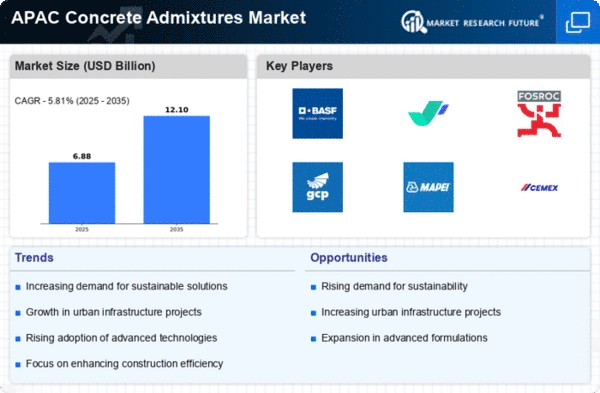
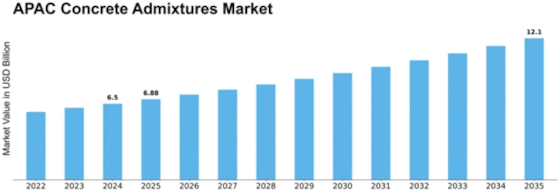
As per Market Research Future analysis, the APAC concrete admixtures market Size was estimated at 6.5 USD Billion in 2024. The APAC concrete admixtures market is projected to grow from 6.88 USD Billion in 2025 to 12.1 USD Billion by 2035, exhibiting a compound annual growth rate (CAGR) of 5.8% during the forecast period 2025 - 2035

Key Market Trends & Highlights

The APAC concrete admixtures market is experiencing robust growth driven by sustainability and technological advancements.

  • Sustainability initiatives are increasingly shaping the concrete admixtures market in APAC, particularly in China and India. Technological advancements in admixture production are enhancing the performance and efficiency of concrete solutions across the region. Urbanization and infrastructure development are driving demand for concrete admixtures, especially in rapidly growing urban centers. Rising construction activities and the growing demand for high-performance concrete are key market drivers influencing the APAC concrete admixtures landscape.

Market Size & Forecast

2024 Market Size 6.5 (USD Billion)
2035 Market Size 12.1 (USD Billion)
CAGR (2025 - 2035) 5.81%

Major Players

BASF (DE), Sika (CH), Fosroc (GB), GCP Applied Technologies (US), Mapei (IT), CEMEX (MX), RPM International (US), Kryton International (CA), Chryso (FR)

Market Trends

The concrete admixtures market is currently experiencing notable growth, driven by increasing urbanization and infrastructure development across various countries in the APAC region. According to recent APAC concrete admixtures market analysis, this growth is largely attributed to the rising demand for high-performance concrete, which is essential for modern construction projects. . As urban areas expand, the need for durable and sustainable building materials becomes paramount. Concrete admixtures play a crucial role in enhancing the properties of concrete, such as workability, strength, and durability, thereby supporting the evolving requirements of the construction industry and expanding the overall APAC concrete admixtures market size.

Moreover, the APAC concrete admixtures market is influenced by the growing emphasis on sustainable construction practices. Governments in the APAC region are implementing stringent regulations aimed at reducing carbon emissions and promoting eco-friendly materials. This shift towards sustainability is encouraging manufacturers to innovate and develop new formulations that incorporate recycled materials and reduce environmental impact. As a result, the market is likely to witness a surge in demand for green concrete admixtures, which could reshape the competitive landscape in the coming years.

Sustainability Initiatives

The concrete admixtures market is increasingly influenced by sustainability initiatives. Governments in the APAC region are promoting eco-friendly construction practices, leading to a rise in demand for green admixtures. These products often utilize recycled materials and reduce carbon footprints, aligning with regulatory requirements and consumer preferences for sustainable solutions.

Technological Advancements

Technological advancements are reshaping the concrete admixtures market. Innovations in formulation and production processes are enhancing the performance characteristics of admixtures. This includes improved workability, strength, and durability, which are essential for meeting the demands of modern construction projects in the APAC region.

Urbanization and Infrastructure Development

Rapid urbanization and infrastructure development are driving growth in the concrete admixtures market. As cities expand and new projects emerge, the need for high-performance concrete becomes critical. Admixtures are essential in achieving the desired properties of concrete, thus supporting the ongoing construction boom in the APAC region.

APAC Concrete Admixtures Market Market Drivers

Rising Construction Activities

The concrete admixtures market in APAC is experiencing a surge due to increasing construction activities across various sectors. Governments and private entities are investing heavily in infrastructure projects, including roads, bridges, and residential buildings. For instance, the construction sector in APAC is projected to grow at a CAGR of approximately 7% from 2025 to 2030. This growth is likely to drive demand for concrete admixtures, which enhance the performance and durability of concrete. As construction companies seek to optimize their material usage and reduce costs, the adoption of advanced concrete admixtures becomes essential. The concrete admixtures market is thus positioned to benefit from this upward trend in construction, as these products are integral to meeting the evolving demands of modern construction practices.

Regulatory Standards and Compliance

In APAC, stringent regulatory standards regarding construction quality and safety are influencing the concrete admixtures market. Governments are implementing regulations that mandate the use of high-performance materials to ensure structural integrity and longevity. This trend is particularly evident in countries like India and China, where compliance with building codes is becoming increasingly rigorous. The concrete admixtures market is responding to these regulations by developing innovative products that meet or exceed these standards. As a result, the demand for specialized admixtures, such as those that improve workability and reduce water usage, is likely to increase. This regulatory landscape not only drives innovation but also encourages manufacturers to invest in research and development, further propelling the market forward.

Sustainability and Eco-Friendly Products

The concrete admixtures market in APAC is increasingly influenced by the demand for sustainability and eco-friendly products. As environmental concerns gain prominence, construction companies are seeking materials that minimize their carbon footprint. This trend is prompting manufacturers to develop admixtures that incorporate recycled materials or reduce the overall environmental impact of concrete production. The concrete admixtures market is responding by innovating products that align with green building standards and certifications. Market analysis suggests that the demand for eco-friendly admixtures could grow by 15% over the next five years, as more projects aim for sustainability certifications. This shift not only meets regulatory requirements but also appeals to environmentally conscious consumers and stakeholders.

Growing Demand for High-Performance Concrete

The concrete admixtures market in APAC is witnessing a growing demand for high-performance concrete (HPC), driven by the need for enhanced durability and sustainability in construction. HPC is increasingly favored for its superior properties, including increased strength and reduced permeability. This shift is particularly notable in urban areas where infrastructure is under constant stress. The concrete admixtures market is adapting to this trend by offering a range of products designed to improve the performance characteristics of concrete. Market data indicates that the demand for high-performance concrete is expected to rise by approximately 10% annually in the coming years. This growth is likely to be fueled by the construction of high-rise buildings and complex structures that require advanced concrete solutions.

Technological Innovations in Admixture Production

Technological advancements in the production of concrete admixtures are significantly impacting the market in APAC. Innovations such as the use of nanotechnology and advanced chemical formulations are enhancing the performance of admixtures, making them more effective and versatile. These developments allow for the creation of products that can cater to specific construction needs, such as rapid setting times or improved resistance to environmental factors. The concrete admixtures market is likely to see increased competition as manufacturers adopt these technologies to differentiate their offerings. Furthermore, the integration of digital tools in production processes is streamlining operations and reducing costs, which may lead to lower prices for end-users and increased market penetration.

Market Segment Insights

By Function: Plasticizers (Largest) vs. Super Plasticizers (Fastest-Growing)

In the APAC concrete admixtures market, <a title="plasticizers" href="https://www.marketresearchfuture.com/reports/plasticizers-market-2295" target="_blank" rel="noopener">Plasticizers</a> hold a significant share, making them the largest segment within the function category. Their widespread application in enhancing workability in concrete mixes has solidified their position among builders and contractors. Following closely is the Super Plasticizers segment which, while smaller in overall size, demonstrates tremendous promise due to their capabilities of greatly reducing water content while maintaining workability. The growth trends in this segment are primarily driven by urbanization and infrastructure development across the region. As construction standards evolve, there is a rising demand for high-performance concrete solutions. Super Plasticizers are witnessing accelerated adoption, particularly with the increasing focus on sustainability in construction practices, presenting opportunities for innovations in formulation and application techniques.

Plasticizers (Dominant) vs. Super Plasticizers (Emerging)

Plasticizers are recognized for their ability to improve the flow and workability of concrete at lower water-cement ratios, making them indispensable in a variety of construction projects. They are widely used across residential, commercial, and <a title="industrial construction" href="https://www.marketresearchfuture.com/reports/industrial-construction-market-41854" target="_blank" rel="noopener">industrial construction</a> due to their cost-effectiveness and performance benefits. In contrast, Super Plasticizers are emerging as a vital component for high-grade concrete applications, particularly in special construction processes that demand superior material properties. Their advanced formulations enable significant reductions in mixing water, allowing for denser concrete matrices with enhanced strength and durability. As sustainability becomes a priority for the construction sector, both Plasticizers and Super Plasticizers are evolving to meet these needs, offering eco-friendly and high-performance solutions.

By Application: Residential (Largest) vs. Infrastructure (Fastest-Growing)

In the concrete admixtures market, the application segments exhibit varied market shares with residential applications holding the largest share. This segment benefits from ongoing urbanization and an increasing number of housing projects across the region. Non-residential applications also maintain a significant presence, driven by commercial and industrial construction activities that require specialized admixtures to enhance concrete performance. On the growth front, the infrastructure segment is recognized as the fastest-growing area, propelled by substantial investments in transportation and public works projects. Factors such as government initiatives to improve infrastructure and the need for durable <a title="construction materials" href="https://www.marketresearchfuture.com/reports/construction-materials-market-12121" target="_blank" rel="noopener">construction materials</a> are driving this trend. Additionally, the rising demand for smart cities and sustainable construction solutions is further stimulating growth in the infrastructure application segment.

Residential (Dominant) vs. Infrastructure (Emerging)

The residential application segment in the concrete admixtures market is characterized by its dominance, attributed to a continuous increase in housing demand and construction activities within urban areas. This segment offers a wide range of admixtures tailored to enhance the quality and longevity of residential concrete. Conversely, the infrastructure segment is emerging rapidly, driven by large-scale projects focused on transportation, utilities, and public facilities. This growth is fueled by government funding and a push for sustainable building practices. While residential projects prioritize aesthetics and durability, infrastructure projects emphasize strength and longevity, creating a distinct focus within the two segments.

Get more detailed insights about APAC Concrete Admixtures Market Research Report-Forecast to 2035

Regional Insights

China : Unmatched Growth and Demand Trends

Key markets include Beijing, Shanghai, and Guangzhou, where major construction projects are underway. The competitive landscape features significant players like BASF, Sika, and GCP Applied Technologies, all vying for market share. Local dynamics are shaped by a mix of international and domestic firms, with a strong emphasis on innovation in product offerings. The construction and infrastructure sectors are the primary consumers of concrete admixtures, reflecting a robust business environment.

India : Infrastructure Development Driving Demand

Key markets include Mumbai, Delhi, and Bengaluru, where infrastructure development is at its peak. The competitive landscape is characterized by the presence of major players such as Sika and BASF, alongside local firms. The business environment is dynamic, with a growing emphasis on innovation and quality. The construction sector, particularly residential and commercial projects, is the primary consumer of concrete admixtures, reflecting a positive outlook for the market.

Japan : Technological Advancements in Construction

Tokyo and Osaka are pivotal markets, with numerous ongoing construction projects. The competitive landscape features established players like Sika and Mapei, who are well-integrated into the local market. The business environment is characterized by high standards and a preference for quality products. The construction sector, particularly in infrastructure and residential projects, drives the demand for concrete admixtures, ensuring a stable market outlook.

South Korea : Government Initiatives Boosting Growth

Seoul and Busan are key markets, with significant construction activities underway. The competitive landscape includes major players like BASF and Sika, who are adapting to local market needs. The business environment is dynamic, with a strong emphasis on innovation and quality. The construction sector, particularly in urban development and infrastructure, is the primary consumer of concrete admixtures, reflecting a positive growth trajectory.

Malaysia : Infrastructure Projects Driving Market Growth

Key markets include Kuala Lumpur and Penang, where significant construction activities are taking place. The competitive landscape features players like Sika and BASF, who are well-established in the region. The business environment is characterized by a mix of local and international firms, with a strong emphasis on innovation. The construction sector, particularly in infrastructure and commercial projects, drives the demand for concrete admixtures, ensuring a positive market outlook.

Thailand : Infrastructure Development as a Catalyst

Bangkok and Chiang Mai are key markets, with numerous construction projects underway. The competitive landscape includes major players like Sika and GCP Applied Technologies, who are adapting to local market needs. The business environment is dynamic, with a growing emphasis on quality and innovation. The construction sector, particularly in infrastructure and residential projects, is the primary consumer of concrete admixtures, reflecting a steady growth trajectory.

Indonesia : Infrastructure Investments Driving Demand

Jakarta and Surabaya are key markets, with ongoing construction projects enhancing demand. The competitive landscape features players like BASF and Sika, who are well-positioned in the market. The business environment is characterized by a mix of local and international firms, with a strong emphasis on innovation. The construction sector, particularly in infrastructure and residential projects, drives the demand for concrete admixtures, ensuring a positive market outlook.

Rest of APAC : Regional Growth in Admixture Demand

Key markets include Vietnam, Philippines, and Singapore, where construction activities are on the rise. The competitive landscape features a mix of local and international players, including Sika and GCP Applied Technologies. The business environment is dynamic, with a strong emphasis on quality and sustainability. The construction sector, particularly in infrastructure and commercial projects, drives the demand for concrete admixtures, ensuring a positive growth trajectory.

Key Players and Competitive Insights

The concrete admixtures market in the APAC region is characterized by a dynamic competitive landscape, driven by increasing urbanization, infrastructure development, and a growing emphasis on sustainability. Key players such as BASF (DE), Sika (CH), and GCP Applied Technologies (US) are strategically positioned to leverage these growth drivers. BASF (DE) focuses on innovation and sustainability, investing heavily in research and development to create eco-friendly products. Sika (CH) emphasizes regional expansion and digital transformation, enhancing its operational efficiency through advanced technologies. GCP Applied Technologies (US) is known for its strategic partnerships and acquisitions, which bolster its market presence and product offerings. Collectively, these strategies shape a competitive environment that is increasingly focused on innovation and sustainability.In terms of business tactics, companies are localizing manufacturing to reduce costs and optimize supply chains, which is crucial in a moderately fragmented market. The competitive structure is influenced by the collective actions of these key players, who are increasingly adopting strategies that enhance their operational capabilities and market reach. This localized approach not only improves responsiveness to market demands but also strengthens their competitive positioning against emerging players.
In October Sika (CH) announced the opening of a new manufacturing facility in India, aimed at increasing its production capacity for concrete admixtures. This strategic move is significant as it allows Sika to cater to the growing demand in the Indian market, which is witnessing rapid infrastructure development. The facility is expected to enhance Sika's supply chain efficiency and reduce lead times, thereby strengthening its competitive edge in the region.
In September GCP Applied Technologies (US) launched a new line of sustainable concrete admixtures designed to reduce carbon emissions during production. This initiative aligns with the global trend towards sustainability and positions GCP as a leader in eco-friendly solutions. The introduction of these products not only meets regulatory demands but also appeals to environmentally conscious consumers, potentially increasing market share.
In August BASF (DE) entered into a strategic partnership with a leading technology firm to integrate AI into its product development processes. This collaboration aims to enhance the efficiency of product formulation and accelerate time-to-market for new admixtures. The integration of AI is likely to provide BASF with a competitive advantage by enabling more precise and innovative product offerings, thus responding effectively to evolving customer needs.
As of November current competitive trends in the concrete admixtures market include a strong focus on digitalization, sustainability, and the integration of advanced technologies such as AI. Strategic alliances are increasingly shaping the landscape, allowing companies to pool resources and expertise to drive innovation. The shift from price-based competition to a focus on technological advancement and supply chain reliability is evident. Moving forward, competitive differentiation will likely hinge on the ability to innovate and deliver sustainable solutions, positioning companies to thrive in an evolving market.

Key Companies in the APAC Concrete Admixtures Market include

Industry Developments

The APAC Concrete Admixtures Market has seen notable activity in recent months, particularly as countries strengthen their infrastructure development efforts. The market is buoyed by increasing demand for high-performance concrete, which has led to significant growth in the valuation of companies like Sika, BASF, and Mapei. In June 2023, Tremco announced a strategic collaboration with local firms to enhance its distribution network within Asia-Pacific. Additionally, in August 2023, RPM International reported an acquisition of a regional provider to further expand its portfolio in the concrete admixtures sector.

In the previous years, companies such as Pidilite Industries have reported substantial growth, attributed to rising construction activities and government initiatives promoting modern infrastructure, showing a notable market shift with a focus on sustainability and efficiency. Also, in early 2022, Global Building Solutions launched a new range of eco-friendly admixtures aimed at the APAC market, responding to the regional demand for more sustainable construction practices. As urbanization continues to rise, the competitive landscape among major players remains intense, highlighting the importance of innovation and superior product offerings in the APAC Concrete Admixtures Market.

Future Outlook

APAC Concrete Admixtures Market Future Outlook

The concrete admixtures market is projected to grow at a 5.81% CAGR from 2025 to 2035, driven by urbanization, infrastructure development, and technological advancements.

New opportunities lie in:

  • <p>Development of eco-friendly admixtures to meet sustainability demands. Investment in smart concrete technologies for enhanced performance. Expansion of distribution networks to penetrate emerging markets.</p>

By 2035, the concrete admixtures market is expected to achieve substantial growth and innovation.

Market Segmentation

APAC Concrete Admixtures Market Function Outlook

  • Plasticizers
  • Super Plasticizers
  • Air Entrainers
  • Accelerators
  • Retarders
  • Waterproofing Admixtures
  • others

APAC Concrete Admixtures Market Application Outlook

  • Residential
  • Non-Residential
  • Infrastructure

Report Scope

MARKET SIZE 2024 6.5(USD Billion)
MARKET SIZE 2025 6.88(USD Billion)
MARKET SIZE 2035 12.1(USD Billion)
COMPOUND ANNUAL GROWTH RATE (CAGR) 5.81% (2025 - 2035)
REPORT COVERAGE Revenue Forecast, Competitive Landscape, Growth Factors, and Trends
BASE YEAR 2024
Market Forecast Period 2025 - 2035
Historical Data 2019 - 2024
Market Forecast Units USD Billion
Key Companies Profiled BASF (DE), Sika (CH), Fosroc (GB), GCP Applied Technologies (US), Mapei (IT), CEMEX (MX), RPM International (US), Kryton International (CA), Chryso (FR)
Segments Covered Function, Application
Key Market Opportunities Growing demand for sustainable concrete solutions drives innovation in the concrete admixtures market.
Key Market Dynamics Rising demand for sustainable construction fuels growth in the concrete admixtures market across the APAC region.
Countries Covered China, India, Japan, South Korea, Malaysia, Thailand, Indonesia, Rest of APAC

FAQs

What was the overall market valuation of the concrete admixtures market in 2024?

<p>The overall market valuation was $6.5 Billion in 2024.</p>

What is the projected market valuation for the concrete admixtures market by 2035?

<p>The projected valuation for 2035 is $12.1 Billion.</p>

What is the expected CAGR for the concrete admixtures market during the forecast period 2025 - 2035?

<p>The expected CAGR for the market during the forecast period 2025 - 2035 is 5.81%.</p>

Which segment had the highest valuation in 2024 for concrete admixtures?

<p>In 2024, the Plasticizers segment had a valuation of $1.3 Billion.</p>

What is the projected valuation for the Super Plasticizers segment by 2035?

<p>The projected valuation for the Super Plasticizers segment by 2035 is $2.8 Billion.</p>

How much is the Infrastructure application segment expected to grow by 2035?

<p>The Infrastructure application segment is expected to grow to $3.3 Billion by 2035.</p>

Which company is a key player in the concrete admixtures market?

<p>BASF is one of the key players in the concrete admixtures market.</p>

What was the valuation of the Waterproofing Admixtures segment in 2024?

<p>The Waterproofing Admixtures segment had a valuation of $1.0 Billion in 2024.</p>

What is the projected growth for the Non-Residential application segment by 2035?

<p>The Non-Residential application segment is projected to reach $4.2 Billion by 2035.</p>

What is the expected valuation for the Retarders segment in 2035?

<p>The expected valuation for the Retarders segment in 2035 is $1.1 Billion.</p>

  1. SECTION I: EXECUTIVE SUMMARY AND KEY HIGHLIGHTS
    1. | 1.1 EXECUTIVE SUMMARY
    2. | | 1.1.1 Market Overview
    3. | | 1.1.2 Key Findings
    4. | | 1.1.3 Market Segmentation
    5. | | 1.1.4 Competitive Landscape
    6. | | 1.1.5 Challenges and Opportunities
    7. | | 1.1.6 Future Outlook
  2. SECTION II: SCOPING, METHODOLOGY AND MARKET STRUCTURE
    1. | 2.1 MARKET INTRODUCTION
    2. | | 2.1.1 Definition
    3. | | 2.1.2 Scope of the study
    4. | | | 2.1.2.1 Research Objective
    5. | | | 2.1.2.2 Assumption
    6. | | | 2.1.2.3 Limitations
    7. | 2.2 RESEARCH METHODOLOGY
    8. | | 2.2.1 Overview
    9. | | 2.2.2 Data Mining
    10. | | 2.2.3 Secondary Research
    11. | | 2.2.4 Primary Research
    12. | | | 2.2.4.1 Primary Interviews and Information Gathering Process
    13. | | | 2.2.4.2 Breakdown of Primary Respondents
    14. | | 2.2.5 Forecasting Model
    15. | | 2.2.6 Market Size Estimation
    16. | | | 2.2.6.1 Bottom-Up Approach
    17. | | | 2.2.6.2 Top-Down Approach
    18. | | 2.2.7 Data Triangulation
    19. | | 2.2.8 Validation
  3. SECTION III: QUALITATIVE ANALYSIS
    1. | 3.1 MARKET DYNAMICS
    2. | | 3.1.1 Overview
    3. | | 3.1.2 Drivers
    4. | | 3.1.3 Restraints
    5. | | 3.1.4 Opportunities
    6. | 3.2 MARKET FACTOR ANALYSIS
    7. | | 3.2.1 Value chain Analysis
    8. | | 3.2.2 Porter's Five Forces Analysis
    9. | | | 3.2.2.1 Bargaining Power of Suppliers
    10. | | | 3.2.2.2 Bargaining Power of Buyers
    11. | | | 3.2.2.3 Threat of New Entrants
    12. | | | 3.2.2.4 Threat of Substitutes
    13. | | | 3.2.2.5 Intensity of Rivalry
    14. | | 3.2.3 COVID-19 Impact Analysis
    15. | | | 3.2.3.1 Market Impact Analysis
    16. | | | 3.2.3.2 Regional Impact
    17. | | | 3.2.3.3 Opportunity and Threat Analysis
  4. SECTION IV: QUANTITATIVE ANALYSIS
    1. | 4.1 Industrial Automation & Equipment, BY Function (USD Billion)
    2. | | 4.1.1 Plasticizers
    3. | | 4.1.2 Super Plasticizers
    4. | | 4.1.3 Air Entrainers
    5. | | 4.1.4 Accelerators
    6. | | 4.1.5 Retarders
    7. | | 4.1.6 Waterproofing Admixtures
    8. | | 4.1.7 Others
    9. | 4.2 Industrial Automation & Equipment, BY Application (USD Billion)
    10. | | 4.2.1 Residential
    11. | | 4.2.2 Non-Residential
    12. | | 4.2.3 Infrastructure
  5. SECTION V: COMPETITIVE ANALYSIS
    1. | 5.1 Competitive Landscape
    2. | | 5.1.1 Overview
    3. | | 5.1.2 Competitive Analysis
    4. | | 5.1.3 Market share Analysis
    5. | | 5.1.4 Major Growth Strategy in the Industrial Automation & Equipment
    6. | | 5.1.5 Competitive Benchmarking
    7. | | 5.1.6 Leading Players in Terms of Number of Developments in the Industrial Automation & Equipment
    8. | | 5.1.7 Key developments and growth strategies
    9. | | | 5.1.7.1 New Product Launch/Service Deployment
    10. | | | 5.1.7.2 Merger & Acquisitions
    11. | | | 5.1.7.3 Joint Ventures
    12. | | 5.1.8 Major Players Financial Matrix
    13. | | | 5.1.8.1 Sales and Operating Income
    14. | | | 5.1.8.2 Major Players R&D Expenditure. 2023
    15. | 5.2 Company Profiles
    16. | | 5.2.1 BASF (DE)
    17. | | | 5.2.1.1 Financial Overview
    18. | | | 5.2.1.2 Products Offered
    19. | | | 5.2.1.3 Key Developments
    20. | | | 5.2.1.4 SWOT Analysis
    21. | | | 5.2.1.5 Key Strategies
    22. | | 5.2.2 Sika (CH)
    23. | | | 5.2.2.1 Financial Overview
    24. | | | 5.2.2.2 Products Offered
    25. | | | 5.2.2.3 Key Developments
    26. | | | 5.2.2.4 SWOT Analysis
    27. | | | 5.2.2.5 Key Strategies
    28. | | 5.2.3 Fosroc (GB)
    29. | | | 5.2.3.1 Financial Overview
    30. | | | 5.2.3.2 Products Offered
    31. | | | 5.2.3.3 Key Developments
    32. | | | 5.2.3.4 SWOT Analysis
    33. | | | 5.2.3.5 Key Strategies
    34. | | 5.2.4 GCP Applied Technologies (US)
    35. | | | 5.2.4.1 Financial Overview
    36. | | | 5.2.4.2 Products Offered
    37. | | | 5.2.4.3 Key Developments
    38. | | | 5.2.4.4 SWOT Analysis
    39. | | | 5.2.4.5 Key Strategies
    40. | | 5.2.5 Mapei (IT)
    41. | | | 5.2.5.1 Financial Overview
    42. | | | 5.2.5.2 Products Offered
    43. | | | 5.2.5.3 Key Developments
    44. | | | 5.2.5.4 SWOT Analysis
    45. | | | 5.2.5.5 Key Strategies
    46. | | 5.2.6 CEMEX (MX)
    47. | | | 5.2.6.1 Financial Overview
    48. | | | 5.2.6.2 Products Offered
    49. | | | 5.2.6.3 Key Developments
    50. | | | 5.2.6.4 SWOT Analysis
    51. | | | 5.2.6.5 Key Strategies
    52. | | 5.2.7 RPM International (US)
    53. | | | 5.2.7.1 Financial Overview
    54. | | | 5.2.7.2 Products Offered
    55. | | | 5.2.7.3 Key Developments
    56. | | | 5.2.7.4 SWOT Analysis
    57. | | | 5.2.7.5 Key Strategies
    58. | | 5.2.8 Kryton International (CA)
    59. | | | 5.2.8.1 Financial Overview
    60. | | | 5.2.8.2 Products Offered
    61. | | | 5.2.8.3 Key Developments
    62. | | | 5.2.8.4 SWOT Analysis
    63. | | | 5.2.8.5 Key Strategies
    64. | | 5.2.9 Chryso (FR)
    65. | | | 5.2.9.1 Financial Overview
    66. | | | 5.2.9.2 Products Offered
    67. | | | 5.2.9.3 Key Developments
    68. | | | 5.2.9.4 SWOT Analysis
    69. | | | 5.2.9.5 Key Strategies
    70. | 5.3 Appendix
    71. | | 5.3.1 References
    72. | | 5.3.2 Related Reports
  6. LIST OF FIGURES
    1. | 6.1 MARKET SYNOPSIS
    2. | 6.2 APAC MARKET ANALYSIS BY FUNCTION
    3. | 6.3 APAC MARKET ANALYSIS BY APPLICATION
    4. | 6.4 KEY BUYING CRITERIA OF INDUSTRIAL AUTOMATION & EQUIPMENT
    5. | 6.5 RESEARCH PROCESS OF MRFR
    6. | 6.6 DRO ANALYSIS OF INDUSTRIAL AUTOMATION & EQUIPMENT
    7. | 6.7 DRIVERS IMPACT ANALYSIS: INDUSTRIAL AUTOMATION & EQUIPMENT
    8. | 6.8 RESTRAINTS IMPACT ANALYSIS: INDUSTRIAL AUTOMATION & EQUIPMENT
    9. | 6.9 SUPPLY / VALUE CHAIN: INDUSTRIAL AUTOMATION & EQUIPMENT
    10. | 6.10 INDUSTRIAL AUTOMATION & EQUIPMENT, BY FUNCTION, 2024 (% SHARE)
    11. | 6.11 INDUSTRIAL AUTOMATION & EQUIPMENT, BY FUNCTION, 2024 TO 2035 (USD Billion)
    12. | 6.12 INDUSTRIAL AUTOMATION & EQUIPMENT, BY APPLICATION, 2024 (% SHARE)
    13. | 6.13 INDUSTRIAL AUTOMATION & EQUIPMENT, BY APPLICATION, 2024 TO 2035 (USD Billion)
    14. | 6.14 BENCHMARKING OF MAJOR COMPETITORS
  7. LIST OF TABLES
    1. | 7.1 LIST OF ASSUMPTIONS
    2. | | 7.1.1
    3. | 7.2 APAC MARKET SIZE ESTIMATES; FORECAST
    4. | | 7.2.1 BY FUNCTION, 2025-2035 (USD Billion)
    5. | | 7.2.2 BY APPLICATION, 2025-2035 (USD Billion)
    6. | 7.3 PRODUCT LAUNCH/PRODUCT DEVELOPMENT/APPROVAL
    7. | | 7.3.1
    8. | 7.4 ACQUISITION/PARTNERSHIP
    9. | | 7.4.1

APAC Industrial Automation & Equipment Market Segmentation

Industrial Automation & Equipment By Function (USD Billion, 2025-2035)

  • Plasticizers
  • Super Plasticizers
  • Air Entrainers
  • Accelerators
  • Retarders
  • Waterproofing Admixtures
  • Others

Industrial Automation & Equipment By Application (USD Billion, 2025-2035)

  • Residential
  • Non-Residential
  • Infrastructure
Infographic

Free Sample Request

Kindly complete the form below to receive a free sample of this Report

Get Free Sample

Customer Strories

Compare Licence

×
Features License Type
Single User Multiuser License Enterprise User
Price $4,950 $5,950 $7,250
Maximum User Access Limit 1 User Upto 10 Users Unrestricted Access Throughout the Organization
Free Customization
Direct Access to Analyst
Deliverable Format
Platform Access
Discount on Next Purchase 10% 15% 15%
Printable Versions