Request Free Sample ×

Kindly complete the form below to receive a free sample of this Report

* Please use a valid business email

Leading companies partner with us for data-driven Insights

clients tt-cursor
Hero Background
English
Chinese
French
Japanese
Korean
German
Spanish

Anticoagulation Market Size

ID: MRFR/HC/9168-CR
200 Pages
Rahul Gotadki
July 2025

Anticoagulation Market Research Report By Drug Type (Vitamin K Antagonists, Direct Oral Anticoagulants, Heparin), By Route of Administration (Oral, Injectable, Transdermal), By Indication (Atrial Fibrillation, Deep Vein Thrombosis, Pulmonary Embolism, Myocardial Infarction), By End Use (Hospitals, Home Care, Clinics) and By Regional (North America, Europe, South America, Asia Pacific, Middle East and Africa) - Growth & Industry Forecast 2025 To 2035

Share:
Download PDF ×

We do not share your information with anyone. However, we may send you emails based on your report interest from time to time. You may contact us at any time to opt-out.

Anticoagulation Market Infographic
Purchase Options

Anticoagulation Size

Anticoagulation Market Growth Projections and Opportunities

The expansion of the anticoagulation market finds its roots in several key factors driving its growth trajectory. Chief among these is the escalating prevalence of venous thromboembolism (VTE) and cardiovascular disorders, necessitating effective treatments to manage these conditions. The rising adoption of novel oral anticoagulants (NOACs) has significantly contributed to this market surge, particularly owing to their efficacy and convenience compared to traditional therapies.

This growth isn't confined solely to developed regions; it extends to developing areas where there's a notable increase in awareness about NOACs. This heightened awareness, combined with the growing incidence of VTE and cardiovascular disorders in these regions, fuels the market expansion.

Moreover, demographic shifts play a significant role in propelling this market forward. Factors like the increasing population of obese and elderly individuals, who are more prone to such conditions, drive the demand for effective anticoagulation therapies. Additionally, the market benefits from higher unmet medical needs, where the demand for innovative therapeutics remains robust, opening avenues for novel treatments in this space.

However, certain challenges impede the market's growth trajectory. The relatively higher price associated with NOACs compared to conventional anticoagulants presents a barrier to widespread adoption. This pricing discrepancy poses a challenge, particularly in regions where cost remains a significant factor influencing treatment choices. Furthermore, the lack of antidotes for NOACs stands as a notable impediment, affecting their uptake in clinical practice.

Addressing these challenges while leveraging the growing demand for effective anticoagulation therapies presents both opportunities and obstacles for market players. Strategies that focus on balancing affordability without compromising on efficacy, coupled with research and development initiatives targeting antidote development, are crucial in overcoming these hurdles.

Despite these challenges, the trajectory of the anticoagulation market remains promising. With a confluence of factors, including the rising prevalence of related disorders, increased adoption of NOACs, and ongoing research aimed at addressing existing limitations, the market for anticoagulation therapies is poised for continued expansion and innovation. Efforts aimed at mitigating obstacles and capitalizing on emerging opportunities will be instrumental in shaping the future landscape of anticoagulation therapeutics.
Anticoagulation Market Size Graph
Author
Author Profile
Rahul Gotadki
Research Manager

He holds an experience of about 9+ years in Market Research and Business Consulting, working under the spectrum of Life Sciences and Healthcare domains. Rahul conceptualizes and implements a scalable business strategy and provides strategic leadership to the clients. His expertise lies in market estimation, competitive intelligence, pipeline analysis, customer assessment, etc.

Leave a Comment

FAQs

What is the projected market valuation of the Anticoagulation Market by 2035?

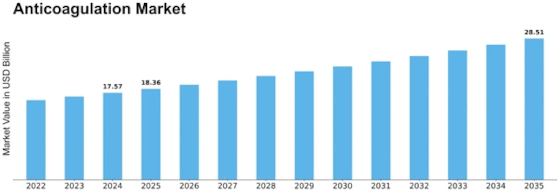
<p>The Anticoagulation Market is projected to reach a valuation of 28.51 USD Billion by 2035.</p>

What was the market valuation of the Anticoagulation Market in 2024?

<p>In 2024, the Anticoagulation Market was valued at 17.57 USD Billion.</p>

What is the expected CAGR for the Anticoagulation Market during the forecast period 2025 - 2035?

<p>The expected CAGR for the Anticoagulation Market during the forecast period 2025 - 2035 is 4.5%.</p>

Which segment of the Anticoagulation Market had the highest valuation in 2024?

<p>In 2024, the Direct Oral Anticoagulants segment had the highest valuation at 7.0 USD Billion.</p>

What are the projected valuations for the Heparin segment by 2035?

<p>The Heparin segment is projected to reach valuations between 9.01 USD Billion by 2035.</p>

Which route of administration is expected to dominate the Anticoagulation Market by 2035?

<p>The Oral route of administration is expected to dominate, with projected valuations reaching 12.0 USD Billion by 2035.</p>

What is the anticipated market size for Atrial Fibrillation indications by 2035?

<p>The market size for Atrial Fibrillation indications is anticipated to reach 10.5 USD Billion by 2035.</p>

Which end-use segment is projected to have the highest growth by 2035?

<p>The Hospitals end-use segment is projected to have the highest growth, reaching 11.2 USD Billion by 2035.</p>

Who are the key players in the Anticoagulation Market?

<p>Key players in the Anticoagulation Market include Bristol-Myers Squibb, Bayer, Johnson & Johnson, and others.</p>

What is the projected valuation for the Home Care segment by 2035?

<p>The Home Care segment is projected to reach a valuation of 8.5 USD Billion by 2035.</p>

Market Summary

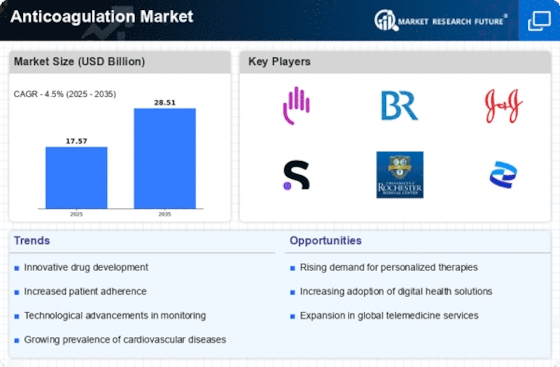
As per Market Research Future analysis, the Anticoagulation Market Size was estimated at 17.57 USD Billion in 2024. The Anticoagulation industry is projected to grow from 18.36 USD Billion in 2025 to 28.51 USD Billion by 2035, exhibiting a compound annual growth rate (CAGR) of 4.5% during the forecast period 2025 - 2035

Key Market Trends & Highlights

The Anticoagulation Market is experiencing a transformative shift towards novel therapies and preventive healthcare strategies.

  • The market is witnessing a notable shift towards novel anticoagulants, particularly in North America, which remains the largest market. In Asia-Pacific, the anticoagulation market is rapidly expanding, driven by increasing healthcare access and awareness. Direct Oral Anticoagulants dominate the market, while Heparin is emerging as the fastest-growing segment due to its evolving applications. Key drivers of this market include the rising incidence of cardiovascular diseases and advancements in anticoagulant therapies, which are shaping treatment paradigms.

Market Size & Forecast

2024 Market Size 17.57 (USD Billion)
2035 Market Size 28.51 (USD Billion)
CAGR (2025 - 2035) 4.5%
Largest Regional Market Share in 2024 North America

Major Players

<a href="https://news.bms.com/news/details/2025/Bristol-Myers-Squibb-and-Pfizer-Announce-Direct-to-Patient-Eliquis-apixaban-Option/default.aspx">Bristol-Myers Squibb</a> (US), Bayer (DE), <a href="https://www.jnj.com/media-center/press-releases/fda-advisory-committee-recommends-approval-of-oral-anticoagulant-rivaroxaban-for-the-prevention-of-stroke-and-systemic-embolism-in-patients-with-non-valvular-atrial-fibrillation">Johnson &amp; Johnson </a>(US), Sanofi (FR), Roche (CH), Pfizer (US), AstraZeneca (GB), Daiichi Sankyo (JP), Merck &amp; Co. (US)

Market Trends

The Anticoagulation Market is currently experiencing a dynamic evolution, driven by advancements in medical technology and an increasing awareness of thromboembolic disorders. The rise in the prevalence of conditions such as atrial fibrillation and venous thromboembolism has led to a heightened demand for anticoagulant therapies. Furthermore, the market is witnessing a shift towards novel oral anticoagulants, which offer advantages over traditional therapies, including improved safety profiles and ease of use. This transition is indicative of a broader trend towards personalized medicine, where treatment regimens are tailored to individual patient needs, thereby enhancing therapeutic outcomes. In addition to the technological advancements, regulatory bodies are playing a crucial role in shaping the Anticoagulation Market. The approval of new anticoagulant agents and the ongoing research into their efficacy and safety are likely to influence market dynamics significantly. Moreover, the growing emphasis on preventive healthcare is prompting healthcare providers to adopt anticoagulation therapies more proactively. As the market continues to evolve, stakeholders must remain vigilant to emerging trends and adapt their strategies accordingly to maintain a competitive edge in this rapidly changing landscape.

Shift Towards Novel Anticoagulants

The Anticoagulation Market is witnessing a notable shift towards novel oral anticoagulants, which are increasingly favored due to their user-friendly administration and favorable safety profiles. This trend suggests a growing preference among healthcare providers and patients for therapies that simplify treatment regimens while maintaining efficacy.

Regulatory Influence on Market Dynamics

Regulatory bodies are exerting a significant influence on the Anticoagulation Market by approving new therapeutic agents and establishing guidelines for their use. This regulatory landscape is likely to shape the availability and adoption of anticoagulant therapies, impacting market growth and innovation.

Focus on Preventive Healthcare

There is a discernible trend towards preventive healthcare within the Anticoagulation Market, as healthcare providers increasingly recognize the importance of early intervention in thromboembolic disorders. This proactive approach may lead to higher adoption rates of anticoagulant therapies, ultimately enhancing patient outcomes.

Anticoagulation Market Market Drivers

Growing Geriatric Population

The increasing geriatric population is a significant driver of the Anticoagulation Market Industry. Older adults are at a higher risk for thromboembolic disorders, necessitating effective anticoagulation management. As life expectancy rises, the number of individuals requiring anticoagulant therapy is expected to grow substantially. This demographic shift is prompting healthcare systems to adapt their strategies to accommodate the needs of older patients, including the development of tailored anticoagulant therapies. Additionally, the prevalence of comorbidities in the elderly population further complicates treatment regimens, creating a demand for anticoagulants that are both effective and safe. Consequently, the Anticoagulation Market Industry is likely to experience robust growth in response to this demographic trend.

Increased Awareness and Education

There is a growing awareness and education regarding the importance of anticoagulation therapy, which serves as a crucial driver for the Anticoagulation Market Industry. Healthcare professionals and patients alike are becoming more informed about the risks associated with thromboembolic events and the benefits of anticoagulant treatments. This heightened awareness is leading to earlier diagnosis and treatment initiation, which is essential for effective management. Educational initiatives and campaigns are being implemented to promote understanding of anticoagulation therapy, thereby increasing patient engagement and adherence. As a result, the demand for anticoagulants is likely to rise, contributing to the overall growth of the Anticoagulation Market Industry.

Advancements in Anticoagulant Therapies

Technological advancements in anticoagulant therapies are reshaping the Anticoagulation Market Industry. The introduction of novel oral anticoagulants (NOACs) has revolutionized treatment protocols, offering patients more convenient options with fewer monitoring requirements. These advancements not only enhance patient compliance but also improve clinical outcomes. The market is witnessing a shift from traditional vitamin K antagonists to these newer agents, which are gaining traction due to their efficacy and safety profiles. As healthcare providers increasingly adopt these innovative therapies, the Anticoagulation Market Industry is expected to expand significantly. Furthermore, ongoing research and development efforts are likely to yield even more effective anticoagulants, further driving market growth.

Regulatory Support and Approval Processes

Regulatory support plays a pivotal role in shaping the Anticoagulation Market Industry. The approval of new anticoagulant medications by regulatory bodies facilitates market entry and encourages innovation. Streamlined approval processes for novel therapies can significantly reduce the time it takes for new products to reach the market, thereby enhancing competition. Regulatory agencies are increasingly recognizing the need for effective anticoagulant therapies, which has led to expedited review pathways for promising candidates. This supportive environment fosters research and development, ultimately benefiting patients and healthcare providers. As more anticoagulants gain regulatory approval, the Anticoagulation Market Industry is poised for continued expansion.

Rising Incidence of Cardiovascular Diseases

The increasing prevalence of cardiovascular diseases is a primary driver of the Anticoagulation Market Industry. Conditions such as atrial fibrillation and venous thromboembolism are becoming more common, leading to a heightened demand for anticoagulant therapies. According to recent statistics, cardiovascular diseases account for a significant portion of global mortality, prompting healthcare systems to prioritize effective management strategies. This trend is likely to continue, as the aging population and lifestyle factors contribute to the rise in these conditions. Consequently, pharmaceutical companies are focusing on developing innovative anticoagulants to address this growing need, thereby expanding the Anticoagulation Market Industry. The market is projected to witness substantial growth, with estimates suggesting a compound annual growth rate of over 7% in the coming years.

Market Segment Insights

By Type: Direct Oral Anticoagulants (Largest) vs. Heparin (Fastest-Growing)

In the Anticoagulation Market, the segment distribution reveals that Direct Oral Anticoagulants (DOACs) hold the largest market share, significantly outperforming other types like Vitamin K Antagonists and Heparin. DOACs are preferred due to their ease of use, rapid action, and minimal monitoring requirements, making them a favored choice among both healthcare providers and patients. Heparin, while historically important, is increasingly overshadowed by the convenience and effectiveness of DOACs. Meanwhile, Vitamin K Antagonists continue to hold a stable position in the market, primarily used in specific patient populations that require long-term anticoagulation therapy.

Direct Oral Anticoagulants (Dominant) vs. Heparin (Emerging)

Direct Oral Anticoagulants (DOACs) are currently the dominant force in the Anticoagulation Market, offering significant advantages such as predetermined dosing and reduced monitoring compared to traditional Vitamin K Antagonists. They are ideal for a wide range of indications, which amplifies their market presence. Conversely, Heparin is experiencing an emergence phase, primarily due to its adaptability in hospital settings, especially in acute care scenarios. Despite being less convenient than DOACs, Heparin's role in rapid anticoagulation and its well-established safety profile make it a crucial option. The growing demand for anticoagulation therapies is stimulating innovation in Heparin formulations, suggesting potential growth in this segment.

By Route of Administration: Oral (Largest) vs. Injectable (Fastest-Growing)

The anticoagulation market is segmented by route of administration into three main categories: oral, injectable, and transdermal. Among these, oral administration holds the largest market share due to its convenience and patient preference, significantly leading in adoption rates. Injectable anticoagulants, while smaller in overall market size, are rapidly gaining traction owing to their efficacy and targeted delivery, making them a vital part of treatment regimens.

Administration Method: Oral (Dominant) vs. Injectable (Emerging)

Oral anticoagulants represent the dominant method of administration in the anticoagulation market, offering ease of use, dosing flexibility, and improved patient compliance. Popular oral options are pivotal for long-term management of conditions like atrial fibrillation. Conversely, injectable anticoagulants, categorized as an emerging segment, are experiencing rapid growth. They are often used in acute care settings and for patients with higher risks requiring immediate therapeutic effects. The trend towards newer, novel injectable agents is driven by advancements in formulations that allow for less frequent dosing, enhancing patient convenience and adherence.

By Indication: Atrial Fibrillation (Largest) vs. Deep Vein Thrombosis (Fastest-Growing)

In the Anticoagulation Market, Atrial Fibrillation represents the largest indication segment, commanding the highest market share due to the increasing prevalence of this condition globally. This segment is characterized by an aging population and lifestyle factors contributing to higher rates of atrial fibrillation. Following this, Deep Vein Thrombosis is observed as the fastest-growing segment, driven by rising awareness and improved diagnosis techniques, making it a crucial area for market growth.

Atrial Fibrillation: Dominant vs. Deep Vein Thrombosis: Emerging

Atrial Fibrillation is positioned as the dominant segment in the Anticoagulation Market, primarily due to its association with serious health risks like stroke and its high incidence among older adults. Its management often requires long-term anticoagulation therapy, which increases market demand for anticoagulants. On the other hand, Deep Vein Thrombosis is recognized as an emerging segment, experiencing rapid growth due to enhanced awareness, screening initiatives, and the evolving understanding of its risk factors and complications. Innovations in treatment options and patient management further support the expansion of this segment, indicating a dynamic shift in therapeutic focus.

By End Use: Hospitals (Largest) vs. Home Care (Fastest-Growing)

In the Anticoagulation Market, hospitals account for the largest share of end-use settings, driven by the demand for advanced healthcare solutions and the complexities of anticoagulation therapies. Hospitals provide specialized services, supporting acute care and complex patient management, which solidifies their primary role in this segment. Home care continues to rise as a significant player, reflecting a shift towards outpatient treatment and the preference for patient-centered care, especially for chronic anticoagulation therapy management. The growth trends in this segment are influenced by several factors. The increasing prevalence of cardiovascular diseases drives demand for anticoagulants in hospitals. Simultaneously, advancements in <a href="https://www.marketresearchfuture.com/reports/telemedicine-market-2216">telemedicine </a>and self-monitoring devices facilitate home care solutions, attracting patients seeking convenience and personalized treatment. As the population ages and healthcare systems evolve, the balance between hospital and home care is redefining treatment protocols in the anticoagulation space.

Hospitals (Dominant) vs. Clinics (Emerging)

Hospitals remain the dominant force in the Anticoagulation Market, providing a comprehensive range of specialized resources and expertise essential for managing anticoagulation therapies effectively. Their integrated approach ensures nearly constant patient monitoring, which is vital for minimizing complications associated with anticoagulant treatments. In contrast, clinics represent an emerging segment, catering to patients with less complex needs or those on preventive anticoagulant therapy. While clinics enable access to treatments for a broader demographic, they currently lack the comprehensive care model found in hospitals. As the industry evolves, clinics aim to strengthen their position through enhanced care coordination and innovative treatment options.

Get more detailed insights about Anticoagulation Market Research Report—Global Forecast till 2035

Regional Insights

The Anticoagulation Market is poised for substantial growth, with a total valuation of 17.57 USD billion in 2024.

North America majorly dominates the market, holding a value of 7.5 USD billion, anticipated to grow to 12.1 USD billion by 2035, due to the high prevalence of cardiovascular diseases and advanced healthcare infrastructure.

Europe follows with a significant market presence, valued at 5.0 USD billion in 2024 and projected to reach 8.0 USD billion by 2035, benefiting from extensive research and public health initiatives.

In South America, the market value stands at 1.5 USD Billion in 2024, reflecting emerging healthcare needs in anticoagulation therapies with an expected rise to 2.5 USD billion by 2035.

The Asia Pacific market, valued at 3.0 USD Billion in 2024, displays noteworthy growth potential due to increasing healthcare investment, expected to expand to 4.5 USD Billion.

Meanwhile, the Middle East and Africa segment represents the smallest portion of the market at 0.57 USD billion in 2024, with opportunities for growth by enhancing access to anticoagulation solutions, aiming for a value of 1.4 USD billion by 2035.

Overall, the geographical segmentation reflects a diverse landscape shaped by varying healthcare challenges and regional health policies.

Key Players and Competitive Insights

The Anticoagulation Market represents a dynamic and competitive landscape characterized by a wide range of key players actively involved in research, development, and the commercialization of anticoagulant therapies.This market is driven by the increasing prevalence of thromboembolic disorders and the rising awareness among healthcare providers and patients regarding the effective management of blood clots.The competition is further intensified by the ongoing advancements in technologies and the introduction of innovative products that cater to varying patient needs.The evolution of the regulatory environment and the enhancement of healthcare infrastructures are additional factors influencing the strategic approaches adopted by various companies, as they seek to solidify their positions in the market and expand their reach on a global scale.

Daiichi Sankyo has carved a notable position for itself in the Anticoagulation Market, attributed to its commitment to developing novel therapeutic options and its strong focus on research and development. The company leverages its extensive expertise in pharmaceutical innovation to deliver highly effective anticoagulation treatments.By prioritizing quality and efficacy, Daiichi Sankyo has managed to gain trust among healthcare professionals and patients alike, thus enhancing its brand reputation.Furthermore, the company's strategic partnerships and collaborations with various healthcare organizations have enabled it to broaden its market presence, making significant strides in improving patient outcomes through the provision of tailored therapeutic solutions.

Bayer holds a significant position in the Anticoagulation Market, reflecting its robust product portfolio that includes some of the leading anticoagulants in the industry.The company's commitment to developing innovative solutions has resulted in successful introductions of key products that cater to the diverse needs of patients and healthcare systems worldwide.Bayer’s strong market presence is reinforced by its comprehensive marketing strategies and a commitment to education and awareness, which aim to support healthcare professionals in the management of anticoagulation therapies.The organization has also engaged in strategic mergers and acquisitions to expand its capabilities and enhance its competitive edge in the market.This proactive approach not only strengthens Bayer's position but also allows for greater resources allocated to research and development, ensuring the continuous improvement and refinement of its product offerings in the global anticoagulation landscape.

Key Companies in the Anticoagulation Market include

Industry Developments

In December 2023, Daiichi Sankyo initiated a global Phase III trial (ENGAGE-AF TIMI 48) involving over 16,000 patients with atrial fibrillation to assess the efficacy of edoxaban (DU-176b) in preventing strokes in comparison to warfarin to advance its investigational oral Factor-Xa inhibitor.Throughout 2024, Boehringer-Ingelheim increased its investment in research and development (R&D) in its anticoagulant portfolio.

The company's primary objectives were to target emerging cardiovascular risk segments, expand the use of reversible agents, and develop novel formulations.In 2024, Bayer reported significant growth in its direct-acting oral anticoagulants division, which was subsequently reinvested in next-generation drug development and expanded label indications for cardiovascular disease populations.Pfizer and Amgen jointly announced a strategic co-development partnership in September 2023 to develop a novel anticoagulant therapy. The agreement aims to expand their combined portfolio and address unmet medical requirements. To diversify its anticoagulant pipeline, Johnson & Johnson acquired a small biotech company in early 2022.

This acquisition aimed to integrate new molecular candidates that target thrombosis and stroke prevention in high-risk patients.

Future Outlook

Anticoagulation Market Future Outlook

The Anticoagulation Market is projected to grow at a 4.5% CAGR from 2025 to 2035, driven by increasing prevalence of thromboembolic disorders, advancements in drug development, and rising awareness of anticoagulation therapies.

New opportunities lie in:

  • Development of personalized anticoagulation management software solutions.</p><p>Expansion of<a href="https://www.marketresearchfuture.com/reports/telehealth-market-900"> telehealth</a> services for remote patient monitoring.</p><p>Investment in novel oral anticoagulants with improved safety profiles.

By 2035, the Anticoagulation Market is expected to achieve substantial growth, reflecting evolving healthcare needs.

Market Segmentation

Anticoagulation Market Type Outlook

  • Vitamin K Antagonists
  • Direct Oral Anticoagulants
  • Heparin

Anticoagulation Market End Use Outlook

  • Hospitals
  • Home Care
  • Clinics

Anticoagulation Market Indication Outlook

  • Atrial Fibrillation
  • Deep Vein Thrombosis
  • Pulmonary Embolism
  • Myocardial Infarction

Anticoagulation Market Route of Administration Outlook

  • Oral
  • Injectable
  • Transdermal

Report Scope

MARKET SIZE 2024 17.57(USD Billion)
MARKET SIZE 2025 18.36(USD Billion)
MARKET SIZE 2035 28.51(USD Billion)
COMPOUND ANNUAL GROWTH RATE (CAGR) 4.5% (2025 - 2035)
REPORT COVERAGE Revenue Forecast, Competitive Landscape, Growth Factors, and Trends
BASE YEAR 2024
Market Forecast Period 2025 - 2035
Historical Data 2019 - 2024
Market Forecast Units USD Billion
Key Companies Profiled Bristol-Myers Squibb (US), Bayer (DE), Johnson & Johnson (US), Sanofi (FR), Roche (CH), Pfizer (US), AstraZeneca (GB), Daiichi Sankyo (JP), Merck & Co. (US)
Segments Covered Drug Type, Route of Administration, Indication, End Use, Regional
Key Market Opportunities Integration of digital health technologies enhances patient adherence in the Anticoagulation Market.
Key Market Dynamics Rising demand for novel anticoagulants drives innovation and competition among pharmaceutical companies in the anticoagulation market.
Countries Covered North America, Europe, APAC, South America, MEA

FAQs

What is the projected market valuation of the Anticoagulation Market by 2035?

<p>The Anticoagulation Market is projected to reach a valuation of 28.51 USD Billion by 2035.</p>

What was the market valuation of the Anticoagulation Market in 2024?

<p>In 2024, the Anticoagulation Market was valued at 17.57 USD Billion.</p>

What is the expected CAGR for the Anticoagulation Market during the forecast period 2025 - 2035?

<p>The expected CAGR for the Anticoagulation Market during the forecast period 2025 - 2035 is 4.5%.</p>

Which segment of the Anticoagulation Market had the highest valuation in 2024?

<p>In 2024, the Direct Oral Anticoagulants segment had the highest valuation at 7.0 USD Billion.</p>

What are the projected valuations for the Heparin segment by 2035?

<p>The Heparin segment is projected to reach valuations between 9.01 USD Billion by 2035.</p>

Which route of administration is expected to dominate the Anticoagulation Market by 2035?

<p>The Oral route of administration is expected to dominate, with projected valuations reaching 12.0 USD Billion by 2035.</p>

What is the anticipated market size for Atrial Fibrillation indications by 2035?

<p>The market size for Atrial Fibrillation indications is anticipated to reach 10.5 USD Billion by 2035.</p>

Which end-use segment is projected to have the highest growth by 2035?

<p>The Hospitals end-use segment is projected to have the highest growth, reaching 11.2 USD Billion by 2035.</p>

Who are the key players in the Anticoagulation Market?

<p>Key players in the Anticoagulation Market include Bristol-Myers Squibb, Bayer, Johnson & Johnson, and others.</p>

What is the projected valuation for the Home Care segment by 2035?

<p>The Home Care segment is projected to reach a valuation of 8.5 USD Billion by 2035.</p>

  1. SECTION I: EXECUTIVE SUMMARY AND KEY HIGHLIGHTS
    1. | 1.1 EXECUTIVE SUMMARY
    2. | | 1.1.1 Market Overview
    3. | | 1.1.2 Key Findings
    4. | | 1.1.3 Market Segmentation
    5. | | 1.1.4 Competitive Landscape
    6. | | 1.1.5 Challenges and Opportunities
    7. | | 1.1.6 Future Outlook
  2. SECTION II: SCOPING, METHODOLOGY AND MARKET STRUCTURE
    1. | 2.1 MARKET INTRODUCTION
    2. | | 2.1.1 Definition
    3. | | 2.1.2 Scope of the study
    4. | | | 2.1.2.1 Research Objective
    5. | | | 2.1.2.2 Assumption
    6. | | | 2.1.2.3 Limitations
    7. | 2.2 RESEARCH METHODOLOGY
    8. | | 2.2.1 Overview
    9. | | 2.2.2 Data Mining
    10. | | 2.2.3 Secondary Research
    11. | | 2.2.4 Primary Research
    12. | | | 2.2.4.1 Primary Interviews and Information Gathering Process
    13. | | | 2.2.4.2 Breakdown of Primary Respondents
    14. | | 2.2.5 Forecasting Model
    15. | | 2.2.6 Market Size Estimation
    16. | | | 2.2.6.1 Bottom-Up Approach
    17. | | | 2.2.6.2 Top-Down Approach
    18. | | 2.2.7 Data Triangulation
    19. | | 2.2.8 Validation
  3. SECTION III: QUALITATIVE ANALYSIS
    1. | 3.1 MARKET DYNAMICS
    2. | | 3.1.1 Overview
    3. | | 3.1.2 Drivers
    4. | | 3.1.3 Restraints
    5. | | 3.1.4 Opportunities
    6. | 3.2 MARKET FACTOR ANALYSIS
    7. | | 3.2.1 Value chain Analysis
    8. | | 3.2.2 Porter's Five Forces Analysis
    9. | | | 3.2.2.1 Bargaining Power of Suppliers
    10. | | | 3.2.2.2 Bargaining Power of Buyers
    11. | | | 3.2.2.3 Threat of New Entrants
    12. | | | 3.2.2.4 Threat of Substitutes
    13. | | | 3.2.2.5 Intensity of Rivalry
    14. | | 3.2.3 COVID-19 Impact Analysis
    15. | | | 3.2.3.1 Market Impact Analysis
    16. | | | 3.2.3.2 Regional Impact
    17. | | | 3.2.3.3 Opportunity and Threat Analysis
  4. SECTION IV: QUANTITATIVE ANALYSIS
    1. | 4.1 Healthcare, BY Type (USD Billion)
    2. | | 4.1.1 Vitamin K Antagonists
    3. | | 4.1.2 Direct Oral Anticoagulants
    4. | | 4.1.3 Heparin
    5. | 4.2 Healthcare, BY Route of Administration (USD Billion)
    6. | | 4.2.1 Oral
    7. | | 4.2.2 Injectable
    8. | | 4.2.3 Transdermal
    9. | 4.3 Healthcare, BY Indication (USD Billion)
    10. | | 4.3.1 Atrial Fibrillation
    11. | | 4.3.2 Deep Vein Thrombosis
    12. | | 4.3.3 Pulmonary Embolism
    13. | | 4.3.4 Myocardial Infarction
    14. | 4.4 Healthcare, BY End Use (USD Billion)
    15. | | 4.4.1 Hospitals
    16. | | 4.4.2 Home Care
    17. | | 4.4.3 Clinics
    18. | 4.5 Healthcare, BY Region (USD Billion)
    19. | | 4.5.1 North America
    20. | | | 4.5.1.1 US
    21. | | | 4.5.1.2 Canada
    22. | | 4.5.2 Europe
    23. | | | 4.5.2.1 Germany
    24. | | | 4.5.2.2 UK
    25. | | | 4.5.2.3 France
    26. | | | 4.5.2.4 Russia
    27. | | | 4.5.2.5 Italy
    28. | | | 4.5.2.6 Spain
    29. | | | 4.5.2.7 Rest of Europe
    30. | | 4.5.3 APAC
    31. | | | 4.5.3.1 China
    32. | | | 4.5.3.2 India
    33. | | | 4.5.3.3 Japan
    34. | | | 4.5.3.4 South Korea
    35. | | | 4.5.3.5 Malaysia
    36. | | | 4.5.3.6 Thailand
    37. | | | 4.5.3.7 Indonesia
    38. | | | 4.5.3.8 Rest of APAC
    39. | | 4.5.4 South America
    40. | | | 4.5.4.1 Brazil
    41. | | | 4.5.4.2 Mexico
    42. | | | 4.5.4.3 Argentina
    43. | | | 4.5.4.4 Rest of South America
    44. | | 4.5.5 MEA
    45. | | | 4.5.5.1 GCC Countries
    46. | | | 4.5.5.2 South Africa
    47. | | | 4.5.5.3 Rest of MEA
  5. SECTION V: COMPETITIVE ANALYSIS
    1. | 5.1 Competitive Landscape
    2. | | 5.1.1 Overview
    3. | | 5.1.2 Competitive Analysis
    4. | | 5.1.3 Market share Analysis
    5. | | 5.1.4 Major Growth Strategy in the Healthcare
    6. | | 5.1.5 Competitive Benchmarking
    7. | | 5.1.6 Leading Players in Terms of Number of Developments in the Healthcare
    8. | | 5.1.7 Key developments and growth strategies
    9. | | | 5.1.7.1 New Product Launch/Service Deployment
    10. | | | 5.1.7.2 Merger & Acquisitions
    11. | | | 5.1.7.3 Joint Ventures
    12. | | 5.1.8 Major Players Financial Matrix
    13. | | | 5.1.8.1 Sales and Operating Income
    14. | | | 5.1.8.2 Major Players R&D Expenditure. 2023
    15. | 5.2 Company Profiles
    16. | | 5.2.1 Bristol-Myers Squibb (US)
    17. | | | 5.2.1.1 Financial Overview
    18. | | | 5.2.1.2 Products Offered
    19. | | | 5.2.1.3 Key Developments
    20. | | | 5.2.1.4 SWOT Analysis
    21. | | | 5.2.1.5 Key Strategies
    22. | | 5.2.2 Bayer (DE)
    23. | | | 5.2.2.1 Financial Overview
    24. | | | 5.2.2.2 Products Offered
    25. | | | 5.2.2.3 Key Developments
    26. | | | 5.2.2.4 SWOT Analysis
    27. | | | 5.2.2.5 Key Strategies
    28. | | 5.2.3 Johnson & Johnson (US)
    29. | | | 5.2.3.1 Financial Overview
    30. | | | 5.2.3.2 Products Offered
    31. | | | 5.2.3.3 Key Developments
    32. | | | 5.2.3.4 SWOT Analysis
    33. | | | 5.2.3.5 Key Strategies
    34. | | 5.2.4 Sanofi (FR)
    35. | | | 5.2.4.1 Financial Overview
    36. | | | 5.2.4.2 Products Offered
    37. | | | 5.2.4.3 Key Developments
    38. | | | 5.2.4.4 SWOT Analysis
    39. | | | 5.2.4.5 Key Strategies
    40. | | 5.2.5 Roche (CH)
    41. | | | 5.2.5.1 Financial Overview
    42. | | | 5.2.5.2 Products Offered
    43. | | | 5.2.5.3 Key Developments
    44. | | | 5.2.5.4 SWOT Analysis
    45. | | | 5.2.5.5 Key Strategies
    46. | | 5.2.6 Pfizer (US)
    47. | | | 5.2.6.1 Financial Overview
    48. | | | 5.2.6.2 Products Offered
    49. | | | 5.2.6.3 Key Developments
    50. | | | 5.2.6.4 SWOT Analysis
    51. | | | 5.2.6.5 Key Strategies
    52. | | 5.2.7 AstraZeneca (GB)
    53. | | | 5.2.7.1 Financial Overview
    54. | | | 5.2.7.2 Products Offered
    55. | | | 5.2.7.3 Key Developments
    56. | | | 5.2.7.4 SWOT Analysis
    57. | | | 5.2.7.5 Key Strategies
    58. | | 5.2.8 Daiichi Sankyo (JP)
    59. | | | 5.2.8.1 Financial Overview
    60. | | | 5.2.8.2 Products Offered
    61. | | | 5.2.8.3 Key Developments
    62. | | | 5.2.8.4 SWOT Analysis
    63. | | | 5.2.8.5 Key Strategies
    64. | | 5.2.9 Merck & Co. (US)
    65. | | | 5.2.9.1 Financial Overview
    66. | | | 5.2.9.2 Products Offered
    67. | | | 5.2.9.3 Key Developments
    68. | | | 5.2.9.4 SWOT Analysis
    69. | | | 5.2.9.5 Key Strategies
    70. | 5.3 Appendix
    71. | | 5.3.1 References
    72. | | 5.3.2 Related Reports
  6. LIST OF FIGURES
    1. | 6.1 MARKET SYNOPSIS
    2. | 6.2 NORTH AMERICA MARKET ANALYSIS
    3. | 6.3 US MARKET ANALYSIS BY TYPE
    4. | 6.4 US MARKET ANALYSIS BY ROUTE OF ADMINISTRATION
    5. | 6.5 US MARKET ANALYSIS BY INDICATION
    6. | 6.6 US MARKET ANALYSIS BY END USE
    7. | 6.7 CANADA MARKET ANALYSIS BY TYPE
    8. | 6.8 CANADA MARKET ANALYSIS BY ROUTE OF ADMINISTRATION
    9. | 6.9 CANADA MARKET ANALYSIS BY INDICATION
    10. | 6.10 CANADA MARKET ANALYSIS BY END USE
    11. | 6.11 EUROPE MARKET ANALYSIS
    12. | 6.12 GERMANY MARKET ANALYSIS BY TYPE
    13. | 6.13 GERMANY MARKET ANALYSIS BY ROUTE OF ADMINISTRATION
    14. | 6.14 GERMANY MARKET ANALYSIS BY INDICATION
    15. | 6.15 GERMANY MARKET ANALYSIS BY END USE
    16. | 6.16 UK MARKET ANALYSIS BY TYPE
    17. | 6.17 UK MARKET ANALYSIS BY ROUTE OF ADMINISTRATION
    18. | 6.18 UK MARKET ANALYSIS BY INDICATION
    19. | 6.19 UK MARKET ANALYSIS BY END USE
    20. | 6.20 FRANCE MARKET ANALYSIS BY TYPE
    21. | 6.21 FRANCE MARKET ANALYSIS BY ROUTE OF ADMINISTRATION
    22. | 6.22 FRANCE MARKET ANALYSIS BY INDICATION
    23. | 6.23 FRANCE MARKET ANALYSIS BY END USE
    24. | 6.24 RUSSIA MARKET ANALYSIS BY TYPE
    25. | 6.25 RUSSIA MARKET ANALYSIS BY ROUTE OF ADMINISTRATION
    26. | 6.26 RUSSIA MARKET ANALYSIS BY INDICATION
    27. | 6.27 RUSSIA MARKET ANALYSIS BY END USE
    28. | 6.28 ITALY MARKET ANALYSIS BY TYPE
    29. | 6.29 ITALY MARKET ANALYSIS BY ROUTE OF ADMINISTRATION
    30. | 6.30 ITALY MARKET ANALYSIS BY INDICATION
    31. | 6.31 ITALY MARKET ANALYSIS BY END USE
    32. | 6.32 SPAIN MARKET ANALYSIS BY TYPE
    33. | 6.33 SPAIN MARKET ANALYSIS BY ROUTE OF ADMINISTRATION
    34. | 6.34 SPAIN MARKET ANALYSIS BY INDICATION
    35. | 6.35 SPAIN MARKET ANALYSIS BY END USE
    36. | 6.36 REST OF EUROPE MARKET ANALYSIS BY TYPE
    37. | 6.37 REST OF EUROPE MARKET ANALYSIS BY ROUTE OF ADMINISTRATION
    38. | 6.38 REST OF EUROPE MARKET ANALYSIS BY INDICATION
    39. | 6.39 REST OF EUROPE MARKET ANALYSIS BY END USE
    40. | 6.40 APAC MARKET ANALYSIS
    41. | 6.41 CHINA MARKET ANALYSIS BY TYPE
    42. | 6.42 CHINA MARKET ANALYSIS BY ROUTE OF ADMINISTRATION
    43. | 6.43 CHINA MARKET ANALYSIS BY INDICATION
    44. | 6.44 CHINA MARKET ANALYSIS BY END USE
    45. | 6.45 INDIA MARKET ANALYSIS BY TYPE
    46. | 6.46 INDIA MARKET ANALYSIS BY ROUTE OF ADMINISTRATION
    47. | 6.47 INDIA MARKET ANALYSIS BY INDICATION
    48. | 6.48 INDIA MARKET ANALYSIS BY END USE
    49. | 6.49 JAPAN MARKET ANALYSIS BY TYPE
    50. | 6.50 JAPAN MARKET ANALYSIS BY ROUTE OF ADMINISTRATION
    51. | 6.51 JAPAN MARKET ANALYSIS BY INDICATION
    52. | 6.52 JAPAN MARKET ANALYSIS BY END USE
    53. | 6.53 SOUTH KOREA MARKET ANALYSIS BY TYPE
    54. | 6.54 SOUTH KOREA MARKET ANALYSIS BY ROUTE OF ADMINISTRATION
    55. | 6.55 SOUTH KOREA MARKET ANALYSIS BY INDICATION
    56. | 6.56 SOUTH KOREA MARKET ANALYSIS BY END USE
    57. | 6.57 MALAYSIA MARKET ANALYSIS BY TYPE
    58. | 6.58 MALAYSIA MARKET ANALYSIS BY ROUTE OF ADMINISTRATION
    59. | 6.59 MALAYSIA MARKET ANALYSIS BY INDICATION
    60. | 6.60 MALAYSIA MARKET ANALYSIS BY END USE
    61. | 6.61 THAILAND MARKET ANALYSIS BY TYPE
    62. | 6.62 THAILAND MARKET ANALYSIS BY ROUTE OF ADMINISTRATION
    63. | 6.63 THAILAND MARKET ANALYSIS BY INDICATION
    64. | 6.64 THAILAND MARKET ANALYSIS BY END USE
    65. | 6.65 INDONESIA MARKET ANALYSIS BY TYPE
    66. | 6.66 INDONESIA MARKET ANALYSIS BY ROUTE OF ADMINISTRATION
    67. | 6.67 INDONESIA MARKET ANALYSIS BY INDICATION
    68. | 6.68 INDONESIA MARKET ANALYSIS BY END USE
    69. | 6.69 REST OF APAC MARKET ANALYSIS BY TYPE
    70. | 6.70 REST OF APAC MARKET ANALYSIS BY ROUTE OF ADMINISTRATION
    71. | 6.71 REST OF APAC MARKET ANALYSIS BY INDICATION
    72. | 6.72 REST OF APAC MARKET ANALYSIS BY END USE
    73. | 6.73 SOUTH AMERICA MARKET ANALYSIS
    74. | 6.74 BRAZIL MARKET ANALYSIS BY TYPE
    75. | 6.75 BRAZIL MARKET ANALYSIS BY ROUTE OF ADMINISTRATION
    76. | 6.76 BRAZIL MARKET ANALYSIS BY INDICATION
    77. | 6.77 BRAZIL MARKET ANALYSIS BY END USE
    78. | 6.78 MEXICO MARKET ANALYSIS BY TYPE
    79. | 6.79 MEXICO MARKET ANALYSIS BY ROUTE OF ADMINISTRATION
    80. | 6.80 MEXICO MARKET ANALYSIS BY INDICATION
    81. | 6.81 MEXICO MARKET ANALYSIS BY END USE
    82. | 6.82 ARGENTINA MARKET ANALYSIS BY TYPE
    83. | 6.83 ARGENTINA MARKET ANALYSIS BY ROUTE OF ADMINISTRATION
    84. | 6.84 ARGENTINA MARKET ANALYSIS BY INDICATION
    85. | 6.85 ARGENTINA MARKET ANALYSIS BY END USE
    86. | 6.86 REST OF SOUTH AMERICA MARKET ANALYSIS BY TYPE
    87. | 6.87 REST OF SOUTH AMERICA MARKET ANALYSIS BY ROUTE OF ADMINISTRATION
    88. | 6.88 REST OF SOUTH AMERICA MARKET ANALYSIS BY INDICATION
    89. | 6.89 REST OF SOUTH AMERICA MARKET ANALYSIS BY END USE
    90. | 6.90 MEA MARKET ANALYSIS
    91. | 6.91 GCC COUNTRIES MARKET ANALYSIS BY TYPE
    92. | 6.92 GCC COUNTRIES MARKET ANALYSIS BY ROUTE OF ADMINISTRATION
    93. | 6.93 GCC COUNTRIES MARKET ANALYSIS BY INDICATION
    94. | 6.94 GCC COUNTRIES MARKET ANALYSIS BY END USE
    95. | 6.95 SOUTH AFRICA MARKET ANALYSIS BY TYPE
    96. | 6.96 SOUTH AFRICA MARKET ANALYSIS BY ROUTE OF ADMINISTRATION
    97. | 6.97 SOUTH AFRICA MARKET ANALYSIS BY INDICATION
    98. | 6.98 SOUTH AFRICA MARKET ANALYSIS BY END USE
    99. | 6.99 REST OF MEA MARKET ANALYSIS BY TYPE
    100. | 6.100 REST OF MEA MARKET ANALYSIS BY ROUTE OF ADMINISTRATION
    101. | 6.101 REST OF MEA MARKET ANALYSIS BY INDICATION
    102. | 6.102 REST OF MEA MARKET ANALYSIS BY END USE
    103. | 6.103 KEY BUYING CRITERIA OF HEALTHCARE
    104. | 6.104 RESEARCH PROCESS OF MRFR
    105. | 6.105 DRO ANALYSIS OF HEALTHCARE
    106. | 6.106 DRIVERS IMPACT ANALYSIS: HEALTHCARE
    107. | 6.107 RESTRAINTS IMPACT ANALYSIS: HEALTHCARE
    108. | 6.108 SUPPLY / VALUE CHAIN: HEALTHCARE
    109. | 6.109 HEALTHCARE, BY TYPE, 2024 (% SHARE)
    110. | 6.110 HEALTHCARE, BY TYPE, 2024 TO 2035 (USD Billion)
    111. | 6.111 HEALTHCARE, BY ROUTE OF ADMINISTRATION, 2024 (% SHARE)
    112. | 6.112 HEALTHCARE, BY ROUTE OF ADMINISTRATION, 2024 TO 2035 (USD Billion)
    113. | 6.113 HEALTHCARE, BY INDICATION, 2024 (% SHARE)
    114. | 6.114 HEALTHCARE, BY INDICATION, 2024 TO 2035 (USD Billion)
    115. | 6.115 HEALTHCARE, BY END USE, 2024 (% SHARE)
    116. | 6.116 HEALTHCARE, BY END USE, 2024 TO 2035 (USD Billion)
    117. | 6.117 BENCHMARKING OF MAJOR COMPETITORS
  7. LIST OF TABLES
    1. | 7.1 LIST OF ASSUMPTIONS
    2. | | 7.1.1
    3. | 7.2 North America MARKET SIZE ESTIMATES; FORECAST
    4. | | 7.2.1 BY TYPE, 2025-2035 (USD Billion)
    5. | | 7.2.2 BY ROUTE OF ADMINISTRATION, 2025-2035 (USD Billion)
    6. | | 7.2.3 BY INDICATION, 2025-2035 (USD Billion)
    7. | | 7.2.4 BY END USE, 2025-2035 (USD Billion)
    8. | 7.3 US MARKET SIZE ESTIMATES; FORECAST
    9. | | 7.3.1 BY TYPE, 2025-2035 (USD Billion)
    10. | | 7.3.2 BY ROUTE OF ADMINISTRATION, 2025-2035 (USD Billion)
    11. | | 7.3.3 BY INDICATION, 2025-2035 (USD Billion)
    12. | | 7.3.4 BY END USE, 2025-2035 (USD Billion)
    13. | 7.4 Canada MARKET SIZE ESTIMATES; FORECAST
    14. | | 7.4.1 BY TYPE, 2025-2035 (USD Billion)
    15. | | 7.4.2 BY ROUTE OF ADMINISTRATION, 2025-2035 (USD Billion)
    16. | | 7.4.3 BY INDICATION, 2025-2035 (USD Billion)
    17. | | 7.4.4 BY END USE, 2025-2035 (USD Billion)
    18. | 7.5 Europe MARKET SIZE ESTIMATES; FORECAST
    19. | | 7.5.1 BY TYPE, 2025-2035 (USD Billion)
    20. | | 7.5.2 BY ROUTE OF ADMINISTRATION, 2025-2035 (USD Billion)
    21. | | 7.5.3 BY INDICATION, 2025-2035 (USD Billion)
    22. | | 7.5.4 BY END USE, 2025-2035 (USD Billion)
    23. | 7.6 Germany MARKET SIZE ESTIMATES; FORECAST
    24. | | 7.6.1 BY TYPE, 2025-2035 (USD Billion)
    25. | | 7.6.2 BY ROUTE OF ADMINISTRATION, 2025-2035 (USD Billion)
    26. | | 7.6.3 BY INDICATION, 2025-2035 (USD Billion)
    27. | | 7.6.4 BY END USE, 2025-2035 (USD Billion)
    28. | 7.7 UK MARKET SIZE ESTIMATES; FORECAST
    29. | | 7.7.1 BY TYPE, 2025-2035 (USD Billion)
    30. | | 7.7.2 BY ROUTE OF ADMINISTRATION, 2025-2035 (USD Billion)
    31. | | 7.7.3 BY INDICATION, 2025-2035 (USD Billion)
    32. | | 7.7.4 BY END USE, 2025-2035 (USD Billion)
    33. | 7.8 France MARKET SIZE ESTIMATES; FORECAST
    34. | | 7.8.1 BY TYPE, 2025-2035 (USD Billion)
    35. | | 7.8.2 BY ROUTE OF ADMINISTRATION, 2025-2035 (USD Billion)
    36. | | 7.8.3 BY INDICATION, 2025-2035 (USD Billion)
    37. | | 7.8.4 BY END USE, 2025-2035 (USD Billion)
    38. | 7.9 Russia MARKET SIZE ESTIMATES; FORECAST
    39. | | 7.9.1 BY TYPE, 2025-2035 (USD Billion)
    40. | | 7.9.2 BY ROUTE OF ADMINISTRATION, 2025-2035 (USD Billion)
    41. | | 7.9.3 BY INDICATION, 2025-2035 (USD Billion)
    42. | | 7.9.4 BY END USE, 2025-2035 (USD Billion)
    43. | 7.10 Italy MARKET SIZE ESTIMATES; FORECAST
    44. | | 7.10.1 BY TYPE, 2025-2035 (USD Billion)
    45. | | 7.10.2 BY ROUTE OF ADMINISTRATION, 2025-2035 (USD Billion)
    46. | | 7.10.3 BY INDICATION, 2025-2035 (USD Billion)
    47. | | 7.10.4 BY END USE, 2025-2035 (USD Billion)
    48. | 7.11 Spain MARKET SIZE ESTIMATES; FORECAST
    49. | | 7.11.1 BY TYPE, 2025-2035 (USD Billion)
    50. | | 7.11.2 BY ROUTE OF ADMINISTRATION, 2025-2035 (USD Billion)
    51. | | 7.11.3 BY INDICATION, 2025-2035 (USD Billion)
    52. | | 7.11.4 BY END USE, 2025-2035 (USD Billion)
    53. | 7.12 Rest of Europe MARKET SIZE ESTIMATES; FORECAST
    54. | | 7.12.1 BY TYPE, 2025-2035 (USD Billion)
    55. | | 7.12.2 BY ROUTE OF ADMINISTRATION, 2025-2035 (USD Billion)
    56. | | 7.12.3 BY INDICATION, 2025-2035 (USD Billion)
    57. | | 7.12.4 BY END USE, 2025-2035 (USD Billion)
    58. | 7.13 APAC MARKET SIZE ESTIMATES; FORECAST
    59. | | 7.13.1 BY TYPE, 2025-2035 (USD Billion)
    60. | | 7.13.2 BY ROUTE OF ADMINISTRATION, 2025-2035 (USD Billion)
    61. | | 7.13.3 BY INDICATION, 2025-2035 (USD Billion)
    62. | | 7.13.4 BY END USE, 2025-2035 (USD Billion)
    63. | 7.14 China MARKET SIZE ESTIMATES; FORECAST
    64. | | 7.14.1 BY TYPE, 2025-2035 (USD Billion)
    65. | | 7.14.2 BY ROUTE OF ADMINISTRATION, 2025-2035 (USD Billion)
    66. | | 7.14.3 BY INDICATION, 2025-2035 (USD Billion)
    67. | | 7.14.4 BY END USE, 2025-2035 (USD Billion)
    68. | 7.15 India MARKET SIZE ESTIMATES; FORECAST
    69. | | 7.15.1 BY TYPE, 2025-2035 (USD Billion)
    70. | | 7.15.2 BY ROUTE OF ADMINISTRATION, 2025-2035 (USD Billion)
    71. | | 7.15.3 BY INDICATION, 2025-2035 (USD Billion)
    72. | | 7.15.4 BY END USE, 2025-2035 (USD Billion)
    73. | 7.16 Japan MARKET SIZE ESTIMATES; FORECAST
    74. | | 7.16.1 BY TYPE, 2025-2035 (USD Billion)
    75. | | 7.16.2 BY ROUTE OF ADMINISTRATION, 2025-2035 (USD Billion)
    76. | | 7.16.3 BY INDICATION, 2025-2035 (USD Billion)
    77. | | 7.16.4 BY END USE, 2025-2035 (USD Billion)
    78. | 7.17 South Korea MARKET SIZE ESTIMATES; FORECAST
    79. | | 7.17.1 BY TYPE, 2025-2035 (USD Billion)
    80. | | 7.17.2 BY ROUTE OF ADMINISTRATION, 2025-2035 (USD Billion)
    81. | | 7.17.3 BY INDICATION, 2025-2035 (USD Billion)
    82. | | 7.17.4 BY END USE, 2025-2035 (USD Billion)
    83. | 7.18 Malaysia MARKET SIZE ESTIMATES; FORECAST
    84. | | 7.18.1 BY TYPE, 2025-2035 (USD Billion)
    85. | | 7.18.2 BY ROUTE OF ADMINISTRATION, 2025-2035 (USD Billion)
    86. | | 7.18.3 BY INDICATION, 2025-2035 (USD Billion)
    87. | | 7.18.4 BY END USE, 2025-2035 (USD Billion)
    88. | 7.19 Thailand MARKET SIZE ESTIMATES; FORECAST
    89. | | 7.19.1 BY TYPE, 2025-2035 (USD Billion)
    90. | | 7.19.2 BY ROUTE OF ADMINISTRATION, 2025-2035 (USD Billion)
    91. | | 7.19.3 BY INDICATION, 2025-2035 (USD Billion)
    92. | | 7.19.4 BY END USE, 2025-2035 (USD Billion)
    93. | 7.20 Indonesia MARKET SIZE ESTIMATES; FORECAST
    94. | | 7.20.1 BY TYPE, 2025-2035 (USD Billion)
    95. | | 7.20.2 BY ROUTE OF ADMINISTRATION, 2025-2035 (USD Billion)
    96. | | 7.20.3 BY INDICATION, 2025-2035 (USD Billion)
    97. | | 7.20.4 BY END USE, 2025-2035 (USD Billion)
    98. | 7.21 Rest of APAC MARKET SIZE ESTIMATES; FORECAST
    99. | | 7.21.1 BY TYPE, 2025-2035 (USD Billion)
    100. | | 7.21.2 BY ROUTE OF ADMINISTRATION, 2025-2035 (USD Billion)
    101. | | 7.21.3 BY INDICATION, 2025-2035 (USD Billion)
    102. | | 7.21.4 BY END USE, 2025-2035 (USD Billion)
    103. | 7.22 South America MARKET SIZE ESTIMATES; FORECAST
    104. | | 7.22.1 BY TYPE, 2025-2035 (USD Billion)
    105. | | 7.22.2 BY ROUTE OF ADMINISTRATION, 2025-2035 (USD Billion)
    106. | | 7.22.3 BY INDICATION, 2025-2035 (USD Billion)
    107. | | 7.22.4 BY END USE, 2025-2035 (USD Billion)
    108. | 7.23 Brazil MARKET SIZE ESTIMATES; FORECAST
    109. | | 7.23.1 BY TYPE, 2025-2035 (USD Billion)
    110. | | 7.23.2 BY ROUTE OF ADMINISTRATION, 2025-2035 (USD Billion)
    111. | | 7.23.3 BY INDICATION, 2025-2035 (USD Billion)
    112. | | 7.23.4 BY END USE, 2025-2035 (USD Billion)
    113. | 7.24 Mexico MARKET SIZE ESTIMATES; FORECAST
    114. | | 7.24.1 BY TYPE, 2025-2035 (USD Billion)
    115. | | 7.24.2 BY ROUTE OF ADMINISTRATION, 2025-2035 (USD Billion)
    116. | | 7.24.3 BY INDICATION, 2025-2035 (USD Billion)
    117. | | 7.24.4 BY END USE, 2025-2035 (USD Billion)
    118. | 7.25 Argentina MARKET SIZE ESTIMATES; FORECAST
    119. | | 7.25.1 BY TYPE, 2025-2035 (USD Billion)
    120. | | 7.25.2 BY ROUTE OF ADMINISTRATION, 2025-2035 (USD Billion)
    121. | | 7.25.3 BY INDICATION, 2025-2035 (USD Billion)
    122. | | 7.25.4 BY END USE, 2025-2035 (USD Billion)
    123. | 7.26 Rest of South America MARKET SIZE ESTIMATES; FORECAST
    124. | | 7.26.1 BY TYPE, 2025-2035 (USD Billion)
    125. | | 7.26.2 BY ROUTE OF ADMINISTRATION, 2025-2035 (USD Billion)
    126. | | 7.26.3 BY INDICATION, 2025-2035 (USD Billion)
    127. | | 7.26.4 BY END USE, 2025-2035 (USD Billion)
    128. | 7.27 MEA MARKET SIZE ESTIMATES; FORECAST
    129. | | 7.27.1 BY TYPE, 2025-2035 (USD Billion)
    130. | | 7.27.2 BY ROUTE OF ADMINISTRATION, 2025-2035 (USD Billion)
    131. | | 7.27.3 BY INDICATION, 2025-2035 (USD Billion)
    132. | | 7.27.4 BY END USE, 2025-2035 (USD Billion)
    133. | 7.28 GCC Countries MARKET SIZE ESTIMATES; FORECAST
    134. | | 7.28.1 BY TYPE, 2025-2035 (USD Billion)
    135. | | 7.28.2 BY ROUTE OF ADMINISTRATION, 2025-2035 (USD Billion)
    136. | | 7.28.3 BY INDICATION, 2025-2035 (USD Billion)
    137. | | 7.28.4 BY END USE, 2025-2035 (USD Billion)
    138. | 7.29 South Africa MARKET SIZE ESTIMATES; FORECAST
    139. | | 7.29.1 BY TYPE, 2025-2035 (USD Billion)
    140. | | 7.29.2 BY ROUTE OF ADMINISTRATION, 2025-2035 (USD Billion)
    141. | | 7.29.3 BY INDICATION, 2025-2035 (USD Billion)
    142. | | 7.29.4 BY END USE, 2025-2035 (USD Billion)
    143. | 7.30 Rest of MEA MARKET SIZE ESTIMATES; FORECAST
    144. | | 7.30.1 BY TYPE, 2025-2035 (USD Billion)
    145. | | 7.30.2 BY ROUTE OF ADMINISTRATION, 2025-2035 (USD Billion)
    146. | | 7.30.3 BY INDICATION, 2025-2035 (USD Billion)
    147. | | 7.30.4 BY END USE, 2025-2035 (USD Billion)
    148. | 7.31 PRODUCT LAUNCH/PRODUCT DEVELOPMENT/APPROVAL
    149. | | 7.31.1
    150. | 7.32 ACQUISITION/PARTNERSHIP
    151. | | 7.32.1

Healthcare Market Segmentation

Healthcare By Type (USD Billion, 2025-2035)

  • Vitamin K Antagonists
  • Direct Oral Anticoagulants
  • Heparin

Healthcare By Route of Administration (USD Billion, 2025-2035)

  • Oral
  • Injectable
  • Transdermal

Healthcare By Indication (USD Billion, 2025-2035)

  • Atrial Fibrillation
  • Deep Vein Thrombosis
  • Pulmonary Embolism
  • Myocardial Infarction

Healthcare By End Use (USD Billion, 2025-2035)

  • Hospitals
  • Home Care
  • Clinics
Infographic

Free Sample Request

Kindly complete the form below to receive a free sample of this Report

Get Free Sample

Customer Strories

Compare Licence

×
Features License Type
Single User Multiuser License Enterprise User
Price $4,950 $5,950 $7,250
Maximum User Access Limit 1 User Upto 10 Users Unrestricted Access Throughout the Organization
Free Customization
Direct Access to Analyst
Deliverable Format
Platform Access
Discount on Next Purchase 10% 15% 15%
Printable Versions
%>