Request Free Sample ×

Kindly complete the form below to receive a free sample of this Report

* Please use a valid business email

Leading companies partner with us for data-driven Insights

clients tt-cursor
Hero Background
English
Chinese
French
Japanese
Korean
German
Spanish

Antibody Drug Conjugate Market Size

ID: MRFR/HC/0607-HCR
200 Pages
Nidhi Mandole
March 2026

Antibody Drug Conjugate Market Research Report: Size, Share, Trend Analysis By Types (Cytotoxic Drug Conjugates, Immunomodulatory Drug Conjugates, Radiolabeled Drug Conjugates, Dual Action Drug Conjugates), By Therapeutic Area (Oncology, Autoimmune Diseases, Infectious Diseases, Neurological Disorders), By Mechanism of Action (Targeted Delivery, Cell Cycle Disruption, Immune Modulation, Antibody-Dependent Cellular Cytotoxicity), By Route of Administration (Intravenous, Subcutaneous, Intramuscular) and By Regional (North America, Europe, South America, Asia Pacific, Middle East and Africa) - Growth Outlook & Industry Forecast Till 2035

Share:
Download PDF ×

We do not share your information with anyone. However, we may send you emails based on your report interest from time to time. You may contact us at any time to opt-out.

Antibody Drug Conjugate Market Infographic
Purchase Options

Antibody Drug Conjugate Size

Antibody Drug Conjugate Market Growth Projections and Opportunities

The scene of the antibody drug conjugate (ADC) market is unpredictably molded by a huge number of impacting factors. Relating to this particular area of the drug business, partners craving to gain by the valuable open doors should have a nuanced cognizance of these market factors.

Accuracy Medication and Designated Disease Treatments: The rising spotlight on designated malignant growth treatments and accuracy medication has considerably moved the ADC market. The nonstop movement of information in regard to disease science expands the requirement for treatment choices that are both exact and strong. ADCs, by prudence of their ability to regulate cytotoxic mixtures explicitly to malignant growth cells, are as per the precepts of accuracy medication.

Mechanical Progressions in Counter acting agent Designing: The ADC market is fundamentally affected by innovative advances in neutralizer designing. Progressions in payload conveyance frameworks, neutralizer plan, and formation strategies expand the particularity and adequacy of ADCs. Associations that designate assets towards state-of-the-art innovations accomplish an upper hand by creating prevalent items that address the consistently changing requests of the restorative business.

Oncology Medication Improvement Scene: The ADC market is significantly influenced by the more extensive scene of oncology drug advancement. The interest in ADCs is affected by the pervasiveness of specific disease types, the advancement of novel biomarkers, and the development of treatment standards. Organizations that better adjust their item improvement systems to the consistently changing oncology climate have a more prominent possibility of making progress.

Administrative Climate and Endorsements: The ADC market is fundamentally impacted by the administrative climate, explicitly the endorsement processes for novel therapeutics. Albeit thorough administrative norms ensure the security and viability of an item, they likewise present impediments as time and assets expected to enter the market. Associations that have the capacity to really explore administrative cycles can speed up the endorsement of their items, in this manner achieving an upper hand.

The ADC market is set apart by an exceptionally serious climate, which requires the execution of separation techniques. Associations that give particular ADC details, upgraded linker advances, or further developed security profiles separate themselves. As well as drawing in medical care experts, compelling separation impacts recommending designs, which adds to the development of piece of the pie.

The openness and reasonableness of ADC treatments for patients is a basic perspective that is influenced by different elements, including repayment strategies and the ability to pay. Associations whose evaluating methodologies work out some kind of harmony among maintainability and availability advance their market situating. Accomplishing broad patient access through medical services framework route is crucial for long haul market achievement.

Clinical Preliminary Outcomes and Genuine Proof: The validity and agreeableness of ADCs are impacted by the results of clinical preliminaries and the age of certifiable proof. Associations that allot assets towards complete clinical preliminary drives and reliably track experimental information can outfit medical care experts with convincing validation in regard to the adequacy and security of their items, consequently strengthening market trust.

Encouraging joint efforts and venturing into global business sectors are basic key targets for associations working in the ADC area. Possibilities for development are given by the cooperation of global accomplices and the variety of territorial medical care conditions. Associations that successfully oversee mind boggling worldwide administrative scenes and develop productive coalitions lay out an establishment for an extended market impression.

Patient and Doctor Training Drives: The ADC market is altogether affected by instructive drives that target the two patients and doctors. Associations that effectively partake in instructive missions improve public awareness as well as enable medical care specialists and patients to settle on very much educated choices. Upgrading cognizance helpfully affects market interest.

Antibody Drug Conjugate Market Size Graph
Author
Author Profile
Nidhi Mandole
Senior Research Analyst

She is an extremely curious individual currently working in Healthcare and Medical Devices Domain. Nidhi is comfortably versed in data centric research backed by healthcare educational background. She leverages extensive data mining and analytics tools such as Primary and Secondary Research, Statistical Analysis, Machine Learning, Data Modelling. Her key role also involves Technical Sales Support, Client Interaction and Project management within the Healthcare team. Lastly, she showcases extensive affinity towards learning new skills and remain fascinated in implementing them.

Leave a Comment

FAQs

What is the current valuation of the Antibody Drug Conjugate Market as of 2024?

<p>The Antibody Drug Conjugate Market was valued at 10.97 USD Billion in 2024.</p>

What is the projected market size for the Antibody Drug Conjugate Market by 2035?

<p>The market is projected to reach 51.1 USD Billion by 2035.</p>

What is the expected CAGR for the Antibody Drug Conjugate Market during the forecast period 2025 - 2035?

<p>The expected CAGR for the market during the forecast period 2025 - 2035 is 15.01%.</p>

Which therapeutic area is expected to dominate the Antibody Drug Conjugate Market?

<p>Oncology is expected to dominate the market, with a projected valuation of 25.0 USD Billion by 2035.</p>

What are the key types of Antibody Drug Conjugates and their projected valuations?

<p>Cytotoxic Drug Conjugates are projected to reach 20.0 USD Billion, while Immunomodulatory Drug Conjugates may reach 10.0 USD Billion by 2035.</p>

Which companies are considered key players in the Antibody Drug Conjugate Market?

<p>Key players include Roche, Bristol-Myers Squibb, Gilead Sciences, AstraZeneca, and Pfizer.</p>

What is the projected valuation for the route of administration segment in the Antibody Drug Conjugate Market?

<p>The Intravenous route is projected to reach 30.0 USD Billion by 2035.</p>

How do the mechanisms of action for Antibody Drug Conjugates vary in terms of market valuation?

<p>Antibody-Dependent Cellular Cytotoxicity is projected to reach 15.51 USD Billion by 2035, indicating its potential significance.</p>

What is the expected market size for autoimmune diseases within the Antibody Drug Conjugate Market?

<p>The market for autoimmune diseases is projected to reach 10.0 USD Billion by 2035.</p>

What is the significance of the projected growth in the Antibody Drug Conjugate Market?

<p>The substantial growth indicates a robust demand for innovative therapies, particularly in oncology and autoimmune diseases.</p>

Market Summary

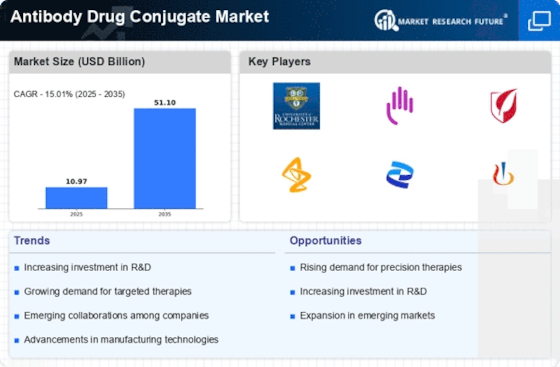
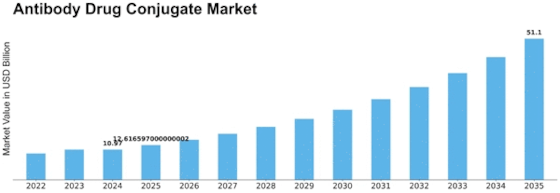
As per MRFR analysis, the Antibody Drug Conjugate Market size was valued at USD 10.97 Billion in 2024. The market is projected to grow from USD 12.62 Billion in 2025 to USD 51.1 Billion by 2035, exhibiting a CAGR of 15.01% during the forecast period 2025-2035. North America led the market with over 45% share, generating around USD 4.9 billion in revenue.
 
The antibody‑drug conjugate (ADC) market is propelled by rising cancer incidence and the shift toward precision, targeted therapies that enhance efficacy while reducing toxicity. Growth is reinforced by biotechnology innovations in linker and payload design, increasing regulatory approvals, and stronger academia‑industry collaborations accelerating R&D pipelines.

Key Market Trends & Highlights

The Antibody Drug Conjugate Market is poised for substantial growth driven by innovative therapies and increasing demand for targeted treatments.

  • The market experiences a rising demand for targeted therapies, particularly in oncology, which remains the largest segment. Innovations in drug development are propelling advancements in cytotoxic drug conjugates, the largest category within the market. Collaborative research initiatives are becoming more prevalent, especially in the Asia-Pacific region, which is the fastest-growing market. The increasing prevalence of cancer and growing investment in cancer research are key drivers fueling Antibody-Drug Conjugates (ADCs) market expansion.

Market Size & Forecast

2024 Market Size 10.97 (USD Billion)
2035 Market Size 51.1 (USD Billion)
CAGR (2025 - 2035) 15.01%
Largest Regional Market Share in 2024 North America

Major Players

Roche (CH), <a title="Bristol-Myers Squibb" href="https://www.bms.com/media/media-library/scientific-media-resources/antibody-drug-conjugates-fact-sheet.html" target="_blank" rel="noopener">Bristol-Myers Squibb</a> (US), Gilead Sciences (US), <a title="AstraZeneca" href="https://www.astrazeneca.com/r-d/next-generation-therapeutics/antibody-drug-conjugate.html" target="_blank" rel="noopener">AstraZeneca</a> (GB), Pfizer (US), Novartis (CH), Seattle Genetics (US), Merck &amp; Co. (US), Takeda Pharmaceutical (JP)

Market Trends

The Antibody Drug Conjugate Market is currently experiencing a transformative phase, characterized by advancements in targeted therapies and personalized medicine. This market appears to be driven by the increasing prevalence of various cancers and the growing demand for more effective treatment options.

As healthcare providers seek to enhance patient outcomes, the integration of antibody drug conjugates into treatment regimens seems to be gaining traction. Furthermore, the ongoing research and development efforts by pharmaceutical companies indicate a commitment to innovation, potentially leading to the introduction of novel therapies that could reshape the landscape of cancer treatment.

In addition to the focus on efficacy, safety profiles of these therapies are under scrutiny, as stakeholders aim to minimize adverse effects while maximizing therapeutic benefits. Regulatory bodies are also playing a crucial role in this market, as they evaluate the safety and effectiveness of new products. The collaboration between academia and industry appears to foster a conducive environment for breakthroughs in this field.

Overall, the Antibody Drug Conjugate Market is poised for growth, with a promising outlook as it adapts to the evolving needs of patients and healthcare systems.

Rising Demand for Targeted Therapies

The Antibody Drug Conjugate Market is witnessing an increasing preference for targeted therapies, which aim to deliver drugs directly to cancer cells while sparing healthy tissues. This trend reflects a broader shift towards precision medicine, where treatments are tailored to individual patient profiles, enhancing efficacy and reducing side effects.

Innovations in Drug Development

Ongoing innovations in drug development methodologies are shaping the Antibody Drug Conjugate Market. Advances in linker technology and payload design are enabling the creation of more effective conjugates, which may lead to improved therapeutic outcomes and broaden the scope of treatable cancers.

Collaborative Research Initiatives

Collaborative research initiatives between academic institutions and pharmaceutical companies are becoming increasingly prevalent in the Antibody Drug Conjugate Market. These partnerships are likely to accelerate the discovery and development of new therapies, fostering a culture of innovation and enhancing the overall pipeline of antibody drug conjugates.

Antibody Drug Conjugate Market Market Drivers

Advancements in Biotechnology

Technological advancements in biotechnology are significantly influencing the Antibody Drug Conjugate Market. Innovations in genetic engineering, monoclonal antibody production, and conjugation techniques have led to the development of more effective and safer antibody drug conjugates. For instance, the introduction of site-specific conjugation methods has improved the therapeutic index of these drugs, allowing for better targeting of cancer cells while sparing healthy tissues.
 
The market is witnessing a surge in research and development activities, with numerous clinical trials underway to evaluate new formulations. This dynamic environment suggests that the Antibody Drug Conjugate Market will continue to thrive as biopharmaceutical companies leverage cutting-edge technologies to enhance drug efficacy and safety profiles.

Increasing Prevalence of Cancer

The rising incidence of cancer worldwide is a primary driver for the Antibody Drug Conjugate Market. As cancer remains a leading cause of mortality, the demand for effective treatment options continues to escalate. According to recent statistics, cancer cases are projected to increase significantly, with estimates suggesting that by 2040, there could be over 27 million new cancer cases annually.
 
This alarming trend propels pharmaceutical companies to invest in innovative therapies, including antibody drug conjugates, which offer targeted treatment with reduced side effects. The Antibody Drug Conjugate Market is thus positioned to expand as healthcare providers seek advanced solutions to combat various cancer types, enhancing patient outcomes and survival rates.

Growing Investment in Cancer Research

The increasing investment in cancer research is a crucial driver for the Antibody Drug Conjugate Market. Governments and private organizations are allocating substantial funds to support research initiatives aimed at discovering novel cancer therapies. In recent years, funding for cancer research has seen a marked increase, with billions of dollars directed towards innovative treatment modalities, including antibody drug conjugates.
 
This financial backing fosters collaboration between academic institutions and pharmaceutical companies, accelerating the development of new therapies. As a result, the Antibody Drug Conjugate Market is likely to benefit from a robust pipeline of new products, enhancing treatment options available to patients and healthcare providers.

Rising Awareness of Personalized Medicine

The growing awareness and acceptance of personalized medicine are driving the Antibody Drug Conjugate Market. Patients and healthcare providers are increasingly recognizing the benefits of tailored therapies that target specific cancer types and genetic profiles. This shift towards personalized treatment approaches is prompting pharmaceutical companies to develop antibody drug conjugates that cater to individual patient needs.
 
As a result, the market is witnessing a rise in demand for these targeted therapies, which are perceived to offer improved efficacy and reduced toxicity compared to traditional chemotherapy. The Antibody Drug Conjugate Market is likely to expand as more healthcare professionals advocate for personalized treatment plans, aligning with the broader trend of precision medicine in oncology.

Regulatory Support for Innovative Therapies

Regulatory agencies are increasingly supportive of innovative therapies, which is positively impacting the Antibody Drug Conjugate Market. Initiatives such as expedited review processes and breakthrough therapy designations are designed to facilitate the development and approval of novel cancer treatments. This regulatory environment encourages pharmaceutical companies to invest in antibody drug conjugates, as they can bring these therapies to market more swiftly.
 
The approval of several antibody drug conjugates in recent years underscores this trend, indicating a favorable landscape for future developments. Consequently, the Antibody Drug Conjugate Market is poised for growth as more innovative therapies gain regulatory approval, ultimately benefiting patients in need of effective cancer treatments.

Market Segment Insights

By Type: Cytotoxic Drug Conjugates (Largest) vs. Immunomodulatory Drug Conjugates (Fastest-Growing)

The Antibody Drug Conjugate Market shows a diverse landscape within its 'Type' segment. <a href="https://www.marketresearchfuture.com/reports/cytotoxic-drugs-market-43097">Cytotoxic Drug</a> Conjugates lead the market, characterized by their potent ability to deliver localized cytotoxic agents directly to cancer cells. This targeted approach significantly enhances treatment efficacy while minimizing systemic toxicity, making it a preferred choice among healthcare professionals. On the other hand, Immunomodulatory Drug Conjugates are gaining traction, leveraging their ability to modulate the immune response to bolster anti-tumor activity, thus helping them rise rapidly in market share and utilization in clinical therapies. Growth trends indicate a robust trajectory for both segments, influenced by advancements in biotechnology and an increasing focus on personalized medicine. The demand for Cytotoxic Drug Conjugates continues to prosper, supported by ongoing research and successful clinical trials that showcase their efficacy against various malignancies. Conversely, Immunomodulatory Drug Conjugates are experiencing accelerated growth due to increasing approval rates and a surge in innovative product launches, which are powered by promising outcomes reported in recent oncology studies.

Cytotoxic Drug Conjugates (Dominant) vs. Immunomodulatory Drug Conjugates (Emerging)

Cytotoxic Drug Conjugates stand out in the market share as the dominant force, known for their exceptional ability to combine strong cytotoxic agents with the precision of monoclonal <a title="antibodies" href="https://www.marketresearchfuture.com/reports/antibodies-market-20684" target="_blank" rel="noopener">antibodies</a>. This synergy allows targeted destruction of cancer cells while limiting damage to healthy tissues. They have become a cornerstone in the treatment paradigm for various cancers, supported by a robust portfolio of approved therapies. In contrast, Immunomodulatory Drug Conjugates represent an emerging trend, emphasizing the intersection of immunotherapy and traditional cytotoxic approaches. By enhancing immune system response against tumors, these conjugates are increasingly appealing in the oncology landscape, supported by encouraging research outcomes and regulatory endorsements, positioning them as vital contenders for future treatment strategies.

By Therapeutic Area: Oncology (Largest) vs. Autoimmune Diseases (Fastest-Growing)

The Antibody Drug Conjugate Market (ADC) market is significantly influenced by its therapeutic areas, with oncology holding the largest share. This segment benefits from a robust pipeline of ADCs tailored to various cancers, translating into sustained demand. Meanwhile, autoimmune diseases, although currently smaller in market share, are emerging swiftly as an important category due to increasing research and development initiatives that focus on targeted therapies to combat autoimmune conditions.

Oncology (Dominant) vs. Autoimmune Diseases (Emerging)

Oncology remains the dominant therapeutic area in the market share, driven by a plethora of innovative therapies aimed at various cancer types, enhancing efficacy and reducing toxicity. ADCs targeted towards specific tumor antigens are gaining traction, showcasing higher response rates in clinical settings. Conversely, autoimmune diseases represent an emerging segment, experiencing rapid growth as more companies recognize the potential of ADCs in treating these complex disorders. The increasing prevalence of autoimmune conditions, coupled with technological advancements in antibody engineering, fosters a favorable landscape for further development in this area.

By Mechanism of Action: Targeted Delivery (Largest) vs. Immune Modulation (Fastest-Growing)

The Antibody Drug Conjugate Market is significantly influenced by its mechanism of action categorizations, where Targeted Delivery holds the largest market share. This mechanism focuses on delivering therapeutic agents directly to cancer cells, enhancing efficacy while minimizing systemic toxicity. Meanwhile, Cell Cycle Disruption, Immune Modulation, and Antibody-Dependent Cellular Cytotoxicity follow, contributing variably to overall market dynamics. Each mechanism not only serves distinct therapeutic angles but also caters to the evolving treatment landscapes of cancer therapies.

Targeted Delivery (Dominant) vs. Immune Modulation (Emerging)

Targeted Delivery remains the dominant mechanism of action within the market share, recognized for its precision in targeting malignant cells which maximizes treatment efficacy while limiting harm to healthy tissue. This segment drives the broader market with well-established products that leverage monoclonal antibodies for selective targeting. Conversely, Immune Modulation is emerging robustly, depicted as a forward-thinking approach that harnesses and enhances the body's immune response against tumors. This mechanism is gaining traction as newer therapies are developed, promising a shift in treatment approaches, with significant investments funneling into research exploring its potential.

By Route of Administration: Intravenous (Largest) vs. Subcutaneous (Fastest-Growing)

In the Antibody Drug Conjugate Market (ADC) Market, the route of administration significantly affects the adoption and efficacy of treatments. Intravenous (IV) administration currently holds the largest market share, owing to its established use in clinical settings and its ability to ensure rapid drug delivery. Conversely, Subcutaneous administration is emerging rapidly, favored for its ease of use and potential for at-home patient administration, leading to increased acceptance and market growth. Intramuscular administration, while used, does not demonstrate the same level of preference and is thus positioned as a smaller segment in this market landscape. The growth trends in the ADC market reveal a shift towards more patient-friendly administration routes. Subcutaneous administration is gaining traction as it aligns with the evolving preference for minimizing hospital visits and enhancing patient comfort during treatment. This expediency is critical in chronic illness management, propelling Subcutaneous methods to the forefront as healthcare providers seek innovative ways to improve patient experience and adherence. Meanwhile, Intravenous administration, while still dominant, faces competition from these emerging alternatives, necessitating ongoing innovations to maintain its leading position in the market.

Route of Administration: Intravenous (Dominant) vs. Subcutaneous (Emerging)

Intravenous administration remains the dominant route in the market share, characterized by its extensive use in oncology therapies that benefit from rapid systemic exposure to the drug. This method allows for precise control over drug concentration and is well-established in hospital settings. The established protocols and wide acceptance among healthcare professionals reinforce its market position. On the other hand, Subcutaneous administration is rapidly emerging as a preferred alternative, largely due to its convenience and reduced burden on healthcare facilities. This method supports self-administration, which is attractive to patients seeking autonomy in managing their treatments. As delivery technology continues to advance, Subcutaneous methods are expected to gain an increasing share of the market, particularly among patients with chronic conditions.

Get more detailed insights about Antibody Drug Conjugate Market Research Report – Forecast to 2035

Regional Insights

North America : Leading Innovation and Demand

North America leads in the Antibody Drug Conjugate Market Size, accounting for over 44.99% of the global revenue in 2024. The region benefits from advanced healthcare infrastructure, significant R&D investments, and a strong presence of leading pharmaceutical companies. Regulatory support from agencies like the FDA further accelerates the approval of innovative therapies, driving demand for ADCs in oncology and other therapeutic areas. 

The United States is the primary contributor to this market, with key players such as Roche, Bristol-Myers Squibb, and Gilead Sciences leading the charge. The competitive landscape is characterized by continuous innovation and strategic partnerships, enhancing the development pipeline. Canada also plays a vital role, contributing to the overall growth with supportive healthcare policies and increasing investments in biopharmaceuticals.

Europe : Emerging Market with Growth Potential

Europe Antibody Drug Conjugate Market was valued at USD 15.33 billion in 2024, making it the second-largest regional market with a 30% share. The region is witnessing a surge in demand driven by increasing cancer prevalence and a growing focus on personalized medicine. Regulatory bodies like the European Medicines Agency (EMA) are actively facilitating the approval of innovative ADC therapies, which is expected to further boost market growth in the coming years.

Leading countries in this region include Germany, France, and the UK, where major pharmaceutical companies such as AstraZeneca and Novartis are heavily investing in ADC research and development. The competitive landscape is marked by collaborations between biotech firms and established pharmaceutical companies, enhancing the availability of advanced therapies. The presence of a robust healthcare system also supports the adoption of these innovative treatments.

Asia-Pacific : Rapidly Growing Market Segment

Asia-Pacific is rapidly emerging as a significant player in the Antibody Drug Conjugate Market, holding about 20% of the global market share. The region's growth is driven by increasing investments in healthcare infrastructure, rising cancer incidence, and a growing focus on biopharmaceuticals. Countries like Japan and China are leading this growth, supported by favorable regulatory environments and government initiatives aimed at enhancing drug development.

Japan is home to key players like Takeda Pharmaceutical, while China is witnessing a surge in local biotech firms entering the ADC space. The competitive landscape is evolving, with collaborations and partnerships becoming common as companies seek to leverage each other's strengths. The increasing demand for targeted therapies is expected to further propel the ADC market in this region, making it a focal point for future investments.

Middle East and Africa : Untapped Market with Potential

The Middle East and Africa region is currently the smallest market for Antibody Drug Conjugates, holding around 5% of the global market share. However, there is a growing interest in ADCs driven by increasing cancer rates and a rising demand for advanced therapeutic options. Regulatory bodies in countries like South Africa are beginning to recognize the potential of ADCs, which may lead to more favorable policies in the future.

Countries such as South Africa and the UAE are emerging as key players in this market, with increasing investments in healthcare and biopharmaceuticals. The competitive landscape is still developing, with both local and international companies exploring opportunities in this region. As healthcare systems improve and awareness of ADCs grows, the market is expected to expand significantly in the coming years.

Key Players and Competitive Insights

The Antibody Drug Conjugate Market is rapidly evolving, driven by the increasing incidence of cancer and the growing demand for targeted therapies that improve treatment efficacy while minimizing side effects. This specialized market focuses on the innovative fusion of monoclonal antibodies with cytotoxic drugs. As companies venture into this specialized treatment realm, they are heavily investing in research and development activities to harness the potential of ADCs in treating various indications, especially oncology.
 
The competitive landscape is characterized by strategic collaborations, partnerships, and mergers aimed at enhancing product pipelines and expanding market reach. As more pharmaceutical companies enter this space, the competition intensifies, leading to an accelerated pace of innovation and improvement in treatment options.
 
Merck & Co. commands a substantial presence in the Antibody Drug Conjugate Market, with its robust portfolio of innovative therapies that have demonstrated strong clinical efficacy. The company benefits from its extensive research and development resources that allow it to maintain a competitive edge in technology and product advancement. Merck’s established brand equity and commitment to quality contribute significantly to its strengths in the market.
 
The strategic collaborations and partnerships that Merck engages in enable it to leverage expertise across multiple domains, facilitating comprehensive solutions in targeted therapies. Furthermore, Merck's commitment to addressing unmet medical needs in oncology enables it to align its product offerings closely with market demands, thereby reinforcing its position as a leading player in the antibody drug conjugate landscape.

Novartis is also a formidable entity in the Antibody Drug Conjugate Market, recognized for its significant breakthroughs in oncology therapies. The company boasts a pipeline that includes pioneering ADCs, placing it among the frontrunners in the treatment of various cancers. Novartis’s strengths lie in its commitment to innovation and research which are reflected in its expansive product offerings and sustained market presence.
 
The company has made strategic investments in mergers and acquisitions to bolster its capabilities, thereby enabling faster development and market entry of new therapies. Novartis’s focus on integrating cutting-edge technologies and advanced delivery systems into its ADC products positions it well for significant penetration within the global market. With consistent improvements and milestones, Novartis reinforces its commitment to enhancing patient outcomes through targeted treatment modalities while solidifying its competitive stance.

Key Companies in the Antibody Drug Conjugate Market include

Industry Developments

2025 marked a strong momentum shift with new clinical data on HER2-targeting ADCs, showing superior efficacy in metastatic breast cancer and driving fresh investment from global biopharma.

In December 2023, Pfizer finalized its acquisition of Seagen, which substantially enhances Pfizer's oncology and ADC platform by incorporating Seagen's proprietary ADC technology and four approved ADCs (e.g., ADCETRIS®, PADCEV®, TIVDAK®).In October 2023, Merck and Daiichi Sankyo engaged into a global collaboration valued at up to US$22 billion (with US$4 billion upfront) to co-develop three DXd-based ADC candidates. This collaboration will enhance Merck's ADC pipeline in immuno-oncology.In January 2024, Johnson & Johnson acquired Ambrx for an estimated US$2 billion.

This acquisition enabled the company to integrate the OptiDC™ ADC development platform and advance its clinical and pre-clinical ADC pipeline.Astellas and Seagen presented compelling results from the EV-302 trial in bladder cancer at the ESMO Congress 2023 in October 2023. The results showed that enfortumab vedotin + pembrolizumab doubled survival compared to chemotherapy, and this marked a significant clinical breakthrough for ADC combinations.In June 2023, AstraZeneca commenced the first-in-human trials of AZD9592, a novel ADC monotherapy (EGRET study) for advanced solid tumors, in both single-agent and combination settings.

This marked the company's strategic entry into ADC development.Kelun-Biotech, a Chinese biotech company, announced in January 2024 that it would submit two ADCs—TroP-ADC and a HER2-targeting ADC—within the year. This announcement was indicative of the accelerated pace of ADC innovation in China.

Future Outlook

Antibody Drug Conjugate Market Future Outlook

The Antibody Drug Conjugate Market size is projected to reach USD 51.1 Billion by 2035, growing at a CAGR of 15.01%

New opportunities lie in:

  • <p>Expansion into emerging markets with tailored ADC solutions. Development of next-generation linker technologies for enhanced efficacy. Strategic partnerships with biotech firms for innovative drug combinations.</p>

By 2035, the market is expected to solidify its position as a leader in targeted cancer therapies.

Market Segmentation

Antibody Drug Conjugate Market Type Outlook

  • Cytotoxic Drug Conjugates
  • Immunomodulatory Drug Conjugates
  • Radiolabeled Drug Conjugates
  • Dual Action Drug Conjugates

Antibody Drug Conjugate Market Therapeutic Area Outlook

  • Oncology
  • Autoimmune Diseases
  • Infectious Diseases
  • Neurological Disorders

Antibody Drug Conjugate Market Mechanism of Action Outlook

  • Targeted Delivery
  • Cell Cycle Disruption
  • Immune Modulation
  • Antibody-Dependent Cellular Cytotoxicity

Antibody Drug Conjugate Market Route of Administration Outlook

  • Intravenous
  • Subcutaneous
  • Intramuscular

Report Scope

MARKET SIZE 2024 10.97(USD Billion)
MARKET SIZE 2025 12.62(USD Billion)
MARKET SIZE 2035 51.1(USD Billion)
COMPOUND ANNUAL GROWTH RATE (CAGR) 15.01% (2025 - 2035)
REPORT COVERAGE Revenue Forecast, Competitive Landscape, Growth Factors, and Trends
BASE YEAR 2024
Market Forecast Period 2026 - 2035
Historical Data 2019 - 2024
Market Forecast Units USD Billion
Key Companies Profiled Roche (CH), Bristol-Myers Squibb (US), Gilead Sciences (US), AstraZeneca (GB), Pfizer (US), Novartis (CH), Seattle Genetics (US), Merck & Co. (US), Takeda Pharmaceutical (JP)
Segments Covered Types, Therapeutic Area, Mechanism of Action, Route of Administration, Regional
Key Market Opportunities Advancements in targeted therapies enhance growth potential in the Antibody Drug Conjugate Market.
Key Market Dynamics Rising demand for targeted therapies drives innovation and competition in the Antibody Drug Conjugate Market.
Countries Covered North America, Europe, APAC, South America, MEA

FAQs

What is the current valuation of the Antibody Drug Conjugate Market as of 2024?

<p>The Antibody Drug Conjugate Market was valued at 10.97 USD Billion in 2024.</p>

What is the projected market size for the Antibody Drug Conjugate Market by 2035?

<p>The market is projected to reach 51.1 USD Billion by 2035.</p>

What is the expected CAGR for the Antibody Drug Conjugate Market during the forecast period 2025 - 2035?

<p>The expected CAGR for the market during the forecast period 2025 - 2035 is 15.01%.</p>

Which therapeutic area is expected to dominate the Antibody Drug Conjugate Market?

<p>Oncology is expected to dominate the market, with a projected valuation of 25.0 USD Billion by 2035.</p>

What are the key types of Antibody Drug Conjugates and their projected valuations?

<p>Cytotoxic Drug Conjugates are projected to reach 20.0 USD Billion, while Immunomodulatory Drug Conjugates may reach 10.0 USD Billion by 2035.</p>

Which companies are considered key players in the Antibody Drug Conjugate Market?

<p>Key players include Roche, Bristol-Myers Squibb, Gilead Sciences, AstraZeneca, and Pfizer.</p>

What is the projected valuation for the route of administration segment in the Antibody Drug Conjugate Market?

<p>The Intravenous route is projected to reach 30.0 USD Billion by 2035.</p>

How do the mechanisms of action for Antibody Drug Conjugates vary in terms of market valuation?

<p>Antibody-Dependent Cellular Cytotoxicity is projected to reach 15.51 USD Billion by 2035, indicating its potential significance.</p>

What is the expected market size for autoimmune diseases within the Antibody Drug Conjugate Market?

<p>The market for autoimmune diseases is projected to reach 10.0 USD Billion by 2035.</p>

What is the significance of the projected growth in the Antibody Drug Conjugate Market?

<p>The substantial growth indicates a robust demand for innovative therapies, particularly in oncology and autoimmune diseases.</p>

  1. SECTION I: EXECUTIVE SUMMARY AND KEY HIGHLIGHTS
    1. | 1.1 EXECUTIVE SUMMARY
    2. | | 1.1.1 Market Overview
    3. | | 1.1.2 Key Findings
    4. | | 1.1.3 Market Segmentation
    5. | | 1.1.4 Competitive Landscape
    6. | | 1.1.5 Challenges and Opportunities
    7. | | 1.1.6 Future Outlook
  2. SECTION II: SCOPING, METHODOLOGY AND MARKET STRUCTURE
    1. | 2.1 MARKET INTRODUCTION
    2. | | 2.1.1 Definition
    3. | | 2.1.2 Scope of the study
    4. | | | 2.1.2.1 Research Objective
    5. | | | 2.1.2.2 Assumption
    6. | | | 2.1.2.3 Limitations
    7. | 2.2 RESEARCH METHODOLOGY
    8. | | 2.2.1 Overview
    9. | | 2.2.2 Data Mining
    10. | | 2.2.3 Secondary Research
    11. | | 2.2.4 Primary Research
    12. | | | 2.2.4.1 Primary Interviews and Information Gathering Process
    13. | | | 2.2.4.2 Breakdown of Primary Respondents
    14. | | 2.2.5 Forecasting Model
    15. | | 2.2.6 Market Size Estimation
    16. | | | 2.2.6.1 Bottom-Up Approach
    17. | | | 2.2.6.2 Top-Down Approach
    18. | | 2.2.7 Data Triangulation
    19. | | 2.2.8 Validation
  3. SECTION III: QUALITATIVE ANALYSIS
    1. | 3.1 MARKET DYNAMICS
    2. | | 3.1.1 Overview
    3. | | 3.1.2 Drivers
    4. | | 3.1.3 Restraints
    5. | | 3.1.4 Opportunities
    6. | 3.2 MARKET FACTOR ANALYSIS
    7. | | 3.2.1 Value chain Analysis
    8. | | 3.2.2 Porter's Five Forces Analysis
    9. | | | 3.2.2.1 Bargaining Power of Suppliers
    10. | | | 3.2.2.2 Bargaining Power of Buyers
    11. | | | 3.2.2.3 Threat of New Entrants
    12. | | | 3.2.2.4 Threat of Substitutes
    13. | | | 3.2.2.5 Intensity of Rivalry
    14. | | 3.2.3 COVID-19 Impact Analysis
    15. | | | 3.2.3.1 Market Impact Analysis
    16. | | | 3.2.3.2 Regional Impact
    17. | | | 3.2.3.3 Opportunity and Threat Analysis
  4. SECTION IV: QUANTITATIVE ANALYSIS
    1. | 4.1 Healthcare, BY Type (USD Billion)
    2. | | 4.1.1 Cytotoxic Drug Conjugates
    3. | | 4.1.2 Immunomodulatory Drug Conjugates
    4. | | 4.1.3 Radiolabeled Drug Conjugates
    5. | | 4.1.4 Dual Action Drug Conjugates
    6. | 4.2 Healthcare, BY Therapeutic Area (USD Billion)
    7. | | 4.2.1 Oncology
    8. | | 4.2.2 Autoimmune Diseases
    9. | | 4.2.3 Infectious Diseases
    10. | | 4.2.4 Neurological Disorders
    11. | 4.3 Healthcare, BY Mechanism of Action (USD Billion)
    12. | | 4.3.1 Targeted Delivery
    13. | | 4.3.2 Cell Cycle Disruption
    14. | | 4.3.3 Immune Modulation
    15. | | 4.3.4 Antibody-Dependent Cellular Cytotoxicity
    16. | 4.4 Healthcare, BY Route of Administration (USD Billion)
    17. | | 4.4.1 Intravenous
    18. | | 4.4.2 Subcutaneous
    19. | | 4.4.3 Intramuscular
    20. | 4.5 Healthcare, BY Region (USD Billion)
    21. | | 4.5.1 North America
    22. | | | 4.5.1.1 US
    23. | | | 4.5.1.2 Canada
    24. | | 4.5.2 Europe
    25. | | | 4.5.2.1 Germany
    26. | | | 4.5.2.2 UK
    27. | | | 4.5.2.3 France
    28. | | | 4.5.2.4 Russia
    29. | | | 4.5.2.5 Italy
    30. | | | 4.5.2.6 Spain
    31. | | | 4.5.2.7 Rest of Europe
    32. | | 4.5.3 APAC
    33. | | | 4.5.3.1 China
    34. | | | 4.5.3.2 India
    35. | | | 4.5.3.3 Japan
    36. | | | 4.5.3.4 South Korea
    37. | | | 4.5.3.5 Malaysia
    38. | | | 4.5.3.6 Thailand
    39. | | | 4.5.3.7 Indonesia
    40. | | | 4.5.3.8 Rest of APAC
    41. | | 4.5.4 South America
    42. | | | 4.5.4.1 Brazil
    43. | | | 4.5.4.2 Mexico
    44. | | | 4.5.4.3 Argentina
    45. | | | 4.5.4.4 Rest of South America
    46. | | 4.5.5 MEA
    47. | | | 4.5.5.1 GCC Countries
    48. | | | 4.5.5.2 South Africa
    49. | | | 4.5.5.3 Rest of MEA
  5. SECTION V: COMPETITIVE ANALYSIS
    1. | 5.1 Competitive Landscape
    2. | | 5.1.1 Overview
    3. | | 5.1.2 Competitive Analysis
    4. | | 5.1.3 Market share Analysis
    5. | | 5.1.4 Major Growth Strategy in the Healthcare
    6. | | 5.1.5 Competitive Benchmarking
    7. | | 5.1.6 Leading Players in Terms of Number of Developments in the Healthcare
    8. | | 5.1.7 Key developments and growth strategies
    9. | | | 5.1.7.1 New Product Launch/Service Deployment
    10. | | | 5.1.7.2 Merger & Acquisitions
    11. | | | 5.1.7.3 Joint Ventures
    12. | | 5.1.8 Major Players Financial Matrix
    13. | | | 5.1.8.1 Sales and Operating Income
    14. | | | 5.1.8.2 Major Players R&D Expenditure. 2023
    15. | 5.2 Company Profiles
    16. | | 5.2.1 Roche (CH)
    17. | | | 5.2.1.1 Financial Overview
    18. | | | 5.2.1.2 Products Offered
    19. | | | 5.2.1.3 Key Developments
    20. | | | 5.2.1.4 SWOT Analysis
    21. | | | 5.2.1.5 Key Strategies
    22. | | 5.2.2 Bristol-Myers Squibb (US)
    23. | | | 5.2.2.1 Financial Overview
    24. | | | 5.2.2.2 Products Offered
    25. | | | 5.2.2.3 Key Developments
    26. | | | 5.2.2.4 SWOT Analysis
    27. | | | 5.2.2.5 Key Strategies
    28. | | 5.2.3 Gilead Sciences (US)
    29. | | | 5.2.3.1 Financial Overview
    30. | | | 5.2.3.2 Products Offered
    31. | | | 5.2.3.3 Key Developments
    32. | | | 5.2.3.4 SWOT Analysis
    33. | | | 5.2.3.5 Key Strategies
    34. | | 5.2.4 AstraZeneca (GB)
    35. | | | 5.2.4.1 Financial Overview
    36. | | | 5.2.4.2 Products Offered
    37. | | | 5.2.4.3 Key Developments
    38. | | | 5.2.4.4 SWOT Analysis
    39. | | | 5.2.4.5 Key Strategies
    40. | | 5.2.5 Pfizer (US)
    41. | | | 5.2.5.1 Financial Overview
    42. | | | 5.2.5.2 Products Offered
    43. | | | 5.2.5.3 Key Developments
    44. | | | 5.2.5.4 SWOT Analysis
    45. | | | 5.2.5.5 Key Strategies
    46. | | 5.2.6 Novartis (CH)
    47. | | | 5.2.6.1 Financial Overview
    48. | | | 5.2.6.2 Products Offered
    49. | | | 5.2.6.3 Key Developments
    50. | | | 5.2.6.4 SWOT Analysis
    51. | | | 5.2.6.5 Key Strategies
    52. | | 5.2.7 Seattle Genetics (US)
    53. | | | 5.2.7.1 Financial Overview
    54. | | | 5.2.7.2 Products Offered
    55. | | | 5.2.7.3 Key Developments
    56. | | | 5.2.7.4 SWOT Analysis
    57. | | | 5.2.7.5 Key Strategies
    58. | | 5.2.8 Merck & Co. (US)
    59. | | | 5.2.8.1 Financial Overview
    60. | | | 5.2.8.2 Products Offered
    61. | | | 5.2.8.3 Key Developments
    62. | | | 5.2.8.4 SWOT Analysis
    63. | | | 5.2.8.5 Key Strategies
    64. | | 5.2.9 Takeda Pharmaceutical (JP)
    65. | | | 5.2.9.1 Financial Overview
    66. | | | 5.2.9.2 Products Offered
    67. | | | 5.2.9.3 Key Developments
    68. | | | 5.2.9.4 SWOT Analysis
    69. | | | 5.2.9.5 Key Strategies
    70. | 5.3 Appendix
    71. | | 5.3.1 References
    72. | | 5.3.2 Related Reports
  6. LIST OF FIGURES
    1. | 6.1 MARKET SYNOPSIS
    2. | 6.2 NORTH AMERICA MARKET ANALYSIS
    3. | 6.3 US MARKET ANALYSIS BY TYPE
    4. | 6.4 US MARKET ANALYSIS BY THERAPEUTIC AREA
    5. | 6.5 US MARKET ANALYSIS BY MECHANISM OF ACTION
    6. | 6.6 US MARKET ANALYSIS BY ROUTE OF ADMINISTRATION
    7. | 6.7 CANADA MARKET ANALYSIS BY TYPE
    8. | 6.8 CANADA MARKET ANALYSIS BY THERAPEUTIC AREA
    9. | 6.9 CANADA MARKET ANALYSIS BY MECHANISM OF ACTION
    10. | 6.10 CANADA MARKET ANALYSIS BY ROUTE OF ADMINISTRATION
    11. | 6.11 EUROPE MARKET ANALYSIS
    12. | 6.12 GERMANY MARKET ANALYSIS BY TYPE
    13. | 6.13 GERMANY MARKET ANALYSIS BY THERAPEUTIC AREA
    14. | 6.14 GERMANY MARKET ANALYSIS BY MECHANISM OF ACTION
    15. | 6.15 GERMANY MARKET ANALYSIS BY ROUTE OF ADMINISTRATION
    16. | 6.16 UK MARKET ANALYSIS BY TYPE
    17. | 6.17 UK MARKET ANALYSIS BY THERAPEUTIC AREA
    18. | 6.18 UK MARKET ANALYSIS BY MECHANISM OF ACTION
    19. | 6.19 UK MARKET ANALYSIS BY ROUTE OF ADMINISTRATION
    20. | 6.20 FRANCE MARKET ANALYSIS BY TYPE
    21. | 6.21 FRANCE MARKET ANALYSIS BY THERAPEUTIC AREA
    22. | 6.22 FRANCE MARKET ANALYSIS BY MECHANISM OF ACTION
    23. | 6.23 FRANCE MARKET ANALYSIS BY ROUTE OF ADMINISTRATION
    24. | 6.24 RUSSIA MARKET ANALYSIS BY TYPE
    25. | 6.25 RUSSIA MARKET ANALYSIS BY THERAPEUTIC AREA
    26. | 6.26 RUSSIA MARKET ANALYSIS BY MECHANISM OF ACTION
    27. | 6.27 RUSSIA MARKET ANALYSIS BY ROUTE OF ADMINISTRATION
    28. | 6.28 ITALY MARKET ANALYSIS BY TYPE
    29. | 6.29 ITALY MARKET ANALYSIS BY THERAPEUTIC AREA
    30. | 6.30 ITALY MARKET ANALYSIS BY MECHANISM OF ACTION
    31. | 6.31 ITALY MARKET ANALYSIS BY ROUTE OF ADMINISTRATION
    32. | 6.32 SPAIN MARKET ANALYSIS BY TYPE
    33. | 6.33 SPAIN MARKET ANALYSIS BY THERAPEUTIC AREA
    34. | 6.34 SPAIN MARKET ANALYSIS BY MECHANISM OF ACTION
    35. | 6.35 SPAIN MARKET ANALYSIS BY ROUTE OF ADMINISTRATION
    36. | 6.36 REST OF EUROPE MARKET ANALYSIS BY TYPE
    37. | 6.37 REST OF EUROPE MARKET ANALYSIS BY THERAPEUTIC AREA
    38. | 6.38 REST OF EUROPE MARKET ANALYSIS BY MECHANISM OF ACTION
    39. | 6.39 REST OF EUROPE MARKET ANALYSIS BY ROUTE OF ADMINISTRATION
    40. | 6.40 APAC MARKET ANALYSIS
    41. | 6.41 CHINA MARKET ANALYSIS BY TYPE
    42. | 6.42 CHINA MARKET ANALYSIS BY THERAPEUTIC AREA
    43. | 6.43 CHINA MARKET ANALYSIS BY MECHANISM OF ACTION
    44. | 6.44 CHINA MARKET ANALYSIS BY ROUTE OF ADMINISTRATION
    45. | 6.45 INDIA MARKET ANALYSIS BY TYPE
    46. | 6.46 INDIA MARKET ANALYSIS BY THERAPEUTIC AREA
    47. | 6.47 INDIA MARKET ANALYSIS BY MECHANISM OF ACTION
    48. | 6.48 INDIA MARKET ANALYSIS BY ROUTE OF ADMINISTRATION
    49. | 6.49 JAPAN MARKET ANALYSIS BY TYPE
    50. | 6.50 JAPAN MARKET ANALYSIS BY THERAPEUTIC AREA
    51. | 6.51 JAPAN MARKET ANALYSIS BY MECHANISM OF ACTION
    52. | 6.52 JAPAN MARKET ANALYSIS BY ROUTE OF ADMINISTRATION
    53. | 6.53 SOUTH KOREA MARKET ANALYSIS BY TYPE
    54. | 6.54 SOUTH KOREA MARKET ANALYSIS BY THERAPEUTIC AREA
    55. | 6.55 SOUTH KOREA MARKET ANALYSIS BY MECHANISM OF ACTION
    56. | 6.56 SOUTH KOREA MARKET ANALYSIS BY ROUTE OF ADMINISTRATION
    57. | 6.57 MALAYSIA MARKET ANALYSIS BY TYPE
    58. | 6.58 MALAYSIA MARKET ANALYSIS BY THERAPEUTIC AREA
    59. | 6.59 MALAYSIA MARKET ANALYSIS BY MECHANISM OF ACTION
    60. | 6.60 MALAYSIA MARKET ANALYSIS BY ROUTE OF ADMINISTRATION
    61. | 6.61 THAILAND MARKET ANALYSIS BY TYPE
    62. | 6.62 THAILAND MARKET ANALYSIS BY THERAPEUTIC AREA
    63. | 6.63 THAILAND MARKET ANALYSIS BY MECHANISM OF ACTION
    64. | 6.64 THAILAND MARKET ANALYSIS BY ROUTE OF ADMINISTRATION
    65. | 6.65 INDONESIA MARKET ANALYSIS BY TYPE
    66. | 6.66 INDONESIA MARKET ANALYSIS BY THERAPEUTIC AREA
    67. | 6.67 INDONESIA MARKET ANALYSIS BY MECHANISM OF ACTION
    68. | 6.68 INDONESIA MARKET ANALYSIS BY ROUTE OF ADMINISTRATION
    69. | 6.69 REST OF APAC MARKET ANALYSIS BY TYPE
    70. | 6.70 REST OF APAC MARKET ANALYSIS BY THERAPEUTIC AREA
    71. | 6.71 REST OF APAC MARKET ANALYSIS BY MECHANISM OF ACTION
    72. | 6.72 REST OF APAC MARKET ANALYSIS BY ROUTE OF ADMINISTRATION
    73. | 6.73 SOUTH AMERICA MARKET ANALYSIS
    74. | 6.74 BRAZIL MARKET ANALYSIS BY TYPE
    75. | 6.75 BRAZIL MARKET ANALYSIS BY THERAPEUTIC AREA
    76. | 6.76 BRAZIL MARKET ANALYSIS BY MECHANISM OF ACTION
    77. | 6.77 BRAZIL MARKET ANALYSIS BY ROUTE OF ADMINISTRATION
    78. | 6.78 MEXICO MARKET ANALYSIS BY TYPE
    79. | 6.79 MEXICO MARKET ANALYSIS BY THERAPEUTIC AREA
    80. | 6.80 MEXICO MARKET ANALYSIS BY MECHANISM OF ACTION
    81. | 6.81 MEXICO MARKET ANALYSIS BY ROUTE OF ADMINISTRATION
    82. | 6.82 ARGENTINA MARKET ANALYSIS BY TYPE
    83. | 6.83 ARGENTINA MARKET ANALYSIS BY THERAPEUTIC AREA
    84. | 6.84 ARGENTINA MARKET ANALYSIS BY MECHANISM OF ACTION
    85. | 6.85 ARGENTINA MARKET ANALYSIS BY ROUTE OF ADMINISTRATION
    86. | 6.86 REST OF SOUTH AMERICA MARKET ANALYSIS BY TYPE
    87. | 6.87 REST OF SOUTH AMERICA MARKET ANALYSIS BY THERAPEUTIC AREA
    88. | 6.88 REST OF SOUTH AMERICA MARKET ANALYSIS BY MECHANISM OF ACTION
    89. | 6.89 REST OF SOUTH AMERICA MARKET ANALYSIS BY ROUTE OF ADMINISTRATION
    90. | 6.90 MEA MARKET ANALYSIS
    91. | 6.91 GCC COUNTRIES MARKET ANALYSIS BY TYPE
    92. | 6.92 GCC COUNTRIES MARKET ANALYSIS BY THERAPEUTIC AREA
    93. | 6.93 GCC COUNTRIES MARKET ANALYSIS BY MECHANISM OF ACTION
    94. | 6.94 GCC COUNTRIES MARKET ANALYSIS BY ROUTE OF ADMINISTRATION
    95. | 6.95 SOUTH AFRICA MARKET ANALYSIS BY TYPE
    96. | 6.96 SOUTH AFRICA MARKET ANALYSIS BY THERAPEUTIC AREA
    97. | 6.97 SOUTH AFRICA MARKET ANALYSIS BY MECHANISM OF ACTION
    98. | 6.98 SOUTH AFRICA MARKET ANALYSIS BY ROUTE OF ADMINISTRATION
    99. | 6.99 REST OF MEA MARKET ANALYSIS BY TYPE
    100. | 6.100 REST OF MEA MARKET ANALYSIS BY THERAPEUTIC AREA
    101. | 6.101 REST OF MEA MARKET ANALYSIS BY MECHANISM OF ACTION
    102. | 6.102 REST OF MEA MARKET ANALYSIS BY ROUTE OF ADMINISTRATION
    103. | 6.103 KEY BUYING CRITERIA OF HEALTHCARE
    104. | 6.104 RESEARCH PROCESS OF MRFR
    105. | 6.105 DRO ANALYSIS OF HEALTHCARE
    106. | 6.106 DRIVERS IMPACT ANALYSIS: HEALTHCARE
    107. | 6.107 RESTRAINTS IMPACT ANALYSIS: HEALTHCARE
    108. | 6.108 SUPPLY / VALUE CHAIN: HEALTHCARE
    109. | 6.109 HEALTHCARE, BY TYPE, 2024 (% SHARE)
    110. | 6.110 HEALTHCARE, BY TYPE, 2024 TO 2035 (USD Billion)
    111. | 6.111 HEALTHCARE, BY THERAPEUTIC AREA, 2024 (% SHARE)
    112. | 6.112 HEALTHCARE, BY THERAPEUTIC AREA, 2024 TO 2035 (USD Billion)
    113. | 6.113 HEALTHCARE, BY MECHANISM OF ACTION, 2024 (% SHARE)
    114. | 6.114 HEALTHCARE, BY MECHANISM OF ACTION, 2024 TO 2035 (USD Billion)
    115. | 6.115 HEALTHCARE, BY ROUTE OF ADMINISTRATION, 2024 (% SHARE)
    116. | 6.116 HEALTHCARE, BY ROUTE OF ADMINISTRATION, 2024 TO 2035 (USD Billion)
    117. | 6.117 BENCHMARKING OF MAJOR COMPETITORS
  7. LIST OF TABLES
    1. | 7.1 LIST OF ASSUMPTIONS
    2. | | 7.1.1
    3. | 7.2 North America MARKET SIZE ESTIMATES; FORECAST
    4. | | 7.2.1 BY TYPE, 2025-2035 (USD Billion)
    5. | | 7.2.2 BY THERAPEUTIC AREA, 2025-2035 (USD Billion)
    6. | | 7.2.3 BY MECHANISM OF ACTION, 2025-2035 (USD Billion)
    7. | | 7.2.4 BY ROUTE OF ADMINISTRATION, 2025-2035 (USD Billion)
    8. | 7.3 US MARKET SIZE ESTIMATES; FORECAST
    9. | | 7.3.1 BY TYPE, 2025-2035 (USD Billion)
    10. | | 7.3.2 BY THERAPEUTIC AREA, 2025-2035 (USD Billion)
    11. | | 7.3.3 BY MECHANISM OF ACTION, 2025-2035 (USD Billion)
    12. | | 7.3.4 BY ROUTE OF ADMINISTRATION, 2025-2035 (USD Billion)
    13. | 7.4 Canada MARKET SIZE ESTIMATES; FORECAST
    14. | | 7.4.1 BY TYPE, 2025-2035 (USD Billion)
    15. | | 7.4.2 BY THERAPEUTIC AREA, 2025-2035 (USD Billion)
    16. | | 7.4.3 BY MECHANISM OF ACTION, 2025-2035 (USD Billion)
    17. | | 7.4.4 BY ROUTE OF ADMINISTRATION, 2025-2035 (USD Billion)
    18. | 7.5 Europe MARKET SIZE ESTIMATES; FORECAST
    19. | | 7.5.1 BY TYPE, 2025-2035 (USD Billion)
    20. | | 7.5.2 BY THERAPEUTIC AREA, 2025-2035 (USD Billion)
    21. | | 7.5.3 BY MECHANISM OF ACTION, 2025-2035 (USD Billion)
    22. | | 7.5.4 BY ROUTE OF ADMINISTRATION, 2025-2035 (USD Billion)
    23. | 7.6 Germany MARKET SIZE ESTIMATES; FORECAST
    24. | | 7.6.1 BY TYPE, 2025-2035 (USD Billion)
    25. | | 7.6.2 BY THERAPEUTIC AREA, 2025-2035 (USD Billion)
    26. | | 7.6.3 BY MECHANISM OF ACTION, 2025-2035 (USD Billion)
    27. | | 7.6.4 BY ROUTE OF ADMINISTRATION, 2025-2035 (USD Billion)
    28. | 7.7 UK MARKET SIZE ESTIMATES; FORECAST
    29. | | 7.7.1 BY TYPE, 2025-2035 (USD Billion)
    30. | | 7.7.2 BY THERAPEUTIC AREA, 2025-2035 (USD Billion)
    31. | | 7.7.3 BY MECHANISM OF ACTION, 2025-2035 (USD Billion)
    32. | | 7.7.4 BY ROUTE OF ADMINISTRATION, 2025-2035 (USD Billion)
    33. | 7.8 France MARKET SIZE ESTIMATES; FORECAST
    34. | | 7.8.1 BY TYPE, 2025-2035 (USD Billion)
    35. | | 7.8.2 BY THERAPEUTIC AREA, 2025-2035 (USD Billion)
    36. | | 7.8.3 BY MECHANISM OF ACTION, 2025-2035 (USD Billion)
    37. | | 7.8.4 BY ROUTE OF ADMINISTRATION, 2025-2035 (USD Billion)
    38. | 7.9 Russia MARKET SIZE ESTIMATES; FORECAST
    39. | | 7.9.1 BY TYPE, 2025-2035 (USD Billion)
    40. | | 7.9.2 BY THERAPEUTIC AREA, 2025-2035 (USD Billion)
    41. | | 7.9.3 BY MECHANISM OF ACTION, 2025-2035 (USD Billion)
    42. | | 7.9.4 BY ROUTE OF ADMINISTRATION, 2025-2035 (USD Billion)
    43. | 7.10 Italy MARKET SIZE ESTIMATES; FORECAST
    44. | | 7.10.1 BY TYPE, 2025-2035 (USD Billion)
    45. | | 7.10.2 BY THERAPEUTIC AREA, 2025-2035 (USD Billion)
    46. | | 7.10.3 BY MECHANISM OF ACTION, 2025-2035 (USD Billion)
    47. | | 7.10.4 BY ROUTE OF ADMINISTRATION, 2025-2035 (USD Billion)
    48. | 7.11 Spain MARKET SIZE ESTIMATES; FORECAST
    49. | | 7.11.1 BY TYPE, 2025-2035 (USD Billion)
    50. | | 7.11.2 BY THERAPEUTIC AREA, 2025-2035 (USD Billion)
    51. | | 7.11.3 BY MECHANISM OF ACTION, 2025-2035 (USD Billion)
    52. | | 7.11.4 BY ROUTE OF ADMINISTRATION, 2025-2035 (USD Billion)
    53. | 7.12 Rest of Europe MARKET SIZE ESTIMATES; FORECAST
    54. | | 7.12.1 BY TYPE, 2025-2035 (USD Billion)
    55. | | 7.12.2 BY THERAPEUTIC AREA, 2025-2035 (USD Billion)
    56. | | 7.12.3 BY MECHANISM OF ACTION, 2025-2035 (USD Billion)
    57. | | 7.12.4 BY ROUTE OF ADMINISTRATION, 2025-2035 (USD Billion)
    58. | 7.13 APAC MARKET SIZE ESTIMATES; FORECAST
    59. | | 7.13.1 BY TYPE, 2025-2035 (USD Billion)
    60. | | 7.13.2 BY THERAPEUTIC AREA, 2025-2035 (USD Billion)
    61. | | 7.13.3 BY MECHANISM OF ACTION, 2025-2035 (USD Billion)
    62. | | 7.13.4 BY ROUTE OF ADMINISTRATION, 2025-2035 (USD Billion)
    63. | 7.14 China MARKET SIZE ESTIMATES; FORECAST
    64. | | 7.14.1 BY TYPE, 2025-2035 (USD Billion)
    65. | | 7.14.2 BY THERAPEUTIC AREA, 2025-2035 (USD Billion)
    66. | | 7.14.3 BY MECHANISM OF ACTION, 2025-2035 (USD Billion)
    67. | | 7.14.4 BY ROUTE OF ADMINISTRATION, 2025-2035 (USD Billion)
    68. | 7.15 India MARKET SIZE ESTIMATES; FORECAST
    69. | | 7.15.1 BY TYPE, 2025-2035 (USD Billion)
    70. | | 7.15.2 BY THERAPEUTIC AREA, 2025-2035 (USD Billion)
    71. | | 7.15.3 BY MECHANISM OF ACTION, 2025-2035 (USD Billion)
    72. | | 7.15.4 BY ROUTE OF ADMINISTRATION, 2025-2035 (USD Billion)
    73. | 7.16 Japan MARKET SIZE ESTIMATES; FORECAST
    74. | | 7.16.1 BY TYPE, 2025-2035 (USD Billion)
    75. | | 7.16.2 BY THERAPEUTIC AREA, 2025-2035 (USD Billion)
    76. | | 7.16.3 BY MECHANISM OF ACTION, 2025-2035 (USD Billion)
    77. | | 7.16.4 BY ROUTE OF ADMINISTRATION, 2025-2035 (USD Billion)
    78. | 7.17 South Korea MARKET SIZE ESTIMATES; FORECAST
    79. | | 7.17.1 BY TYPE, 2025-2035 (USD Billion)
    80. | | 7.17.2 BY THERAPEUTIC AREA, 2025-2035 (USD Billion)
    81. | | 7.17.3 BY MECHANISM OF ACTION, 2025-2035 (USD Billion)
    82. | | 7.17.4 BY ROUTE OF ADMINISTRATION, 2025-2035 (USD Billion)
    83. | 7.18 Malaysia MARKET SIZE ESTIMATES; FORECAST
    84. | | 7.18.1 BY TYPE, 2025-2035 (USD Billion)
    85. | | 7.18.2 BY THERAPEUTIC AREA, 2025-2035 (USD Billion)
    86. | | 7.18.3 BY MECHANISM OF ACTION, 2025-2035 (USD Billion)
    87. | | 7.18.4 BY ROUTE OF ADMINISTRATION, 2025-2035 (USD Billion)
    88. | 7.19 Thailand MARKET SIZE ESTIMATES; FORECAST
    89. | | 7.19.1 BY TYPE, 2025-2035 (USD Billion)
    90. | | 7.19.2 BY THERAPEUTIC AREA, 2025-2035 (USD Billion)
    91. | | 7.19.3 BY MECHANISM OF ACTION, 2025-2035 (USD Billion)
    92. | | 7.19.4 BY ROUTE OF ADMINISTRATION, 2025-2035 (USD Billion)
    93. | 7.20 Indonesia MARKET SIZE ESTIMATES; FORECAST
    94. | | 7.20.1 BY TYPE, 2025-2035 (USD Billion)
    95. | | 7.20.2 BY THERAPEUTIC AREA, 2025-2035 (USD Billion)
    96. | | 7.20.3 BY MECHANISM OF ACTION, 2025-2035 (USD Billion)
    97. | | 7.20.4 BY ROUTE OF ADMINISTRATION, 2025-2035 (USD Billion)
    98. | 7.21 Rest of APAC MARKET SIZE ESTIMATES; FORECAST
    99. | | 7.21.1 BY TYPE, 2025-2035 (USD Billion)
    100. | | 7.21.2 BY THERAPEUTIC AREA, 2025-2035 (USD Billion)
    101. | | 7.21.3 BY MECHANISM OF ACTION, 2025-2035 (USD Billion)
    102. | | 7.21.4 BY ROUTE OF ADMINISTRATION, 2025-2035 (USD Billion)
    103. | 7.22 South America MARKET SIZE ESTIMATES; FORECAST
    104. | | 7.22.1 BY TYPE, 2025-2035 (USD Billion)
    105. | | 7.22.2 BY THERAPEUTIC AREA, 2025-2035 (USD Billion)
    106. | | 7.22.3 BY MECHANISM OF ACTION, 2025-2035 (USD Billion)
    107. | | 7.22.4 BY ROUTE OF ADMINISTRATION, 2025-2035 (USD Billion)
    108. | 7.23 Brazil MARKET SIZE ESTIMATES; FORECAST
    109. | | 7.23.1 BY TYPE, 2025-2035 (USD Billion)
    110. | | 7.23.2 BY THERAPEUTIC AREA, 2025-2035 (USD Billion)
    111. | | 7.23.3 BY MECHANISM OF ACTION, 2025-2035 (USD Billion)
    112. | | 7.23.4 BY ROUTE OF ADMINISTRATION, 2025-2035 (USD Billion)
    113. | 7.24 Mexico MARKET SIZE ESTIMATES; FORECAST
    114. | | 7.24.1 BY TYPE, 2025-2035 (USD Billion)
    115. | | 7.24.2 BY THERAPEUTIC AREA, 2025-2035 (USD Billion)
    116. | | 7.24.3 BY MECHANISM OF ACTION, 2025-2035 (USD Billion)
    117. | | 7.24.4 BY ROUTE OF ADMINISTRATION, 2025-2035 (USD Billion)
    118. | 7.25 Argentina MARKET SIZE ESTIMATES; FORECAST
    119. | | 7.25.1 BY TYPE, 2025-2035 (USD Billion)
    120. | | 7.25.2 BY THERAPEUTIC AREA, 2025-2035 (USD Billion)
    121. | | 7.25.3 BY MECHANISM OF ACTION, 2025-2035 (USD Billion)
    122. | | 7.25.4 BY ROUTE OF ADMINISTRATION, 2025-2035 (USD Billion)
    123. | 7.26 Rest of South America MARKET SIZE ESTIMATES; FORECAST
    124. | | 7.26.1 BY TYPE, 2025-2035 (USD Billion)
    125. | | 7.26.2 BY THERAPEUTIC AREA, 2025-2035 (USD Billion)
    126. | | 7.26.3 BY MECHANISM OF ACTION, 2025-2035 (USD Billion)
    127. | | 7.26.4 BY ROUTE OF ADMINISTRATION, 2025-2035 (USD Billion)
    128. | 7.27 MEA MARKET SIZE ESTIMATES; FORECAST
    129. | | 7.27.1 BY TYPE, 2025-2035 (USD Billion)
    130. | | 7.27.2 BY THERAPEUTIC AREA, 2025-2035 (USD Billion)
    131. | | 7.27.3 BY MECHANISM OF ACTION, 2025-2035 (USD Billion)
    132. | | 7.27.4 BY ROUTE OF ADMINISTRATION, 2025-2035 (USD Billion)
    133. | 7.28 GCC Countries MARKET SIZE ESTIMATES; FORECAST
    134. | | 7.28.1 BY TYPE, 2025-2035 (USD Billion)
    135. | | 7.28.2 BY THERAPEUTIC AREA, 2025-2035 (USD Billion)
    136. | | 7.28.3 BY MECHANISM OF ACTION, 2025-2035 (USD Billion)
    137. | | 7.28.4 BY ROUTE OF ADMINISTRATION, 2025-2035 (USD Billion)
    138. | 7.29 South Africa MARKET SIZE ESTIMATES; FORECAST
    139. | | 7.29.1 BY TYPE, 2025-2035 (USD Billion)
    140. | | 7.29.2 BY THERAPEUTIC AREA, 2025-2035 (USD Billion)
    141. | | 7.29.3 BY MECHANISM OF ACTION, 2025-2035 (USD Billion)
    142. | | 7.29.4 BY ROUTE OF ADMINISTRATION, 2025-2035 (USD Billion)
    143. | 7.30 Rest of MEA MARKET SIZE ESTIMATES; FORECAST
    144. | | 7.30.1 BY TYPE, 2025-2035 (USD Billion)
    145. | | 7.30.2 BY THERAPEUTIC AREA, 2025-2035 (USD Billion)
    146. | | 7.30.3 BY MECHANISM OF ACTION, 2025-2035 (USD Billion)
    147. | | 7.30.4 BY ROUTE OF ADMINISTRATION, 2025-2035 (USD Billion)
    148. | 7.31 PRODUCT LAUNCH/PRODUCT DEVELOPMENT/APPROVAL
    149. | | 7.31.1
    150. | 7.32 ACQUISITION/PARTNERSHIP
    151. | | 7.32.1

Healthcare Market Segmentation

Healthcare By Type (USD Billion, 2025-2035)

  • Cytotoxic Drug Conjugates
  • Immunomodulatory Drug Conjugates
  • Radiolabeled Drug Conjugates
  • Dual Action Drug Conjugates

Healthcare By Therapeutic Area (USD Billion, 2025-2035)

  • Oncology
  • Autoimmune Diseases
  • Infectious Diseases
  • Neurological Disorders

Healthcare By Mechanism of Action (USD Billion, 2025-2035)

  • Targeted Delivery
  • Cell Cycle Disruption
  • Immune Modulation
  • Antibody-Dependent Cellular Cytotoxicity

Healthcare By Route of Administration (USD Billion, 2025-2035)

  • Intravenous
  • Subcutaneous
  • Intramuscular
Infographic

Free Sample Request

Kindly complete the form below to receive a free sample of this Report

Get Free Sample

Customer Strories

Compare Licence

×
Features License Type
Single User Multiuser License Enterprise User
Price $4,950 $5,950 $7,250
Maximum User Access Limit 1 User Upto 10 Users Unrestricted Access Throughout the Organization
Free Customization
Direct Access to Analyst
Deliverable Format
Platform Access
Discount on Next Purchase 10% 15% 15%
Printable Versions