Request Free Sample ×

Kindly complete the form below to receive a free sample of this Report

* Please use a valid business email

Leading companies partner with us for data-driven Insights

clients tt-cursor
Hero Background
English
Chinese
French
Japanese
Korean
German
Spanish

Anti Reflective Coatings Market Trends

ID: MRFR/CnM/1600-HCR
111 Pages
Chitranshi Jaiswal
April 2026

Anti-Reflective Coatings Market Research Report Information By Substrate (Glass, Silicon, Quartz, Sapphire, Plastic), By Resin (Epoxy, Polyurethane, Acrylic), By Technology (Electronic Beam Evaporation, Vacuum Deposition, Sol-Gel, Sputtering) And By Region (North America, Europe, Asia-Pacific, And Rest Of The World) –Market Forecast Till 2035

Share:
Download PDF ×

We do not share your information with anyone. However, we may send you emails based on your report interest from time to time. You may contact us at any time to opt-out.

Anti Reflective Coatings Market Infographic
Purchase Options

Market Trends

Key Emerging Trends in the Anti Reflective Coatings Market

The market for anti-reflective coatings is right now going through remarkable turns of events, which are being impacted by innovative advancement and moving buyer tendencies. This unique area is influenced by a large number of elements that decide its course and affect key members. Coming up next is a compact breakdown of the market patterns relating to hostile to intelligent coatings, outlined utilizing pointers: Expanding Gadgets and Showcases Request: • The showcase and gadgets areas are critical buyers of anti-reflective coatings. • The multiplication of electronic gadgets has brought about an expanded requirement for coatings that further develop screen perceivability and reduce reflections, accordingly, driving business sector extension. Use Development in the Eyewear Business: • In the eyewear business, against intelligent coatings are filling in fame, as they offer improved perceivability and lessened reflection to the wearer. • The interest in eyeglasses that give further developed visual solace is driving the fuse of intelligent coatings into both remedy and over-the-counter eyewear. Expanding Need for Energy Protection: • anti-reflective coatings are in more noteworthy interest because of the expanded accentuation on energy proficiency in various applications, including windows and sunlight-based chargers. • By expanding light transmission, these coatings add to the energy viability of sunlight-based chargers and reduction building energy utilization. The movement of nanotechnology: Nanotechnology has essentially added to the headway of modern enemy of intelligent coatings. Nanostructured coatings are explicitly designed to control light at the nanoscale, in this manner giving upgraded sturdiness and anti-reflective coatings qualities. Expanding Auto Industry Reception: anti-reflective coatings are right now being incorporated into vehicle presentations, windshields, and mirrors inside the auto business. • By expanding perceivability and diminishing reflection, these coatings add to upgraded wellbeing, making them a resource for contemporary auto plan. Underline Solidness and Protection from Scratches: • The two ventures and shoppers are progressively focusing on coatings that show protection from scratches and broaden their life expectancy. Makers are at present during the time spent making anti-reflective coatings that show further developed strength to take special care of the prerequisites of many applications, for example, eyewear and electronic gadgets. Change to Harmless to the ecosystem Covering Innovations: • On account of natural worries, covering arrangements that are more economical are acquiring fame. Producers are making interest in the innovative work of harmless to the ecosystem coatings, as per the overall development towards reasonable practices. Forte and redone coatings: • A pattern toward customization is arising on the lookout, as buyers seek after specialty coatings for specific applications. • Customized enemy of intelligent coatings oblige an extensive variety of shopper requests, incorporating those related with specific electronic presentations or unmistakable eyewear particulars. Headways in Covering Techniques: Ceaseless headways in covering philosophies are bringing about the advancement of creative enemy of intelligent arrangements. These progressions are focused on the advancement of covering application strategies, the assurance of predictable inclusion, and the improvement of generally speaking execution. Development of the Worldwide Market and Local Elements: The extension of the worldwide market for anti-reflective coatings is a consequence of rising interest in different locales. Provincial elements, like paces of innovative reception and monetary extension, apply an effect on the pace of market development across different worldwide districts.

Author
Author Profile
Chitranshi Jaiswal
Team Lead - Research

Chitranshi is a Team Leader in the Chemicals & Materials (CnM) and Energy & Power (EnP) domains, with 6+ years of experience in market research. She leads and mentors teams to deliver cross-domain projects that equip clients with actionable insights and growth strategies. She is skilled in market estimation, forecasting, competitive benchmarking, and both primary & secondary research, enabling her to turn complex data into decision-ready insights. An engineer and MBA professional, she combines technical expertise with strategic acumen to solve dynamic market challenges. Chitranshi has successfully managed projects that support market entry, investment planning, and competitive positioning, while building strong client relationships. Certified in Advanced Excel & Power BI she leverages data-driven approaches to ensure accuracy, clarity, and impactful outcomes.

Leave a Comment

FAQs

What is the projected market valuation of the Anti-Reflective Coatings Market by 2035?

<p>The Anti-Reflective Coatings Market is projected to reach a valuation of 12.42 USD Billion by 2035.</p>

What was the market valuation of the Anti-Reflective Coatings Market in 2024?

<p>In 2024, the market valuation of Anti-Reflective Coatings was 6.04 USD Billion.</p>

What is the expected CAGR for the Anti-Reflective Coatings Market from 2025 to 2035?

<p>The expected CAGR for the Anti-Reflective Coatings Market during the forecast period 2025 - 2035 is 6.77%.</p>

Which companies are considered key players in the Anti-Reflective Coatings Market?

<p>Key players in the Anti-Reflective Coatings Market include PPG Industries, BASF SE, Saint-Gobain, and Corning Incorporated.</p>

What are the projected valuations for different substrate segments in the Anti-Reflective Coatings Market by 2035?

<p>By 2035, the projected valuations for substrate segments include Glass at 3.66 USD Billion and Plastic at 3.18 USD Billion.</p>

How do resin segments perform in the Anti-Reflective Coatings Market?

<p>The projected valuation for the resin segment, particularly Polyurethane, is expected to reach 4.12 USD Billion by 2035.</p>

What technologies are driving growth in the Anti-Reflective Coatings Market?

Technologies such as Vacuum Deposition and Sputtering are projected to reach valuations of 3.7 USD Billion and 4.14 USD Billion, respectively, by 2035.

What is the significance of the Anti-Reflective Coatings Market for the optical industry?

The Anti-Reflective Coatings Market plays a crucial role in enhancing optical performance, with key players like Zeiss Group leading innovations.

How does the growth of the Anti-Reflective Coatings Market compare across different segments?

The market shows varied growth across segments, with Silicon projected to grow from 1.21 USD Billion to 2.48 USD Billion by 2035.

What factors contribute to the growth of the Anti-Reflective Coatings Market?

Factors such as increasing demand for high-performance optical products and advancements in coating technologies are likely to drive market growth.

Market Summary

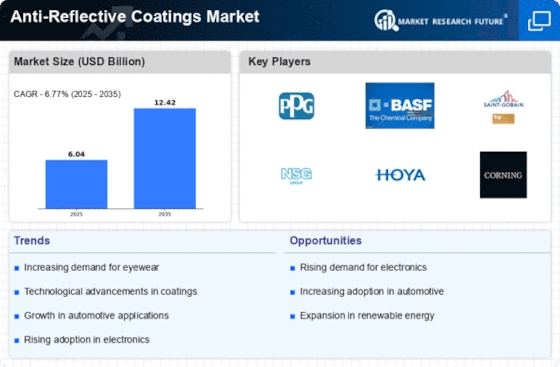
As per Market Research Future analysis, the Anti-Reflective Coatings Market Size was estimated at 6.04 USD Billion in 2024. The Anti-Reflective Coatings industry is projected to grow from 6.449 USD Billion in 2025 to 12.42 USD Billion by 2035, exhibiting a compound annual growth rate (CAGR) of 6.77% during the forecast period 2025 - 2035

Key Market Trends & Highlights

The Anti-Reflective Coatings Market is poised for substantial growth driven by technological advancements and increasing demand across various sectors.

  • North America remains the largest market for anti-reflective coatings, driven by robust demand in electronics and optical applications. Asia-Pacific is recognized as the fastest-growing region, with a notable surge in automotive applications and rising awareness of eye health. The glass segment continues to dominate the market, while the plastic segment is experiencing rapid growth due to customization trends. Key market drivers include the increasing demand in electronics and technological innovations in coating processes.

Market Size & Forecast

2024 Market Size 6.04 (USD Billion)
2035 Market Size 12.42 (USD Billion)
CAGR (2025 - 2035) 6.77%
Largest Regional Market Share in 2024 North America

Major Players

PPG Industries (US), BASF SE (DE), Saint-Gobain (FR), Nippon Sheet Glass (JP), Hoya Corporation (JP), Corning Incorporated (US), Zeiss Group (DE), Optical Coating Technologies (US), Rodenstock GmbH (DE)

Market Trends

The Anti-Reflective Coatings Market is currently experiencing a notable transformation, driven by advancements in technology and increasing demand across various sectors. These coatings, which enhance optical clarity by reducing glare and reflections, are becoming essential in industries such as electronics, automotive, and healthcare. The growing trend towards high-performance displays and the proliferation of smart devices are contributing to the rising adoption of anti-reflective coatings. Furthermore, environmental considerations are prompting manufacturers to develop eco-friendly formulations, aligning with global sustainability goals. In addition, the market is witnessing a shift towards customization, as consumers seek tailored solutions that meet specific requirements. This trend is particularly evident in the eyewear sector, where personalized coatings are gaining traction. The integration of anti-reflective coatings in architectural glass and solar panels also indicates a broader application scope, suggesting a robust future for this market. As innovation continues to drive growth, stakeholders are likely to explore new materials and technologies to enhance performance and durability, ensuring that the Anti-Reflective Coatings Market remains dynamic and competitive.

Technological Advancements

The Anti-Reflective Coatings Market trends  marks the strong predominance of rapid technological innovations. New manufacturing techniques and materials are enhancing the performance of coatings, making them more effective in reducing glare and improving visibility. This trend is particularly relevant in the electronics sector, where high-definition displays are becoming commonplace.

Sustainability Initiatives

There is a growing emphasis on sustainability within the Anti-Reflective Coatings Market. Manufacturers are increasingly focusing on developing eco-friendly products that minimize environmental impact. This shift aligns with global efforts to promote greener practices and could influence consumer preferences in the coming years.

Customization and Personalization

The demand for customized solutions is rising within the Anti-Reflective Coatings Market. Consumers are seeking coatings tailored to their specific needs, particularly in eyewear and architectural applications. This trend indicates a shift towards more personalized products, which may enhance customer satisfaction and loyalty.

Anti Reflective Coatings Market Market Drivers

Rising Awareness of Eye Health

There is a growing awareness regarding eye health, which is influencing the Anti-Reflective Coatings Market. Consumers are increasingly seeking products that reduce eye strain and improve visual comfort, particularly in environments with high screen exposure. This trend is reflected in the eyewear segment, where anti-reflective coatings are becoming a standard feature in prescription glasses and sunglasses. The market for eyewear coatings is projected to grow significantly, as more individuals recognize the benefits of these coatings in protecting their vision. This heightened awareness is likely to drive further innovation and investment in the Anti-Reflective Coatings Market.

Increasing Demand in Electronics

The Anti-Reflective Coatings Market is experiencing a surge in demand driven by the electronics sector. With the proliferation of smartphones, tablets, and laptops, the need for high-quality displays has intensified. Anti-reflective coatings enhance screen visibility and reduce glare, which is crucial for user experience. In 2025, the electronics segment is projected to account for a substantial share of the market, reflecting a growing consumer preference for devices that offer superior visual performance. This trend is likely to propel manufacturers to invest in advanced coating technologies, thereby fostering innovation within the Anti-Reflective Coatings Market.

Expansion in Optical Applications

The optical industry is witnessing a notable expansion, which is positively impacting the Anti-Reflective Coatings Market. With the increasing use of optical devices such as cameras, microscopes, and telescopes, the demand for high-performance coatings that minimize reflections is on the rise. The optical segment is expected to grow at a robust pace, driven by advancements in imaging technologies and the need for precision optics. This growth presents opportunities for manufacturers to develop specialized anti-reflective coatings tailored to specific applications, thereby enhancing their competitive edge in the Anti-Reflective Coatings Market.

Growth in Automotive Applications

The automotive sector is increasingly adopting anti-reflective coatings, contributing to the expansion of the Anti-Reflective Coatings Market. As vehicles become more technologically advanced, the integration of heads-up displays and infotainment systems necessitates the use of coatings that minimize glare and enhance visibility. The market for automotive applications is expected to witness a compound annual growth rate of approximately 6% through 2025. This growth is indicative of a broader trend where manufacturers prioritize safety and user experience, thereby driving demand for anti-reflective solutions in the automotive industry.

Technological Innovations in Coating Processes

Technological innovations in coating processes are significantly shaping the Anti-Reflective Coatings Market. Advances in deposition techniques, such as atomic layer deposition and sol-gel processes, are enabling the production of more effective and durable coatings. These innovations not only improve the performance of anti-reflective coatings but also reduce production costs, making them more accessible to a wider range of applications. As manufacturers continue to explore new technologies, the market is likely to see an influx of innovative products that meet the evolving needs of consumers and industries alike, thereby driving growth in the Anti-Reflective Coatings Market.

Market Segment Insights

By Substrate: Glass (Largest) vs. Plastic (Fastest-Growing)

In the Anti-Reflective Coatings Market, the substrate segment is predominantly led by <a href="https://www.marketresearchfuture.com/reports/glass-market-11515">glass</a>, which holds the largest market share due to its extensive use in optical applications such as eyeglasses, camera lenses, and electronic displays. Other substrates, including silicon, quartz, sapphire, and plastic, follow, but with varying degrees of adoption influenced by specific use cases and technological advancements. While glass remains a staple, the introduction of advanced coatings is transforming the role of other substrates in the market, reflecting shifts in consumer preferences and emerging technologies. Plastic, although previously trailing behind glass, has seen significant growth spurred by demand for lightweight and flexible options in the automotive and consumer electronics sectors. Its fast-growing nature is attested to by innovations in polymer-based coatings that enhance durability and performance. Meanwhile, quartz and sapphire substrates are gaining traction in specialized markets, positioning themselves as valuable alternatives that cater to high-end applications, particularly in the optics and semiconductor industries.

Glass (Dominant) vs. Plastic (Emerging)

Glass, as the dominant substrate in the Anti-Reflective Coatings Market, benefits from its established reputation for quality and performance in optics and display applications. This traditional substrate is favored for its clarity and durability, making it the preferred choice for high-end optical devices. On the other hand, <a href="https://www.marketresearchfuture.com/reports/plastics-market-8347">plastic</a> substrates represent the emerging segment, driven by trends towards lightweight and cost-effective solutions. Innovations in plastic coatings offer robust anti-reflective properties while maintaining flexibility and impact resistance, appealing to industries like consumer electronics and automotive. This duality between glass's dominance and plastic's emergence illustrates a dynamic shift in substrate preferences, reflecting broader trends toward versatility and adaptability in manufacturing.

By Resin: Epoxy (Largest) vs. Polyurethane (Fastest-Growing)

The Anti-Reflective Coatings Market exhibits a strong preference for the <a href="https://www.marketresearchfuture.com/reports/epoxy-resin-market-1736">epoxy resin</a> segment, which has established itself as the largest segment due to its exceptional performance characteristics and adhesion properties. On the other hand, the polyurethane resin segment is gaining traction rapidly, riding on its unique advantages such as flexibility and durability, and thus attracting a growing share of market attention and investment. As industry standards evolve, these <a href="https://www.marketresearchfuture.com/reports/resins-market-12613" target="_blank" title="resins">resins</a> are becoming increasingly integrated into applications requiring high-performance coatings. Growth trends in the resin segment are heavily influenced by the evolving technological landscape, particularly in sectors such as automotive and electronics, where lightweight and high-performance materials are essential. The increasing demand for energy-efficient products, alongside manufacturing innovations in coating processes, drives the adoption of <a href="https://www.marketresearchfuture.com/reports/polyurethane-market-2444">polyurethane</a>. This segment is poised for robust growth as manufacturers lean towards environmentally sustainable and versatile options, indicating a positive shift in consumer preferences and regulatory landscapes.

Epoxy (Dominant) vs. Polyurethane (Emerging)

Epoxy resins are well-established as the dominant force in the Anti-Reflective Coatings Market, known for their outstanding durability and adhesion to a variety of substrates. They are extensively utilized in applications requiring superior optical clarity and long-lasting protection, making them the preferred choice for high-performance anti-reflective coatings. Conversely, polyurethane resins, while emerging, showcase notable advantages such as flexibility, scratch resistance, and a broader range of compatible surface finishes. As the market shifts towards lighter and high-performance materials, polyurethane is well-positioned to capture a growing share, particularly in dynamic sectors such as consumer electronics. The increasing focus on sustainable and high-efficiency products enhances its attractiveness, setting the stage for potential rapid growth in the coming years.

By Technology: Sputtering (Largest) vs. Sol-Gel (Fastest-Growing)

In the Anti-Reflective Coatings Market, the technology segment showcases diverse methods like Electronic Beam Evaporation, Vacuum Deposition, Sol-Gel, and Sputtering. Sputtering holds the largest market share due to its extensive application in various industries such as optics and electronics, while Sol-Gel is rapidly gaining traction due to its cost-effectiveness and versatility. Overall, the segment is characterized by technological advancements driving each method's adoption based on specific requirements.

Technology: Sputtering (Dominant) vs. Sol-Gel (Emerging)

Sputtering is recognized as the dominant technology in the Anti-Reflective Coatings Market due to its ability to produce high-quality thin films with superior uniformity and adhesion. This method is widely used in the production of optical devices and photovoltaic cells, making it crucial for industries that require precise coatings. Conversely, Sol-Gel technology is emerging, favored for its simplicity, low-temperature processing, and environmental friendliness. As a result, Sol-Gel is becoming increasingly popular among manufacturers aiming for cost-effective solutions without compromising quality, positioning it as a competitive alternative to traditional techniques.

Get more detailed insights about Anti-Reflective Coatings Market Research Report - Forecast till 2035

Regional Insights

By region, the study provides the market insights into North America, Europe, Asia-Pacific and Rest of the World. The North American Anti-Reflective Coatings Market area will dominate this market, because of the increasing use of AR coatings in consumer electronics products such as tablets, smartphones, smartwatches, cameras, and other display devices, the region's market is predicted to rise rapidly throughout the forecast period.

Further, the major countries studied in the market report are The US, Canada, German, France, the UK, Italy, Spain, China, Japan, India, Australia, South Korea, and Brazil.

Figure2:  ANTI-REFLECTIVE COATINGS MARKET SHARE BY REGION 2022 (USD Billion)

Europe Anti-Reflective Coatings Market accounts for the second-largest market share due to strong attention towards health. Further, the German Anti-Reflective Coatings Market held the largest market share, and the UK Anti-Reflective Coatings Market was the fastest growing market in the European region

The Asia-Pacific Anti-Reflective Coatings Market is expected to grow at the fastest CAGR from 2023 to 2032. This is due to the increased need for semiconductors, electronics, and other manufacturing operations. Moreover, China’s Anti-Reflective Coatings Market held the largest market share, and the Indian Anti-Reflective Coatings Market was the fastest growing market in the Asia-Pacific region.

Key Players and Competitive Insights

Leading market players are investing heavily in research and development in order to expand their product lines, which will help the Anti-Reflective Coatings Market grow even more. Market participants are also undertaking a variety of strategic activities to expand their footprint, with important market developments including new product launches, contractual agreements, mergers and acquisitions, higher investments, and collaboration with other organizations. To expand and survive in a more competitive and rising market climate, Anti-Reflective Coatingsindustry must offer cost-effective items.
Manufacturing locally to minimize operational costs is one of the key business tactics used by manufacturers in the Anti-Reflective Coatings industry to benefit clients and increase the market sector. In recent years, the Anti-Reflective Coatings industry has offered some of the most significant advantages to medicine. Major players in the Anti-Reflective Coatings Market, including PPG Industries, Inc (US), MAC Thin Films (US), Honeywell International Inc (US), ICOAT COMPANY, LLC (US), Janos Tech (US), and RODENSTOCK GMBH (Germany) and others, are attempting to increase market demand by investing in research and development operations.
VSP Vision Care (VSP) is a health insurance company that provides vision care in Australia, Canada, Ireland, the United States, and the United Kingdom. It is a doctor-led company with five divisions: "eye care insurance, high-quality eyewear, lens and lens enhancements, ophthalmic technology, and connected experiences to strengthen patients' relationships with their eye doctors." It employs around 80 million people ly and is the largest eye insurance company in the United States. In May 2020, VSP Optical Group Inc. has introduced TechShield anti-reflective coating for eyewear, which includes ISO-certified anti-bacterial technology.
The proprietary coatings are exclusively offered through VS network private-practice doctors.
Carl Zeiss AG is a German optical system and optoelectronics firm founded in Jena, Germany in 1846 by optician Carl Zeiss. He laid the groundwork for today's multinational corporation with Ernst Abbe (joined 1866) and Otto Schott (joined 1884). The current corporation arose from the 1990s consolidation period of Carl Zeiss companies in East and West Germany.
In February Carl Zeiss AG and Sony Corporation strengthened their strategic partnership to include ZEISS optics with T* anti-reflective coatings in the new Xperia smartphone, improving image quality and providing users with a fine photography experience.
According to US-based Thornova, their new panel will have a temperature coefficient of -0.29% per C in 2024 and a power conversion efficiency ranging from 22.4% to 23.2%. The business, a division of Sunova Solar, a Chinese manufacturer, is now developing a factory that will produce solar cells and modules at an undisclosed location in the United States.
Leading provider of ophthalmic lens technology, HOYA Vision Care, announced today the arrival of Super HiVision® MeiryoTM EX4TM anti-reflective treatment in the United States for 2023. As patients and eye care professionals have come to expect, the new lens treatment provides industry-leading scratch resistance, durability, and long-term cleanability in addition to full back-side UV protection.

Key Companies in the Anti Reflective Coatings Market include

Industry Developments

  • Q2 2024: PPG Launches New Anti-Reflective Coating for Solar Panels PPG announced the commercial launch of a next-generation anti-reflective coating designed to improve the efficiency of solar panels, targeting utility-scale solar projects and module manufacturers.
  • Q2 2024: EssilorLuxottica Expands Anti-Reflective Coating Production with New Facility in Thailand EssilorLuxottica inaugurated a new manufacturing facility in Thailand dedicated to producing advanced anti-reflective coatings for eyewear, aiming to meet growing demand in the Asia-Pacific region.
  • Q3 2024: AGC Inc. Announces Strategic Partnership with SolarEdge for Anti-Reflective Glass Modules AGC Inc. entered a partnership with SolarEdge to supply anti-reflective coated glass for high-efficiency solar modules, enhancing module performance and durability.
  • Q3 2024: DuPont Acquires Cascade Optical Corp. to Expand Advanced Coatings Portfolio DuPont completed the acquisition of Cascade Optical Corp., a specialist in anti-reflective and specialty coatings, to strengthen its position in the electronics and optics markets.
  • Q4 2024: Carl Zeiss AG Launches Next-Gen DuraVision Anti-Reflective Coating for Eyewear Carl Zeiss AG introduced DuraVision Platinum UV, a new anti-reflective coating for prescription lenses, offering enhanced scratch resistance and UV protection.
  • Q4 2024: Honeywell Signs Multi-Year Supply Agreement for Anti-Reflective Coatings with Leading Display Manufacturer Honeywell secured a multi-year contract to supply anti-reflective coatings for use in high-end consumer electronics displays, supporting the expansion of next-generation device production.
  • Q1 2025: HOYA Corporation Opens New R&D Center Focused on Advanced Optical Coatings HOYA Corporation opened a new research and development center in Japan dedicated to innovating anti-reflective and functional coatings for medical and consumer optics.
  • Q1 2025: Optics Balzers AG Announces $30M Investment in Anti-Reflective Coating Production Expansion Optics Balzers AG revealed a $30 million investment to expand its anti-reflective coating production capacity in Europe, citing increased demand from the automotive and photonics sectors.
  • Q2 2025: Nippon Sheet Glass Co. Ltd. Wins Major Contract to Supply Anti-Reflective Glass for European Solar Farms Nippon Sheet Glass Co. Ltd. secured a contract to provide anti-reflective glass panels for several large-scale solar farm projects across Europe, supporting the region's renewable energy goals.
  • Q2 2025: AMETEK Announces Acquisition of EMF Corp. to Broaden Optical Coatings Capabilities AMETEK completed the acquisition of EMF Corp., a provider of anti-reflective and specialty optical coatings, to enhance its offerings for the aerospace and defense industries.
  • Q2 2025: Gooch & Housego Unveils New Anti-Reflective Coating for LIDAR Applications Gooch & Housego launched a specialized anti-reflective coating optimized for LIDAR sensors, targeting the autonomous vehicle and robotics markets.
  • Q3 2025: Optical Coatings Japan Announces Partnership with Leading Smartphone OEM for Display Coatings Optical Coatings Japan entered a partnership with a major smartphone manufacturer to supply anti-reflective coatings for next-generation mobile device displays.

Future Outlook

Anti Reflective Coatings Market Future Outlook

The Anti-Reflective Coatings Market size is projected to grow at a 6.77% CAGR from 2024 to 2035, driven by increasing demand in electronics, automotive, and healthcare sectors.<br>The Anti-Reflective Coatings Market is accelerating as high-performance optics become essential for the green and digital economy. Growth is driven by soaring solar panel efficiency needs, next-generation smartphone displays, and advanced automotive safety systems.

New opportunities lie in:

  • <p>Expansion into emerging markets with tailored product offerings. Development of eco-friendly anti-reflective coatings for sustainability. Integration of smart technologies in coating applications for enhanced performance.</p>

By 2035, the Anti-Reflective Coatings Market  is expected to achieve substantial growth, reflecting evolving consumer needs and technological advancements.

Market Segmentation

Anti Reflective Coatings Market Resin Outlook

  • Epoxy
  • Polyurethane
  • Acrylic

Anti Reflective Coatings Market Substrate Outlook

  • Glass
  • Silicon
  • Quartz
  • Sapphire
  • Plastic

Anti Reflective Coatings Market Technology Outlook

  • Electronic Beam Evaporation
  • Vacuum Deposition
  • Sol-Gel
  • Sputtering

Report Scope

MARKET SIZE 2024 6.04(USD Billion)
MARKET SIZE 2025 6.449(USD Billion)
MARKET SIZE 2035 12.42(USD Billion)
COMPOUND ANNUAL GROWTH RATE (CAGR) 6.77% (2025 - 2035)
REPORT COVERAGE Revenue Forecast, Competitive Landscape, Growth Factors, and Trends
BASE YEAR 2024
Market Forecast Period 2025 - 2035
Historical Data 2019 - 2024
Market Forecast Units USD Billion
Key Companies Profiled PPG Industries (US), BASF SE (DE), Saint-Gobain (FR), Nippon Sheet Glass (JP), Hoya Corporation (JP), Corning Incorporated (US), Zeiss Group (DE), Optical Coating Technologies (US), Rodenstock GmbH (DE)
Segments Covered Substrate, Resin, Technology, Region
Key Market Opportunities Growing demand for advanced optical devices drives innovation in the Anti-Reflective Coatings Market.
Key Market Dynamics Rising demand for anti-reflective coatings in electronics drives innovation and competitive dynamics in the market.
Countries Covered North America, Europe, APAC, South America, MEA

FAQs

What is the projected market valuation of the Anti-Reflective Coatings Market by 2035?

<p>The Anti-Reflective Coatings Market is projected to reach a valuation of 12.42 USD Billion by 2035.</p>

What was the market valuation of the Anti-Reflective Coatings Market in 2024?

<p>In 2024, the market valuation of Anti-Reflective Coatings was 6.04 USD Billion.</p>

What is the expected CAGR for the Anti-Reflective Coatings Market from 2025 to 2035?

<p>The expected CAGR for the Anti-Reflective Coatings Market during the forecast period 2025 - 2035 is 6.77%.</p>

Which companies are considered key players in the Anti-Reflective Coatings Market?

<p>Key players in the Anti-Reflective Coatings Market include PPG Industries, BASF SE, Saint-Gobain, and Corning Incorporated.</p>

What are the projected valuations for different substrate segments in the Anti-Reflective Coatings Market by 2035?

<p>By 2035, the projected valuations for substrate segments include Glass at 3.66 USD Billion and Plastic at 3.18 USD Billion.</p>

How do resin segments perform in the Anti-Reflective Coatings Market?

<p>The projected valuation for the resin segment, particularly Polyurethane, is expected to reach 4.12 USD Billion by 2035.</p>

What technologies are driving growth in the Anti-Reflective Coatings Market?

Technologies such as Vacuum Deposition and Sputtering are projected to reach valuations of 3.7 USD Billion and 4.14 USD Billion, respectively, by 2035.

What is the significance of the Anti-Reflective Coatings Market for the optical industry?

The Anti-Reflective Coatings Market plays a crucial role in enhancing optical performance, with key players like Zeiss Group leading innovations.

How does the growth of the Anti-Reflective Coatings Market compare across different segments?

The market shows varied growth across segments, with Silicon projected to grow from 1.21 USD Billion to 2.48 USD Billion by 2035.

What factors contribute to the growth of the Anti-Reflective Coatings Market?

Factors such as increasing demand for high-performance optical products and advancements in coating technologies are likely to drive market growth.

  1. SECTION I: EXECUTIVE SUMMARY AND KEY HIGHLIGHTS
    1. | 1.1 EXECUTIVE SUMMARY
    2. | | 1.1.1 Market Overview
    3. | | 1.1.2 Key Findings
    4. | | 1.1.3 Market Segmentation
    5. | | 1.1.4 Competitive Landscape
    6. | | 1.1.5 Challenges and Opportunities
    7. | | 1.1.6 Future Outlook
  2. SECTION II: SCOPING, METHODOLOGY AND MARKET STRUCTURE
    1. | 2.1 MARKET INTRODUCTION
    2. | | 2.1.1 Definition
    3. | | 2.1.2 Scope of the study
    4. | | | 2.1.2.1 Research Objective
    5. | | | 2.1.2.2 Assumption
    6. | | | 2.1.2.3 Limitations
    7. | 2.2 RESEARCH METHODOLOGY
    8. | | 2.2.1 Overview
    9. | | 2.2.2 Data Mining
    10. | | 2.2.3 Secondary Research
    11. | | 2.2.4 Primary Research
    12. | | | 2.2.4.1 Primary Interviews and Information Gathering Process
    13. | | | 2.2.4.2 Breakdown of Primary Respondents
    14. | | 2.2.5 Forecasting Model
    15. | | 2.2.6 Market Size Estimation
    16. | | | 2.2.6.1 Bottom-Up Approach
    17. | | | 2.2.6.2 Top-Down Approach
    18. | | 2.2.7 Data Triangulation
    19. | | 2.2.8 Validation
  3. SECTION III: QUALITATIVE ANALYSIS
    1. | 3.1 MARKET DYNAMICS
    2. | | 3.1.1 Overview
    3. | | 3.1.2 Drivers
    4. | | 3.1.3 Restraints
    5. | | 3.1.4 Opportunities
    6. | 3.2 MARKET FACTOR ANALYSIS
    7. | | 3.2.1 Value chain Analysis
    8. | | 3.2.2 Porter's Five Forces Analysis
    9. | | | 3.2.2.1 Bargaining Power of Suppliers
    10. | | | 3.2.2.2 Bargaining Power of Buyers
    11. | | | 3.2.2.3 Threat of New Entrants
    12. | | | 3.2.2.4 Threat of Substitutes
    13. | | | 3.2.2.5 Intensity of Rivalry
    14. | | 3.2.3 COVID-19 Impact Analysis
    15. | | | 3.2.3.1 Market Impact Analysis
    16. | | | 3.2.3.2 Regional Impact
    17. | | | 3.2.3.3 Opportunity and Threat Analysis
  4. SECTION IV: QUANTITATIVE ANALYSIS
    1. | 4.1 Chemicals and Materials, BY Substrate (USD Billion)
    2. | | 4.1.1 Glass
    3. | | 4.1.2 Silicon
    4. | | 4.1.3 Quartz
    5. | | 4.1.4 Sapphire
    6. | | 4.1.5 Plastic
    7. | 4.2 Chemicals and Materials, BY Resin (USD Billion)
    8. | | 4.2.1 Epoxy
    9. | | 4.2.2 Polyurethane
    10. | | 4.2.3 Acrylic
    11. | 4.3 Chemicals and Materials, BY Technology (USD Billion)
    12. | | 4.3.1 Electronic Beam Evaporation
    13. | | 4.3.2 Vacuum Deposition
    14. | | 4.3.3 Sol-Gel
    15. | | 4.3.4 Sputtering
    16. | 4.4 Chemicals and Materials, BY Region (USD Billion)
    17. | | 4.4.1 North America
    18. | | | 4.4.1.1 US
    19. | | | 4.4.1.2 Canada
    20. | | 4.4.2 Europe
    21. | | | 4.4.2.1 Germany
    22. | | | 4.4.2.2 UK
    23. | | | 4.4.2.3 France
    24. | | | 4.4.2.4 Russia
    25. | | | 4.4.2.5 Italy
    26. | | | 4.4.2.6 Spain
    27. | | | 4.4.2.7 Rest of Europe
    28. | | 4.4.3 APAC
    29. | | | 4.4.3.1 China
    30. | | | 4.4.3.2 India
    31. | | | 4.4.3.3 Japan
    32. | | | 4.4.3.4 South Korea
    33. | | | 4.4.3.5 Malaysia
    34. | | | 4.4.3.6 Thailand
    35. | | | 4.4.3.7 Indonesia
    36. | | | 4.4.3.8 Rest of APAC
    37. | | 4.4.4 South America
    38. | | | 4.4.4.1 Brazil
    39. | | | 4.4.4.2 Mexico
    40. | | | 4.4.4.3 Argentina
    41. | | | 4.4.4.4 Rest of South America
    42. | | 4.4.5 MEA
    43. | | | 4.4.5.1 GCC Countries
    44. | | | 4.4.5.2 South Africa
    45. | | | 4.4.5.3 Rest of MEA
  5. SECTION V: COMPETITIVE ANALYSIS
    1. | 5.1 Competitive Landscape
    2. | | 5.1.1 Overview
    3. | | 5.1.2 Competitive Analysis
    4. | | 5.1.3 Market share Analysis
    5. | | 5.1.4 Major Growth Strategy in the Chemicals and Materials
    6. | | 5.1.5 Competitive Benchmarking
    7. | | 5.1.6 Leading Players in Terms of Number of Developments in the Chemicals and Materials
    8. | | 5.1.7 Key developments and growth strategies
    9. | | | 5.1.7.1 New Product Launch/Service Deployment
    10. | | | 5.1.7.2 Merger & Acquisitions
    11. | | | 5.1.7.3 Joint Ventures
    12. | | 5.1.8 Major Players Financial Matrix
    13. | | | 5.1.8.1 Sales and Operating Income
    14. | | | 5.1.8.2 Major Players R&D Expenditure. 2023
    15. | 5.2 Company Profiles
    16. | | 5.2.1 PPG Industries (US)
    17. | | | 5.2.1.1 Financial Overview
    18. | | | 5.2.1.2 Products Offered
    19. | | | 5.2.1.3 Key Developments
    20. | | | 5.2.1.4 SWOT Analysis
    21. | | | 5.2.1.5 Key Strategies
    22. | | 5.2.2 BASF SE (DE)
    23. | | | 5.2.2.1 Financial Overview
    24. | | | 5.2.2.2 Products Offered
    25. | | | 5.2.2.3 Key Developments
    26. | | | 5.2.2.4 SWOT Analysis
    27. | | | 5.2.2.5 Key Strategies
    28. | | 5.2.3 Saint-Gobain (FR)
    29. | | | 5.2.3.1 Financial Overview
    30. | | | 5.2.3.2 Products Offered
    31. | | | 5.2.3.3 Key Developments
    32. | | | 5.2.3.4 SWOT Analysis
    33. | | | 5.2.3.5 Key Strategies
    34. | | 5.2.4 Nippon Sheet Glass (JP)
    35. | | | 5.2.4.1 Financial Overview
    36. | | | 5.2.4.2 Products Offered
    37. | | | 5.2.4.3 Key Developments
    38. | | | 5.2.4.4 SWOT Analysis
    39. | | | 5.2.4.5 Key Strategies
    40. | | 5.2.5 Hoya Corporation (JP)
    41. | | | 5.2.5.1 Financial Overview
    42. | | | 5.2.5.2 Products Offered
    43. | | | 5.2.5.3 Key Developments
    44. | | | 5.2.5.4 SWOT Analysis
    45. | | | 5.2.5.5 Key Strategies
    46. | | 5.2.6 Corning Incorporated (US)
    47. | | | 5.2.6.1 Financial Overview
    48. | | | 5.2.6.2 Products Offered
    49. | | | 5.2.6.3 Key Developments
    50. | | | 5.2.6.4 SWOT Analysis
    51. | | | 5.2.6.5 Key Strategies
    52. | | 5.2.7 Zeiss Group (DE)
    53. | | | 5.2.7.1 Financial Overview
    54. | | | 5.2.7.2 Products Offered
    55. | | | 5.2.7.3 Key Developments
    56. | | | 5.2.7.4 SWOT Analysis
    57. | | | 5.2.7.5 Key Strategies
    58. | | 5.2.8 Optical Coating Technologies (US)
    59. | | | 5.2.8.1 Financial Overview
    60. | | | 5.2.8.2 Products Offered
    61. | | | 5.2.8.3 Key Developments
    62. | | | 5.2.8.4 SWOT Analysis
    63. | | | 5.2.8.5 Key Strategies
    64. | | 5.2.9 Rodenstock GmbH (DE)
    65. | | | 5.2.9.1 Financial Overview
    66. | | | 5.2.9.2 Products Offered
    67. | | | 5.2.9.3 Key Developments
    68. | | | 5.2.9.4 SWOT Analysis
    69. | | | 5.2.9.5 Key Strategies
    70. | 5.3 Appendix
    71. | | 5.3.1 References
    72. | | 5.3.2 Related Reports
  6. LIST OF FIGURES
    1. | 6.1 MARKET SYNOPSIS
    2. | 6.2 NORTH AMERICA MARKET ANALYSIS
    3. | 6.3 US MARKET ANALYSIS BY SUBSTRATE
    4. | 6.4 US MARKET ANALYSIS BY RESIN
    5. | 6.5 US MARKET ANALYSIS BY TECHNOLOGY
    6. | 6.6 CANADA MARKET ANALYSIS BY SUBSTRATE
    7. | 6.7 CANADA MARKET ANALYSIS BY RESIN
    8. | 6.8 CANADA MARKET ANALYSIS BY TECHNOLOGY
    9. | 6.9 EUROPE MARKET ANALYSIS
    10. | 6.10 GERMANY MARKET ANALYSIS BY SUBSTRATE
    11. | 6.11 GERMANY MARKET ANALYSIS BY RESIN
    12. | 6.12 GERMANY MARKET ANALYSIS BY TECHNOLOGY
    13. | 6.13 UK MARKET ANALYSIS BY SUBSTRATE
    14. | 6.14 UK MARKET ANALYSIS BY RESIN
    15. | 6.15 UK MARKET ANALYSIS BY TECHNOLOGY
    16. | 6.16 FRANCE MARKET ANALYSIS BY SUBSTRATE
    17. | 6.17 FRANCE MARKET ANALYSIS BY RESIN
    18. | 6.18 FRANCE MARKET ANALYSIS BY TECHNOLOGY
    19. | 6.19 RUSSIA MARKET ANALYSIS BY SUBSTRATE
    20. | 6.20 RUSSIA MARKET ANALYSIS BY RESIN
    21. | 6.21 RUSSIA MARKET ANALYSIS BY TECHNOLOGY
    22. | 6.22 ITALY MARKET ANALYSIS BY SUBSTRATE
    23. | 6.23 ITALY MARKET ANALYSIS BY RESIN
    24. | 6.24 ITALY MARKET ANALYSIS BY TECHNOLOGY
    25. | 6.25 SPAIN MARKET ANALYSIS BY SUBSTRATE
    26. | 6.26 SPAIN MARKET ANALYSIS BY RESIN
    27. | 6.27 SPAIN MARKET ANALYSIS BY TECHNOLOGY
    28. | 6.28 REST OF EUROPE MARKET ANALYSIS BY SUBSTRATE
    29. | 6.29 REST OF EUROPE MARKET ANALYSIS BY RESIN
    30. | 6.30 REST OF EUROPE MARKET ANALYSIS BY TECHNOLOGY
    31. | 6.31 APAC MARKET ANALYSIS
    32. | 6.32 CHINA MARKET ANALYSIS BY SUBSTRATE
    33. | 6.33 CHINA MARKET ANALYSIS BY RESIN
    34. | 6.34 CHINA MARKET ANALYSIS BY TECHNOLOGY
    35. | 6.35 INDIA MARKET ANALYSIS BY SUBSTRATE
    36. | 6.36 INDIA MARKET ANALYSIS BY RESIN
    37. | 6.37 INDIA MARKET ANALYSIS BY TECHNOLOGY
    38. | 6.38 JAPAN MARKET ANALYSIS BY SUBSTRATE
    39. | 6.39 JAPAN MARKET ANALYSIS BY RESIN
    40. | 6.40 JAPAN MARKET ANALYSIS BY TECHNOLOGY
    41. | 6.41 SOUTH KOREA MARKET ANALYSIS BY SUBSTRATE
    42. | 6.42 SOUTH KOREA MARKET ANALYSIS BY RESIN
    43. | 6.43 SOUTH KOREA MARKET ANALYSIS BY TECHNOLOGY
    44. | 6.44 MALAYSIA MARKET ANALYSIS BY SUBSTRATE
    45. | 6.45 MALAYSIA MARKET ANALYSIS BY RESIN
    46. | 6.46 MALAYSIA MARKET ANALYSIS BY TECHNOLOGY
    47. | 6.47 THAILAND MARKET ANALYSIS BY SUBSTRATE
    48. | 6.48 THAILAND MARKET ANALYSIS BY RESIN
    49. | 6.49 THAILAND MARKET ANALYSIS BY TECHNOLOGY
    50. | 6.50 INDONESIA MARKET ANALYSIS BY SUBSTRATE
    51. | 6.51 INDONESIA MARKET ANALYSIS BY RESIN
    52. | 6.52 INDONESIA MARKET ANALYSIS BY TECHNOLOGY
    53. | 6.53 REST OF APAC MARKET ANALYSIS BY SUBSTRATE
    54. | 6.54 REST OF APAC MARKET ANALYSIS BY RESIN
    55. | 6.55 REST OF APAC MARKET ANALYSIS BY TECHNOLOGY
    56. | 6.56 SOUTH AMERICA MARKET ANALYSIS
    57. | 6.57 BRAZIL MARKET ANALYSIS BY SUBSTRATE
    58. | 6.58 BRAZIL MARKET ANALYSIS BY RESIN
    59. | 6.59 BRAZIL MARKET ANALYSIS BY TECHNOLOGY
    60. | 6.60 MEXICO MARKET ANALYSIS BY SUBSTRATE
    61. | 6.61 MEXICO MARKET ANALYSIS BY RESIN
    62. | 6.62 MEXICO MARKET ANALYSIS BY TECHNOLOGY
    63. | 6.63 ARGENTINA MARKET ANALYSIS BY SUBSTRATE
    64. | 6.64 ARGENTINA MARKET ANALYSIS BY RESIN
    65. | 6.65 ARGENTINA MARKET ANALYSIS BY TECHNOLOGY
    66. | 6.66 REST OF SOUTH AMERICA MARKET ANALYSIS BY SUBSTRATE
    67. | 6.67 REST OF SOUTH AMERICA MARKET ANALYSIS BY RESIN
    68. | 6.68 REST OF SOUTH AMERICA MARKET ANALYSIS BY TECHNOLOGY
    69. | 6.69 MEA MARKET ANALYSIS
    70. | 6.70 GCC COUNTRIES MARKET ANALYSIS BY SUBSTRATE
    71. | 6.71 GCC COUNTRIES MARKET ANALYSIS BY RESIN
    72. | 6.72 GCC COUNTRIES MARKET ANALYSIS BY TECHNOLOGY
    73. | 6.73 SOUTH AFRICA MARKET ANALYSIS BY SUBSTRATE
    74. | 6.74 SOUTH AFRICA MARKET ANALYSIS BY RESIN
    75. | 6.75 SOUTH AFRICA MARKET ANALYSIS BY TECHNOLOGY
    76. | 6.76 REST OF MEA MARKET ANALYSIS BY SUBSTRATE
    77. | 6.77 REST OF MEA MARKET ANALYSIS BY RESIN
    78. | 6.78 REST OF MEA MARKET ANALYSIS BY TECHNOLOGY
    79. | 6.79 KEY BUYING CRITERIA OF CHEMICALS AND MATERIALS
    80. | 6.80 RESEARCH PROCESS OF MRFR
    81. | 6.81 DRO ANALYSIS OF CHEMICALS AND MATERIALS
    82. | 6.82 DRIVERS IMPACT ANALYSIS: CHEMICALS AND MATERIALS
    83. | 6.83 RESTRAINTS IMPACT ANALYSIS: CHEMICALS AND MATERIALS
    84. | 6.84 SUPPLY / VALUE CHAIN: CHEMICALS AND MATERIALS
    85. | 6.85 CHEMICALS AND MATERIALS, BY SUBSTRATE, 2024 (% SHARE)
    86. | 6.86 CHEMICALS AND MATERIALS, BY SUBSTRATE, 2024 TO 2035 (USD Billion)
    87. | 6.87 CHEMICALS AND MATERIALS, BY RESIN, 2024 (% SHARE)
    88. | 6.88 CHEMICALS AND MATERIALS, BY RESIN, 2024 TO 2035 (USD Billion)
    89. | 6.89 CHEMICALS AND MATERIALS, BY TECHNOLOGY, 2024 (% SHARE)
    90. | 6.90 CHEMICALS AND MATERIALS, BY TECHNOLOGY, 2024 TO 2035 (USD Billion)
    91. | 6.91 BENCHMARKING OF MAJOR COMPETITORS
  7. LIST OF TABLES
    1. | 7.1 LIST OF ASSUMPTIONS
    2. | | 7.1.1
    3. | 7.2 North America MARKET SIZE ESTIMATES; FORECAST
    4. | | 7.2.1 BY SUBSTRATE, 2025-2035 (USD Billion)
    5. | | 7.2.2 BY RESIN, 2025-2035 (USD Billion)
    6. | | 7.2.3 BY TECHNOLOGY, 2025-2035 (USD Billion)
    7. | 7.3 US MARKET SIZE ESTIMATES; FORECAST
    8. | | 7.3.1 BY SUBSTRATE, 2025-2035 (USD Billion)
    9. | | 7.3.2 BY RESIN, 2025-2035 (USD Billion)
    10. | | 7.3.3 BY TECHNOLOGY, 2025-2035 (USD Billion)
    11. | 7.4 Canada MARKET SIZE ESTIMATES; FORECAST
    12. | | 7.4.1 BY SUBSTRATE, 2025-2035 (USD Billion)
    13. | | 7.4.2 BY RESIN, 2025-2035 (USD Billion)
    14. | | 7.4.3 BY TECHNOLOGY, 2025-2035 (USD Billion)
    15. | 7.5 Europe MARKET SIZE ESTIMATES; FORECAST
    16. | | 7.5.1 BY SUBSTRATE, 2025-2035 (USD Billion)
    17. | | 7.5.2 BY RESIN, 2025-2035 (USD Billion)
    18. | | 7.5.3 BY TECHNOLOGY, 2025-2035 (USD Billion)
    19. | 7.6 Germany MARKET SIZE ESTIMATES; FORECAST
    20. | | 7.6.1 BY SUBSTRATE, 2025-2035 (USD Billion)
    21. | | 7.6.2 BY RESIN, 2025-2035 (USD Billion)
    22. | | 7.6.3 BY TECHNOLOGY, 2025-2035 (USD Billion)
    23. | 7.7 UK MARKET SIZE ESTIMATES; FORECAST
    24. | | 7.7.1 BY SUBSTRATE, 2025-2035 (USD Billion)
    25. | | 7.7.2 BY RESIN, 2025-2035 (USD Billion)
    26. | | 7.7.3 BY TECHNOLOGY, 2025-2035 (USD Billion)
    27. | 7.8 France MARKET SIZE ESTIMATES; FORECAST
    28. | | 7.8.1 BY SUBSTRATE, 2025-2035 (USD Billion)
    29. | | 7.8.2 BY RESIN, 2025-2035 (USD Billion)
    30. | | 7.8.3 BY TECHNOLOGY, 2025-2035 (USD Billion)
    31. | 7.9 Russia MARKET SIZE ESTIMATES; FORECAST
    32. | | 7.9.1 BY SUBSTRATE, 2025-2035 (USD Billion)
    33. | | 7.9.2 BY RESIN, 2025-2035 (USD Billion)
    34. | | 7.9.3 BY TECHNOLOGY, 2025-2035 (USD Billion)
    35. | 7.10 Italy MARKET SIZE ESTIMATES; FORECAST
    36. | | 7.10.1 BY SUBSTRATE, 2025-2035 (USD Billion)
    37. | | 7.10.2 BY RESIN, 2025-2035 (USD Billion)
    38. | | 7.10.3 BY TECHNOLOGY, 2025-2035 (USD Billion)
    39. | 7.11 Spain MARKET SIZE ESTIMATES; FORECAST
    40. | | 7.11.1 BY SUBSTRATE, 2025-2035 (USD Billion)
    41. | | 7.11.2 BY RESIN, 2025-2035 (USD Billion)
    42. | | 7.11.3 BY TECHNOLOGY, 2025-2035 (USD Billion)
    43. | 7.12 Rest of Europe MARKET SIZE ESTIMATES; FORECAST
    44. | | 7.12.1 BY SUBSTRATE, 2025-2035 (USD Billion)
    45. | | 7.12.2 BY RESIN, 2025-2035 (USD Billion)
    46. | | 7.12.3 BY TECHNOLOGY, 2025-2035 (USD Billion)
    47. | 7.13 APAC MARKET SIZE ESTIMATES; FORECAST
    48. | | 7.13.1 BY SUBSTRATE, 2025-2035 (USD Billion)
    49. | | 7.13.2 BY RESIN, 2025-2035 (USD Billion)
    50. | | 7.13.3 BY TECHNOLOGY, 2025-2035 (USD Billion)
    51. | 7.14 China MARKET SIZE ESTIMATES; FORECAST
    52. | | 7.14.1 BY SUBSTRATE, 2025-2035 (USD Billion)
    53. | | 7.14.2 BY RESIN, 2025-2035 (USD Billion)
    54. | | 7.14.3 BY TECHNOLOGY, 2025-2035 (USD Billion)
    55. | 7.15 India MARKET SIZE ESTIMATES; FORECAST
    56. | | 7.15.1 BY SUBSTRATE, 2025-2035 (USD Billion)
    57. | | 7.15.2 BY RESIN, 2025-2035 (USD Billion)
    58. | | 7.15.3 BY TECHNOLOGY, 2025-2035 (USD Billion)
    59. | 7.16 Japan MARKET SIZE ESTIMATES; FORECAST
    60. | | 7.16.1 BY SUBSTRATE, 2025-2035 (USD Billion)
    61. | | 7.16.2 BY RESIN, 2025-2035 (USD Billion)
    62. | | 7.16.3 BY TECHNOLOGY, 2025-2035 (USD Billion)
    63. | 7.17 South Korea MARKET SIZE ESTIMATES; FORECAST
    64. | | 7.17.1 BY SUBSTRATE, 2025-2035 (USD Billion)
    65. | | 7.17.2 BY RESIN, 2025-2035 (USD Billion)
    66. | | 7.17.3 BY TECHNOLOGY, 2025-2035 (USD Billion)
    67. | 7.18 Malaysia MARKET SIZE ESTIMATES; FORECAST
    68. | | 7.18.1 BY SUBSTRATE, 2025-2035 (USD Billion)
    69. | | 7.18.2 BY RESIN, 2025-2035 (USD Billion)
    70. | | 7.18.3 BY TECHNOLOGY, 2025-2035 (USD Billion)
    71. | 7.19 Thailand MARKET SIZE ESTIMATES; FORECAST
    72. | | 7.19.1 BY SUBSTRATE, 2025-2035 (USD Billion)
    73. | | 7.19.2 BY RESIN, 2025-2035 (USD Billion)
    74. | | 7.19.3 BY TECHNOLOGY, 2025-2035 (USD Billion)
    75. | 7.20 Indonesia MARKET SIZE ESTIMATES; FORECAST
    76. | | 7.20.1 BY SUBSTRATE, 2025-2035 (USD Billion)
    77. | | 7.20.2 BY RESIN, 2025-2035 (USD Billion)
    78. | | 7.20.3 BY TECHNOLOGY, 2025-2035 (USD Billion)
    79. | 7.21 Rest of APAC MARKET SIZE ESTIMATES; FORECAST
    80. | | 7.21.1 BY SUBSTRATE, 2025-2035 (USD Billion)
    81. | | 7.21.2 BY RESIN, 2025-2035 (USD Billion)
    82. | | 7.21.3 BY TECHNOLOGY, 2025-2035 (USD Billion)
    83. | 7.22 South America MARKET SIZE ESTIMATES; FORECAST
    84. | | 7.22.1 BY SUBSTRATE, 2025-2035 (USD Billion)
    85. | | 7.22.2 BY RESIN, 2025-2035 (USD Billion)
    86. | | 7.22.3 BY TECHNOLOGY, 2025-2035 (USD Billion)
    87. | 7.23 Brazil MARKET SIZE ESTIMATES; FORECAST
    88. | | 7.23.1 BY SUBSTRATE, 2025-2035 (USD Billion)
    89. | | 7.23.2 BY RESIN, 2025-2035 (USD Billion)
    90. | | 7.23.3 BY TECHNOLOGY, 2025-2035 (USD Billion)
    91. | 7.24 Mexico MARKET SIZE ESTIMATES; FORECAST
    92. | | 7.24.1 BY SUBSTRATE, 2025-2035 (USD Billion)
    93. | | 7.24.2 BY RESIN, 2025-2035 (USD Billion)
    94. | | 7.24.3 BY TECHNOLOGY, 2025-2035 (USD Billion)
    95. | 7.25 Argentina MARKET SIZE ESTIMATES; FORECAST
    96. | | 7.25.1 BY SUBSTRATE, 2025-2035 (USD Billion)
    97. | | 7.25.2 BY RESIN, 2025-2035 (USD Billion)
    98. | | 7.25.3 BY TECHNOLOGY, 2025-2035 (USD Billion)
    99. | 7.26 Rest of South America MARKET SIZE ESTIMATES; FORECAST
    100. | | 7.26.1 BY SUBSTRATE, 2025-2035 (USD Billion)
    101. | | 7.26.2 BY RESIN, 2025-2035 (USD Billion)
    102. | | 7.26.3 BY TECHNOLOGY, 2025-2035 (USD Billion)
    103. | 7.27 MEA MARKET SIZE ESTIMATES; FORECAST
    104. | | 7.27.1 BY SUBSTRATE, 2025-2035 (USD Billion)
    105. | | 7.27.2 BY RESIN, 2025-2035 (USD Billion)
    106. | | 7.27.3 BY TECHNOLOGY, 2025-2035 (USD Billion)
    107. | 7.28 GCC Countries MARKET SIZE ESTIMATES; FORECAST
    108. | | 7.28.1 BY SUBSTRATE, 2025-2035 (USD Billion)
    109. | | 7.28.2 BY RESIN, 2025-2035 (USD Billion)
    110. | | 7.28.3 BY TECHNOLOGY, 2025-2035 (USD Billion)
    111. | 7.29 South Africa MARKET SIZE ESTIMATES; FORECAST
    112. | | 7.29.1 BY SUBSTRATE, 2025-2035 (USD Billion)
    113. | | 7.29.2 BY RESIN, 2025-2035 (USD Billion)
    114. | | 7.29.3 BY TECHNOLOGY, 2025-2035 (USD Billion)
    115. | 7.30 Rest of MEA MARKET SIZE ESTIMATES; FORECAST
    116. | | 7.30.1 BY SUBSTRATE, 2025-2035 (USD Billion)
    117. | | 7.30.2 BY RESIN, 2025-2035 (USD Billion)
    118. | | 7.30.3 BY TECHNOLOGY, 2025-2035 (USD Billion)
    119. | 7.31 PRODUCT LAUNCH/PRODUCT DEVELOPMENT/APPROVAL
    120. | | 7.31.1
    121. | 7.32 ACQUISITION/PARTNERSHIP
    122. | | 7.32.1

Chemicals and Materials Market Segmentation

Chemicals and Materials By Substrate (USD Billion, 2025-2035)

  • Glass
  • Silicon
  • Quartz
  • Sapphire
  • Plastic

Chemicals and Materials By Resin (USD Billion, 2025-2035)

  • Epoxy
  • Polyurethane
  • Acrylic

Chemicals and Materials By Technology (USD Billion, 2025-2035)

  • Electronic Beam Evaporation
  • Vacuum Deposition
  • Sol-Gel
  • Sputtering
Infographic

Free Sample Request

Kindly complete the form below to receive a free sample of this Report

Get Free Sample

Customer Strories

Compare Licence

×
Features License Type
Single User Multiuser License Enterprise User
Price $4,950 $5,950 $7,250
Maximum User Access Limit 1 User Upto 10 Users Unrestricted Access Throughout the Organization
Free Customization
Direct Access to Analyst
Deliverable Format
Platform Access
Discount on Next Purchase 10% 15% 15%
Printable Versions
%>