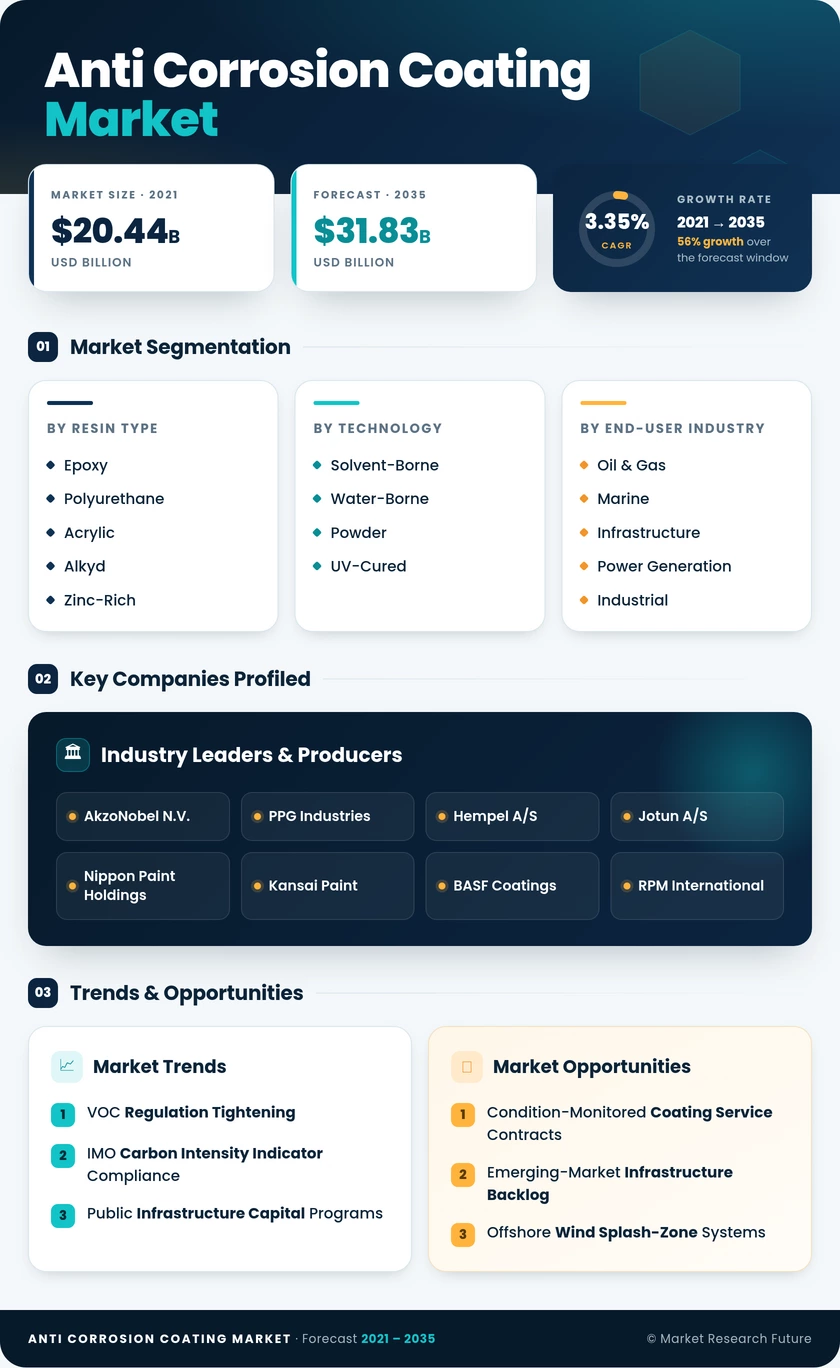
Segmentation Quick Reference
| Dimension | Sub-Segments | Dominant Segment | Fastest Growing Segment |
| By Resin Type | Epoxy; Polyurethane; Acrylic; Alkyd; Zinc-Rich; Others | Epoxy | Polyurethane |
| By Technology | Solvent-Borne; Water-Borne; Powder; UV-Cured | Solvent-Borne | UV-Cured |
| By End-User Industry | Oil & Gas; Marine; Infrastructure; Power Generation; Industrial; Automotive & Others | Oil & Gas | Infrastructure |
| By Region | North America; Europe; Asia-Pacific; South America; Middle East & Africa | Asia-Pacific | Middle East & Africa |
Market Segmentation Overview
By Resin Type
| Sub-Segment | Key Trend |
| Epoxy | Novolac and high-solids grades gaining share in immersion and buried service |
| Polyurethane | REACH training obligations pushing formulators toward lower-monomer hardeners |
| Acrylic | Water-borne dispersions displacing solvent-borne alkyd in light industrial repaint |
| Alkyd | Declining in regulated regions; persists in low-cost maintenance repaint |
| Zinc-Rich | Inorganic silicate variants preferred where long-term galvanic protection is specified |
| Others | Siloxane, polyaspartic, and hybrid systems targeting fast-return-to-service niches |
Resin selection remains the primary determinant of service life and cost, and it is where regulation bites hardest. Epoxy holds its position through unmatched adhesion and chemical resistance, while polyurethane grows as topcoat requirements tighten around UV stability and colour retention. The fastest reformulation activity sits in acrylic and alkyd, where VOC ceilings have made legacy chemistries commercially unviable across large parts of Europe, North America, and China.
By Technology
| Sub-Segment | Key Trend |
| Solvent-Borne | Retains field-application advantage but faces narrowing permit headroom |
| Water-Borne | Performance parity closing in immersion service; adoption accelerating post-2030 |
| Powder | Shop-application growth on rebar, valves, and standardized structural sections |
| UV-Cured | Second-scale cure compressing fabrication schedules in high-throughput shops |
Technology choice increasingly follows the permit environment rather than pure performance. Solvent-borne systems keep majority share because field conditions favour them, particularly under variable humidity. The structural story is the water-borne share gain after 2030 as permit thresholds tighten, alongside powder and UV-cured routes that eliminate emissions exposure entirely but remain confined to controlled shop environments.
By End-User Industry
| Sub-Segment | Key Trend |
| Oil & Gas | Integrity management rules driving scheduled rather than reactive recoating |
| Marine | Carbon Intensity Indicator grading tying hull condition to regulatory compliance |
| Infrastructure | Public capital programs creating decade-long specification-driven demand |
| Power Generation | Offshore wind foundations demanding 25-year maintenance-free systems |
| Industrial | Chemical process equipment requiring specialized lining chemistries |
| Automotive & Others | Chassis and component protection tied to vehicle production volumes |
Demand concentration follows installed asset stock. Oil and gas leads because its asset base is large, aging, and governed by statutory integrity requirements that convert maintenance into a compliance obligation. Infrastructure grows fastest on public programs insulated from commodity cycles, while power generation shifts composition as offshore wind foundations replace retiring thermal capacity in the addressable base.
By Region
| Sub-Segment | Key Trend |
| North America | Bridge rehabilitation and midstream integrity spending anchoring volume |
| Europe | Regulatory reformulation and offshore wind creating a two-track demand profile |
| Asia-Pacific | Shipbuilding and petrochemical scale sustaining dominant regional share |
| South America | Offshore pre-salt and mining maintenance driving cyclical demand |
| Middle East & Africa | Refinery, desalination, and port assets producing the fastest regional growth |
Geographic performance separates replacement-driven mature markets from build-driven emerging ones. Asia-Pacific's dominance rests on shipyard and petrochemical throughput that no other region approaches. Middle East & Africa leads in growth rate because Gulf refinery and desalination assets are entering their first major recoating cycles under exposure conditions that shorten service life relative to temperate climates.


 Noah Malgeri
Co-Founder

 Peter Groot koerkamp
Account and Business Manager

 Younghwan Choi
Senior Retail Manager

 Mark Irwin
Management Consultant

 Akif Moroglu
Strategy & Business Development Director

 Guilherme Gomes Martins
Product Management Director

 Joseph Aguayo
Sales Operations & Pricing Manager

 La Terria Dodd
Program Support Specialist

 Rob Kooiker
Group Product Manager HVAC & Fire Protection GMA