×
Request Free Sample ×

Kindly complete the form below to receive a free sample of this Report

* Please use a valid business email

Leading companies partner with us for data-driven Insights

clients tt-cursor
Hero Background
English
Chinese
French
Japanese
Korean
German
Spanish

Anti-Aging Services Market Analysis

ID: MRFR/HC/6110-HCR
130 Pages
Kinjoll Dey
February 2026

Anti-Aging Services Market Research Report Information by Type of Service (Microdermabrasion, Liposuction, Sclerotherapy, Chemical Peel, and Others), Service Provider (Hospitals, Dermatology Clinics, and Others), and Region Forecast till 2035

Share:
Download PDF ×

We do not share your information with anyone. However, we may send you emails based on your report interest from time to time. You may contact us at any time to opt-out.

Anti-Aging Services Market Infographic
Purchase Options

Market Analysis

In-depth Analysis of Anti-Aging Services Market Industry Landscape

The industry of anti-aging services expanding due to the dynamics of demographic shifts, technological advancement, customer choices and shifting focus to the whole health care. The power consists in the international aging population which plays a major role and is connected with the growth of the number of the elderly people who search for different methods to diminish the visible signs of the aging process. This type of demographic movements really ramp up the demand of products and services connected with anti-aging like beauty products or cosmetic surgeries.

Technological discoveries play a crucial part to ensure market development. In non-surgical cosmetic procedures that are non-invasive, innovations such as laser therapies, injectables, and advanced skincare technologies are providing solutions superior with limited down time. Secondly, the incorporation of artificial intelligence and personalised medicine into anti-aging services provides a more specific approach to the treatments, which attracts more attention to the market as well.

A significant shift can be observed in the consumer behavior, people are becoming more and more conscious and acquiescent to preventive aging treatments. The paradigm of anti-aging seems to be evolving to corporeal to corporeal, where along with the skincare and other cosmetic procedures, the lifestyle modifications and wellbeing notions are also considered. Customers continuously exhibit a need for treatments that enhance their complete well-being, with aging and balanced lifestyle being primary factors, thus leading the market to expand outside of aesthetic purposes.

Furthermore, global economic aspect affects market dynamics which are not only the accessibility and affordability of anti-aging services but also people’s selection. In some areas, there is a drive to invest in such services as synthetic beauty and wellness due to economic prosperity. Contrarily, one form of a hurricane in household’s spending on luxury niches may be affected which the industry - along with their production trends, and range of services - might end up as a business issue depending on different economic conditions.

The manner in which competitive landscape of the market is can change based on the service providers available because they range from medical spas, aesthetic clinics, and wellness centers. Split into areas such as customer service, reputation and the competencies in providing solutions against aging, different providers come into attractive positioning in the market. A close cooperation and collaboration of healthcare practitioners, beauty experts, and wellness specialists do contribute to a multi-disciplinary approach towards the provision of anti-aging services.

The anti-aging services market, with the aid of research collaborations and investigations, continues to witness novel product and technology development. Scientific research participation perfects the knowledge in aging processes and speeds up the implementation of evidence based interventions. The motion of development which is achieved through research activities makes the providers keep up with the latest scientific developments.


Author
Kinjoll Dey
Senior Research Analyst

He is an extremely curious individual currently working in Healthcare and Medical Devices Domain. Kinjoll is comfortably versed in data centric research backed by healthcare educational background. He leverages extensive data mining and analytics tools such as Primary and Secondary Research, Statistical Analysis, Machine Learning, Data Modelling. His key role also involves Technical Sales Support, Client Interaction and Project management within the Healthcare team. Lastly, he showcases extensive affinity towards learning new skills and remain fascinated in implementing them.

Leave a Comment

FAQs

What is the projected market valuation of the Anti-Aging Services Market by 2035?

<p>The Anti-Aging Services Market is projected to reach a valuation of 16.95 USD Billion by 2035.</p>

What was the market valuation of the Anti-Aging Services Market in 2024?

<p>In 2024, the market valuation of the Anti-Aging Services Market was 9.08 USD Billion.</p>

What is the expected CAGR for the Anti-Aging Services Market during the forecast period 2025 - 2035?

<p>The expected CAGR for the Anti-Aging Services Market during the forecast period 2025 - 2035 is 5.84%.</p>

Which segment is projected to have the highest valuation in 2035?

<p>The Liposuction segment is projected to reach a valuation of 3.45 USD Billion by 2035.</p>

What are the key players in the Anti-Aging Services Market?

<p>Key players in the market include Allergan, Revance Therapeutics, Galderma, Hugel, Medytox, Ipsen, and Sientra.</p>

How does the market valuation of Botox Treatment compare to that of Dermal Fillers in 2035?

By 2035, Botox Treatment is expected to reach 3.45 USD Billion, while Dermal Fillers are projected to reach 2.58 USD Billion.

What is the projected valuation for Dermatology Clinics by 2035?

Dermatology Clinics are projected to have a valuation of 5.5 USD Billion by 2035.

Which service provider segment is expected to show the most growth by 2035?

The Dermatology Clinics segment is expected to show the most growth, reaching 5.5 USD Billion by 2035.

What is the expected valuation for the Chemical Peel segment in 2035?

The Chemical Peel segment is expected to reach a valuation of 1.39 USD Billion by 2035.

How does the market for Anti-Aging Services appear to be evolving?

The Anti-Aging Services Market appears to be evolving positively, with a projected increase in valuation from 9.08 USD Billion in 2024 to 16.95 USD Billion by 2035.

Market Summary

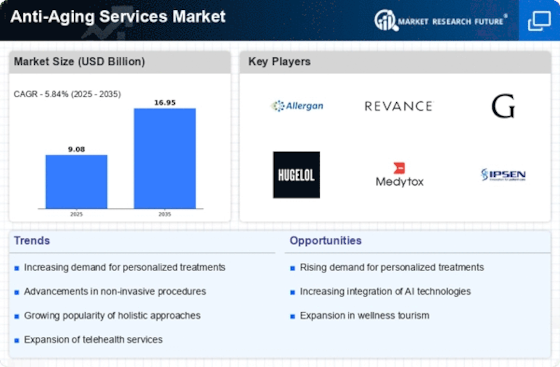
As per Market Research Future analysis, the Anti-Aging Services Market was estimated at 9.08 USD Billion in 2024. The Anti-Aging Services industry is projected to grow from 9.61 USD Billion in 2025 to 16.95 USD Billion by 2035, exhibiting a compound annual growth rate (CAGR) of 5.84% during the forecast period 2025 - 2035

Key Market Trends & Highlights

The Anti-Aging Services Market is experiencing a dynamic shift towards non-invasive treatments and personalized services, driven by technological advancements and demographic changes.

  • The market is witnessing a notable rise in non-invasive treatments, appealing to a broader demographic seeking less invasive options. Personalization of services is becoming increasingly prevalent, as consumers demand tailored solutions to meet their unique needs. North America remains the largest market, while the Asia-Pacific region is emerging as the fastest-growing area for anti-aging services. Key market drivers include the increasing aging population and advancements in aesthetic technology, which are propelling growth across segments.

Market Size & Forecast

2024 Market Size 9.08 (USD Billion)
2035 Market Size 16.95 (USD Billion)
CAGR (2025 - 2035) 5.84%
Largest Regional Market Share in 2024 Americas

Major Players

Allergan (US), Revance Therapeutics (US), Galderma (CH), Hugel (KR), Medytox (KR), Ipsen (FR), <a href="https://sientra.com/consult-free/">Sientra</a> (US), Medytox (KR), Hugel (KR)

Market Trends

The Anti-Aging Services Market is currently experiencing a notable transformation, driven by a growing consumer awareness regarding the importance of maintaining youthful appearance and health. This market encompasses a wide array of services, including cosmetic procedures, skincare treatments, and wellness programs aimed at mitigating the effects of aging. As individuals increasingly prioritize self-care and longevity, the demand for innovative solutions continues to rise. Moreover, advancements in technology and research are likely to enhance the efficacy of these services, thereby attracting a broader clientele. In addition, the Anti-Aging Services Market appears to be influenced by shifting demographics, particularly as the aging population seeks effective ways to address age-related concerns. This trend suggests a potential for growth, as service providers adapt their offerings to meet the diverse needs of various age groups. Furthermore, the integration of holistic approaches, combining traditional and modern techniques, may enhance the appeal of these services. Overall, the market is poised for expansion, reflecting a societal shift towards embracing aging with grace and vitality.

Rise of Non-Invasive Treatments

There is a growing preference for non-invasive procedures within the Anti-Aging Services Market. Consumers appear to favor options that minimize recovery time and reduce risks associated with surgical interventions. This trend indicates a shift towards treatments such as injectables, laser therapies, and advanced skincare regimens that promise visible results without the need for extensive downtime.

Personalization of Services

The demand for personalized anti-aging solutions is on the rise. Service providers are increasingly tailoring their offerings to meet individual needs, preferences, and skin types. This trend suggests that consumers are seeking more customized experiences, which may enhance satisfaction and effectiveness, ultimately leading to better outcomes in anti-aging treatments.

Integration of Technology

The incorporation of technology into anti-aging services is becoming more prevalent. From telemedicine consultations to the use of artificial intelligence in treatment planning, technology seems to play a crucial role in enhancing service delivery. This trend indicates a potential for improved accessibility and efficiency, allowing consumers to engage with anti-aging solutions in innovative ways.

Anti-Aging Services Market Market Drivers

Rising Disposable Income

The Anti-Aging Services Market is benefiting from the rising disposable income among consumers. As economic conditions improve, individuals are increasingly willing to invest in personal care and wellness services. This trend is particularly evident in emerging markets, where a growing middle class is prioritizing health and beauty expenditures. Reports indicate that The Anti-Aging Services Market is expected to reach over 800 billion by 2025, with a significant portion allocated to anti-aging products and services. This increase in disposable income allows consumers to seek premium anti-aging treatments, thereby driving growth in the market. Service providers are responding by offering a wider range of options, from luxury spa experiences to high-end cosmetic procedures, catering to the evolving preferences of affluent consumers in the Anti-Aging Services Market.

Increasing Aging Population

The Anti-Aging Services Market is experiencing a notable surge due to the increasing aging population. As life expectancy rises, a larger segment of the population is seeking services that address age-related concerns. According to demographic data, individuals aged 60 and above are projected to reach 2 billion by 2050, which indicates a substantial market for anti-aging services. This demographic shift is driving demand for various treatments, including skincare, cosmetic procedures, and wellness therapies. The growing awareness of health and beauty among older adults further fuels this trend, as they seek to maintain their vitality and appearance. Consequently, businesses in the Anti-Aging Services Market are adapting their offerings to cater to this expanding demographic, ensuring that they meet the unique needs and preferences of older consumers.

Advancements in Aesthetic Technology

Technological advancements play a pivotal role in shaping the Anti-Aging Services Market. Innovations in aesthetic technology, such as laser treatments, microdermabrasion, and injectable fillers, have revolutionized the way anti-aging services are delivered. These advancements not only enhance the effectiveness of treatments but also improve safety and reduce recovery times. For instance, non-invasive procedures are gaining popularity, as they offer significant results with minimal downtime. The market for aesthetic devices is projected to grow substantially, with estimates suggesting a compound annual growth rate of over 10% in the coming years. As consumers become more informed about these technologies, the demand for advanced anti-aging solutions is likely to increase, prompting service providers to invest in the latest equipment and training to remain competitive in the Anti-Aging Services Market.

Growing Awareness of Preventive Healthcare

There is a notable shift towards preventive healthcare, which is significantly influencing the Anti-Aging Services Market. Consumers are increasingly recognizing the importance of maintaining their health and appearance as they age. This awareness is leading to a proactive approach to anti-aging, where individuals seek services that not only address existing concerns but also prevent future issues. The rise of wellness trends, including nutrition, fitness, and skincare regimens, is indicative of this shift. Market data suggests that preventive healthcare spending is on the rise, with consumers willing to invest in services that promote longevity and well-being. As a result, businesses in the Anti-Aging Services Market are expanding their offerings to include holistic approaches that encompass both aesthetic and health-related services, appealing to the growing demand for comprehensive anti-aging solutions.

Influence of Social Media and Celebrity Endorsements

The Anti-Aging Services Market is increasingly influenced by social media and celebrity endorsements. Platforms such as Instagram and TikTok have become powerful tools for promoting anti-aging treatments and products. Influencers and celebrities often share their experiences with various services, creating a buzz that drives consumer interest. This trend is particularly impactful among younger demographics, who are more likely to seek out anti-aging solutions as a preventive measure. Market analysis indicates that social media marketing strategies are yielding high returns on investment for businesses in the Anti-Aging Services Market. As consumers turn to online platforms for information and recommendations, the importance of a strong digital presence becomes evident. Consequently, service providers are investing in social media campaigns to enhance their visibility and attract a broader audience.

Market Segment Insights

By Type: Botox Treatment (Largest) vs. Microdermabrasion (Fastest-Growing)

In the Anti-Aging Services Market, Botox Treatment holds the largest share, showcasing its strong preference among consumers seeking effective anti-aging solutions. Other notable segments include Dermal Fillers and Liposuction, which also command significant market presence. Microdermabrasion, while currently smaller in share, is capturing increasing attention thanks to rising consumer awareness and preference for less invasive treatments. This distribution reflects a market that is diverse, with clients applying different methods based on their personal preferences and the desired outcomes.

Botox Treatment (Dominant) vs. Microdermabrasion (Emerging)

Botox Treatment remains the dominant force, appealing to a wide demographic looking for quick and effective results in reducing facial wrinkles and fine lines. Its established reputation and efficacy make it a go-to option for many. Conversely, Microdermabrasion is emerging rapidly, favored by those who prioritize non-invasive procedures with minimal downtime. This segment's growth is driven by an increasing trend towards skin revitalization and maintenance, particularly among younger consumers. The rising demand for aesthetic procedures that enhance appearance without significant recovery time positions Microdermabrasion as a key player in shaping future trends in the anti-aging sector.

By Service Provider: Dermatology Clinics (Largest) vs. Hospitals (Fastest-Growing)

In the Anti-Aging Services Market, the segment distribution reveals that dermatology clinics hold the largest share, establishing themselves as the go-to provider for anti-aging treatments. Hospitals represent a significant portion as well, but they are also experiencing rapid growth due to their ability to offer a wide range of specialized treatments. Salons and other providers are important players, but their market share is notably smaller compared to the top two segments.

Dermatology Clinics (Dominant) vs. Hospitals (Emerging)

Dermatology clinics stand out as dominant players in the Anti-Aging Services Market, providing a variety of skin-related treatments and solutions that effectively address aging concerns. This segment benefits from the expertise of licensed dermatologists and advanced technologies, attracting a diverse clientele seeking professional care. Conversely, hospitals are emerging in this space, driven by the integration of comprehensive healthcare services that cater to anti-aging therapies. They are expanding their offerings to include surgical and non-surgical options, which are appealing to patients looking for holistic solutions. Both segments are poised for growth, but dermatology clinics currently lead the way in market preference.

Get more detailed insights about Anti-Aging Services Market Research Report – Forecast till 2035

Regional Insights

North America : Leading Market for Innovation

North America is the largest market for anti-aging services, accounting for approximately 45% of the global market share. The region's growth is driven by increasing consumer awareness, advancements in technology, and a growing aging population. Regulatory support from agencies like the FDA facilitates the introduction of innovative products and services, further boosting market demand. The trend towards minimally invasive procedures is also gaining traction, contributing to market expansion. The United States leads the North American market, with significant contributions from Canada. Key players such as Allergan and Revance Therapeutics dominate the landscape, offering a range of products from injectables to skin care solutions. The competitive environment is characterized by continuous innovation and strategic partnerships, ensuring a robust supply of anti-aging services. The presence of well-established healthcare infrastructure also supports market growth.

Europe : Emerging Regulatory Frameworks

Europe is the second-largest market for anti-aging services, holding approximately 30% of the global market share. The region benefits from a strong emphasis on research and development, alongside increasing consumer demand for aesthetic treatments. Regulatory frameworks, such as those established by the European Medicines Agency, are evolving to accommodate new technologies and procedures, thereby enhancing market growth. The rising trend of preventive healthcare is also a significant driver in this region. Leading countries in Europe include Germany, France, and the UK, which are home to numerous key players like Galderma and Ipsen. The competitive landscape is marked by a mix of established companies and emerging startups, all vying for market share through innovative offerings. The presence of advanced healthcare systems and a growing focus on aesthetic procedures further solidify Europe's position in the anti-aging services market.

Asia-Pacific : Rapid Growth and Demand

Asia-Pacific is rapidly emerging as a significant player in the anti-aging services market, accounting for approximately 20% of the global market share. The region's growth is fueled by rising disposable incomes, increasing awareness of aesthetic treatments, and a burgeoning aging population. Countries like China and Japan are witnessing a surge in demand for anti-aging solutions, driven by cultural factors that prioritize youthful appearances. Regulatory bodies are also becoming more supportive of new technologies, enhancing market dynamics. China and South Korea are at the forefront of this growth, with key players like Hugel and Medytox leading the charge. The competitive landscape is characterized by a mix of local and international companies, all striving to capture the growing consumer base. The increasing availability of advanced treatment options and a focus on quality are further propelling the market forward, making Asia-Pacific a vital region for anti-aging services.

Middle East and Africa : Untapped Market Potential

The Middle East and Africa represent an emerging market for anti-aging services, holding approximately 5% of the global market share. The region is witnessing a gradual increase in demand for aesthetic treatments, driven by changing beauty standards and a growing middle class. Regulatory bodies are beginning to recognize the potential of this market, leading to more favorable conditions for service providers. The increasing influence of social media is also contributing to heightened consumer interest in anti-aging solutions. Countries like the UAE and South Africa are leading the charge, with a growing number of clinics and service providers entering the market. The competitive landscape is still developing, with both local and international players vying for market share. The presence of key players is gradually increasing, and as awareness grows, the market is expected to expand significantly in the coming years.

Key Players and Competitive Insights

The Anti-Aging Services Market is currently characterized by a dynamic competitive landscape, driven by a confluence of innovation, strategic partnerships, and an increasing consumer demand for aesthetic treatments. Key players such as Allergan (US), Revance Therapeutics (US), and Galderma (CH) are at the forefront, each adopting distinct strategies to enhance their market positioning. Allergan (US) continues to leverage its strong brand recognition and extensive product portfolio, focusing on innovation in injectable treatments. Meanwhile, Revance Therapeutics (US) emphasizes its commitment to developing advanced neuromodulators and dermal fillers, aiming to differentiate itself through superior product efficacy and safety profiles. Galderma (CH), on the other hand, is actively expanding its global footprint, particularly in emerging markets, while also investing in digital transformation to enhance customer engagement and streamline operations. Collectively, these strategies contribute to a competitive environment that is increasingly focused on innovation and customer-centric solutions.

In terms of business tactics, companies are increasingly localizing manufacturing and optimizing their supply chains to enhance efficiency and responsiveness to market demands. The Anti-Aging Services Market appears moderately fragmented, with a mix of established players and emerging companies vying for market share. The collective influence of these key players shapes the market structure, as they engage in strategic collaborations and partnerships to bolster their competitive edge.

In August 2025, Allergan (US) announced the launch of a new line of advanced dermal fillers designed to provide longer-lasting results. This strategic move is significant as it not only reinforces Allergan's commitment to innovation but also positions the company to capture a larger share of the growing demand for non-surgical aesthetic treatments. The introduction of these fillers is likely to enhance customer loyalty and attract new clientele seeking effective anti-aging solutions.

In September 2025, Revance Therapeutics (US) secured a partnership with a leading aesthetic clinic chain to expand the distribution of its latest neuromodulator product. This collaboration is pivotal, as it allows Revance to leverage the clinic's established customer base, thereby accelerating market penetration. The partnership underscores the importance of strategic alliances in enhancing product visibility and accessibility in a competitive market.

In July 2025, Galderma (CH) launched a digital platform aimed at providing personalized skincare solutions, integrating AI technology to tailor recommendations based on individual skin types. This initiative reflects a broader trend towards digitalization in the anti-aging sector, as companies seek to enhance customer engagement through technology. By adopting such innovative approaches, Galderma positions itself as a forward-thinking leader in the market, likely attracting tech-savvy consumers.

As of October 2025, the competitive trends in the Anti-Aging Services Market are increasingly defined by digitalization, sustainability, and the integration of artificial intelligence. Strategic alliances are becoming more prevalent, as companies recognize the value of collaboration in navigating the complexities of the market. Looking ahead, competitive differentiation is expected to evolve, shifting from traditional price-based competition to a focus on innovation, technological advancements, and supply chain reliability. This transition may redefine how companies engage with consumers, ultimately shaping the future landscape of the anti-aging services sector.

Key Companies in the Anti-Aging Services Market include

Industry Developments

  • Q2 2024: Allergan Aesthetics Announces FDA Approval of Skinvive by Juvéderm for Cheek Skin Smoothness Allergan Aesthetics, an AbbVie company, received FDA approval for Skinvive by Juvéderm, a hyaluronic acid microdroplet injectable, expanding its anti-aging injectable portfolio for skin smoothness in the cheeks.
  • Q2 2024: Galderma Launches Restylane Eyelight in the United States Galderma announced the U.S. launch of Restylane Eyelight, a hyaluronic acid dermal filler designed to treat under-eye hollows, expanding its anti-aging treatment offerings.
  • Q2 2024: L'Oréal Acquires Australian Anti-Aging Skincare Brand Aesop for $2.5 Billion L'Oréal completed the acquisition of Aesop, a premium skincare brand known for its anti-aging products, marking one of the largest deals in the sector to date.
  • Q1 2024: Revance Therapeutics Appoints Mark Foley as CEO Revance Therapeutics, a biotechnology company specializing in aesthetic and anti-aging treatments, announced the appointment of Mark Foley as its new Chief Executive Officer.
  • Q2 2024: Alma Lasers Receives FDA Clearance for Alma TED Hair Restoration Device Alma Lasers received FDA clearance for its TED device, a non-invasive treatment for hair restoration, expanding its portfolio of anti-aging and aesthetic medical devices.
  • Q1 2024: Hydrafacial Company Opens New Manufacturing Facility in Long Beach, California The Hydrafacial Company, known for its anti-aging facial treatments, opened a new manufacturing facility to meet growing demand for its products and services.
  • Q2 2024: Crown Aesthetics Launches BIOJUVE, a Living Microbiome Skincare Platform Crown Aesthetics launched BIOJUVE, a new anti-aging skincare platform utilizing live microbes to improve skin health and appearance, marking a novel approach in the sector.
  • Q1 2024: Sofwave Medical Receives Health Canada Approval for Sofwave Synchronous Ultrasound Technology Sofwave Medical received regulatory approval from Health Canada for its Synchronous Ultrasound Parallel Beam Technology, used in non-invasive wrinkle reduction and anti-aging treatments.
  • Q2 2024: Evolus Launches Nuceiva in Germany for Frown Line Treatment Evolus, a performance beauty company, launched Nuceiva, a neurotoxin for the treatment of glabellar lines (frown lines), in Germany, expanding its European anti-aging product footprint.
  • Q1 2024: Alastin Skincare Launches ReSURFACE Skin Polish for Anti-Aging Alastin Skincare, a Galderma company, launched ReSURFACE Skin Polish, a new exfoliating product targeting anti-aging and skin rejuvenation.
  • Q2 2024: Merz Aesthetics Announces Partnership with Candela for Energy-Based Anti-Aging Treatments Merz Aesthetics entered a strategic partnership with Candela to co-market energy-based devices and injectables for comprehensive anti-aging treatment solutions.
  • Q1 2024: Solta Medical Launches Thermage FLX in Japan Solta Medical, a division of Bausch Health, launched Thermage FLX, a non-invasive radiofrequency device for skin tightening and wrinkle reduction, in the Japanese market.

Intended Audience

  • Device Manufacturers and Distributors
  • Aesthetical Care Providers
  • Hospitals and Specialty Dermatology Clinics
  • Medical Device Companies
  • Contract Research Organizations
  • Academic and Research Institutes
  • Government Associations

Future Outlook

Anti-Aging Services Market Future Outlook

The Anti-Aging Services Market is projected to grow at a 5.84% CAGR from 2025 to 2035, driven by technological advancements, increasing consumer awareness, and a growing aging population.

New opportunities lie in:

  • Expansion of telehealth consultations for anti-aging treatments.
  • Development of personalized skincare regimens using AI technology.
  • Investment in <a href="https://www.marketresearchfuture.com/reports/regenerative-medicine-market-2220">regenerative medicine</a> research and applications.

By 2035, the market is expected to be robust, driven by innovation and consumer demand.

Market Segmentation

Anti-Aging Services Market Type Outlook

  • Microdermabrasion
  • Breast Augmentation
  • Liposuction
  • Chemical Peel
  • Sclerotherapy
  • Intense Pulsed Light
  • Botox Treatment
  • Dermal Fillers
  • Others

Anti-Aging Services Market Service Provider Outlook

  • Hospitals
  • Dermatology Clinics
  • Salons
  • Others

Report Scope

MARKET SIZE 2024 9.08(USD Billion)
MARKET SIZE 2025 9.61(USD Billion)
MARKET SIZE 2035 16.95(USD Billion)
COMPOUND ANNUAL GROWTH RATE (CAGR) 5.84% (2025 - 2035)
REPORT COVERAGE Revenue Forecast, Competitive Landscape, Growth Factors, and Trends
BASE YEAR 2024
Market Forecast Period 2025 - 2035
Historical Data 2019 - 2024
Market Forecast Units USD Billion
Key Companies Profiled Allergan (US), Revance Therapeutics (US), Galderma (CH), Hugel (KR), Medytox (KR), Ipsen (FR), Sientra (US), Medytox (KR), Hugel (KR)
Segments Covered Type of Service
Key Market Opportunities Integration of advanced technologies in personalized anti-aging treatments enhances consumer engagement and market growth.
Key Market Dynamics Rising consumer demand for non-invasive treatments drives innovation and competition in the Anti-Aging Services Market.
Countries Covered North America, Europe, APAC, South America, MEA

FAQs

What is the projected market valuation of the Anti-Aging Services Market by 2035?

<p>The Anti-Aging Services Market is projected to reach a valuation of 16.95 USD Billion by 2035.</p>

What was the market valuation of the Anti-Aging Services Market in 2024?

<p>In 2024, the market valuation of the Anti-Aging Services Market was 9.08 USD Billion.</p>

What is the expected CAGR for the Anti-Aging Services Market during the forecast period 2025 - 2035?

<p>The expected CAGR for the Anti-Aging Services Market during the forecast period 2025 - 2035 is 5.84%.</p>

Which segment is projected to have the highest valuation in 2035?

<p>The Liposuction segment is projected to reach a valuation of 3.45 USD Billion by 2035.</p>

What are the key players in the Anti-Aging Services Market?

<p>Key players in the market include Allergan, Revance Therapeutics, Galderma, Hugel, Medytox, Ipsen, and Sientra.</p>

How does the market valuation of Botox Treatment compare to that of Dermal Fillers in 2035?

By 2035, Botox Treatment is expected to reach 3.45 USD Billion, while Dermal Fillers are projected to reach 2.58 USD Billion.

What is the projected valuation for Dermatology Clinics by 2035?

Dermatology Clinics are projected to have a valuation of 5.5 USD Billion by 2035.

Which service provider segment is expected to show the most growth by 2035?

The Dermatology Clinics segment is expected to show the most growth, reaching 5.5 USD Billion by 2035.

What is the expected valuation for the Chemical Peel segment in 2035?

The Chemical Peel segment is expected to reach a valuation of 1.39 USD Billion by 2035.

How does the market for Anti-Aging Services appear to be evolving?

The Anti-Aging Services Market appears to be evolving positively, with a projected increase in valuation from 9.08 USD Billion in 2024 to 16.95 USD Billion by 2035.

  1. SECTION I: EXECUTIVE SUMMARY AND KEY HIGHLIGHTS
    1. | 1.1 EXECUTIVE SUMMARY
    2. | | 1.1.1 Market Overview
    3. | | 1.1.2 Key Findings
    4. | | 1.1.3 Market Segmentation
    5. | | 1.1.4 Competitive Landscape
    6. | | 1.1.5 Challenges and Opportunities
    7. | | 1.1.6 Future Outlook
  2. SECTION II: SCOPING, METHODOLOGY AND MARKET STRUCTURE
    1. | 2.1 MARKET INTRODUCTION
    2. | | 2.1.1 Definition
    3. | | 2.1.2 Scope of the study
    4. | | | 2.1.2.1 Research Objective
    5. | | | 2.1.2.2 Assumption
    6. | | | 2.1.2.3 Limitations
    7. | 2.2 RESEARCH METHODOLOGY
    8. | | 2.2.1 Overview
    9. | | 2.2.2 Data Mining
    10. | | 2.2.3 Secondary Research
    11. | | 2.2.4 Primary Research
    12. | | | 2.2.4.1 Primary Interviews and Information Gathering Process
    13. | | | 2.2.4.2 Breakdown of Primary Respondents
    14. | | 2.2.5 Forecasting Model
    15. | | 2.2.6 Market Size Estimation
    16. | | | 2.2.6.1 Bottom-Up Approach
    17. | | | 2.2.6.2 Top-Down Approach
    18. | | 2.2.7 Data Triangulation
    19. | | 2.2.8 Validation
  3. SECTION III: QUALITATIVE ANALYSIS
    1. | 3.1 MARKET DYNAMICS
    2. | | 3.1.1 Overview
    3. | | 3.1.2 Drivers
    4. | | 3.1.3 Restraints
    5. | | 3.1.4 Opportunities
    6. | 3.2 MARKET FACTOR ANALYSIS
    7. | | 3.2.1 Value chain Analysis
    8. | | 3.2.2 Porter's Five Forces Analysis
    9. | | | 3.2.2.1 Bargaining Power of Suppliers
    10. | | | 3.2.2.2 Bargaining Power of Buyers
    11. | | | 3.2.2.3 Threat of New Entrants
    12. | | | 3.2.2.4 Threat of Substitutes
    13. | | | 3.2.2.5 Intensity of Rivalry
    14. | | 3.2.3 COVID-19 Impact Analysis
    15. | | | 3.2.3.1 Market Impact Analysis
    16. | | | 3.2.3.2 Regional Impact
    17. | | | 3.2.3.3 Opportunity and Threat Analysis
  4. SECTION IV: QUANTITATIVE ANALYSIS
    1. | 4.1 Healthcare, BY Type (USD Billion)
    2. | | 4.1.1 Microdermabrasion
    3. | | 4.1.2 Breast Augmentation
    4. | | 4.1.3 Liposuction
    5. | | 4.1.4 Chemical Peel
    6. | | 4.1.5 Sclerotherapy
    7. | | 4.1.6 Intense Pulsed Light
    8. | | 4.1.7 Botox Treatment
    9. | | 4.1.8 Dermal Fillers
    10. | | 4.1.9 Others
    11. | 4.2 Healthcare, BY Service Provider (USD Billion)
    12. | | 4.2.1 Hospitals
    13. | | 4.2.2 Dermatology Clinics
    14. | | 4.2.3 Salons
    15. | | 4.2.4 Others
    16. | 4.3 Healthcare, BY Region (USD Billion)
    17. | | 4.3.1 North America
    18. | | | 4.3.1.1 US
    19. | | | 4.3.1.2 Canada
    20. | | 4.3.2 Europe
    21. | | | 4.3.2.1 Germany
    22. | | | 4.3.2.2 UK
    23. | | | 4.3.2.3 France
    24. | | | 4.3.2.4 Russia
    25. | | | 4.3.2.5 Italy
    26. | | | 4.3.2.6 Spain
    27. | | | 4.3.2.7 Rest of Europe
    28. | | 4.3.3 APAC
    29. | | | 4.3.3.1 China
    30. | | | 4.3.3.2 India
    31. | | | 4.3.3.3 Japan
    32. | | | 4.3.3.4 South Korea
    33. | | | 4.3.3.5 Malaysia
    34. | | | 4.3.3.6 Thailand
    35. | | | 4.3.3.7 Indonesia
    36. | | | 4.3.3.8 Rest of APAC
    37. | | 4.3.4 South America
    38. | | | 4.3.4.1 Brazil
    39. | | | 4.3.4.2 Mexico
    40. | | | 4.3.4.3 Argentina
    41. | | | 4.3.4.4 Rest of South America
    42. | | 4.3.5 MEA
    43. | | | 4.3.5.1 GCC Countries
    44. | | | 4.3.5.2 South Africa
    45. | | | 4.3.5.3 Rest of MEA
  5. SECTION V: COMPETITIVE ANALYSIS
    1. | 5.1 Competitive Landscape
    2. | | 5.1.1 Overview
    3. | | 5.1.2 Competitive Analysis
    4. | | 5.1.3 Market share Analysis
    5. | | 5.1.4 Major Growth Strategy in the Healthcare
    6. | | 5.1.5 Competitive Benchmarking
    7. | | 5.1.6 Leading Players in Terms of Number of Developments in the Healthcare
    8. | | 5.1.7 Key developments and growth strategies
    9. | | | 5.1.7.1 New Product Launch/Service Deployment
    10. | | | 5.1.7.2 Merger & Acquisitions
    11. | | | 5.1.7.3 Joint Ventures
    12. | | 5.1.8 Major Players Financial Matrix
    13. | | | 5.1.8.1 Sales and Operating Income
    14. | | | 5.1.8.2 Major Players R&D Expenditure. 2023
    15. | 5.2 Company Profiles
    16. | | 5.2.1 Allergan (US)
    17. | | | 5.2.1.1 Financial Overview
    18. | | | 5.2.1.2 Products Offered
    19. | | | 5.2.1.3 Key Developments
    20. | | | 5.2.1.4 SWOT Analysis
    21. | | | 5.2.1.5 Key Strategies
    22. | | 5.2.2 Revance Therapeutics (US)
    23. | | | 5.2.2.1 Financial Overview
    24. | | | 5.2.2.2 Products Offered
    25. | | | 5.2.2.3 Key Developments
    26. | | | 5.2.2.4 SWOT Analysis
    27. | | | 5.2.2.5 Key Strategies
    28. | | 5.2.3 Galderma (CH)
    29. | | | 5.2.3.1 Financial Overview
    30. | | | 5.2.3.2 Products Offered
    31. | | | 5.2.3.3 Key Developments
    32. | | | 5.2.3.4 SWOT Analysis
    33. | | | 5.2.3.5 Key Strategies
    34. | | 5.2.4 Hugel (KR)
    35. | | | 5.2.4.1 Financial Overview
    36. | | | 5.2.4.2 Products Offered
    37. | | | 5.2.4.3 Key Developments
    38. | | | 5.2.4.4 SWOT Analysis
    39. | | | 5.2.4.5 Key Strategies
    40. | | 5.2.5 Medytox (KR)
    41. | | | 5.2.5.1 Financial Overview
    42. | | | 5.2.5.2 Products Offered
    43. | | | 5.2.5.3 Key Developments
    44. | | | 5.2.5.4 SWOT Analysis
    45. | | | 5.2.5.5 Key Strategies
    46. | | 5.2.6 Ipsen (FR)
    47. | | | 5.2.6.1 Financial Overview
    48. | | | 5.2.6.2 Products Offered
    49. | | | 5.2.6.3 Key Developments
    50. | | | 5.2.6.4 SWOT Analysis
    51. | | | 5.2.6.5 Key Strategies
    52. | | 5.2.7 Sientra (US)
    53. | | | 5.2.7.1 Financial Overview
    54. | | | 5.2.7.2 Products Offered
    55. | | | 5.2.7.3 Key Developments
    56. | | | 5.2.7.4 SWOT Analysis
    57. | | | 5.2.7.5 Key Strategies
    58. | | 5.2.8 Medytox (KR)
    59. | | | 5.2.8.1 Financial Overview
    60. | | | 5.2.8.2 Products Offered
    61. | | | 5.2.8.3 Key Developments
    62. | | | 5.2.8.4 SWOT Analysis
    63. | | | 5.2.8.5 Key Strategies
    64. | | 5.2.9 Hugel (KR)
    65. | | | 5.2.9.1 Financial Overview
    66. | | | 5.2.9.2 Products Offered
    67. | | | 5.2.9.3 Key Developments
    68. | | | 5.2.9.4 SWOT Analysis
    69. | | | 5.2.9.5 Key Strategies
    70. | 5.3 Appendix
    71. | | 5.3.1 References
    72. | | 5.3.2 Related Reports
  6. LIST OF FIGURES
    1. | 6.1 MARKET SYNOPSIS
    2. | 6.2 NORTH AMERICA MARKET ANALYSIS
    3. | 6.3 US MARKET ANALYSIS BY TYPE
    4. | 6.4 US MARKET ANALYSIS BY SERVICE PROVIDER
    5. | 6.5 CANADA MARKET ANALYSIS BY TYPE
    6. | 6.6 CANADA MARKET ANALYSIS BY SERVICE PROVIDER
    7. | 6.7 EUROPE MARKET ANALYSIS
    8. | 6.8 GERMANY MARKET ANALYSIS BY TYPE
    9. | 6.9 GERMANY MARKET ANALYSIS BY SERVICE PROVIDER
    10. | 6.10 UK MARKET ANALYSIS BY TYPE
    11. | 6.11 UK MARKET ANALYSIS BY SERVICE PROVIDER
    12. | 6.12 FRANCE MARKET ANALYSIS BY TYPE
    13. | 6.13 FRANCE MARKET ANALYSIS BY SERVICE PROVIDER
    14. | 6.14 RUSSIA MARKET ANALYSIS BY TYPE
    15. | 6.15 RUSSIA MARKET ANALYSIS BY SERVICE PROVIDER
    16. | 6.16 ITALY MARKET ANALYSIS BY TYPE
    17. | 6.17 ITALY MARKET ANALYSIS BY SERVICE PROVIDER
    18. | 6.18 SPAIN MARKET ANALYSIS BY TYPE
    19. | 6.19 SPAIN MARKET ANALYSIS BY SERVICE PROVIDER
    20. | 6.20 REST OF EUROPE MARKET ANALYSIS BY TYPE
    21. | 6.21 REST OF EUROPE MARKET ANALYSIS BY SERVICE PROVIDER
    22. | 6.22 APAC MARKET ANALYSIS
    23. | 6.23 CHINA MARKET ANALYSIS BY TYPE
    24. | 6.24 CHINA MARKET ANALYSIS BY SERVICE PROVIDER
    25. | 6.25 INDIA MARKET ANALYSIS BY TYPE
    26. | 6.26 INDIA MARKET ANALYSIS BY SERVICE PROVIDER
    27. | 6.27 JAPAN MARKET ANALYSIS BY TYPE
    28. | 6.28 JAPAN MARKET ANALYSIS BY SERVICE PROVIDER
    29. | 6.29 SOUTH KOREA MARKET ANALYSIS BY TYPE
    30. | 6.30 SOUTH KOREA MARKET ANALYSIS BY SERVICE PROVIDER
    31. | 6.31 MALAYSIA MARKET ANALYSIS BY TYPE
    32. | 6.32 MALAYSIA MARKET ANALYSIS BY SERVICE PROVIDER
    33. | 6.33 THAILAND MARKET ANALYSIS BY TYPE
    34. | 6.34 THAILAND MARKET ANALYSIS BY SERVICE PROVIDER
    35. | 6.35 INDONESIA MARKET ANALYSIS BY TYPE
    36. | 6.36 INDONESIA MARKET ANALYSIS BY SERVICE PROVIDER
    37. | 6.37 REST OF APAC MARKET ANALYSIS BY TYPE
    38. | 6.38 REST OF APAC MARKET ANALYSIS BY SERVICE PROVIDER
    39. | 6.39 SOUTH AMERICA MARKET ANALYSIS
    40. | 6.40 BRAZIL MARKET ANALYSIS BY TYPE
    41. | 6.41 BRAZIL MARKET ANALYSIS BY SERVICE PROVIDER
    42. | 6.42 MEXICO MARKET ANALYSIS BY TYPE
    43. | 6.43 MEXICO MARKET ANALYSIS BY SERVICE PROVIDER
    44. | 6.44 ARGENTINA MARKET ANALYSIS BY TYPE
    45. | 6.45 ARGENTINA MARKET ANALYSIS BY SERVICE PROVIDER
    46. | 6.46 REST OF SOUTH AMERICA MARKET ANALYSIS BY TYPE
    47. | 6.47 REST OF SOUTH AMERICA MARKET ANALYSIS BY SERVICE PROVIDER
    48. | 6.48 MEA MARKET ANALYSIS
    49. | 6.49 GCC COUNTRIES MARKET ANALYSIS BY TYPE
    50. | 6.50 GCC COUNTRIES MARKET ANALYSIS BY SERVICE PROVIDER
    51. | 6.51 SOUTH AFRICA MARKET ANALYSIS BY TYPE
    52. | 6.52 SOUTH AFRICA MARKET ANALYSIS BY SERVICE PROVIDER
    53. | 6.53 REST OF MEA MARKET ANALYSIS BY TYPE
    54. | 6.54 REST OF MEA MARKET ANALYSIS BY SERVICE PROVIDER
    55. | 6.55 KEY BUYING CRITERIA OF HEALTHCARE
    56. | 6.56 RESEARCH PROCESS OF MRFR
    57. | 6.57 DRO ANALYSIS OF HEALTHCARE
    58. | 6.58 DRIVERS IMPACT ANALYSIS: HEALTHCARE
    59. | 6.59 RESTRAINTS IMPACT ANALYSIS: HEALTHCARE
    60. | 6.60 SUPPLY / VALUE CHAIN: HEALTHCARE
    61. | 6.61 HEALTHCARE, BY TYPE, 2024 (% SHARE)
    62. | 6.62 HEALTHCARE, BY TYPE, 2024 TO 2035 (USD Billion)
    63. | 6.63 HEALTHCARE, BY SERVICE PROVIDER, 2024 (% SHARE)
    64. | 6.64 HEALTHCARE, BY SERVICE PROVIDER, 2024 TO 2035 (USD Billion)
    65. | 6.65 BENCHMARKING OF MAJOR COMPETITORS
  7. LIST OF TABLES
    1. | 7.1 LIST OF ASSUMPTIONS
    2. | | 7.1.1
    3. | 7.2 North America MARKET SIZE ESTIMATES; FORECAST
    4. | | 7.2.1 BY TYPE, 2025-2035 (USD Billion)
    5. | | 7.2.2 BY SERVICE PROVIDER, 2025-2035 (USD Billion)
    6. | 7.3 US MARKET SIZE ESTIMATES; FORECAST
    7. | | 7.3.1 BY TYPE, 2025-2035 (USD Billion)
    8. | | 7.3.2 BY SERVICE PROVIDER, 2025-2035 (USD Billion)
    9. | 7.4 Canada MARKET SIZE ESTIMATES; FORECAST
    10. | | 7.4.1 BY TYPE, 2025-2035 (USD Billion)
    11. | | 7.4.2 BY SERVICE PROVIDER, 2025-2035 (USD Billion)
    12. | 7.5 Europe MARKET SIZE ESTIMATES; FORECAST
    13. | | 7.5.1 BY TYPE, 2025-2035 (USD Billion)
    14. | | 7.5.2 BY SERVICE PROVIDER, 2025-2035 (USD Billion)
    15. | 7.6 Germany MARKET SIZE ESTIMATES; FORECAST
    16. | | 7.6.1 BY TYPE, 2025-2035 (USD Billion)
    17. | | 7.6.2 BY SERVICE PROVIDER, 2025-2035 (USD Billion)
    18. | 7.7 UK MARKET SIZE ESTIMATES; FORECAST
    19. | | 7.7.1 BY TYPE, 2025-2035 (USD Billion)
    20. | | 7.7.2 BY SERVICE PROVIDER, 2025-2035 (USD Billion)
    21. | 7.8 France MARKET SIZE ESTIMATES; FORECAST
    22. | | 7.8.1 BY TYPE, 2025-2035 (USD Billion)
    23. | | 7.8.2 BY SERVICE PROVIDER, 2025-2035 (USD Billion)
    24. | 7.9 Russia MARKET SIZE ESTIMATES; FORECAST
    25. | | 7.9.1 BY TYPE, 2025-2035 (USD Billion)
    26. | | 7.9.2 BY SERVICE PROVIDER, 2025-2035 (USD Billion)
    27. | 7.10 Italy MARKET SIZE ESTIMATES; FORECAST
    28. | | 7.10.1 BY TYPE, 2025-2035 (USD Billion)
    29. | | 7.10.2 BY SERVICE PROVIDER, 2025-2035 (USD Billion)
    30. | 7.11 Spain MARKET SIZE ESTIMATES; FORECAST
    31. | | 7.11.1 BY TYPE, 2025-2035 (USD Billion)
    32. | | 7.11.2 BY SERVICE PROVIDER, 2025-2035 (USD Billion)
    33. | 7.12 Rest of Europe MARKET SIZE ESTIMATES; FORECAST
    34. | | 7.12.1 BY TYPE, 2025-2035 (USD Billion)
    35. | | 7.12.2 BY SERVICE PROVIDER, 2025-2035 (USD Billion)
    36. | 7.13 APAC MARKET SIZE ESTIMATES; FORECAST
    37. | | 7.13.1 BY TYPE, 2025-2035 (USD Billion)
    38. | | 7.13.2 BY SERVICE PROVIDER, 2025-2035 (USD Billion)
    39. | 7.14 China MARKET SIZE ESTIMATES; FORECAST
    40. | | 7.14.1 BY TYPE, 2025-2035 (USD Billion)
    41. | | 7.14.2 BY SERVICE PROVIDER, 2025-2035 (USD Billion)
    42. | 7.15 India MARKET SIZE ESTIMATES; FORECAST
    43. | | 7.15.1 BY TYPE, 2025-2035 (USD Billion)
    44. | | 7.15.2 BY SERVICE PROVIDER, 2025-2035 (USD Billion)
    45. | 7.16 Japan MARKET SIZE ESTIMATES; FORECAST
    46. | | 7.16.1 BY TYPE, 2025-2035 (USD Billion)
    47. | | 7.16.2 BY SERVICE PROVIDER, 2025-2035 (USD Billion)
    48. | 7.17 South Korea MARKET SIZE ESTIMATES; FORECAST
    49. | | 7.17.1 BY TYPE, 2025-2035 (USD Billion)
    50. | | 7.17.2 BY SERVICE PROVIDER, 2025-2035 (USD Billion)
    51. | 7.18 Malaysia MARKET SIZE ESTIMATES; FORECAST
    52. | | 7.18.1 BY TYPE, 2025-2035 (USD Billion)
    53. | | 7.18.2 BY SERVICE PROVIDER, 2025-2035 (USD Billion)
    54. | 7.19 Thailand MARKET SIZE ESTIMATES; FORECAST
    55. | | 7.19.1 BY TYPE, 2025-2035 (USD Billion)
    56. | | 7.19.2 BY SERVICE PROVIDER, 2025-2035 (USD Billion)
    57. | 7.20 Indonesia MARKET SIZE ESTIMATES; FORECAST
    58. | | 7.20.1 BY TYPE, 2025-2035 (USD Billion)
    59. | | 7.20.2 BY SERVICE PROVIDER, 2025-2035 (USD Billion)
    60. | 7.21 Rest of APAC MARKET SIZE ESTIMATES; FORECAST
    61. | | 7.21.1 BY TYPE, 2025-2035 (USD Billion)
    62. | | 7.21.2 BY SERVICE PROVIDER, 2025-2035 (USD Billion)
    63. | 7.22 South America MARKET SIZE ESTIMATES; FORECAST
    64. | | 7.22.1 BY TYPE, 2025-2035 (USD Billion)
    65. | | 7.22.2 BY SERVICE PROVIDER, 2025-2035 (USD Billion)
    66. | 7.23 Brazil MARKET SIZE ESTIMATES; FORECAST
    67. | | 7.23.1 BY TYPE, 2025-2035 (USD Billion)
    68. | | 7.23.2 BY SERVICE PROVIDER, 2025-2035 (USD Billion)
    69. | 7.24 Mexico MARKET SIZE ESTIMATES; FORECAST
    70. | | 7.24.1 BY TYPE, 2025-2035 (USD Billion)
    71. | | 7.24.2 BY SERVICE PROVIDER, 2025-2035 (USD Billion)
    72. | 7.25 Argentina MARKET SIZE ESTIMATES; FORECAST
    73. | | 7.25.1 BY TYPE, 2025-2035 (USD Billion)
    74. | | 7.25.2 BY SERVICE PROVIDER, 2025-2035 (USD Billion)
    75. | 7.26 Rest of South America MARKET SIZE ESTIMATES; FORECAST
    76. | | 7.26.1 BY TYPE, 2025-2035 (USD Billion)
    77. | | 7.26.2 BY SERVICE PROVIDER, 2025-2035 (USD Billion)
    78. | 7.27 MEA MARKET SIZE ESTIMATES; FORECAST
    79. | | 7.27.1 BY TYPE, 2025-2035 (USD Billion)
    80. | | 7.27.2 BY SERVICE PROVIDER, 2025-2035 (USD Billion)
    81. | 7.28 GCC Countries MARKET SIZE ESTIMATES; FORECAST
    82. | | 7.28.1 BY TYPE, 2025-2035 (USD Billion)
    83. | | 7.28.2 BY SERVICE PROVIDER, 2025-2035 (USD Billion)
    84. | 7.29 South Africa MARKET SIZE ESTIMATES; FORECAST
    85. | | 7.29.1 BY TYPE, 2025-2035 (USD Billion)
    86. | | 7.29.2 BY SERVICE PROVIDER, 2025-2035 (USD Billion)
    87. | 7.30 Rest of MEA MARKET SIZE ESTIMATES; FORECAST
    88. | | 7.30.1 BY TYPE, 2025-2035 (USD Billion)
    89. | | 7.30.2 BY SERVICE PROVIDER, 2025-2035 (USD Billion)
    90. | 7.31 PRODUCT LAUNCH/PRODUCT DEVELOPMENT/APPROVAL
    91. | | 7.31.1
    92. | 7.32 ACQUISITION/PARTNERSHIP
    93. | | 7.32.1

Healthcare Market Segmentation

Healthcare By Type (USD Billion, 2025-2035)

  • Microdermabrasion
  • Breast Augmentation
  • Liposuction
  • Chemical Peel
  • Sclerotherapy
  • Intense Pulsed Light
  • Botox Treatment
  • Dermal Fillers
  • Others

Healthcare By Service Provider (USD Billion, 2025-2035)

  • Hospitals
  • Dermatology Clinics
  • Salons
  • Others
Infographic

Free Sample Request

Kindly complete the form below to receive a free sample of this Report

Get Free Sample

Customer Strories

Compare Licence

×
Features License Type
Single User Multiuser License Enterprise User
Price $4,950 $5,950 $7,250
Maximum User Access Limit 1 User Upto 10 Users Unrestricted Access Throughout the Organization
Free Customization
Direct Access to Analyst
Deliverable Format
Platform Access
Discount on Next Purchase 10% 15% 15%
Printable Versions