Segmentation Quick Reference
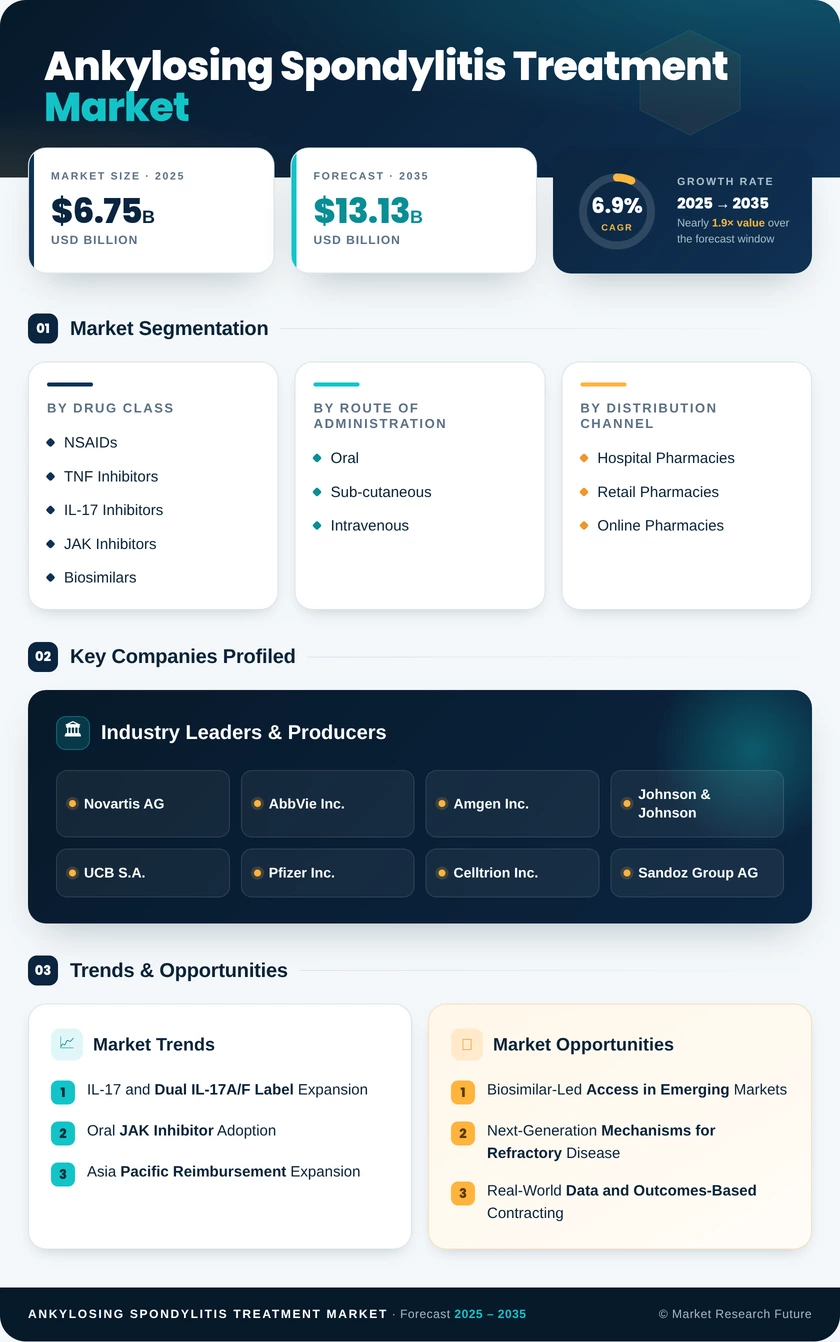
| Dimension | Sub-Segments | Dominant Segment | Fastest Growing Segment |
|---|
| By Drug Class | NSAIDs, TNF Inhibitors, IL-17 Inhibitors, JAK Inhibitors, Biosimilars, Others | TNF Inhibitors (50.4% share) | NSAIDs (8.3% CAGR) |
| By Route of Administration | Oral, Subcutaneous, Intravenous | Subcutaneous (55.4% share) | Oral (8.5% CAGR) |
| By Distribution Channel | Hospital Pharmacies, Retail Pharmacies, Online Pharmacies | Hospital Pharmacies (46.9% share) | Online Pharmacies (8.0% CAGR) |
| By Region | North America, Europe, Asia Pacific, Middle East and Africa, South America | North America (41.8% share) | Asia Pacific (8.6% CAGR) |
Market Segmentation Overview
| Sub-Segment | Key Trend |
|---|
| NSAIDs | Continuous COX-2 therapy repositioned as structure-modifying |
| TNF Inhibitors | Volume steady, net price falling under biosimilar pressure |
| IL-17 Inhibitors | Share gains in biologic-naïve and switcher patients |
| JAK Inhibitors | Oral option after TNF failure, limited by boxed warnings |
| Biosimilars | Formulary-mandated switching from originator TNF brands |
| Others | Corticosteroids, conventional DMARDs, and pipeline agents |
TNF Inhibitors lead the drug class mix at a 50.4% share because adalimumab and etanercept still anchor most first biologic starts. NSAIDs grow fastest at an 8.3% CAGR as guidelines keep them first-line and continuous celecoxib dosing gains credibility for slowing spinal fusion. IL-17 Inhibitors take incremental share from TNF agents, especially where bimekizumab is positioned for patients needing stronger radiographic control.
| Sub-Segment | Key Trend |
|---|
| Oral | JAK inhibitors and long-term NSAIDs drive tablet growth |
| Sub-cutaneous | Autoinjectors and high-concentration pens dominate home use |
| Intravenous | Niche use for infusion-preferring or reaction-prone patients |
Subcutaneous administration leads with a 55.4% share since nearly every major biologic is self-injected at home. Oral delivery grows fastest at an 8.5% CAGR as JAK inhibitors move into post-TNF lines and payers accept tablet regimens with simpler logistics. Intravenous use persists mainly through biosimilar infliximab and IV secukinumab in infusion centres.
| Sub-Segment | Key Trend |
|---|
| Hospital Pharmacies | Biologic initiation, infusions, and safety monitoring |
| Retail Pharmacies | NSAID and oral small-molecule dispensing |
| Online Pharmacies | Cold-chain home delivery and copay assistance |
Hospital Pharmacies hold a 46.9% share because biologic initiation, infusion chairs, and adverse-event monitoring sit inside health systems. Online Pharmacies grow fastest at an 8.0% CAGR as PBM-owned specialty arms bundle home delivery, nurse training, and refill reminders for working-age patients. Retail Pharmacies remain essential for NSAIDs and oral agents but continue to lose complex biologics to specialist channels.


 Noah Malgeri
Co-Founder

 Peter Groot koerkamp
Account and Business Manager

 Younghwan Choi
Senior Retail Manager

 Mark Irwin
Management Consultant

 Akif Moroglu
Strategy & Business Development Director

 Guilherme Gomes Martins
Product Management Director

 Joseph Aguayo
Sales Operations & Pricing Manager

 La Terria Dodd
Program Support Specialist

 Rob Kooiker
Group Product Manager HVAC & Fire Protection GMA