Request Free Sample ×

Kindly complete the form below to receive a free sample of this Report

* Please use a valid business email

Leading companies partner with us for data-driven Insights

clients tt-cursor
Hero Background
English
Chinese
French
Japanese
Korean
German
Spanish

Aluminum Flat Rolled Products Market Share

ID: MRFR/CnM/6739-CR
188 Pages
Priya Nagrale
August 2019

Aluminum Flat-Rolled Products Market Research Report Information By Product Type (Plates, Sheets, Standard GEQ, Circles, Foil Stock, Can Stock, and Fin Stock), By End-Use Industry (Building & Construction, Automotive & Transportation, Consumer Goods, Electrical & Electronics, Industrial, and Packaging) And By Region (North America, Europe, Asia-Pacific, And Rest Of The World) –Market Forecast Till 2035

Share:
Download PDF ×

We do not share your information with anyone. However, we may send you emails based on your report interest from time to time. You may contact us at any time to opt-out.

Aluminum Flat Rolled Products Market Infographic
Purchase Options

Market Share

Aluminum Flat Rolled Products Market Share Analysis

The market for aluminum flat-rolled products uses a variety of strategic techniques to increase its market share and successfully negotiate the competitive environment. These tactics are essential for maintaining growth and establishing a strong presence in the sector. The following summarizes the main market share positioning tactics used in the aluminum flat-rolled products industry: Spreading Out Your Offerings: Businesses in the market for aluminum flat-rolled products concentrate on diversifying their product lines. To serve a wider range of industries and applications, this entails introducing a number of flat-rolled aluminum products with varying specifications. Investing in Cutting-Edge Manufacturing Technologies: Technological innovation must never stop if you want to stay ahead of the competition. In order to gain a competitive edge, manufacturers engage in cutting-edge manufacturing technologies that increase production efficiency, lower costs, and improve the quality of flat-rolled aluminum products. Expansion of a Strategic Geographic Area: In order to increase their market share, businesses employ global expansion tactics. In order to meet local demands and access a variety of customer bases, this may entail establishing production sites in important foreign markets or building strategic alliances. Effective Supply Chain Management: For market leaders, supply chain optimization is essential. In order to guarantee timely production and satisfy client needs, producers of aluminum flat-rolled products strive to increase the efficiency of their supply chains at every stage, from locating raw materials to delivering completed goods. Environmentally Responsible Practices: Businesses in this market are investing in sustainable practices as a result of growing environmental consciousness. This entails matching consumer expectations, utilizing recycled aluminum, cutting energy use, and implementing environmentally friendly production techniques in order to meet global sustainability targets. Working Together with Industry Participants: Creating coalitions with important industry players, such distributors and suppliers, is a typical tactic. These partnerships promote innovation, give access to priceless resources, and strengthen and connect the supply chain. Customizing Goods for Particular Sectors: Customization is a feature that manufacturers of Aluminum Flat-Rolled Products give in recognition of the various needs of various sectors. Whether in the automotive, construction, or packaging industries, customizing products for particular uses enables businesses to target niche markets and obtain a competitive edge. Building a Robust Brand Image: Market positioning requires strong branding and marketing. In order to establish a strong and identifiable market presence, manufacturers spend in brand promotion through a variety of channels, highlighting the quality, dependability, and distinctive attributes of their products. Respondent Customer Service: A crucial element of market share positioning is placing a high priority on customer satisfaction. Manufacturers of aluminum flat-rolled products place a high priority on offering timely, courteous customer service, handling questions from customers, offering technical assistance, and developing enduring bonds with them. Respect for Strict Quality Guidelines: One of the essential components of market leadership is the unavoidable maintenance of high standards. Businesses in this field put a strong emphasis on ongoing quality improvement and frequently get certified to show that they are dedicated to producing goods that either meet or surpass industry standards.


Author
Author Profile
Priya Nagrale
Senior Research Analyst

With an experience of over five years in market research industry (Chemicals & Materials domain), I gather and analyze market data from diverse sources to produce results, which are then presented back to a client. Also, provide recommendations based on the findings. As a Senior Research Analyst, I perform quality checks (QC) for market estimations, QC for reports, and handle queries and work extensively on client customizations. Also, handle the responsibilities of client proposals, report planning, report finalization, and execution

Leave a Comment

FAQs

What is the projected market valuation for the Aluminum Flat-Rolled Products Market in 2035?

<p>The projected market valuation for the Aluminum Flat-Rolled Products Market in 2035 is 91.55 USD Billion.</p>

What was the market valuation of Aluminum Flat-Rolled Products in 2024?

<p>The market valuation of Aluminum Flat-Rolled Products in 2024 was 42.34 USD Billion.</p>

What is the expected CAGR for the Aluminum Flat-Rolled Products Market from 2025 to 2035?

<p>The expected CAGR for the Aluminum Flat-Rolled Products Market during the forecast period 2025 - 2035 is 7.26%.</p>

Which product type segment is projected to have the highest valuation by 2035?

<p>The Automotive & Transportation segment is projected to reach a valuation of 22.0 USD Billion by 2035.</p>

What are the key players in the Aluminum Flat-Rolled Products Market?

<p>Key players in the market include Alcoa Corporation, Novelis Inc., and Constellium SE, among others.</p>

How does the valuation of the Sheets segment compare to the Plates segment by 2035?

<p>By 2035, the Sheets segment is projected to reach 22.0 USD Billion, while the Plates segment is expected to reach 11.0 USD Billion.</p>

What is the projected valuation for the Packaging end-use industry segment by 2035?

The projected valuation for the Packaging end-use industry segment by 2035 is 13.05 USD Billion.

Which product type segment is expected to show the most growth from 2024 to 2035?

The Can Stock segment is expected to show substantial growth, increasing from 8.0 USD Billion in 2024 to 18.0 USD Billion by 2035.

What is the expected valuation for the Electrical & Electronics segment by 2035?

The expected valuation for the Electrical &amp; Electronics segment by 2035 is 10.0 USD Billion.

How does the growth of the Consumer Goods segment compare to the Industrial segment by 2035?

By 2035, the Consumer Goods segment is projected to reach 12.0 USD Billion, while the Industrial segment is expected to reach 15.0 USD Billion.

Market Summary

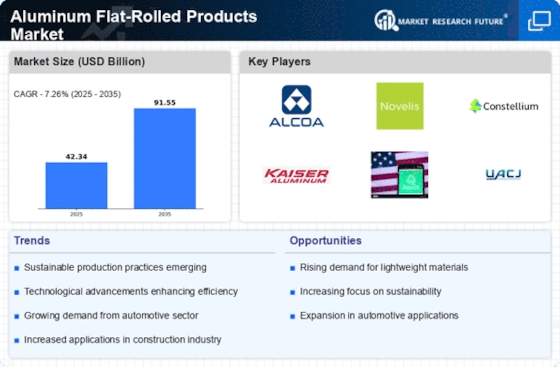
As per Market Research Future analysis, the Aluminum Flat-Rolled Products Market Size was estimated at 42.34 USD Billion in 2024. The Aluminum Flat-Rolled Products industry is projected to grow from 45.41 USD Billion in 2025 to 91.55 USD Billion by 2035, exhibiting a compound annual growth rate (CAGR) of 7.26% during the forecast period 2025 - 2035

Key Market Trends & Highlights

The Aluminum Flat-Rolled Products Market is experiencing robust growth driven by sustainability and technological advancements.

  • North America remains the largest market for aluminum flat-rolled products, driven by strong demand in the building and construction sector. Asia-Pacific is the fastest-growing region, with increasing investments in automotive and transportation applications. The sheets segment continues to dominate the market, while foil stock is emerging as the fastest-growing segment due to its diverse applications. Sustainability initiatives and technological advancements are key drivers propelling market growth across various sectors.

Market Size & Forecast

2024 Market Size 42.34 (USD Billion)
2035 Market Size 91.55 (USD Billion)
CAGR (2025 - 2035) 7.26%
Largest Regional Market Share in 2024 Asia Pacific

Major Players

Alcoa Corporation (US), Novelis Inc. (US), Constellium SE (FR), Kaiser Aluminum Corporation (US), Aleris Corporation (US), UACJ Corporation (JP), Hindalco Industries Limited (IN), China Hongqiao Group Limited (CN), Norsk Hydro ASA (NO)

Market Trends

The Aluminum Flat-Rolled Products Market is currently experiencing a dynamic phase characterized by evolving consumer preferences and technological advancements. The demand for lightweight materials in various industries, including automotive and construction, is driving the growth of this market. Manufacturers are increasingly focusing on enhancing production efficiency and sustainability practices, which appears to be a response to both regulatory pressures and consumer expectations. Innovations in alloy compositions and surface treatments are also emerging, potentially leading to improved performance characteristics and broader applications. Moreover, the market landscape is influenced by global trade dynamics and supply chain considerations. As countries strive for energy efficiency and reduced carbon footprints, the Aluminum Flat-Rolled Products Market is likely to witness a shift towards more eco-friendly production methods. This trend may encourage collaboration between manufacturers and technology providers to develop sustainable solutions. Overall, the market seems poised for continued growth, driven by a combination of technological innovation and changing market demands.

Sustainability Initiatives

The Aluminum Flat-Rolled Products Market is increasingly prioritizing sustainability, with manufacturers adopting eco-friendly practices. This trend reflects a growing awareness of environmental impacts and regulatory requirements, leading to innovations in recycling and energy-efficient production methods.

Technological Advancements

Technological progress is reshaping the Aluminum Flat-Rolled Products Market, as new manufacturing techniques enhance product quality and reduce costs. Automation and digitalization are becoming integral, potentially improving operational efficiency and product customization.

Diverse Applications

The versatility of aluminum flat-rolled products is expanding their applications across various sectors. Industries such as packaging, automotive, and construction are increasingly utilizing these materials, indicating a broadening market scope and potential for future growth.

Aluminum Flat Rolled Products Market Market Drivers

Economic Growth

Economic growth is a significant driver influencing the Aluminum Flat-Rolled Products Market. As economies expand, the demand for aluminum products tends to rise, particularly in construction and manufacturing sectors. Increased infrastructure development and urbanization are contributing to higher consumption of aluminum flat-rolled products, as they are essential for various applications, including roofing, siding, and structural components. Recent economic indicators suggest a positive outlook for several regions, which may lead to increased investments in construction and manufacturing. This growth trajectory is likely to bolster the Aluminum Flat-Rolled Products Market, as companies seek to capitalize on the rising demand for lightweight and durable materials.

Diverse Applications

The diverse applications of aluminum flat-rolled products are a key driver for the Aluminum Flat-Rolled Products Market. These products are utilized in a wide range of sectors, including automotive, aerospace, construction, and packaging. In the automotive industry, for example, the lightweight nature of aluminum flat-rolled products contributes to fuel efficiency and reduced emissions, making them increasingly popular among manufacturers. According to recent data, the automotive sector alone accounts for a substantial portion of aluminum consumption, with projections indicating continued growth in this area. Furthermore, the construction industry is also embracing aluminum for its durability and aesthetic appeal, further expanding the market's reach. This versatility in applications is likely to sustain demand and foster innovation within the Aluminum Flat-Rolled Products Market.

Regulatory Compliance

Regulatory compliance is emerging as a crucial driver for the Aluminum Flat-Rolled Products Market. Governments worldwide are implementing stringent regulations aimed at reducing environmental impact and promoting sustainable practices. These regulations often require manufacturers to adhere to specific standards regarding emissions, waste management, and product safety. As a result, companies within the Aluminum Flat-Rolled Products Market are compelled to invest in cleaner technologies and processes to meet these requirements. Compliance not only helps in avoiding penalties but also enhances brand reputation and customer trust. Moreover, companies that proactively embrace regulatory changes may find new opportunities for growth, as consumers increasingly favor products that align with environmental standards.

Sustainability Initiatives

The Aluminum Flat-Rolled Products Market is experiencing a notable shift towards sustainability initiatives. Manufacturers are increasingly adopting eco-friendly practices, driven by regulatory pressures and consumer demand for greener products. The industry is witnessing a rise in the use of recycled aluminum, which not only reduces energy consumption but also minimizes waste. In fact, the recycling of aluminum saves up to 95% of the energy required to produce new aluminum from ore. This trend is likely to enhance the market's appeal, as companies that prioritize sustainability may gain a competitive edge. Furthermore, the emphasis on reducing carbon footprints aligns with global efforts to combat climate change, potentially leading to increased investments in sustainable technologies within the Aluminum Flat-Rolled Products Market.

Technological Advancements

Technological advancements play a pivotal role in shaping the Aluminum Flat-Rolled Products Market. Innovations in manufacturing processes, such as advanced rolling techniques and automation, are enhancing production efficiency and product quality. For instance, the introduction of high-speed rolling mills has significantly reduced production times while maintaining precision. Additionally, the integration of Industry 4.0 technologies, including IoT and AI, is enabling real-time monitoring and predictive maintenance, which can lead to reduced downtime and operational costs. As these technologies continue to evolve, they are likely to drive growth in the Aluminum Flat-Rolled Products Market, allowing manufacturers to meet the increasing demand for high-performance aluminum products across various sectors.

Market Segment Insights

By Product Type: Sheets (Largest) vs. Foil Stock (Fastest-Growing)

In the Aluminum Flat-Rolled Products Market, Sheets hold the largest market share, dominating the product type segment due to their extensive applications across various industries including construction, automotive, and packaging. Plates and Standard GEQ follow, but their shares are significantly lower compared to Sheets. Circles and Can Stock are also relevant players, although they occupy niche markets, while Fin Stock is specialized for specific applications, leading to a diversified landscape within the segment.

Sheets (Dominant) vs. Foil Stock (Emerging)

Sheets are characterized by their versatility and adaptability, making them the dominant player in the aluminum flat-rolled products market. They are widely utilized in construction and manufacturing, thanks to their strength and lightweight nature. Foil Stock, on the other hand, represents an emerging segment driven by increasing demand for packaging solutions, especially in the food and pharmaceutical industries. Its low weight and excellent barrier properties make it highly sought after. The growth of e-commerce and the need for sustainable packaging solutions further enhance Foil Stock's market position, highlighting a shift toward more innovative products.

By End-Use Industry: Building & Construction (Largest) vs. Automotive & Transportation (Fastest-Growing)

The Aluminum Flat-Rolled Products Market exhibits a diverse market share distribution among various end-use industries. Dominated by the Building &amp; Construction sector, this segment plays a crucial role due to the lightweight and corrosion-resistant properties of aluminum, which are essential for modern architectural designs. The Automotive &amp; Transportation sector follows closely, reflecting a growing trend toward lighter vehicles for enhanced fuel efficiency and sustainability.

Building &amp; Construction (Dominant) vs. Automotive &amp; Transportation (Emerging)

The Building &amp; Construction sector stands as a dominant force in the Aluminum Flat-Rolled Products Market, leveraging aluminum's advantages for roofing, facades, and framing. Its extensive use is driven by a surge in construction activities, particularly in emerging economies. In contrast, the Automotive &amp; Transportation segment is labeled as emerging, reflecting rapid advancements in technology and design. This segment is increasingly adopting aluminum flat-rolled products for vehicle components as manufacturers seek to improve fuel efficiency and comply with stringent emissions regulations. Both segments are propelled by a growing emphasis on sustainable practices and innovative applications.

Get more detailed insights about Aluminum Flat-Rolled Products Market Research Report - Global Forecast till 2035

Regional Insights

North America : Innovation and Demand Growth

North America is witnessing robust growth in the aluminum flat-rolled products market, driven by increasing demand from the automotive and aerospace sectors. The region holds approximately 35% of the global market share, making it the largest market. Regulatory support for lightweight materials and sustainability initiatives further catalyze this growth. The U.S. and Canada are the primary contributors, with significant investments in manufacturing capabilities. The competitive landscape is dominated by key players such as Alcoa Corporation, Novelis Inc., and Kaiser Aluminum Corporation. These companies are focusing on innovation and expanding their product offerings to meet the rising demand. The presence of advanced manufacturing technologies and a skilled workforce enhances the region's competitive edge. Additionally, the U.S. government's emphasis on infrastructure development is expected to bolster market growth further.

Europe : Sustainability and Innovation Focus

Europe is emerging as a significant player in the aluminum flat-rolled products market, driven by stringent environmental regulations and a strong push for sustainability. The region accounts for approximately 30% of the global market share, making it the second-largest market. The European Union's Green Deal and initiatives to reduce carbon emissions are key regulatory catalysts that are shaping the market landscape. Demand is particularly strong in the automotive and packaging sectors, where lightweight materials are increasingly favored. Leading countries in this region include Germany, France, and Italy, with major companies like Constellium SE and Norsk Hydro ASA leading the charge. The competitive landscape is characterized by a focus on innovation, with investments in recycling technologies and sustainable production methods. The presence of a well-established supply chain and advanced manufacturing facilities further strengthens Europe's position in the global market.

Asia-Pacific : Rapid Industrialization and Growth

The Asia-Pacific region is experiencing rapid growth in the aluminum flat-rolled products market, fueled by industrialization and urbanization. This region holds approximately 25% of the global market share, with China being the largest contributor, followed by India. The demand for aluminum products is driven by the construction, automotive, and electronics sectors, supported by government initiatives to boost manufacturing and infrastructure development. China Hongqiao Group Limited and Hindalco Industries Limited are among the key players in this region, focusing on expanding their production capacities to meet the growing demand. The competitive landscape is marked by a mix of established companies and emerging players, all vying for market share. Additionally, favorable trade policies and investments in technology are expected to further enhance the region's market potential.

Middle East and Africa : Resource-Rich and Emerging Markets

The Middle East and Africa (MEA) region is witnessing a gradual increase in the aluminum flat-rolled products market, driven by resource availability and growing industrial activities. This region holds approximately 10% of the global market share, with countries like the UAE and South Africa leading the way. The demand is primarily fueled by the construction and automotive sectors, supported by government initiatives to diversify economies and promote manufacturing. Key players in this region include UACJ Corporation and other local manufacturers who are focusing on expanding their production capabilities. The competitive landscape is evolving, with increasing investments in technology and infrastructure. As the region continues to develop, opportunities for growth in the aluminum market are expected to expand, particularly in emerging economies that are investing in industrialization.

Key Players and Competitive Insights

Leading market players are investing heavily in research and development in order to expand their product lines, which will help the Aluminum Flat-Rolled Products market, grow even more. Market players are adopting various strategies to extend their footprint, with important market developments including new product developments, contracts & agreements, mergers & acquisitions, higher investments, and collaboration with other organizations. To expand and survive in a more competitive and rising market climate, the Aluminum Flat-Rolled Products industry must offer cost-effective items.
Manufacturing locally to minimize operational costs is one of the key business tactics used by manufacturers in the Aluminum Flat-Rolled Products industry to benefit clients and increase the market sector. In recent years, the Aluminum Flat-Rolled Products industry has offered some of the most significant advantages to medicine.
Major players in the Aluminum Flat-Rolled Products market, including Hindalco Industries Limited (India), Alcoa Corporation (US), Constellium (The Netherlands), Norsk Hydro ASA (Norway), Aluminum Corporation of China (Chalco) (China), Arconic (US), NALCO (India), UACJ Corporation (Japan), Elvalhalcor Hellenic Copper, Aluminum Industry S.A. (Greece), JW Aluminum (US), and others, are attempting to increase market demand by investing in research and development operations.
Aluminum is produced and exported by National Aluminum Co Ltd (NALCO). It conducts bauxite mining, alumina refining, Aluminum smelting and casting, power production, rail, and port operations. The company's main goods include chemicals and metals made of Aluminum. It runs bauxite mining in the Koraput district of Odisha's Panchpatmali Hills, an alumina refinery at Damanjodi, an Aluminum smelter, and a 1200 MW captive power plant in Angul.
Additionally, it runs four wind farms: a 50.4 MW wind farm in Gandikota, Andhra Pradesh; a 47.6 MW wind farm in Ludarva, Jaisalmer, Rajasthan; a 50 MW wind farm in Devikot, Jaisalmer, Rajasthan; and a 50.4 MW wind farm in Jath, Sangli, Maharastra.
In December The share price of National Aluminum Company increased by 5.77%.
The Department of Revenue, Ministry of Finance, Government of India stated in a notification dated December 6, 2021 that the dumping margin for the subject goods from the subject country is positive and important in the case of certain flat rolled Aluminum products originating in or exported from China. The ministry claims that the domestic industry has been materially harmed as a result of the dumping of Chinese goods.
Manufacturers and distributors of specialised rolled and extruded Aluminum products include Constellium SE (Constellium). Packaging, automotive rolled goods, aerospace, transportation, defence, end markets, automotive structures, and industrial items are all available. The business produces plates and sheets for the aerospace industry, as well as wing skins, general engineering plates, transportation sheets, packaging, and automotive rolled goods. Constellium also makes extruded items including automobile frames, huge profiles, and soft and hard alloys.
In January 2023, Constellium SE and Daher have a multi-year agreement under which the latter will receive a variety of flat-rolled Aluminum products from Constellium SE's factory in Issoire, France. In particular, the TBM and Kodiak versions of light aircraft will employ the Aluminum. Constellium can increase its customer base in the commercial and regional planes industry by joining Daher as a strategic Aluminum supplier.

Key Companies in the Aluminum Flat Rolled Products Market include

Industry Developments

November 2020: Alcoa Corporation announced a deal with Kaiser Aluminum Corporation to sell its rolling mill operations, which are currently owned by Alcoa Warrick LLC, for a total price of about $670 million.

July 2022: The Board of Directors of Steel Dynamics, Inc. approved the company's request to build and run a 650,000-ton low-carbon, recycled Aluminum flat-rolled mill with two auxiliary satellite recycled Aluminum slab centers. Commercial production is anticipated to start in the first quarter of 2025, with an estimated capital investment of $2.2 billion for the three sites.

Future Outlook

Aluminum Flat Rolled Products Market Future Outlook

The Aluminum Flat-Rolled Products Market is projected to grow at a 7.26% CAGR from 2025 to 2035, driven by increasing demand in automotive and construction sectors.

New opportunities lie in:

  • <p>Expansion into electric vehicle lightweight components Development of sustainable aluminum recycling technologies Investment in advanced manufacturing processes for high-performance alloys</p>

By 2035, the market is expected to achieve robust growth, solidifying its position as a key industry player.

Market Segmentation

Aluminum Flat Rolled Products Market Product Type Outlook

  • Plates
  • Sheets
  • Standard GEQ
  • Circles
  • Foil Stock
  • Can Stock
  • Fin Stock

Aluminum Flat Rolled Products Market End-Use Industry Outlook

  • Building & Construction
  • Automotive & Transportation
  • Consumer Goods
  • Electrical & Electronics
  • Industrial
  • Packaging

Report Scope

MARKET SIZE 2024 42.34(USD Billion)
MARKET SIZE 2025 45.41(USD Billion)
MARKET SIZE 2035 91.55(USD Billion)
COMPOUND ANNUAL GROWTH RATE (CAGR) 7.26% (2025 - 2035)
REPORT COVERAGE Revenue Forecast, Competitive Landscape, Growth Factors, and Trends
BASE YEAR 2024
Market Forecast Period 2025 - 2035
Historical Data 2019 - 2024
Market Forecast Units USD Billion
Key Companies Profiled Alcoa Corporation (US), Novelis Inc. (US), Constellium SE (FR), Kaiser Aluminum Corporation (US), Aleris Corporation (US), UACJ Corporation (JP), Hindalco Industries Limited (IN), China Hongqiao Group Limited (CN), Norsk Hydro ASA (NO)
Segments Covered Product Type, End-Use Industry, Region
Key Market Opportunities Growing demand for lightweight materials in automotive and aerospace sectors drives Aluminum Flat-Rolled Products Market opportunities.
Key Market Dynamics Rising demand for lightweight materials drives innovation and competition in the aluminum flat-rolled products sector.
Countries Covered North America, Europe, APAC, South America, MEA

FAQs

What is the projected market valuation for the Aluminum Flat-Rolled Products Market in 2035?

<p>The projected market valuation for the Aluminum Flat-Rolled Products Market in 2035 is 91.55 USD Billion.</p>

What was the market valuation of Aluminum Flat-Rolled Products in 2024?

<p>The market valuation of Aluminum Flat-Rolled Products in 2024 was 42.34 USD Billion.</p>

What is the expected CAGR for the Aluminum Flat-Rolled Products Market from 2025 to 2035?

<p>The expected CAGR for the Aluminum Flat-Rolled Products Market during the forecast period 2025 - 2035 is 7.26%.</p>

Which product type segment is projected to have the highest valuation by 2035?

<p>The Automotive & Transportation segment is projected to reach a valuation of 22.0 USD Billion by 2035.</p>

What are the key players in the Aluminum Flat-Rolled Products Market?

<p>Key players in the market include Alcoa Corporation, Novelis Inc., and Constellium SE, among others.</p>

How does the valuation of the Sheets segment compare to the Plates segment by 2035?

<p>By 2035, the Sheets segment is projected to reach 22.0 USD Billion, while the Plates segment is expected to reach 11.0 USD Billion.</p>

What is the projected valuation for the Packaging end-use industry segment by 2035?

The projected valuation for the Packaging end-use industry segment by 2035 is 13.05 USD Billion.

Which product type segment is expected to show the most growth from 2024 to 2035?

The Can Stock segment is expected to show substantial growth, increasing from 8.0 USD Billion in 2024 to 18.0 USD Billion by 2035.

What is the expected valuation for the Electrical & Electronics segment by 2035?

The expected valuation for the Electrical &amp; Electronics segment by 2035 is 10.0 USD Billion.

How does the growth of the Consumer Goods segment compare to the Industrial segment by 2035?

By 2035, the Consumer Goods segment is projected to reach 12.0 USD Billion, while the Industrial segment is expected to reach 15.0 USD Billion.

  1. SECTION I: EXECUTIVE SUMMARY AND KEY HIGHLIGHTS
    1. | 1.1 EXECUTIVE SUMMARY
    2. | | 1.1.1 Market Overview
    3. | | 1.1.2 Key Findings
    4. | | 1.1.3 Market Segmentation
    5. | | 1.1.4 Competitive Landscape
    6. | | 1.1.5 Challenges and Opportunities
    7. | | 1.1.6 Future Outlook
  2. SECTION II: SCOPING, METHODOLOGY AND MARKET STRUCTURE
    1. | 2.1 MARKET INTRODUCTION
    2. | | 2.1.1 Definition
    3. | | 2.1.2 Scope of the study
    4. | | | 2.1.2.1 Research Objective
    5. | | | 2.1.2.2 Assumption
    6. | | | 2.1.2.3 Limitations
    7. | 2.2 RESEARCH METHODOLOGY
    8. | | 2.2.1 Overview
    9. | | 2.2.2 Data Mining
    10. | | 2.2.3 Secondary Research
    11. | | 2.2.4 Primary Research
    12. | | | 2.2.4.1 Primary Interviews and Information Gathering Process
    13. | | | 2.2.4.2 Breakdown of Primary Respondents
    14. | | 2.2.5 Forecasting Model
    15. | | 2.2.6 Market Size Estimation
    16. | | | 2.2.6.1 Bottom-Up Approach
    17. | | | 2.2.6.2 Top-Down Approach
    18. | | 2.2.7 Data Triangulation
    19. | | 2.2.8 Validation
  3. SECTION III: QUALITATIVE ANALYSIS
    1. | 3.1 MARKET DYNAMICS
    2. | | 3.1.1 Overview
    3. | | 3.1.2 Drivers
    4. | | 3.1.3 Restraints
    5. | | 3.1.4 Opportunities
    6. | 3.2 MARKET FACTOR ANALYSIS
    7. | | 3.2.1 Value chain Analysis
    8. | | 3.2.2 Porter's Five Forces Analysis
    9. | | | 3.2.2.1 Bargaining Power of Suppliers
    10. | | | 3.2.2.2 Bargaining Power of Buyers
    11. | | | 3.2.2.3 Threat of New Entrants
    12. | | | 3.2.2.4 Threat of Substitutes
    13. | | | 3.2.2.5 Intensity of Rivalry
    14. | | 3.2.3 COVID-19 Impact Analysis
    15. | | | 3.2.3.1 Market Impact Analysis
    16. | | | 3.2.3.2 Regional Impact
    17. | | | 3.2.3.3 Opportunity and Threat Analysis
  4. SECTION IV: QUANTITATIVE ANALYSIS
    1. | 4.1 Chemicals and Materials, BY Product Type (USD Billion)
    2. | | 4.1.1 Plates
    3. | | 4.1.2 Sheets
    4. | | 4.1.3 Standard GEQ
    5. | | 4.1.4 Circles
    6. | | 4.1.5 Foil Stock
    7. | | 4.1.6 Can Stock
    8. | | 4.1.7 Fin Stock
    9. | 4.2 Chemicals and Materials, BY End-Use Industry (USD Billion)
    10. | | 4.2.1 Building & Construction
    11. | | 4.2.2 Automotive & Transportation
    12. | | 4.2.3 Consumer Goods
    13. | | 4.2.4 Electrical & Electronics
    14. | | 4.2.5 Industrial
    15. | | 4.2.6 Packaging
    16. | 4.3 Chemicals and Materials, BY Region (USD Billion)
    17. | | 4.3.1 North America
    18. | | | 4.3.1.1 US
    19. | | | 4.3.1.2 Canada
    20. | | 4.3.2 Europe
    21. | | | 4.3.2.1 Germany
    22. | | | 4.3.2.2 UK
    23. | | | 4.3.2.3 France
    24. | | | 4.3.2.4 Russia
    25. | | | 4.3.2.5 Italy
    26. | | | 4.3.2.6 Spain
    27. | | | 4.3.2.7 Rest of Europe
    28. | | 4.3.3 APAC
    29. | | | 4.3.3.1 China
    30. | | | 4.3.3.2 India
    31. | | | 4.3.3.3 Japan
    32. | | | 4.3.3.4 South Korea
    33. | | | 4.3.3.5 Malaysia
    34. | | | 4.3.3.6 Thailand
    35. | | | 4.3.3.7 Indonesia
    36. | | | 4.3.3.8 Rest of APAC
    37. | | 4.3.4 South America
    38. | | | 4.3.4.1 Brazil
    39. | | | 4.3.4.2 Mexico
    40. | | | 4.3.4.3 Argentina
    41. | | | 4.3.4.4 Rest of South America
    42. | | 4.3.5 MEA
    43. | | | 4.3.5.1 GCC Countries
    44. | | | 4.3.5.2 South Africa
    45. | | | 4.3.5.3 Rest of MEA
  5. SECTION V: COMPETITIVE ANALYSIS
    1. | 5.1 Competitive Landscape
    2. | | 5.1.1 Overview
    3. | | 5.1.2 Competitive Analysis
    4. | | 5.1.3 Market share Analysis
    5. | | 5.1.4 Major Growth Strategy in the Chemicals and Materials
    6. | | 5.1.5 Competitive Benchmarking
    7. | | 5.1.6 Leading Players in Terms of Number of Developments in the Chemicals and Materials
    8. | | 5.1.7 Key developments and growth strategies
    9. | | | 5.1.7.1 New Product Launch/Service Deployment
    10. | | | 5.1.7.2 Merger & Acquisitions
    11. | | | 5.1.7.3 Joint Ventures
    12. | | 5.1.8 Major Players Financial Matrix
    13. | | | 5.1.8.1 Sales and Operating Income
    14. | | | 5.1.8.2 Major Players R&D Expenditure. 2023
    15. | 5.2 Company Profiles
    16. | | 5.2.1 Alcoa Corporation (US)
    17. | | | 5.2.1.1 Financial Overview
    18. | | | 5.2.1.2 Products Offered
    19. | | | 5.2.1.3 Key Developments
    20. | | | 5.2.1.4 SWOT Analysis
    21. | | | 5.2.1.5 Key Strategies
    22. | | 5.2.2 Novelis Inc. (US)
    23. | | | 5.2.2.1 Financial Overview
    24. | | | 5.2.2.2 Products Offered
    25. | | | 5.2.2.3 Key Developments
    26. | | | 5.2.2.4 SWOT Analysis
    27. | | | 5.2.2.5 Key Strategies
    28. | | 5.2.3 Constellium SE (FR)
    29. | | | 5.2.3.1 Financial Overview
    30. | | | 5.2.3.2 Products Offered
    31. | | | 5.2.3.3 Key Developments
    32. | | | 5.2.3.4 SWOT Analysis
    33. | | | 5.2.3.5 Key Strategies
    34. | | 5.2.4 Kaiser Aluminum Corporation (US)
    35. | | | 5.2.4.1 Financial Overview
    36. | | | 5.2.4.2 Products Offered
    37. | | | 5.2.4.3 Key Developments
    38. | | | 5.2.4.4 SWOT Analysis
    39. | | | 5.2.4.5 Key Strategies
    40. | | 5.2.5 Aleris Corporation (US)
    41. | | | 5.2.5.1 Financial Overview
    42. | | | 5.2.5.2 Products Offered
    43. | | | 5.2.5.3 Key Developments
    44. | | | 5.2.5.4 SWOT Analysis
    45. | | | 5.2.5.5 Key Strategies
    46. | | 5.2.6 UACJ Corporation (JP)
    47. | | | 5.2.6.1 Financial Overview
    48. | | | 5.2.6.2 Products Offered
    49. | | | 5.2.6.3 Key Developments
    50. | | | 5.2.6.4 SWOT Analysis
    51. | | | 5.2.6.5 Key Strategies
    52. | | 5.2.7 Hindalco Industries Limited (IN)
    53. | | | 5.2.7.1 Financial Overview
    54. | | | 5.2.7.2 Products Offered
    55. | | | 5.2.7.3 Key Developments
    56. | | | 5.2.7.4 SWOT Analysis
    57. | | | 5.2.7.5 Key Strategies
    58. | | 5.2.8 China Hongqiao Group Limited (CN)
    59. | | | 5.2.8.1 Financial Overview
    60. | | | 5.2.8.2 Products Offered
    61. | | | 5.2.8.3 Key Developments
    62. | | | 5.2.8.4 SWOT Analysis
    63. | | | 5.2.8.5 Key Strategies
    64. | | 5.2.9 Norsk Hydro ASA (NO)
    65. | | | 5.2.9.1 Financial Overview
    66. | | | 5.2.9.2 Products Offered
    67. | | | 5.2.9.3 Key Developments
    68. | | | 5.2.9.4 SWOT Analysis
    69. | | | 5.2.9.5 Key Strategies
    70. | 5.3 Appendix
    71. | | 5.3.1 References
    72. | | 5.3.2 Related Reports
  6. LIST OF FIGURES
    1. | 6.1 MARKET SYNOPSIS
    2. | 6.2 NORTH AMERICA MARKET ANALYSIS
    3. | 6.3 US MARKET ANALYSIS BY PRODUCT TYPE
    4. | 6.4 US MARKET ANALYSIS BY END-USE INDUSTRY
    5. | 6.5 CANADA MARKET ANALYSIS BY PRODUCT TYPE
    6. | 6.6 CANADA MARKET ANALYSIS BY END-USE INDUSTRY
    7. | 6.7 EUROPE MARKET ANALYSIS
    8. | 6.8 GERMANY MARKET ANALYSIS BY PRODUCT TYPE
    9. | 6.9 GERMANY MARKET ANALYSIS BY END-USE INDUSTRY
    10. | 6.10 UK MARKET ANALYSIS BY PRODUCT TYPE
    11. | 6.11 UK MARKET ANALYSIS BY END-USE INDUSTRY
    12. | 6.12 FRANCE MARKET ANALYSIS BY PRODUCT TYPE
    13. | 6.13 FRANCE MARKET ANALYSIS BY END-USE INDUSTRY
    14. | 6.14 RUSSIA MARKET ANALYSIS BY PRODUCT TYPE
    15. | 6.15 RUSSIA MARKET ANALYSIS BY END-USE INDUSTRY
    16. | 6.16 ITALY MARKET ANALYSIS BY PRODUCT TYPE
    17. | 6.17 ITALY MARKET ANALYSIS BY END-USE INDUSTRY
    18. | 6.18 SPAIN MARKET ANALYSIS BY PRODUCT TYPE
    19. | 6.19 SPAIN MARKET ANALYSIS BY END-USE INDUSTRY
    20. | 6.20 REST OF EUROPE MARKET ANALYSIS BY PRODUCT TYPE
    21. | 6.21 REST OF EUROPE MARKET ANALYSIS BY END-USE INDUSTRY
    22. | 6.22 APAC MARKET ANALYSIS
    23. | 6.23 CHINA MARKET ANALYSIS BY PRODUCT TYPE
    24. | 6.24 CHINA MARKET ANALYSIS BY END-USE INDUSTRY
    25. | 6.25 INDIA MARKET ANALYSIS BY PRODUCT TYPE
    26. | 6.26 INDIA MARKET ANALYSIS BY END-USE INDUSTRY
    27. | 6.27 JAPAN MARKET ANALYSIS BY PRODUCT TYPE
    28. | 6.28 JAPAN MARKET ANALYSIS BY END-USE INDUSTRY
    29. | 6.29 SOUTH KOREA MARKET ANALYSIS BY PRODUCT TYPE
    30. | 6.30 SOUTH KOREA MARKET ANALYSIS BY END-USE INDUSTRY
    31. | 6.31 MALAYSIA MARKET ANALYSIS BY PRODUCT TYPE
    32. | 6.32 MALAYSIA MARKET ANALYSIS BY END-USE INDUSTRY
    33. | 6.33 THAILAND MARKET ANALYSIS BY PRODUCT TYPE
    34. | 6.34 THAILAND MARKET ANALYSIS BY END-USE INDUSTRY
    35. | 6.35 INDONESIA MARKET ANALYSIS BY PRODUCT TYPE
    36. | 6.36 INDONESIA MARKET ANALYSIS BY END-USE INDUSTRY
    37. | 6.37 REST OF APAC MARKET ANALYSIS BY PRODUCT TYPE
    38. | 6.38 REST OF APAC MARKET ANALYSIS BY END-USE INDUSTRY
    39. | 6.39 SOUTH AMERICA MARKET ANALYSIS
    40. | 6.40 BRAZIL MARKET ANALYSIS BY PRODUCT TYPE
    41. | 6.41 BRAZIL MARKET ANALYSIS BY END-USE INDUSTRY
    42. | 6.42 MEXICO MARKET ANALYSIS BY PRODUCT TYPE
    43. | 6.43 MEXICO MARKET ANALYSIS BY END-USE INDUSTRY
    44. | 6.44 ARGENTINA MARKET ANALYSIS BY PRODUCT TYPE
    45. | 6.45 ARGENTINA MARKET ANALYSIS BY END-USE INDUSTRY
    46. | 6.46 REST OF SOUTH AMERICA MARKET ANALYSIS BY PRODUCT TYPE
    47. | 6.47 REST OF SOUTH AMERICA MARKET ANALYSIS BY END-USE INDUSTRY
    48. | 6.48 MEA MARKET ANALYSIS
    49. | 6.49 GCC COUNTRIES MARKET ANALYSIS BY PRODUCT TYPE
    50. | 6.50 GCC COUNTRIES MARKET ANALYSIS BY END-USE INDUSTRY
    51. | 6.51 SOUTH AFRICA MARKET ANALYSIS BY PRODUCT TYPE
    52. | 6.52 SOUTH AFRICA MARKET ANALYSIS BY END-USE INDUSTRY
    53. | 6.53 REST OF MEA MARKET ANALYSIS BY PRODUCT TYPE
    54. | 6.54 REST OF MEA MARKET ANALYSIS BY END-USE INDUSTRY
    55. | 6.55 KEY BUYING CRITERIA OF CHEMICALS AND MATERIALS
    56. | 6.56 RESEARCH PROCESS OF MRFR
    57. | 6.57 DRO ANALYSIS OF CHEMICALS AND MATERIALS
    58. | 6.58 DRIVERS IMPACT ANALYSIS: CHEMICALS AND MATERIALS
    59. | 6.59 RESTRAINTS IMPACT ANALYSIS: CHEMICALS AND MATERIALS
    60. | 6.60 SUPPLY / VALUE CHAIN: CHEMICALS AND MATERIALS
    61. | 6.61 CHEMICALS AND MATERIALS, BY PRODUCT TYPE, 2024 (% SHARE)
    62. | 6.62 CHEMICALS AND MATERIALS, BY PRODUCT TYPE, 2024 TO 2035 (USD Billion)
    63. | 6.63 CHEMICALS AND MATERIALS, BY END-USE INDUSTRY, 2024 (% SHARE)
    64. | 6.64 CHEMICALS AND MATERIALS, BY END-USE INDUSTRY, 2024 TO 2035 (USD Billion)
    65. | 6.65 BENCHMARKING OF MAJOR COMPETITORS
  7. LIST OF TABLES
    1. | 7.1 LIST OF ASSUMPTIONS
    2. | | 7.1.1
    3. | 7.2 North America MARKET SIZE ESTIMATES; FORECAST
    4. | | 7.2.1 BY PRODUCT TYPE, 2025-2035 (USD Billion)
    5. | | 7.2.2 BY END-USE INDUSTRY, 2025-2035 (USD Billion)
    6. | 7.3 US MARKET SIZE ESTIMATES; FORECAST
    7. | | 7.3.1 BY PRODUCT TYPE, 2025-2035 (USD Billion)
    8. | | 7.3.2 BY END-USE INDUSTRY, 2025-2035 (USD Billion)
    9. | 7.4 Canada MARKET SIZE ESTIMATES; FORECAST
    10. | | 7.4.1 BY PRODUCT TYPE, 2025-2035 (USD Billion)
    11. | | 7.4.2 BY END-USE INDUSTRY, 2025-2035 (USD Billion)
    12. | 7.5 Europe MARKET SIZE ESTIMATES; FORECAST
    13. | | 7.5.1 BY PRODUCT TYPE, 2025-2035 (USD Billion)
    14. | | 7.5.2 BY END-USE INDUSTRY, 2025-2035 (USD Billion)
    15. | 7.6 Germany MARKET SIZE ESTIMATES; FORECAST
    16. | | 7.6.1 BY PRODUCT TYPE, 2025-2035 (USD Billion)
    17. | | 7.6.2 BY END-USE INDUSTRY, 2025-2035 (USD Billion)
    18. | 7.7 UK MARKET SIZE ESTIMATES; FORECAST
    19. | | 7.7.1 BY PRODUCT TYPE, 2025-2035 (USD Billion)
    20. | | 7.7.2 BY END-USE INDUSTRY, 2025-2035 (USD Billion)
    21. | 7.8 France MARKET SIZE ESTIMATES; FORECAST
    22. | | 7.8.1 BY PRODUCT TYPE, 2025-2035 (USD Billion)
    23. | | 7.8.2 BY END-USE INDUSTRY, 2025-2035 (USD Billion)
    24. | 7.9 Russia MARKET SIZE ESTIMATES; FORECAST
    25. | | 7.9.1 BY PRODUCT TYPE, 2025-2035 (USD Billion)
    26. | | 7.9.2 BY END-USE INDUSTRY, 2025-2035 (USD Billion)
    27. | 7.10 Italy MARKET SIZE ESTIMATES; FORECAST
    28. | | 7.10.1 BY PRODUCT TYPE, 2025-2035 (USD Billion)
    29. | | 7.10.2 BY END-USE INDUSTRY, 2025-2035 (USD Billion)
    30. | 7.11 Spain MARKET SIZE ESTIMATES; FORECAST
    31. | | 7.11.1 BY PRODUCT TYPE, 2025-2035 (USD Billion)
    32. | | 7.11.2 BY END-USE INDUSTRY, 2025-2035 (USD Billion)
    33. | 7.12 Rest of Europe MARKET SIZE ESTIMATES; FORECAST
    34. | | 7.12.1 BY PRODUCT TYPE, 2025-2035 (USD Billion)
    35. | | 7.12.2 BY END-USE INDUSTRY, 2025-2035 (USD Billion)
    36. | 7.13 APAC MARKET SIZE ESTIMATES; FORECAST
    37. | | 7.13.1 BY PRODUCT TYPE, 2025-2035 (USD Billion)
    38. | | 7.13.2 BY END-USE INDUSTRY, 2025-2035 (USD Billion)
    39. | 7.14 China MARKET SIZE ESTIMATES; FORECAST
    40. | | 7.14.1 BY PRODUCT TYPE, 2025-2035 (USD Billion)
    41. | | 7.14.2 BY END-USE INDUSTRY, 2025-2035 (USD Billion)
    42. | 7.15 India MARKET SIZE ESTIMATES; FORECAST
    43. | | 7.15.1 BY PRODUCT TYPE, 2025-2035 (USD Billion)
    44. | | 7.15.2 BY END-USE INDUSTRY, 2025-2035 (USD Billion)
    45. | 7.16 Japan MARKET SIZE ESTIMATES; FORECAST
    46. | | 7.16.1 BY PRODUCT TYPE, 2025-2035 (USD Billion)
    47. | | 7.16.2 BY END-USE INDUSTRY, 2025-2035 (USD Billion)
    48. | 7.17 South Korea MARKET SIZE ESTIMATES; FORECAST
    49. | | 7.17.1 BY PRODUCT TYPE, 2025-2035 (USD Billion)
    50. | | 7.17.2 BY END-USE INDUSTRY, 2025-2035 (USD Billion)
    51. | 7.18 Malaysia MARKET SIZE ESTIMATES; FORECAST
    52. | | 7.18.1 BY PRODUCT TYPE, 2025-2035 (USD Billion)
    53. | | 7.18.2 BY END-USE INDUSTRY, 2025-2035 (USD Billion)
    54. | 7.19 Thailand MARKET SIZE ESTIMATES; FORECAST
    55. | | 7.19.1 BY PRODUCT TYPE, 2025-2035 (USD Billion)
    56. | | 7.19.2 BY END-USE INDUSTRY, 2025-2035 (USD Billion)
    57. | 7.20 Indonesia MARKET SIZE ESTIMATES; FORECAST
    58. | | 7.20.1 BY PRODUCT TYPE, 2025-2035 (USD Billion)
    59. | | 7.20.2 BY END-USE INDUSTRY, 2025-2035 (USD Billion)
    60. | 7.21 Rest of APAC MARKET SIZE ESTIMATES; FORECAST
    61. | | 7.21.1 BY PRODUCT TYPE, 2025-2035 (USD Billion)
    62. | | 7.21.2 BY END-USE INDUSTRY, 2025-2035 (USD Billion)
    63. | 7.22 South America MARKET SIZE ESTIMATES; FORECAST
    64. | | 7.22.1 BY PRODUCT TYPE, 2025-2035 (USD Billion)
    65. | | 7.22.2 BY END-USE INDUSTRY, 2025-2035 (USD Billion)
    66. | 7.23 Brazil MARKET SIZE ESTIMATES; FORECAST
    67. | | 7.23.1 BY PRODUCT TYPE, 2025-2035 (USD Billion)
    68. | | 7.23.2 BY END-USE INDUSTRY, 2025-2035 (USD Billion)
    69. | 7.24 Mexico MARKET SIZE ESTIMATES; FORECAST
    70. | | 7.24.1 BY PRODUCT TYPE, 2025-2035 (USD Billion)
    71. | | 7.24.2 BY END-USE INDUSTRY, 2025-2035 (USD Billion)
    72. | 7.25 Argentina MARKET SIZE ESTIMATES; FORECAST
    73. | | 7.25.1 BY PRODUCT TYPE, 2025-2035 (USD Billion)
    74. | | 7.25.2 BY END-USE INDUSTRY, 2025-2035 (USD Billion)
    75. | 7.26 Rest of South America MARKET SIZE ESTIMATES; FORECAST
    76. | | 7.26.1 BY PRODUCT TYPE, 2025-2035 (USD Billion)
    77. | | 7.26.2 BY END-USE INDUSTRY, 2025-2035 (USD Billion)
    78. | 7.27 MEA MARKET SIZE ESTIMATES; FORECAST
    79. | | 7.27.1 BY PRODUCT TYPE, 2025-2035 (USD Billion)
    80. | | 7.27.2 BY END-USE INDUSTRY, 2025-2035 (USD Billion)
    81. | 7.28 GCC Countries MARKET SIZE ESTIMATES; FORECAST
    82. | | 7.28.1 BY PRODUCT TYPE, 2025-2035 (USD Billion)
    83. | | 7.28.2 BY END-USE INDUSTRY, 2025-2035 (USD Billion)
    84. | 7.29 South Africa MARKET SIZE ESTIMATES; FORECAST
    85. | | 7.29.1 BY PRODUCT TYPE, 2025-2035 (USD Billion)
    86. | | 7.29.2 BY END-USE INDUSTRY, 2025-2035 (USD Billion)
    87. | 7.30 Rest of MEA MARKET SIZE ESTIMATES; FORECAST
    88. | | 7.30.1 BY PRODUCT TYPE, 2025-2035 (USD Billion)
    89. | | 7.30.2 BY END-USE INDUSTRY, 2025-2035 (USD Billion)
    90. | 7.31 PRODUCT LAUNCH/PRODUCT DEVELOPMENT/APPROVAL
    91. | | 7.31.1
    92. | 7.32 ACQUISITION/PARTNERSHIP
    93. | | 7.32.1

Chemicals and Materials Market Segmentation

Chemicals and Materials By Product Type (USD Billion, 2025-2035)

  • Plates
  • Sheets
  • Standard GEQ
  • Circles
  • Foil Stock
  • Can Stock
  • Fin Stock

Chemicals and Materials By End-Use Industry (USD Billion, 2025-2035)

  • Building & Construction
  • Automotive & Transportation
  • Consumer Goods
  • Electrical & Electronics
  • Industrial
  • Packaging
Infographic

Free Sample Request

Kindly complete the form below to receive a free sample of this Report

Get Free Sample

Customer Strories

Compare Licence

×
Features License Type
Single User Multiuser License Enterprise User
Price $4,950 $5,950 $7,250
Maximum User Access Limit 1 User Upto 10 Users Unrestricted Access Throughout the Organization
Free Customization
Direct Access to Analyst
Deliverable Format
Platform Access
Discount on Next Purchase 10% 15% 15%
Printable Versions