Aluminium Nickel Catalyst Market

ID: MRFR/CnM/32982-HCR
111 Pages
Chitranshi Jaiswal
Last Updated: May 18, 2026
Aluminium Nickel Catalyst Market Research Report: By Application (Chemical Synthesis, Petrochemicals, Pharmaceuticals, Agricultural Chemicals), By Form (Granules, Powder, Pellets), By End Use Industry (Chemical Industry, Oil and Gas, Automotive, Pharmaceutical), By Catalyst Type (Homogeneous, Heterogeneous, Biocatalysts) and  By Regional (North America, Europe, South America, Asia Pacific, Middle East and Africa)  - Forecast to 2035.
Download PDF ×

We do not share your information with anyone. However, we may send you emails based on your report interest from time to time. You may contact us at any time to opt-out.

Aluminium Nickel Catalyst Market

Market Size

Forecast Period2025 - 2035
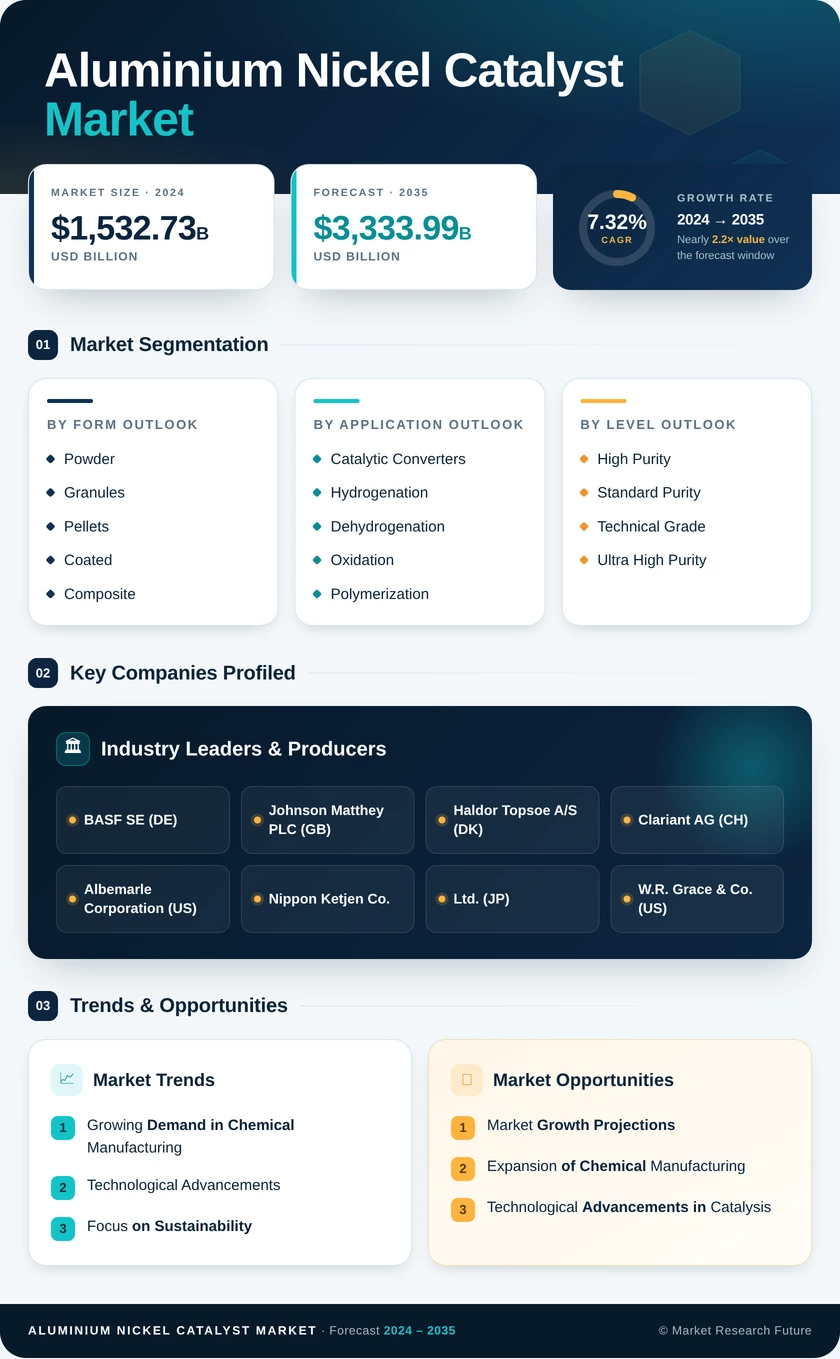
CAGR (2025 - 2035)7.32%
2024 Market Size$ 1,532.73 Million
2025 Market Size$ 1,644.93 Million
2035 Market Size$ 3,333.99 Million

Key Players

BASF SE
Johnson Matthey PLC
Haldor Topsoe A/S
Clariant AG
Albemarle Corporation
Nippon Ketjen Co.
Opportunities
  • Market Growth Projections
  • Expansion of Chemical Manufacturing
  • Technological Advancements in Catalysis
  1. 1 SECTION I: EXECUTIVE SUMMARY AND KEY HIGHLIGHTS
    1. 1.1 EXECUTIVE SUMMARY
      1. 1.1.1 Market Overview
      2. 1.1.2 Key Findings
      3. 1.1.3 Market Segmentation
      4. 1.1.4 Competitive Landscape
      5. 1.1.5 Challenges and Opportunities
      6. 1.1.6 Future Outlook
  2. 2 SECTION II: SCOPING, METHODOLOGY AND MARKET STRUCTURE
    1. 2.1 MARKET INTRODUCTION
      1. 2.1.1 Definition
      2. 2.1.2 Scope of the study
        1. 2.1.2.1 Research Objective
        2. 2.1.2.2 Assumption
        3. 2.1.2.3 Limitations
    2. 2.2 RESEARCH METHODOLOGY
      1. 2.2.1 Overview
      2. 2.2.2 Data Mining
      3. 2.2.3 Secondary Research
      4. 2.2.4 Primary Research
        1. 2.2.4.1 Primary Interviews and Information Gathering Process
        2. 2.2.4.2 Breakdown of Primary Respondents
      5. 2.2.5 Forecasting Model
      6. 2.2.6 Market Size Estimation
        1. 2.2.6.1 Bottom-Up Approach
        2. 2.2.6.2 Top-Down Approach
      7. 2.2.7 Data Triangulation
      8. 2.2.8 Validation
  3. 3 SECTION III: QUALITATIVE ANALYSIS
    1. 3.1 MARKET DYNAMICS
      1. 3.1.1 Overview
      2. 3.1.2 Drivers
      3. 3.1.3 Restraints
      4. 3.1.4 Opportunities
    2. 3.2 MARKET FACTOR ANALYSIS
      1. 3.2.1 Value chain Analysis
      2. 3.2.2 Porter's Five Forces Analysis
        1. 3.2.2.1 Bargaining Power of Suppliers
        2. 3.2.2.2 Bargaining Power of Buyers
        3. 3.2.2.3 Threat of New Entrants
        4. 3.2.2.4 Threat of Substitutes
        5. 3.2.2.5 Intensity of Rivalry
      3. 3.2.3 COVID-19 Impact Analysis
        1. 3.2.3.1 Market Impact Analysis
        2. 3.2.3.2 Regional Impact
        3. 3.2.3.3 Opportunity and Threat Analysis
  4. 4 SECTION IV: QUANTITATIVE ANALYSIS
    1. 4.1 Aluminium Nickel Catalyst Market, BY Application (USD Million)
      1. 4.1.1 Catalytic Converters
      2. 4.1.2 Hydrogenation
      3. 4.1.3 Dehydrogenation
      4. 4.1.4 Oxidation
      5. 4.1.5 Polymerization
    2. 4.2 Aluminium Nickel Catalyst Market, BY End Use Industry (USD Million)
      1. 4.2.1 Automotive
      2. 4.2.2 Chemical Manufacturing
      3. 4.2.3 Pharmaceuticals
      4. 4.2.4 Petrochemicals
      5. 4.2.5 Energy
    3. 4.3 Aluminium Nickel Catalyst Market, BY Form (USD Million)
      1. 4.3.1 Powder
      2. 4.3.2 Granules
      3. 4.3.3 Pellets
      4. 4.3.4 Coated
      5. 4.3.5 Composite
    4. 4.4 Aluminium Nickel Catalyst Market, BY Purity Level (USD Million)
      1. 4.4.1 High Purity
      2. 4.4.2 Standard Purity
      3. 4.4.3 Technical Grade
      4. 4.4.4 Ultra High Purity
    5. 4.5 Aluminium Nickel Catalyst Market, BY Region (USD Million)
      1. 4.5.1 North America
        1. 4.5.1.1 US
        2. 4.5.1.2 Canada
      2. 4.5.2 Europe
        1. 4.5.2.1 Germany
        2. 4.5.2.2 UK
        3. 4.5.2.3 France
        4. 4.5.2.4 Russia
        5. 4.5.2.5 Italy
        6. 4.5.2.6 Spain
        7. 4.5.2.7 Rest of Europe
      3. 4.5.3 APAC
        1. 4.5.3.1 China
        2. 4.5.3.2 India
        3. 4.5.3.3 Japan
        4. 4.5.3.4 South Korea
        5. 4.5.3.5 Malaysia
        6. 4.5.3.6 Thailand
        7. 4.5.3.7 Indonesia
        8. 4.5.3.8 Rest of APAC
      4. 4.5.4 South America
        1. 4.5.4.1 Brazil
        2. 4.5.4.2 Mexico
        3. 4.5.4.3 Argentina
        4. 4.5.4.4 Rest of South America
      5. 4.5.5 MEA
        1. 4.5.5.1 GCC Countries
        2. 4.5.5.2 South Africa
        3. 4.5.5.3 Rest of MEA
  5. 5 SECTION V: COMPETITIVE ANALYSIS
    1. 5.1 Competitive Landscape
      1. 5.1.1 Overview
      2. 5.1.2 Competitive Analysis
      3. 5.1.3 Market share Analysis
      4. 5.1.4 Major Growth Strategy in the Chemicals and Materials
      5. 5.1.5 Competitive Benchmarking
      6. 5.1.6 Leading Players in Terms of Number of Developments in the Chemicals and Materials
      7. 5.1.7 Key developments and growth strategies
        1. 5.1.7.1 New Product Launch/Service Deployment
        2. 5.1.7.2 Merger & Acquisitions
        3. 5.1.7.3 Joint Ventures
      8. 5.1.8 Major Players Financial Matrix
        1. 5.1.8.1 Sales and Operating Income
        2. 5.1.8.2 Major Players R&D Expenditure. 2023
    2. 5.2 Company Profiles
      1. 5.2.1 BASF SE (DE)
        1. 5.2.1.1 Financial Overview
        2. 5.2.1.2 Products Offered
        3. 5.2.1.3 Key Developments
        4. 5.2.1.4 SWOT Analysis
        5. 5.2.1.5 Key Strategies
      2. 5.2.2 Johnson Matthey PLC (GB)
        1. 5.2.2.1 Financial Overview
        2. 5.2.2.2 Products Offered
        3. 5.2.2.3 Key Developments
        4. 5.2.2.4 SWOT Analysis
        5. 5.2.2.5 Key Strategies
      3. 5.2.3 Haldor Topsoe A/S (DK)
        1. 5.2.3.1 Financial Overview
        2. 5.2.3.2 Products Offered
        3. 5.2.3.3 Key Developments
        4. 5.2.3.4 SWOT Analysis
        5. 5.2.3.5 Key Strategies
      4. 5.2.4 Clariant AG (CH)
        1. 5.2.4.1 Financial Overview
        2. 5.2.4.2 Products Offered
        3. 5.2.4.3 Key Developments
        4. 5.2.4.4 SWOT Analysis
        5. 5.2.4.5 Key Strategies
      5. 5.2.5 Albemarle Corporation (US)
        1. 5.2.5.1 Financial Overview
        2. 5.2.5.2 Products Offered
        3. 5.2.5.3 Key Developments
        4. 5.2.5.4 SWOT Analysis
        5. 5.2.5.5 Key Strategies
      6. 5.2.6 Nippon Ketjen Co., Ltd. (JP)
        1. 5.2.6.1 Financial Overview
        2. 5.2.6.2 Products Offered
        3. 5.2.6.3 Key Developments
        4. 5.2.6.4 SWOT Analysis
        5. 5.2.6.5 Key Strategies
      7. 5.2.7 W.R. Grace & Co. (US)
        1. 5.2.7.1 Financial Overview
        2. 5.2.7.2 Products Offered
        3. 5.2.7.3 Key Developments
        4. 5.2.7.4 SWOT Analysis
        5. 5.2.7.5 Key Strategies
      8. 5.2.8 Evonik Industries AG (DE)
        1. 5.2.8.1 Financial Overview
        2. 5.2.8.2 Products Offered
        3. 5.2.8.3 Key Developments
        4. 5.2.8.4 SWOT Analysis
        5. 5.2.8.5 Key Strategies
      9. 5.2.9 SABIC (SA)
        1. 5.2.9.1 Financial Overview
        2. 5.2.9.2 Products Offered
        3. 5.2.9.3 Key Developments
        4. 5.2.9.4 SWOT Analysis
        5. 5.2.9.5 Key Strategies
    3. 5.3 Appendix
      1. 5.3.1 References
      2. 5.3.2 Related Reports

Aluminium Nickel Catalyst Market Segmentation

Aluminium Nickel Catalyst Market By Application (USD Million, 2025-2035)

  • Catalytic Converters
  • Hydrogenation
  • Dehydrogenation
  • Oxidation
  • Polymerization

Aluminium Nickel Catalyst Market By End Use Industry (USD Million, 2025-2035)

  • Automotive
  • Chemical Manufacturing
  • Pharmaceuticals
  • Petrochemicals
  • Energy

Aluminium Nickel Catalyst Market By Form (USD Million, 2025-2035)

  • Powder
  • Granules
  • Pellets
  • Coated
  • Composite

Aluminium Nickel Catalyst Market By Purity Level (USD Million, 2025-2035)

  • High Purity
  • Standard Purity
  • Technical Grade
  • Ultra High Purity