Aloe Vera Extract Market (2026 - 2035)

ID: MRFR/FnB/36488-HCR 128 Pages Snehal Singh Last Updated: September 17, 2026
Aloe Vera Extract Market Size, Share, Industry Trend & Analysis Research Report By Product Form (Liquid, Gel, Powder, Others), By Nature (Conventional, Organic), By Application (Cosmetics & Personal Care, Food & Beverage, Pharmaceuticals, Dietary Supplements, Animal Feed, Others), By Geography (North America, Europe, Asia-Pacific, South America, Middle East & Africa) - Forecast to 2035
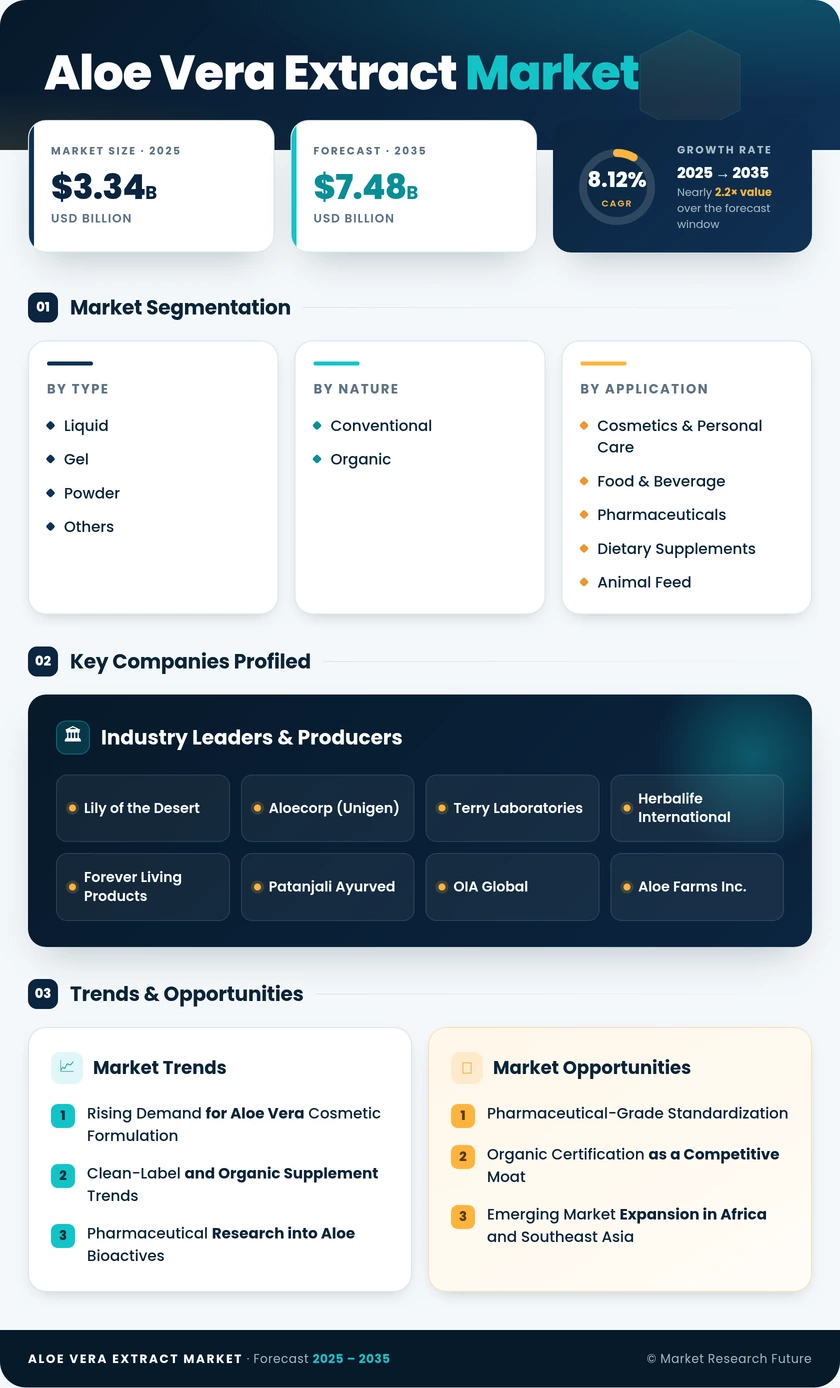
Aloe Vera Extract Market
Market Size
Forecast Period2026-2035
CAGR (2026-2035)8.12%
2025 Market SizeUSD 3.34 Billion
2035 Market SizeUSD 7.48 Billion
Key Players
Lily of the Desert
Aloecorp
Terry Laboratories
Herbalife International
Forever Living Products
Patanjali Ayurved
Opportunities
  • Pharmaceutical-Grade Standardization
  • Organic Certification as a Competitive Moat
  • Emerging Market Expansion in Africa and Southeast Asia
  1. 1 Market Overview |
    1. 1.1 Study Assumptions & Market Definition |
    2. 1.2 Scope of the Study |
    3. 1.3 Research Methodology
  2. 2 Market Summary & Key Takeaways
  3. 3 Market Dynamics |
    1. 3.1 Market Drivers Analysis | |
      1. 3.1.1 Rising Demand for Aloe Vera Cosmetic Formulation | |
      2. 3.1.2 Clean-Label and Organic Aloe Vera Extract Supplement Trends | |
      3. 3.1.3 Pharmaceutical R&D into Aloe Vera Bioactives | |
      4. 3.1.4 Aloe Vera Juice Health Drink Premiumization | |
      5. 3.1.5 Government Herbal Medicine Promotion Policies | |
      6. 3.1.6 E-Commerce Expansion for DTC Supplement Brands | |
      7. 3.1.7 Precision Agriculture and Yield Optimization |
    2. 3.2 Market Restraints Analysis | |
      1. 3.2.1 Supply Chain Fragmentation and Quality Inconsistency | |
      2. 3.2.2 Adulteration and Labeling Fraud | |
      3. 3.2.3 Water Scarcity in Key Cultivation Regions | |
      4. 3.2.4 Price Volatility of Raw Aloe Vera Leaf | |
      5. 3.2.5 Regulatory Divergence Across Markets |
    3. 3.3 Market Opportunity Analysis | |
      1. 3.3.1 Pharmaceutical-Grade Standardization | |
      2. 3.3.2 Organic Certification as a Competitive Moat | |
      3. 3.3.3 Emerging Market Expansion in Africa and Southeast Asia | |
      4. 3.3.4 Direct-to-Consumer Digital Channels | |
      5. 3.3.5 Upcycling and Biorefinery Models |
    4. 3.4 Industry Value Chain Analysis |
    5. 3.5 Porter's Five Forces Analysis
  4. 4 Global Aloe Vera Extract Market Size & Forecast (2021–2035) |
    1. 4.1 Historical Market Size (2021–2025) |
    2. 4.2 Current & Forecast Market Size (2026–2035) |
    3. 4.3 Market Size by Revenue (USD Billion) |
    4. 4.4 Year-over-Year Growth Analysis
  5. 5 Segmentation Analysis |
    1. 5.1 By Product Form | |
      1. 5.1.1 Liquid | |
      2. 5.1.2 Gel | |
      3. 5.1.3 Powder | |
      4. 5.1.4 Others |
    2. 5.2 By Nature | |
      1. 5.2.1 Conventional | |
      2. 5.2.2 Organic |
    3. 5.3 By Application | |
      1. 5.3.1 Cosmetics and Personal Care | |
      2. 5.3.2 Food and Beverage | |
      3. 5.3.3 Pharmaceuticals | |
      4. 5.3.4 Dietary Supplements | |
      5. 5.3.5 Animal Feed | |
      6. 5.3.6 Others
  6. 6 Regional Analysis |
    1. 6.1 North America | |
      1. 6.1.1 United States | |
      2. 6.1.2 Canada | |
      3. 6.1.3 Mexico |
    2. 6.2 Europe | |
      1. 6.2.1 Germany | |
      2. 6.2.2 United Kingdom | |
      3. 6.2.3 France | |
      4. 6.2.4 Italy | |
      5. 6.2.5 Spain | |
      6. 6.2.6 Nordic Countries | |
      7. 6.2.7 Russia | |
      8. 6.2.8 Rest of Europe |
    3. 6.3 Asia-Pacific | |
      1. 6.3.1 China | |
      2. 6.3.2 India | |
      3. 6.3.3 Japan | |
      4. 6.3.4 South Korea | |
      5. 6.3.5 ASEAN | |
      6. 6.3.6 Rest of Asia-Pacific |
    4. 6.4 South America | |
      1. 6.4.1 Brazil | |
      2. 6.4.2 Argentina | |
      3. 6.4.3 Rest of South America |
    5. 6.5 Middle East & Africa | |
      1. 6.5.1 Saudi Arabia | |
      2. 6.5.2 UAE | |
      3. 6.5.3 South Africa | |
      4. 6.5.4 Egypt | |
      5. 6.5.5 Rest of MEA
  7. 7 Competitive Landscape |
    1. 7.1 Market Share Analysis (2025) |
    2. 7.2 Competitive Benchmarking Matrix |
    3. 7.3 Company Profiles | |
      1. 7.3.1 Lily of the Desert | |
      2. 7.3.2 Aloecorp (Unigen) | |
      3. 7.3.3 Terry Laboratories | |
      4. 7.3.4 Herbalife International | |
      5. 7.3.5 Forever Living Products | |
      6. 7.3.6 Patanjali Ayurved | |
      7. 7.3.7 OIA Global | |
      8. 7.3.8 Aloe Farms Inc. | |
      9. 7.3.9 Pharmachem Laboratories | |
      10. 7.3.10 Ashland Global Holdings
  8. 8 Future Outlook & Strategic Recommendations (2026–2035) |
    1. 8.1 Precision Agriculture and Smart Cultivation |
    2. 8.2 Biotech-Enhanced Aloe Varieties |
    3. 8.3 Sustainability and ESG-Driven Sourcing |
    4. 8.4 Convergence of Food, Pharma, and Beauty
  9. 9 Recent Developments & News
  10. 10 Frequently Asked Questions (FAQs)
  11. 11 Report Scope & Methodology |
    1. 11.1 Study Period & Base Year |
    2. 11.2 Data Sources & Citations |
    3. 11.3 Abbreviations
  12. 1 LIST OF TABLES
  13. 2 LIST OF FIGURES

Segmentation Quick Reference

DimensionSub-SegmentsDominant SegmentFastest Growing Segment
Product FormLiquid, Gel, Powder, OthersLiquidGel
NatureConventional, OrganicConventionalOrganic
ApplicationCosmetics & Personal Care, Food & Beverage, Aloe Vera Extract Markets, Dietary Supplements, Animal Feed, OthersCosmetics & Personal CareAloe Vera Extract Markets
GeographyNorth America, Europe, Asia-Pacific, South America, Middle East & AfricaAsia-PacificEurope


Market Segmentation Overview

By Product Form

Sub-SegmentKey Trend
LiquidDominant format for aloe vera juice health drink manufacturing and cosmetic serums; extended shelf-life through aseptic processing
GelFastest-growing form driven by aloe vera gel topical ingredient demand in skincare and wound care
PowderGrowing adoption of dietary supplement capsules and food-grade additives for convenience
OthersNiche formats, including concentrates, lyophilized extracts, and oleoresins for specialty applications


Liquid extracts remain the workhorse of the aloe vera extract market, serving both beverage and cosmetic channels with versatile formulation compatibility. Gel formats are gaining ground as consumers increasingly seek transparent, minimally processed aloe vera gel topical ingredient products.

By Nature

Sub-SegmentKey Trend
ConventionalCost-competitive supply from established plantations in India, Mexico, and the Dominican Republic
OrganicPremium positioning with 25–40% price premiums; accelerating certification adoption


Conventional aloe vera extract dominates volume, but organic aloe vera extract supplement products are capturing incremental share as retail channels expand certified-organic shelf space and consumer willingness-to-pay for clean-label ingredients increases.

By Application

Sub-SegmentKey Trend
Cosmetics & Personal CareLargest application; aloe vera cosmetic formulation in skincare, hair care, and sun care
Food & BeverageAloe vera juice, a health drink, and a functional food incorporation
Aloe Vera Extract MarketsFastest-growing application; clinical validation of inner leaf aloe vera extract in wound healing and anti-inflammatory therapies
Dietary SupplementsOrganic aloe vera extract supplement capsules and powders for digestive and immune health
Animal FeedEmerging use as a gut health additive in poultry and livestock nutrition
OthersIndustrial applications, including textile finishing and paper coating


Cosmetics and personal care anchor the aloe vera extract market, with aloe vera cosmetic formulation embedded across moisturizers, cleansers, and after-sun products. Aloe Vera Extract Market applications are gaining momentum as evidence-based inner leaf aloe vera extract formulations enter clinical pipelines.

By Geography

Sub-SegmentKey Trend
North AmericaStrong organic aloe vera extract supplement retail demand; FDA botanical guidance shaping quality standards
EuropeFastest-growing region; EU clean-beauty regulation driving aloe vera cosmetic formulation adoption
Asia-PacificLargest region; aloe vera juice health drink consumption and cultivation scale in India and China
South AmericaExport-oriented processing hub; Brazil's cosmetics sector drives domestic demand
Middle East & AfricaHalal cosmetics growth and emerging personal care markets


Asia-Pacific leads the aloe vera extract market by revenue share, anchored by large-scale cultivation and strong consumption of aloe vera juice health drink products. Europe is the fastest-growing region as regulatory frameworks increasingly favor botanical and organic aloe vera extract supplement ingredients in cosmetic and personal care formulations.


Download PDF ×

We do not share your information with anyone. However, we may send you emails based on your report interest from time to time. You may contact us at any time to opt-out.