
×
Hero Background
English
Chinese
French
Japanese
Korean
German
Spanish

Airside Services Market Size

ID: MRFR/AD/10287-HCR
128 Pages
Swapnil Palwe
October 2025

Airside Services Market Research Report Information By Airport Class (Class A, Class B, Class C, and Class D), By Operation (Aircraft Handling, Passenger Handling, and Cargo Handling), By Platform (Hardware, Software, and Service), By End Use (Commercial and Military), and By Region (North America, Europe, Asia-Pacific, and Rest Of The World) – Market Forecast Till 2035

Share:
Download PDF ×

We do not share your information with anyone. However, we may send you emails based on your report interest from time to time. You may contact us at any time to opt-out.

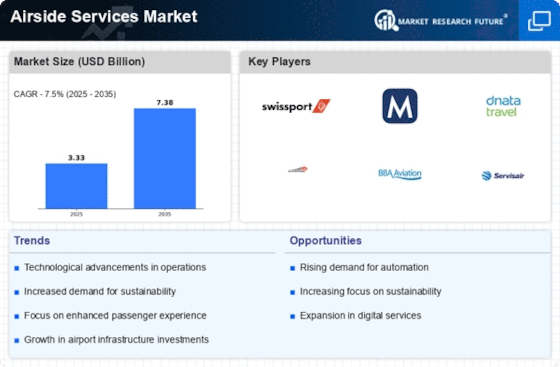
Airside Services Market Infographic
Purchase Options

Airside Services Size

Airside Services Market Growth Projections and Opportunities

The airside services market encompasses a wide range of ground handling and support services essential for the efficient operation of airports and aviation infrastructure. This market is influenced by several key factors that shape its growth and evolution. One of the primary drivers of the airside services market is the increasing demand for air travel and the growth of the aviation industry globally. As passenger traffic continues to rise, airports face the challenge of handling larger volumes of aircraft movements, baggage handling, and passenger services. This drives the demand for ground handling services such as aircraft marshalling, baggage loading and unloading, aircraft towing, and aircraft refueling to ensure smooth and timely aircraft turnaround times and efficient airport operations.

Moreover, the increasing trend towards outsourcing of ground handling services by airlines and airport operators is driving growth in the airside services market. Outsourcing allows airlines and airports to focus on their core activities while leveraging the expertise and resources of specialized ground handling service providers. Ground handling companies offer a wide range of services tailored to the specific needs of airlines and airports, including passenger handling, ramp services, cargo handling, and aircraft maintenance, repair, and overhaul (MRO) services. This creates opportunities for ground handling service providers to expand their service offerings, enter new markets, and forge strategic partnerships with airlines and airport operators, driving further growth in the airside services market.

Furthermore, advancements in technology and automation are transforming the airside services market, driving efficiency improvements and cost savings for airlines and airports. Automation technologies such as automated baggage handling systems, robotic baggage loaders, and self-service check-in kiosks enable airports to streamline passenger processing, reduce queuing times, and improve operational efficiency. Similarly, advanced ground support equipment (GSE) such as aircraft pushback tugs, baggage loaders, and de-icing trucks equipped with state-of-the-art technology and digital connectivity features enable ground handlers to perform tasks more efficiently and safely, reducing turnaround times and minimizing delays for airlines.

Additionally, the growing focus on safety and security in aviation operations is driving investment in airside services that enhance safety measures and compliance with regulatory requirements. Ground handling companies are investing in training programs, safety protocols, and equipment upgrades to ensure the highest standards of safety for passengers, crew, and airport personnel. This includes implementing technologies such as surveillance cameras, access control systems, and perimeter security solutions to prevent unauthorized access to restricted areas and mitigate security risks at airports. By prioritizing safety and security, ground handling service providers can build trust and confidence among airlines and passengers, driving further demand for their services in the airside services market.

Moreover, the emergence of environmental sustainability and carbon reduction initiatives is driving innovation and investment in eco-friendly ground handling practices and equipment. Ground handling companies are adopting alternative fuels, electric vehicles, and renewable energy sources to power their operations and reduce their carbon footprint. This includes initiatives such as electrification of ground support equipment, implementation of sustainable aviation fuel (SAF) programs, and adoption of green technologies for waste management and recycling. By embracing sustainable practices, ground handling service providers can not only reduce their environmental impact but also attract environmentally conscious airlines and passengers, driving further growth in the airside services market.
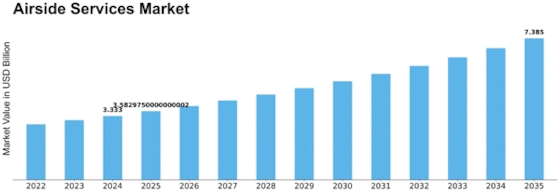

Airside Services Market Size Graph
Author
Swapnil Palwe
Team Lead - Research

With a technical background as Bachelor's in Mechanical Engineering, with MBA in Operations Management , Swapnil has 6+ years of experience in market research, consulting and analytics with the tasks of data mining, analysis, and project execution. He is the POC for our clients, for their consulting projects running under the Automotive/A&D domain. Swapnil has worked on major projects in verticals such as Aerospace & Defense, Automotive and many other domain projects. He has worked on projects for fortune 500 companies' syndicate and consulting projects along with several government projects.

Leave a Comment

FAQs

What is the projected market valuation of the Airside Services Market by 2035?

The Airside Services Market is projected to reach a valuation of 7.385 USD Billion by 2035.

What was the market valuation of the Airside Services Market in 2024?

In 2024, the overall market valuation was 3.333 USD Billion.

What is the expected CAGR for the Airside Services Market during the forecast period 2025 - 2035?

The expected CAGR for the Airside Services Market during the forecast period 2025 - 2035 is 7.5%.

Which companies are considered key players in the Airside Services Market?

Key players in the Airside Services Market include Swissport International Ltd, Menzies Aviation, Dnata, and Aviapartner.

What are the main operational segments of the Airside Services Market?

The main operational segments include Aircraft Handling, Passenger Handling, and Cargo Handling.

How much is the Aircraft Handling segment projected to grow by 2035?

The Aircraft Handling segment is projected to grow from 1.0 USD Billion in 2024 to 2.3 USD Billion by 2035.

Market Summary

As per MRFR analysis, the Airside Services Market Size was estimated at 3.333 USD Billion in 2024. The Airside Services industry is projected to grow from 3.583 USD Billion in 2025 to 7.385 USD Billion by 2035, exhibiting a compound annual growth rate (CAGR) of 7.5 during the forecast period 2025 - 2035.

Key Market Trends & Highlights

The Airside Services Market is poised for growth driven by technological advancements and sustainability initiatives.

  • Technological integration is reshaping airside operations, enhancing efficiency and safety across the sector.
  • The focus on sustainability is becoming increasingly prominent, with stakeholders prioritizing eco-friendly practices in airside services.
  • North America remains the largest market, while the Asia-Pacific region is emerging as the fastest-growing area for airside services.
  • Increased air traffic demand and regulatory compliance are key drivers propelling growth in the passenger handling segment, which is currently the largest.

Market Size & Forecast

2024 Market Size 3.333 (USD Billion)
2035 Market Size 7.385 (USD Billion)
CAGR (2025 - 2035) 7.5%
Largest Regional Market Share in 2024 North America

Major Players

<p>Swissport International Ltd (CH), Menzies Aviation (GB), Dnata (AE), Aviapartner (BE), BBA Aviation (GB), Servisair (GB), Air France KLM Martinair Cargo (FR), Qantas Ground Services (AU), TAM Ground Services (BR)</p>

Market Trends

The Airside Services Market is currently experiencing a dynamic evolution, driven by various factors that influence operational efficiency and customer satisfaction. As airports expand and modernize, the demand for comprehensive airside services, including ground handling, baggage services, and aircraft maintenance, appears to be on the rise. This trend is likely fueled by the increasing number of air travelers and the need for enhanced safety protocols. Moreover, advancements in technology, such as automation and digitalization, seem to play a pivotal role in streamlining operations and improving service delivery. Consequently, stakeholders in the Airside Services Market are compelled to adapt to these changes to remain competitive and meet the expectations of airlines and passengers alike. In addition to technological advancements, sustainability initiatives are gaining traction within the Airside Services Market. There is a growing emphasis on reducing carbon footprints and implementing eco-friendly practices. This shift may lead to the adoption of electric ground support equipment and the implementation of waste reduction strategies. Furthermore, collaboration among various stakeholders, including airlines, airport authorities, and service providers, appears essential for fostering innovation and enhancing service quality. As the market continues to evolve, it is crucial for industry players to stay attuned to these trends to capitalize on emerging opportunities and navigate potential challenges effectively.

Technological Integration

The integration of advanced technologies into airside operations is becoming increasingly prevalent. Automation and digital tools are enhancing efficiency, reducing turnaround times, and improving overall service quality. This trend suggests that companies in the Airside Services Market may need to invest in innovative solutions to remain competitive.

Sustainability Focus

A notable trend within the Airside Services Market is the heightened focus on sustainability. Stakeholders are increasingly prioritizing eco-friendly practices, such as utilizing electric vehicles and implementing waste management strategies. This shift indicates a broader commitment to reducing environmental impact.

Collaborative Approaches

Collaboration among various stakeholders is emerging as a key trend in the Airside Services Market. Partnerships between airlines, airport authorities, and service providers are likely to foster innovation and improve service delivery. This collaborative approach may enhance operational efficiency and customer satisfaction.

Airside Services Market Market Drivers

Collaborative Partnerships

Collaborative partnerships are emerging as a key driver in the Airside Services Market. Airports, airlines, and service providers are increasingly recognizing the benefits of working together to enhance operational efficiency and customer experience. These partnerships can lead to shared resources, improved communication, and streamlined processes, ultimately benefiting all stakeholders involved. For instance, joint ventures between airlines and ground handling companies can result in more efficient service delivery and cost reductions. Additionally, collaboration with technology firms can facilitate the integration of innovative solutions into airside operations. As the industry continues to evolve, the trend towards collaboration is likely to strengthen, fostering a more interconnected and efficient Airside Services Market.

Sustainability Initiatives

Sustainability initiatives are becoming increasingly prominent within the Airside Services Market. As environmental concerns grow, airports and airlines are prioritizing eco-friendly practices, such as reducing carbon emissions and minimizing waste. This shift is prompting airside service providers to adopt sustainable technologies and practices, such as electric ground support equipment and waste recycling programs. According to industry reports, the adoption of sustainable practices can lead to cost savings and improved operational efficiency. Furthermore, regulatory bodies are beginning to incentivize sustainable practices, which may further drive demand for environmentally friendly airside services. As the industry moves towards a more sustainable future, the Airside Services Market is likely to see a rise in demand for services that align with these initiatives.

Technological Advancements

Technological advancements play a crucial role in shaping the Airside Services Market. Innovations such as automated baggage handling systems, advanced ground support equipment, and real-time data analytics are transforming airside operations. The integration of artificial intelligence and machine learning is enhancing operational efficiency and safety. For instance, predictive maintenance technologies are being adopted to minimize aircraft downtime, which is essential for airlines aiming to optimize their schedules. Furthermore, the implementation of digital platforms for communication between ground services and airlines is streamlining processes. As technology continues to evolve, it is expected that airside service providers will increasingly leverage these advancements to improve service delivery and customer satisfaction, thereby driving growth in the Airside Services Market.

Increased Air Traffic Demand

The Airside Services Market is experiencing a notable surge in air traffic demand, driven by rising passenger numbers and cargo volumes. According to recent data, air travel is projected to grow at a compound annual growth rate of approximately 4.5% over the next decade. This increase necessitates enhanced airside services, including ground handling, baggage management, and aircraft maintenance. Airports are investing in infrastructure upgrades to accommodate this growth, which in turn fuels demand for airside services. As airlines expand their fleets and routes, the need for efficient airside operations becomes paramount. Consequently, service providers are likely to innovate and expand their offerings to meet the evolving needs of airlines and airports, thereby propelling the Airside Services Market forward.

Regulatory Compliance and Safety Standards

The Airside Services Market is significantly influenced by stringent regulatory compliance and safety standards imposed by aviation authorities. These regulations are designed to ensure the safety and security of air travel, necessitating that airside service providers adhere to specific operational protocols. Compliance with these standards often requires investment in training, equipment, and technology, which can be a driving force for market growth. For example, the International Civil Aviation Organization (ICAO) sets guidelines that airside service providers must follow, impacting their operational practices. As safety remains a top priority for airlines and airports, the demand for compliant airside services is likely to increase, thereby enhancing the overall market landscape.

Market Segment Insights

By Airport Class: Class A (Largest) vs. Class B (Fastest-Growing)

<p>In the Airside Services Market, the distribution of segments by airport class reveals that Class A continues to dominate with its robust infrastructure and high passenger traffic. It holds the largest market share due to its comprehensive service offerings, attracting a significant volume of operations. Class B, while smaller in comparison, is poised for substantial growth as airports focus on expanding their capacities and enhancing service quality to accommodate rising air travel demands.</p>

<p>Class A (Dominant) vs. Class B (Emerging)</p>

<p>Class A airports are characterized by their extensive facilities, advanced technology, and high levels of operational efficiency. They offer a wide range of airside services, including ground handling and passenger services, which are vital for managing large volumes of air traffic. Meanwhile, Class B airports, while traditionally seen as secondary, are emerging rapidly due to increased investments aimed at upgrading their infrastructure and expanding service capabilities. This competitive landscape is reshaping the market dynamics, with Class B airports carving out significant roles in handling air traffic, particularly in regions experiencing economic growth.</p>

By Operation: Passenger Handling (Largest) vs. Cargo Handling (Fastest-Growing)

<p>In the Airside Services Market, the operation segment showcases three primary categories: Aircraft Handling, Passenger Handling, and Cargo Handling. Passenger Handling holds the largest share in this segment, benefiting significantly from the booming travel industry, while Cargo Handling is emerging as the fastest-growing segment due to the increasing global demand for logistics and freight services. Aircraft Handling continues to play a crucial role as well, ensuring the effective management of flight operations and maintaining airport efficiency.</p>

<p>Passenger Handling: Dominant vs. Cargo Handling: Emerging</p>

<p>Passenger Handling has established itself as a dominant force within the Airside Services Market, providing essential services such as check-in, boarding, baggage handling, and customer service. This segment is characterized by its focus on enhancing the passenger experience and operational efficiency, leveraging technology to streamline processes and reduce wait times. Conversely, Cargo Handling, while currently smaller in market share, is rapidly emerging due to the rise in e-commerce and international trade, driving innovation in logistics solutions. Companies in this segment are investing in advanced tracking systems and infrastructure improvements to support increased cargo volumes, highlighting the shift in air transport towards freight as a key growth area.</p>

By Platform: Software (Largest) vs. Hardware (Fastest-Growing)

<p>In the Airside Services Market, the platform segment is primarily composed of three values: hardware, software, and service. Notably, software holds the largest market share, reflecting the increasing demand for sophisticated solutions that enhance operational efficiency and safety. Hardware, while currently smaller in share, is witnessing rapid adoption, driven by technological advancements and the need for modernized equipment in airside operations.</p>

<p>Software: Leading vs. Hardware: Fastest-Growing</p>

<p>Software solutions in the Airside Services Market are currently dominant as they provide critical functionality for managing airside operations, including flight tracking systems, baggage handling, and ground services management. These solutions improve efficiency and reduce operational costs for airports and ground service providers. On the other hand, hardware, encompassing essential equipment such as fueling systems and ground support vehicles, is emerging as the fastest-growing segment. The growth in hardware is propelled by the need for improved safety standards and maintenance practices, alongside the integration of advanced technologies such as automation and IoT, which are set to revolutionize airside services.</p>

By End Use: Commercial (Largest) vs. Military (Fastest-Growing)

<p>The Airside Services Market is primarily divided into two key end-use segments: Commercial and Military. The commercial segment holds the largest share, driven by the increasing number of commercial air travel and the corresponding need for ground support services. This segment benefits from the higher frequency of flights and the growing emphasis on passenger experience, which translates to investment in quality airside services. In contrast, the military segment, while currently smaller, is poised for rapid growth, propelled by increasing defense budgets and a rising focus on modernization of military operations, which includes enhanced logistical operations and support capabilities.</p>

<p>End Use: Commercial (Dominant) vs. Military (Emerging)</p>

<p>The commercial end-use segment of the Airside Services Market is characterized by its resilience and extensive availability of resources to meet the demands of civilian air travel. It includes a wide array of services such as passenger handling, ramp services, and cargo handling, all crucial for ensuring smooth airport operations. This segment sees consistent demand due to the healthy growth in air passenger traffic. On the other hand, the military segment is emerging as a significant player, focusing on specialized support services such as aircraft maintenance and logistics operations tailored to defense needs. This segment is increasingly focusing on technological advancements and strategic partnerships to enhance operational efficiency, leading to its projected faster growth.</p>

Get more detailed insights about Airside Services Market Research Report—Global Forecast till 2035

Regional Insights

North America : Market Leader in Airside Services Market

North America is the largest market for airside services, holding approximately 40% of the global share. The growth is driven by increasing air travel demand, technological advancements, and stringent safety regulations. The U.S. and Canada are the primary contributors, with a robust infrastructure supporting airside operations. Regulatory bodies like the FAA ensure compliance, fostering a competitive environment that encourages innovation and efficiency. The competitive landscape is characterized by major players such as Swissport International Ltd and Menzies Aviation, which dominate the market. The presence of these key players, along with a growing number of regional service providers, enhances service quality and operational efficiency. The U.S. market is particularly focused on integrating advanced technologies to streamline operations, ensuring a high standard of service delivery.

Europe : Emerging Hub for Airside Services Market

Europe is witnessing significant growth in the airside services market, accounting for approximately 30% of the global share. The demand is fueled by increasing passenger traffic and the expansion of low-cost carriers. Countries like the UK and Germany are leading the market, supported by favorable regulations and investments in airport infrastructure. The European Union's regulations on air transport safety and efficiency are pivotal in shaping market dynamics. The competitive landscape features key players such as Dnata and Aviapartner, which are expanding their operations across various European airports. The presence of multiple service providers enhances competition, driving innovation and service quality. Additionally, the European market is increasingly focusing on sustainability, with initiatives aimed at reducing carbon footprints in airside operations, aligning with broader EU environmental goals.

Asia-Pacific : Rapid Growth in Airside Services Market

The Asia-Pacific region is rapidly emerging as a significant player in the airside services market, holding about 25% of the global share. The growth is driven by rising air travel demand, particularly in countries like China and India, where increasing disposable incomes and urbanization are propelling air travel. Regulatory support from local governments is also enhancing operational standards and safety measures in the aviation sector. China is the largest market in the region, with substantial investments in airport infrastructure and airside services. Key players like Dnata and Qantas Ground Services are expanding their footprint, catering to the growing demand. The competitive landscape is evolving, with both local and international companies vying for market share, leading to improved service offerings and operational efficiencies across the region.

Middle East and Africa : Emerging Market with Potential

The Middle East and Africa region is witnessing a burgeoning airside services market, accounting for approximately 5% of the global share. The growth is primarily driven by increasing air travel, particularly in the Gulf states, where major airlines are expanding their operations. Regulatory frameworks are evolving to support this growth, with governments investing in airport infrastructure and airside service capabilities. Countries like the UAE and South Africa are at the forefront, with key players such as Dnata and TAM Ground Services enhancing service quality. The competitive landscape is characterized by a mix of established international firms and emerging local players, fostering innovation and improved service delivery. The region's strategic location as a transit hub further enhances its potential in the airside services market, attracting investments and partnerships.

Key Players and Competitive Insights

Leading market players are investing heavily in research and development in order to expand their product lines, which will help the Airside Services Market, grow even more. Market participants are also undertaking a variety of strategic activities to expand their global footprint, with important market developments including new product launches, contractual agreements, mergers and acquisitions, higher investments, and collaboration with other organizations. To expand and survive in a more competitive and rising market climate, Airside Services industry must offer cost-effective items.

Manufacturing locally to minimize operational costs is one of the key business tactics used by manufacturers in the global Airside Services industry to benefit clients and increase the market sector. In recent years, the Airside Services industry has offered some of the most significant advantages to medicine. Major players in the Airside Services Market, including Aena, Amadeus IT Group SA, Cisco Systems, Inc., Daifuku Co.

Ltd, Damarel System International Ltd., Honeywell International Inc., HUAWEI TECHNOLOGIES CO., LTD., IBM, INFORM GMBH, Indra, QinetiQ, Raytheon Technologies Corporation, Siemens, SITA, Teledyne Technologies Incorporated, and Thales, are attempting to increase market demand by investing in research and development operations.

A media and communications company is Havas SA (Havas). Advertising, analytics and decision sciences, brand designing, brand strategies, content development and administration, digital commerce, direct marketing, and engagement planning are all services that the company provides. Additionally, it provides services for designing user experiences, product development, social marketing, healthcare communications, mobile marketing, PR, corporate communications, and integrated planning, buying, contest, and marketing support services across channels. Additionally, the business has a number of cooperative workspaces known as Havas villages around the globe that allow colleagues from different fields and media and creative companies to collaborate.

Operating in the Americas, Europe, Asia Pacific, and Africa are Havas and its subsidiaries. The headquarters of Havas are in Paris, Ile-de-France, France. Havaş purchased MZLZ Ground Handling Services in February 2022 to operate at Zagreb Airport (ZAG). Zagreb is now the 31st air terminal in Havaş' portfolio because to this new arrangement. In Zagreb, Croatia, Havaş has announced that it will begin offering airport services.

Ground and air cargo handling services are offered by Swissport International AG (Swissport). Passenger services, ramp handling, lounge hospitality, fueling, aircraft maintenance, and aviation security are all part of the company's service offering. Other aviation services offered by Swissport include flight planning, aid for passengers and crew, help with customs and immigration, and booking aircraft charter. The company offers a variety of cargo services, including trucking, warehousing, freight handling, and freighter ramp services. Additionally, the business provides e-ticketing, catering arrangements, hotel and restaurant bookings, and automobile rentals.

It is present in a number of nations in Europe, Africa, the Middle East, Asia-Pacific, North America, and Latin America. The headquarters of Swissport are in Zurich, Switzerland. Swissport International and the International Airlines Group (IAG) inked a contract in March 2021 to provide air terminal ground services to IAG's carriers at the new Berlin Brandenburg International Airport (BER) for an extended period of time.

Key Companies in the Airside Services Market market include

Industry Developments

September 2021: The main new customer of Worldwide Flight Services (WFS) at London Heathrow is now Sri Lankan Airlines.

Future Outlook

Airside Services Market Future Outlook

<p>The Airside Services Market is projected to grow at a 7.5% CAGR from 2024 to 2035, driven by increasing air traffic, technological advancements, and sustainability initiatives.</p>

New opportunities lie in:

  • <p>Implementation of automated baggage handling systems to enhance efficiency.</p>
  • <p>Development of eco-friendly ground support equipment to meet sustainability goals.</p>
  • <p>Expansion of digital platforms for real-time service tracking and management.</p>

<p>By 2035, the Airside Services Market is expected to be robust, driven by innovation and strategic investments.</p>

Market Segmentation

Airside Services Market End Use Outlook

  • Commercial
  • Military

Airside Services Market Platform Outlook

  • Hardware
  • Software
  • Service

Airside Services Market Operation Outlook

  • Aircraft Handling
  • Passenger Handling
  • Cargo Handling

Airside Services Market Airport Class Outlook

  • Class A
  • Class B
  • Class C
  • Class D

Report Scope

MARKET SIZE 20243.333(USD Billion)
MARKET SIZE 20253.583(USD Billion)
MARKET SIZE 20357.385(USD Billion)
COMPOUND ANNUAL GROWTH RATE (CAGR)7.5% (2024 - 2035)
REPORT COVERAGERevenue Forecast, Competitive Landscape, Growth Factors, and Trends
BASE YEAR2024
Market Forecast Period2025 - 2035
Historical Data2019 - 2024
Market Forecast UnitsUSD Billion
Key Companies ProfiledMarket analysis in progress
Segments CoveredMarket segmentation analysis in progress
Key Market OpportunitiesIntegration of advanced automation technologies enhances efficiency in the Airside Services Market.
Key Market DynamicsTechnological advancements and regulatory changes drive innovation and efficiency in the airside services market.

Countries CoveredNorth America, Europe, APAC, South America, MEA

FAQs

What is the projected market valuation of the Airside Services Market by 2035?

The Airside Services Market is projected to reach a valuation of 7.385 USD Billion by 2035.

What was the market valuation of the Airside Services Market in 2024?

In 2024, the overall market valuation was 3.333 USD Billion.

What is the expected CAGR for the Airside Services Market during the forecast period 2025 - 2035?

The expected CAGR for the Airside Services Market during the forecast period 2025 - 2035 is 7.5%.

Which companies are considered key players in the Airside Services Market?

Key players in the Airside Services Market include Swissport International Ltd, Menzies Aviation, Dnata, and Aviapartner.

What are the main operational segments of the Airside Services Market?

The main operational segments include Aircraft Handling, Passenger Handling, and Cargo Handling.

How much is the Aircraft Handling segment projected to grow by 2035?

The Aircraft Handling segment is projected to grow from 1.0 USD Billion in 2024 to 2.3 USD Billion by 2035.

  1. SECTION I: EXECUTIVE SUMMARY AND KEY HIGHLIGHTS
    1. EXECUTIVE SUMMARY
      1. Market Overview
      2. Key Findings
      3. Market Segmentation
      4. Competitive Landscape
      5. Challenges and Opportunities
      6. Future Outlook
  2. SECTION II: SCOPING, METHODOLOGY AND MARKET STRUCTURE
    1. MARKET INTRODUCTION
      1. Definition
      2. Scope of the study
    2. RESEARCH METHODOLOGY
      1. Overview
      2. Data Mining
      3. Secondary Research
      4. Primary Research
      5. Forecasting Model
      6. Market Size Estimation
      7. Data Triangulation
      8. Validation
  3. SECTION III: QUALITATIVE ANALYSIS
    1. MARKET DYNAMICS
      1. Overview
      2. Drivers
      3. Restraints
      4. Opportunities
    2. MARKET FACTOR ANALYSIS
      1. Value chain Analysis
      2. Porter's Five Forces Analysis
      3. COVID-19 Impact Analysis
  4. SECTION IV: QUANTITATIVE ANALYSIS
    1. Aerospace & Defense, BY Airport Class (USD Billion)
      1. Class A
      2. Class B
      3. Class C
      4. Class D
    2. Aerospace & Defense, BY Operation (USD Billion)
      1. Aircraft Handling
      2. Passenger Handling
      3. Cargo Handling
    3. Aerospace & Defense, BY Platform (USD Billion)
      1. Hardware
      2. Software
      3. Service
    4. Aerospace & Defense, BY End Use (USD Billion)
      1. Commercial
      2. Military
    5. Aerospace & Defense, BY Region (USD Billion)
      1. North America
      2. Europe
      3. APAC
      4. South America
      5. MEA
  5. SECTION V: COMPETITIVE ANALYSIS
    1. Competitive Landscape
      1. Overview
      2. Competitive Analysis
      3. Market share Analysis
      4. Major Growth Strategy in the Aerospace & Defense
      5. Competitive Benchmarking
      6. Leading Players in Terms of Number of Developments in the Aerospace & Defense
      7. Key developments and growth strategies
      8. Major Players Financial Matrix
    2. Company Profiles
      1. Swissport International Ltd (CH)
      2. Menzies Aviation (GB)
      3. Dnata (AE)
      4. Aviapartner (BE)
      5. BBA Aviation (GB)
      6. Servisair (GB)
      7. Air France KLM Martinair Cargo (FR)
      8. Qantas Ground Services (AU)
      9. TAM Ground Services (BR)
    3. Appendix
      1. References
      2. Related Reports
  6. LIST OF FIGURES
    1. MARKET SYNOPSIS
    2. NORTH AMERICA MARKET ANALYSIS
    3. US MARKET ANALYSIS BY AIRPORT CLASS
    4. US MARKET ANALYSIS BY OPERATION
    5. US MARKET ANALYSIS BY PLATFORM
    6. US MARKET ANALYSIS BY END USE
    7. CANADA MARKET ANALYSIS BY AIRPORT CLASS
    8. CANADA MARKET ANALYSIS BY OPERATION
    9. CANADA MARKET ANALYSIS BY PLATFORM
    10. CANADA MARKET ANALYSIS BY END USE
    11. EUROPE MARKET ANALYSIS
    12. GERMANY MARKET ANALYSIS BY AIRPORT CLASS
    13. GERMANY MARKET ANALYSIS BY OPERATION
    14. GERMANY MARKET ANALYSIS BY PLATFORM
    15. GERMANY MARKET ANALYSIS BY END USE
    16. UK MARKET ANALYSIS BY AIRPORT CLASS
    17. UK MARKET ANALYSIS BY OPERATION
    18. UK MARKET ANALYSIS BY PLATFORM
    19. UK MARKET ANALYSIS BY END USE
    20. FRANCE MARKET ANALYSIS BY AIRPORT CLASS
    21. FRANCE MARKET ANALYSIS BY OPERATION
    22. FRANCE MARKET ANALYSIS BY PLATFORM
    23. FRANCE MARKET ANALYSIS BY END USE
    24. RUSSIA MARKET ANALYSIS BY AIRPORT CLASS
    25. RUSSIA MARKET ANALYSIS BY OPERATION
    26. RUSSIA MARKET ANALYSIS BY PLATFORM
    27. RUSSIA MARKET ANALYSIS BY END USE
    28. ITALY MARKET ANALYSIS BY AIRPORT CLASS
    29. ITALY MARKET ANALYSIS BY OPERATION
    30. ITALY MARKET ANALYSIS BY PLATFORM
    31. ITALY MARKET ANALYSIS BY END USE
    32. SPAIN MARKET ANALYSIS BY AIRPORT CLASS
    33. SPAIN MARKET ANALYSIS BY OPERATION
    34. SPAIN MARKET ANALYSIS BY PLATFORM
    35. SPAIN MARKET ANALYSIS BY END USE
    36. REST OF EUROPE MARKET ANALYSIS BY AIRPORT CLASS
    37. REST OF EUROPE MARKET ANALYSIS BY OPERATION
    38. REST OF EUROPE MARKET ANALYSIS BY PLATFORM
    39. REST OF EUROPE MARKET ANALYSIS BY END USE
    40. APAC MARKET ANALYSIS
    41. CHINA MARKET ANALYSIS BY AIRPORT CLASS
    42. CHINA MARKET ANALYSIS BY OPERATION
    43. CHINA MARKET ANALYSIS BY PLATFORM
    44. CHINA MARKET ANALYSIS BY END USE
    45. INDIA MARKET ANALYSIS BY AIRPORT CLASS
    46. INDIA MARKET ANALYSIS BY OPERATION
    47. INDIA MARKET ANALYSIS BY PLATFORM
    48. INDIA MARKET ANALYSIS BY END USE
    49. JAPAN MARKET ANALYSIS BY AIRPORT CLASS
    50. JAPAN MARKET ANALYSIS BY OPERATION
    51. JAPAN MARKET ANALYSIS BY PLATFORM
    52. JAPAN MARKET ANALYSIS BY END USE
    53. SOUTH KOREA MARKET ANALYSIS BY AIRPORT CLASS
    54. SOUTH KOREA MARKET ANALYSIS BY OPERATION
    55. SOUTH KOREA MARKET ANALYSIS BY PLATFORM
    56. SOUTH KOREA MARKET ANALYSIS BY END USE
    57. MALAYSIA MARKET ANALYSIS BY AIRPORT CLASS
    58. MALAYSIA MARKET ANALYSIS BY OPERATION
    59. MALAYSIA MARKET ANALYSIS BY PLATFORM
    60. MALAYSIA MARKET ANALYSIS BY END USE
    61. THAILAND MARKET ANALYSIS BY AIRPORT CLASS
    62. THAILAND MARKET ANALYSIS BY OPERATION
    63. THAILAND MARKET ANALYSIS BY PLATFORM
    64. THAILAND MARKET ANALYSIS BY END USE
    65. INDONESIA MARKET ANALYSIS BY AIRPORT CLASS
    66. INDONESIA MARKET ANALYSIS BY OPERATION
    67. INDONESIA MARKET ANALYSIS BY PLATFORM
    68. INDONESIA MARKET ANALYSIS BY END USE
    69. REST OF APAC MARKET ANALYSIS BY AIRPORT CLASS
    70. REST OF APAC MARKET ANALYSIS BY OPERATION
    71. REST OF APAC MARKET ANALYSIS BY PLATFORM
    72. REST OF APAC MARKET ANALYSIS BY END USE
    73. SOUTH AMERICA MARKET ANALYSIS
    74. BRAZIL MARKET ANALYSIS BY AIRPORT CLASS
    75. BRAZIL MARKET ANALYSIS BY OPERATION
    76. BRAZIL MARKET ANALYSIS BY PLATFORM
    77. BRAZIL MARKET ANALYSIS BY END USE
    78. MEXICO MARKET ANALYSIS BY AIRPORT CLASS
    79. MEXICO MARKET ANALYSIS BY OPERATION
    80. MEXICO MARKET ANALYSIS BY PLATFORM
    81. MEXICO MARKET ANALYSIS BY END USE
    82. ARGENTINA MARKET ANALYSIS BY AIRPORT CLASS
    83. ARGENTINA MARKET ANALYSIS BY OPERATION
    84. ARGENTINA MARKET ANALYSIS BY PLATFORM
    85. ARGENTINA MARKET ANALYSIS BY END USE
    86. REST OF SOUTH AMERICA MARKET ANALYSIS BY AIRPORT CLASS
    87. REST OF SOUTH AMERICA MARKET ANALYSIS BY OPERATION
    88. REST OF SOUTH AMERICA MARKET ANALYSIS BY PLATFORM
    89. REST OF SOUTH AMERICA MARKET ANALYSIS BY END USE
    90. MEA MARKET ANALYSIS
    91. GCC COUNTRIES MARKET ANALYSIS BY AIRPORT CLASS
    92. GCC COUNTRIES MARKET ANALYSIS BY OPERATION
    93. GCC COUNTRIES MARKET ANALYSIS BY PLATFORM
    94. GCC COUNTRIES MARKET ANALYSIS BY END USE
    95. SOUTH AFRICA MARKET ANALYSIS BY AIRPORT CLASS
    96. SOUTH AFRICA MARKET ANALYSIS BY OPERATION
    97. SOUTH AFRICA MARKET ANALYSIS BY PLATFORM
    98. SOUTH AFRICA MARKET ANALYSIS BY END USE
    99. REST OF MEA MARKET ANALYSIS BY AIRPORT CLASS
    100. REST OF MEA MARKET ANALYSIS BY OPERATION
    101. REST OF MEA MARKET ANALYSIS BY PLATFORM
    102. REST OF MEA MARKET ANALYSIS BY END USE
    103. KEY BUYING CRITERIA OF AEROSPACE & DEFENSE
    104. RESEARCH PROCESS OF MRFR
    105. DRO ANALYSIS OF AEROSPACE & DEFENSE
    106. DRIVERS IMPACT ANALYSIS: AEROSPACE & DEFENSE
    107. RESTRAINTS IMPACT ANALYSIS: AEROSPACE & DEFENSE
    108. SUPPLY / VALUE CHAIN: AEROSPACE & DEFENSE
    109. AEROSPACE & DEFENSE, BY AIRPORT CLASS, 2024 (% SHARE)
    110. AEROSPACE & DEFENSE, BY AIRPORT CLASS, 2024 TO 2035 (USD Billion)
    111. AEROSPACE & DEFENSE, BY OPERATION, 2024 (% SHARE)
    112. AEROSPACE & DEFENSE, BY OPERATION, 2024 TO 2035 (USD Billion)
    113. AEROSPACE & DEFENSE, BY PLATFORM, 2024 (% SHARE)
    114. AEROSPACE & DEFENSE, BY PLATFORM, 2024 TO 2035 (USD Billion)
    115. AEROSPACE & DEFENSE, BY END USE, 2024 (% SHARE)
    116. AEROSPACE & DEFENSE, BY END USE, 2024 TO 2035 (USD Billion)
    117. BENCHMARKING OF MAJOR COMPETITORS
  7. LIST OF TABLES
    1. LIST OF ASSUMPTIONS
    2. North America MARKET SIZE ESTIMATES; FORECAST
      1. BY AIRPORT CLASS, 2025-2035 (USD Billion)
      2. BY OPERATION, 2025-2035 (USD Billion)
      3. BY PLATFORM, 2025-2035 (USD Billion)
      4. BY END USE, 2025-2035 (USD Billion)
    3. US MARKET SIZE ESTIMATES; FORECAST
      1. BY AIRPORT CLASS, 2025-2035 (USD Billion)
      2. BY OPERATION, 2025-2035 (USD Billion)
      3. BY PLATFORM, 2025-2035 (USD Billion)
      4. BY END USE, 2025-2035 (USD Billion)
    4. Canada MARKET SIZE ESTIMATES; FORECAST
      1. BY AIRPORT CLASS, 2025-2035 (USD Billion)
      2. BY OPERATION, 2025-2035 (USD Billion)
      3. BY PLATFORM, 2025-2035 (USD Billion)
      4. BY END USE, 2025-2035 (USD Billion)
    5. Europe MARKET SIZE ESTIMATES; FORECAST
      1. BY AIRPORT CLASS, 2025-2035 (USD Billion)
      2. BY OPERATION, 2025-2035 (USD Billion)
      3. BY PLATFORM, 2025-2035 (USD Billion)
      4. BY END USE, 2025-2035 (USD Billion)
    6. Germany MARKET SIZE ESTIMATES; FORECAST
      1. BY AIRPORT CLASS, 2025-2035 (USD Billion)
      2. BY OPERATION, 2025-2035 (USD Billion)
      3. BY PLATFORM, 2025-2035 (USD Billion)
      4. BY END USE, 2025-2035 (USD Billion)
    7. UK MARKET SIZE ESTIMATES; FORECAST
      1. BY AIRPORT CLASS, 2025-2035 (USD Billion)
      2. BY OPERATION, 2025-2035 (USD Billion)
      3. BY PLATFORM, 2025-2035 (USD Billion)
      4. BY END USE, 2025-2035 (USD Billion)
    8. France MARKET SIZE ESTIMATES; FORECAST
      1. BY AIRPORT CLASS, 2025-2035 (USD Billion)
      2. BY OPERATION, 2025-2035 (USD Billion)
      3. BY PLATFORM, 2025-2035 (USD Billion)
      4. BY END USE, 2025-2035 (USD Billion)
    9. Russia MARKET SIZE ESTIMATES; FORECAST
      1. BY AIRPORT CLASS, 2025-2035 (USD Billion)
      2. BY OPERATION, 2025-2035 (USD Billion)
      3. BY PLATFORM, 2025-2035 (USD Billion)
      4. BY END USE, 2025-2035 (USD Billion)
    10. Italy MARKET SIZE ESTIMATES; FORECAST
      1. BY AIRPORT CLASS, 2025-2035 (USD Billion)
      2. BY OPERATION, 2025-2035 (USD Billion)
      3. BY PLATFORM, 2025-2035 (USD Billion)
      4. BY END USE, 2025-2035 (USD Billion)
    11. Spain MARKET SIZE ESTIMATES; FORECAST
      1. BY AIRPORT CLASS, 2025-2035 (USD Billion)
      2. BY OPERATION, 2025-2035 (USD Billion)
      3. BY PLATFORM, 2025-2035 (USD Billion)
      4. BY END USE, 2025-2035 (USD Billion)
    12. Rest of Europe MARKET SIZE ESTIMATES; FORECAST
      1. BY AIRPORT CLASS, 2025-2035 (USD Billion)
      2. BY OPERATION, 2025-2035 (USD Billion)
      3. BY PLATFORM, 2025-2035 (USD Billion)
      4. BY END USE, 2025-2035 (USD Billion)
    13. APAC MARKET SIZE ESTIMATES; FORECAST
      1. BY AIRPORT CLASS, 2025-2035 (USD Billion)
      2. BY OPERATION, 2025-2035 (USD Billion)
      3. BY PLATFORM, 2025-2035 (USD Billion)
      4. BY END USE, 2025-2035 (USD Billion)
    14. China MARKET SIZE ESTIMATES; FORECAST
      1. BY AIRPORT CLASS, 2025-2035 (USD Billion)
      2. BY OPERATION, 2025-2035 (USD Billion)
      3. BY PLATFORM, 2025-2035 (USD Billion)
      4. BY END USE, 2025-2035 (USD Billion)
    15. India MARKET SIZE ESTIMATES; FORECAST
      1. BY AIRPORT CLASS, 2025-2035 (USD Billion)
      2. BY OPERATION, 2025-2035 (USD Billion)
      3. BY PLATFORM, 2025-2035 (USD Billion)
      4. BY END USE, 2025-2035 (USD Billion)
    16. Japan MARKET SIZE ESTIMATES; FORECAST
      1. BY AIRPORT CLASS, 2025-2035 (USD Billion)
      2. BY OPERATION, 2025-2035 (USD Billion)
      3. BY PLATFORM, 2025-2035 (USD Billion)
      4. BY END USE, 2025-2035 (USD Billion)
    17. South Korea MARKET SIZE ESTIMATES; FORECAST
      1. BY AIRPORT CLASS, 2025-2035 (USD Billion)
      2. BY OPERATION, 2025-2035 (USD Billion)
      3. BY PLATFORM, 2025-2035 (USD Billion)
      4. BY END USE, 2025-2035 (USD Billion)
    18. Malaysia MARKET SIZE ESTIMATES; FORECAST
      1. BY AIRPORT CLASS, 2025-2035 (USD Billion)
      2. BY OPERATION, 2025-2035 (USD Billion)
      3. BY PLATFORM, 2025-2035 (USD Billion)
      4. BY END USE, 2025-2035 (USD Billion)
    19. Thailand MARKET SIZE ESTIMATES; FORECAST
      1. BY AIRPORT CLASS, 2025-2035 (USD Billion)
      2. BY OPERATION, 2025-2035 (USD Billion)
      3. BY PLATFORM, 2025-2035 (USD Billion)
      4. BY END USE, 2025-2035 (USD Billion)
    20. Indonesia MARKET SIZE ESTIMATES; FORECAST
      1. BY AIRPORT CLASS, 2025-2035 (USD Billion)
      2. BY OPERATION, 2025-2035 (USD Billion)
      3. BY PLATFORM, 2025-2035 (USD Billion)
      4. BY END USE, 2025-2035 (USD Billion)
    21. Rest of APAC MARKET SIZE ESTIMATES; FORECAST
      1. BY AIRPORT CLASS, 2025-2035 (USD Billion)
      2. BY OPERATION, 2025-2035 (USD Billion)
      3. BY PLATFORM, 2025-2035 (USD Billion)
      4. BY END USE, 2025-2035 (USD Billion)
    22. South America MARKET SIZE ESTIMATES; FORECAST
      1. BY AIRPORT CLASS, 2025-2035 (USD Billion)
      2. BY OPERATION, 2025-2035 (USD Billion)
      3. BY PLATFORM, 2025-2035 (USD Billion)
      4. BY END USE, 2025-2035 (USD Billion)
    23. Brazil MARKET SIZE ESTIMATES; FORECAST
      1. BY AIRPORT CLASS, 2025-2035 (USD Billion)
      2. BY OPERATION, 2025-2035 (USD Billion)
      3. BY PLATFORM, 2025-2035 (USD Billion)
      4. BY END USE, 2025-2035 (USD Billion)
    24. Mexico MARKET SIZE ESTIMATES; FORECAST
      1. BY AIRPORT CLASS, 2025-2035 (USD Billion)
      2. BY OPERATION, 2025-2035 (USD Billion)
      3. BY PLATFORM, 2025-2035 (USD Billion)
      4. BY END USE, 2025-2035 (USD Billion)
    25. Argentina MARKET SIZE ESTIMATES; FORECAST
      1. BY AIRPORT CLASS, 2025-2035 (USD Billion)
      2. BY OPERATION, 2025-2035 (USD Billion)
      3. BY PLATFORM, 2025-2035 (USD Billion)
      4. BY END USE, 2025-2035 (USD Billion)
    26. Rest of South America MARKET SIZE ESTIMATES; FORECAST
      1. BY AIRPORT CLASS, 2025-2035 (USD Billion)
      2. BY OPERATION, 2025-2035 (USD Billion)
      3. BY PLATFORM, 2025-2035 (USD Billion)
      4. BY END USE, 2025-2035 (USD Billion)
    27. MEA MARKET SIZE ESTIMATES; FORECAST
      1. BY AIRPORT CLASS, 2025-2035 (USD Billion)
      2. BY OPERATION, 2025-2035 (USD Billion)
      3. BY PLATFORM, 2025-2035 (USD Billion)
      4. BY END USE, 2025-2035 (USD Billion)
    28. GCC Countries MARKET SIZE ESTIMATES; FORECAST
      1. BY AIRPORT CLASS, 2025-2035 (USD Billion)
      2. BY OPERATION, 2025-2035 (USD Billion)
      3. BY PLATFORM, 2025-2035 (USD Billion)
      4. BY END USE, 2025-2035 (USD Billion)
    29. South Africa MARKET SIZE ESTIMATES; FORECAST
      1. BY AIRPORT CLASS, 2025-2035 (USD Billion)
      2. BY OPERATION, 2025-2035 (USD Billion)
      3. BY PLATFORM, 2025-2035 (USD Billion)
      4. BY END USE, 2025-2035 (USD Billion)
    30. Rest of MEA MARKET SIZE ESTIMATES; FORECAST
      1. BY AIRPORT CLASS, 2025-2035 (USD Billion)
      2. BY OPERATION, 2025-2035 (USD Billion)
      3. BY PLATFORM, 2025-2035 (USD Billion)
      4. BY END USE, 2025-2035 (USD Billion)
    31. PRODUCT LAUNCH/PRODUCT DEVELOPMENT/APPROVAL
    32. ACQUISITION/PARTNERSHIP

Airside Services Market Segmentation

Airside Services Airport Class Outlook (USD Billion, 2018-2032)

  • Class A
  • Class B
  • Class C
  • Class D

Airside Services Operation Outlook (USD Billion, 2018-2032)

  • Aircraft Handling
  • Passenger Handling
  • Cargo Handling

Airside Services Platform Outlook (USD Billion, 2018-2032)

  • Hardware
  • Software
  • Service

Airside Services End Use Outlook (USD Billion, 2018-2032)

  • Commercial
  • Military

Airside Services Regional Outlook (USD Billion, 2018-2032)

  • North America Outlook (USD Billion, 2018-2032)

    • Airside Services by Airport Class
      • Class A
      • Class B
      • Class C
      • Class D
    • Airside Services Operation Outlook (USD Billion, 2018-2032)

      • Aircraft Handling
      • Passenger Handling
      • Cargo Handling
    • Airside Services Platform Outlook (USD Billion, 2018-2032)

      • Hardware
      • Software
      • Service
    • Airside Services End Use Outlook (USD Billion, 2018-2032)

      • Commercial
      • Military
    • US Outlook (USD Billion, 2018-2032)

    • Airside Services by Airport Class
      • Class A
      • Class B
      • Class C
      • Class D
    • Airside Services Operation Outlook (USD Billion, 2018-2032)

      • Aircraft Handling
      • Passenger Handling
      • Cargo Handling
    • Airside Services Platform Outlook (USD Billion, 2018-2032)

      • Hardware
      • Software
      • Service
    • Airside Services End Use Outlook (USD Billion, 2018-2032)

      • Commercial
      • Military
    • Canada Outlook (USD Billion, 2018-2032)

    • Airside Services by Airport Class
      • Class A
      • Class B
      • Class C
      • Class D
    • Airside Services Operation Outlook (USD Billion, 2018-2032)

      • Aircraft Handling
      • Passenger Handling
      • Cargo Handling
    • Airside Services Platform Outlook (USD Billion, 2018-2032)

      • Hardware
      • Software
      • Service
    • Airside Services End Use Outlook (USD Billion, 2018-2032)

      • Commercial
      • Military
  • Europe Outlook (USD Billion, 2018-2032)

    • Airside Services by Airport Class
      • Class A
      • Class B
      • Class C
      • Class D
    • Airside Services Operation Outlook (USD Billion, 2018-2032)

      • Aircraft Handling
      • Passenger Handling
      • Cargo Handling
    • Airside Services Platform Outlook (USD Billion, 2018-2032)

      • Hardware
      • Software
      • Service
    • Airside Services End Use Outlook (USD Billion, 2018-2032)

      • Commercial
      • Military
    • Germany Outlook (USD Billion, 2018-2032)

    • Airside Services by Airport Class
      • Class A
      • Class B
      • Class C
      • Class D
    • Airside Services Operation Outlook (USD Billion, 2018-2032)

      • Aircraft Handling
      • Passenger Handling
      • Cargo Handling
    • Airside Services Platform Outlook (USD Billion, 2018-2032)

      • Hardware
      • Software
      • Service
    • Airside Services End Use Outlook (USD Billion, 2018-2032)

      • Commercial
      • Military
    • France Outlook (USD Billion, 2018-2032)

    • Airside Services by Airport Class
      • Class A
      • Class B
      • Class C
      • Class D
    • Airside Services Operation Outlook (USD Billion, 2018-2032)

      • Aircraft Handling
      • Passenger Handling
      • Cargo Handling
    • Airside Services Platform Outlook (USD Billion, 2018-2032)

      • Hardware
      • Software
      • Service
    • Airside Services End Use Outlook (USD Billion, 2018-2032)

      • Commercial
      • Military
    • UK Outlook (USD Billion, 2018-2032)

    • Airside Services by Airport Class
      • Class A
      • Class B
      • Class C
      • Class D
    • Airside Services Operation Outlook (USD Billion, 2018-2032)

      • Aircraft Handling
      • Passenger Handling
      • Cargo Handling
    • Airside Services Platform Outlook (USD Billion, 2018-2032)

      • Hardware
      • Software
      • Service
    • Airside Services End Use Outlook (USD Billion, 2018-2032)

      • Commercial
      • Military
    • Italy Outlook (USD Billion, 2018-2032)

    • Airside Services by Airport Class
      • Class A
      • Class B
      • Class C
      • Class D
    • Airside Services Operation Outlook (USD Billion, 2018-2032)

      • Aircraft Handling
      • Passenger Handling
      • Cargo Handling
    • Airside Services Platform Outlook (USD Billion, 2018-2032)

      • Hardware
      • Software
      • Service
    • Airside Services End Use Outlook (USD Billion, 2018-2032)

      • Commercial
      • Military
    • Spain Outlook (USD Billion, 2018-2032)

    • Airside Services by Airport Class
      • Class A
      • Class B
      • Class C
      • Class D
    • Airside Services Operation Outlook (USD Billion, 2018-2032)

      • Aircraft Handling
      • Passenger Handling
      • Cargo Handling
    • Airside Services Platform Outlook (USD Billion, 2018-2032)

      • Hardware
      • Software
      • Service
    • Airside Services End Use Outlook (USD Billion, 2018-2032)

      • Commercial
      • Military
    • Rest Of Europe Outlook (USD Billion, 2018-2032)

    • Airside Services by Airport Class
      • Class A
      • Class B
      • Class C
      • Class D
    • Airside Services Operation Outlook (USD Billion, 2018-2032)

      • Aircraft Handling
      • Passenger Handling
      • Cargo Handling
    • Airside Services Platform Outlook (USD Billion, 2018-2032)

      • Hardware
      • Software
      • Service
    • Airside Services End Use Outlook (USD Billion, 2018-2032)

      • Commercial
      • Military
  • Asia-Pacific Outlook (USD Billion, 2018-2032)

    • Airside Services by Airport Class
      • Class A
      • Class B
      • Class C
      • Class D
    • Airside Services Operation Outlook (USD Billion, 2018-2032)

      • Aircraft Handling
      • Passenger Handling
      • Cargo Handling
    • Airside Services Platform Outlook (USD Billion, 2018-2032)

      • Hardware
      • Software
      • Service
    • Airside Services End Use Outlook (USD Billion, 2018-2032)

      • Commercial
      • Military
    • China Outlook (USD Billion, 2018-2032)

      • Class A
      • Class B
      • Class C
      • Class D
    • Airside Services Operation Outlook (USD Billion, 2018-2032)

      • Aircraft Handling
      • Passenger Handling
      • Cargo Handling
    • Airside Services Platform Outlook (USD Billion, 2018-2032)

      • Hardware
      • Software
      • Service
    • Airside Services End Use Outlook (USD Billion, 2018-2032)

      • Commercial
      • Military
    • Japan Outlook (USD Billion, 2018-2032)

    • Airside Services by Airport Class
      • Class A
      • Class B
      • Class C
      • Class D
    • Airside Services Operation Outlook (USD Billion, 2018-2032)

      • Aircraft Handling
      • Passenger Handling
      • Cargo Handling
    • Airside Services Platform Outlook (USD Billion, 2018-2032)

      • Hardware
      • Software
      • Service
    • Airside Services End Use Outlook (USD Billion, 2018-2032)

      • Commercial
      • Military
    • India Outlook (USD Billion, 2018-2032)

    • Airside Services by Airport Class
      • Class A
      • Class B
      • Class C
      • Class D
    • Airside Services Operation Outlook (USD Billion, 2018-2032)

      • Aircraft Handling
      • Passenger Handling
      • Cargo Handling
    • Airside Services Platform Outlook (USD Billion, 2018-2032)

      • Hardware
      • Software
      • Service
    • Airside Services End Use Outlook (USD Billion, 2018-2032)

      • Commercial
      • Military
    • Australia Outlook (USD Billion, 2018-2032)

    • Airside Services by Airport Class
      • Class A
      • Class B
      • Class C
      • Class D
    • Airside Services Operation Outlook (USD Billion, 2018-2032)

      • Aircraft Handling
      • Passenger Handling
      • Cargo Handling
    • Airside Services Platform Outlook (USD Billion, 2018-2032)

      • Hardware
      • Software
      • Service
    • Airside Services End Use Outlook (USD Billion, 2018-2032)

      • Commercial
      • Military
    • Rest of Asia-Pacific Outlook (USD Billion, 2018-2032)

    • Airside Services by Airport Class
      • Class A
      • Class B
      • Class C
      • Class D
    • Airside Services Operation Outlook (USD Billion, 2018-2032)

      • Aircraft Handling
      • Passenger Handling
      • Cargo Handling
    • Airside Services Platform Outlook (USD Billion, 2018-2032)

      • Hardware
      • Software
      • Service
    • Airside Services End Use Outlook (USD Billion, 2018-2032)

      • Commercial
      • Military
  • Rest of the World Outlook (USD Billion, 2018-2032)

    • Airside Services by Airport Class
      • Class A
      • Class B
      • Class C
      • Class D
    • Airside Services Operation Outlook (USD Billion, 2018-2032)

      • Aircraft Handling
      • Passenger Handling
      • Cargo Handling
    • Airside Services Platform Outlook (USD Billion, 2018-2032)

      • Hardware
      • Software
      • Service
    • Airside Services End Use Outlook (USD Billion, 2018-2032)

      • Commercial
      • Military
    • Middle East Outlook (USD Billion, 2018-2032)

    • Airside Services by Airport Class
      • Class A
      • Class B
      • Class C
      • Class D
    • Airside Services Operation Outlook (USD Billion, 2018-2032)

      • Aircraft Handling
      • Passenger Handling
      • Cargo Handling
    • Airside Services Platform Outlook (USD Billion, 2018-2032)

      • Hardware
      • Software
      • Service
    • Airside Services End Use Outlook (USD Billion, 2018-2032)

      • Commercial
      • Military
    • Africa Outlook (USD Billion, 2018-2032)

    • Airside Services by Airport Class
      • Class A
      • Class B
      • Class C
      • Class D
    • Airside Services Operation Outlook (USD Billion, 2018-2032)

      • Aircraft Handling
      • Passenger Handling
      • Cargo Handling
    • Airside Services Platform Outlook (USD Billion, 2018-2032)

      • Hardware
      • Software
      • Service
    • Airside Services End Use Outlook (USD Billion, 2018-2032)

      • Commercial
      • Military
    • Latin America Outlook (USD Billion, 2018-2032)

    • Airside Services by Airport Class
      • Class A
      • Class B
      • Class C
      • Class D
    • Airside Services Operation Outlook (USD Billion, 2018-2032)

      • Aircraft Handling
      • Passenger Handling
      • Cargo Handling
    • Airside Services Platform Outlook (USD Billion, 2018-2032)

      • Hardware
      • Software
      • Service
    • Airside Services End Use Outlook (USD Billion, 2018-2032)

      • Commercial
      • Military

Infographic

Free Sample Request

Kindly complete the form below to receive a free sample of this Report

Get Free Sample

Customer Strories

Compare Licence

×
Features License Type
Single User Multiuser License Enterprise User
Price $4,950 $5,950 $7,250
Maximum User Access Limit 1 User Upto 10 Users Unrestricted Access Throughout the Organization
Free Customization
Direct Access to Analyst
Deliverable Format
Platform Access
Discount on Next Purchase 10% 15% 15%
Printable Versions