×
Request Free Sample ×

Kindly complete the form below to receive a free sample of this Report

* Please use a valid business email

Leading companies partner with us for data-driven Insights

clients tt-cursor
Hero Background
English
Chinese
French
Japanese
Korean
German
Spanish

Airport Ground Support Equipment Market Analysis

ID: MRFR/AD/4663-HCR
100 Pages
Sejal Akre
February 2026

Airport Ground Support Equipment Market Size, Share, Industry Trend & Analysis Research Report Information by Type (Fixed and Mobile), Power Source (Hybrid GSE, Electric GSE, and Non-Electric GSE), Application (Aircraft Handling, Cargo Handling, and Passenger Handling), Equipment (Assembly Tool and Movement Equipment), End User (Military Airport and Commercial Airport) and Region (North America, Europe, Asia-Pacific, Middle East & Africa, and Latin America)-Forecast till 2035

Share:
Download PDF ×

We do not share your information with anyone. However, we may send you emails based on your report interest from time to time. You may contact us at any time to opt-out.

Airport Ground Support Equipment Market Infographic
Purchase Options

Market Analysis

In-depth Analysis of Airport Ground Support Equipment Market Industry Landscape

The airport ground support equipment (GSE) market is influenced by various market factors that collectively shape its dynamics, ranging from the expansion of air travel to regulatory requirements and technological advancements. One key factor is the robust growth in global air traffic. The increasing number of air passengers worldwide drives the demand for efficient ground handling operations at airports, thereby fostering the need for advanced GSE. As airports experience heightened aircraft movements and higher passenger volumes, the market factors are influenced by the imperative to enhance operational efficiency and maintain smooth airport logistics.

Buckle up for smoother takeoffs and landings! The aircraft ground support equipment market is about to hit the runway with a 6.4% CAGR, reaching a projected USD 9.6 billion by 2030. Think everything from baggage loaders to pushback tugs and passenger shuttles – this vital behind-the-scenes crew keeps planes prepped, passengers pampered, and cargo on track. So next time you soar through the skies, remember the silent heroes of the tarmac ensuring your journey is safe, efficient, and maybe even a little more comfortable. Safety and environmental regulations constitute significant market factors in the airport GSE sector. The aviation industry is subject to stringent safety standards and environmental mandates, requiring airports and ground handling service providers to adhere to specific guidelines. Compliance with these regulations influences the market dynamics, prompting manufacturers to develop GSE that meets safety and emission standards. The demand for GSE that aligns with environmental sustainability goals, incorporating features like lower emissions and noise reduction, is a notable factor shaping the market.

Technological advancements play a pivotal role in shaping the market factors of the airport GSE market. The continual evolution of technologies, including electric propulsion, automation, telematics, and connectivity, introduces new capabilities and efficiencies to ground handling operations. The market factors are influenced by the development of smart GSE equipped with sensors, data analytics, and real-time monitoring capabilities, contributing to improved maintenance practices and operational effectiveness. The pace of technological innovation drives market competitiveness and shapes procurement decisions by airports seeking cutting-edge solutions.

Economic factors, such as fuel prices and overall economic conditions, significantly impact the airport GSE market. Fluctuations in fuel prices have a direct effect on operational costs for airlines and airports. The market factors are influenced by the demand for fuel-efficient GSE solutions that contribute to cost savings. Additionally, the overall economic climate and conditions influence the budgetary decisions of airports, affecting their capacity to invest in new and advanced GSE. Economic stability and growth contribute to increased capital expenditure, fostering demand for innovative GSE solutions.

Airports' infrastructural development projects are critical market factors in the airport GSE sector. As airports undergo expansions, renovations, and capacity enhancements to accommodate growing air traffic, the demand for GSE that integrates seamlessly with modern airport infrastructure becomes imperative. Market factors are shaped by the need for GSE solutions that can support increased aircraft movements and passenger loads, contributing to the efficiency of ground handling operations during airport infrastructure development projects.

The trend towards outsourcing and privatization of ground handling services is a significant market factor influencing the demand for airport GSE. Many airports globally opt to outsource ground handling operations to specialized service providers, creating a demand for efficient and adaptable GSE. Market factors are shaped by the need for GSE solutions that can cater to diverse aircraft types and handle various ground handling functions efficiently, aligning with the requirements of outsourced services and privatized ground handling operations.

Regulatory initiatives related to safety and emissions contribute to market factors influencing the airport GSE sector. Governments and aviation authorities implement regulations to ensure safe and environmentally responsible ground handling practices. Compliance with these regulations becomes a market factor that guides the development and adoption of GSE solutions. Manufacturers focusing on innovative and compliant GSE solutions gain a competitive edge in a market where adherence to regulatory standards is paramount.

The global focus on sustainability and environmental responsibility is a growing market factor in the airport GSE sector. The aviation industry is increasingly recognizing the importance of reducing its carbon footprint and adopting greener practices. Market factors are influenced by the demand for GSE solutions that prioritize environmental sustainability, including electric and hybrid options, as airports strive to align with global efforts to mitigate the environmental impact of air travel.

Global events, such as the COVID-19 pandemic, can significantly impact market factors in the airport GSE sector. The pandemic underscored the importance of health and hygiene considerations in airport operations. Market factors were influenced by the need for GSE solutions that prioritize passenger and employee safety, introducing features such as touchless controls and antimicrobial surfaces to enhance health-conscious ground handling practices.

Author
Sejal Akre
Senior Research Analyst

She has over 5 years of rich experience, in market research and consulting providing valuable market insights to client. Hands on expertise in management consulting, and extensive knowledge in domain including ICT, Automotive & Transportation and Aerospace & Defense. She is skilled in Go-to market strategy, industry analysis, market sizing, in depth company profiling, competitive intelligence & benchmarking and value chain amongst others.

Leave a Comment

FAQs

Which region is generating the higher Airport Ground Support Equipment Market Share for the forecast period?

The Asia Pacific region is generating a higher Airport Ground Support Equipment Market Share for 2020-2030.

What are the major segments of the Airport Ground Support Equipment Market?

The Airport Ground Support Equipment Market has been segregated into the application, end-users, power source, equipment, and types.

What are the major growth driving factors of the Airport Ground Support Equipment Market?

The Airport Ground Support Equipment Market has driven its growth due to the increasing investments in the airport infrastructure, increasing several airport expansions, and increasing warehouse operations at airports.

Market Summary

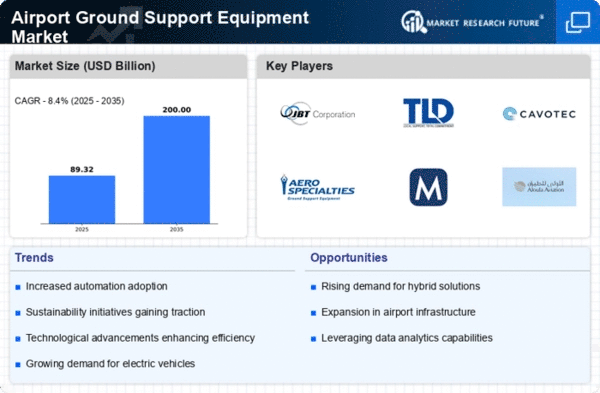
As per MRFR analysis, the Airport Ground Support Equipment Market Size was estimated at 82.4 USD Billion in 2024. The Airport Ground Support Equipment industry is projected to grow from 89.3 USD Billion in 2025 to 200.0 USD Billion by 2035, exhibiting a compound annual growth rate (CAGR) of 8.4 during the forecast period 2025 - 2035.

Key Market Trends & Highlights

The Airport Ground Support Equipment Market is poised for substantial growth driven by sustainability and technological advancements.

  • North America remains the largest market for airport ground support equipment, reflecting robust infrastructure and air traffic demand.
  • Asia-Pacific is emerging as the fastest-growing region, propelled by rapid airport expansions and increasing air travel.
  • The passenger transport segment dominates the market, while the cargo transport segment is witnessing the fastest growth due to rising e-commerce activities.
  • Key market drivers include increased air traffic demand and regulatory compliance, which are shaping the industry's evolution.

Market Size & Forecast

2024 Market Size 82.4 (USD Billion)
2035 Market Size 200.0 (USD Billion)
CAGR (2025 - 2035) 8.4%
Largest Regional Market Share in 2024 North America

Major Players

JBT Corporation (US), TLD Group (FR), Cavotec SA (CH), Aero Specialties Inc (US), Menzies Aviation (GB), Doll Aviation (DE), Konecranes (FI), Textron GSE (US), Cavotec (SE)

Market Trends

Airport Ground Support Equipment

Airport Ground Support Equipment Market Market Drivers

Market Growth Projections

The Global airport ground support equipment Market (GSE) Industry is poised for substantial growth, with projections indicating a market value of 9.6 USD Billion in 2024 and an anticipated increase to 19.0 USD Billion by 2035. This growth trajectory suggests a compound annual growth rate of 6.4% from 2025 to 2035. Such projections reflect the increasing demand for advanced ground support solutions, driven by factors such as rising air traffic, technological advancements, and sustainability initiatives. The market's expansion is likely to create opportunities for innovation and investment, further enhancing the capabilities of ground support operations worldwide.

Sustainability Initiatives

Sustainability initiatives are becoming a cornerstone of the Global Airport Ground Support Equipment Industry. Airports are increasingly adopting green practices to reduce their environmental footprint. This shift is evident in the growing demand for electric and hybrid ground support airport gse equipment, which aligns with global efforts to combat climate change. As airports strive to meet sustainability targets, investments in eco-friendly equipment are likely to rise. This trend not only enhances operational efficiency but also appeals to environmentally conscious travelers. The focus on sustainability is expected to contribute to the market's growth trajectory, with a projected value of 19.0 USD Billion by 2035.

Technological Advancements

Technological innovations play a pivotal role in shaping the Global Airport Ground Support Equipment Industry. The integration of automation and digital solutions enhances operational efficiency and safety. For instance, the adoption of electric ground support equipment reduces carbon emissions and operational costs, aligning with global sustainability goals. As airports increasingly prioritize eco-friendly practices, the demand for advanced airport gse equipment is expected to rise. This trend is likely to contribute to the market's projected growth, with a compound annual growth rate of 6.4% anticipated from 2025 to 2035. Thus, technological advancements are not merely enhancements but essential components for future market expansion.

Globalization of Air Travel

The globalization of air travel is a significant driver of the Global Airport Ground Support Equipment Industry. As international travel becomes more accessible, airports are experiencing increased passenger volumes and diverse airline operations. This trend necessitates the expansion and modernization of ground support equipment to accommodate various aircraft types and operational requirements. Airports are investing in versatile equipment that can handle the complexities of global air travel, including multi-functional vehicles and advanced baggage handling systems. This globalization trend is likely to stimulate market growth, as airports seek to enhance their capabilities and improve passenger experiences.

Increasing Air Traffic Demand

The Global Airport Ground Support Equipment Industry is experiencing a surge in demand driven by the increasing volume of air traffic worldwide. As more passengers opt for air travel, airports are compelled to enhance their operational efficiency and capacity. This trend is expected to contribute to the market's growth, with projections indicating a market value of 9.6 USD Billion in 2024. The need for advanced ground support equipment, such as baggage handling systems and refueling vehicles, becomes paramount to accommodate this rising demand. Consequently, investments in modernizing ground support infrastructure are likely to escalate, further propelling the market forward.

Regulatory Compliance and Safety Standards

The Global Airport Ground Support Equipment Industry is significantly influenced by stringent regulatory compliance and safety standards. Governments worldwide are implementing rigorous regulations to ensure the safety and efficiency of airport operations. Compliance with these regulations necessitates the acquisition of modern ground support equipment that meets safety and environmental standards. As a result, airports are increasingly investing in state-of-the-art equipment to adhere to these regulations. This trend is expected to drive market growth, as the need for compliant airport gse equipment becomes a priority for airport operators. The emphasis on safety and compliance is likely to shape the future landscape of the market.

Market Segment Insights

By Application: Passenger Transport (Largest) vs. Cargo Transport (Fastest-Growing)

In the Airport Ground Support Equipment Market, the application segment is primarily dominated by Passenger Transport, which holds the largest market share. This segment encompasses a wide range of equipment used to facilitate the efficient movement of passengers from check-in to boarding. Cargo Transport, while smaller, is rapidly gaining traction due to the increasing demand for air freight services. Both of these segments play crucial roles in the overall functionality and efficiency of airport operations.

Passenger Transport (Dominant) vs. Cargo Transport (Emerging)

Passenger Transport stands out as the dominant application in the Airport Ground Support Equipment Market, characterized by the extensive use of vehicles and equipment such as baggage carts, passenger boarding bridges, and shuttle buses. This sector is critical for enhancing the passenger experience and ensuring smooth airport operations. Conversely, Cargo Transport is emerging quickly, fueled by a surge in e-commerce and global trade. This segment focuses on the equipment needed for the efficient handling and transportation of cargo, including cargo loaders and dollies. Both Passenger and Cargo Transport require ongoing innovation and investment to keep pace with evolving airport demands and technological advancements.

By Equipment Type: Tugs (Largest) vs. De-icing Equipment (Fastest-Growing)

In the Airport Ground Support Equipment Market, Tugs hold the largest market share, representing a critical component for efficient baggage and cargo movement. Following Tugs, Belt Loaders and Ground Power Units also share a significant portion of the market, catering to the essential needs of airport operations. Pushback Tractors, while pivotal for aircraft movements, and De-icing Equipment are vital for specialized functions, with the latter gaining remarkable traction due to increasing regulatory demands regarding safety in flight operations during winter conditions.

Belt Loaders (Dominant) vs. Pushback Tractors (Emerging)

Belt Loaders are a dominant force in the Airport Ground Support Equipment Market due to their crucial role in facilitating the loading and unloading of baggage and cargo from aircraft. Their efficiency and reliability make them indispensable for airport operations. On the other hand, Pushback Tractors are emerging in importance as airports increasingly seek to optimize the movement of aircraft on taxiways and aprons. The growing trend towards automation and advancements in tractor technology are likely to enhance the capabilities, safety, and operational efficiency of Pushback Tractors, highlighting their potential for future growth.

By Power Source: Electric (Largest) vs. Hydrogen Fuel Cell (Fastest-Growing)

The Airport Ground Support Equipment (GSE) Market exhibits a diverse distribution among various power sources. Electric ground support equipment currently holds the largest market share due to its increasing adoption driven by environmental sustainability efforts. This segment benefits from advancements in battery technology and lower operational costs, making it a preferred choice for many airport operators focused on efficiency and reduced emissions. In contrast, the hydrogen fuel cell segment is gaining momentum as one of the fastest-growing power sources in the GSE market. This growth is propelled by the global shift toward greener alternatives and substantial investments in hydrogen infrastructure. Moreover, the unique advantage of hydrogen fuel cells, such as faster refueling times and longer operational ranges, positions it as a promising option for future airport ground operations, enhancing market competition further.

Electric (Dominant) vs. Hydrogen Fuel Cell (Emerging)

The electric segment is undeniably dominant in the Airport Ground Support Equipment market, characterized by its established presence and favorable operational costs. Electric ground support equipment is equipped with advanced batteries that provide efficient power with lower environmental impact, appealing to airports aiming to fulfill sustainability goals. On the other hand, the hydrogen fuel cell segment is an emerging contender, showcasing innovative potential for fueling GSE. Hydrogen fuel cells provide unique benefits, including faster refueling and extended range compared to traditional electric systems. With growing support from government initiatives and substantial investments in hydrogen infrastructure, this segment is expected to attract considerable attention from airport authorities seeking futuristic and sustainable ground support solutions.

Get more detailed insights about Airport Ground Support Equipment Market Research Report - Forecast till 2035

Regional Insights

North America : Market Leader in Ground Support

North America is poised to maintain its leadership in the Airport Ground Support Equipment market, holding a significant 41.0% share as of 2024. The region's growth is driven by increasing air travel demand, technological advancements, and stringent safety regulations. Government initiatives aimed at enhancing airport infrastructure further catalyze market expansion, ensuring compliance with evolving standards and improving operational efficiency. The competitive landscape in North America is robust, featuring key players such as JBT Corporation, Aero Specialties Inc, and Textron GSE. These companies are leveraging innovation to enhance their product offerings, focusing on electric and eco-friendly equipment. The U.S. remains the largest market, supported by a well-established aviation sector and ongoing investments in airport modernization projects. The presence of major manufacturers ensures a dynamic market environment, fostering continuous improvement and competitiveness.

Europe : Emerging Market with Growth Potential

Europe's Airport Ground Support Equipment market is experiencing notable growth, accounting for 25.0% of the global share. The region benefits from increasing passenger traffic and a focus on sustainability, driving demand for advanced ground support solutions. Regulatory frameworks promoting environmental standards and efficiency are pivotal in shaping market dynamics, encouraging investments in innovative technologies and equipment. Leading countries such as Germany, France, and the UK are at the forefront of this growth, with companies like TLD Group and Menzies Aviation playing significant roles. The competitive landscape is characterized by a mix of established players and emerging startups, fostering innovation. The European market is also witnessing collaborations aimed at enhancing service delivery and operational efficiency, positioning it as a key player in the global arena.

Asia-Pacific : Rapid Growth in Aviation Sector

The Asia-Pacific region is witnessing rapid growth in the Airport Ground Support Equipment market, holding a 14.0% share. This growth is fueled by increasing air travel, urbanization, and government investments in airport infrastructure. Regulatory support for enhancing safety and efficiency in ground operations is also a significant driver, encouraging the adoption of advanced technologies and equipment in the sector. Countries like China, India, and Japan are leading the charge, with a growing number of airports and rising passenger volumes. Key players such as Cavotec SA and Konecranes are expanding their presence in the region, focusing on innovative solutions tailored to local needs. The competitive landscape is evolving, with both The Airport Ground Support Equipment share, ensuring a dynamic environment for growth and development.

Middle East and Africa : Emerging Market with Unique Challenges

The Middle East and Africa region represents a nascent market in Airport Ground Support Equipment, with a share of 2.4%. Despite its smaller size, the region is poised for growth driven by increasing air travel and investments in airport infrastructure. Government initiatives aimed at enhancing connectivity and tourism are pivotal in shaping market dynamics, fostering demand for efficient ground support solutions. Countries like the UAE and South Africa are leading the way, with significant airport expansion projects underway. The competitive landscape is characterized by a mix of local and international players, including Doll Aviation and Cavotec. As the region continues to develop its aviation sector, the demand for advanced ground support equipment is expected to rise, presenting opportunities for growth and innovation.

Key Players and Competitive Insights

The Airport Ground Support Equipment Market is characterized by a dynamic competitive landscape, driven by increasing air travel demand and the need for efficient ground operations. Key players such as JBT Corporation (US), TLD Group (FR), and Cavotec SA (CH) are at the forefront, each adopting distinct strategies to enhance their market positioning. JBT Corporation (US) focuses on innovation through the development of advanced automated solutions, while TLD Group (FR) emphasizes regional expansion and partnerships to strengthen its global footprint. Cavotec SA (CH) appears to be concentrating on sustainability initiatives, integrating eco-friendly technologies into its product offerings. Collectively, these strategies contribute to a competitive environment that is increasingly focused on technological advancement and operational efficiency.In terms of business tactics, companies are localizing manufacturing and optimizing supply chains to enhance responsiveness to market demands. The competitive structure of the market is moderately fragmented, with several key players exerting influence over various segments. This fragmentation allows for niche players to thrive, while larger companies leverage their scale to drive innovation and efficiency.

In November JBT Corporation (US) announced the launch of a new line of electric ground support equipment aimed at reducing carbon emissions. This strategic move not only aligns with global sustainability trends but also positions JBT as a leader in eco-friendly solutions, potentially attracting environmentally conscious clients and enhancing its market share.

In October TLD Group (FR) entered into a strategic partnership with a leading technology firm to develop AI-driven ground support solutions. This collaboration is likely to enhance TLD's product offerings, enabling more efficient operations and improved safety standards, which could significantly bolster its competitive edge in the market.

In September Cavotec SA (CH) unveiled a new range of automated baggage handling systems designed to streamline airport operations. This innovation reflects Cavotec's commitment to enhancing operational efficiency and reducing turnaround times, which are critical factors in the highly competitive airport services sector.

As of December the competitive trends in the Airport Ground Support Equipment Market are increasingly defined by digitalization, sustainability, and AI integration. Strategic alliances are becoming more prevalent, as companies recognize the need to collaborate to stay ahead in a rapidly evolving landscape. Looking forward, competitive differentiation is expected to shift from price-based competition to a focus on innovation, technology, and supply chain reliability, as companies strive to meet the demands of a more discerning customer base.

Key Companies in the Airport Ground Support Equipment Market include

Industry Developments

On May 30, 2023,

Oshkosh Corporation, a leading manufacturer of purpose-built vehicles and equipment, announced that it is acquiring the AeroTech business from JBT Corporation. The acquisition will enable Oshkosh to enter the attractive air transportation support market, witnessing increasing air travel demand, commercial airline investments, and infrastructure improvement.

On Apr. 14, 2023,

Air India, a Tata Group airline, announced signing an agreement with KSU Aviation to deploy TaxiBot ground handling for its Airbus A320 Family of aircraft at Delhi and Bengaluru airports.

Using the semi-robotic TaxiBot aircraft ground handling vehicle will offer multiple benefits, including reduced operational emissions by cutting the need for the aircraft to use its engines during the taxi procedure. In addition, the TaxiBots adoption at the two major Indian airports will allow a potential saving of approx. Fifteen thousand tonnes of fuel over the next three years.

On Mar.31, 2023,

Mallaghan, a leading global manufacturer of airport ground support equipment (GSE), announced a major recruitment drive at its Dungannon headquarters. The company stated that it is creating 30 new positions to respond to sustained customer demand across its expansive product range, witnessing increased order values. As a leading GSE manufacturer, Mallaghan aims to deliver modern, sustainable products to major airlines and airports worldwide.

On Dec. 15, 2022,

Celebi India announced winning a ground-handling contract at Chennai International Airport. The company will provide ground handling support to scheduled & non-scheduled airlines at domestic and international terminals.

Celebi will provide quality ground handling services at Chennai airport and develop a sustainable ecosystem meeting the larger needs of the aviation industry to become carbon neutral very soon. The company has started working on fulfilling the requirements to start the services. The company understands the growing needs of the Indian airlines and aviation industry and is well-equipped to meet current & future airline and passenger traffic.

Competitive Landscape Analysis

According to the Airport Ground Support Equipment Market Analysis, the marketing leaders are the right hand of the global market who are contributing more significantly to the global market. These market leaders are:

  • JBT Corporation (US)
  • Textron Ground Support Equipment Inc. (US)
  • MULAG Fahrzeugwerk (Germany)
  • Rheinmetall AG (Germany)
  • TLD (France)
  • Mallaghan Engineering Limited (UK)
  • Tronair Inc. (US)
  • GATE GSE (Belgium)
  • Curtis Instruments, Inc. (US)
  • STANGCO Industrial Equipment, Inc. (US)
  • Shenzhen CIMC-TianDa Airport Support Ltd. (CIMC-TianDa) (China)
  • Avia Equipment Pte Ltd (Singapore)
  • Charlotte America (US).

In the global Airport Ground Support Equipment Market Trends, the key leaders are making efforts to promote the equipment and adopting new innovative techniques to develop the new equipment.

Future Outlook

Airport Ground Support Equipment Market Future Outlook

The Airport Ground Support Equipment Market is projected to grow at an 8.4% CAGR from 2025 to 2035, driven by technological advancements, increasing air traffic, and sustainability initiatives.

New opportunities lie in:

  • Integration of electric ground support vehicles for reduced emissions.
  • Development of automated baggage handling systems to enhance efficiency.
  • Implementation of predictive maintenance solutions to minimize downtime.

By 2035, the market is expected to be robust, driven by innovation and sustainability.

Market Segmentation

Airport Ground Support Equipment Market Application Outlook

  • Passenger Transport
  • Cargo Transport
  • Aircraft Maintenance
  • Ground Handling
  • Baggage Handling

Airport Ground Support Equipment Market Power Source Outlook

  • Electric
  • Internal Combustion Engine
  • Hybrid
  • Hydrogen Fuel Cell
  • Solar

Airport Ground Support Equipment Market Equipment Type Outlook

  • Tugs
  • Belt Loaders
  • Ground Power Units
  • Pushback Tractors
  • De-icing Equipment

Report Scope

MARKET SIZE 202482.4(USD Billion)
MARKET SIZE 202589.3(USD Billion)
MARKET SIZE 2035200.0(USD Billion)
COMPOUND ANNUAL GROWTH RATE (CAGR)8.4% (2025 - 2035)
REPORT COVERAGERevenue Forecast, Competitive Landscape, Growth Factors, and Trends
BASE YEAR2024
Market Forecast Period2025 - 2035
Historical Data2019 - 2024
Market Forecast UnitsUSD Billion
Key Companies ProfiledJBT Corporation (US), TLD Group (FR), Cavotec SA (CH), Aero Specialties Inc (US), Menzies Aviation (GB), Doll Aviation (DE), Konecranes (FI), Textron GSE (US), Cavotec (SE)
Segments CoveredApplication, Equipment Type, Power Source
Key Market OpportunitiesIntegration of electric vehicles and automation in the Airport Ground Support Equipment Market.
Key Market DynamicsTechnological advancements and regulatory changes drive innovation and efficiency in the Airport Ground Support Equipment market.
Countries CoveredNorth America, Europe, APAC, South America, MEA

FAQs

Which region is generating the higher Airport Ground Support Equipment Market Share for the forecast period?

The Asia Pacific region is generating a higher Airport Ground Support Equipment Market Share for 2020-2030.

What are the major segments of the Airport Ground Support Equipment Market?

The Airport Ground Support Equipment Market has been segregated into the application, end-users, power source, equipment, and types.

What are the major growth driving factors of the Airport Ground Support Equipment Market?

The Airport Ground Support Equipment Market has driven its growth due to the increasing investments in the airport infrastructure, increasing several airport expansions, and increasing warehouse operations at airports.

  1. SECTION I: EXECUTIVE SUMMARY AND KEY HIGHLIGHTS
    1. EXECUTIVE SUMMARY
      1. Market Overview
      2. Key Findings
      3. Market Segmentation
      4. Competitive Landscape
      5. Challenges and Opportunities
      6. Future Outlook
  2. SECTION II: SCOPING, METHODOLOGY AND MARKET STRUCTURE
    1. MARKET INTRODUCTION
      1. Definition
      2. Scope of the study
    2. RESEARCH METHODOLOGY
      1. Overview
      2. Data Mining
      3. Secondary Research
      4. Primary Research
      5. Forecasting Model
      6. Market Size Estimation
      7. Data Triangulation
      8. Validation
  3. SECTION III: QUALITATIVE ANALYSIS
    1. MARKET DYNAMICS
      1. Overview
      2. Drivers
      3. Restraints
      4. Opportunities
    2. MARKET FACTOR ANALYSIS
      1. Value chain Analysis
      2. Porter's Five Forces Analysis
      3. COVID-19 Impact Analysis
  4. SECTION IV: QUANTITATIVE ANALYSIS
    1. Airport Ground Support Equipment Market, BY Application (USD Billion)
      1. Passenger Transport
      2. Cargo Transport
      3. Aircraft Maintenance
      4. Ground Handling
      5. Baggage Handling
    2. Airport Ground Support Equipment Market, BY Equipment Type (USD Billion)
      1. Tugs
      2. Belt Loaders
      3. Ground Power Units
      4. Pushback Tractors
      5. De-icing Equipment
    3. Airport Ground Support Equipment Market, BY Power Source (USD Billion)
      1. Electric
      2. Internal Combustion Engine
      3. Hybrid
      4. Hydrogen Fuel Cell
      5. Solar
    4. Airport Ground Support Equipment Market, BY Region (USD Billion)
      1. North America
      2. Europe
      3. APAC
      4. South America
      5. MEA
  5. SECTION V: COMPETITIVE ANALYSIS
    1. Competitive Landscape
      1. Overview
      2. Competitive Analysis
      3. Market share Analysis
      4. Major Growth Strategy in the Aerospace & Defense
      5. Competitive Benchmarking
      6. Leading Players in Terms of Number of Developments in the Aerospace & Defense
      7. Key developments and growth strategies
      8. Major Players Financial Matrix
    2. Company Profiles
      1. JBT Corporation (US)
      2. TLD Group (FR)
      3. Cavotec SA (CH)
      4. Aero Specialties Inc (US)
      5. Menzies Aviation (GB)
      6. Doll Aviation (DE)
      7. Konecranes (FI)
      8. Textron GSE (US)
      9. Cavotec (SE)
    3. Appendix
      1. References
      2. Related Reports

Airport Ground Support Equipment Market Segmentation

Airport Ground Support Equipment Market By Application (USD Billion, 2025-2035)

  • Passenger Transport
  • Cargo Transport
  • Aircraft Maintenance
  • Ground Handling
  • Baggage Handling

Airport Ground Support Equipment Market By Equipment Type (USD Billion, 2025-2035)

  • Tugs
  • Belt Loaders
  • Ground Power Units
  • Pushback Tractors
  • De-icing Equipment

Airport Ground Support Equipment Market By Power Source (USD Billion, 2025-2035)

  • Electric
  • Internal Combustion Engine
  • Hybrid
  • Hydrogen Fuel Cell
  • Solar
Infographic

Free Sample Request

Kindly complete the form below to receive a free sample of this Report

Get Free Sample

Customer Strories

Compare Licence

×
Features License Type
Single User Multiuser License Enterprise User
Price $4,950 $5,950 $7,250
Maximum User Access Limit 1 User Upto 10 Users Unrestricted Access Throughout the Organization
Free Customization
Direct Access to Analyst
Deliverable Format
Platform Access
Discount on Next Purchase 10% 15% 15%
Printable Versions