
Request Free Sample ×

Kindly complete the form below to receive a free sample of this Report

* Please use a valid business email

Leading companies partner with us for data-driven Insights

clients tt-cursor
Hero Background
English
Chinese
French
Japanese
Korean
German
Spanish

Aircraft Gearbox Market Size

ID: MRFR/AD/8844-HCR
168 Pages
Abbas Raut
March 2026

Aircraft Gearbox Market Size, Share, Industry Trend & Analysis Research Report Information By End User (OEM and Aftermarket), Gearbox Type (Accessory Gearbox, Reduction Gearbox, Actuation Gearbox, Tail Rotor Gearbox, Auxiliary Power Unit Gearbox and Others), Aircraft Type (Civil Aircraft and Military Aircraft), Component (Gears, Housing, Bearing and Others), Application (Engine and Airframe) and Region (North America, Europe, Asia-Pacific and Rest of the World) - Forecast till 2035

Share:
Download PDF ×

We do not share your information with anyone. However, we may send you emails based on your report interest from time to time. You may contact us at any time to opt-out.

Aircraft Gearbox Market Infographic
Purchase Options

Aircraft Gearbox Size

Aircraft Gearbox Market Growth Projections and Opportunities

The Aircraft Gearbox Market is dynamic due to several variables, indicating the importance of gearbox systems in aviation. Technological innovation drives market dynamics. Modern aircraft manufacturers want innovative gearbox systems that improve efficiency, weight, and performance. Market dynamics encourage continual innovation to meet the changing needs of military and commercial aircraft gearbox systems. Geopolitics influence the Aircraft Gearbox Market. Advanced gearbox systems are needed for military aircraft due to national security and strategic requirements. Air forces worldwide have specific operational and regional security concerns. Hence, the industry dynamically provides tailored gearbox solutions. Gearbox designs must adjust to various countries' sociopolitical conditions and mission characteristics. Aviation innovations and air travel trends affect the Aircraft Gearbox Market. Aircraft makers want gearbox systems that transmit power reliably, save maintenance, and improve safety. Market conditions favor gearbox systems with lightweight materials, better durability, and efficiency. The necessity for adaptable gearbox systems that can meet the changing demands of aircraft platforms drives demand. Aircraft Gearbox Market dynamics depend on technological integration. Gearbox solutions must interface with other aircraft components as avionics systems grow increasingly complex. Market dynamics emphasize the development of gearbox systems that can work together in the aviation ecosystem to improve aircraft efficiency and connectivity. The aviation Gearbox Market is driven by aviation system interoperability and cooperation. To ensure aircraft dependability and performance, manufacturers seek gearbox systems that interact smoothly with engines, avionics, and other important components. Market dynamics promote interoperable gearbox systems, which improve cooperation across the complex aircraft system network and simplify and integrate aviation architecture. Aircraft Gearbox Market dynamics depend on material advances. Aviation seeks fuel economy and performance improvement, thus lightweight, robust materials are prioritized. Market dynamics include innovative materials like composites and alloys into gearbox designs to make them durable and reduce airplane weight. The Aircraft Gearbox Market is heavily influenced by global economic and airline industry developments. Air travel demand, aircraft production, and economic circumstances affect market growth. Market dynamics respond to airline fleet changes, reflecting global events, economic upheavals, and regulatory changes on aviation. Gearbox system demand depends on commercial aviation's health and growth. Aircraft Gearbox Market dynamics depend on regulations and safety. Gearbox makers must follow strict aviation, certification, and safety rules. Market dynamics guarantee gearbox systems are rigorously tested and fulfill safety and certification criteria to assure aircraft dependability and airworthiness, keeping with worldwide aviation regulations.

Aircraft Gearbox Market Size Graph
Author
Author Profile
Abbas Raut
Research Analyst

Abbas Raut is a Senior Research Analyst with 5+ years of experience delivering data-driven insights and strategic recommendations across the Automotive and Aerospace & Defense sectors. He specializes in emerging technologies, industry value chains, and global market dynamics shaping the future of mobility and defense. In automotive, Abbas has led studies on EVs, charging stations, BMS, superchargers, and more, guiding stakeholders through electrification and regulatory shifts. In Aerospace & Defense, he has analyzed markets for military electronics, drones, radars, and electronic warfare solutions, supporting procurement and investment strategies. With expertise in market sizing, forecasting, benchmarking, and technology adoption, Abbas is known for transforming complex datasets into actionable insights that drive strategy, innovation, and growth.

Leave a Comment

FAQs

What is the current valuation of the Aircraft Gearbox Market?

<p>As of 2024, the Aircraft Gearbox Market was valued at 79.6 USD Billion.</p>

What is the projected market size for the Aircraft Gearbox Market by 2035?

<p>The market is projected to reach 195.2 USD Billion by 2035.</p>

What is the expected CAGR for the Aircraft Gearbox Market during the forecast period 2025 - 2035?

<p>The expected CAGR for the Aircraft Gearbox Market during 2025 - 2035 is 8.5%.</p>

Which segment of the Aircraft Gearbox Market had the highest valuation in 2024?

<p>In 2024, the Main Gearbox segment had the highest valuation, ranging from 30.0 to 75.0 USD Billion.</p>

What are the key applications driving the Aircraft Gearbox Market?

<p>Key applications include Commercial Aviation, Military Aviation, and General Aviation, with valuations of 30.0, 20.0, and 10.0 USD Billion respectively in 2024.</p>

Which materials are predominantly used in the Aircraft Gearbox Market?

The predominant materials include Steel Alloys, Aluminum Alloys, and Titanium Alloys, with valuations of 30.0, 15.0, and 10.0 USD Billion respectively in 2024.

Who are the leading players in the Aircraft Gearbox Market?

Leading players include General Electric, Honeywell, Rolls-Royce, and Pratt &amp; Whitney, among others.

What is the valuation range for the Aircraft Maintenance and Repair segment in 2024?

The Aircraft Maintenance and Repair segment had a valuation range of 25.0 to 60.0 USD Billion in 2024.

What types of gearboxes are included in the Aircraft Gearbox Market?

Types of gearboxes include Reduction Gearbox, Accessory Gearbox, and Tail Gearbox, with valuations of 15.0, 10.0, and 12.0 USD Billion respectively in 2024.

What power sources are utilized in the Aircraft Gearbox Market?

Power sources include Turbine Engine, Internal Combustion Engine, and Electric Motor, with valuations of 31.84, 23.88, and 11.92 USD Billion respectively in 2024.

Market Summary

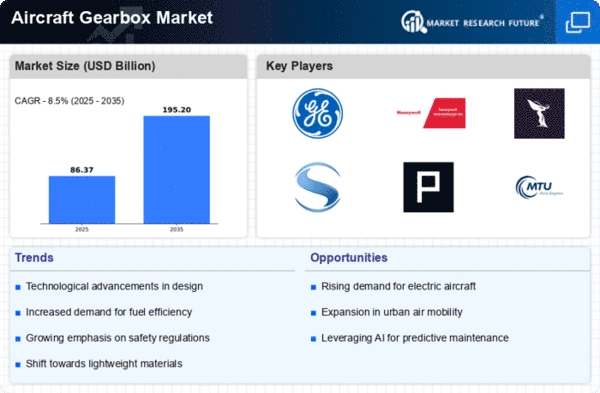
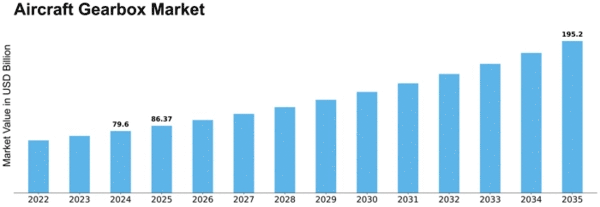
As per MRFR analysis, the Aircraft Gearbox Market Size was estimated at 79.6 USD Billion in 2024. The Aircraft Gearbox industry is projected to grow from 86.3 USD Billion in 2025 to 195.2 USD Billion by 2035, exhibiting a compound annual growth rate (CAGR) of 8.5% during the forecast period 2025 - 2035.

Key Market Trends & Highlights

The Aircraft Gearbox Market is poised for substantial growth driven by technological advancements and increasing demand for efficiency.

  • Technological advancements are reshaping the design and functionality of aircraft gearboxes, enhancing performance and reliability. Sustainability initiatives are gaining traction, prompting manufacturers to develop eco-friendly gearbox solutions that reduce environmental impact. North America remains the largest market for aircraft gearboxes, while the Asia-Pacific region is recognized as the fastest-growing market, reflecting diverse regional demands. The growth in aircraft production and the increasing demand for fuel efficiency are key drivers propelling the market forward.

Market Size & Forecast

2024 Market Size 79.6 (USD Billion)
2035 Market Size 195.2 (USD Billion)
CAGR (2025 - 2035) 8.5%
Largest Regional Market Share in 2024 North America

Major Players

General Electric (US), Honeywell International (US), Rolls-Royce (GB), Safran (FR), Pratt &amp; Whitney (US), MTU Aero Engines (DE), Boeing (US), Northrop Grumman (US), Liebherr Aerospace (DE)

Market Trends

The Aircraft Gearbox Market is currently experiencing a dynamic evolution, driven by advancements in technology and increasing demand for fuel-efficient aircraft. Manufacturers are focusing on developing lightweight and high-performance gearboxes that can withstand the rigorous demands of modern aviation. This shift towards innovation is not only enhancing operational efficiency but also contributing to reduced maintenance costs. Furthermore, the growing emphasis on sustainability within the aerospace sector is prompting companies to explore alternative materials and designs that minimize environmental impact. As a result, the market landscape is becoming increasingly competitive, with new entrants and established players alike striving to capture market share through innovative solutions.

In addition to technological advancements, the Aircraft Gearbox Market is influenced by regulatory changes and the need for compliance with stringent safety standards. This necessitates ongoing investment in research and development to ensure that products meet evolving requirements. Moreover, the rise in air travel and the expansion of the global aviation industry are likely to further fuel demand for advanced gearbox systems. As the aircraft gearbox market continues to mature, collaboration between manufacturers, suppliers, and regulatory bodies will be essential to navigate challenges and seize opportunities for growth. Overall, the Aircraft Gearbox Market appears poised for a transformative period, characterized by innovation, collaboration, and a commitment to sustainability.

Technological Advancements

The Aircraft Gearbox Market is witnessing rapid technological advancements, with manufacturers investing in research and development to create more efficient and durable gear systems. Innovations such as advanced materials and smart technologies are enhancing performance and reliability, thereby attracting interest from various stakeholders.

Sustainability Initiatives

There is a growing trend towards sustainability within the Aircraft Gearbox Market, as companies seek to reduce their environmental footprint. This includes the adoption of eco-friendly materials and processes, as well as designs that promote energy efficiency, aligning with global efforts to combat climate change.

Regulatory Compliance

The Aircraft Gearbox Market is increasingly shaped by stringent regulatory requirements aimed at ensuring safety and performance. Manufacturers are compelled to adapt their products to meet these evolving standards, which may drive innovation and lead to the development of more advanced gearbox solutions.

Aircraft Gearbox Market Market Drivers

Increasing Demand for Fuel Efficiency

The Global aircraft gearbox Market Industry experiences a notable surge in demand for fuel-efficient aircraft. As airlines strive to reduce operational costs and environmental impact, the integration of advanced gearboxes plays a crucial role. These gearboxes enhance engine performance and optimize fuel consumption, aligning with global sustainability goals. For instance, the market is projected to reach 1.83 USD Billion in 2024, driven by innovations in gearbox technology that improve efficiency. This trend is expected to continue, as the industry anticipates a market value of 3.18 USD Billion by 2035, reflecting a compound annual growth rate of 5.16% from 2025 to 2035.

Focus on Military Aircraft Modernization

The Global Aircraft Gearbox Market Industry benefits from the ongoing modernization of military aircraft. Governments are investing in upgrading their fleets to enhance operational capabilities and maintain strategic advantages. This modernization often involves the integration of advanced gearbox systems that improve performance and reliability. For example, military contracts for new aircraft often specify the latest gearbox technologies to ensure optimal functionality. As nations prioritize defense spending, the demand for sophisticated gearbox solutions is likely to increase, contributing to the overall growth of the market. This trend underscores the importance of military applications in driving advancements within the gearbox sector.

Growth of the Commercial Aviation Sector

The Global Aircraft Gearbox Market Industry is closely tied to the expansion of the commercial aviation sector. As air travel demand continues to rise, airlines are investing in new aircraft equipped with advanced gearbox systems. This trend is particularly evident in emerging markets, where increasing disposable incomes and urbanization drive air travel growth. The market is projected to grow significantly, reaching 1.83 USD Billion in 2024, as airlines prioritize modernizing their fleets. This growth trajectory is expected to persist, with the market anticipated to reach 3.18 USD Billion by 2035, reflecting the robust demand for efficient and reliable aircraft gearboxes.

Regulatory Support for Aerospace Innovations

Regulatory frameworks play a pivotal role in shaping the Global Aircraft Gearbox Market Industry. Governments worldwide are increasingly supportive of innovations that enhance safety and efficiency in aviation. For instance, regulatory bodies are encouraging the adoption of advanced gearbox technologies that comply with stringent safety standards. This support is reflected in various initiatives aimed at promoting research and development in aerospace technologies. As a result, manufacturers are more inclined to invest in innovative gearbox solutions, thereby driving market growth. The alignment of regulatory policies with industry advancements fosters a conducive environment for the expansion of the gearbox market.

Technological Advancements in Gearbox Design

Technological advancements significantly influence the Global Aircraft Gearbox Market Industry. Innovations in materials and design methodologies lead to lighter, more durable gearboxes that enhance aircraft performance. For example, the adoption of composite materials reduces weight while maintaining strength, which is essential for modern aircraft. Furthermore, advancements in manufacturing techniques, such as additive manufacturing, allow for more complex designs that improve efficiency. These developments not only enhance operational capabilities but also contribute to the overall growth of the market, as manufacturers seek to meet the evolving demands of the aerospace sector.

Market Segment Insights

By Application: Commercial Aviation (Largest) vs. Unmanned Aerial Vehicles (Fastest-Growing)

The Aircraft Gearbox Market is characterized by a diverse range of applications including Commercial Aviation, Military Aviation, General Aviation, Cargo Transport, and Unmanned Aerial Vehicles. Among these, Commercial Aviation holds the largest share due to the increasing demand for air travel and the expansion of airline fleets globally. Military Aviation and General Aviation also contribute significantly, but they do not match the scale of commercial sector demand. Unmanned Aerial Vehicles, however, are gaining traction and gradually capturing a notable portion of the market as technological advancements continue to emerge. Growth trends in the Aircraft Gearbox Market are influenced by various factors including innovation, safety regulations, and increasing fuel efficiency requirements. The growth of Commercial Aviation is driven by rising passenger numbers and expansions of low-cost carriers. Meanwhile, Unmanned Aerial Vehicles are currently the fastest-growing segment, propelled by advanced applications across different sectors such as surveillance, delivery, and agricultural monitoring. As investment in UAV technology increases, this segment is expected to transform the market landscape significantly.

Commercial Aviation: Dominant vs. Unmanned Aerial Vehicles: Emerging

In the Aircraft Gearbox Market, Commercial Aviation remains the dominant application due to the sheer volume of aircraft operations and the ongoing expansion of commercial fleets. This sector encompasses a wide variety of aircraft, from regionals to large intercontinental jets, all of which require reliable and efficient gearbox systems to ensure optimal performance and safety. In contrast, Unmanned Aerial Vehicles represent the emerging segment within the market, characterized by rapid advancements in technology and an expanding range of operational uses. UAVs are increasingly being integrated into logistics, agriculture, and defense applications, thus driving demand for specialized gearboxes designed for varied performance requirements. This dual dynamic showcases the robust nature of the market, with Commercial Aviation providing stability and Unmanned Aerial Vehicles injecting innovative growth potential.

By Type: Main Gearbox (Largest) vs. Reduction Gearbox (Fastest-Growing)

The Aircraft Gearbox Market is primarily segmented into several types: Main Gearbox, Reduction Gearbox, Accessory Gearbox, Tail Gearbox, and Planetary Gearbox. Furthermore, the aircraft auxiliary power unit gearbox market is gaining significant attention as operators seek more reliable power generation for onboard electrical systems during ground operations and emergencies. Among these, the Main Gearbox holds the largest market share, being crucial for the overall functionality and efficiency of aircraft propulsion systems. It integrates with the engine and plays a vital role in power transmission, making it indispensable in modern aircraft designs. In contrast, the Reduction Gearbox is gaining rapid traction due to the increasing demand for lightweight and high-performance systems, leading to its recognition as the fastest-growing segment within the market.

Main Gearbox (Dominant) vs. Reduction Gearbox (Emerging)

The Main Gearbox, regarded as the dominant segment in the Aircraft Gearbox Market, is engineered to withstand high power loads and efficiently convert engine output into manageable levels for propeller or rotor systems. Its robust design and reliability make it vital for commercial and military aircraft. Conversely, the Reduction Gearbox, while emerging, is recognized for its ability to enhance performance drastically by reducing engine speed and increasing torque. This contributes to fuel efficiency and operational performance, which are increasingly demanded in modern aircraft technologies. As aircraft manufacturers focus on innovation and sustainability, the Reduction Gearbox is carving a significant niche as a key component in next-generation aircraft.

By Material: Steel Alloys (Largest) vs. Titanium Alloys (Fastest-Growing)

In the Aircraft Gearbox Market, Steel Alloys hold the largest share due to their superior strength and durability, making them the preferred choice for critical components. In contrast, Titanium Alloys, while currently smaller in market share, are rapidly gaining traction thanks to their lightweight properties and corrosion resistance, which are highly valued in modern aircraft design. The demand for enhanced performance and efficiency is driving a shift towards the use of Titanium Alloys in various applications within the sector.

Material: Steel Alloys (Dominant) vs. Titanium Alloys (Emerging)

Steel Alloys dominate the Aircraft Gearbox Market due to their exceptional load-bearing capabilities and cost-effectiveness. They are extensively used in traditional gearbox designs, providing reliability in high-stress environments. Meanwhile, Titanium Alloys are emerging as a key player in this segment, offering properties such as reduced weight and increased resistance to fatigue and corrosion, which are critical in aerospace applications. As manufacturers seek to improve fuel efficiency and overall performance, the adoption of Titanium Alloys is expected to rise, establishing a competitive landscape between these two materials.

By Power Source: Turbine Engine (Largest) vs. Electric Motor (Fastest-Growing)

In the Aircraft Gearbox Market, the power source segment is dominated by turbine engines, which account for the largest market share due to their established technology and reliability in various aircraft engines. Following closely are internal combustion engines and electric motors, which are gaining traction. Hybrid systems and alternative fuels, while representing smaller shares, add diversity to the market, reflecting ongoing innovations in aerospace engineering.

Turbine Engine (Dominant) vs. Electric Motor (Emerging)

Turbine engines remain the dominant power source in the aircraft gearbox market, known for their efficiency and high thrust capabilities in large aircraft. They leverage advanced engineering to maintain performance across long durations. In contrast, electric motors represent an emerging alternative, gaining traction due to their sustainability, reduced maintenance costs, and compatibility with modern aircraft designs. With advancements in battery technology and increased focus on eco-friendly aviation, electric motors are set to reshape the market landscape, potentially challenging the dominance of turbine engines in the near future.

By End Use: New Aircraft Manufacturing (Largest) vs. Aircraft Maintenance and Repair (Fastest-Growing)

The Aircraft Gearbox Market displays a diverse distribution among its end-use segments, with New Aircraft Manufacturing leading in market share, driven by the continuous demand for modern aircraft. This segment benefits from innovative technologies, robust construction, and the integration of advanced materials that enhance performance and reliability. Conversely, Aircraft Maintenance and Repair is swiftly gaining traction as airlines prioritize operational efficiency and safety, contributing to a notable increase in repair activities and service contracts, thereby affirming its growth potential. Analyzing the growth trends, New Aircraft Manufacturing is poised for expansion as fleet modernization efforts continue globally, fueled by the adoption of energy-efficient models. On the other hand, Aircraft Maintenance and Repair is propelled by a burgeoning demand for maintenance services and parts replacement stemming from increased flight hours and aging fleets. This dual trend indicates a solid foundation for sustained growth within the Aircraft Gearbox Market, emphasizing the importance of both new aircraft production and ongoing maintenance efforts.

New Aircraft Manufacturing (Dominant) vs. Aircraft Maintenance and Repair (Emerging)

The New Aircraft Manufacturing segment remains dominant in the Aircraft Gearbox Market, characterized by continuous innovations and the emerging need for advanced gearbox designs that cater to the latest aviation technologies. Manufacturers focus on lightweight materials and greater efficiency to improve performance and fuel economy. In contrast, the Aircraft Maintenance and Repair segment is labeled as emerging, responding to a growing fleet of aging aircraft that demand more frequent servicing and gearbox replacements. This segment is increasingly adopting predictive maintenance practices and smart technologies to streamline repair processes and enhance reliability. Together, these segments signify the dual focus of the market on new innovations while addressing the existing fleet's operational challenges.

Get more detailed insights about Aircraft Gearbox Market Research Report - Global Forecast till 2035

Regional Insights

North America : Market Leader in Innovation

North America continues to lead the Aircraft Gearbox Market, holding a significant share of 39.8% in 2024. The region's growth is driven by advancements in aerospace technology, increasing defense budgets, and a robust commercial aviation sector. Regulatory support from agencies like the FAA fosters innovation and safety standards, further propelling market demand. The rising need for fuel-efficient and lightweight gearboxes is also a key driver, aligning with environmental regulations and consumer preferences. The competitive landscape in North America is characterized by the presence of major players such as General Electric, Honeywell International, and Pratt & Whitney. These companies are at the forefront of technological advancements, focusing on R&D to enhance gearbox performance and reliability. The U.S. remains the leading country, with significant investments in aerospace manufacturing and a strong supply chain network. This dynamic environment positions North America as a hub for aircraft gearbox innovation and production.

Europe : Emerging Market with Growth Potential

Europe holds a market share of 25.0% in the Aircraft Gearbox Market, driven by increasing demand for commercial and military aircraft. The region benefits from stringent regulatory frameworks that promote safety and efficiency, encouraging manufacturers to innovate. The European Union's initiatives to enhance aerospace technology and sustainability are pivotal in shaping market dynamics. Additionally, the rise in air travel and the need for modernized fleets are significant growth catalysts. Leading countries in Europe include Germany, France, and the UK, where key players like Rolls-Royce and Safran are headquartered. The competitive landscape is marked by collaborations and partnerships aimed at technological advancements. The European market is also witnessing a shift towards electric and hybrid aircraft, which is expected to influence gearbox design and functionality. This evolving landscape presents opportunities for growth and innovation in the region.

Asia-Pacific : Rapidly Growing Aviation Hub

The Asia-Pacific region is emerging as a significant player in the Aircraft Gearbox Market, with a market share of 12.0%. The growth is fueled by increasing air travel demand, rising disposable incomes, and government initiatives to boost the aviation sector. Countries like China and India are investing heavily in their aerospace industries, leading to a surge in aircraft production and modernization. Regulatory bodies are also enhancing safety standards, which is vital for market expansion. China and India are the leading countries in this region, with a growing number of local manufacturers entering the market. The competitive landscape is evolving, with both established players and new entrants focusing on innovation and cost-effective solutions. Partnerships between local firms and global giants are becoming common, facilitating technology transfer and enhancing product offerings. This dynamic environment positions Asia-Pacific as a key growth area for the aircraft gearbox market.

Middle East and Africa : Emerging Market with Untapped Potential

The Middle East and Africa region holds a modest market share of 2.8% in the Aircraft Gearbox Market, but it presents significant growth opportunities. The aviation sector in this region is expanding rapidly, driven by increasing air travel and investments in airport infrastructure. Governments are recognizing the importance of aviation for economic development, leading to supportive policies and regulations that encourage market growth. The rise of low-cost carriers is also contributing to the demand for aircraft gearboxes. Countries like the UAE and South Africa are at the forefront of this growth, with investments in both commercial and military aviation. The competitive landscape is characterized by a mix of local and international players, with a focus on enhancing operational efficiency and safety. As the region continues to develop its aviation capabilities, the demand for advanced aircraft gearboxes is expected to rise, creating opportunities for manufacturers and suppliers.

Key Players and Competitive Insights

The Aircraft Gearbox Market is currently characterized by a dynamic competitive landscape, driven by technological advancements and increasing demand for fuel-efficient aircraft. Major players such as General Electric (US), Rolls-Royce (GB), and Honeywell International (US) are strategically positioned to leverage innovation and partnerships to enhance their market presence. General Electric (US) focuses on integrating advanced materials and digital technologies into their gearbox designs, which appears to be a response to the growing emphasis on sustainability and efficiency in aviation. Meanwhile, Rolls-Royce (GB) has been investing heavily in research and development to improve the performance and reliability of their gearboxes, indicating a commitment to maintaining a competitive edge through technological superiority.The market structure is moderately fragmented, with several key players exerting influence over various segments. Companies are increasingly localizing manufacturing and optimizing supply chains to enhance operational efficiency and reduce costs. This trend suggests a collective effort among major players to adapt to regional demands while maintaining competitive pricing. The presence of established firms alongside emerging players creates a competitive environment that fosters innovation and responsiveness to market needs.
In November Honeywell International (US) announced a strategic partnership with a leading aerospace manufacturer to co-develop next-generation gearbox systems. This collaboration is expected to enhance Honeywell's capabilities in producing lightweight and efficient gearboxes, aligning with the industry's shift towards more sustainable aviation solutions. The partnership not only strengthens Honeywell's product offerings but also positions the company as a key player in the evolving landscape of aircraft propulsion systems.
In October Rolls-Royce (GB) unveiled a new gearbox technology that significantly reduces weight while improving fuel efficiency. This innovation is particularly relevant as airlines seek to lower operational costs and meet stringent environmental regulations. The introduction of this technology underscores Rolls-Royce's commitment to innovation and its strategic focus on enhancing the performance of its products in a competitive market.
In September General Electric (US) expanded its manufacturing capabilities in Europe, aiming to increase production capacity for its advanced gearbox systems. This move is indicative of GE's strategy to cater to the growing demand for high-performance gearboxes in the European market, which is experiencing a surge in aircraft orders. By enhancing its local manufacturing footprint, GE is likely to improve its supply chain efficiency and responsiveness to customer needs.
As of December the Aircraft Gearbox Market is witnessing trends such as digitalization, sustainability, and the integration of artificial intelligence in design and manufacturing processes. Strategic alliances among key players are shaping the competitive landscape, fostering innovation and collaboration. The shift from price-based competition to a focus on technological advancement and supply chain reliability is becoming increasingly evident. Companies that prioritize innovation and sustainability are likely to differentiate themselves in this evolving market, suggesting a future where competitive advantage hinges on technological prowess and operational excellence.

Key Companies in the Aircraft Gearbox Market include

Industry Developments

Safran and Liebherr: These remain the top players, but unfortunately, specific recent developments aren't readily available in public news sources. These companies likely focus on continual improvement and may not announce them widely.

Triumph Group: In October 2020, they secured a contract to supply spare high-speed gearboxes for Lockheed C-5 Galaxy aircraft US military transport plane

Future Outlook

Aircraft Gearbox Market Future Outlook

The Aircraft Gearbox Market is projected to grow at an 8.5% CAGR from 2025 to 2035, driven by advancements in aerospace technology and increasing demand for fuel efficiency.

New opportunities lie in:

  • <p>Development of lightweight composite gearboxes for enhanced fuel efficiency. Integration of smart technology for predictive maintenance solutions. Expansion into emerging markets with tailored gearbox solutions for regional aircraft.</p>

By 2035, the Aircraft Gearbox Market is expected to achieve substantial growth, reflecting evolving industry demands.

Market Segmentation

Aircraft Gearbox Market Type Outlook

  • Helicopter Gearbox
  • Fixed-Wing Aircraft Gearbox
  • Unmanned Aerial Vehicle Gearbox
  • Regional Aircraft Gearbox

Aircraft Gearbox Market Material Outlook

  • Aluminum Alloys
  • Titanium Alloys
  • Composite Materials
  • Steel Alloys

Aircraft Gearbox Market Application Outlook

  • Commercial Aviation
  • Military Aviation
  • Cargo Transport
  • Private Aviation

Aircraft Gearbox Market Power Source Outlook

  • Internal Combustion Engine
  • Electric Motor
  • Hybrid System
  • Turbine Engine

Aircraft Gearbox Market Gear Configuration Outlook

  • Planetary Gear System
  • Helical Gear System
  • Spur Gear System
  • Bevel Gear System

Report Scope

MARKET SIZE 2024 79.6(USD Billion)
MARKET SIZE 2025 86.3(USD Billion)
MARKET SIZE 2035 195.2(USD Billion)
COMPOUND ANNUAL GROWTH RATE (CAGR) 8.5% (2025 - 2035)
REPORT COVERAGE Revenue Forecast, Competitive Landscape, Growth Factors, and Trends
BASE YEAR 2024
Market Forecast Period 2025 - 2035
Historical Data 2019 - 2024
Market Forecast Units USD Billion
Key Companies Profiled General Electric (US), Honeywell International (US), Rolls-Royce (GB), Safran (FR), Pratt & Whitney (US), MTU Aero Engines (DE), Boeing (US), Northrop Grumman (US), Liebherr Aerospace (DE)
Segments Covered Application, Type, Power Source, Material, Gear Configuration
Key Market Opportunities Integration of advanced materials and automation technologies enhances efficiency in the Aircraft Gearbox Market.
Key Market Dynamics Technological advancements and regulatory changes drive innovation and competition in the Aircraft Gearbox Market.
Countries Covered North America, Europe, APAC, South America, MEA

FAQs

What is the current valuation of the Aircraft Gearbox Market?

<p>As of 2024, the Aircraft Gearbox Market was valued at 79.6 USD Billion.</p>

What is the projected market size for the Aircraft Gearbox Market by 2035?

<p>The market is projected to reach 195.2 USD Billion by 2035.</p>

What is the expected CAGR for the Aircraft Gearbox Market during the forecast period 2025 - 2035?

<p>The expected CAGR for the Aircraft Gearbox Market during 2025 - 2035 is 8.5%.</p>

Which segment of the Aircraft Gearbox Market had the highest valuation in 2024?

<p>In 2024, the Main Gearbox segment had the highest valuation, ranging from 30.0 to 75.0 USD Billion.</p>

What are the key applications driving the Aircraft Gearbox Market?

<p>Key applications include Commercial Aviation, Military Aviation, and General Aviation, with valuations of 30.0, 20.0, and 10.0 USD Billion respectively in 2024.</p>

Which materials are predominantly used in the Aircraft Gearbox Market?

The predominant materials include Steel Alloys, Aluminum Alloys, and Titanium Alloys, with valuations of 30.0, 15.0, and 10.0 USD Billion respectively in 2024.

Who are the leading players in the Aircraft Gearbox Market?

Leading players include General Electric, Honeywell, Rolls-Royce, and Pratt &amp; Whitney, among others.

What is the valuation range for the Aircraft Maintenance and Repair segment in 2024?

The Aircraft Maintenance and Repair segment had a valuation range of 25.0 to 60.0 USD Billion in 2024.

What types of gearboxes are included in the Aircraft Gearbox Market?

Types of gearboxes include Reduction Gearbox, Accessory Gearbox, and Tail Gearbox, with valuations of 15.0, 10.0, and 12.0 USD Billion respectively in 2024.

What power sources are utilized in the Aircraft Gearbox Market?

Power sources include Turbine Engine, Internal Combustion Engine, and Electric Motor, with valuations of 31.84, 23.88, and 11.92 USD Billion respectively in 2024.

  1. SECTION I: EXECUTIVE SUMMARY AND KEY HIGHLIGHTS |
    1. EXECUTIVE SUMMARY | |
      1. Market Overview | |
      2. Key Findings | |
      3. Market Segmentation | |
      4. Competitive Landscape | |
      5. Challenges and Opportunities | |
      6. Future Outlook 2
  2. SECTION II: SCOPING, METHODOLOGY AND MARKET STRUCTURE |
    1. MARKET INTRODUCTION | |
      1. Definition | |
      2. Scope of the study | | |
    2. RESEARCH METHODOLOGY | |
      1. Overview | |
      2. Data Mining | |
      3. Secondary Research | |
      4. Primary Research | | |
      5. Forecasting Model | |
      6. Market Size Estimation | | |
      7. Data Triangulation | |
      8. Validation 3
  3. SECTION III: QUALITATIVE ANALYSIS |
    1. MARKET DYNAMICS | |
      1. Overview | |
      2. Drivers | |
      3. Restraints | |
      4. Opportunities |
    2. MARKET FACTOR ANALYSIS | |
      1. Value chain Analysis | |
      2. Porter's Five Forces Analysis | | |
      3. COVID-19 Impact Analysis | | |
  4. SECTION IV: QUANTITATIVE ANALYSIS |
    1. Aerospace & Defense, BY Application (USD Billion) | |
      1. Commercial Aviation | |
      2. Military Aviation | |
      3. General Aviation | |
      4. Cargo Transport | |
      5. Unmanned Aerial Vehicles |
    2. Aerospace & Defense, BY Type (USD Billion) | |
      1. Reduction Gearbox | |
      2. Accessory Gearbox | |
      3. Main Gearbox | |
      4. Tail Gearbox | |
      5. Planetary Gearbox |
    3. Aerospace & Defense, BY Material (USD Billion) | |
      1. Aluminum Alloys | |
      2. Titanium Alloys | |
      3. Steel Alloys | |
      4. Composite Materials | |
      5. Magnesium Alloys |
    4. Aerospace & Defense, BY Power Source (USD Billion) | |
      1. Turbine Engine | |
      2. Internal Combustion Engine | |
      3. Electric Motor | |
      4. Hybrid Systems | |
      5. Alternative Fuels |
    5. Aerospace & Defense, BY End Use (USD Billion) | |
      1. New Aircraft Manufacturing | |
      2. Aircraft Maintenance and Repair | |
      3. Aircraft Upgrades | |
      4. Retrofit Projects | |
      5. Research and Development |
    6. Aerospace & Defense, BY Region (USD Billion) | |
      1. North America | | |
      2. Europe | | |
      3. APAC | | |
      4. South America | | |
      5. MEA | | |
  5. SECTION V: COMPETITIVE ANALYSIS |
    1. Competitive Landscape | |
      1. Overview | |
      2. Competitive Analysis | |
      3. Market share Analysis | |
      4. Major Growth Strategy in the Aerospace & Defense | |
      5. Competitive Benchmarking | |
      6. Leading Players in Terms of Number of Developments in the Aerospace & Defense | |
      7. Key developments and growth strategies | | |
      8. Major Players Financial Matrix | | |
    2. Company Profiles | |
      1. General Electric (US) | | |
      2. Honeywell (US) | | |
      3. Rolls-Royce (GB) | | |
      4. Safran (FR) | | |
      5. Pratt & Whitney (US) | | |
      6. MTU Aero Engines (DE) | | |
      7. Boeing (US) | | |
      8. Liebherr (DE) | | |
      9. Northrop Grumman (US) | | |
      10. GKN Aerospace (GB) | | |
    3. Appendix | |
      1. References | |
      2. Related Reports 6 LIST OF FIGURES |
    4. MARKET SYNOPSIS |
    5. NORTH AMERICA MARKET ANALYSIS |
    6. US MARKET ANALYSIS BY APPLICATION |
    7. US MARKET ANALYSIS BY TYPE |
    8. US MARKET ANALYSIS BY MATERIAL |
    9. US MARKET ANALYSIS BY POWER SOURCE |
    10. US MARKET ANALYSIS BY END USE |
    11. CANADA MARKET ANALYSIS BY APPLICATION |
    12. CANADA MARKET ANALYSIS BY TYPE |
    13. CANADA MARKET ANALYSIS BY MATERIAL |
    14. CANADA MARKET ANALYSIS BY POWER SOURCE |
    15. CANADA MARKET ANALYSIS BY END USE |
    16. EUROPE MARKET ANALYSIS |
    17. GERMANY MARKET ANALYSIS BY APPLICATION |
    18. GERMANY MARKET ANALYSIS BY TYPE |
    19. GERMANY MARKET ANALYSIS BY MATERIAL |
    20. GERMANY MARKET ANALYSIS BY POWER SOURCE |
    21. GERMANY MARKET ANALYSIS BY END USE |
    22. UK MARKET ANALYSIS BY APPLICATION |
    23. UK MARKET ANALYSIS BY TYPE |
    24. UK MARKET ANALYSIS BY MATERIAL |
    25. UK MARKET ANALYSIS BY POWER SOURCE |
    26. UK MARKET ANALYSIS BY END USE |
    27. FRANCE MARKET ANALYSIS BY APPLICATION |
    28. FRANCE MARKET ANALYSIS BY TYPE |
    29. FRANCE MARKET ANALYSIS BY MATERIAL |
    30. FRANCE MARKET ANALYSIS BY POWER SOURCE |
    31. FRANCE MARKET ANALYSIS BY END USE |
    32. RUSSIA MARKET ANALYSIS BY APPLICATION |
    33. RUSSIA MARKET ANALYSIS BY TYPE |
    34. RUSSIA MARKET ANALYSIS BY MATERIAL |
    35. RUSSIA MARKET ANALYSIS BY POWER SOURCE |
    36. RUSSIA MARKET ANALYSIS BY END USE |
    37. ITALY MARKET ANALYSIS BY APPLICATION |
    38. ITALY MARKET ANALYSIS BY TYPE |
    39. ITALY MARKET ANALYSIS BY MATERIAL |
    40. ITALY MARKET ANALYSIS BY POWER SOURCE |
    41. ITALY MARKET ANALYSIS BY END USE |
    42. SPAIN MARKET ANALYSIS BY APPLICATION |
    43. SPAIN MARKET ANALYSIS BY TYPE |
    44. SPAIN MARKET ANALYSIS BY MATERIAL |
    45. SPAIN MARKET ANALYSIS BY POWER SOURCE |
    46. SPAIN MARKET ANALYSIS BY END USE |
    47. REST OF EUROPE MARKET ANALYSIS BY APPLICATION |
    48. REST OF EUROPE MARKET ANALYSIS BY TYPE |
    49. REST OF EUROPE MARKET ANALYSIS BY MATERIAL |
    50. REST OF EUROPE MARKET ANALYSIS BY POWER SOURCE |
    51. REST OF EUROPE MARKET ANALYSIS BY END USE |
    52. APAC MARKET ANALYSIS |
    53. CHINA MARKET ANALYSIS BY APPLICATION |
    54. CHINA MARKET ANALYSIS BY TYPE |
    55. CHINA MARKET ANALYSIS BY MATERIAL |
    56. CHINA MARKET ANALYSIS BY POWER SOURCE |
    57. CHINA MARKET ANALYSIS BY END USE |
    58. INDIA MARKET ANALYSIS BY APPLICATION |
    59. INDIA MARKET ANALYSIS BY TYPE |
    60. INDIA MARKET ANALYSIS BY MATERIAL |
    61. INDIA MARKET ANALYSIS BY POWER SOURCE |
    62. INDIA MARKET ANALYSIS BY END USE |
    63. JAPAN MARKET ANALYSIS BY APPLICATION |
    64. JAPAN MARKET ANALYSIS BY TYPE |
    65. JAPAN MARKET ANALYSIS BY MATERIAL |
    66. JAPAN MARKET ANALYSIS BY POWER SOURCE |
    67. JAPAN MARKET ANALYSIS BY END USE |
    68. SOUTH KOREA MARKET ANALYSIS BY APPLICATION |
    69. SOUTH KOREA MARKET ANALYSIS BY TYPE |
    70. SOUTH KOREA MARKET ANALYSIS BY MATERIAL |
    71. SOUTH KOREA MARKET ANALYSIS BY POWER SOURCE |
    72. SOUTH KOREA MARKET ANALYSIS BY END USE |
    73. MALAYSIA MARKET ANALYSIS BY APPLICATION |
    74. MALAYSIA MARKET ANALYSIS BY TYPE |
    75. MALAYSIA MARKET ANALYSIS BY MATERIAL |
    76. MALAYSIA MARKET ANALYSIS BY POWER SOURCE |
    77. MALAYSIA MARKET ANALYSIS BY END USE |
    78. THAILAND MARKET ANALYSIS BY APPLICATION |
    79. THAILAND MARKET ANALYSIS BY TYPE |
    80. THAILAND MARKET ANALYSIS BY MATERIAL |
    81. THAILAND MARKET ANALYSIS BY POWER SOURCE |
    82. THAILAND MARKET ANALYSIS BY END USE |
    83. INDONESIA MARKET ANALYSIS BY APPLICATION |
    84. INDONESIA MARKET ANALYSIS BY TYPE |
    85. INDONESIA MARKET ANALYSIS BY MATERIAL |
    86. INDONESIA MARKET ANALYSIS BY POWER SOURCE |
    87. INDONESIA MARKET ANALYSIS BY END USE |
    88. REST OF APAC MARKET ANALYSIS BY APPLICATION |
    89. REST OF APAC MARKET ANALYSIS BY TYPE |
    90. REST OF APAC MARKET ANALYSIS BY MATERIAL |
    91. REST OF APAC MARKET ANALYSIS BY POWER SOURCE |
    92. REST OF APAC MARKET ANALYSIS BY END USE |
    93. SOUTH AMERICA MARKET ANALYSIS |
    94. BRAZIL MARKET ANALYSIS BY APPLICATION |
    95. BRAZIL MARKET ANALYSIS BY TYPE |
    96. BRAZIL MARKET ANALYSIS BY MATERIAL |
    97. BRAZIL MARKET ANALYSIS BY POWER SOURCE |
    98. BRAZIL MARKET ANALYSIS BY END USE |
    99. MEXICO MARKET ANALYSIS BY APPLICATION |
    100. MEXICO MARKET ANALYSIS BY TYPE |
    101. MEXICO MARKET ANALYSIS BY MATERIAL |
    102. MEXICO MARKET ANALYSIS BY POWER SOURCE |
    103. MEXICO MARKET ANALYSIS BY END USE |
    104. ARGENTINA MARKET ANALYSIS BY APPLICATION |
    105. ARGENTINA MARKET ANALYSIS BY TYPE |
    106. ARGENTINA MARKET ANALYSIS BY MATERIAL |
    107. ARGENTINA MARKET ANALYSIS BY POWER SOURCE |
    108. ARGENTINA MARKET ANALYSIS BY END USE |
    109. REST OF SOUTH AMERICA MARKET ANALYSIS BY APPLICATION |
    110. REST OF SOUTH AMERICA MARKET ANALYSIS BY TYPE |
    111. REST OF SOUTH AMERICA MARKET ANALYSIS BY MATERIAL |
    112. REST OF SOUTH AMERICA MARKET ANALYSIS BY POWER SOURCE |
    113. REST OF SOUTH AMERICA MARKET ANALYSIS BY END USE |
    114. MEA MARKET ANALYSIS |
    115. GCC COUNTRIES MARKET ANALYSIS BY APPLICATION |
    116. GCC COUNTRIES MARKET ANALYSIS BY TYPE |
    117. GCC COUNTRIES MARKET ANALYSIS BY MATERIAL |
    118. GCC COUNTRIES MARKET ANALYSIS BY POWER SOURCE |
    119. GCC COUNTRIES MARKET ANALYSIS BY END USE |
    120. SOUTH AFRICA MARKET ANALYSIS BY APPLICATION |
    121. SOUTH AFRICA MARKET ANALYSIS BY TYPE |
    122. SOUTH AFRICA MARKET ANALYSIS BY MATERIAL |
    123. SOUTH AFRICA MARKET ANALYSIS BY POWER SOURCE |
    124. SOUTH AFRICA MARKET ANALYSIS BY END USE |
    125. REST OF MEA MARKET ANALYSIS BY APPLICATION |
    126. REST OF MEA MARKET ANALYSIS BY TYPE |
    127. REST OF MEA MARKET ANALYSIS BY MATERIAL |
    128. REST OF MEA MARKET ANALYSIS BY POWER SOURCE |
    129. REST OF MEA MARKET ANALYSIS BY END USE |
    130. KEY BUYING CRITERIA OF AEROSPACE & DEFENSE |
    131. RESEARCH PROCESS OF MRFR |
    132. DRO ANALYSIS OF AEROSPACE & DEFENSE |
    133. DRIVERS IMPACT ANALYSIS: AEROSPACE & DEFENSE |
    134. RESTRAINTS IMPACT ANALYSIS: AEROSPACE & DEFENSE |
    135. SUPPLY / VALUE CHAIN: AEROSPACE & DEFENSE |
    136. AEROSPACE & DEFENSE, BY APPLICATION, 2024 (% SHARE) |
    137. AEROSPACE & DEFENSE, BY APPLICATION, 2024 TO 2035 (USD Billion) |
    138. AEROSPACE & DEFENSE, BY TYPE, 2024 (% SHARE) |
    139. AEROSPACE & DEFENSE, BY TYPE, 2024 TO 2035 (USD Billion) |
    140. AEROSPACE & DEFENSE, BY MATERIAL, 2024 (% SHARE) |
    141. AEROSPACE & DEFENSE, BY MATERIAL, 2024 TO 2035 (USD Billion) |
    142. AEROSPACE & DEFENSE, BY POWER SOURCE, 2024 (% SHARE) |
    143. AEROSPACE & DEFENSE, BY POWER SOURCE, 2024 TO 2035 (USD Billion) |
    144. AEROSPACE & DEFENSE, BY END USE, 2024 (% SHARE) |
    145. AEROSPACE & DEFENSE, BY END USE, 2024 TO 2035 (USD Billion) |
    146. BENCHMARKING OF MAJOR COMPETITORS 7 LIST OF TABLES |
    147. LIST OF ASSUMPTIONS | |
      1. |
    148. North America MARKET SIZE ESTIMATES; FORECAST | |
      1. BY APPLICATION, 2025-2035 (USD Billion) | |
      2. BY TYPE, 2025-2035 (USD Billion) | |
      3. BY MATERIAL, 2025-2035 (USD Billion) | |
      4. BY POWER SOURCE, 2025-2035 (USD Billion) | |
      5. BY END USE, 2025-2035 (USD Billion) |
    149. US MARKET SIZE ESTIMATES; FORECAST | |
      1. BY APPLICATION, 2025-2035 (USD Billion) | |
      2. BY TYPE, 2025-2035 (USD Billion) | |
      3. BY MATERIAL, 2025-2035 (USD Billion) | |
      4. BY POWER SOURCE, 2025-2035 (USD Billion) | |
      5. BY END USE, 2025-2035 (USD Billion) |
    150. Canada MARKET SIZE ESTIMATES; FORECAST | |
      1. BY APPLICATION, 2025-2035 (USD Billion) | |
      2. BY TYPE, 2025-2035 (USD Billion) | |
      3. BY MATERIAL, 2025-2035 (USD Billion) | |
      4. BY POWER SOURCE, 2025-2035 (USD Billion) | |
      5. BY END USE, 2025-2035 (USD Billion) |
    151. Europe MARKET SIZE ESTIMATES; FORECAST | |
      1. BY APPLICATION, 2025-2035 (USD Billion) | |
      2. BY TYPE, 2025-2035 (USD Billion) | |
      3. BY MATERIAL, 2025-2035 (USD Billion) | |
      4. BY POWER SOURCE, 2025-2035 (USD Billion) | |
      5. BY END USE, 2025-2035 (USD Billion) |
    152. Germany MARKET SIZE ESTIMATES; FORECAST | |
      1. BY APPLICATION, 2025-2035 (USD Billion) | |
      2. BY TYPE, 2025-2035 (USD Billion) | |
      3. BY MATERIAL, 2025-2035 (USD Billion) | |
      4. BY POWER SOURCE, 2025-2035 (USD Billion) | |
      5. BY END USE, 2025-2035 (USD Billion) |
    153. UK MARKET SIZE ESTIMATES; FORECAST | |
      1. BY APPLICATION, 2025-2035 (USD Billion) | |
      2. BY TYPE, 2025-2035 (USD Billion) | |
      3. BY MATERIAL, 2025-2035 (USD Billion) | |
      4. BY POWER SOURCE, 2025-2035 (USD Billion) | |
      5. BY END USE, 2025-2035 (USD Billion) |
    154. France MARKET SIZE ESTIMATES; FORECAST | |
      1. BY APPLICATION, 2025-2035 (USD Billion) | |
      2. BY TYPE, 2025-2035 (USD Billion) | |
      3. BY MATERIAL, 2025-2035 (USD Billion) | |
      4. BY POWER SOURCE, 2025-2035 (USD Billion) | |
      5. BY END USE, 2025-2035 (USD Billion) |
    155. Russia MARKET SIZE ESTIMATES; FORECAST | |
      1. BY APPLICATION, 2025-2035 (USD Billion) | |
      2. BY TYPE, 2025-2035 (USD Billion) | |
      3. BY MATERIAL, 2025-2035 (USD Billion) | |
      4. BY POWER SOURCE, 2025-2035 (USD Billion) | |
      5. BY END USE, 2025-2035 (USD Billion) |
    156. Italy MARKET SIZE ESTIMATES; FORECAST | |
      1. BY APPLICATION, 2025-2035 (USD Billion) | |
      2. BY TYPE, 2025-2035 (USD Billion) | |
      3. BY MATERIAL, 2025-2035 (USD Billion) | |
      4. BY POWER SOURCE, 2025-2035 (USD Billion) | |
      5. BY END USE, 2025-2035 (USD Billion) |
    157. Spain MARKET SIZE ESTIMATES; FORECAST | |
      1. BY APPLICATION, 2025-2035 (USD Billion) | |
      2. BY TYPE, 2025-2035 (USD Billion) | |
      3. BY MATERIAL, 2025-2035 (USD Billion) | |
      4. BY POWER SOURCE, 2025-2035 (USD Billion) | |
      5. BY END USE, 2025-2035 (USD Billion) |
    158. Rest of Europe MARKET SIZE ESTIMATES; FORECAST | |
      1. BY APPLICATION, 2025-2035 (USD Billion) | |
      2. BY TYPE, 2025-2035 (USD Billion) | |
      3. BY MATERIAL, 2025-2035 (USD Billion) | |
      4. BY POWER SOURCE, 2025-2035 (USD Billion) | |
      5. BY END USE, 2025-2035 (USD Billion) |
    159. APAC MARKET SIZE ESTIMATES; FORECAST | |
      1. BY APPLICATION, 2025-2035 (USD Billion) | |
      2. BY TYPE, 2025-2035 (USD Billion) | |
      3. BY MATERIAL, 2025-2035 (USD Billion) | |
      4. BY POWER SOURCE, 2025-2035 (USD Billion) | |
      5. BY END USE, 2025-2035 (USD Billion) |
    160. China MARKET SIZE ESTIMATES; FORECAST | |
      1. BY APPLICATION, 2025-2035 (USD Billion) | |
      2. BY TYPE, 2025-2035 (USD Billion) | |
      3. BY MATERIAL, 2025-2035 (USD Billion) | |
      4. BY POWER SOURCE, 2025-2035 (USD Billion) | |
      5. BY END USE, 2025-2035 (USD Billion) |
    161. India MARKET SIZE ESTIMATES; FORECAST | |
      1. BY APPLICATION, 2025-2035 (USD Billion) | |
      2. BY TYPE, 2025-2035 (USD Billion) | |
      3. BY MATERIAL, 2025-2035 (USD Billion) | |
      4. BY POWER SOURCE, 2025-2035 (USD Billion) | |
      5. BY END USE, 2025-2035 (USD Billion) |
    162. Japan MARKET SIZE ESTIMATES; FORECAST | |
      1. BY APPLICATION, 2025-2035 (USD Billion) | |
      2. BY TYPE, 2025-2035 (USD Billion) | |
      3. BY MATERIAL, 2025-2035 (USD Billion) | |
      4. BY POWER SOURCE, 2025-2035 (USD Billion) | |
      5. BY END USE, 2025-2035 (USD Billion) |
    163. South Korea MARKET SIZE ESTIMATES; FORECAST | |
      1. BY APPLICATION, 2025-2035 (USD Billion) | |
      2. BY TYPE, 2025-2035 (USD Billion) | |
      3. BY MATERIAL, 2025-2035 (USD Billion) | |
      4. BY POWER SOURCE, 2025-2035 (USD Billion) | |
      5. BY END USE, 2025-2035 (USD Billion) |
    164. Malaysia MARKET SIZE ESTIMATES; FORECAST | |
      1. BY APPLICATION, 2025-2035 (USD Billion) | |
      2. BY TYPE, 2025-2035 (USD Billion) | |
      3. BY MATERIAL, 2025-2035 (USD Billion) | |
      4. BY POWER SOURCE, 2025-2035 (USD Billion) | |
      5. BY END USE, 2025-2035 (USD Billion) |
    165. Thailand MARKET SIZE ESTIMATES; FORECAST | |
      1. BY APPLICATION, 2025-2035 (USD Billion) | |
      2. BY TYPE, 2025-2035 (USD Billion) | |
      3. BY MATERIAL, 2025-2035 (USD Billion) | |
      4. BY POWER SOURCE, 2025-2035 (USD Billion) | |
      5. BY END USE, 2025-2035 (USD Billion) |
    166. Indonesia MARKET SIZE ESTIMATES; FORECAST | |
      1. BY APPLICATION, 2025-2035 (USD Billion) | |
      2. BY TYPE, 2025-2035 (USD Billion) | |
      3. BY MATERIAL, 2025-2035 (USD Billion) | |
      4. BY POWER SOURCE, 2025-2035 (USD Billion) | |
      5. BY END USE, 2025-2035 (USD Billion) |
    167. Rest of APAC MARKET SIZE ESTIMATES; FORECAST | |
      1. BY APPLICATION, 2025-2035 (USD Billion) | |
      2. BY TYPE, 2025-2035 (USD Billion) | |
      3. BY MATERIAL, 2025-2035 (USD Billion) | |
      4. BY POWER SOURCE, 2025-2035 (USD Billion) | |
      5. BY END USE, 2025-2035 (USD Billion) |
    168. South America MARKET SIZE ESTIMATES; FORECAST | |
      1. BY APPLICATION, 2025-2035 (USD Billion) | |
      2. BY TYPE, 2025-2035 (USD Billion) | |
      3. BY MATERIAL, 2025-2035 (USD Billion) | |
      4. BY POWER SOURCE, 2025-2035 (USD Billion) | |
      5. BY END USE, 2025-2035 (USD Billion) |
    169. Brazil MARKET SIZE ESTIMATES; FORECAST | |
      1. BY APPLICATION, 2025-2035 (USD Billion) | |
      2. BY TYPE, 2025-2035 (USD Billion) | |
      3. BY MATERIAL, 2025-2035 (USD Billion) | |
      4. BY POWER SOURCE, 2025-2035 (USD Billion) | |
      5. BY END USE, 2025-2035 (USD Billion) |
    170. Mexico MARKET SIZE ESTIMATES; FORECAST | |
      1. BY APPLICATION, 2025-2035 (USD Billion) | |
      2. BY TYPE, 2025-2035 (USD Billion) | |
      3. BY MATERIAL, 2025-2035 (USD Billion) | |
      4. BY POWER SOURCE, 2025-2035 (USD Billion) | |
      5. BY END USE, 2025-2035 (USD Billion) |
    171. Argentina MARKET SIZE ESTIMATES; FORECAST | |
      1. BY APPLICATION, 2025-2035 (USD Billion) | |
      2. BY TYPE, 2025-2035 (USD Billion) | |
      3. BY MATERIAL, 2025-2035 (USD Billion) | |
      4. BY POWER SOURCE, 2025-2035 (USD Billion) | |
      5. BY END USE, 2025-2035 (USD Billion) |
    172. Rest of South America MARKET SIZE ESTIMATES; FORECAST | |
      1. BY APPLICATION, 2025-2035 (USD Billion) | |
      2. BY TYPE, 2025-2035 (USD Billion) | |
      3. BY MATERIAL, 2025-2035 (USD Billion) | |
      4. BY POWER SOURCE, 2025-2035 (USD Billion) | |
      5. BY END USE, 2025-2035 (USD Billion) |
    173. MEA MARKET SIZE ESTIMATES; FORECAST | |
      1. BY APPLICATION, 2025-2035 (USD Billion) | |
      2. BY TYPE, 2025-2035 (USD Billion) | |
      3. BY MATERIAL, 2025-2035 (USD Billion) | |
      4. BY POWER SOURCE, 2025-2035 (USD Billion) | |
      5. BY END USE, 2025-2035 (USD Billion) |
    174. GCC Countries MARKET SIZE ESTIMATES; FORECAST | |
      1. BY APPLICATION, 2025-2035 (USD Billion) | |
      2. BY TYPE, 2025-2035 (USD Billion) | |
      3. BY MATERIAL, 2025-2035 (USD Billion) | |
      4. BY POWER SOURCE, 2025-2035 (USD Billion) | |
      5. BY END USE, 2025-2035 (USD Billion) |
    175. South Africa MARKET SIZE ESTIMATES; FORECAST | |
      1. BY APPLICATION, 2025-2035 (USD Billion) | |
      2. BY TYPE, 2025-2035 (USD Billion) | |
      3. BY MATERIAL, 2025-2035 (USD Billion) | |
      4. BY POWER SOURCE, 2025-2035 (USD Billion) | |
      5. BY END USE, 2025-2035 (USD Billion) |
    176. Rest of MEA MARKET SIZE ESTIMATES; FORECAST | |
      1. BY APPLICATION, 2025-2035 (USD Billion) | |
      2. BY TYPE, 2025-2035 (USD Billion) | |
      3. BY MATERIAL, 2025-2035 (USD Billion) | |
      4. BY POWER SOURCE, 2025-2035 (USD Billion) | |
      5. BY END USE, 2025-2035 (USD Billion) |
    177. PRODUCT LAUNCH/PRODUCT DEVELOPMENT/APPROVAL | |
      1. |
    178. ACQUISITION/PARTNERSHIP | |

Aerospace & Defense Market Segmentation

Aerospace & Defense By Application (USD Billion, 2025-2035)

  • Commercial Aviation
  • Military Aviation
  • General Aviation
  • Cargo Transport
  • Unmanned Aerial Vehicles

Aerospace & Defense By Type (USD Billion, 2025-2035)

  • Reduction Gearbox
  • Accessory Gearbox
  • Main Gearbox
  • Tail Gearbox
  • Planetary Gearbox

Aerospace & Defense By Material (USD Billion, 2025-2035)

  • Aluminum Alloys
  • Titanium Alloys
  • Steel Alloys
  • Composite Materials
  • Magnesium Alloys

Aerospace & Defense By Power Source (USD Billion, 2025-2035)

  • Turbine Engine
  • Internal Combustion Engine
  • Electric Motor
  • Hybrid Systems
  • Alternative Fuels

Aerospace & Defense By End Use (USD Billion, 2025-2035)

  • New Aircraft Manufacturing
  • Aircraft Maintenance and Repair
  • Aircraft Upgrades
  • Retrofit Projects
  • Research and Development
Infographic

Free Sample Request

Kindly complete the form below to receive a free sample of this Report

Get Free Sample

Customer Strories

Compare Licence

×
Features License Type
Single User Multiuser License Enterprise User
Price $4,950 $5,950 $7,250
Maximum User Access Limit 1 User Upto 10 Users Unrestricted Access Throughout the Organization
Free Customization
Direct Access to Analyst
Deliverable Format
Platform Access
Discount on Next Purchase 10% 15% 15%
Printable Versions