
×
Request Free Sample ×

Kindly complete the form below to receive a free sample of this Report

* Please use a valid business email

Leading companies partner with us for data-driven Insights

clients tt-cursor
Hero Background
English
Chinese
French
Japanese
Korean
German
Spanish

Aircraft Galley Equipment Market Trends

ID: MRFR/AD/4632-HCR
100 Pages
Swapnil Palwe
October 2025

Aircraft Galley Equipment Market Size, Share, Industry Trend & Analysis Research Report Information by Galley Type (Standard Galley, Modular Galley, and Customized Galley), Fit (Line Fit and Retro Fit), Inserts (Electric and Non-Electric Insert), Application (Narrow-Body, Wide-Body, Very Large Body, and Regional, Business Jets), and Region (North America, Europe, Asia-Pacific, Middle East & Africa, and Latin America)-Forecast till 2035

Share:
Download PDF ×

We do not share your information with anyone. However, we may send you emails based on your report interest from time to time. You may contact us at any time to opt-out.

Aircraft Galley Equipment Market Infographic
Purchase Options

Market Trends

Introduction

As we enter 2024, the Aircraft Galley Equipment Market is experiencing significant transformation driven by a confluence of macro factors. Technological advancements are reshaping the design and functionality of galley equipment, enhancing efficiency and passenger experience. Concurrently, regulatory pressures are compelling manufacturers to innovate in safety and sustainability, aligning with global environmental goals. Additionally, shifts in consumer behavior, particularly the demand for improved in-flight services and amenities, are prompting airlines to invest in modern galley solutions. These trends are strategically important for stakeholders, as they not only influence product development and operational efficiency but also play a critical role in enhancing customer satisfaction and brand loyalty in an increasingly competitive aviation landscape.

Top Trends

  1. Sustainability Initiatives
    The push for eco-friendly materials in aircraft galley equipment is gaining momentum, with companies like JAMCO Corporation leading the charge. Recent studies indicate that 70% of airlines are prioritizing sustainable practices, which is reshaping procurement strategies. This trend not only reduces environmental impact but also enhances brand reputation. Future developments may include the integration of biodegradable materials and energy-efficient appliances.
  2. Smart Technology Integration
    The incorporation of IoT and smart technology in galley equipment is revolutionizing operations, as seen with Rockwell Collins Inc.'s advancements. Data shows that smart galleys can improve efficiency by up to 30%, optimizing inventory management and reducing waste. This trend is expected to expand, with predictive maintenance and real-time monitoring becoming standard features in future designs.
  3. Modular Design Trends
    Modular galley systems are becoming increasingly popular, allowing for flexible configurations and easy upgrades. Companies like AIM Altitude are pioneering this approach, which can reduce installation time by 25%. This trend supports airlines in adapting to changing passenger demands and operational needs, with future designs likely to focus on even greater customization and scalability.
  4. Health and Safety Enhancements
    In response to the COVID-19 pandemic, health and safety features in galley equipment have become paramount. Turkish Cabin Interior has introduced antimicrobial surfaces, which are now a requirement for many airlines. This trend is expected to persist, with ongoing innovations aimed at improving hygiene standards and passenger confidence in air travel.
  5. Increased Focus on Passenger Experience
    Enhancing passenger experience through innovative galley solutions is a key trend, with companies like Diehl Stiftung & Co. developing equipment that allows for personalized service. Research indicates that 80% of travelers prioritize comfort and service quality, driving airlines to invest in advanced galley technologies. Future developments may include customizable meal options and improved in-flight service efficiency.
  6. Regulatory Compliance and Standards
    Stricter regulations regarding safety and environmental standards are influencing the design of galley equipment. Governments are mandating compliance with new safety protocols, impacting manufacturers like KGBucher Group. This trend necessitates ongoing investment in R&D to meet evolving regulations, with future implications for product development cycles and certification processes.
  7. Cost Efficiency Measures
    Airlines are increasingly focused on cost efficiency, prompting manufacturers to develop more economical galley solutions. Aerolux has introduced lightweight materials that reduce fuel consumption, which can lower operational costs by up to 15%. This trend is likely to continue, with future innovations aimed at balancing cost and performance in galley equipment.
  8. Collaboration and Partnerships
    Strategic partnerships between airlines and equipment manufacturers are on the rise, fostering innovation in galley solutions. For instance, collaborations between Turkish Cabin Interior and various airlines have led to tailored equipment designs. This trend enhances product development and market responsiveness, with future partnerships likely focusing on co-creating sustainable and efficient solutions.
  9. Digital Transformation in Operations
    The digital transformation of airline operations is influencing galley equipment design, with a focus on data analytics and operational efficiency. Companies like Zodiac Aerospace are leveraging big data to optimize galley layouts and workflows. This trend is expected to grow, with future developments likely incorporating AI-driven insights for continuous improvement in service delivery.
  10. Customization and Personalization
    The demand for customized galley solutions is increasing, driven by diverse passenger preferences. Manufacturers are responding by offering tailored equipment options, as seen with JAMCO Corporation's bespoke designs. This trend not only enhances customer satisfaction but also allows airlines to differentiate their services, with future implications for more personalized in-flight experiences.

Conclusion: Navigating the Competitive Landscape Ahead

The Aircraft Galley Equipment Market is characterized by a dynamic competitive landscape, marked by both fragmentation and the emergence of innovative players. Regional trends indicate a growing demand for advanced solutions in North America and Europe, while Asia-Pacific is witnessing a surge in new entrants. Legacy manufacturers are leveraging their established reputations and extensive distribution networks, while emerging players are focusing on cutting-edge capabilities such as AI, automation, and sustainability to differentiate themselves. As the market evolves, vendors must prioritize flexibility in their offerings to adapt to changing airline requirements and consumer preferences. The ability to integrate advanced technologies will be crucial for leadership, as companies that can effectively harness AI and automation will likely gain a competitive edge in this rapidly transforming environment.


Author
Swapnil Palwe
Team Lead - Research

With a technical background as Bachelor's in Mechanical Engineering, with MBA in Operations Management , Swapnil has 6+ years of experience in market research, consulting and analytics with the tasks of data mining, analysis, and project execution. He is the POC for our clients, for their consulting projects running under the Automotive/A&D domain. Swapnil has worked on major projects in verticals such as Aerospace & Defense, Automotive and many other domain projects. He has worked on projects for fortune 500 companies' syndicate and consulting projects along with several government projects.

Leave a Comment

FAQs

How Aircraft Galley Equipment Market is Worth Globally?

Aircraft Galley Equipment Market size is Exhibiting A CAGR Of 5.01% By 2022-2030

Who Are The Top Key Players in Aircraft Galley Equipment Market ?

Zodiac Aerospace, Rockwell Collins Inc., JAMCO Corporation, AIM Altitude, Diehl Stiftung & Co. KG, Bucher Group, Aerolux, Turkish Cabin Interior, Korita Aviation

In which Region Aircraft Galley Equipment Market Growing ?

North America is Highest Share Holder of Aircraft Galley Equipment Market

Which are The key drivers of Aircraft Galley Equipment Industry ?

Increase in demand for efficient and functional aircraft galley equipment and high competition among airlines to deliver better services to flyers

Market Summary

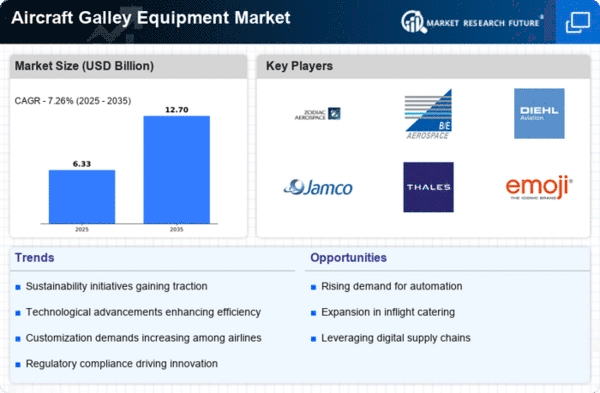
As per MRFR analysis, the Aircraft Galley Equipment Market Size was estimated at 5.9 USD Billion in 2024. The Aircraft Galley Equipment industry is projected to grow from 6.3 in 2025 to 12.7 by 2035, exhibiting a compound annual growth rate (CAGR) of 7.26 during the forecast period 2025 - 2035.

Key Market Trends & Highlights

The Aircraft Galley Equipment Market is poised for growth driven by technological advancements and sustainability initiatives.

  • Technological advancements are reshaping the Aircraft Galley Equipment Market, enhancing efficiency and user experience.
  • North America remains the largest market, while Asia-Pacific is emerging as the fastest-growing region in this sector.
  • The Food Preparation segment dominates the market, whereas the Beverage Service segment is witnessing rapid growth.
  • Rising air travel demand and a focus on in-flight experience are key drivers propelling market expansion.

Market Size & Forecast

2024 Market Size 5.9 (USD Billion)
2035 Market Size 12.7 (USD Billion)
CAGR (2025 - 2035) 7.26%
Largest Regional Market Share in 2024 North America

Major Players

Zodiac Aerospace (FR), B/E Aerospace (US), Diehl Aviation (DE), Jamco Corporation (JP), Thales Group (FR), Amoji (US), Satair (DK), AeroSpecialties (US)

Market Trends

Aircraft Galley Equipment

Aircraft Galley Equipment Market Market Drivers

Regulatory Compliance

The Global aircraft galley equipment Market Industry is also shaped by stringent regulatory requirements. Airlines must adhere to various safety and health regulations, which necessitate the use of compliant galley equipment. This includes standards set by aviation authorities regarding food safety, equipment durability, and operational efficiency. Compliance with these regulations often leads to the replacement or upgrading of existing equipment, thereby driving market growth. As regulations evolve, airlines are likely to invest in modern galley solutions that not only meet compliance but also enhance service delivery, thus fostering a competitive edge in the market.

Emerging Markets Growth

Emerging markets are playing a crucial role in the expansion of the Global Aircraft Galley Equipment Market Industry. Countries with increasing disposable incomes and a growing middle class are witnessing a surge in air travel. This trend is prompting airlines in these regions to invest in modern galley equipment to cater to the rising passenger expectations. As a result, the market is likely to experience significant growth in these areas, contributing to the overall valuation of 128.3 USD Billion by 2035. The focus on enhancing passenger experience in emerging markets is expected to drive demand for innovative galley solutions.

Focus on Sustainability

Sustainability is becoming a pivotal driver in the Global Aircraft Galley Equipment Market Industry. Airlines are increasingly prioritizing eco-friendly practices, leading to the development of equipment that minimizes environmental impact. This includes the use of recyclable materials and energy-efficient appliances. For example, some airlines are implementing waste reduction strategies in their galleys, which not only comply with regulatory standards but also appeal to environmentally conscious travelers. As the industry moves towards greener operations, the demand for sustainable galley equipment is expected to rise, further contributing to the market's growth and aligning with global sustainability initiatives.

Technological Advancements

Technological innovations are significantly influencing the Global Aircraft Galley Equipment Market Industry. The introduction of smart galleys, which integrate IoT and automation, enhances operational efficiency and reduces waste. Airlines are increasingly adopting these technologies to streamline food preparation and service processes. For instance, automated ovens and refrigeration systems are becoming commonplace, allowing for better temperature control and food safety. This trend not only improves service quality but also aligns with sustainability goals. As airlines continue to invest in these advancements, the market is likely to see a compound annual growth rate of 4.77% from 2025 to 2035, indicating a shift towards more sophisticated galley solutions.

Increasing Air Travel Demand

The Global Aircraft Galley Equipment Market Industry is experiencing growth driven by the rising demand for air travel. As more passengers opt for air transportation, airlines are compelled to enhance their in-flight services, which includes upgrading galley equipment. In 2024, the market is valued at 76.8 USD Billion, reflecting the industry's response to this demand. Airlines are investing in advanced galley systems to improve efficiency and passenger satisfaction. This trend is expected to continue, with projections indicating that the market could reach 128.3 USD Billion by 2035, suggesting a robust growth trajectory fueled by increased air travel.

Market Segment Insights

By Application: Food Preparation (Largest) vs. Beverage Service (Fastest-Growing)

In the Aircraft Galley Equipment Market, the food preparation segment holds the largest share, reflecting its critical role in ensuring passengers receive high-quality meals during flights. This segment encompasses essential equipment such as ovens, stoves, and food warming systems, facilitating efficient meal preparation. Meanwhile, the beverage service segment is experiencing rapid growth, driven by increasing consumer demand for various beverage options and the rise in premium in-flight service offerings.

Food Preparation (Dominant) vs. Beverage Service (Emerging)

The food preparation segment is at the forefront of the aircraft galley equipment market, characterized by robust technologies that ensure safe and efficient meal preparation in confined spaces. This segment benefits from innovations aimed at enhancing food safety and minimizing cooking time, thus improving service efficiency. On the other hand, the beverage service segment is emerging rapidly, spurred by evolving consumer preferences for diverse beverage experiences onboard. Airlines are investing in advanced beverage dispensers and storage options to cater to this growing demand, positioning themselves to enhance passenger satisfaction and loyalty.

By Equipment Type: Ovens (Largest) vs. Refrigerators (Fastest-Growing)

In the Aircraft Galley Equipment Market, the distribution of market share among the key equipment types indicates that ovens hold the largest portion, showcasing their essential role in inflight meal preparation. Refrigerators, while not as dominant, are gaining traction and share within the market, reflecting their importance in maintaining food safety and quality at altitude. Other equipment types such as coffee makers and heating cabinets also play crucial roles but occupy smaller segments of the overall market. Growth trends show that the demand for Refrigerators is on the rise, fueled by increasing passenger expectations for fresh food offerings during flights and a growing emphasis on catering to dietary needs. Ovens continue to sustain their relevance, yet innovation in efficiency and technology among other equipment types is driving competition and setting the stage for rapid developments in the segment, particularly for Refrigerators as airlines modernize their fleets.

Ovens (Dominant) vs. Coffee Makers (Emerging)

Ovens are the dominant equipment type in the Aircraft Galley Equipment Market, characterized by their essential functionality in cooking and reheating meals. Their robustness and reliability make them indispensable in the airline industry, where the quality of inflight cuisine can significantly impact passenger satisfaction. Conversely, coffee makers are emerging as a pivotal segment due to the rising demand for fresh beverages, reflecting broader consumer trends toward premium coffee experiences even in transit. While ovens maintain their well-established position, advancements in coffee maker technology are positioning them to capture an increasing share of the market as travelers seek more diverse inflight offerings.

By End Use: Commercial Aviation (Largest) vs. Cargo Aviation (Fastest-Growing)

In the Aircraft Galley Equipment Market, the end-use segment primarily comprises Commercial Aviation, Private Aviation, and Cargo Aviation. Commercial Aviation holds a significant portion of the market share, attributed to the massive number of passengers traveling annually, which necessitates robust and efficient galley equipment. Private Aviation contributes to a smaller yet crucial part of the market, appealing mainly to affluent individuals and businesses who prioritize luxury and efficiency. Cargo Aviation, while typically considered secondary, is emerging rapidly as e-commerce continues to drive demand for air freight, thus presenting a unique opportunity for growth in galley equipment catering to specific cargo needs.

Commercial Aviation (Dominant) vs. Cargo Aviation (Emerging)

Commercial Aviation remains the dominant end-use segment in the Aircraft Galley Equipment Market, characterized by high demand for diverse equipment ranging from food preparation units to storage solutions that meet varying airline standards. Airlines invest significantly in modern galley systems to enhance passenger experience and operational efficiency, making it a cornerstone of aircraft design and functionality. In contrast, Cargo Aviation is an emerging segment that is witnessing growth due to the increasing need for specialized galley equipment that can facilitate the handling of food and refreshments in cargo aircraft. This segment addresses logistical challenges while ensuring compliance with health standards, positioning it as a key player in future market dynamics.

By Material Type: Stainless Steel (Largest) vs. Aluminum (Fastest-Growing)

In the Aircraft Galley Equipment Market, the material type segment is predominantly led by Stainless Steel, which accounts for a significant portion of the market share. This material is favored due to its durability, resistance to corrosion, and ability to maintain hygiene standards, making it ideal for airline applications. Meanwhile, Aluminum commands a growing presence, increasingly being utilized for its lightweight nature, which contributes to fuel efficiency and operational cost savings in airlines. As airlines focus on reducing weight to enhance fuel efficiency, demand for Aluminum in aircraft galley equipment is on the rise. This lightweight material is also gaining traction due to advances in alloy technologies that improve its strength-to-weight ratio, thereby making it suitable for more applications. In contrast, while Stainless Steel remains dominant, innovations and sustainability considerations are stimulating growth in alternative materials, offering airlines various options for their galley equipment needs.

Stainless Steel (Dominant) vs. Composite Materials (Emerging)

Stainless Steel remains the dominant material in the Aircraft Galley Equipment Market due to its inherent attributes such as corrosion resistance, durability, and strength, making it a preferred choice for airlines seeking longevity and reliability in their equipment. Conversely, Composite Materials present an emerging opportunity, gaining traction for their lightweight properties and versatility. They offer improved fuel efficiency and design flexibility, catering to modern aircraft requirements. The adoption of Composite Materials is increasing as manufacturers innovate to develop specialized solutions that can withstand the demanding conditions of aviation while meeting regulatory standards. The competition between these materials is likely to shape the future landscape of aircraft galley equipment, as airlines seek optimal combinations of weight reduction, cost efficiency, and durability.

By Design Type: Modular Design (Largest) vs. Integrated Design (Fastest-Growing)

In the Aircraft Galley Equipment Market, the Modular Design segment commands the largest share due to its flexibility and ease of installation. Aircraft manufacturers prefer modular designs as they facilitate quicker upgrades and configurations tailored to specific airline needs, making it a staple choice. In contrast, the Integrated Design segment is witnessing rapid growth. It offers a seamless solution that enhances the overall aesthetic and functionality of the galley, becoming increasingly popular among modern aircraft designs.

Modular Design (Dominant) vs. Integrated Design (Emerging)

The Modular Design is characterized by modular components that can be easily reconfigured or replaced. This design approach is favored for its adaptability to various aircraft layouts and maintenance conveniences. It allows airlines to minimize downtime during refurbishments, thus enhancing operational efficiency. On the other hand, the Integrated Design presents a more cohesive and streamlined look, often merging multiple functions into a single system. This design is gaining traction as airlines focus on modern aesthetics and improved space utilization. The growing trend towards customization in aircraft interiors further fuels the emergence of integrated solutions, enabling airlines to offer a differentiated experience to passengers.

Get more detailed insights about Aircraft Galley Equipment Market Research Report -Forecast till 2035

Regional Insights

North America : Market Leader in Innovation

North America is poised to maintain its leadership in the Aircraft Galley Equipment Market, holding a significant market share of 3.0 in 2025. The region's growth is driven by increasing air travel demand, technological advancements, and stringent safety regulations. The presence of major airlines and aircraft manufacturers further fuels this demand, as they seek to enhance passenger experience and operational efficiency. The competitive landscape is robust, with key players like B/E Aerospace and Zodiac Aerospace leading the charge. The U.S. is the primary market, supported by a strong regulatory framework that encourages innovation and quality standards. This environment fosters collaboration among manufacturers, ensuring that North America remains at the forefront of aircraft galley equipment development.

Europe : Emerging Market with Growth Potential

Europe, with a market size of 1.8, is witnessing a steady growth trajectory in the Aircraft Galley Equipment Market. Factors such as increasing passenger traffic, a focus on sustainability, and regulatory support for modernizing fleet equipment are driving this growth. The European Union's regulations on aviation safety and environmental standards are also pivotal in shaping market dynamics, encouraging innovation and compliance among manufacturers. Leading countries like Germany, France, and the UK are at the forefront, hosting major players such as Diehl Aviation and Thales Group. The competitive landscape is characterized by collaborations and partnerships aimed at enhancing product offerings. The region's commitment to sustainability and efficiency positions it as a key player in the global market.

Asia-Pacific : Rapid Growth in Emerging Markets

The Asia-Pacific region, with a market size of 0.9, is emerging as a significant player in the Aircraft Galley Equipment Market. The growth is primarily driven by increasing air travel, expanding airline fleets, and rising disposable incomes in countries like China and India. Regulatory bodies are also promoting modernization in aviation infrastructure, which is crucial for meeting the growing demand for efficient and innovative galley solutions. Countries such as Japan and Australia are leading the charge, with key players like Jamco Corporation actively participating in the market. The competitive landscape is evolving, with local manufacturers gaining traction alongside established global players. This dynamic environment is expected to foster innovation and enhance product offerings in the region.

Middle East and Africa : Emerging Market with Untapped Potential

The Middle East and Africa (MEA) region, with a market size of 0.2, presents untapped potential in the Aircraft Galley Equipment Market. The growth is driven by increasing air travel demand, particularly in the Gulf states, and investments in aviation infrastructure. Regulatory support for enhancing safety and efficiency in air travel is also a key driver, as governments seek to boost tourism and connectivity in the region. Countries like the UAE and South Africa are leading the market, with a growing number of airlines investing in modernizing their fleets. The competitive landscape is characterized by a mix of local and international players, creating opportunities for collaboration and innovation. As the region continues to develop, the demand for advanced galley equipment is expected to rise significantly.

Key Players and Competitive Insights

The Aircraft Galley Equipment Market is characterized by a competitive landscape that is increasingly shaped by innovation, sustainability, and strategic partnerships. Key players such as Zodiac Aerospace (FR), B/E Aerospace (US), and Diehl Aviation (DE) are actively pursuing strategies that emphasize technological advancements and operational efficiencies. For instance, Zodiac Aerospace (FR) has focused on enhancing its product offerings through the integration of smart technologies, which not only improve functionality but also align with the growing demand for eco-friendly solutions. B/E Aerospace (US) appears to be concentrating on expanding its market presence through strategic acquisitions, thereby consolidating its position in the market. Meanwhile, Diehl Aviation (DE) is leveraging its expertise in lightweight materials to develop more efficient galley equipment, which is crucial in an era where fuel efficiency is paramount. Collectively, these strategies indicate a shift towards a more innovation-driven competitive environment.In terms of business tactics, companies are increasingly localizing manufacturing to reduce lead times and optimize supply chains. This approach is particularly relevant in a moderately fragmented market where agility can provide a competitive edge. The collective influence of these key players is significant, as they not only set industry standards but also drive technological advancements that shape market dynamics.

In November Jamco Corporation (JP) announced a partnership with a leading aerospace manufacturer to co-develop next-generation galley systems that incorporate AI-driven features. This strategic move is likely to enhance operational efficiency and improve the passenger experience, reflecting a broader trend towards digital transformation in the industry. The collaboration underscores Jamco's commitment to innovation and positions it favorably against competitors.

In October Thales Group (FR) unveiled a new line of galley equipment designed with sustainability in mind, utilizing recyclable materials and energy-efficient technologies. This initiative not only aligns with global sustainability goals but also caters to the increasing consumer demand for environmentally responsible products. Thales's proactive approach may serve to strengthen its market position as airlines seek to enhance their green credentials.

In September Satair (DK) expanded its service offerings by launching a digital platform aimed at streamlining the procurement process for galley equipment. This platform is expected to enhance supply chain reliability and provide airlines with greater flexibility in managing their inventory. Satair's initiative reflects a growing trend towards digitalization in the market, which is likely to redefine how companies interact with their customers and suppliers.

As of December the competitive trends in the Aircraft Galley Equipment Market are increasingly defined by digitalization, sustainability, and the integration of AI technologies. Strategic alliances are becoming more prevalent, as companies recognize the value of collaboration in driving innovation. The competitive landscape is shifting from traditional price-based competition to a focus on technological differentiation and supply chain reliability. This evolution suggests that future success will hinge on the ability to innovate and adapt to changing market demands.

Key Companies in the Aircraft Galley Equipment Market include

Industry Developments

    • Major businesses that operate in the aircraft galley equipment global market, such as Zodiac Aerospace, have been integrating electric-based technologies and robust systems to improve business efficiency and performance.
    • Turkish Aerospace has signed an agreement with TCI Cabin Interior for Airborne Standoff Jammer (ASOJ) project to detect enemy communication radars and systems and to jam them to ensure that they are not used allies, specifically in cross-border activities. 

Key Industrial segments

By Gallery Type

    • Standard Gallery
    • Modular Gallery
    • Customized Gallery

By Fit

    • Line Fit
    • Retro Fit

By Inserts

    • Electric Insert
    • Non-electric Insert

By Application 

    • Narrow Body
    • Wide Body
    • Very Large Body

Future Outlook

Aircraft Galley Equipment Market Future Outlook

The Aircraft Galley Equipment Market is projected to grow at a 7.26% CAGR from 2025 to 2035, driven by technological advancements, increasing air travel demand, and evolving passenger preferences.

New opportunities lie in:

  • Integration of smart kitchen technology for enhanced efficiency.
  • Development of eco-friendly galley equipment to meet sustainability goals.
  • Expansion of modular galley systems for diverse aircraft configurations.

By 2035, the market is expected to be robust, reflecting significant advancements and growth.

Market Segmentation

Aircraft Galley Equipment Market End Use Outlook

  • Commercial Aviation
  • Private Aviation
  • Cargo Aviation

Aircraft Galley Equipment Market Application Outlook

  • Food Preparation
  • Beverage Service
  • Storage Solutions
  • Waste Management

Aircraft Galley Equipment Market Design Type Outlook

  • Modular Design
  • Integrated Design
  • Custom Design

Aircraft Galley Equipment Market Material Type Outlook

  • Stainless Steel
  • Aluminum
  • Plastic
  • Composite Materials

Aircraft Galley Equipment Market Equipment Type Outlook

  • Ovens
  • Refrigerators
  • Coffee Makers
  • Heating Cabinets

Report Scope

MARKET SIZE 20245.9(USD Billion)
MARKET SIZE 20256.3(USD Billion)
MARKET SIZE 203512.7(USD Billion)
COMPOUND ANNUAL GROWTH RATE (CAGR)7.26% (2025 - 2035)
REPORT COVERAGERevenue Forecast, Competitive Landscape, Growth Factors, and Trends
BASE YEAR2024
Market Forecast Period2025 - 2035
Historical Data2019 - 2024
Market Forecast UnitsUSD Billion
Key Companies ProfiledZodiac Aerospace (FR), B/E Aerospace (US), Diehl Aviation (DE), Jamco Corporation (JP), Thales Group (FR), Amoji (US), Satair (DK), AeroSpecialties (US)
Segments CoveredApplication, Equipment Type, End Use, Material Type, Design Type
Key Market OpportunitiesIntegration of smart technology in Aircraft Galley Equipment enhances efficiency and passenger experience.
Key Market DynamicsTechnological advancements and regulatory changes drive innovation and efficiency in the Aircraft Galley Equipment Market.
Countries CoveredNorth America, Europe, APAC, South America, MEA

FAQs

How Aircraft Galley Equipment Market is Worth Globally?

Aircraft Galley Equipment Market size is Exhibiting A CAGR Of 5.01% By 2022-2030

Who Are The Top Key Players in Aircraft Galley Equipment Market ?

Zodiac Aerospace, Rockwell Collins Inc., JAMCO Corporation, AIM Altitude, Diehl Stiftung & Co. KG, Bucher Group, Aerolux, Turkish Cabin Interior, Korita Aviation

In which Region Aircraft Galley Equipment Market Growing ?

North America is Highest Share Holder of Aircraft Galley Equipment Market

Which are The key drivers of Aircraft Galley Equipment Industry ?

Increase in demand for efficient and functional aircraft galley equipment and high competition among airlines to deliver better services to flyers

  1. SECTION I: EXECUTIVE SUMMARY AND KEY HIGHLIGHTS
    1. | 1.1 EXECUTIVE SUMMARY
    2. | 1.1.1 Market Overview
    3. | 1.1.2 Key Findings
    4. | 1.1.3 Market Segmentation
    5. | 1.1.4 Competitive Landscape
    6. | 1.1.5 Challenges and Opportunities
    7. | 1.1.6 Future Outlook
  2. SECTION II: SCOPING, METHODOLOGY AND MARKET STRUCTURE
    1. | 2.1 MARKET INTRODUCTION
    2. | 2.1.1 Definition
    3. | 2.1.2 Scope of the study
    4. |-- 2.1.2.1 Research Objective
    5. |-- 2.1.2.2 Assumption
    6. |-- 2.1.2.3 Limitations
    7. | 2.2 RESEARCH METHODOLOGY
    8. | 2.2.1 Overview
    9. | 2.2.2 Data Mining
    10. | 2.2.3 Secondary Research
    11. | 2.2.4 Primary Research
    12. |-- 2.2.4.1 Primary Interviews and Information Gathering Process
    13. |-- 2.2.4.2 Breakdown of Primary Respondents
    14. | 2.2.5 Forecasting Model
    15. | 2.2.6 Market Size Estimation
    16. |-- 2.2.6.1 Bottom-Up Approach
    17. |-- 2.2.6.2 Top-Down Approach
    18. | 2.2.7 Data Triangulation
    19. | 2.2.8 Validation
  3. SECTION III: QUALITATIVE ANALYSIS
    1. | 3.1 MARKET DYNAMICS
    2. | 3.1.1 Overview
    3. | 3.1.2 Drivers
    4. | 3.1.3 Restraints
    5. | 3.1.4 Opportunities
    6. | 3.2 MARKET FACTOR ANALYSIS
    7. | 3.2.1 Value chain Analysis
    8. | 3.2.2 Porter's Five Forces Analysis
    9. |-- 3.2.2.1 Bargaining Power of Suppliers
    10. |-- 3.2.2.2 Bargaining Power of Buyers
    11. |-- 3.2.2.3 Threat of New Entrants
    12. |-- 3.2.2.4 Threat of Substitutes
    13. |-- 3.2.2.5 Intensity of Rivalry
    14. | 3.2.3 COVID-19 Impact Analysis
    15. |-- 3.2.3.1 Market Impact Analysis
    16. |-- 3.2.3.2 Regional Impact
    17. |-- 3.2.3.3 Opportunity and Threat Analysis
  4. SECTION IV: QUANTITATIVE ANALYSIS
    1. | 4.1 Aerospace & Defense, BY Application (USD Billion)
    2. | 4.1.1 Food Preparation
    3. | 4.1.2 Beverage Service
    4. | 4.1.3 Storage Solutions
    5. | 4.1.4 Waste Management
    6. | 4.2 Aerospace & Defense, BY Equipment Type (USD Billion)
    7. | 4.2.1 Ovens
    8. | 4.2.2 Refrigerators
    9. | 4.2.3 Coffee Makers
    10. | 4.2.4 Heating Cabinets
    11. | 4.3 Aerospace & Defense, BY End Use (USD Billion)
    12. | 4.3.1 Commercial Aviation
    13. | 4.3.2 Private Aviation
    14. | 4.3.3 Cargo Aviation
    15. | 4.4 Aerospace & Defense, BY Material Type (USD Billion)
    16. | 4.4.1 Stainless Steel
    17. | 4.4.2 Aluminum
    18. | 4.4.3 Plastic
    19. | 4.4.4 Composite Materials
    20. | 4.5 Aerospace & Defense, BY Design Type (USD Billion)
    21. | 4.5.1 Modular Design
    22. | 4.5.2 Integrated Design
    23. | 4.5.3 Custom Design
    24. | 4.6 Aerospace & Defense, BY Region (USD Billion)
    25. | 4.6.1 North America
    26. |-- 4.6.1.1 US
    27. |-- 4.6.1.2 Canada
    28. | 4.6.2 Europe
    29. |-- 4.6.2.1 Germany
    30. |-- 4.6.2.2 UK
    31. |-- 4.6.2.3 France
    32. |-- 4.6.2.4 Russia
    33. |-- 4.6.2.5 Italy
    34. |-- 4.6.2.6 Spain
    35. |-- 4.6.2.7 Rest of Europe
    36. | 4.6.3 APAC
    37. |-- 4.6.3.1 China
    38. |-- 4.6.3.2 India
    39. |-- 4.6.3.3 Japan
    40. |-- 4.6.3.4 South Korea
    41. |-- 4.6.3.5 Malaysia
    42. |-- 4.6.3.6 Thailand
    43. |-- 4.6.3.7 Indonesia
    44. |-- 4.6.3.8 Rest of APAC
    45. | 4.6.4 South America
    46. |-- 4.6.4.1 Brazil
    47. |-- 4.6.4.2 Mexico
    48. |-- 4.6.4.3 Argentina
    49. |-- 4.6.4.4 Rest of South America
    50. | 4.6.5 MEA
    51. |-- 4.6.5.1 GCC Countries
    52. |-- 4.6.5.2 South Africa
    53. |-- 4.6.5.3 Rest of MEA
  5. SECTION V: COMPETITIVE ANALYSIS
    1. | 5.1 Competitive Landscape
    2. | 5.1.1 Overview
    3. | 5.1.2 Competitive Analysis
    4. | 5.1.3 Market share Analysis
    5. | 5.1.4 Major Growth Strategy in the Aerospace & Defense
    6. | 5.1.5 Competitive Benchmarking
    7. | 5.1.6 Leading Players in Terms of Number of Developments in the Aerospace & Defense
    8. | 5.1.7 Key developments and growth strategies
    9. |-- 5.1.7.1 New Product Launch/Service Deployment
    10. |-- 5.1.7.2 Merger & Acquisitions
    11. |-- 5.1.7.3 Joint Ventures
    12. | 5.1.8 Major Players Financial Matrix
    13. |-- 5.1.8.1 Sales and Operating Income
    14. |-- 5.1.8.2 Major Players R&D Expenditure. 2023
    15. | 5.2 Company Profiles
    16. | 5.2.1 Zodiac Aerospace (FR)
    17. |-- 5.2.1.1 Financial Overview
    18. |-- 5.2.1.2 Products Offered
    19. |-- 5.2.1.3 Key Developments
    20. |-- 5.2.1.4 SWOT Analysis
    21. |-- 5.2.1.5 Key Strategies
    22. | 5.2.2 B/E Aerospace (US)
    23. |-- 5.2.2.1 Financial Overview
    24. |-- 5.2.2.2 Products Offered
    25. |-- 5.2.2.3 Key Developments
    26. |-- 5.2.2.4 SWOT Analysis
    27. |-- 5.2.2.5 Key Strategies
    28. | 5.2.3 Diehl Aviation (DE)
    29. |-- 5.2.3.1 Financial Overview
    30. |-- 5.2.3.2 Products Offered
    31. |-- 5.2.3.3 Key Developments
    32. |-- 5.2.3.4 SWOT Analysis
    33. |-- 5.2.3.5 Key Strategies
    34. | 5.2.4 Jamco Corporation (JP)
    35. |-- 5.2.4.1 Financial Overview
    36. |-- 5.2.4.2 Products Offered
    37. |-- 5.2.4.3 Key Developments
    38. |-- 5.2.4.4 SWOT Analysis
    39. |-- 5.2.4.5 Key Strategies
    40. | 5.2.5 Thales Group (FR)
    41. |-- 5.2.5.1 Financial Overview
    42. |-- 5.2.5.2 Products Offered
    43. |-- 5.2.5.3 Key Developments
    44. |-- 5.2.5.4 SWOT Analysis
    45. |-- 5.2.5.5 Key Strategies
    46. | 5.2.6 Amoji (US)
    47. |-- 5.2.6.1 Financial Overview
    48. |-- 5.2.6.2 Products Offered
    49. |-- 5.2.6.3 Key Developments
    50. |-- 5.2.6.4 SWOT Analysis
    51. |-- 5.2.6.5 Key Strategies
    52. | 5.2.7 Satair (DK)
    53. |-- 5.2.7.1 Financial Overview
    54. |-- 5.2.7.2 Products Offered
    55. |-- 5.2.7.3 Key Developments
    56. |-- 5.2.7.4 SWOT Analysis
    57. |-- 5.2.7.5 Key Strategies
    58. | 5.2.8 AeroSpecialties (US)
    59. |-- 5.2.8.1 Financial Overview
    60. |-- 5.2.8.2 Products Offered
    61. |-- 5.2.8.3 Key Developments
    62. |-- 5.2.8.4 SWOT Analysis
    63. |-- 5.2.8.5 Key Strategies
    64. | 5.3 Appendix
    65. | 5.3.1 References
    66. | 5.3.2 Related Reports

Aerospace & Defense Market Segmentation

Aerospace & Defense By Application (USD Billion, 2025-2035)

  • Food Preparation
  • Beverage Service
  • Storage Solutions
  • Waste Management

Aerospace & Defense By Equipment Type (USD Billion, 2025-2035)

  • Ovens
  • Refrigerators
  • Coffee Makers
  • Heating Cabinets

Aerospace & Defense By End Use (USD Billion, 2025-2035)

  • Commercial Aviation
  • Private Aviation
  • Cargo Aviation

Aerospace & Defense By Material Type (USD Billion, 2025-2035)

  • Stainless Steel
  • Aluminum
  • Plastic
  • Composite Materials

Aerospace & Defense By Design Type (USD Billion, 2025-2035)

  • Modular Design
  • Integrated Design
  • Custom Design
Infographic

Free Sample Request

Kindly complete the form below to receive a free sample of this Report

Get Free Sample

Customer Strories

Compare Licence

×
Features License Type
Single User Multiuser License Enterprise User
Price $4,950 $5,950 $7,250
Maximum User Access Limit 1 User Upto 10 Users Unrestricted Access Throughout the Organization
Free Customization
Direct Access to Analyst
Deliverable Format
Platform Access
Discount on Next Purchase 10% 15% 15%
Printable Versions