Request Free Sample ×

Kindly complete the form below to receive a free sample of this Report

* Please use a valid business email

Leading companies partner with us for data-driven Insights

clients tt-cursor
Hero Background

Aircraft Battery Market

ID: MRFR/AD/7294-HCR
175 Pages
Abbas Raut
Last Updated: May 27, 2026

Aircraft Battery Market Size, Share, Industry Trend & Analysis Research Report: Information By Battery Type (Lead-Acid, Nickel-Cadmium (NiCd), Lithium-Ion (Li-ion), Lithium-Sulfur (Li-S), Other Advanced), By Application (Emergency & Backup Power, Main Propulsion, eVTOL Propulsion, Auxiliary Power Unit (APU) Start, Avionics & Instrumentation), By Aircraft Type (Fixed-Wing, Rotary Wing, Advanced Air Mobility (AAM), Unmanned (UAS/Drone)), By Power Density (Below 300 Wh/kg, 300–500 Wh/kg, Above 500 Wh/kg), By End User (OEM, Aftermarket) – Forecast Till 2035

English
Share:
Download PDF ×

We do not share your information with anyone. However, we may send you emails based on your report interest from time to time. You may contact us at any time to opt-out.

  1. 1 Market Overview |
    1. 1.1 Study Assumptions & Market Definition |
    2. 1.2 Scope of the Study |
    3. 1.3 Research Methodology
  2. 2 Market Summary & Key Takeaways
  3. 3 Market Dynamics |
    1. 3.1 Market Drivers Analysis | |
      1. 3.1.1 Electrification Mandates & Emissions Regulation | |
      2. 3.1.2 eVTOL & AAM Certification Pipeline | |
      3. 3.1.3 Solid-State & Lithium-Sulfur Cell Breakthroughs | |
      4. 3.1.4 Defense Hybrid-Electric Propulsion Programs | |
      5. 3.1.5 Aftermarket Fleet Retrofit Demand | |
      6. 3.1.6 Asia-Pacific Low-Altitude Economy Policies | |
      7. 3.1.7 Venture & Strategic Investment Inflows |
    2. 3.2 Market Restraints Analysis | |
      1. 3.2.1 Certification Complexity & Timeline Risk | |
      2. 3.2.2 Thermal-Runaway & Safety Qualification Costs | |
      3. 3.2.3 Raw-Material Supply-Chain Bottlenecks | |
      4. 3.2.4 High Upfront Cost vs. Legacy NiCd/Lead-Acid | |
      5. 3.2.5 Limited Recycling & Second-Life Infrastructure |
    3. 3.3 Market Opportunity Analysis | |
      1. 3.3.1 Solid-State Batteries for Next-Generation Platforms | |
      2. 3.3.2 Battery-as-a-Service and Leasing Models | |
      3. 3.3.3 Emerging-Market Urban Air-Mobility Corridors | |
      4. 3.3.4 Second-Life and Recycling Ecosystems | |
      5. 3.3.5 Data-Driven Battery Health Monitoring and Monetization |
    4. 3.4 Industry Value Chain Analysis |
    5. 3.5 Porter's Five Forces Analysis
  4. 4 Global Aircraft Battery Market Size & Forecast (2021–2035) |
    1. 4.1 Historical Market Size (2021–2025) |
    2. 4.2 Current & Forecast Market Size (2026–2035) |
    3. 4.3 Market Size by Revenue (USD Billion) |
    4. 4.4 Year-over-Year Growth Analysis
  5. 5 Segmentation Analysis |
    1. 5.1 By Battery Type | |
      1. 5.1.1 Lead-Acid | |
      2. 5.1.2 Nickel-Cadmium (NiCd) | |
      3. 5.1.3 Lithium-Ion (Li-ion) | |
      4. 5.1.4 Lithium-Sulfur (Li-S) | |
      5. 5.1.5 Other Advanced Chemistries |
    2. 5.2 By Application | |
      1. 5.2.1 Emergency & Backup Power | |
      2. 5.2.2 Main Propulsion | |
      3. 5.2.3 eVTOL Propulsion | |
      4. 5.2.4 Auxiliary Power Unit (APU) Start | |
      5. 5.2.5 Avionics & Instrumentation | |
      6. 5.2.6 Advanced Battery System |
    3. 5.3 By Aircraft Technology | |
      1. 5.3.1 Traditional | |
      2. 5.3.2 Hybrid-Electric | |
      3. 5.3.3 Fully Electric |
    4. 5.4 By Aircraft Type | |
      1. 5.4.1 Fixed-Wing | |
      2. 5.4.2 Rotary Wing | |
      3. 5.4.3 Advanced Air Mobility (AAM) | |
      4. 5.4.4 Unmanned (UAS/Drone) |
    5. 5.5 By Power Density | |
      1. 5.5.1 Below 300 Wh/kg | |
      2. 5.5.2 300–500 Wh/kg | |
      3. 5.5.3 Above 500 Wh/kg |
    6. 5.6 By End User | |
      1. 5.6.1 OEM | |
      2. 5.6.2 Aftermarket
  6. 6 Regional Analysis |
    1. 6.1 North America | |
      1. 6.1.1 United States | |
      2. 6.1.2 Canada | |
      3. 6.1.3 Mexico |
    2. 6.2 Europe | |
      1. 6.2.1 Germany | |
      2. 6.2.2 United Kingdom | |
      3. 6.2.3 France | |
      4. 6.2.4 Italy | |
      5. 6.2.5 Spain | |
      6. 6.2.6 Nordic Countries | |
      7. 6.2.7 Russia | |
      8. 6.2.8 Rest of Europe |
    3. 6.3 Asia-Pacific | |
      1. 6.3.1 China | |
      2. 6.3.2 India | |
      3. 6.3.3 Japan | |
      4. 6.3.4 South Korea | |
      5. 6.3.5 ASEAN | |
      6. 6.3.6 Rest of Asia-Pacific |
    4. 6.4 South America | |
      1. 6.4.1 Brazil | |
      2. 6.4.2 Argentina | |
      3. 6.4.3 Rest of South America |
    5. 6.5 Middle East & Africa | |
      1. 6.5.1 Saudi Arabia | |
      2. 6.5.2 UAE | |
      3. 6.5.3 South Africa | |
      4. 6.5.4 Egypt | |
      5. 6.5.5 Rest of MEA
  7. 7 Competitive Landscape |
    1. 7.1 Market Share Analysis (2025) |
    2. 7.2 Competitive Benchmarking Matrix |
    3. 7.3 Company Profiles | |
      1. 7.3.1 EaglePicher Technologies | |
      2. 7.3.2 Saft (TotalEnergies) | |
      3. 7.3.3 GS Yuasa Corporation | |
      4. 7.3.4 Concorde Battery Corporation | |
      5. 7.3.5 EnerSys | |
      6. 7.3.6 True Blue Power (Mid-Continent) | |
      7. 7.3.7 Teledyne Technologies | |
      8. 7.3.8 Samsung SDI | |
      9. 7.3.9 CATL | |
      10. 7.3.10 Cuberg (Northvolt)
  8. 8 Future Outlook & Strategic Recommendations (2026–2035) |
    1. 8.1 AI-Enabled Battery Management and Autonomous Operations |
    2. 8.2 Platform Economics and Battery-Leasing Ecosystems |
    3. 8.3 The Electrification Supercycle |
    4. 8.4 ESG Reporting and Sustainable-Aviation Compliance
  9. 9 Recent Developments & News
  10. 10 Frequently Asked Questions (FAQs)
  11. 11 Report Scope & Methodology |
    1. 11.1 Study Period & Base Year |
    2. 11.2 Data Sources & Citations |
    3. 11.3 Abbreviations
  12. 12 LIST OF TABLES |
  13. TABLE 1 Global Aircraft Battery Market Size & Forecast, by Revenue (USD Billion), 2021–2035 |
  14. TABLE 2 Global Aircraft Battery Market — Year-over-Year Growth Analysis, 2021–2035 |
  15. TABLE 3 Driver Impact Analysis — Aircraft Battery Market, 2026–2035 |
  16. TABLE 4 Restraint Impact Analysis — Aircraft Battery Market, 2026–2035 |
  17. TABLE 5 Regional Market Share Summary — Aircraft Battery Market, 2025 |
  18. TABLE 6 North America Aircraft Battery Market Size, by Country, 2021–2035 (USD Billion) |
  19. TABLE 7 Europe Aircraft Battery Market Size, by Country, 2021–2035 (USD Billion) |
  20. TABLE 8 Asia-Pacific Aircraft Battery Market Size, by Country, 2021–2035 (USD Billion) |
  21. TABLE 9 South America Aircraft Battery Market Size, by Country, 2021–2035 (USD Billion) |
  22. TABLE 10 Middle East & Africa Aircraft Battery Market Size, by Country, 2021–2035 (USD Billion) |
  23. TABLE 11 Global Aircraft Battery Market Size, by Battery Type, 2021–2035 (USD Billion) |
  24. TABLE 12 Global Aircraft Battery Market Size, by Application, 2021–2035 (USD Billion) |
  25. TABLE 13 Global Aircraft Battery Market Size, by Aircraft Type, 2021–2035 (USD Billion) |
  26. TABLE 14 Global Aircraft Battery Market Size, by Power Density, 2021–2035 (USD Billion) |
  27. TABLE 15 Global Aircraft Battery Market Size, by End User, 2021–2035 (USD Billion) |
  28. TABLE 16 Competitive Benchmarking Matrix — Aircraft Battery Market, 2025 |
  29. TABLE 17 Company Profiles — Key Players, Aircraft Battery Market |
  30. TABLE 18 Recent Developments & Strategic Announcements, 2023–2025 |
  31. TABLE 19 Report Scope & Methodology Summary |
  32. TABLE 20 Detailed Sources and Citations
  33. 13 LIST OF FIGURES |
  34. FIGURE 1 Aircraft Battery Market Dynamics — Drivers, Restraints, Opportunities |
  35. FIGURE 2 Industry Value Chain Analysis — Aircraft Battery Market |
  36. FIGURE 3 Porter's Five Forces Analysis — Aircraft Battery Market |
  37. FIGURE 4 Global Aircraft Battery Market Size Trend & Forecast (USD Billion), 2021–2035 |
  38. FIGURE 5 Aircraft Battery Market Share, by Battery Type, 2025 |
  39. FIGURE 6 Aircraft Battery Market Share, by Application, 2025 |
  40. FIGURE 7 Aircraft Battery Market Share, by Aircraft Type, 2025 |
  41. FIGURE 8 Aircraft Battery Market Share, by Power Density, 2025 |
  42. FIGURE 9 Aircraft Battery Market Share, by End User, 2025 |
  43. FIGURE 10 Aircraft Battery Market Share, by Region, 2025 |
  44. FIGURE 11 North America Aircraft Battery Market — Country Share, 2025 |
  45. FIGURE 12 Europe Aircraft Battery Market — Country Share, 2025 |
  46. FIGURE 13 Asia-Pacific Aircraft Battery Market — Country Share, 2025 |
  47. FIGURE 14 South America Aircraft Battery Market — Country Share, 2025 |
  48. FIGURE 15 Middle East & Africa Aircraft Battery Market — Country Share, 2025 |
  49. FIGURE 16 Competitive Landscape — Aircraft Battery Market Revenue Share, 2025

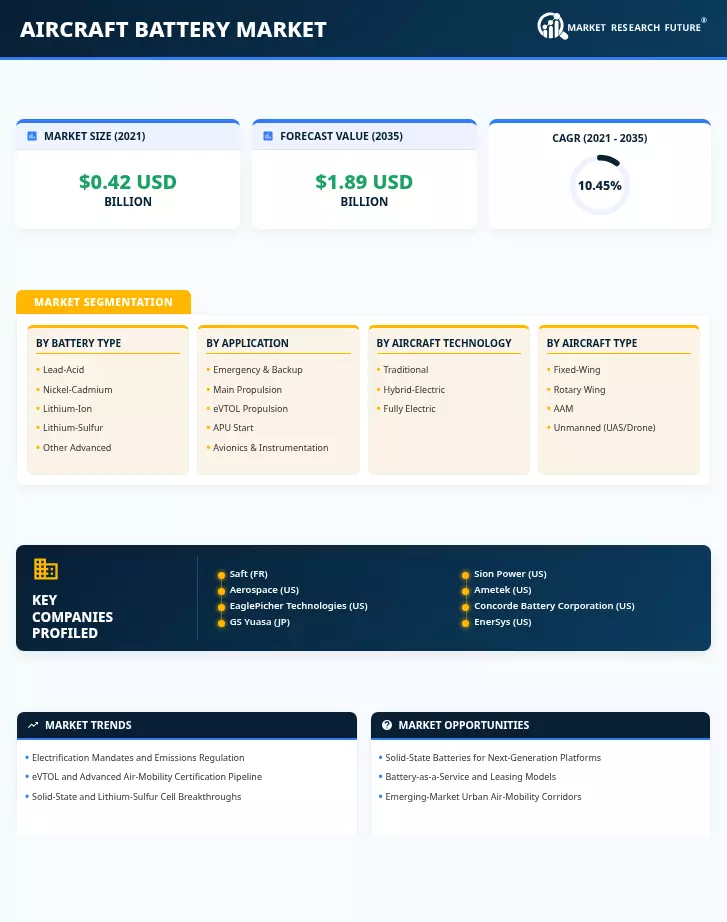
Segmentation Quick Reference

DimensionSub-SegmentsDominant SegmentFastest Growing Segment
Battery TypeLead-Acid, Nickel-Cadmium, Lithium-Ion, Lithium-Sulfur, Other AdvancedLithium-Ion (56.1% share, 2025)Lithium-Sulfur (25.4% CAGR)
ApplicationEmergency & Backup, Main Propulsion, eVTOL Propulsion, APU Start, Avionics & InstrumentationEmergency & Backup (40.8% share, 2025)eVTOL Propulsion (31.2% CAGR)
Aircraft TechnologyTraditional, Hybrid-Electric, Fully ElectricTraditional (~62% share, 2025)Fully Electric (~32% CAGR)
Aircraft TypeFixed-Wing, Rotary Wing, AAM, Unmanned (UAS/Drone)Fixed-Wing (65.2% share, 2025)AAM (31.5% CAGR)
Power DensityBelow 300 Wh/kg, 300–500 Wh/kg, Above 500 Wh/kgBelow 300 Wh/kg (72.1% share, 2025)Above 500 Wh/kg (29.1% CAGR)
End UserOEM, AftermarketOEM (65.4% share, 2025)Aftermarket (8.2% CAGR)


Market Segmentation Overview

By Battery Type

Sub-SegmentKey Trend
Lead-AcidDeclining share as general-aviation operators transition to lithium-ion drop-in replacements.
Nickel-Cadmium (NiCd)Legacy installed base in military rotary-wing; phase-outs accelerating under REACH regulation
Lithium-Ion (Li-ion)Dominant chemistry with expanding TSO certifications for main-ship and emergency roles
Lithium-Sulfur (Li-S)Rapid R&D with prototype packs now in eVTOL flight testing; cycle-life improvements critical
Other AdvancedSolid-state and lithium-air cells in laboratory-to-pilot transition; aviation certification post-2029


Lithium-ion remains the workhorse chemistry in aviation, benefiting from automotive-scale cost reductions and a growing portfolio of FAA/EASA-certified part numbers. Lithium-sulfur and solid-state alternatives are progressing rapidly through prototype flight testing, and their eventual certification will reshape competitive dynamics across the Aircraft Battery Market.

By Application

Sub-SegmentKey Trend
Emergency & Backup PowerMandatory on all certified aircraft; transitioning from NiCd to Li-ion chemistry
Main PropulsionGrowing as fully electric regional platforms approach certification
eVTOL PropulsionFastest-growing application driven by AAM corridor commercialization
APU StartNarrowbody fleet modernization is creating steady replacement demand.
Avionics & InstrumentationGlass-cockpit retrofits and IFE power upgrades are sustaining mid-single-digit growth.


Emergency and backup power remains the largest application by revenue. Still, the strategic center of gravity is shifting toward propulsion applications as eVTOL and hybrid-electric platforms move from prototype to production.

By Aircraft Technology

Sub-SegmentKey Trend
TraditionalLargest share; battery demand driven by auxiliary and emergency systems
Hybrid-ElectricDemonstrators transitioning to certification; regional turboprop conversions leading.
Fully ElectricHighest CAGR; eVTOL and light sport aircraft platforms at the forefront


Traditional aircraft platforms generate the bulk of current battery revenue through auxiliary and emergency installations. Still, fully electric platforms are capturing the fastest growth trajectory as type-certification milestones unlock commercial orders.

By Aircraft Type

Sub-SegmentKey Trend
Fixed-WingDominant share from commercial narrowbody/widebody fleets
Rotary WingDefense and offshore helicopter operations are sustaining steady demand.
Advanced Air Mobility (AAM)Fastest growth from eVTOL certification and vertiport buildout
Unmanned (UAS/Drone)Mid-tier growth from cargo drone logistics and ISR missions


Fixed-wing aircraft account for the majority of installed battery units, but the advanced air-mobility segment is growing at the fastest rate as new eVTOL platforms enter service and urban vertiport networks expand globally.

By Power Density

Sub-SegmentKey Trend
Below 300 Wh/kgCurrent-generation Li-ion packs; dominant installed base
300–500 Wh/kgSilicon-anode and high-nickel cathode cells are entering qualification.
Above 500 Wh/kgSolid-state and Li-S cells in early-stage flight testing


Cells below 300 Wh/kg dominate today's fleet, but aggressive R&D in solid-state and lithium-sulfur chemistries is pushing the frontier above 500 Wh/kg, with aviation qualification expected in the early 2030s.

By End User

Sub-SegmentKey Trend
OEMLine-fit dominance; battery selection locked during aircraft design
AftermarketAccelerating as first-generation Li-ion packs reach replacement age


OEM channels capture the majority of revenue because battery specifications are determined during platform certification. Aftermarket volumes are rising as early lithium-ion installations approach their 8–10-year service-life limits, creating a growing replacement cycle.