×
Request Free Sample ×

Kindly complete the form below to receive a free sample of this Report

* Please use a valid business email

Leading companies partner with us for data-driven Insights

clients tt-cursor
Hero Background
English
Chinese
French
Japanese
Korean
German
Spanish

Air Filter For Automotive Share

ID: MRFR/AT/1673-HCR
111 Pages
Sejal Akre
October 2025

Air Filter for Automotive Market Research Report By Application (Engine Air Filters, Cabin Air Filters, Fuel Filters, Oil Filters), By Type (Disposable Filters, Reusable Filters, Electrostatic Filters), By Filter Material (Paper, Foam, Cotton, Synthetic Materials), By End Use (Passenger Vehicles, Commercial Vehicles, Two Wheelers) and By Regional (North America, Europe, South America, Asia Pacific, Middle East and Africa) - Industry Trends & Forecast to 2035

Share:
Download PDF ×

We do not share your information with anyone. However, we may send you emails based on your report interest from time to time. You may contact us at any time to opt-out.

Air Filter For Automotive Infographic
×
Air Filter For Automotive Infographic Full View
Purchase Options

Market Share

Introduction: Navigating the Competitive Landscape of Automotive Air Filters

The automobile air-cleaner market is in the throes of a revolution, resulting from the rapid development of technology, from the tightening of regulations and from the increasing demands of consumers for cleaner and more efficient vehicles. In this context, the major players, namely the automobile manufacturers, the aftermarket suppliers and new, disruptive companies, are using new and advanced technologies, such as data analysis and the Internet of Things, to enhance the performance and customer experience of their products. The automobile manufacturers are concentrating on integrating smart filtration systems which optimize the engine’s performance. The aftermarket suppliers are responding to the growing demand for high-performance, sustainable filters. New, disruptive companies are developing biometrics and greener solutions for eco-conscious consumers. The development of these new and advanced technologies will be essential for the companies that wish to be successful in the automobile air-cleaner market, especially in Asia-Pacific and North America.

Competitive Positioning

Full-Suite Integrators

These vendors offer comprehensive solutions across multiple automotive filtration needs, integrating various technologies for enhanced performance.

Vendor Competitive Edge Solution Focus Regional Focus
Mahle Strong R&D capabilities Automotive filtration systems Global
Denso Corporation Advanced technology integration Automotive components and filters Asia, North America, Europe
Valeo Innovative product development Automotive air filters Global
Bosch Strong brand recognition Automotive filtration solutions Global

Specialized Technology Vendors

These vendors focus on niche technologies and innovative solutions within the automotive air filtration sector.

Vendor Competitive Edge Solution Focus Regional Focus
Mann+Hummel Expertise in filtration technology Air and liquid filters Global
Donaldson Company High-performance filtration solutions Industrial and automotive filters North America, Europe
Freudenberg Group Diverse material expertise Sealing and filtration solutions Global

Infrastructure & Equipment Providers

These vendors provide essential components and systems that support the manufacturing and performance of automotive air filters.

Vendor Competitive Edge Solution Focus Regional Focus
Parker Hannifin Comprehensive fluid management solutions Filtration and separation technologies Global
Sogefi Group Focus on sustainable solutions Automotive filtration systems Europe, Asia
Hengst SEK and N Engineering Innovative filtration technologies Air and fluid filtration Europe, Asia
Webasto Strong automotive partnerships Heating and cooling systems Global
Cummins Inc. Robust engine filtration solutions Engine and filtration systems Global
Filtration Group Custom filtration solutions Industrial and automotive filters North America, Europe
H. K. M. S. O. Specialized automotive solutions Air filtration products Regional focus unspecified

Emerging Players & Regional Champions

  • EcoAir Filters, USA, a manufacturer of air filters made of biodegradable materials, has recently won a contract with a major manufacturer of electric vehicles, and is thus challenging the established suppliers by promoting the idea of sustainability in the field of car parts.
  • Aeroclean (Germany): This manufacturer of high-efficiency filters for luxury vehicles has recently entered into a partnership with a major automobile manufacturer to improve the air quality in its new models. Its high-end solutions complement those of the established suppliers.
  • FilterTech Innovations, India: Provides cost-effective air filters for the growing Indian automobile market, and recently won a government contract for filters for public transport vehicles. By offering inexpensive alternatives to the established suppliers, it is challenging the established companies.
  • PureFlow (Canada): Using nanotechnology, this company has developed high-efficiency filtration systems. It has just teamed up with a Canadian automaker to integrate its filters into a new electric car, thereby complementing the work of the established suppliers and pushing the boundaries of filtration.

Regional Trends: In 2024, the tendency towards the sustainable and eco-friendly solutions in the automobile air-filter market, especially in North America and Europe, is evident. The new entrants in the market are concentrating on the new materials and new techniques such as biodegradable filters and nanotechnology to meet the rising demand for the cleaner air inside the vehicles. In Asia-Pacific, the tendency towards the cost-effective solutions is also noticeable, resulting from the rapid growth of the automobile industry and the government initiatives to promote public transport.

Collaborations & M&A Movements

  • Mann+Hummel and Toyota partnered to develop advanced air filtration systems aimed at reducing emissions in hybrid vehicles, enhancing their competitive positioning in the eco-friendly automotive segment.
  • Donaldson Company acquired the air filtration division of a leading automotive supplier to expand its product offerings and strengthen its market share in the automotive sector.
  • Freudenberg Filtration Technologies collaborated with Bosch to integrate smart filtration solutions into automotive HVAC systems, aiming to improve air quality and meet stricter regulatory standards.

Competitive Summary Table

Capability Leading Players Remarks
Filtration Efficiency Mann+Hummel, Donaldson Company A new development of filtration technology, Mann & Hummel has been able to achieve a filtration efficiency of up to 99% in its latest product range. The Donaldson Company is a supplier of high-quality filters that are designed to increase the life of engines. Case studies demonstrate that maintenance costs are reduced and that the engines can be used for longer.
Sustainability K&N Engineering, Bosch The re-usable air filters from K&N are designed to reduce waste and are said to have a 50% smaller carbon footprint than traditional filters. And the filters from Bosch are made from a high percentage of recycled material, demonstrating the company’s commitment to the circular economy.
Smart Technology Integration Denso, Mahle In addition, by introducing IoT technology into the air filters, it is possible to monitor the state of the air filters in real time, which can help improve the maintenance of vehicles. Mahle has developed smart filters that communicate with the vehicle’s onboard systems to optimize the quality of the air intake and engine performance.
Cost-Effectiveness Fram, ACDelco Its cheapest filters are not the cheapest in quality, but are the best for those who are budget-conscious. The ACDelco filters, which combine quality and cost, have earned a reputation for reliability among automobile mechanics.
Customization Options Spectre Performance, Airaid Customized air filters for specific vehicle models. For the enthusiast. Airaid offers a wide range of filters for different driving styles and needs. The choice is yours.

Conclusion: Navigating the Competitive Air Filter Landscape

In 2024, the market for automobile air filters is characterized by intense competition and considerable fragmentation, with both established and new players competing for market share. Regional trends are characterized by a growing focus on compliance and on the environment, which are causing the industry to rethink its product offerings. In this process, established companies are able to take advantage of their brand loyalty and distribution network, while newcomers are able to focus on their technological expertise and automation in manufacturing. As the market evolves, the ability to integrate sustainable practices and remain flexible in operations will be crucial for companies aiming to maintain their positions as market leaders. To seize emerging opportunities, companies will have to prioritise these capabilities.

Author
Sejal Akre
Senior Research Analyst

She has over 5 years of rich experience, in market research and consulting providing valuable market insights to client. Hands on expertise in management consulting, and extensive knowledge in domain including ICT, Automotive & Transportation and Aerospace & Defense. She is skilled in Go-to market strategy, industry analysis, market sizing, in depth company profiling, competitive intelligence & benchmarking and value chain amongst others.

Leave a Comment

FAQs

What is the expected market size of the Air Filter for Automotive Market in 2024?

The Air Filter for Automotive Market is expected to be valued at 4.43 USD Billion in 2024.

What is the projected market size of the Air Filter for Automotive Market by 2035?

By 2035, the Air Filter for Automotive Market is projected to reach 6.2 USD Billion

What is the expected CAGR for the Air Filter for Automotive Market from 2025 to 2035?

The expected CAGR for the Air Filter for Automotive Market from 2025 to 2035 is 3.11%.

Which region is expected to dominate the Air Filter for Automotive Market in 2024?

In 2024, the North America region is expected to dominate the Air Filter for Automotive Market with a value of 1.3 USD Billion.

What will be the market value of the Asia-Pacific region for the Air Filter for Automotive Market in 2035?

The Asia-Pacific region is projected to have a market value of 2.3 USD Billion for the Air Filter for Automotive Market by 2035.

What are the expected market sizes for Engine Air Filters and Cabin Air Filters in 2024?

In 2024, Engine Air Filters are valued at 1.45 USD Billion and Cabin Air Filters at 1.1 USD Billion.

Who are the key players in the Air Filter for Automotive Market?

Key players in the Air Filter for Automotive Market include Mahle, Denso Corporation, Valeo, and Mann+Hummel, among others.

What will be the market size for Oil Filters by 2035?

The market size for Oil Filters in the Air Filter for Automotive Market is projected to reach 1.25 USD Billion by 2035.

Which application segment is expected to experience the highest growth in the Air Filter for Automotive Market?

The Engine Air Filters segment is expected to experience significant growth in the Air Filter for Automotive Market during the forecast period.

What is the estimated value of Fuel Filters in 2024 within the Air Filter for Automotive Market?

The estimated value of Fuel Filters in the Air Filter for Automotive Market is 1.08 USD Billion in 2024.

Market Summary

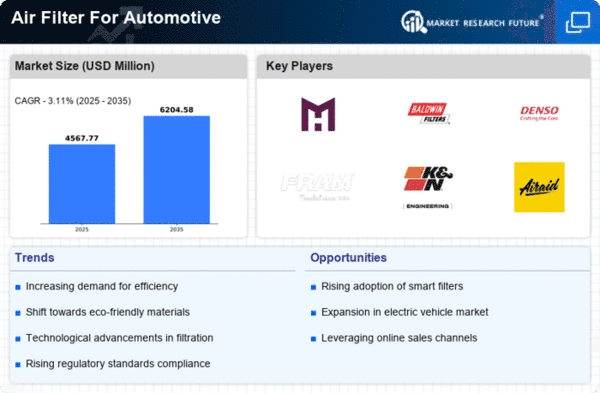
As per MRFR analysis, the Air Filter For Automotive Size was estimated at 4430.0 USD Million in 2024. The Air Filter For Automotive industry is projected to grow from 4567.77 in 2025 to 6204.58 by 2035, exhibiting a compound annual growth rate (CAGR) of 3.11 during the forecast period 2025 - 2035.

Key Market Trends & Highlights

The automotive air filter market is experiencing a transformative shift driven by sustainability and technological advancements.

  • North America remains the largest market for automotive air filters, reflecting robust vehicle production and consumer demand. The Asia-Pacific region is the fastest-growing market, propelled by increasing urbanization and vehicle ownership rates. Passenger vehicles dominate the market, while commercial vehicles are emerging as the fastest-growing segment due to rising logistics needs. Key market drivers include stringent emission regulations and rising consumer awareness regarding air quality and vehicle performance.

Market Size & Forecast

2024 Market Size 4430.0 (USD Million)
2035 Market Size 6204.58 (USD Million)
CAGR (2025 - 2035) 3.11%
Largest Regional Market Share in 2024 North America

Major Players

Mann+Hummel (DE), Mahle (DE), Baldwin Filters (US), Denso (JP), Fram (US), K&N Engineering (US), Airaid (US), S&B Filters (US), Bosch (DE)

Market Trends

The market for Air Filter For Automotive is currently experiencing a notable transformation, driven by increasing environmental awareness and stringent regulations aimed at reducing vehicular emissions. Consumers are becoming more conscious of air quality, which has led to a growing demand for high-efficiency air filters that can effectively trap pollutants and particulates.

This shift is further supported by advancements in filter technology, which enhance the performance and longevity of automotive air filters. Manufacturers are investing in research and development to create innovative products that not only meet regulatory standards but also cater to the evolving preferences of environmentally aware consumers. In addition to environmental considerations, the Air Filter For Automotive market is influenced by the rising trend of electric vehicles.

As the automotive industry transitions towards electrification, the need for specialized air filtration solutions is becoming apparent. Electric vehicles, while producing zero tailpipe emissions, still require effective air filtration systems to maintain cabin air quality. This presents a unique opportunity for manufacturers to develop tailored air filters that address the specific needs of electric and hybrid vehicles. Overall, the Air Filter For Automotive market appears poised for growth, driven by technological advancements and changing consumer expectations.

Sustainability Focus

There is a growing emphasis on sustainability within the Air Filter For Automotive market. Manufacturers are increasingly adopting eco-friendly materials and production processes to align with consumer preferences for environmentally responsible products. This trend reflects a broader societal shift towards sustainability, influencing purchasing decisions.

Technological Advancements

Innovations in filter technology are reshaping the Air Filter For Automotive landscape. Enhanced filtration capabilities, such as improved particle capture and longer service life, are becoming standard features. These advancements not only improve vehicle performance but also contribute to better air quality.

Electric Vehicle Integration

The rise of electric vehicles is creating new opportunities within the Air Filter For Automotive sector. As these vehicles require specialized air filtration systems to ensure optimal cabin air quality, manufacturers are focusing on developing filters that cater specifically to the needs of electric and hybrid models.

Air Filter For Automotive Market Drivers

Market Segment Insights

By Application: Passenger Vehicle (Largest) vs. Commercial Vehicle (Fastest-Growing)

The automotive air filter market is segmented into four primary applications: <a href="https://www.marketresearchfuture.com/reports/passenger-cars-market-42133">passenger vehicles</a>, commercial vehicles, heavy-duty vehicles, and motorcycles. Among these, passenger vehicles represent the largest share, driven by their widespread usage and the growing emphasis on enhancing vehicle performance. In contrast, commercial vehicles have emerged as the fastest-growing segment, reflecting the rise in e-commerce and logistics that demand efficient transportation solutions today.

Passenger Vehicle (Dominant) vs. Commercial Vehicle (Emerging)

Passenger vehicles dominate the automotive air filter market due to their high demand and a wide array of manufacturers offering advanced filtration solutions. They are characterized by a diverse range of air filter technologies, including HEPA filters and multi-stage filtration systems, aimed at improving air quality and engine efficiency. On the other hand, commercial vehicles, while emerging, are rapidly gaining traction due to the increasing focus on reducing operational costs and enhancing fleet performance. These vehicles adopt specialized air filters designed to meet rigorous operational demands, thus experiencing a swift adoption rate as industries seek more sustainable and effective solutions.

By Type: Cabin Air Filter (Largest) vs. Engine Air Filter (Fastest-Growing)

The automotive air filter market is diversified into several types, with the Cabin Air Filter holding the largest market share. This segment is critical for maintaining air quality within vehicles, appealing to health-conscious consumers. In contrast, the Engine Air Filter, while currently smaller in market share, is noted for its rapid growth due to increasing awareness about engine performance and fuel efficiency among consumers. The trend towards stricter emissions regulations and advancing technology is significantly impacting the growth of the Engine Air Filter segment. The demand for high-performance air filtration systems is on the rise, driven by both consumer preference for eco-friendly vehicles and the automotive industry's shift towards sustainable practices. As automotive technology continues to evolve, these filters are becoming essential components for maintaining optimal vehicle performance and longevity.

Cabin Air Filter (Dominant) vs. Engine Air Filter (Emerging)

Cabin Air Filters are crucial for enhancing passenger comfort, effectively removing pollutants and allergens from the cabin air. Their dominance in the market stems from the increasing focus on vehicle interior air quality and health issues among consumers. As such, they are widely implemented across various vehicle types, ensuring a growing demand. On the other hand, Engine Air Filters are emerging as an essential component in vehicle performance optimization, gaining traction as consumers seek improved fuel efficiency and engine longevity. As the automotive sector embraces innovations such as turbocharging, the need for advanced Engine Air Filters tailored to support these technologies is increasing, positioning them as a faster-growing segment with promising potential in the coming years.

By Material: Paper (Largest) vs. Synthetic Fiber (Fastest-Growing)

In the air filter for automotive market, the material segment showcases a variety of options including paper, cotton, synthetic fiber, and foam. Currently, paper filters hold the largest market share due to their widespread use in traditional automotive applications. Their affordability and capability to effectively capture particulate matter contribute to their dominance. Conversely, synthetic fiber is rapidly gaining traction, appealing to manufacturers and consumers alike with its superior filtration performance and durability. This shift is indicative of a broader trend towards more efficient and reliable filter solutions.

Paper (Dominant) vs. Cotton (Emerging)

Paper filters are known for their high efficiency and cost-effectiveness, making them the dominant choice in automotive air filtration. Their design typically allows for a higher dirt-loading capacity and better airflow performance. On the other hand, cotton filters are emerging as a popular alternative for those seeking reusable options. While they provide excellent filtration and airflow, they require regular cleaning and maintenance. The contrast between these two materials highlights a consumer preference for low maintenance versus long-term sustainability. As automakers increasingly focus on enhancing vehicle performance, the adoption of high-efficiency cotton filters is expected to grow, positioning them as a notable player in the evolving automotive market.

By Filtration Efficiency: High Efficiency (Largest) vs. Ultra High Efficiency (Fastest-Growing)

In the automotive air filter market, the filtration efficiency segment is characterized by distinct levels of performance, which include Low Efficiency, Medium Efficiency, High Efficiency, and Ultra High Efficiency. Among these, High Efficiency air filters command the largest share, primarily due to their superior capability to capture airborne pollutants and improve engine performance. The growing consumer preference for enhanced air quality and improved vehicle lifespan has significantly contributed to the dominance of this segment. Meanwhile, the Ultra High Efficiency segment is gaining traction as more manufacturers innovate to meet stricter emission standards, making it the fastest-growing segment within this category.

High Efficiency (Dominant) vs. Ultra High Efficiency (Emerging)

High Efficiency air filters are critical in promoting vehicle performance and engine health by effectively trapping pollutants and particulates. These filters are often made from advanced materials that offer a balance between airflow and filtration capability, making them popular among consumers seeking quality and longevity. On the other hand, Ultra High Efficiency air filters are at the forefront of technological advancements in automotive filtration. As manufacturers respond to escalating environmental regulations, these filters are designed to provide superior filtration performance while minimizing airflow restrictions. Consequently, Ultra High Efficiency filters are quickly becoming an emerging choice for environmentally conscious consumers looking for optimized vehicle efficiency.

Get more detailed insights about Air Filter For Automotive Market Research Report - Global Forecast to 2035

Regional Insights

North America : Market Leader in Air Filters

North America is poised to maintain its leadership in the automotive air filter market, holding a significant share of 2218.5 million. The region's growth is driven by stringent environmental regulations and increasing consumer awareness regarding vehicle maintenance. The demand for high-efficiency air filters is on the rise, fueled by the growing automotive sector and the shift towards electric vehicles, which require advanced filtration solutions. The competitive landscape in North America is robust, featuring key players such as Baldwin Filters, Denso, and K&N Engineering. The U.S. stands out as the largest market, supported by a strong manufacturing base and innovation in filtration technologies. Companies are investing in R&D to develop products that meet regulatory standards and consumer expectations, ensuring a dynamic market environment.

Europe : Regulatory-Driven Market Growth

Europe's automotive air filter market is projected to reach 1100.0 million, driven by stringent EU regulations aimed at reducing emissions and enhancing air quality. The demand for eco-friendly and high-performance filters is increasing, as consumers and manufacturers alike prioritize sustainability. The European market is characterized by a shift towards innovative filtration technologies that comply with environmental standards, fostering growth in this sector. Leading countries such as Germany, France, and the UK are at the forefront of this market, with major players like Mann+Hummel and Bosch leading the charge. The competitive landscape is marked by collaborations and partnerships aimed at enhancing product offerings. As the region embraces electric vehicles, the need for advanced air filtration solutions is expected to grow, further solidifying Europe's position in the global market.

Asia-Pacific : Emerging Market Potential

The Asia-Pacific region is witnessing significant growth in the automotive air filter market, projected to reach 900.0 million. This growth is driven by increasing vehicle production and rising consumer demand for better air quality. Countries like China and India are leading this trend, supported by government initiatives aimed at improving environmental standards and promoting cleaner technologies. The region's expanding middle class is also contributing to the demand for high-quality automotive products. China stands out as the largest market, with numerous local and international players competing for market share. Key companies such as Denso and Mahle are investing in advanced filtration technologies to cater to the growing demand. The competitive landscape is evolving, with a focus on innovation and sustainability, positioning Asia-Pacific as a vital player in The Air Filter For Automotive.

Middle East and Africa : Developing Market Landscape

The Middle East and Africa (MEA) region is gradually emerging in the automotive air filter market, with a projected size of 211.5 million. The growth is primarily driven by increasing vehicle ownership and a rising awareness of air quality issues. Governments in the region are beginning to implement regulations aimed at improving environmental standards, which is expected to further boost demand for automotive air filters. The market is still in its nascent stages, presenting significant growth opportunities for manufacturers. Countries like South Africa and the UAE are leading the market, with a growing number of automotive manufacturers establishing operations in the region. The competitive landscape is characterized by a mix of local and international players, with companies focusing on expanding their product offerings to meet the evolving needs of consumers. As the automotive sector continues to grow, the demand for efficient air filtration solutions is anticipated to rise.

Key Players and Competitive Insights

The global market for air filters in the automotive sector is characterized by a dynamic competitive landscape, driven by increasing consumer awareness regarding vehicle maintenance and environmental regulations. Key players such as Mann+Hummel (Germany), Mahle (Germany), and Denso (Japan) are strategically positioned to leverage innovation and sustainability in their operations. Mann+Hummel (Germany), for instance, emphasizes its commitment to developing high-efficiency filters that align with stringent emission standards, while Mahle (Germany) focuses on expanding its product portfolio through strategic partnerships and technological advancements. Denso (Japan) appears to be investing heavily in digital transformation, enhancing its manufacturing processes to improve efficiency and reduce waste, thereby shaping a competitive environment that prioritizes sustainability and technological integration.
In terms of business tactics, companies are increasingly localizing manufacturing to reduce lead times and optimize supply chains. The market structure is moderately fragmented, with several players vying for market share, yet the collective influence of major companies like Baldwin Filters (US) and Bosch (Germany) is notable. Baldwin Filters (US) has been focusing on enhancing its distribution network, which allows for quicker response times to market demands, while Bosch (Germany) is leveraging its extensive research and development capabilities to introduce innovative filtration solutions that cater to evolving consumer needs.
In November 2025, Denso (Japan) announced a partnership with a leading technology firm to develop AI-driven air filter monitoring systems. This strategic move is significant as it not only enhances the functionality of their products but also positions Denso at the forefront of the digitalization trend within the automotive sector. By integrating AI technology, Denso aims to provide real-time data to consumers, thereby improving maintenance schedules and overall vehicle performance.
In October 2025, Mann+Hummel (Germany) launched a new line of eco-friendly air filters made from recycled materials. This initiative reflects a growing trend towards sustainability in the automotive industry, as consumers increasingly demand environmentally responsible products. The introduction of these filters not only strengthens Mann+Hummel's market position but also aligns with global efforts to reduce plastic waste and promote circular economy practices.
In September 2025, Mahle (Germany) expanded its manufacturing capabilities in North America by opening a new facility dedicated to producing high-performance air filters. This expansion is indicative of Mahle's strategy to enhance its regional presence and meet the rising demand for advanced filtration solutions in the automotive market. By localizing production, Mahle aims to improve supply chain efficiency and reduce operational costs, thereby gaining a competitive edge.
As of December 2025, the competitive trends in the air filter market are increasingly defined by digitalization, sustainability, and the integration of advanced technologies such as AI. Strategic alliances among key players are shaping the landscape, fostering innovation and enhancing product offerings. The shift from price-based competition to a focus on technological advancement and supply chain reliability is evident, suggesting that future differentiation will hinge on the ability to innovate and respond to consumer demands effectively.

Key Companies in the Air Filter For Automotive include

Industry Developments

  • Q2 2024: MANN+HUMMEL acquires majority stake in Seccua Holding AG to expand filtration portfolio MANN+HUMMEL, a leading filtration solutions provider, announced the acquisition of a majority stake in Seccua Holding AG, strengthening its position in advanced filtration technologies for automotive and other sectors.
  • Q2 2024: Donaldson Company opens new manufacturing facility in Pune, India Donaldson Company, a global leader in filtration products, inaugurated a new manufacturing plant in Pune to expand its automotive air filter production capacity and better serve the Asia-Pacific market.
  • Q1 2024: MANN+HUMMEL launches new HEPA cabin air filter for electric vehicles MANN+HUMMEL introduced a new high-efficiency particulate air (HEPA) cabin filter designed specifically for electric vehicles, aiming to improve in-cabin air quality and meet stricter emission standards.
  • Q2 2024: Mahle secures major contract to supply air filters for next-generation EVs Mahle announced it has won a multi-year contract to supply advanced air filtration systems for a leading global electric vehicle manufacturer, marking a significant expansion in its EV-focused product line.
  • Q1 2024: Toyota Boshoku develops new PM2.5 air filter for automotive applications Toyota Boshoku unveiled a new air filter capable of capturing PM2.5 particles, targeting improved air quality in vehicle cabins and compliance with evolving health regulations.
  • Q3 2024: Freudenberg Filtration Technologies announces partnership with BYD for advanced cabin air filters Freudenberg Filtration Technologies entered into a strategic partnership with BYD to co-develop and supply advanced cabin air filters for BYD’s upcoming electric vehicle models.
  • Q2 2024: Bosch launches next-generation automotive air filter with antimicrobial technology Bosch introduced a new automotive air filter featuring antimicrobial properties, designed to reduce allergens and pathogens in vehicle cabins, targeting both passenger and commercial vehicles.
  • Q1 2024: Denso announces new air filter production line at Czech Republic facility Denso expanded its manufacturing operations in the Czech Republic with a new production line dedicated to advanced automotive air filters, aiming to meet growing European demand.
  • Q2 2025: Valeo unveils smart air filter system for connected vehicles Valeo launched a smart air filter system equipped with sensors and IoT connectivity, enabling real-time monitoring of air quality and filter status in connected and autonomous vehicles.
  • Q1 2025: Sogefi appoints new CEO to drive innovation in automotive filtration Sogefi, a major automotive filter supplier, announced the appointment of a new CEO with a mandate to accelerate product innovation and global expansion in the air filter segment.
  • Q3 2024: MANN+HUMMEL opens new R&D center for automotive filtration in Germany MANN+HUMMEL inaugurated a new research and development center focused on next-generation automotive air filtration technologies, supporting innovation for both combustion and electric vehicles.
  • Q2 2024: Parker Hannifin wins contract to supply air filters for major European automaker Parker Hannifin secured a significant contract to provide advanced air filtration systems for a leading European automotive manufacturer, reinforcing its presence in the OEM supply chain.

Future Outlook

Air Filter For Automotive Future Outlook

The Air Filter For Automotive is projected to grow at a 3.11% CAGR from 2024 to 2035, driven by increasing vehicle production and stringent emission regulations.

New opportunities lie in:

  • Development of high-efficiency particulate air (HEPA) filters for electric vehicles.
  • Expansion into emerging markets with tailored filtration solutions.
  • Integration of IoT technology for predictive maintenance in air filtration systems.

By 2035, the market is expected to achieve robust growth, driven by innovation and regulatory compliance.

Market Segmentation

Air Filter For Automotive Type Outlook

  • Cabin Air Filter
  • Engine Air Filter
  • Fuel Filter
  • Oil Filter

Air Filter For Automotive Material Outlook

  • Paper
  • Cotton
  • Synthetic Fiber
  • Foam

Air Filter For Automotive Application Outlook

  • Passenger Vehicle
  • Commercial Vehicle
  • Heavy-Duty Vehicle
  • Motorcycle

Air Filter For Automotive Filtration Efficiency Outlook

  • Low Efficiency
  • Medium Efficiency
  • High Efficiency
  • Ultra High Efficiency

Report Scope

MARKET SIZE 2024 4430.0(USD Million)
MARKET SIZE 2025 4567.77(USD Million)
MARKET SIZE 2035 6204.58(USD Million)
COMPOUND ANNUAL GROWTH RATE (CAGR) 3.11% (2025 - 2035)
REPORT COVERAGE Revenue Forecast, Competitive Landscape, Growth Factors, and Trends
BASE YEAR 2024
Market Forecast Period 2025 - 2035
Historical Data 2019 - 2024
Market Forecast Units USD Million
Key Companies Profiled Mann+Hummel (DE), Mahle (DE), Baldwin Filters (US), Denso (JP), Fram (US), K&N Engineering (US), Airaid (US), S&B Filters (US), Bosch (DE)
Segments Covered Application, Type, Material, Filtration Efficiency
Key Market Opportunities Integration of advanced filtration technologies to enhance air quality and engine performance in Air Filter For Automotive.
Key Market Dynamics Rising demand for high-efficiency air filters driven by stringent emissions regulations and consumer preference for cleaner air.
Countries Covered North America, Europe, APAC, South America, MEA

FAQs

What is the expected market size of the Air Filter for Automotive Market in 2024?

The Air Filter for Automotive Market is expected to be valued at 4.43 USD Billion in 2024.

What is the projected market size of the Air Filter for Automotive Market by 2035?

By 2035, the Air Filter for Automotive Market is projected to reach 6.2 USD Billion

What is the expected CAGR for the Air Filter for Automotive Market from 2025 to 2035?

The expected CAGR for the Air Filter for Automotive Market from 2025 to 2035 is 3.11%.

Which region is expected to dominate the Air Filter for Automotive Market in 2024?

In 2024, the North America region is expected to dominate the Air Filter for Automotive Market with a value of 1.3 USD Billion.

What will be the market value of the Asia-Pacific region for the Air Filter for Automotive Market in 2035?

The Asia-Pacific region is projected to have a market value of 2.3 USD Billion for the Air Filter for Automotive Market by 2035.

What are the expected market sizes for Engine Air Filters and Cabin Air Filters in 2024?

In 2024, Engine Air Filters are valued at 1.45 USD Billion and Cabin Air Filters at 1.1 USD Billion.

Who are the key players in the Air Filter for Automotive Market?

Key players in the Air Filter for Automotive Market include Mahle, Denso Corporation, Valeo, and Mann+Hummel, among others.

What will be the market size for Oil Filters by 2035?

The market size for Oil Filters in the Air Filter for Automotive Market is projected to reach 1.25 USD Billion by 2035.

Which application segment is expected to experience the highest growth in the Air Filter for Automotive Market?

The Engine Air Filters segment is expected to experience significant growth in the Air Filter for Automotive Market during the forecast period.

What is the estimated value of Fuel Filters in 2024 within the Air Filter for Automotive Market?

The estimated value of Fuel Filters in the Air Filter for Automotive Market is 1.08 USD Billion in 2024.

  1. SECTION I: EXECUTIVE SUMMARY AND KEY HIGHLIGHTS
    1. | 1.1 EXECUTIVE SUMMARY
  2. SECTION II: SCOPING, METHODOLOGY AND MARKET STRUCTURE
    1. | 2.1 MARKET INTRODUCTION
    2. | 2.2 RESEARCH METHODOLOGY
  3. SECTION III: QUALITATIVE ANALYSIS
    1. | 3.1 MARKET DYNAMICS
    2. | 3.2 MARKET FACTOR ANALYSIS
  4. SECTION IV: QUANTITATIVE ANALYSIS
    1. | 4.1 Automobile, BY Application (USD Million)
    2. | 4.2 Automobile, BY Type (USD Million)
    3. | 4.3 Automobile, BY Material (USD Million)
    4. | 4.4 Automobile, BY Filtration Efficiency (USD Million)
    5. | 4.5 Automobile, BY Region (USD Million)
  5. SECTION V: COMPETITIVE ANALYSIS
    1. | 5.1 Competitive Landscape
    2. | 5.2 Company Profiles
    3. | 5.3 Appendix

Air Filter For Automotive Market Segmentation

Market Segmentation Overview

  • Detailed segmentation data will be available in the full report
  • Comprehensive analysis by multiple parameters
  • Regional and country-level breakdowns
  • Market size forecasts by segment
Infographic

Free Sample Request

Kindly complete the form below to receive a free sample of this Report

Get Free Sample

Customer Strories

Compare Licence

×
Features License Type
Single User Multiuser License Enterprise User
Price $4,950 $5,950 $7,250
Maximum User Access Limit 1 User Upto 10 Users Unrestricted Access Throughout the Organization
Free Customization
Direct Access to Analyst
Deliverable Format
Platform Access
Discount on Next Purchase 10% 15% 15%
Printable Versions