
×
Request Free Sample ×

Kindly complete the form below to receive a free sample of this Report

* Please use a valid business email

Leading companies partner with us for data-driven Insights

clients tt-cursor
Hero Background
English
Chinese
French
Japanese
Korean
German
Spanish

AI Enabled Translation Services Market Size

ID: MRFR/ICT/10687-HCR
128 Pages
Aarti Dhapte
February 2026

AI Enabled Translation Services Market Size, Share and Trends Analysis Report By Type (Online Service, Offline Service), By Application (Large Enterprises and SMEs) And By Region (North America, Europe, Asia-Pacific, and Rest of the World) –Market Forecast Till 2035.

Share:
Download PDF ×

We do not share your information with anyone. However, we may send you emails based on your report interest from time to time. You may contact us at any time to opt-out.

AI Enabled Translation Services Market Infographic
Purchase Options

Ai Enabled Translation Services Size

AI Enabled Translation Services Market Growth Projections and Opportunities

The AI-enabled translation services market is encountering big development, pushed by a mix of market factors that highlight the rising interest in powerful and precise language translation arrangements. One key detail included in this flood is the worldwide concept of business and correspondence. As companies develop their obligations universally, the requirement for constant correspondence across language limitations will become important. AI-enabled translation services offer an answer by providing rapid and stable translations running with smoother multifaceted connections. Besides, headways in computerized reasoning and normal language coping with advances count as an urgent component in the market's extension. The constant improvement of AI calculations has essentially upgraded the exactness and context-oriented comprehension of language translation frameworks. This has precipitated a flood in the reception of AI-enabled translation services as corporations look to apply those state-of-the-art artwork improvements to upgrade their international correspondence strategies. Besides, price viability is a large motivating force within the reception of AI-enabled translation services. Customary translation offerings may be tedious and luxurious, particularly for agencies with incessant and sizeable scope translation needs. AI improvements mechanize the interpretation interplay, mostly diminishing each time and price related to manual translation services. This value scalability is a convincing component for groups hoping to improve their belongings and designate spending plans efficaciously. The ascent of net commercial enterprises and the globalization of online markets additionally contribute to the market's development. As businesses enterprise to gain the latest markets and arrive at a giant customer base, the capability to present item facts, customer service, and advertising content material in several dialects will become large. AI-enabled translation services empower online enterprise levels to scale their duties universally, giving constant and constrained insight to customers in numerous locales. Furthermore, the growing familiarity with the impediments of conventional language translation strategies has triggered a developing inclination for AI-driven arrangements. Customary translation services often battle with subtleties, sayings, and putting that are fundamental for genuine correspondence. The market for AI-enabled translation services is additionally stricken by the growing spotlight on statistics protection and safety. Organizations looking after delicate data, like authoritative data, economic reports, and different substances, require translation offerings that target records protection. AI-pushed arrangements regularly consolidate stepped-forward encryption and safety efforts, addressing concerns related to the privacy and uprightness of interpreted substances.

AI Enabled Translation Services Market Size Graph
Author
Aarti Dhapte
AVP - Research

A consulting professional focused on helping businesses navigate complex markets through structured research and strategic insights. I partner with clients to solve high-impact business problems across market entry strategy, competitive intelligence, and opportunity assessment. Over the course of my experience, I have led and contributed to 100+ market research and consulting engagements, delivering insights across multiple industries and geographies, and supporting strategic decisions linked to $500M+ market opportunities. My core expertise lies in building robust market sizing, forecasting, and commercial models (top-down and bottom-up), alongside deep-dive competitive and industry analysis. I have played a key role in shaping go-to-market strategies, investment cases, and growth roadmaps, enabling clients to make confident, data-backed decisions in dynamic markets.

Leave a Comment

FAQs

What is the current valuation of the AI-Enabled Translation Services Market?

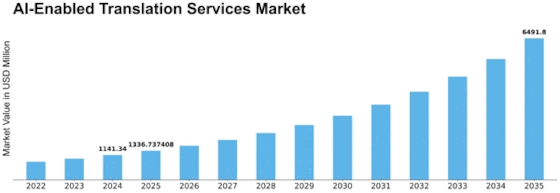
<p>The market valuation was 1141.34 USD Million in 2024.</p>

What is the projected market size for AI-Enabled Translation Services by 2035?

<p>The projected valuation for 2035 is 6491.8 USD Million.</p>

What is the expected CAGR for the AI-Enabled Translation Services Market from 2025 to 2035?

<p>The expected CAGR during the forecast period is 17.12%.</p>

Which companies are considered key players in the AI-Enabled Translation Services Market?

<p>Key players include Google, Microsoft, Amazon, IBM, SDL, iFLYTEK, Baidu, SYSTRAN, and Lingmo.</p>

How do online and offline services compare in terms of market valuation?

<p>In 2024, online services were valued at 3890.0 USD Million, while offline services were valued at 2601.8 USD Million.</p>

What is the market segmentation based on application for AI-Enabled Translation Services?

The market is segmented into Large Enterprises, valued at 3841.8 USD Million, and SMEs, valued at 2650.0 USD Million.

How has the market for AI-Enabled Translation Services evolved from 2024 to 2025?

The market continues to grow, with expectations of reaching new heights as it approaches 2035.

What role do large enterprises play in the AI-Enabled Translation Services Market?

Large Enterprises represent a substantial portion of the market, with a valuation of 3841.8 USD Million.

What factors contribute to the growth of the AI-Enabled Translation Services Market?

The growth appears driven by advancements in AI technology and increasing demand for translation services.

How does the performance of SMEs compare to large enterprises in this market?

SMEs are valued at 2650.0 USD Million, indicating a significant but smaller share compared to large enterprises.

Market Summary

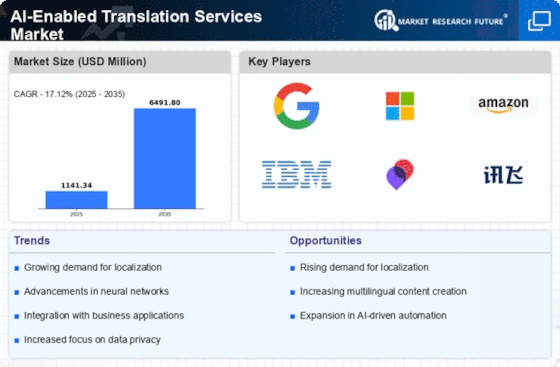
As per Market Research Future analysis, the AI-Enabled Translation Services Market was estimated at 1141.34 USD Million in 2024. The AI-Enabled Translation Services industry is projected to grow from 1336.74 USD Million in 2025 to 6491.8 USD Million by 2035, exhibiting a compound annual growth rate (CAGR) of 17.12% during the forecast period 2025 - 2035

Key Market Trends & Highlights

The AI-Enabled Translation Services Market is experiencing robust growth driven by technological advancements and increasing demand for multilingual solutions.

  • The demand for multilingual content is surging, particularly in North America, which remains the largest market for AI-enabled translation services.
  • Integration of AI with human expertise is becoming a prevalent trend, enhancing the quality and accuracy of translations across various sectors.
  • Real-time translation solutions are gaining traction, especially among large enterprises that require immediate communication across global markets.
  • Rising global trade and communication, alongside the increased adoption of e-learning platforms, are key drivers propelling market growth in both North America and the rapidly expanding Asia-Pacific region.

Market Size & Forecast

2024 Market Size 1141.34 (USD Million)
2035 Market Size 6491.8 (USD Million)
CAGR (2025 - 2035) 17.12%
Largest Regional Market Share in 2024 North America

Major Players

Google (US), Microsoft (US), Amazon (US), IBM (US), SDL (GB), iFLYTEK (CN), Baidu (CN), SYSTRAN (FR), Lingmo (AU)

Market Trends

The AI-Enabled Translation Services Market is currently experiencing a transformative phase, driven by advancements in artificial intelligence and machine learning technologies. These innovations are enhancing the accuracy and efficiency of translation processes, allowing businesses to communicate seamlessly across linguistic barriers. As globalization continues to expand, the demand for reliable translation services is likely to grow, with organizations seeking to reach diverse audiences. This market appears to be characterized by a blend of traditional human expertise and cutting-edge AI capabilities, creating a hybrid model that optimizes both speed and quality. Moreover, the integration of AI in translation services is fostering new applications, such as real-time translation in various contexts, including customer service and content localization. This evolution suggests a shift towards more personalized and context-aware translation solutions, which may cater to specific industry needs. As companies increasingly recognize the value of effective communication, the AI-Enabled Translation Services Market is poised for further growth, potentially leading to innovative service offerings that enhance user experience and engagement.

Increased Demand for Multilingual Content

The rise of global commerce is driving a heightened need for multilingual content. Businesses are recognizing the importance of reaching diverse markets, which necessitates effective translation services. This trend indicates a shift towards creating content that resonates with local audiences, thereby enhancing customer engagement.

Integration of AI with Human Expertise

There is a noticeable trend towards combining AI technologies with human translators. This hybrid approach aims to leverage the strengths of both, ensuring high-quality translations while maintaining efficiency. Such integration appears to enhance the overall service delivery in the AI-Enabled Translation Services Market.

Focus on Real-Time Translation Solutions

The demand for real-time translation solutions is growing, particularly in sectors like customer support and international business meetings. This trend suggests a move towards instantaneous communication, which could significantly improve user experience and operational efficiency in various industries.

AI Enabled Translation Services Market Market Drivers

Technological Advancements in AI

The rapid advancements in artificial intelligence technologies are significantly influencing the AI-Enabled Translation Services Market. Innovations in machine learning, natural language processing, and neural networks are enhancing the accuracy and efficiency of translation services. For instance, the implementation of deep learning algorithms has improved the contextual understanding of languages, resulting in more nuanced translations. As of 2025, the market for AI technologies is expected to grow substantially, with investments pouring into research and development. This technological evolution not only streamlines the translation process but also reduces turnaround times, making AI-enabled solutions more appealing to businesses seeking to optimize their communication strategies.

Rising Global Trade and Communication

The AI-Enabled Translation Services Market is experiencing a surge due to the increasing volume of international trade and cross-border communication. As businesses expand their operations into new markets, the need for accurate and efficient translation services becomes paramount. In 2025, the estimated value of international trade is projected to reach trillions of dollars, necessitating the use of AI-driven solutions to facilitate seamless communication. Companies are increasingly relying on AI-enabled translation services to overcome language barriers, enhance customer engagement, and improve operational efficiency. This trend indicates a growing recognition of the importance of multilingual capabilities in fostering global partnerships and driving economic growth.

Growing Need for Localization in Marketing

The AI-Enabled Translation Services Market is witnessing a heightened focus on localization as businesses strive to connect with diverse consumer bases. Localization goes beyond mere translation; it involves adapting content to resonate with local cultures and preferences. As companies expand their marketing efforts internationally, the demand for AI-enabled translation services that offer localization capabilities is increasing. In 2025, the localization market is projected to grow significantly, driven by the need for tailored marketing strategies. This trend suggests that businesses recognize the value of culturally relevant content in enhancing brand loyalty and customer engagement across different regions.

Increased Adoption of E-Learning Platforms

The proliferation of e-learning platforms is driving demand within the AI-Enabled Translation Services Market. As educational institutions and organizations embrace online learning, the need for translated educational content has escalated. In 2025, the e-learning market is anticipated to reach a valuation of several billion dollars, with a significant portion requiring multilingual support. AI-enabled translation services play a crucial role in making educational resources accessible to diverse audiences, thereby enhancing learning experiences. This trend underscores the importance of effective communication in education and highlights the potential for AI-driven solutions to bridge language gaps in the learning environment.

Regulatory Compliance and Global Standards

The AI-Enabled Translation Services Market is also influenced by the need for regulatory compliance and adherence to global standards. As businesses operate in multiple jurisdictions, they must ensure that their communications, documentation, and marketing materials comply with local laws and regulations. This necessity drives the demand for accurate translation services that can navigate complex legal and regulatory frameworks. In 2025, the emphasis on compliance is expected to intensify, particularly in industries such as finance, healthcare, and technology. Consequently, AI-enabled translation services that can provide precise and contextually appropriate translations will be essential for organizations aiming to mitigate risks and maintain operational integrity.

Market Segment Insights

By Type: Online Service (Largest) vs. Offline Service (Fastest-Growing)

In the AI-Enabled Translation Services Market, the segment is primarily dominated by Online Services, which account for a significant share of the market. This is largely due to the increasing reliance on digital platforms for communication and global business operations. Online services leverage advanced AI algorithms to provide real-time translations, making them the preferred choice for businesses looking for efficiency and accuracy in their translations. Conversely, Offline Services, though currently smaller in market share, are witnessing heightened interest, especially in niche sectors requiring high specificity and localized content.

Online Service (Dominant) vs. Offline Service (Emerging)

The Online Service segment is characterized by its ability to provide quick, scalable, and cost-effective translation solutions using cloud-based technologies. These services are widely adopted across various industries, given their accessibility and range of supported languages. In contrast, Offline Services are emerging as a viable alternative for specific industries that prioritize personalized and contextually rich translations. This segment caters to businesses requiring tailored solutions, such as legal or medical documentation, that demand a human touch alongside AI capabilities. As businesses increasingly recognize the importance of customized translation, the Offline Service market is expected to experience robust growth.

By Application: Large Enterprises (Largest) vs. SMEs (Fastest-Growing)

In the AI-Enabled Translation Services Market, the 'Large Enterprises' segment holds a significant market share, driven by the increasing adoption of AI technologies for seamless communication across global operations. These enterprises leverage advanced translation services to enhance productivity and improve customer engagement. Conversely, small and medium-sized enterprises (SMEs) are emerging as a crucial player in the market, benefiting from affordable AI-driven translation tools that enable them to compete on a global scale.

Market Presence: Large Enterprises (Dominant) vs. SMEs (Emerging)

Large Enterprises typically dominate the AI-Enabled Translation Services Market owing to their substantial resources and capability to invest in cutting-edge technology solutions. They utilize comprehensive translation systems to meet their multilingual needs, offering customized services to clients and improving operational efficiencies. However, SMEs are rapidly transforming the landscape as they adopt AI translation services to streamline communication and expand their reach without significant investment. This emerging segment reflects the growing trend of digital transformation, where SMEs prioritize efficiency and agility to thrive in competitive markets.

Get more detailed insights about AI Enabled Translation Services Market Research Report - Forecast till 2035

Regional Insights

By region, the study provides the market insights into North America, Europe, Asia-Pacific and Rest of the World. The North America AI-Enabled Translation Services Market dominated this market in 2022 (45.80%). In North America, educational institutions and research facilities are leading the way in holographic communication adoption for improved learning experiences and cutting-edge research. This covers projects including collaborative research, scientific visualization, and STEM education. Further, the U.S. AI-Enabled Translation Services market held the largest market share, and the Canada AI-Enabled Translation Services market was the fastest growing market in the North America region.

Further, the major countries studied in the market report are The U.S., Canada, German, France, the UK, Italy, Spain, China, Japan, India, Australia, South Korea, and Brazil.

Figure 3: AI-ENABLED TRANSLATION SERVICES MARKET SHARE BY REGION 2022 (USD Billion)

Europe AI-Enabled Translation Services market accounts for the second-largest market share. Holographic communication technologies are advantageous to Europe's tourism sector and rich cultural legacy. Holographic displays are used in museums, historical sites, and tourist destinations to give guests immersive and interactive experiences. Further, the German AI-Enabled Translation Services market held the largest market share, and the UK AI-Enabled Translation Services market was the fastest growing market in the European region.

The Asia-Pacific AI-Enabled Translation Services Market is expected to grow at the fastest CAGR from 2023 to 2032. The region has a burgeoning entertainment and media industry. Holographic communication technologies are used in theme parks, live events, and virtual concerts, enhancing the entertainment experience for audiences. Moreover, China’s AI-Enabled Translation Services market held the largest market share, and the Indian AI-Enabled Translation Services market was the fastest growing market in the Asia-Pacific region.

Key Players and Competitive Insights

Leading market players are investing heavily in research and development in order to expand their product lines, which will help the AI-Enabled Translation Services market, grow even more. Market participants are also undertaking a variety of strategic activities to expand their global footprint, with important market developments including new product launches, contractual agreements, mergers and acquisitions, higher investments, and collaboration with other organizations. To expand and survive in a more competitive and rising market climate, AI-Enabled Translation Services industry must offer cost-effective items.Manufacturing locally to minimize operational costs is one of the key business tactics used by manufacturers in the global AI-Enabled Translation Services industry to benefit clients and increase the market sector. In recent years, the AI-Enabled Translation Services industry has offered some of the most significant advantages to medicine. Major players in the AI-Enabled Translation Services market, including AppTek, Global Tone Communication, Language I/O, Lilt, MemSource, ModelFront, RWS, SYSTRAN, Tarjama, Translated, TransPerfect, Unbabel, XTM International and others, are attempting to increase market demand by investing in research and development operations.RWS Holdings PLC (RWS), a company based in the UK, provides services to support intellectual property. The company provides a variety of services, including data services for AI, consultancy services, infrastructure and cloud services, internet of things (IOT), and language services for life sciences. RWS provides services to a variety of businesses, including those in manufacturing, energy, chemicals, media, retail, e-commerce, telecom, managed care, insurance, legal, finance, marketing communications, medical device documentation, automotive, and training and e-learning. The company conducts business in North America, South America, Australia, Asia, and Europe. RWS's main office is in Chalfont St.Peter, Buckinghamshire, in the UK.SYSTRAN has been a leader in machine translation technology since its founding in 1968. With a variety of ground-breaking inventions and solutions that are now widely used by businesses and consumers, the company is the industry leader. Innovating more than ever after 50 years, SYSTRAN places a major emphasis on research and development. The possibilities of neural translation are now available to corporate users thanks to SYSTRAN's introduction of its Neural Machine Translation enterprise solution.

Key Companies in the AI Enabled Translation Services Market include

Industry Developments

Feb 2023: RWS has announced the launch of its TrainAI brand, which will provide clients with full, end-to-end data collection, annotation, and validation services for all types of AI data - in any language, at any scale. TrainAI will also offer machine translation and AI training data services to enhance the quality of machine learning models and AI applications for the biggest organizations in the world.

Sept 2022: A language services provider in the MENA region created Tarjama, an Arabic machine translation (AMT) website called Tarjama Translate, with a focus on companies who want quick access to translation in order to reach Arabic-speaking customers.

Future Outlook

AI Enabled Translation Services Market Future Outlook

The AI-Enabled Translation Services Market is projected to grow at a 17.12% CAGR from 2025 to 2035, driven by globalization, technological advancements, and increasing demand for multilingual content.

New opportunities lie in:

  • Development of industry-specific translation tools for legal and medical sectors.
  • Integration of AI-driven real-time translation in customer service platforms.
  • Expansion of cloud-based translation services for remote collaboration.

By 2035, the market is expected to be robust, reflecting substantial growth and innovation.

Market Segmentation

AI Enabled Translation Services Market Type Outlook

  • Online Service
  • Offline Service

AI Enabled Translation Services Market Application Outlook

  • Large Enterprises
  • SMEs

Report Scope

MARKET SIZE 2024 1141.34(USD Million)
MARKET SIZE 2025 1336.74(USD Million)
MARKET SIZE 2035 6491.8(USD Million)
COMPOUND ANNUAL GROWTH RATE (CAGR) 17.12% (2025 - 2035)
REPORT COVERAGE Revenue Forecast, Competitive Landscape, Growth Factors, and Trends
BASE YEAR 2024
Market Forecast Period 2025 - 2035
Historical Data 2019 - 2024
Market Forecast Units USD Million
Key Companies Profiled Google (US), Microsoft (US), Amazon (US), IBM (US), SDL (GB), iFLYTEK (CN), Baidu (CN), SYSTRAN (FR), Lingmo (AU)
Segments Covered Type, Application, Region
Key Market Opportunities Integration of advanced neural networks enhances accuracy and efficiency in the AI-Enabled Translation Services Market.
Key Market Dynamics Rising demand for real-time translation solutions drives innovation and competition in AI-Enabled Translation Services.
Countries Covered North America, Europe, APAC, South America, MEA

FAQs

What is the current valuation of the AI-Enabled Translation Services Market?

<p>The market valuation was 1141.34 USD Million in 2024.</p>

What is the projected market size for AI-Enabled Translation Services by 2035?

<p>The projected valuation for 2035 is 6491.8 USD Million.</p>

What is the expected CAGR for the AI-Enabled Translation Services Market from 2025 to 2035?

<p>The expected CAGR during the forecast period is 17.12%.</p>

Which companies are considered key players in the AI-Enabled Translation Services Market?

<p>Key players include Google, Microsoft, Amazon, IBM, SDL, iFLYTEK, Baidu, SYSTRAN, and Lingmo.</p>

How do online and offline services compare in terms of market valuation?

<p>In 2024, online services were valued at 3890.0 USD Million, while offline services were valued at 2601.8 USD Million.</p>

What is the market segmentation based on application for AI-Enabled Translation Services?

The market is segmented into Large Enterprises, valued at 3841.8 USD Million, and SMEs, valued at 2650.0 USD Million.

How has the market for AI-Enabled Translation Services evolved from 2024 to 2025?

The market continues to grow, with expectations of reaching new heights as it approaches 2035.

What role do large enterprises play in the AI-Enabled Translation Services Market?

Large Enterprises represent a substantial portion of the market, with a valuation of 3841.8 USD Million.

What factors contribute to the growth of the AI-Enabled Translation Services Market?

The growth appears driven by advancements in AI technology and increasing demand for translation services.

How does the performance of SMEs compare to large enterprises in this market?

SMEs are valued at 2650.0 USD Million, indicating a significant but smaller share compared to large enterprises.

  1. SECTION I: EXECUTIVE SUMMARY AND KEY HIGHLIGHTS
    1. | 1.1 EXECUTIVE SUMMARY
    2. | | 1.1.1 Market Overview
    3. | | 1.1.2 Key Findings
    4. | | 1.1.3 Market Segmentation
    5. | | 1.1.4 Competitive Landscape
    6. | | 1.1.5 Challenges and Opportunities
    7. | | 1.1.6 Future Outlook
  2. SECTION II: SCOPING, METHODOLOGY AND MARKET STRUCTURE
    1. | 2.1 MARKET INTRODUCTION
    2. | | 2.1.1 Definition
    3. | | 2.1.2 Scope of the study
    4. | | | 2.1.2.1 Research Objective
    5. | | | 2.1.2.2 Assumption
    6. | | | 2.1.2.3 Limitations
    7. | 2.2 RESEARCH METHODOLOGY
    8. | | 2.2.1 Overview
    9. | | 2.2.2 Data Mining
    10. | | 2.2.3 Secondary Research
    11. | | 2.2.4 Primary Research
    12. | | | 2.2.4.1 Primary Interviews and Information Gathering Process
    13. | | | 2.2.4.2 Breakdown of Primary Respondents
    14. | | 2.2.5 Forecasting Model
    15. | | 2.2.6 Market Size Estimation
    16. | | | 2.2.6.1 Bottom-Up Approach
    17. | | | 2.2.6.2 Top-Down Approach
    18. | | 2.2.7 Data Triangulation
    19. | | 2.2.8 Validation
  3. SECTION III: QUALITATIVE ANALYSIS
    1. | 3.1 MARKET DYNAMICS
    2. | | 3.1.1 Overview
    3. | | 3.1.2 Drivers
    4. | | 3.1.3 Restraints
    5. | | 3.1.4 Opportunities
    6. | 3.2 MARKET FACTOR ANALYSIS
    7. | | 3.2.1 Value chain Analysis
    8. | | 3.2.2 Porter's Five Forces Analysis
    9. | | | 3.2.2.1 Bargaining Power of Suppliers
    10. | | | 3.2.2.2 Bargaining Power of Buyers
    11. | | | 3.2.2.3 Threat of New Entrants
    12. | | | 3.2.2.4 Threat of Substitutes
    13. | | | 3.2.2.5 Intensity of Rivalry
    14. | | 3.2.3 COVID-19 Impact Analysis
    15. | | | 3.2.3.1 Market Impact Analysis
    16. | | | 3.2.3.2 Regional Impact
    17. | | | 3.2.3.3 Opportunity and Threat Analysis
  4. SECTION IV: QUANTITATIVE ANALYSIS
    1. | 4.1 Information and Communications Technology, BY Type (USD Million)
    2. | | 4.1.1 Online Service
    3. | | 4.1.2 Offline Service
    4. | 4.2 Information and Communications Technology, BY Application (USD Million)
    5. | | 4.2.1 Large Enterprises
    6. | | 4.2.2 SMEs
    7. | 4.3 Information and Communications Technology, BY Region (USD Million)
    8. | | 4.3.1 North America
    9. | | | 4.3.1.1 US
    10. | | | 4.3.1.2 Canada
    11. | | 4.3.2 Europe
    12. | | | 4.3.2.1 Germany
    13. | | | 4.3.2.2 UK
    14. | | | 4.3.2.3 France
    15. | | | 4.3.2.4 Russia
    16. | | | 4.3.2.5 Italy
    17. | | | 4.3.2.6 Spain
    18. | | | 4.3.2.7 Rest of Europe
    19. | | 4.3.3 APAC
    20. | | | 4.3.3.1 China
    21. | | | 4.3.3.2 India
    22. | | | 4.3.3.3 Japan
    23. | | | 4.3.3.4 South Korea
    24. | | | 4.3.3.5 Malaysia
    25. | | | 4.3.3.6 Thailand
    26. | | | 4.3.3.7 Indonesia
    27. | | | 4.3.3.8 Rest of APAC
    28. | | 4.3.4 South America
    29. | | | 4.3.4.1 Brazil
    30. | | | 4.3.4.2 Mexico
    31. | | | 4.3.4.3 Argentina
    32. | | | 4.3.4.4 Rest of South America
    33. | | 4.3.5 MEA
    34. | | | 4.3.5.1 GCC Countries
    35. | | | 4.3.5.2 South Africa
    36. | | | 4.3.5.3 Rest of MEA
  5. SECTION V: COMPETITIVE ANALYSIS
    1. | 5.1 Competitive Landscape
    2. | | 5.1.1 Overview
    3. | | 5.1.2 Competitive Analysis
    4. | | 5.1.3 Market share Analysis
    5. | | 5.1.4 Major Growth Strategy in the Information and Communications Technology
    6. | | 5.1.5 Competitive Benchmarking
    7. | | 5.1.6 Leading Players in Terms of Number of Developments in the Information and Communications Technology
    8. | | 5.1.7 Key developments and growth strategies
    9. | | | 5.1.7.1 New Product Launch/Service Deployment
    10. | | | 5.1.7.2 Merger & Acquisitions
    11. | | | 5.1.7.3 Joint Ventures
    12. | | 5.1.8 Major Players Financial Matrix
    13. | | | 5.1.8.1 Sales and Operating Income
    14. | | | 5.1.8.2 Major Players R&D Expenditure. 2023
    15. | 5.2 Company Profiles
    16. | | 5.2.1 Google (US)
    17. | | | 5.2.1.1 Financial Overview
    18. | | | 5.2.1.2 Products Offered
    19. | | | 5.2.1.3 Key Developments
    20. | | | 5.2.1.4 SWOT Analysis
    21. | | | 5.2.1.5 Key Strategies
    22. | | 5.2.2 Microsoft (US)
    23. | | | 5.2.2.1 Financial Overview
    24. | | | 5.2.2.2 Products Offered
    25. | | | 5.2.2.3 Key Developments
    26. | | | 5.2.2.4 SWOT Analysis
    27. | | | 5.2.2.5 Key Strategies
    28. | | 5.2.3 Amazon (US)
    29. | | | 5.2.3.1 Financial Overview
    30. | | | 5.2.3.2 Products Offered
    31. | | | 5.2.3.3 Key Developments
    32. | | | 5.2.3.4 SWOT Analysis
    33. | | | 5.2.3.5 Key Strategies
    34. | | 5.2.4 IBM (US)
    35. | | | 5.2.4.1 Financial Overview
    36. | | | 5.2.4.2 Products Offered
    37. | | | 5.2.4.3 Key Developments
    38. | | | 5.2.4.4 SWOT Analysis
    39. | | | 5.2.4.5 Key Strategies
    40. | | 5.2.5 SDL (GB)
    41. | | | 5.2.5.1 Financial Overview
    42. | | | 5.2.5.2 Products Offered
    43. | | | 5.2.5.3 Key Developments
    44. | | | 5.2.5.4 SWOT Analysis
    45. | | | 5.2.5.5 Key Strategies
    46. | | 5.2.6 iFLYTEK (CN)
    47. | | | 5.2.6.1 Financial Overview
    48. | | | 5.2.6.2 Products Offered
    49. | | | 5.2.6.3 Key Developments
    50. | | | 5.2.6.4 SWOT Analysis
    51. | | | 5.2.6.5 Key Strategies
    52. | | 5.2.7 Baidu (CN)
    53. | | | 5.2.7.1 Financial Overview
    54. | | | 5.2.7.2 Products Offered
    55. | | | 5.2.7.3 Key Developments
    56. | | | 5.2.7.4 SWOT Analysis
    57. | | | 5.2.7.5 Key Strategies
    58. | | 5.2.8 SYSTRAN (FR)
    59. | | | 5.2.8.1 Financial Overview
    60. | | | 5.2.8.2 Products Offered
    61. | | | 5.2.8.3 Key Developments
    62. | | | 5.2.8.4 SWOT Analysis
    63. | | | 5.2.8.5 Key Strategies
    64. | | 5.2.9 Lingmo (AU)
    65. | | | 5.2.9.1 Financial Overview
    66. | | | 5.2.9.2 Products Offered
    67. | | | 5.2.9.3 Key Developments
    68. | | | 5.2.9.4 SWOT Analysis
    69. | | | 5.2.9.5 Key Strategies
    70. | 5.3 Appendix
    71. | | 5.3.1 References
    72. | | 5.3.2 Related Reports
  6. LIST OF FIGURES
    1. | 6.1 MARKET SYNOPSIS
    2. | 6.2 NORTH AMERICA MARKET ANALYSIS
    3. | 6.3 US MARKET ANALYSIS BY TYPE
    4. | 6.4 US MARKET ANALYSIS BY APPLICATION
    5. | 6.5 CANADA MARKET ANALYSIS BY TYPE
    6. | 6.6 CANADA MARKET ANALYSIS BY APPLICATION
    7. | 6.7 EUROPE MARKET ANALYSIS
    8. | 6.8 GERMANY MARKET ANALYSIS BY TYPE
    9. | 6.9 GERMANY MARKET ANALYSIS BY APPLICATION
    10. | 6.10 UK MARKET ANALYSIS BY TYPE
    11. | 6.11 UK MARKET ANALYSIS BY APPLICATION
    12. | 6.12 FRANCE MARKET ANALYSIS BY TYPE
    13. | 6.13 FRANCE MARKET ANALYSIS BY APPLICATION
    14. | 6.14 RUSSIA MARKET ANALYSIS BY TYPE
    15. | 6.15 RUSSIA MARKET ANALYSIS BY APPLICATION
    16. | 6.16 ITALY MARKET ANALYSIS BY TYPE
    17. | 6.17 ITALY MARKET ANALYSIS BY APPLICATION
    18. | 6.18 SPAIN MARKET ANALYSIS BY TYPE
    19. | 6.19 SPAIN MARKET ANALYSIS BY APPLICATION
    20. | 6.20 REST OF EUROPE MARKET ANALYSIS BY TYPE
    21. | 6.21 REST OF EUROPE MARKET ANALYSIS BY APPLICATION
    22. | 6.22 APAC MARKET ANALYSIS
    23. | 6.23 CHINA MARKET ANALYSIS BY TYPE
    24. | 6.24 CHINA MARKET ANALYSIS BY APPLICATION
    25. | 6.25 INDIA MARKET ANALYSIS BY TYPE
    26. | 6.26 INDIA MARKET ANALYSIS BY APPLICATION
    27. | 6.27 JAPAN MARKET ANALYSIS BY TYPE
    28. | 6.28 JAPAN MARKET ANALYSIS BY APPLICATION
    29. | 6.29 SOUTH KOREA MARKET ANALYSIS BY TYPE
    30. | 6.30 SOUTH KOREA MARKET ANALYSIS BY APPLICATION
    31. | 6.31 MALAYSIA MARKET ANALYSIS BY TYPE
    32. | 6.32 MALAYSIA MARKET ANALYSIS BY APPLICATION
    33. | 6.33 THAILAND MARKET ANALYSIS BY TYPE
    34. | 6.34 THAILAND MARKET ANALYSIS BY APPLICATION
    35. | 6.35 INDONESIA MARKET ANALYSIS BY TYPE
    36. | 6.36 INDONESIA MARKET ANALYSIS BY APPLICATION
    37. | 6.37 REST OF APAC MARKET ANALYSIS BY TYPE
    38. | 6.38 REST OF APAC MARKET ANALYSIS BY APPLICATION
    39. | 6.39 SOUTH AMERICA MARKET ANALYSIS
    40. | 6.40 BRAZIL MARKET ANALYSIS BY TYPE
    41. | 6.41 BRAZIL MARKET ANALYSIS BY APPLICATION
    42. | 6.42 MEXICO MARKET ANALYSIS BY TYPE
    43. | 6.43 MEXICO MARKET ANALYSIS BY APPLICATION
    44. | 6.44 ARGENTINA MARKET ANALYSIS BY TYPE
    45. | 6.45 ARGENTINA MARKET ANALYSIS BY APPLICATION
    46. | 6.46 REST OF SOUTH AMERICA MARKET ANALYSIS BY TYPE
    47. | 6.47 REST OF SOUTH AMERICA MARKET ANALYSIS BY APPLICATION
    48. | 6.48 MEA MARKET ANALYSIS
    49. | 6.49 GCC COUNTRIES MARKET ANALYSIS BY TYPE
    50. | 6.50 GCC COUNTRIES MARKET ANALYSIS BY APPLICATION
    51. | 6.51 SOUTH AFRICA MARKET ANALYSIS BY TYPE
    52. | 6.52 SOUTH AFRICA MARKET ANALYSIS BY APPLICATION
    53. | 6.53 REST OF MEA MARKET ANALYSIS BY TYPE
    54. | 6.54 REST OF MEA MARKET ANALYSIS BY APPLICATION
    55. | 6.55 KEY BUYING CRITERIA OF INFORMATION AND COMMUNICATIONS TECHNOLOGY
    56. | 6.56 RESEARCH PROCESS OF MRFR
    57. | 6.57 DRO ANALYSIS OF INFORMATION AND COMMUNICATIONS TECHNOLOGY
    58. | 6.58 DRIVERS IMPACT ANALYSIS: INFORMATION AND COMMUNICATIONS TECHNOLOGY
    59. | 6.59 RESTRAINTS IMPACT ANALYSIS: INFORMATION AND COMMUNICATIONS TECHNOLOGY
    60. | 6.60 SUPPLY / VALUE CHAIN: INFORMATION AND COMMUNICATIONS TECHNOLOGY
    61. | 6.61 INFORMATION AND COMMUNICATIONS TECHNOLOGY, BY TYPE, 2024 (% SHARE)
    62. | 6.62 INFORMATION AND COMMUNICATIONS TECHNOLOGY, BY TYPE, 2024 TO 2035 (USD Million)
    63. | 6.63 INFORMATION AND COMMUNICATIONS TECHNOLOGY, BY APPLICATION, 2024 (% SHARE)
    64. | 6.64 INFORMATION AND COMMUNICATIONS TECHNOLOGY, BY APPLICATION, 2024 TO 2035 (USD Million)
    65. | 6.65 BENCHMARKING OF MAJOR COMPETITORS
  7. LIST OF TABLES
    1. | 7.1 LIST OF ASSUMPTIONS
    2. | | 7.1.1
    3. | 7.2 North America MARKET SIZE ESTIMATES; FORECAST
    4. | | 7.2.1 BY TYPE, 2025-2035 (USD Million)
    5. | | 7.2.2 BY APPLICATION, 2025-2035 (USD Million)
    6. | 7.3 US MARKET SIZE ESTIMATES; FORECAST
    7. | | 7.3.1 BY TYPE, 2025-2035 (USD Million)
    8. | | 7.3.2 BY APPLICATION, 2025-2035 (USD Million)
    9. | 7.4 Canada MARKET SIZE ESTIMATES; FORECAST
    10. | | 7.4.1 BY TYPE, 2025-2035 (USD Million)
    11. | | 7.4.2 BY APPLICATION, 2025-2035 (USD Million)
    12. | 7.5 Europe MARKET SIZE ESTIMATES; FORECAST
    13. | | 7.5.1 BY TYPE, 2025-2035 (USD Million)
    14. | | 7.5.2 BY APPLICATION, 2025-2035 (USD Million)
    15. | 7.6 Germany MARKET SIZE ESTIMATES; FORECAST
    16. | | 7.6.1 BY TYPE, 2025-2035 (USD Million)
    17. | | 7.6.2 BY APPLICATION, 2025-2035 (USD Million)
    18. | 7.7 UK MARKET SIZE ESTIMATES; FORECAST
    19. | | 7.7.1 BY TYPE, 2025-2035 (USD Million)
    20. | | 7.7.2 BY APPLICATION, 2025-2035 (USD Million)
    21. | 7.8 France MARKET SIZE ESTIMATES; FORECAST
    22. | | 7.8.1 BY TYPE, 2025-2035 (USD Million)
    23. | | 7.8.2 BY APPLICATION, 2025-2035 (USD Million)
    24. | 7.9 Russia MARKET SIZE ESTIMATES; FORECAST
    25. | | 7.9.1 BY TYPE, 2025-2035 (USD Million)
    26. | | 7.9.2 BY APPLICATION, 2025-2035 (USD Million)
    27. | 7.10 Italy MARKET SIZE ESTIMATES; FORECAST
    28. | | 7.10.1 BY TYPE, 2025-2035 (USD Million)
    29. | | 7.10.2 BY APPLICATION, 2025-2035 (USD Million)
    30. | 7.11 Spain MARKET SIZE ESTIMATES; FORECAST
    31. | | 7.11.1 BY TYPE, 2025-2035 (USD Million)
    32. | | 7.11.2 BY APPLICATION, 2025-2035 (USD Million)
    33. | 7.12 Rest of Europe MARKET SIZE ESTIMATES; FORECAST
    34. | | 7.12.1 BY TYPE, 2025-2035 (USD Million)
    35. | | 7.12.2 BY APPLICATION, 2025-2035 (USD Million)
    36. | 7.13 APAC MARKET SIZE ESTIMATES; FORECAST
    37. | | 7.13.1 BY TYPE, 2025-2035 (USD Million)
    38. | | 7.13.2 BY APPLICATION, 2025-2035 (USD Million)
    39. | 7.14 China MARKET SIZE ESTIMATES; FORECAST
    40. | | 7.14.1 BY TYPE, 2025-2035 (USD Million)
    41. | | 7.14.2 BY APPLICATION, 2025-2035 (USD Million)
    42. | 7.15 India MARKET SIZE ESTIMATES; FORECAST
    43. | | 7.15.1 BY TYPE, 2025-2035 (USD Million)
    44. | | 7.15.2 BY APPLICATION, 2025-2035 (USD Million)
    45. | 7.16 Japan MARKET SIZE ESTIMATES; FORECAST
    46. | | 7.16.1 BY TYPE, 2025-2035 (USD Million)
    47. | | 7.16.2 BY APPLICATION, 2025-2035 (USD Million)
    48. | 7.17 South Korea MARKET SIZE ESTIMATES; FORECAST
    49. | | 7.17.1 BY TYPE, 2025-2035 (USD Million)
    50. | | 7.17.2 BY APPLICATION, 2025-2035 (USD Million)
    51. | 7.18 Malaysia MARKET SIZE ESTIMATES; FORECAST
    52. | | 7.18.1 BY TYPE, 2025-2035 (USD Million)
    53. | | 7.18.2 BY APPLICATION, 2025-2035 (USD Million)
    54. | 7.19 Thailand MARKET SIZE ESTIMATES; FORECAST
    55. | | 7.19.1 BY TYPE, 2025-2035 (USD Million)
    56. | | 7.19.2 BY APPLICATION, 2025-2035 (USD Million)
    57. | 7.20 Indonesia MARKET SIZE ESTIMATES; FORECAST
    58. | | 7.20.1 BY TYPE, 2025-2035 (USD Million)
    59. | | 7.20.2 BY APPLICATION, 2025-2035 (USD Million)
    60. | 7.21 Rest of APAC MARKET SIZE ESTIMATES; FORECAST
    61. | | 7.21.1 BY TYPE, 2025-2035 (USD Million)
    62. | | 7.21.2 BY APPLICATION, 2025-2035 (USD Million)
    63. | 7.22 South America MARKET SIZE ESTIMATES; FORECAST
    64. | | 7.22.1 BY TYPE, 2025-2035 (USD Million)
    65. | | 7.22.2 BY APPLICATION, 2025-2035 (USD Million)
    66. | 7.23 Brazil MARKET SIZE ESTIMATES; FORECAST
    67. | | 7.23.1 BY TYPE, 2025-2035 (USD Million)
    68. | | 7.23.2 BY APPLICATION, 2025-2035 (USD Million)
    69. | 7.24 Mexico MARKET SIZE ESTIMATES; FORECAST
    70. | | 7.24.1 BY TYPE, 2025-2035 (USD Million)
    71. | | 7.24.2 BY APPLICATION, 2025-2035 (USD Million)
    72. | 7.25 Argentina MARKET SIZE ESTIMATES; FORECAST
    73. | | 7.25.1 BY TYPE, 2025-2035 (USD Million)
    74. | | 7.25.2 BY APPLICATION, 2025-2035 (USD Million)
    75. | 7.26 Rest of South America MARKET SIZE ESTIMATES; FORECAST
    76. | | 7.26.1 BY TYPE, 2025-2035 (USD Million)
    77. | | 7.26.2 BY APPLICATION, 2025-2035 (USD Million)
    78. | 7.27 MEA MARKET SIZE ESTIMATES; FORECAST
    79. | | 7.27.1 BY TYPE, 2025-2035 (USD Million)
    80. | | 7.27.2 BY APPLICATION, 2025-2035 (USD Million)
    81. | 7.28 GCC Countries MARKET SIZE ESTIMATES; FORECAST
    82. | | 7.28.1 BY TYPE, 2025-2035 (USD Million)
    83. | | 7.28.2 BY APPLICATION, 2025-2035 (USD Million)
    84. | 7.29 South Africa MARKET SIZE ESTIMATES; FORECAST
    85. | | 7.29.1 BY TYPE, 2025-2035 (USD Million)
    86. | | 7.29.2 BY APPLICATION, 2025-2035 (USD Million)
    87. | 7.30 Rest of MEA MARKET SIZE ESTIMATES; FORECAST
    88. | | 7.30.1 BY TYPE, 2025-2035 (USD Million)
    89. | | 7.30.2 BY APPLICATION, 2025-2035 (USD Million)
    90. | 7.31 PRODUCT LAUNCH/PRODUCT DEVELOPMENT/APPROVAL
    91. | | 7.31.1
    92. | 7.32 ACQUISITION/PARTNERSHIP
    93. | | 7.32.1

Information and Communications Technology Market Segmentation

Information and Communications Technology By Type (USD Million, 2025-2035)

  • Online Service
  • Offline Service

Information and Communications Technology By Application (USD Million, 2025-2035)

  • Large Enterprises
  • SMEs
Infographic

Free Sample Request

Kindly complete the form below to receive a free sample of this Report

Get Free Sample

Customer Strories

Compare Licence

×
Features License Type
Single User Multiuser License Enterprise User
Price $4,950 $5,950 $7,250
Maximum User Access Limit 1 User Upto 10 Users Unrestricted Access Throughout the Organization
Free Customization
Direct Access to Analyst
Deliverable Format
Platform Access
Discount on Next Purchase 10% 15% 15%
Printable Versions