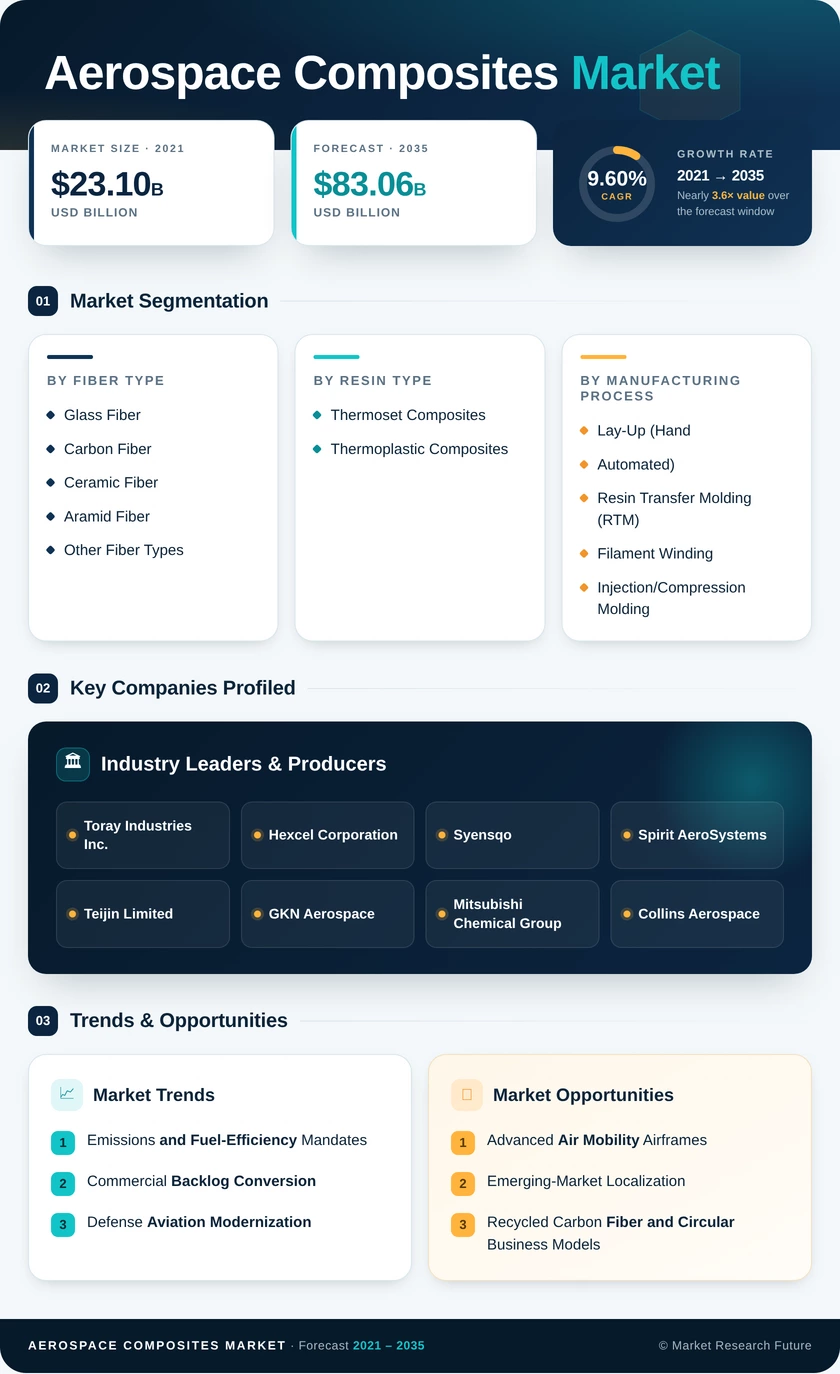
Segmentation Quick Reference
| Dimension | Sub-Segments | Dominant Segment | Fastest Growing Segment |
|---|
| By Fiber Type | Glass Fiber; Carbon Fiber; Ceramic Fiber; Aramid Fiber; Other Fiber Types | Carbon Fiber (48.6%) | Ceramic Fiber (11.5% CAGR) |
| By Resin Type | Thermoset Composites; Thermoplastic Composites | Thermoset Composites (50.2%) | Thermoplastic Composites (14.2% CAGR) |
| By Manufacturing Process | Lay-Up (Hand and Automated); Resin Transfer Molding (RTM); Filament Winding; Injection/Compression Molding; Automated Fiber Placement and Tape Laying; Additive Manufacturing of Composites | Lay-Up (Hand and Automated) (47.4%) | Automated Fiber Placement and Tape Laying (13.7% CAGR) |
| By Aircraft Type | Commercial Aircraft; Business Jets; Military Aircraft; Helicopters; Spacecraft and Launch Vehicles | Commercial Aircraft (55.8%) | Spacecraft and Launch Vehicles (15.5% CAGR) |
| By Structural Component | Interior Components; Exterior and Airframe; Engine Components; Auxiliary Structures | Exterior and Airframe (46.5%) | Engine Components (15.9% CAGR) |
| By End-User | OEM; Aftermarket/MRO | OEM (74.6%) | Aftermarket/MRO (9.6% CAGR) |
| By Region | North America; Europe; Asia-Pacific; South America; Middle East and Africa | North America (38.6%) | Asia-Pacific (11.4% CAGR) |
Market Segmentation Overview
| Sub-Segment | Key Trend |
|---|
| Glass Fiber | Radar-transparent radomes and low-cost interiors |
| Carbon Fiber | Higher-strength grades for thinner laminates |
| Ceramic Fiber | Hot-section and hypersonic applications |
| Aramid Fiber | Impact-resistant rotorcraft floors |
| Other Fiber Types | Hybrid carbon-ceramic layups |
Carbon Fiber leads with a 48.6% share because wings and fuselage barrels on current wide-bodies depend on its stiffness-to-weight ratio. Ceramic Fiber grows fastest at an 11.5% CAGR as engine makers push turbine temperatures higher and hypersonic programmes need heat-tolerant skins. Glass Fiber holds its place in radomes where radar transparency outweighs weight.
| Sub-Segment | Key Trend |
|---|
| Thermoset Composites | Toughened epoxies and BMI for engines |
| Thermoplastic Composites | Welded joints and in-situ consolidation |
Thermoset Composites lead with a 50.2% share because their certification data covers nearly every flying composite part. Thermoplastic Composites grow fastest at a 14.2% CAGR, since welding removes fasteners and cuts cycle times that limit production rates. Regulatory approval of welded control surfaces is opening the path to larger primary parts.
| Sub-Segment | Key Trend |
|---|
| Lay-Up (Hand and Automated) | Shift from manual to robotic layup |
| Resin Transfer Molding (RTM) | Woven-preform fan blades |
| Filament Winding | Launch vehicle and pressure vessel demand |
| Injection/Compression Molding | Short-fiber thermoplastic clips |
| Automated Fiber Placement and Tape Laying | Inline inspection and higher deposition rates |
| Additive Manufacturing of Composites | Printed tooling and brackets |
Lay-Up (Hand and Automated) holds a 47.4% share because existing part designs assume prepreg stacking. Automated Fiber Placement and Tape Laying grows fastest at a 13.7% CAGR as OEMs need repeatable quality at single-aisle rates. Resin Transfer Molding (RTM) is expanding in engine fan blades where net-shape woven preforms reduce machining.
| Sub-Segment | Key Trend |
|---|
| Commercial Aircraft | Narrow-Body rate increases |
| Business Jets | Composite wings on long-range models |
| Military Aircraft | Low-observable airframes and drones |
| Helicopters | Composite rotor blades and fuselages |
| Spacecraft and Launch Vehicles | Reusable booster structures |
Commercial Aircraft dominate with a 55.8% share, led by Narrow-Body programmes as A320 family and 737 output recovers. Spacecraft and Launch Vehicles grow fastest at a 15.5% CAGR on reusable launch and constellation deployment. Military Aircraft add stable demand through stealth fighters and transport upgrades.
| Sub-Segment | Key Trend |
|---|
| Interior Components | Lighter seats, bins and panels |
| Exterior and Airframe | Composite wings and fuselage barrels |
| Engine Components | CMC shrouds and composite fan cases |
| Auxiliary Structures | Fairings and access doors |
Exterior and Airframe parts lead with a 46.5% share because wings and fuselages carry the most composite mass per aircraft. Engine Components grow fastest at a 15.9% CAGR as ceramic matrix shrouds allow hotter, more efficient turbines. Interior Components benefit from cabin retrofit cycles at major carriers.
| Sub-Segment | Key Trend |
|---|
| OEM | Rate-driven material contracts |
| Aftermarket/MRO | Bonded and scarf repair demand |
OEM purchases dominate with a 74.6% share because new aircraft and engine production consume most material. Aftermarket/MRO grows at a 9.6% CAGR as 787 and A350 fleets reach heavy-check intervals. Engine makers are expanding repair networks to handle composite fan cases and shrouds.


 Noah Malgeri
Co-Founder

 Peter Groot koerkamp
Account and Business Manager

 Younghwan Choi
Senior Retail Manager

 Mark Irwin
Management Consultant

 Akif Moroglu
Strategy & Business Development Director

 Guilherme Gomes Martins
Product Management Director

 Joseph Aguayo
Sales Operations & Pricing Manager

 La Terria Dodd
Program Support Specialist

 Rob Kooiker
Group Product Manager HVAC & Fire Protection GMA