Request Free Sample ×

Kindly complete the form below to receive a free sample of this Report

* Please use a valid business email

Leading companies partner with us for data-driven Insights

clients tt-cursor
Hero Background
English
Chinese
French
Japanese
Korean
German
Spanish

Advanced Wound Therapy Devices Market Size

ID: MRFR/HC/5952-CR
98 Pages
Vikita Thakur
February 2019

Advanced Wound Therapy Devices Market Research Report Information by Type (Negative Pressure Wound Therapy Systems, Electric Stimulation Devices, Hyperbaric Oxygen Equipment, Pressure Relief Devices, Others), by End-user (Hospitals & Clinics, Home Care Settings, Others), and Region - Forecast till 2035

Share:
Download PDF ×

We do not share your information with anyone. However, we may send you emails based on your report interest from time to time. You may contact us at any time to opt-out.

Advanced Wound Therapy Devices Market Infographic
Purchase Options

Advanced Wound Therapy Devices Size

Advanced Wound Therapy Devices Market Growth Projections and Opportunities

The Advanced Wound Therapy Devices Market is significantly influenced by the aging global population. As the elderly population increases, so does the prevalence of chronic wounds, such as diabetic ulcers and pressure sores. Advanced wound therapy devices, including negative pressure wound therapy (NPWT) and electrical stimulation devices, are increasingly utilized for effective wound management in this demographic. Wound care is influenced by market dynamics which fluctuates with continuous innovations in technological manufacturing. States-of-the-art wound therapy devices are growing in multidirectional fold, being high on smart sensors, connectivity and performance of advanced materials to assure better outcome. Appearance of these innovations shapes a more competitive market structure where manufactures seek to provide the most advanced systems for wound control. The aspect of lack of obesity and diabetes in the market is a negative influence. People with diabetes have chronic wounds and consequently require advanced wound therapy for the treatment of such open wounds. Furthermore, comorbidities associated with obesity such as ulcers due to venous stasis contribute to the need for technology that enables proper and timely wound recovery and eliminates development risk factors. In turn, the number of surgical procedure has significantly affected market dynamics. Postoperative care of surgical wounds is described as specialized procedures, and such post-operation treatments cannot be absorbed without special units for wound therapy devices. With the surgical volume increasing, the need for products that promote the optimal healing process and prevent potential surgical site infections also grows. Irrelevantly the market is characterized by a trend in traumatic injuries, such as burns and accidents. To optimally heal due to traumatic wounds advanced wound therapy is in numerous cases necessary. There are various devices that help to propel a modern approach on managing complex wounds caused by trauma, such as hyperbaric oxygen therapy chambers and biosynthetic dressings. The specialty wound care clinics and centers play a crucial role as well, that is why such establishments are among the key factors for economic growth in Advanced Wound Therapy Devices Market. The main function of such facilities is to treat wounds through more holistic care, which is often carried out using advanced technologies and devices to increase the effectiveness of addressing these issues. This report, therefore, reflects on the continued spread of such facilities and how this leads to increased use of advanced wound therapy solutions. The economics of market dynamics and the cost-effective measures for containing health care costs are very important. Advanced wound therapy devices are often perceived as cost-effective solutions by reducing hospital stays, preventing complications, and improving overall patient outcomes. Healthcare systems increasingly recognize the value of investing in advanced wound care to minimize long-term costs.
Advanced Wound Therapy Devices Market Size Graph
Author
Author Profile
Vikita Thakur
Senior Research Analyst

She holds an experience of about 5+ years in market research and business consulting projects for sectors such as life sciences, medical devices, and healthcare IT. She possesses a robust background in data analysis, market estimation, competitive intelligence, pipeline analysis market trend identification, and consumer behavior insights. Her expertise lies in technical Sales support, client interaction and project management, designing and implementing market research studies, conducting competitive analysis, and synthesizing complex data into actionable recommendations that drive business growth.

Leave a Comment

FAQs

What is the projected market valuation of The Global Advanced Wound Therapy Devices by 2035?

<p>The market is projected to reach a valuation of 15.11 USD Billion by 2035.</p>

What was the market valuation of The Global Advanced Wound Therapy Devices in 2024?

<p>The overall market valuation was 8.34 USD Billion in 2024.</p>

What is the expected CAGR for The Global Advanced Wound Therapy Devices during the forecast period 2025 - 2035?

<p>The expected CAGR during this period is 5.55%.</p>

Which segment is anticipated to have the highest valuation in The Global Advanced Wound Therapy Devices by 2035?

<p>Negative Pressure Wound Therapy Systems are expected to reach a valuation of 6.11 USD Billion by 2035.</p>

What are the key players in The Global Advanced Wound Therapy Devices?

<p>Key players include Smith & Nephew, Mölnlycke Health Care, Acelity, 3M, ConvaTec, Medtronic, Hollister Incorporated, B. Braun Melsungen AG, and Derma Sciences.</p>

How much is the Home Care Settings segment projected to be worth by 2035?

The Home Care Settings segment is projected to reach 5.5 USD Billion by 2035.

What is the expected valuation for Electric Stimulation Devices by 2035?

Electric Stimulation Devices are expected to reach a valuation of 2.75 USD Billion by 2035.

What is the projected valuation for Pressure Relief Devices in 2035?

Pressure Relief Devices are projected to be valued at 2.0 USD Billion by 2035.

How does the Others segment perform in terms of projected valuation by 2035?

The Others segment is expected to reach a valuation of 2.4 USD Billion by 2035.

What is the anticipated growth trend for The Global Advanced Wound Therapy Devices?

The market appears to be on a growth trajectory, with a projected increase to 15.11 USD Billion by 2035.

Market Summary

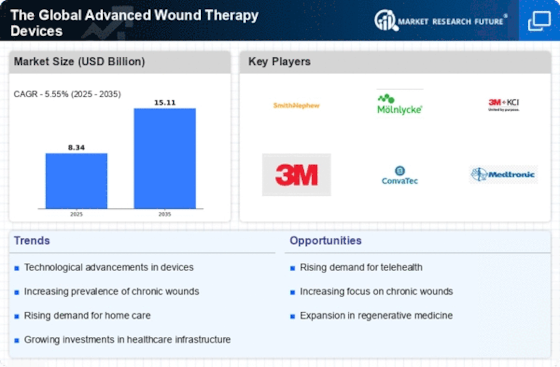
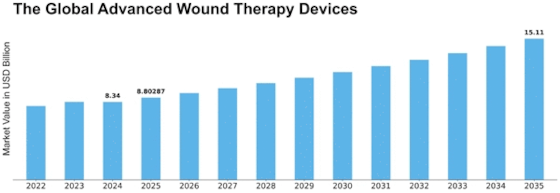
As per Market Research Future analysis, The Global Advanced Wound Therapy Devices Market was estimated at 8.34 USD Billion in 2024. The market is projected to grow from 8.803 USD Billion in 2025 to 15.11 USD Billion by 2035, exhibiting a compound annual growth rate (CAGR) of 5.55% during the forecast period 2025 - 2035

Key Market Trends & Highlights

The Global Advanced Wound Therapy Devices Market is poised for substantial growth driven by technological innovations and increasing healthcare demands.

  • North America remains the largest market for advanced wound therapy devices, reflecting a robust healthcare infrastructure. The Asia-Pacific region is emerging as the fastest-growing market, fueled by rising healthcare investments and population aging. Negative Pressure Wound Therapy Systems dominate the market, while Electric Stimulation Devices are witnessing rapid growth. Key market drivers include technological advancements in wound care and the rising incidence of chronic wounds, which are shaping market dynamics.

Market Size & Forecast

2024 Market Size 8.34 (USD Billion)
2035 Market Size 15.11 (USD Billion)
CAGR (2025 - 2035) 5.55%
Largest Regional Market Share in 2024 Americas

Major Players

Smith &amp; Nephew (GB), Mölnlycke Health Care (SE), Acelity (US), 3M (US), ConvaTec (GB), Medtronic (IE), Hollister Incorporated (US), B. Braun Melsungen AG (DE), Derma Sciences (US)

Market Trends

The Global Advanced Wound Therapy Devices Market is currently experiencing a transformative phase, driven by advancements in technology and an increasing focus on patient-centered care. The integration of innovative materials and techniques is enhancing the efficacy of wound healing processes, thereby improving patient outcomes. Furthermore, the rising prevalence of chronic wounds, such as diabetic ulcers and pressure sores, is propelling demand for advanced therapeutic solutions.

Healthcare providers are increasingly adopting these devices to streamline treatment protocols and reduce healing times, which appears to be a pivotal factor in market growth. In addition, the market landscape is evolving with the introduction of smart wound care technologies that utilize digital health solutions. These innovations facilitate real-time monitoring and data collection, allowing for personalized treatment plans tailored to individual patient needs. As healthcare systems worldwide strive to enhance efficiency and reduce costs, The Global Advanced Wound Therapy Devices Market is likely to witness sustained growth. The emphasis on preventive care and early intervention strategies further underscores the importance of these advanced devices in modern healthcare settings.

Technological Advancements

The Global Advanced Wound Therapy Devices Market is witnessing rapid technological advancements that enhance the effectiveness of wound care. Innovations such as bioengineered skin substitutes and negative pressure wound therapy are becoming increasingly prevalent, offering improved healing rates and reduced infection risks.

Rising Incidence of Chronic Wounds

There is a notable increase in the incidence of chronic wounds globally, driven by factors such as an aging population and the prevalence of lifestyle-related diseases. This trend is prompting healthcare providers to seek advanced wound therapy solutions to address the growing patient needs.

Integration of Digital Health Solutions

The integration of digital health solutions into wound care is transforming The Global Advanced Wound Therapy Devices Market. Technologies that enable remote monitoring and data analytics are enhancing treatment efficacy and patient engagement, thereby reshaping traditional wound management approaches.

Advanced Wound Therapy Devices Market Market Drivers

Increased Healthcare Expenditure

The Global Advanced Wound Therapy Devices Industry is positively impacted by increased healthcare expenditure across various regions. Governments and private sectors are investing more in healthcare infrastructure, which includes advanced wound care technologies. This trend is particularly evident in emerging economies, where rising disposable incomes and a growing middle class are driving demand for better healthcare services. As healthcare budgets expand, there is a greater focus on innovative wound care solutions, which is likely to propel market growth. Projections indicate that this increased investment could lead to a market expansion of approximately 5-7% annually.

Rising Incidence of Chronic Wounds

The Global Advanced Wound Therapy Devices Industry is significantly influenced by the rising incidence of chronic wounds, including diabetic ulcers and pressure sores. As the global population ages, the prevalence of conditions that lead to chronic wounds is expected to increase. Reports indicate that chronic wounds affect approximately 1-2% of the population in developed countries, leading to a growing demand for advanced wound care solutions. This trend is likely to drive market growth, as healthcare providers seek effective therapies to manage these complex wounds, thereby enhancing patient outcomes and reducing healthcare costs.

Integration of Digital Health Solutions

The Global Advanced Wound Therapy Devices Industry is witnessing a notable integration of digital health solutions, which are transforming wound management practices. Telemedicine and mobile health applications are facilitating remote monitoring and consultations, allowing healthcare professionals to manage wounds more effectively. This integration not only improves patient engagement but also streamlines the treatment process. The market is expected to benefit from this trend, as digital health solutions can lead to better adherence to treatment protocols and improved healing outcomes. Analysts predict that the adoption of these technologies will contribute to a substantial increase in market size over the next few years.

Growing Awareness of Advanced Wound Care

The Global Advanced Wound Therapy Devices Industry is benefiting from a growing awareness of advanced wound care among healthcare professionals and patients. Educational initiatives and training programs are being implemented to inform stakeholders about the latest wound care technologies and their benefits. This heightened awareness is leading to increased adoption of advanced therapies, as healthcare providers recognize the importance of effective wound management in improving patient outcomes. Furthermore, as patients become more informed about their treatment options, demand for advanced wound therapy devices is expected to rise, contributing to overall market growth.

Technological Advancements in Wound Care

The Global Advanced Wound Therapy Devices Industry is experiencing a surge in technological advancements that enhance treatment efficacy. Innovations such as bioengineered skin substitutes and advanced negative pressure wound therapy systems are becoming increasingly prevalent. These technologies not only improve healing rates but also reduce the overall cost of care. For instance, the introduction of smart wound dressings equipped with sensors allows for real-time monitoring of wound conditions, which can lead to timely interventions. The market is projected to grow significantly, with estimates suggesting a compound annual growth rate of over 6% in the coming years, driven by these advancements.

Market Segment Insights

By Type: Negative Pressure Wound Therapy Systems (Largest) vs. Electric Stimulation Devices (Fastest-Growing)

In The Global Advanced Wound Therapy Devices Market, Negative Pressure Wound Therapy Systems hold the largest market share, demonstrating significant efficacy in wound healing through the application of negative pressure to the wound bed, helping to reduce infections and promote tissue granulation. Electric Stimulation Devices, though a smaller segment in terms of market share, are gaining traction rapidly, leveraging the benefits of electrical currents to stimulate cellular activity, thus expediting the healing process for chronic wounds.

Negative Pressure Wound Therapy Systems (Dominant) vs. Electric Stimulation Devices (Emerging)

Negative Pressure Wound Therapy Systems are considered the dominant force in the Advanced Wound Therapy Devices Market due to their proven efficacy and widespread adoption across various healthcare settings. These devices effectively manage complex wounds such as diabetic ulcers and postoperative wounds. In contrast, Electric Stimulation Devices, classified as emerging, are rapidly gaining attention due to their innovative approach to enhancing wound healing. These devices utilize electrical currents to promote cell proliferation and blood flow, making them particularly beneficial for hard-to-heal wounds. As the healthcare industry evolves, the potential for Electric Stimulation Devices to complement traditional therapies paves the way for integrated wound management solutions.

By End-user: Hospitals & Clinics (Largest) vs. Home Care Settings (Fastest-Growing)

In The Global Advanced Wound Therapy Devices Market, the distribution of market share across various end-users favors Hospitals and Clinics, which represent the largest segment by a considerable margin. This dominance is attributed to higher patient volumes and the advanced nature of treatment options available in these medical facilities. Conversely, Home Care Settings are experiencing a surge in demand, capitalizing on the trend towards at-home rehabilitation and management of chronic wounds, thereby becoming a crucial component of the market landscape. Growth trends indicate a substantial shift towards home-based care solutions, driven by an increasing prevalence of chronic diseases and a growing preference for minimally invasive treatment options. As patient care increasingly moves outside the hospital environment, advancements in wound therapy technologies tailored for home use are accelerating. Factors like rising healthcare costs in clinical settings and improved patient outcomes through personalized care also play significant roles in this shift, paving the way for Home Care Settings to expand rapidly in the coming years.

Hospitals &amp; Clinics (Dominant) vs. Home Care Settings (Emerging)

Hospitals and Clinics remain the dominant force in The Global Advanced Wound Therapy Devices Market, offering a comprehensive range of sophisticated wound care solutions. These facilities leverage advanced technologies, skilled personnel, and integrated care pathways to manage wounds effectively, catering to a wide array of patient needs. As the primary end-user for these devices, they benefit from substantial investment in medical infrastructure and consistent demand. In contrast, Home Care Settings are seen as an emerging segment, increasingly popular due to the rising preference for at-home treatments and the convenience they offer. These settings are witnessing technological innovations such as portable wound therapy devices designed for easy use by non-professionals, enhancing patient independence and comfort in managing their wounds.

Get more detailed insights about Advanced Wound Therapy Devices Market Research Report – Global Forecast till 2035

Regional Insights

North America : Market Leader in Innovation

North America is the largest market for advanced wound therapy devices, holding approximately 40% of the global market share. The region's growth is driven by an aging population, increasing prevalence of chronic wounds, and advancements in technology. Regulatory support from agencies like the FDA further catalyzes innovation and product approvals, enhancing market dynamics. The demand for effective wound care solutions is also rising due to the growing awareness of advanced therapies. The United States is the leading country in this region, with a significant presence of key players such as Smith & Nephew, Acelity, and 3M. The competitive landscape is characterized by continuous innovation and strategic partnerships among major companies. Canada also contributes to the market, albeit at a smaller scale, focusing on improving healthcare infrastructure and access to advanced wound care solutions. Overall, the North American market is poised for sustained growth, driven by technological advancements and increasing healthcare investments.

Europe : Emerging Market with Growth Potential

Europe is the second-largest market for advanced wound therapy devices, accounting for approximately 30% of the global market share. The region's growth is fueled by rising healthcare expenditures, an increasing elderly population, and a growing incidence of diabetes-related wounds. Regulatory frameworks, such as the EU Medical Device Regulation, are enhancing product safety and efficacy, thereby boosting consumer confidence and market demand. Leading countries in Europe include Germany, the UK, and France, where key players like Mölnlycke Health Care and B. Braun Melsungen AG are actively innovating. The competitive landscape is marked by a mix of established companies and emerging startups focusing on advanced wound care technologies. The European market is characterized by a strong emphasis on research and development, with significant investments aimed at improving patient outcomes and reducing healthcare costs. The region is expected to witness robust growth as healthcare systems adapt to the increasing demand for advanced wound care solutions.

Asia-Pacific : Rapidly Growing Market Segment

Asia-Pacific is an emerging powerhouse in the advanced wound therapy devices market, holding approximately 20% of the global market share. The region's growth is driven by increasing healthcare investments, a rising population, and a growing prevalence of chronic diseases. Countries like China and India are witnessing significant advancements in healthcare infrastructure, which is facilitating access to advanced wound care solutions. Regulatory bodies are also becoming more supportive, streamlining approval processes for new devices. China is the largest market in this region, followed by Japan and India, where local and international players are increasingly investing. The competitive landscape is evolving, with both established companies and new entrants focusing on innovative wound care technologies. Key players such as Medtronic and ConvaTec are expanding their presence in the region, driven by the demand for effective wound management solutions. The Asia-Pacific market is expected to continue its upward trajectory, supported by favorable demographic trends and increasing healthcare awareness.

Middle East and Africa : Untapped Market with Opportunities

The Middle East and Africa represent a growing market for advanced wound therapy devices, accounting for approximately 10% of the global market share. The region's growth is driven by increasing healthcare investments, a rising prevalence of chronic diseases, and a growing awareness of advanced wound care solutions. Regulatory frameworks are gradually evolving, which is expected to enhance market access and product approvals in the coming years. Leading countries in this region include South Africa, the UAE, and Saudi Arabia, where healthcare systems are increasingly adopting advanced wound care technologies. The competitive landscape is characterized by a mix of local and international players, with companies like Hollister Incorporated and Derma Sciences expanding their footprint. The Middle East and Africa market is poised for growth, driven by improving healthcare infrastructure and increasing demand for effective wound management solutions.

Key Players and Competitive Insights

The Global Advanced Wound Therapy Devices is characterized by a dynamic competitive landscape, driven by increasing incidences of chronic wounds and a growing emphasis on advanced treatment modalities. Key players such as Smith & Nephew (GB), Mölnlycke Health Care (SE), and Acelity (US) are strategically positioned to leverage innovation and technological advancements. Smith & Nephew (GB) focuses on enhancing its product portfolio through continuous research and development, while Mölnlycke Health Care (SE) emphasizes partnerships to expand its market reach. Acelity (US), now part of 3M (US), is integrating its advanced wound care solutions with 3M's extensive distribution network, thereby reshaping the competitive environment through enhanced operational synergies.

The market structure appears moderately fragmented, with several players vying for market share. Companies are increasingly localizing manufacturing to reduce costs and optimize supply chains, which is crucial in maintaining competitive pricing. The collective influence of these key players fosters a competitive atmosphere where innovation and operational efficiency are paramount.

In August 2025, Smith & Nephew (GB) announced the launch of a new advanced wound dressing that incorporates antimicrobial technology, aimed at reducing infection rates in chronic wounds. This strategic move not only enhances their product offering but also positions the company as a leader in infection management, a critical aspect of wound care. The introduction of such innovative solutions is likely to attract healthcare providers seeking effective treatment options.

In September 2025, Mölnlycke Health Care (SE) entered into a strategic partnership with a leading telehealth provider to integrate digital health solutions into its wound care management systems. This collaboration is significant as it reflects a growing trend towards digitalization in healthcare, enabling remote monitoring and personalized care plans for patients. Such initiatives may enhance patient outcomes and streamline healthcare delivery, thereby strengthening Mölnlycke's market position.

In July 2025, Acelity (US) unveiled a new line of bioactive wound dressings designed to promote faster healing through advanced biomaterials. This development is indicative of the company's commitment to innovation and aligns with the increasing demand for effective wound care solutions. By focusing on product differentiation, Acelity is likely to enhance its competitive edge in a crowded marketplace.

As of October 2025, the competitive trends in The Global Advanced Wound Therapy Devices are increasingly defined by digitalization, sustainability, and the integration of artificial intelligence. Strategic alliances are becoming more prevalent, as companies recognize the value of collaborative innovation. The shift from price-based competition to a focus on technological advancement and supply chain reliability is evident, suggesting that future competitive differentiation will hinge on the ability to deliver innovative, effective, and sustainable wound care solutions.

Key Companies in the Advanced Wound Therapy Devices Market include

Industry Developments

April 2022

Baptist Health Paducah was one of four wound care centers out of over 600. This is to receive the award. In 2019 the center also won this award. Baptist Health Paducah's Wound Care Center received the Center of the Year Award from Healogics, a company that provides advanced wound care treatment equipment.

The new president of human bioscience is Rohan Jain, and the news was announced recently. The Kollagen biotechnology helps the body heal in ways not present before.

Kerecis®, the company pioneering the use of fish skin and fatty acids in cellular therapy, tissue regeneration, and protection, announced MariGen™ Expanse, the newest addition to Kerecis' product offerings for chronic wound management. Cholederm, a cutting-edge wound care product created by the Sree Chitra Tirunal Institute for Medical Sciences and Technology, has been recognized as a Class D medical device by the Central Drugs Standard Control Organization (CDSCO). The researchers from the Department of Experimental Pathology in the Biomedical Technology wing of SCTIMST developed cholederm, a substance used to treat wounds using the extracellular matrix of decellularized pig gall bladder tissue.

Cholederm is the first domestically manufactured product to meet all regulatory standards, even though using animal-derived products to manufacture advanced wound care material is not new. According to researchers, the scaffold controlled or lessened the scarring responses in subcutaneous, skeletal-muscle, and cardiac tissues. It also could lessen fibrotic scarring in rats who had undergone an artificial myocardial infarction.

Future Outlook

Advanced Wound Therapy Devices Market Future Outlook

The Global Advanced Wound Therapy Devices Market is projected to grow at a 5.55% CAGR from 2025 to 2035, driven by technological advancements, increasing chronic wound prevalence, and rising healthcare expenditure.

New opportunities lie in:

  • <p>Development of portable wound care devices for home healthcare settings. Integration of AI-driven analytics for personalized wound management solutions. Expansion into emerging markets with tailored product offerings.</p>

By 2035, the market is expected to achieve substantial growth, reflecting evolving healthcare needs and technological innovations.

Market Segmentation

Advanced Wound Therapy Devices Market Type Outlook

  • Negative Pressure Wound Therapy Systems
  • Electric Stimulation Devices
  • Hyperbaric Oxygen Equipment
  • Pressure Relief Devices
  • Others

Advanced Wound Therapy Devices Market End-user Outlook

  • Hospitals & Clinics
  • Home Care Settings
  • Others

Report Scope

MARKET SIZE 2024 8.34(USD Billion)
MARKET SIZE 2025 8.803(USD Billion)
MARKET SIZE 2035 15.11(USD Billion)
COMPOUND ANNUAL GROWTH RATE (CAGR) 5.55% (2025 - 2035)
REPORT COVERAGE Revenue Forecast, Competitive Landscape, Growth Factors, and Trends
BASE YEAR 2024
Market Forecast Period 2025 - 2035
Historical Data 2019 - 2024
Market Forecast Units USD Billion
Key Companies Profiled Smith & Nephew (GB), Mölnlycke Health Care (SE), Acelity (US), 3M (US), ConvaTec (GB), Medtronic (IE), Hollister Incorporated (US), B. Braun Melsungen AG (DE), Derma Sciences (US)
Segments Covered Type, End-user
Key Market Opportunities Integration of smart technology in wound care devices enhances patient monitoring and treatment efficacy.
Key Market Dynamics Technological advancements and regulatory changes drive innovation and competition in advanced wound therapy devices market.
Countries Covered North America, Europe, APAC, South America, MEA

FAQs

What is the projected market valuation of The Global Advanced Wound Therapy Devices by 2035?

<p>The market is projected to reach a valuation of 15.11 USD Billion by 2035.</p>

What was the market valuation of The Global Advanced Wound Therapy Devices in 2024?

<p>The overall market valuation was 8.34 USD Billion in 2024.</p>

What is the expected CAGR for The Global Advanced Wound Therapy Devices during the forecast period 2025 - 2035?

<p>The expected CAGR during this period is 5.55%.</p>

Which segment is anticipated to have the highest valuation in The Global Advanced Wound Therapy Devices by 2035?

<p>Negative Pressure Wound Therapy Systems are expected to reach a valuation of 6.11 USD Billion by 2035.</p>

What are the key players in The Global Advanced Wound Therapy Devices?

<p>Key players include Smith & Nephew, Mölnlycke Health Care, Acelity, 3M, ConvaTec, Medtronic, Hollister Incorporated, B. Braun Melsungen AG, and Derma Sciences.</p>

How much is the Home Care Settings segment projected to be worth by 2035?

The Home Care Settings segment is projected to reach 5.5 USD Billion by 2035.

What is the expected valuation for Electric Stimulation Devices by 2035?

Electric Stimulation Devices are expected to reach a valuation of 2.75 USD Billion by 2035.

What is the projected valuation for Pressure Relief Devices in 2035?

Pressure Relief Devices are projected to be valued at 2.0 USD Billion by 2035.

How does the Others segment perform in terms of projected valuation by 2035?

The Others segment is expected to reach a valuation of 2.4 USD Billion by 2035.

What is the anticipated growth trend for The Global Advanced Wound Therapy Devices?

The market appears to be on a growth trajectory, with a projected increase to 15.11 USD Billion by 2035.

  1. SECTION I: EXECUTIVE SUMMARY AND KEY HIGHLIGHTS
    1. | 1.1 EXECUTIVE SUMMARY
    2. | | 1.1.1 Market Overview
    3. | | 1.1.2 Key Findings
    4. | | 1.1.3 Market Segmentation
    5. | | 1.1.4 Competitive Landscape
    6. | | 1.1.5 Challenges and Opportunities
    7. | | 1.1.6 Future Outlook
  2. SECTION II: SCOPING, METHODOLOGY AND MARKET STRUCTURE
    1. | 2.1 MARKET INTRODUCTION
    2. | | 2.1.1 Definition
    3. | | 2.1.2 Scope of the study
    4. | | | 2.1.2.1 Research Objective
    5. | | | 2.1.2.2 Assumption
    6. | | | 2.1.2.3 Limitations
    7. | 2.2 RESEARCH METHODOLOGY
    8. | | 2.2.1 Overview
    9. | | 2.2.2 Data Mining
    10. | | 2.2.3 Secondary Research
    11. | | 2.2.4 Primary Research
    12. | | | 2.2.4.1 Primary Interviews and Information Gathering Process
    13. | | | 2.2.4.2 Breakdown of Primary Respondents
    14. | | 2.2.5 Forecasting Model
    15. | | 2.2.6 Market Size Estimation
    16. | | | 2.2.6.1 Bottom-Up Approach
    17. | | | 2.2.6.2 Top-Down Approach
    18. | | 2.2.7 Data Triangulation
    19. | | 2.2.8 Validation
  3. SECTION III: QUALITATIVE ANALYSIS
    1. | 3.1 MARKET DYNAMICS
    2. | | 3.1.1 Overview
    3. | | 3.1.2 Drivers
    4. | | 3.1.3 Restraints
    5. | | 3.1.4 Opportunities
    6. | 3.2 MARKET FACTOR ANALYSIS
    7. | | 3.2.1 Value chain Analysis
    8. | | 3.2.2 Porter's Five Forces Analysis
    9. | | | 3.2.2.1 Bargaining Power of Suppliers
    10. | | | 3.2.2.2 Bargaining Power of Buyers
    11. | | | 3.2.2.3 Threat of New Entrants
    12. | | | 3.2.2.4 Threat of Substitutes
    13. | | | 3.2.2.5 Intensity of Rivalry
    14. | | 3.2.3 COVID-19 Impact Analysis
    15. | | | 3.2.3.1 Market Impact Analysis
    16. | | | 3.2.3.2 Regional Impact
    17. | | | 3.2.3.3 Opportunity and Threat Analysis
  4. SECTION IV: QUANTITATIVE ANALYSIS
    1. | 4.1 Healthcare, BY Type (USD Billion)
    2. | | 4.1.1 Negative Pressure Wound Therapy Systems
    3. | | 4.1.2 Electric Stimulation Devices
    4. | | 4.1.3 Hyperbaric Oxygen Equipment
    5. | | 4.1.4 Pressure Relief Devices
    6. | | 4.1.5 Others
    7. | 4.2 Healthcare, BY End-user (USD Billion)
    8. | | 4.2.1 Hospitals & Clinics
    9. | | 4.2.2 Home Care Settings
    10. | | 4.2.3 Others
    11. | 4.3 Healthcare, BY Region (USD Billion)
    12. | | 4.3.1 North America
    13. | | | 4.3.1.1 US
    14. | | | 4.3.1.2 Canada
    15. | | 4.3.2 Europe
    16. | | | 4.3.2.1 Germany
    17. | | | 4.3.2.2 UK
    18. | | | 4.3.2.3 France
    19. | | | 4.3.2.4 Russia
    20. | | | 4.3.2.5 Italy
    21. | | | 4.3.2.6 Spain
    22. | | | 4.3.2.7 Rest of Europe
    23. | | 4.3.3 APAC
    24. | | | 4.3.3.1 China
    25. | | | 4.3.3.2 India
    26. | | | 4.3.3.3 Japan
    27. | | | 4.3.3.4 South Korea
    28. | | | 4.3.3.5 Malaysia
    29. | | | 4.3.3.6 Thailand
    30. | | | 4.3.3.7 Indonesia
    31. | | | 4.3.3.8 Rest of APAC
    32. | | 4.3.4 South America
    33. | | | 4.3.4.1 Brazil
    34. | | | 4.3.4.2 Mexico
    35. | | | 4.3.4.3 Argentina
    36. | | | 4.3.4.4 Rest of South America
    37. | | 4.3.5 MEA
    38. | | | 4.3.5.1 GCC Countries
    39. | | | 4.3.5.2 South Africa
    40. | | | 4.3.5.3 Rest of MEA
  5. SECTION V: COMPETITIVE ANALYSIS
    1. | 5.1 Competitive Landscape
    2. | | 5.1.1 Overview
    3. | | 5.1.2 Competitive Analysis
    4. | | 5.1.3 Market share Analysis
    5. | | 5.1.4 Major Growth Strategy in the Healthcare
    6. | | 5.1.5 Competitive Benchmarking
    7. | | 5.1.6 Leading Players in Terms of Number of Developments in the Healthcare
    8. | | 5.1.7 Key developments and growth strategies
    9. | | | 5.1.7.1 New Product Launch/Service Deployment
    10. | | | 5.1.7.2 Merger & Acquisitions
    11. | | | 5.1.7.3 Joint Ventures
    12. | | 5.1.8 Major Players Financial Matrix
    13. | | | 5.1.8.1 Sales and Operating Income
    14. | | | 5.1.8.2 Major Players R&D Expenditure. 2023
    15. | 5.2 Company Profiles
    16. | | 5.2.1 Smith & Nephew (GB)
    17. | | | 5.2.1.1 Financial Overview
    18. | | | 5.2.1.2 Products Offered
    19. | | | 5.2.1.3 Key Developments
    20. | | | 5.2.1.4 SWOT Analysis
    21. | | | 5.2.1.5 Key Strategies
    22. | | 5.2.2 Mölnlycke Health Care (SE)
    23. | | | 5.2.2.1 Financial Overview
    24. | | | 5.2.2.2 Products Offered
    25. | | | 5.2.2.3 Key Developments
    26. | | | 5.2.2.4 SWOT Analysis
    27. | | | 5.2.2.5 Key Strategies
    28. | | 5.2.3 Acelity (US)
    29. | | | 5.2.3.1 Financial Overview
    30. | | | 5.2.3.2 Products Offered
    31. | | | 5.2.3.3 Key Developments
    32. | | | 5.2.3.4 SWOT Analysis
    33. | | | 5.2.3.5 Key Strategies
    34. | | 5.2.4 3M (US)
    35. | | | 5.2.4.1 Financial Overview
    36. | | | 5.2.4.2 Products Offered
    37. | | | 5.2.4.3 Key Developments
    38. | | | 5.2.4.4 SWOT Analysis
    39. | | | 5.2.4.5 Key Strategies
    40. | | 5.2.5 ConvaTec (GB)
    41. | | | 5.2.5.1 Financial Overview
    42. | | | 5.2.5.2 Products Offered
    43. | | | 5.2.5.3 Key Developments
    44. | | | 5.2.5.4 SWOT Analysis
    45. | | | 5.2.5.5 Key Strategies
    46. | | 5.2.6 Medtronic (IE)
    47. | | | 5.2.6.1 Financial Overview
    48. | | | 5.2.6.2 Products Offered
    49. | | | 5.2.6.3 Key Developments
    50. | | | 5.2.6.4 SWOT Analysis
    51. | | | 5.2.6.5 Key Strategies
    52. | | 5.2.7 Hollister Incorporated (US)
    53. | | | 5.2.7.1 Financial Overview
    54. | | | 5.2.7.2 Products Offered
    55. | | | 5.2.7.3 Key Developments
    56. | | | 5.2.7.4 SWOT Analysis
    57. | | | 5.2.7.5 Key Strategies
    58. | | 5.2.8 B. Braun Melsungen AG (DE)
    59. | | | 5.2.8.1 Financial Overview
    60. | | | 5.2.8.2 Products Offered
    61. | | | 5.2.8.3 Key Developments
    62. | | | 5.2.8.4 SWOT Analysis
    63. | | | 5.2.8.5 Key Strategies
    64. | | 5.2.9 Derma Sciences (US)
    65. | | | 5.2.9.1 Financial Overview
    66. | | | 5.2.9.2 Products Offered
    67. | | | 5.2.9.3 Key Developments
    68. | | | 5.2.9.4 SWOT Analysis
    69. | | | 5.2.9.5 Key Strategies
    70. | 5.3 Appendix
    71. | | 5.3.1 References
    72. | | 5.3.2 Related Reports
  6. LIST OF FIGURES
    1. | 6.1 MARKET SYNOPSIS
    2. | 6.2 NORTH AMERICA MARKET ANALYSIS
    3. | 6.3 US MARKET ANALYSIS BY TYPE
    4. | 6.4 US MARKET ANALYSIS BY END-USER
    5. | 6.5 CANADA MARKET ANALYSIS BY TYPE
    6. | 6.6 CANADA MARKET ANALYSIS BY END-USER
    7. | 6.7 EUROPE MARKET ANALYSIS
    8. | 6.8 GERMANY MARKET ANALYSIS BY TYPE
    9. | 6.9 GERMANY MARKET ANALYSIS BY END-USER
    10. | 6.10 UK MARKET ANALYSIS BY TYPE
    11. | 6.11 UK MARKET ANALYSIS BY END-USER
    12. | 6.12 FRANCE MARKET ANALYSIS BY TYPE
    13. | 6.13 FRANCE MARKET ANALYSIS BY END-USER
    14. | 6.14 RUSSIA MARKET ANALYSIS BY TYPE
    15. | 6.15 RUSSIA MARKET ANALYSIS BY END-USER
    16. | 6.16 ITALY MARKET ANALYSIS BY TYPE
    17. | 6.17 ITALY MARKET ANALYSIS BY END-USER
    18. | 6.18 SPAIN MARKET ANALYSIS BY TYPE
    19. | 6.19 SPAIN MARKET ANALYSIS BY END-USER
    20. | 6.20 REST OF EUROPE MARKET ANALYSIS BY TYPE
    21. | 6.21 REST OF EUROPE MARKET ANALYSIS BY END-USER
    22. | 6.22 APAC MARKET ANALYSIS
    23. | 6.23 CHINA MARKET ANALYSIS BY TYPE
    24. | 6.24 CHINA MARKET ANALYSIS BY END-USER
    25. | 6.25 INDIA MARKET ANALYSIS BY TYPE
    26. | 6.26 INDIA MARKET ANALYSIS BY END-USER
    27. | 6.27 JAPAN MARKET ANALYSIS BY TYPE
    28. | 6.28 JAPAN MARKET ANALYSIS BY END-USER
    29. | 6.29 SOUTH KOREA MARKET ANALYSIS BY TYPE
    30. | 6.30 SOUTH KOREA MARKET ANALYSIS BY END-USER
    31. | 6.31 MALAYSIA MARKET ANALYSIS BY TYPE
    32. | 6.32 MALAYSIA MARKET ANALYSIS BY END-USER
    33. | 6.33 THAILAND MARKET ANALYSIS BY TYPE
    34. | 6.34 THAILAND MARKET ANALYSIS BY END-USER
    35. | 6.35 INDONESIA MARKET ANALYSIS BY TYPE
    36. | 6.36 INDONESIA MARKET ANALYSIS BY END-USER
    37. | 6.37 REST OF APAC MARKET ANALYSIS BY TYPE
    38. | 6.38 REST OF APAC MARKET ANALYSIS BY END-USER
    39. | 6.39 SOUTH AMERICA MARKET ANALYSIS
    40. | 6.40 BRAZIL MARKET ANALYSIS BY TYPE
    41. | 6.41 BRAZIL MARKET ANALYSIS BY END-USER
    42. | 6.42 MEXICO MARKET ANALYSIS BY TYPE
    43. | 6.43 MEXICO MARKET ANALYSIS BY END-USER
    44. | 6.44 ARGENTINA MARKET ANALYSIS BY TYPE
    45. | 6.45 ARGENTINA MARKET ANALYSIS BY END-USER
    46. | 6.46 REST OF SOUTH AMERICA MARKET ANALYSIS BY TYPE
    47. | 6.47 REST OF SOUTH AMERICA MARKET ANALYSIS BY END-USER
    48. | 6.48 MEA MARKET ANALYSIS
    49. | 6.49 GCC COUNTRIES MARKET ANALYSIS BY TYPE
    50. | 6.50 GCC COUNTRIES MARKET ANALYSIS BY END-USER
    51. | 6.51 SOUTH AFRICA MARKET ANALYSIS BY TYPE
    52. | 6.52 SOUTH AFRICA MARKET ANALYSIS BY END-USER
    53. | 6.53 REST OF MEA MARKET ANALYSIS BY TYPE
    54. | 6.54 REST OF MEA MARKET ANALYSIS BY END-USER
    55. | 6.55 KEY BUYING CRITERIA OF HEALTHCARE
    56. | 6.56 RESEARCH PROCESS OF MRFR
    57. | 6.57 DRO ANALYSIS OF HEALTHCARE
    58. | 6.58 DRIVERS IMPACT ANALYSIS: HEALTHCARE
    59. | 6.59 RESTRAINTS IMPACT ANALYSIS: HEALTHCARE
    60. | 6.60 SUPPLY / VALUE CHAIN: HEALTHCARE
    61. | 6.61 HEALTHCARE, BY TYPE, 2024 (% SHARE)
    62. | 6.62 HEALTHCARE, BY TYPE, 2024 TO 2035 (USD Billion)
    63. | 6.63 HEALTHCARE, BY END-USER, 2024 (% SHARE)
    64. | 6.64 HEALTHCARE, BY END-USER, 2024 TO 2035 (USD Billion)
    65. | 6.65 BENCHMARKING OF MAJOR COMPETITORS
  7. LIST OF TABLES
    1. | 7.1 LIST OF ASSUMPTIONS
    2. | | 7.1.1
    3. | 7.2 North America MARKET SIZE ESTIMATES; FORECAST
    4. | | 7.2.1 BY TYPE, 2025-2035 (USD Billion)
    5. | | 7.2.2 BY END-USER, 2025-2035 (USD Billion)
    6. | 7.3 US MARKET SIZE ESTIMATES; FORECAST
    7. | | 7.3.1 BY TYPE, 2025-2035 (USD Billion)
    8. | | 7.3.2 BY END-USER, 2025-2035 (USD Billion)
    9. | 7.4 Canada MARKET SIZE ESTIMATES; FORECAST
    10. | | 7.4.1 BY TYPE, 2025-2035 (USD Billion)
    11. | | 7.4.2 BY END-USER, 2025-2035 (USD Billion)
    12. | 7.5 Europe MARKET SIZE ESTIMATES; FORECAST
    13. | | 7.5.1 BY TYPE, 2025-2035 (USD Billion)
    14. | | 7.5.2 BY END-USER, 2025-2035 (USD Billion)
    15. | 7.6 Germany MARKET SIZE ESTIMATES; FORECAST
    16. | | 7.6.1 BY TYPE, 2025-2035 (USD Billion)
    17. | | 7.6.2 BY END-USER, 2025-2035 (USD Billion)
    18. | 7.7 UK MARKET SIZE ESTIMATES; FORECAST
    19. | | 7.7.1 BY TYPE, 2025-2035 (USD Billion)
    20. | | 7.7.2 BY END-USER, 2025-2035 (USD Billion)
    21. | 7.8 France MARKET SIZE ESTIMATES; FORECAST
    22. | | 7.8.1 BY TYPE, 2025-2035 (USD Billion)
    23. | | 7.8.2 BY END-USER, 2025-2035 (USD Billion)
    24. | 7.9 Russia MARKET SIZE ESTIMATES; FORECAST
    25. | | 7.9.1 BY TYPE, 2025-2035 (USD Billion)
    26. | | 7.9.2 BY END-USER, 2025-2035 (USD Billion)
    27. | 7.10 Italy MARKET SIZE ESTIMATES; FORECAST
    28. | | 7.10.1 BY TYPE, 2025-2035 (USD Billion)
    29. | | 7.10.2 BY END-USER, 2025-2035 (USD Billion)
    30. | 7.11 Spain MARKET SIZE ESTIMATES; FORECAST
    31. | | 7.11.1 BY TYPE, 2025-2035 (USD Billion)
    32. | | 7.11.2 BY END-USER, 2025-2035 (USD Billion)
    33. | 7.12 Rest of Europe MARKET SIZE ESTIMATES; FORECAST
    34. | | 7.12.1 BY TYPE, 2025-2035 (USD Billion)
    35. | | 7.12.2 BY END-USER, 2025-2035 (USD Billion)
    36. | 7.13 APAC MARKET SIZE ESTIMATES; FORECAST
    37. | | 7.13.1 BY TYPE, 2025-2035 (USD Billion)
    38. | | 7.13.2 BY END-USER, 2025-2035 (USD Billion)
    39. | 7.14 China MARKET SIZE ESTIMATES; FORECAST
    40. | | 7.14.1 BY TYPE, 2025-2035 (USD Billion)
    41. | | 7.14.2 BY END-USER, 2025-2035 (USD Billion)
    42. | 7.15 India MARKET SIZE ESTIMATES; FORECAST
    43. | | 7.15.1 BY TYPE, 2025-2035 (USD Billion)
    44. | | 7.15.2 BY END-USER, 2025-2035 (USD Billion)
    45. | 7.16 Japan MARKET SIZE ESTIMATES; FORECAST
    46. | | 7.16.1 BY TYPE, 2025-2035 (USD Billion)
    47. | | 7.16.2 BY END-USER, 2025-2035 (USD Billion)
    48. | 7.17 South Korea MARKET SIZE ESTIMATES; FORECAST
    49. | | 7.17.1 BY TYPE, 2025-2035 (USD Billion)
    50. | | 7.17.2 BY END-USER, 2025-2035 (USD Billion)
    51. | 7.18 Malaysia MARKET SIZE ESTIMATES; FORECAST
    52. | | 7.18.1 BY TYPE, 2025-2035 (USD Billion)
    53. | | 7.18.2 BY END-USER, 2025-2035 (USD Billion)
    54. | 7.19 Thailand MARKET SIZE ESTIMATES; FORECAST
    55. | | 7.19.1 BY TYPE, 2025-2035 (USD Billion)
    56. | | 7.19.2 BY END-USER, 2025-2035 (USD Billion)
    57. | 7.20 Indonesia MARKET SIZE ESTIMATES; FORECAST
    58. | | 7.20.1 BY TYPE, 2025-2035 (USD Billion)
    59. | | 7.20.2 BY END-USER, 2025-2035 (USD Billion)
    60. | 7.21 Rest of APAC MARKET SIZE ESTIMATES; FORECAST
    61. | | 7.21.1 BY TYPE, 2025-2035 (USD Billion)
    62. | | 7.21.2 BY END-USER, 2025-2035 (USD Billion)
    63. | 7.22 South America MARKET SIZE ESTIMATES; FORECAST
    64. | | 7.22.1 BY TYPE, 2025-2035 (USD Billion)
    65. | | 7.22.2 BY END-USER, 2025-2035 (USD Billion)
    66. | 7.23 Brazil MARKET SIZE ESTIMATES; FORECAST
    67. | | 7.23.1 BY TYPE, 2025-2035 (USD Billion)
    68. | | 7.23.2 BY END-USER, 2025-2035 (USD Billion)
    69. | 7.24 Mexico MARKET SIZE ESTIMATES; FORECAST
    70. | | 7.24.1 BY TYPE, 2025-2035 (USD Billion)
    71. | | 7.24.2 BY END-USER, 2025-2035 (USD Billion)
    72. | 7.25 Argentina MARKET SIZE ESTIMATES; FORECAST
    73. | | 7.25.1 BY TYPE, 2025-2035 (USD Billion)
    74. | | 7.25.2 BY END-USER, 2025-2035 (USD Billion)
    75. | 7.26 Rest of South America MARKET SIZE ESTIMATES; FORECAST
    76. | | 7.26.1 BY TYPE, 2025-2035 (USD Billion)
    77. | | 7.26.2 BY END-USER, 2025-2035 (USD Billion)
    78. | 7.27 MEA MARKET SIZE ESTIMATES; FORECAST
    79. | | 7.27.1 BY TYPE, 2025-2035 (USD Billion)
    80. | | 7.27.2 BY END-USER, 2025-2035 (USD Billion)
    81. | 7.28 GCC Countries MARKET SIZE ESTIMATES; FORECAST
    82. | | 7.28.1 BY TYPE, 2025-2035 (USD Billion)
    83. | | 7.28.2 BY END-USER, 2025-2035 (USD Billion)
    84. | 7.29 South Africa MARKET SIZE ESTIMATES; FORECAST
    85. | | 7.29.1 BY TYPE, 2025-2035 (USD Billion)
    86. | | 7.29.2 BY END-USER, 2025-2035 (USD Billion)
    87. | 7.30 Rest of MEA MARKET SIZE ESTIMATES; FORECAST
    88. | | 7.30.1 BY TYPE, 2025-2035 (USD Billion)
    89. | | 7.30.2 BY END-USER, 2025-2035 (USD Billion)
    90. | 7.31 PRODUCT LAUNCH/PRODUCT DEVELOPMENT/APPROVAL
    91. | | 7.31.1
    92. | 7.32 ACQUISITION/PARTNERSHIP
    93. | | 7.32.1

Healthcare Market Segmentation

Healthcare By Type (USD Billion, 2025-2035)

  • Negative Pressure Wound Therapy Systems
  • Electric Stimulation Devices
  • Hyperbaric Oxygen Equipment
  • Pressure Relief Devices
  • Others

Healthcare By End-user (USD Billion, 2025-2035)

  • Hospitals & Clinics
  • Home Care Settings
  • Others
Infographic

Free Sample Request

Kindly complete the form below to receive a free sample of this Report

Get Free Sample

Customer Strories

Compare Licence

×
Features License Type
Single User Multiuser License Enterprise User
Price $4,950 $5,950 $7,250
Maximum User Access Limit 1 User Upto 10 Users Unrestricted Access Throughout the Organization
Free Customization
Direct Access to Analyst
Deliverable Format
Platform Access
Discount on Next Purchase 10% 15% 15%
Printable Versions